This day

December 18, 2019

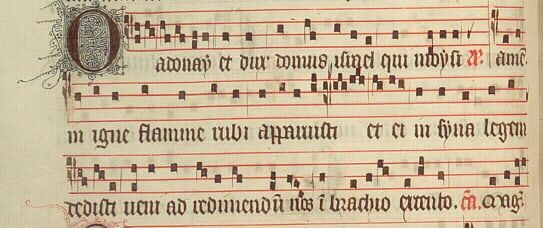
O Adonai, the illuminated opening in the Poissy Antiphonal, folio 30v
Poissy Antiphonal, c. 1335–1345, fol. 30v. State Library Victoria.

Advent

December 18, 2019

December 18: Second Antiphon

From Dom Guéranger’s The Liturgical Year.

O Adonai, et dux domus Israel, qui Moysi in igne flammæ rubi apparuisti, et ei in Sina legem dedisti: veni ad redimendum nos in brachio extento.

O Adonai, and leader of the house of Israel, who appearedst to Moses in the fire of the flaming bush, and gavest him the law on Sinai; come and redeem us by thy outstretched arm.

O sovereign Lord! O Adonai! come and redeem us, not by Thy power, but by Thy humility. Heretofore, Thou didst show Thyself to Moses Thy servant in the midst of a mysterious flame; Thou didst give Thy law to Thy people amidst thunder and lightning; now, on the contrary, Thou co mest not to terrify, but to save us. Thy chaste Mother having heard the emperor’s edict, which obliges her and Joseph her spouse to repair to Bethlehem, prepares everything needed for Thy divine Birth. She prepares for Thee, O Sun of justice! the humble swathing-bands, wherewith to cover Thy nakedness, and protect Thee, the Creator of the world, from the cold of that midnight hour of Thy Nativity! Thus it is that Thou wiliest to deliver us from the slavery of our pride, and show man that Thy divine arm is never stronger than when he thinks it powerless and still.


Wednesday in Ember Week of Advent

From Dom Guéranger’s The Liturgical Year.

Prope est jam Dominus; venite, adoremus.
The Lord is now nigh; come, let us adore.

To-day the Church begins the fast of Quatuor Tempora, or, as we call it, of Ember days: it includes also the Friday and Saturday of this same week. This observance is not peculiar to the Advent liturgy; it is one which has been fixed for each of the four seasons of the ecclesiastical year. We may consider it as one of those practices which the Church took from the Synagogue; for the prophet Zacharias speaks of the fasts of the fourth, fifth, seventh, and tenth months. Its introduction into the Christian Church would seem to have been made in the apostolic times; such, at least, is the opinion of St. Leo, of St. Isidore of Seville, of Rabanus Maurus, and of several other ancient Christian writers. It is remarkable, on the other hand, that the orientals do not observe this fast.

From the first ages the Quatuor Tempora were kept, in the Roman Church, at the same time of the year as at present.

Email view of this day