
This day

October 16, 2020

After Pentecost

October 16, 2020

October 16: St. Hedwige, Widow

From Dom Guéranger’s The Liturgical Year.

[This feast day, previously kept on Oct. 17, was moved to Oct. 16-Ed.]

At the beginning of the thirteenth century, the plateaux of upper Asia poured down a fresh torrent of barbarians, more terrible than all their predecessors. The one fragile barrier, which the Graeco-Slavonian civilization could oppose to the Mongols, had been swept away by the first wave of the invasion; not one of the States formed under the protection of the Byzantine Church had any prospect for the future. But beyond this Ruthenia, which had fallen into dissolution before being conquered, the Roman Church had had time to form a brave and generous people: when the hour arrived, Poland was ready. The Mongols were already inundating Silesia, when, in the plains of Liegnitz, they found themselves confronted by an army of thirty thousand warriors, headed by the duke of Silesia, Henry the pious. The encounter was terrible; the victory remained long undecided, until at length, by the odious treason of some Ruthenian princes, it turned in favour of the barbarians. Duke Henry and the flower of the Polish knighthood were left upon the battle-field.

This week's Sunday: The Nineteenth Sunday after Pentecost

From Dom Guéranger’s The Liturgical Year.

The divine Leader of God’s people is their salvation in all their distress. Did we not last Sunday see Him prove Himself such, and in a very telling way, by curing both body and soul of the poor paralytic, who was a figure of the whole human race? Let us hear His voice, in the Introit, with love and gratitude; let us promise Him the fidelity He asks of us; His Law, if we will but observe it, will preserve us from a relapse.

The anthem which follows is made up of several passages of holy Writ, without being exactly that of any one of them. The verse is taken from Psalm lxxvii.

Salus populi ego sum, dicit Dominus: de quacumque tribulatione clamaverint ad me, exaudiam eos: et ero illorum Dominus in perpetuum.

Ps. Attendite, popule meus, legem meam: inclinate aurem vestram in verba oris mei. Gloria Patri. Salus.

I am the salvation of the people, saith the Lord: in what distress soever they call upon me, I will hear them: and will be their Lord for ever.

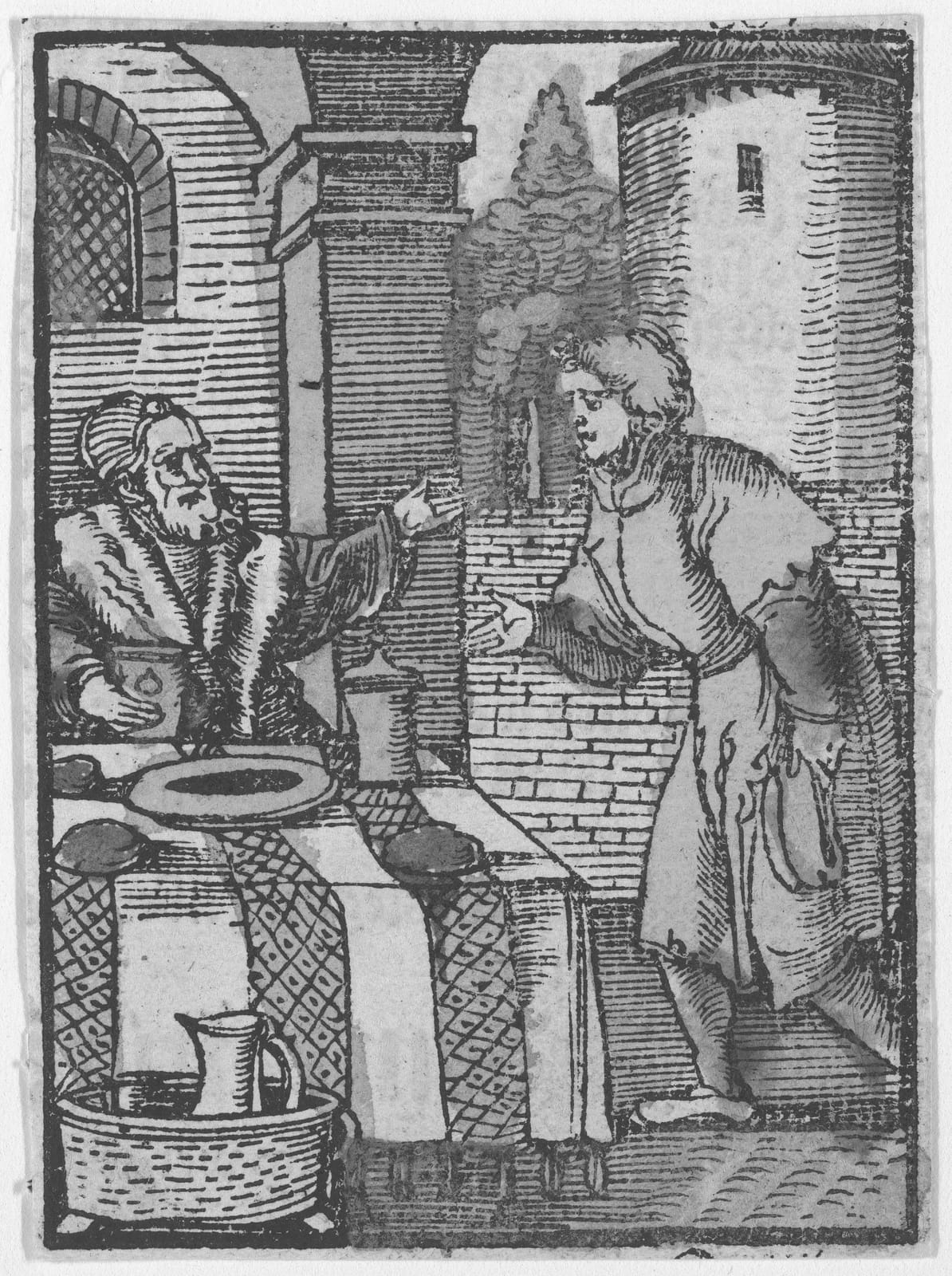
The parable of the banquet whose invited guests stayed away
Hans Schäufelein (1480–1540), The Parable of the Banquet without Guests, from Das Plenarium, 1517. Credits

Email view of this day