This day

August 5, 2027

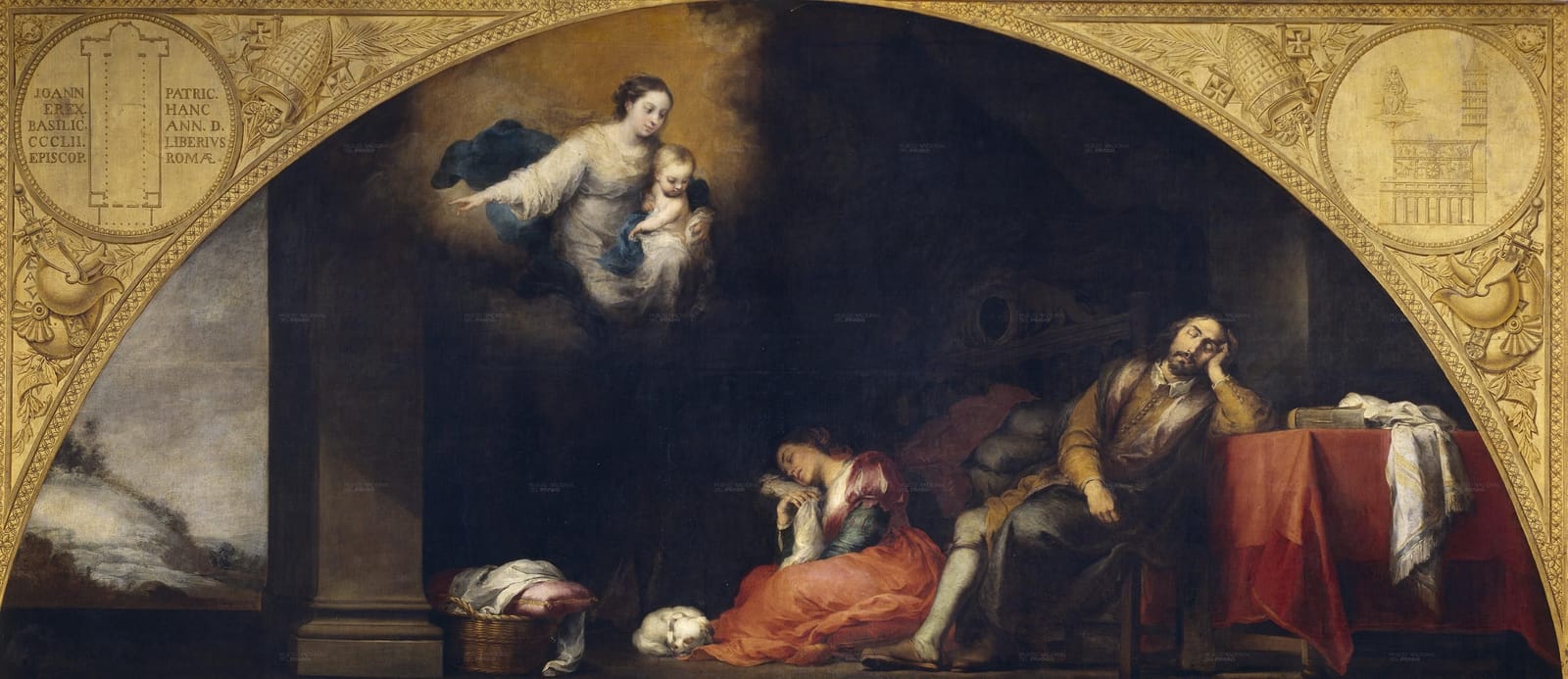
The Dream of the Patrician
The Dream of the Patrician, Bartolomé Esteban Murillo (1617–1682), c. 1664–1665. Credits

After Pentecost

August 5, 2027

August 5: Our Lady of the Snow

From Dom Guéranger’s The Liturgical Year.

ROME, delivered from slavery by Peter on the first of this month, offers to the world a wonderful spectacle. O Wisdom, who, since the glorious Pentecost, hast spread over the whole world, where could it be more true to sing of thee that thou hast trodden the proud heights under thy victorious feet? On seven hills had pagan Rome set up her pageantry and built temples to her false gods; seven churches now appear at the summits on which purified Rome rests her now truly eternal foundations.

By their very site, the basilicas of St. Peter and St. Paul, of St. Laurence and St. Sebastian, placed at the four outer angles of the city of the Cæsars, recall the long siege continued for three centuries around the ancient Rome, while the new Rome was being founded. Helena and her son Constantine, recommencing the work of the foundations of the Holy City, carried the trenches further out; nevertheless, the churches which were their own peculiar work—viz., Holy Cross in Jerusalem, and St. Saviour's on the Lateran, are still at the very entrance of the pagan stronghold, close to the gates, and leaning against the ramparts; just as a soldier, setting foot within a tremendous fortress which has been long invested, advances cautiously, surveying both the breach through which he has just passed, and the labyrinth of unknown paths opening before him.


This week's Sunday: The Eleventh Sunday after Pentecost

From Dom Guéranger’s The Liturgical Year.

With the Greeks, this Sunday—their eleventh of Saint Matthew—is called the Parable of the King, who calls his servants to account. In the western Church, it has gone under the name of Sunday of the deaf and dumb, ever since the Gospel of the pharisee and the publican has been assigned to the tenth. To-day's Mass, as we now have it, still gives evidence as to what was its ancient arrangement. Our commentary on to-day's liturgy will show us this very plainly.

In the years when Easter falls nearest to March 21 the Books of Kings are continued as lessons of Matins up to, but never beyond, this Sunday. The sickness of the good king Ezechias, and the miraculous cure he obtained by his prayers and tears, are then the subject of the first lessons of the night-Office.

The learned and pious Abbot Rupert, writing on this Sunday's Mass previous to the change made in the order of the Gospel lessons, thus explains the Church's reason for selecting the following Introit: ‘The publican in the Gospel accuses himself, saying: “I am not worthy to lift up mine eyes to heaven.”

Christ warning the disciples against false prophets
Hans Schäufelein (1480–1540), Christ Warning the Disciples of False Prophets, from Das Plenarium, 1517. Credits

Email view of this day