This day

May 13, 2029

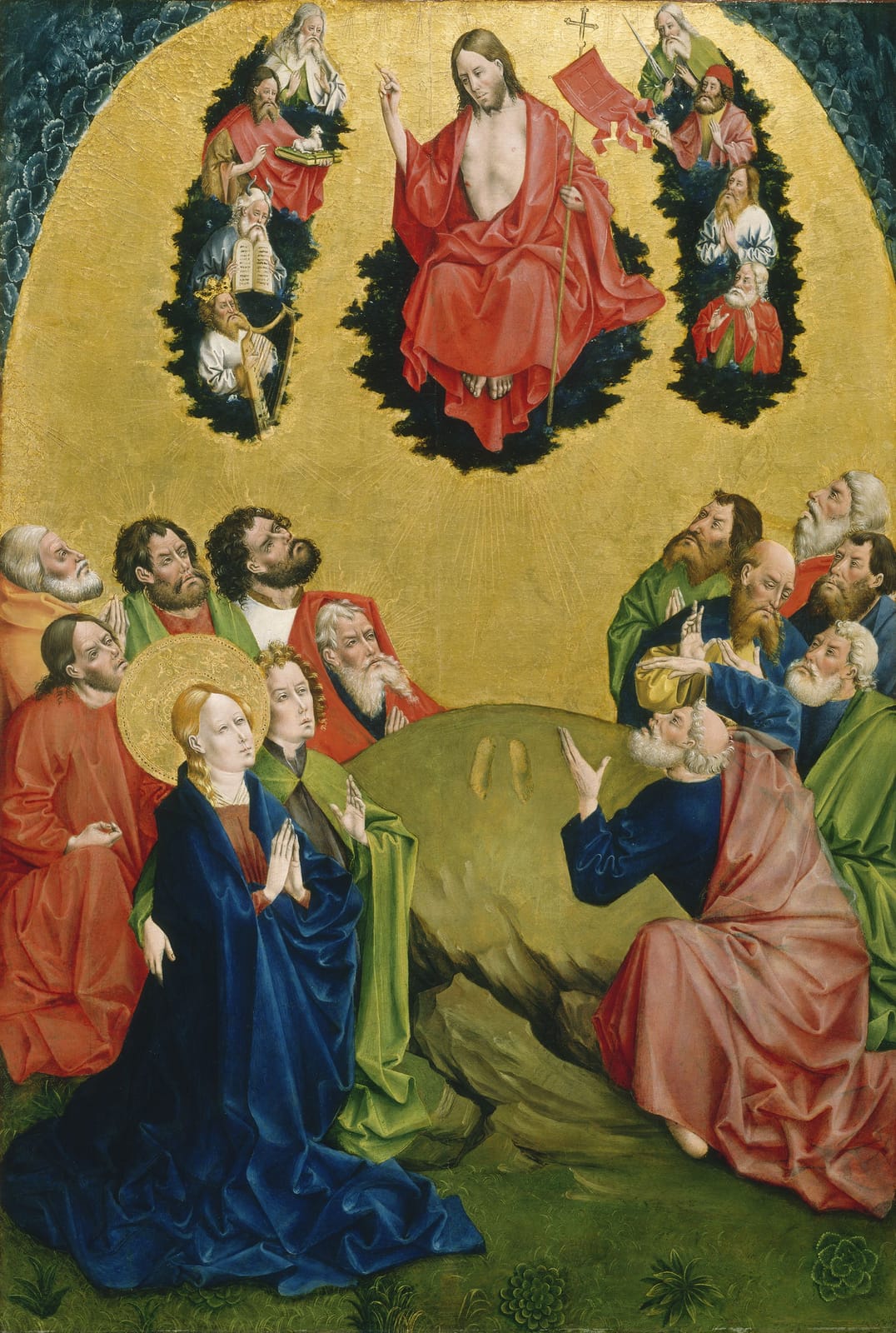
Christ in a red robe ascends in a mandorla while Mary and the apostles kneel on the mount
The Ascension, Johann Koerbecke (c. 1420–1491), 1456–57. Credits

Paschal Time

May 13, 2029

Sunday within the Octave of the Ascension

From Dom Guéranger’s The Liturgical Year.

O King of glory, Lord of hosts, who didst this day ascend in triumph above all the heavens! leave us not orphans, but send upon us the Spirit of truth, promised by the Father, alleluia.

Jesus has ascended into heaven. His Divinity had never been absent; hut, by the Ascension, His Humanity was also enthroned there, and crowned with the brightest diadem of glory. This is another phase of the mystery we are now solemnizing. Besides a triumph, the Ascension gave to the sacred Humanity a place on the very throne of the eternal Word, to whom it was united in unity of Person. From this throne, it is to receive the adoration of men and of angels. At the name of Jesus, Son of Man, and Son of God,—of Jesus who is seated at the right hand of the Father almighty,—'Every knee shall bend, in heaven, on earth and in hell.’

Give ear, O ye inhabitants of earth! This is the Man Jesus, who heretofore was a little Babe wrapped in swaddling clothes; who went through Judea and Galilee, not having where to lay His head; who was bound by the sacrilegious hands of his enemies, was scourged, crowned with thorns, nailed to a cross; who, whilst men thus trampled Him, as a worm, beneath their feet, submitted His will to that of His Father, accepted the chalice of suffering, and, that He might make amends to the divine glory, shed His Blood for the redemption of you sinners.

Chapter 3: The Practice during Paschal Time

From Dom Guéranger’s The Liturgical Year.

THE practice for this holy season mainly consists in the spiritual joy which it should produce in every soul that is risen with Jesus. This joy is a fore-taste of eternal happiness, and the Christian ought to consider it a duty to keep it up within him, by ardently seeking after that life which is in our divine Head, and by carefully shunning sin which causes death. During the last nine weeks we have mourned for our sins and done penance for them; we have followed Jesus to Calvary; but now, our holy Mother the Church is urgent in bidding us rejoice. She herself has laid aside all sorrow; the voice of her weeping is changed into the song of a delighted Spouse.

In order that she might impart this joy to all her children, she has taken their weakness into account. After reminding them of the necessity of expiation, she gave them forty days wherein to do penance; and then, removing the restraint of Lenten mortification, she brings us to Easter as to a land where there is nothing but gladness, light, life, joy, calm, and the sweet hope of immortality.

Christ in a red robe ascends in a mandorla while Mary and the apostles kneel on the mount
Johann Koerbecke (c. 1420–1491), The Ascension, 1456–57. National Gallery of Art, Washington. CC0 (Wikimedia Commons). Credits

Email view of this day