This day

December 19, 2029

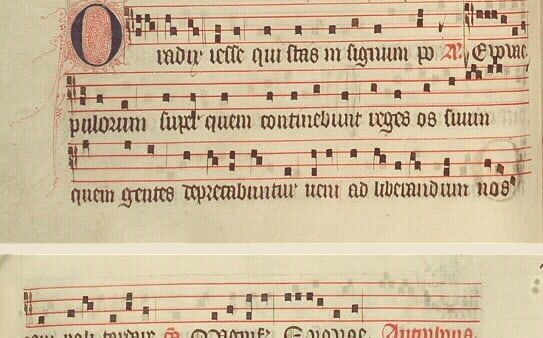
O Radix Jesse, the chant in the Poissy Antiphonal, folios 30v and 31r
Poissy Antiphonal, c. 1335–1345, fol. 30v–31r. State Library Victoria.

Advent

December 19, 2029

December 19: The Third Antiphon

From Dom Guéranger’s The Liturgical Year.

O Root of Jesse, who standest as the ensign of the people; before whom kings shall not open their lips; to whom the nations shall pray: come and deliver us; tarry now no more.

At length, O Son of Jesse! Thou art approaching the city of Thy ancestors. The Ark of the Lord has risen, and journeys, with the God that is in her, to the place of her rest. ‘How beautiful are thy steps, O thou daughter of the Prince,’ now that thou art bringing to the cities of Juda their salvation! The angels escort thee, thy faithful Joseph lavishes his love upon thee, heaven delights in thee, and our earth thrills with joy to bear thus upon itself its Creator and its Queen. Go forward, O Mother of God and Mother of men! Speed thee, thou propitiatory that holdest within thee the divine Manna which gives us life! Our hearts are with thee, and count thy steps. Like thy royal ancestor David, ‘we will not enter into the dwelling of our house, nor go up into the bed whereon we lie, nor give sleep to our eyes, nor rest to our temples, until we have found a place in our hearts for the Lord whom thou bearest, a tabernacle for this God of Jacob.’


Wednesday in Ember Week of Advent

From Dom Guéranger’s The Liturgical Year.

Prope est jam Dominus; venite, adoremus.
The Lord is now nigh; come, let us adore.

To-day the Church begins the fast of Quatuor Tempora, or, as we call it, of Ember days: it includes also the Friday and Saturday of this same week. This observance is not peculiar to the Advent liturgy; it is one which has been fixed for each of the four seasons of the ecclesiastical year. We may consider it as one of those practices which the Church took from the Synagogue; for the prophet Zacharias speaks of the fasts of the fourth, fifth, seventh, and tenth months. Its introduction into the Christian Church would seem to have been made in the apostolic times; such, at least, is the opinion of St. Leo, of St. Isidore of Seville, of Rabanus Maurus, and of several other ancient Christian writers. It is remarkable, on the other hand, that the orientals do not observe this fast.

From the first ages the Quatuor Tempora were kept, in the Roman Church, at the same time of the year as at present.

Email view of this day