Daily reading
January 12 · Temporal
January 12, 2019
From Dom Guéranger’s The Liturgical Year.
January 12: The Seventh Day within the Octave of the Epiphany
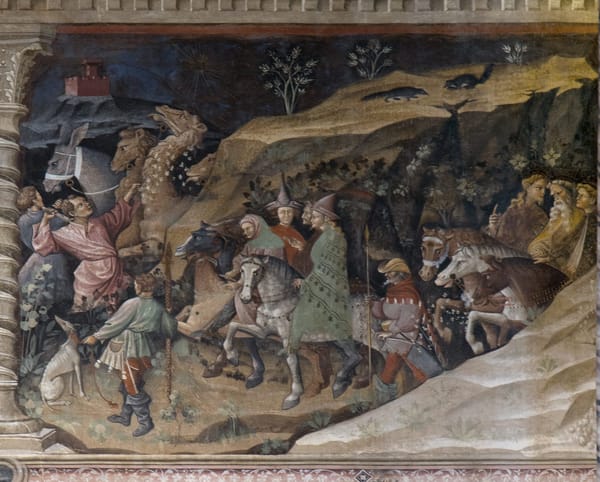
HAVING laid their offerings at the feet of Jesus, as the sign of the alliance they had, in the name of all mankind, contracted with him, and laden with his graces and blessings, the Magi take their leave of the Divine Babe; for such was his will. They take their departure from Bethlehem, and the rest of the world seems a wilderness to them. Oh, if they might be permitted to fix their abode near the new-born King and his incomparable Mother! But no; God's plan for the salvation of the world requires that everything savouring of human pomp and glory should be far from him who had come to take upon himself all our miseries.
Besides, they are to be the first messengers of the Gospel; they must go and tell to the Gentiles that the Mystery of Salvation has begun, that the earth is in possession of its Saviour, and that their salvation is nigh at hand. The star does not return to them; they needed it to find Jesus; but now they have him in their hearts, and will never lose him. These three men are sent back into the midst of the Gentile world, as the leaven of the Gospel which, notwithstanding its being so little, is to leaven the whole paste.* For their sakes, God will bless the nations of the earth; from this day forward infidelity will lose ground, and faith will progress; and when, the Blood of the Lamb having been shed, Baptism shall be promulgated, the Magi shall be, not merely men of desire, but perfect Christians, initiated into all the Mysteries of the Church.
The ancient tradition, which is quoted by the author of The Imperfect Work on St Matthew, which is put in all the editions of St John Chrysostom, and was probably written about the close of the 6th century, tells us that the three Magi were baptized by St Thomas the Apostle, and devoted themselves to the preaching of the Gospel. But we scarcely need a tradition on such a point as this. The vocation of these three Princes could never be limited to the mere privilege of being the first among the Gentiles to visit the eternal King who had come down from heaven to be born on this earth and show himself to his creatures; a second vocation was the consequence of the first, the vocation of preaching Jesus to men.
There are many details relating to the life and actions of the Magi, after they had become Christians, which have been handed down to us; but we refrain from mentioning them, as not being sufficiently ancient or important traditions to have induced the Church to give them place in her Liturgy. We would make the same observation with regard to the names assigned to them of Melchior, Gaspar, and Balthassar; the custom of thus naming them is too modern to deserve credit; and though it might be indiscreet to deny that these were their true names, it seems very difficult to give proofs of their correctness.
The Relics of these holy Kings were translated from Persia to Constantinople, under the first Christian Emperors, and, for a long time, were kept in the Church of Saint Sophia. At a later period, they were translated to Milan, when Eustorgius was Bishop of that city. There they remained till the 12th century, when, through the influence of the Emperor Frederic Barbarossa, they were translated to the Cathedral Church of Cologne by Reynold, Archbishop of that metropolitan see. The Relics are in a magnificent Shrine, perhaps the finest specimen now extant of medieval metallic art, and the superb Cathedral where it is religiously kept is, by its size and architectural beauty, one of the grandest Churches of the Christian world.
Thus have we followed you, O Blessed Magi! Fathers of the Gentile world! from your first setting out from the East for Bethlehem to your return to your own country, and even to your sacred resting-place; which the goodness of God has made to be in this cold West of ours. It was the love of children for their parents that made us thus cling to you. Besides, were we not ourselves in search of that dear King whom you so longed for and found? Blessed be those ardent desires of yours, blessed be your obedience to the guidance of the star, blessed be your devotion at the Crib of Jesus, blessed be the gifts you made him, which, while they were acceptable to God, were full of instruction to us! We revere you as Prophets, for you foretold the characters of the Messias by the selection of your three gifts. We honour you as Apostles, for you preached, even to Jerusalem herself, the Birth of the humble Jesus of Bethlehem, of that Jesus whom his Disciples preached not till after the triumph of his Resurrection. We hail you as the Spring Flowers of the Gentile world, but Flowers which produced abundant and rich fruits, for you brought over entire nations and countless people to the service of our divine King. Watch over us, and protect the Church. Be mindful of those Eastern countries, whence rises to the earth the light of day, the beautiful image of your own journey towards Bethlehem. Bless this Western world of ours, which was buried in darkness when you first saw the star, and is now the favoured portion of God's earth, and on which the Divine Sun of Justice pours forth his brightest and warmest rays. Faith has grown weak among us; reenkindle it. Obtain of the divine mercy that the West may ever send forth her messengers of salvation to the South and North, and even to that infidel East, where are laid the tents of Sem, and where the light that you gave her has been long extinguished by her apostasy. Pray for the Church of Cologne, that illustrious sister of our holiest Churches in the West; may she preserve the faith, may she defend her sacred rights and liberty; may she be the bulwark of Catholic Germany, and be ever blessed by the protection of her Three Kings, and the patronage of the glorious Ursula and her virginal army. Lastly, we beseech you, O venerable Magi! to introduce us to the Infant Jesus, and his Blessed Mother; and grant us to go through these forty days, which the Church consecrates to the Mystery of Christmas, with hearts burning with love for the Divine Child, and may that same love abide with us during the pilgrimage of our life on this earth.
To-day, also, we will make use of the formulas employed by the several ancient Churches in honour of the Mystery of the Epiphany. Our first selection is a hymn written by the great Fulbert of Chartres.
Hymn
Natus est Christus, Dominator orbis,
In Bethlehem Judæ; sic enim Propheta
Dixerat ante.
Hunc canit lætus chorus Angelorum,
Stella declarat, veniunt Eoi
Principes, dignum celebrare cultum,
Mystica dona.
Thus Deo, myrrham tribuunt sepulchro,
Auream Regi speciem decenti,
Dum colunt unum, meminere Trino
Tres dare terna.
Gloriam trinæ monadi canamus,
Cum Deo divæ Genitore Proli,
Flamini necnon ab utroque fuso
Corde fideli.
Christ, the Ruler of the earth,
is born in Bethlehem of Juda:
for thus was it foretold by the Prophet.’
the same is announced by the Star,
and the Eastern Kings come to offer to Jesus
the worthy homage of their mystic gifts.
the Myrrh honours his sepulchre; the Gold is the token of his Kingly character.
Whilst thus worshipping One,
the three offerers give three gifts to the Blessed Three,
glory to the Father, and to his divine Son,
and to the Holy Spirit, who is sent into the hearts of the faithful
by the Father and the Son.
Prayer
Prayer
We take the following Sequence from the ancient Missals of the Churches of Germany.
Sequence
Celebremus cum honore
Diem natalitium.
Nobis datus, nobis natus,
Et nobiscum conversatus,
Lux et salus gentium.
Eva prius interemit;
Sed Salvator nos redemit
Carnis suæ merito.
Prima parens nobis luctum,
Sed Maria vitæ fructum
Protulit cum gaudio.
Negligentes non neglexit,
Sed ex alto nos prospexit
Pater mittens Filium.
Præsens mundo, sed abs consus,
De secreto tamquam sponsu:
Prodiit in publicum.
Gigas velox, gigas fortis,
Gigas nostræ victor mortis,
Accinctus potentia.
Ad currendam venit viam,
Complens in se prophetiam
Et Legis mysteria.
Jesu, nostra salutaris
Medicina, singularis
Nostra pax et gloria;
Quia servis redimendis
Tam decenter condescendis,
Te collaudant omnia.
Amen.
Let us solemnly celebrate
his Birthday.
and with us has he lived,
he the light and salvation of the Gentiles.
but Jesus, by the merits of the human nature he assumed,
has redeemed us.
but Mary joyfully brought forth
for us the fruit of life.
he looked down upon us from heaven,
and sent us his only Son.
but, at length he came forth as a Bridegroom from the nuptial chamber,
and made himself known.
and vanquishing our death,
for he was girt with power.
and so verify the prophecy,
and the mysteries of the Law.
saving medicine,
our only Peace and glory!
for that thou didst so mercifully condescend
to redeem us thy servants!
This beautiful canticle in honour of the Infant Jesus is from the pen of St Ephrem, the sublime bard of the Syrian Church.
Hymn
The Menæa of the Greek Church furnish us with these beautiful stanzas in honour of the holy Mother of God.
Die XVI Januarii
* St Matt. xiii 33. ↩︎
January 12 (the Same Day): St. Benet Biscop, Bishop
ST BENET BISCOP is one of the great Benedictine saints to whom England owes so much. His devotion and loyalty to the Holy See, his love of learning, his zeal for the beauty of the house of God, for the monastic observance and for the Church's chant, show him to be a true monk, though his influence extended far wider than the narrow limits of his monastery, and affected the social condition of the people and the whole life of the Church in England. His feast is kept in several dioceses in England, but as there is no uniformity with regard to the date, we have inserted it in our calendar on the day of his death.
St Benet stands out among the great travellers in the cause of religion. He visited Rome no fewer than seven times, not only to satisfy his own devotion, but to obtain from the mother of all the churches the purest traditions, the most correct books for use in the divine liturgy, and objects of piety wherewith to inspire the devotion of the faithful. These treasures were all destined to be used for the benefit of his own countrymen, who were unable to seek them for themselves at the fountain-head. He inspired all those with whom he came in contact with a more exalted idea of the dignity of the worship of God. With regard to the Divine Service, his ruling principle was that nothing but the best was worthy of use, whether it were in the carrying out of liturgical functions or the actual fabric of the church. In his day Britain was far behind the continental nations in industry and art, and stone buildings were hardly known. St Benet, therefore, journeyed into Gaul to procure stonemasons, who came to the monastery at Wearmouth in Northumbria, and, with the help of the monks whom they instructed, built a stone church for the Community. The making and use of glass was also unknown in these islands at the time, and again St Benet sent messengers to Gaul who brought back workers in glass to glaze the windows of his church.
The record of St Benet's life has come down to us as written by the Venerable Bede, who was a monk of the abbey founded by the saint at Jarrow. Bede was admitted into this monastery when a child, during the lifetime of St Benet Biscop, and thus in his Life speaks from personal experience. He records several charming incidents which are not included in the Breviary lessons, one of which is given here as being illustrative of the saint's zeal for the Divine Office.
The Venerable Bede records that once during a visitation of the pestilence the monks at Jarrow were all stricken with the sickness with such severity that there remained but two persons in the house who were able to go to the church to sing the Divine Office, the Abbot Benet and Bede, who was still a child. These two performed the duties of the whole choir with unflagging zeal until the monks gradually regained sufficient strength to resume their share of the work of God. One can well imagine the joy of the angels at the sight of the venerable Abbot and the innocent child, each intent upon performing his share of the psalmody with exactitude so that it might never be said that the praise of God had ceased to resound through the Abbey church.
The following is the life of the saint as given in the Breviary lessons.
| Previous January 11 (the Same Day): St. Hyginus, Pope and Martyr | Next January 12 (the Same Day): St. Benet Biscop, Bishop |