Daily reading
Semidouble · January 19 · Sanctoral
January 19, 2019
From Dom Guéranger’s The Liturgical Year.
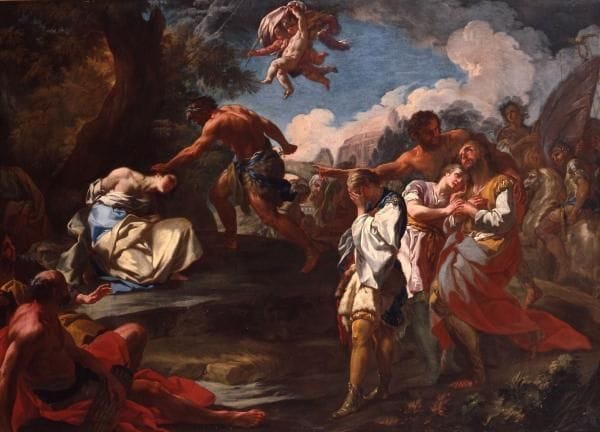
January 19: Sts. Marius, Martha, Audifax, and Abachum, Martyrs
CHRISTIANS from all parts of the world have ever flocked to Rome as to the rock of faith and the foundation of the Church, and honoured with the greatest reverence and piety the spot hallowed by the sepulchre of the Prince of the Apostles.'* These words of Holy Church are exemplified in the Martyrs of to-day. Fired with ambition to have some part and fellowship in the glorious Society of the holy Apostles and Martyrs, they left all things and hastened to the Eternal City, there to receive in fullest measure what they sought. Like the Magi of old they came from the far East. The star of faith had shone for them, and in obedience to its call they set forth in all eagerness to offer their gifts of homage and loyalty to the divine King in the person of his Vicar and his suffering members. Such generosity was not left unrewarded; our Emmanuel crowned it with the laurels of martyrdom, admitting them into that cloud of witnesses that ever stand about him. Let us keep before our minds with our Lord, the author and finisher of their faith, this great and glorious band of martyrs, so that we too may ever run unwearied and with courage and patience in the fight proposed to us.
The following lesson is given in the office:
* Lessons for the Dedication Feast of the Basilicas of Ss Peter and Paul. ↩︎
January 19 (the Same Day): St. Canute, King and Martyr
THE Magi Kings, as we have already observed, have been followed to the Crib of Jesus by saintly Christian monarchs; and it was just that these should be represented on the Church's Calendar during the season which is consecrated to the Mystery of his Birth. The eleventh century is one of the most glorious of the Christian era, and gave, both to the Church and the various States of Europe, a great number of saintly Kings. Among them Canute the Fourth of Denmark stands pre-eminent by reason of the aureole of his martyrdom. He had every quality which forms a Christian prince: he was a zealous propagator of the faith of Christ, he was a brave warrior, he was pious, and he was charitable to the poor. His zeal for the Church (and in those days her rights were counted as the rights of the people) was made the pretext for putting him to death: he died in the midst of a sedition as a victim sacrificed for his people's sake. His offering to the new-born King was that of his blood; and in exchange for the perishable crown he lost, he received that which the Church gives to her Martyrs, and which can never be taken away. The history of Denmark in the eleventh century is scarce known by the rest of the world; but the glory of that country's having had one of her kings a Martyr is known throughout the whole Church, and the Church inhabits the whole earth. This power, possessed by the Spouse of Christ, of conferring honour on the name and actions of the servants and friends of God, is one of the grandest spectacles out of heaven; for when she holds up a name as worthy of honour, that name becomes immortalized, whether he who bore it were a powerful king or the poorest peasant.
We find the following life of this holy King given in the Lessons until recently used in the Breviary.
O holy King! the Sun of Justice had risen upon thy country, and all thy ambition was that thy people might enjoy the fulness of its light and warmth. Like the Magi of the East, thou didst lay thy crown at the feet of the Emmanuel, and at length didst offer thy very life in his service and in that of his Church. But thy people were not worthy of thee; they shed thy blood, as the ungrateful Israel shed the Blood of the Just One who is now born unto us, and whose sweet Infancy we are now celebrating. Thou didst offer thy martyrdom for the sins of thy people; offer it now also for them, that they may recover the true faith they have so long lost. Pray for the Rulers of Christian lands, that they may be faithful to their duties, zealous for justice, and may have respect for the liberty of the Church. Ask for us of the Divine Infant a devotedness in his cause like that which glowed in thy breast; and since we have not a crown to lay at his feet, pray for us that we may be generous enough to give our whole heart.
January 19 (the Same Day): St. Wulstan, Bishop and Confessor
SEVERAL dioceses in England celebrate on this day the feast of St Wulstan, Bishop of Worcester. The last of the Anglo-Saxon saints, Wulstan was worthy to close the long line of men and women who had earned for the country the proud title of 'Insula Sanctorum.' His character as sketched by a contemporary is singularly attractive. A simple man, strong in his simplicity, yet kindly and gifted with a merry wit, he held straight on his course in God's service a priest, monk, prior, and bishop, spending himself in the laborious offices of his ministry, much more intent on the burdens of his position than on its emoluments. A love of beauty ran through his life and manifested itself in building fine churches, in his care of books, in his love for the freshness of children.
In his long life of eighty-seven years Wulstan saw the gradual passing of the old order, the reigns of Ethelbert, Canute, Edward the Confessor, and of his friend King Harold, down to the fateful day when power passed into Norman hands. With all his love for his own land and dynasty the Saint gave no time to useless regrets. He had warned the people that for their sins the country would fall under the dominion of strangers, and when the conquest became a fact he threw his great influence into support of the new dynasty. But he was no time-server, and had no hesitation in confronting the Conqueror to demand redress of injustice done to his See. King William learned to admire the sturdy Saxon prelate, and Wulstan, instead of sharing the fate of nearly all the native bishops who were removed and replaced by Normans, remained in his See and was made the King’s lieutenant for the Midlands.
The following are the lessons of Saint Wulstan.
| Previous January 18 (the Same Day): St. Prisca, Virgin and Martyr | Next January 19 (the Same Day): St. Canute, King and Martyr |