Daily reading
Epiphanytide
Double · January 26 · Sanctoral
January 26: St. Polycarp, Bishop and Martyr
From Dom Guéranger’s The Liturgical Year.
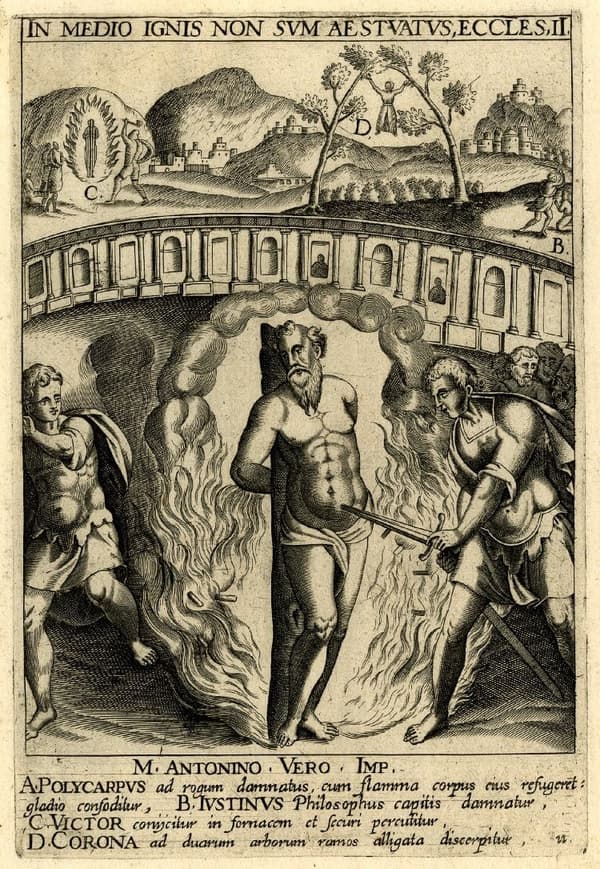 |
AMIDST the sweetness he is enjoying from the contemplation of the Word made Flesh, John, the Beloved Disciple, beholds coming towards him his dear Polycarp, the Angel of the Church of Smyrna,1 all resplendent with the glory of martyrdom. This venerable Saint has in his soul the fervent love that made him say in the amphitheatre, when asked by the Proconsul to curse his Divine Master: "Six-and-eighty years have I served Him, and he has never done me any wrong; nay, he has laden me with kindness. How could I blaspheme my King, who has saved me?" After having suffered fire and the sword, he was admitted into the presence of this King his Saviour, in reward for the eighty-six years of his faithful service, for the labours he had gone through in order to maintain faith and charity among his flock, and for the cruel death he endured.
He was a disciple of St John the Evangelist, whom he imitated by zealously opposing the heretics, who were then striving to corrupt the faith. In obedience to the command of his holy Master,2 he refused to hold intercourse with Marcion, the heresiarch, whom he called the first-born of Satan. This energetic adversary of the proud sect that denied the mystery of the Incarnation, wrote an admirable Epistle to the Philippians, in which we find these words: Whosoever confesses not that Jesus Christ came in the flesh, is an Antichrist. Polycarp, then, had a right to the honour of standing near the Crib, in which the Son of God shows himself to us in all his loveliness, and clothed in flesh like unto our own. Let us honour this disciple of John, this friend of Ignatius, this Bishop of the Apostolic Age, whose praise was pronounced by Jesus Christ himself in the Revelations of Patmos. Our Saviour said to him by the mouth of Saint John: Be thou faithful unto death, and I will give thee the crown of life.3 Polycarp was faithful even unto death, and has received his crown; and whilst we are celebrating the coming of his King among us, he is one of the Saints who assist us to profit by the holy season.
The Church gives us a passage from St Jerome's book, On Ecclesiastical Writers, in which there is contained the following short notice of our holy Martyr.
The Greek Church sings the praises of St Polycarp in her Menæa, from which we extract the following passages.
Die XXIII Februarii
Supra crucem visus, et hierarchico ornamento digne indutus, Pater, in templum Dei introisti proprio sanguine.
That thou, O holy Pontiff! mightest be presented to Christ, the Prince of Pastors, as the victim elect marked out by him, thou becamest the imitator of his passion, and art now a partaker of his glory, and the coheir of his kingdom.
How well didst thou bear out the full meaning of thy name, O Polycarp! for thou didst produce many fruits for thy Saviour, during thy six-and-eighty years spent in his service. The numerous souls won over to Christ, the virtues which adorned thy life, and thy life itself, which thou didst present to thy Lord in its full maturity—these were thy fruits. And what happiness was thine to have received instruction from the Disciple that leaned upon Jesus' Breast! After being separated from him for more than sixty years, thou art united with him on this the day of thy martyrdom, and thy venerable master receives thee in a transport of joy. Thou adorest, with him, that Divine Babe, whose simplicity thou hadst imitated during life, and who was the single object of thy love. Ask of him for us, that we too may be Faithful unto death.
By thy prayers, now that thou art throned in heaven, make fruitful the vineyard of the Church, which when on earth thou didst cultivate by thy labours, and water with the blood of thy glorious martyrdom. Re-establish faith and unity in the Churches of Asia, which were founded by thy venerable hand. Hasten, by thy prayers, the destruction of that degrading slavery of Mohammedanism which has kept the East in bondage so long, because her once faithful children severed themselves from Rome by the great schism of Byzantium. Pray for the Church of Lyons, which regards thee as its founder, through the ministry of thy disciple Pothinus, and takes itself so glorious a share in the apostolate of the Gentiles, by the Work of the Propagation of the Faith.
Watch over the purity of our holy Faith, and preserve us from being deceived by false teachers. The error which thou didst combat, and which teaches that all the mysteries of the Incarnation are but empty symbols, has risen up again in these our days. There are Marcions, even now, who would reduce all religion to myths; and they find some few followers; may thy powerful prayers rid the world of this remnant of so impious a doctrine. Thou didst pay homage to the Apostolic Chair, for thou, too, wouldst see Peter, and didst journey to Rome, in order to consult its Pontiff on questions regarding the interests of thy Church of Smyrna. Defend the rights of this august See, whence alone are derived both the jurisdiction of our Pastors, and the authoritative teachings of Faith. Pray for us, that we may spend the remaining days of this holy Season in the contemplation and the love of our new-born King. May this love, accompanied with purity of heart, draw down upon us the merciful blessings of God, and at length, after our course is run, obtain for us the Crown of Life.
| Previous January 25: The Conversion of St. Paul | Next The Third Sunday after Epiphany |