Daily reading
Epiphanytide
Double · Temporal
January 27, 2019
From Dom Guéranger’s The Liturgical Year.

|
The Third Sunday after Epiphany
THE variation of Easter Sunday necessitates almost every year a different arrangement of the Sundays after the Epiphany from that in which they stand in the Missal. Septuagesima often comes in January and the Feast of the Purification is occasionally later than Quinquagesima Sunday; hence the office of these four last Sundays may have to be transferred to another season of the liturgical cycle. We were obliged then to provide for these changes and simplify them for the Faithful by adopting our present plan. We have inserted here the third and fourth Sundays as usually falling in Christmastide, while the office of the fifth and sixth Sundays will be found in the volumes of Septuagesima and the second after Pentecost, this latter season being the one in which they are most frequently kept.
Mass
The Introit represents the Angels of God adoring him on his entrance into this world, as St Paul* explains this passage of the Psalms. The Church celebrates with David the gladness of Sion, and the joy of the daughters of Juda.
Introit
Collect
Commemoration of the Blessed Virgin Mary
The third Prayer is one of the following:
Against the persecutors of the Church
For the Pope
Epistle
Cap. XII.Fratres, nolite esse prudentes apud vosmetipsos: nulli malum pro malo reddentes: providentes bona non tantum coram Deo, sed etiam coram omnibus hominibus; si fieri potest, quod ex vobis est, cum omnibus hominibus pacem habentes: non vosmetipsos defendentes, carissimi, sed date locum iræ; scriptum est enim; Mihi vindicta, ego retribuam, dicit Dominus. Sed si esurierit inimicus tuus, ciba ilium; si sitit, potum da illi: hoc enim faciens, carbones ignis congeres super caput ejus. Noli vinci a malo, sed vince in bono malum.
Ch. XII.Brethren, be not wise in your own conceits. To no man rendering evil for evil. Providing good things not only in the sight of God, but also in the sight of all men. If it be possible, as much as in you, having peace with all men. Not revenging yourselves, my dearly beloved, but give place unto wrath. For it is written: 'Revenge to me, I will repay,' saith the Lord. But 'if thy enemy be hungry, give him to eat: if he thirst, give him to drink: for doing this, thou shalt heap coals of fire upon his head.’ Be not overcome by evil, but overcome evil by good.
This love of our neighbour, recommended to us by the Apostle, is a consequence of that universal brotherhood which our Saviour, by his Birth, brought us from heaven. He came to establish peace between heaven and earth; men, therefore, ought to be at peace one with another. Our Lord bids us not to be overcome by evil, but to overcome evil by good:—and did not he first practise this by coming among us, who were children of wrath, that he might make us children of adoption by his humiliations and his sufferings?
In the Gradual, the holy Church again celebrates the coming of Emmanuel, and invites all nations, and all the kings of the earth, to come and praise his holy name.
Gradual
Gospel
Cap. VIII.In illo tempore, Cum descendisset Jesus de monte, secutæ sunt eum turbæ multæ; et ecce leprosus veniens, adorabat eum dicens: Domine, si vis, potes me mundare. Et extendens Jesus manum, tetigit eum dicens: Volo, mundare. Et confestim mundata est lepra ejus. Et ait illi Jesus: Vide, nemini dixeris; sed vade, ostende te sacerdoti et offer munus, quod præcepit Moyses, in testimonium illis. Cum autem introisset Capharnaum, accessit ad eum centurio, rogans eum et dicens; Domine, puer meus jacet in domo paralyticus, et male torquetur. Et ait illi Jesus: Ego veniam et curabo eum. Et respondens centurio, ait: Domine, non sum dignus ut intres sub tectum meum; sed tantum dic verbo, et sanabitur puer meus. Nam et ego homo sum sub potestate constitutus, habens sub me milites, et dico huic: vade, et vadit; et alii: veni, et venit; et servo meo: fac hoc, et facit. Audiens autem Jesus, miratus est, et sequentibus se dixit: Amen dico vobis, non inveni tantam fidem in Isræl. Dico autem vobis, quod multi ab oriente et occidente venient, et recumbent cum Abraham et Isaac et Jacob in regno cœlorum; filii autem regni ejicientur in tenebras exteriores: ibi erit fletus et stridor dentium. Et dixit Jesus centurioni: Vade, et sicut credidisti, fiat tibi. Et sanatus est puer in illa hora.
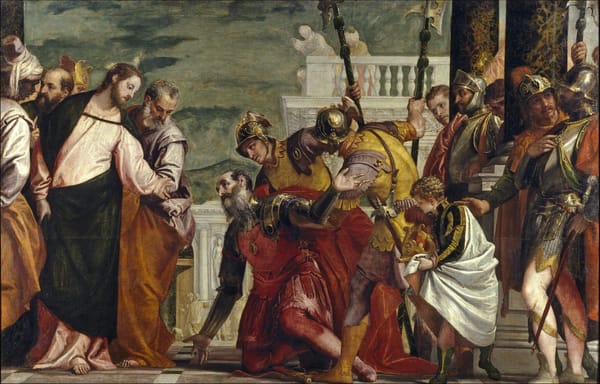
Ch. VIII.At that time, when Jesus was come down from the mountain, great multitudes followed him; and behold a leper came and adored him, saying: Lord, if thou wilt, thou canst make me clean. And Jesus stretching forth his hand, touched him, saying: I will, be thou made clean. And forthwith his leprosy was cleansed. And Jesus saith to him: See thou tell no man, but go, show thyself to the priest, and offer the gift which Moses commanded for a testimony unto them. And when he had entered unto Capharnaum, there came to him a centurion, beseeching him, and saying: Lord, my servant lieth at home sick of the palsy, and is grievously tormented. And Jesus saith to him: I will come and heal him. And the centurion making answer, said: Lord, I am not worthy that thou shouldst enter under my roof; but only say the word, and my servant shall be healed. For I also am a man under authority, having under me soldiers; and I say to this, Go, and he goeth, and to another, Come, and he cometh, and to my servant, Do this, and he doeth it. And when Jesus heard this, he marvelled, and said to them that followed him: Amen, I say to you, I have not found so great faith in Israel. And I say unto you, that many shall come from the east and the west, and shall sit down with Abraham, and Isaac, and Jacob, in the kingdom of heaven; but the children of the kingdom shall be cast out into the exterior darkness: there shall be weeping and gnashing of teeth. And Jesus said to the centurion: Go, and as thou hast believed, so be it done to thee. And the servant was healed at the same hour.
The human race was infected with the leprosy of sin: the Son of God touches it by the mystery of the Incarnation, and restores it to health. But he requires that the sick man, now that he is healed, shall go and show himself to the priest, and comply with the ceremonies prescribed by the law; and this, to show that he allows a human priesthood to co-operate in the work of our salvation. The vocation of the Gentiles, of which the Magi were the first-fruits, is again brought before us in the faith of the centurion. A Roman soldier, and millions like him, shall be reputed as true children of Abraham, Isaac and Jacob; while they who are the sons of this Patriarch according to the flesh, shall be cast out from the feast-chamber into the gloom of blindness; and their punishment shall be given as a spectacle to the whole earth.
Let man, then, saved as he has been by the coming of Emmanuel, sing a hymn of praise to the power of God, who has wrought our salvation by the strength of his almighty arm. Man had been sentenced to death; but now that he has God for a Brother, he shall not die: he will live: and could he spend his life better than in praising the works of this God that has saved him?
Offertory
Secret
Commemoration of the Blessed Virgin Mary
Against the persecutors of the Church
For the Pope
Preface
℣. Dominus vobiscum. ℟. Et cum spiritu tuo.
℣. Sursum corda. ℟. Habemus ad Dominum.
℣. Gratias agamus Dominum Deo nostro. ℟. Dignum et justum est.
℣. The Lord be with you. ℟. And with thy spirit.
℣. Lift up your hearts. ℟. We have them fixed on God.
℣. Let us give thanks to the Lord our God. ℟. It is meet and just.
After having distributed the Bread of Life, the Church reminds us how the people were in admiration at the words of Jesus. The children of the Church, initiated into all his Mysteries, are at this moment enjoying the effects of that ineffable Word, by means of which the Redeemer has changed the bread into his Body, and the wine into his Blood.
Communion
Postcommunion
Commemoration of the Blessed Virgin Mary
Against the persecutors of the Church
For the Pope
Vespers
The Psalms, Antiphons, Capitulum, Hymn, and Versicle are given on pages 89-96.
Antiphon of the Magnificat
* Heb. i 6. ↩︎
January 27: St. John Chrysostom, Bishop and Doctor of the Church
BEFORE our Emmanuel came upon this earth, men were as sheep without a shepherd; the flock was scattered, and the human race was hastening on to perdition. Jesus would, therefore, not only be the Lamb that was to be slain for our sins; he made himself, moreover, a Shepherd, that so he might bring us all back to the divine fold. But as he had to leave us when he ascended into heaven, he has provided for the wants of his sheep by providing us with a succession of Pastors, who should in his name feed the flock even to the end of the world. Now instruction, which is the light of life, is what the flock of Christ needs above all other things; and therefore our Emmanuel required that the Pastors of his Church should also be Doctors of sacred science. The Pastor owes two things to his people; namely, the Word of God and the Sacraments. He is under the obligation of dispensing, personally and unceasingly, this twofold nourishment to his flock, and of laying down his very life, if needed, in the fulfilment of a duty on which rests the whole work of the world’s salvation.
But since the disciple is not above his Master, the Pastors and Doctors of the Christian people, if they are faithful in the discharge of their duties, are sure to be hated by the enemies of God; for they cannot spread the Kingdom of Christ without at the same time taking from the power of Satan. Hence it is that the history of the Church is filled with the persecutions endured by her Pastors and Doctors, who continued the ministry of zeal and charity begun by Christ upon the earth. These contests have been threefold, and gave occasion to three admirable victories.
The Pastors and Doctors of the Church have had to struggle with Paganism, which sought, by inflicting tortures and death, to oppose the preaching of the law of Christ. It was this sort of persecution which gave the Church such saints as those whom we celebrate during this season of Christmas—Polycarp, Ignatius, Fabian, Marcellus, Hyginus, and Telesphorus.
When the era of Persecution was over, the Pastors and Doctors of the Christian people had to engage with enemies of another kind. Kings and Princes became children of the Church, and then sought to make her their own slave. They imagined that it would serve their political interests to interfere with the liberty of the Word of God, which, like the light of the sun, was intended to be carried, without hindrance, throughout the whole earth. They usurped the priestly power, as did the Pagan Cæsars, and presumed to set limits to the administration of those sources of life which become corrupt as soon as they are touched by a profane hand. This usurpation gave rise to an incessant contest between the temporal and spiritual powers, and produced a second class of martyrs. God has glorified his Church during this long period of struggle, and has given her, from time to time, a brave defender of ecclesiastical liberty. We have met two of these champions of the Word and the holy ministry during Christmastide—Thomas of Canterbury, and Hilary of Poitiers.
But there is a third sort of battle in which the Pastors and Doctors of the flock of Christ have had to fight—it is the battle with the world and its vices. It began when Christianity began, and will continue to the day of Judgement. It was their courage in this battle that made so many saintly prelates hated for the name of Jesus Christ. Neither their charity, nor their services to mankind, nor their humility, nor their meekness, protected them from ingratitude, spleen, calumny, and persecution. And what was their offence? They had been faithful in their duty of preaching the doctrines of their Divine Master, of encouraging virtue, and of chiding the sins of men. The amiable Francis de Sales was as much disliked and even hated by bad men as was John Chrysostom himself, whose triumph gladdens the Church today, and who stands near the Crib of his Lord as one of the most illustrious martyrs of pastoral duty courageously discharged.
Fervent in the service of his Saviour, even to the observance of the divine Counsels (for he had embraced the monastic life), this golden-mouthed Preacher made no other use of his wonderful gift of eloquence than that of urging men to the observance of the virtues taught in the Gospel, and of reproving every vice. Satan sought to have his revenge against our Saint by raising against him many enemies. Among these were an Empress, whose vanities and sins he had rebuked; men in power, whose wickedness he had held up to notice; women of influence, who would have him preach a morality more in accordance with their own depravity; a Bishop of Alexandria, and certain Prelates of the Court, who were jealous of his virtues, and still more so of his reputation. He was exceedingly loved by his people—but neither that nor his great virtues protected him from persecution. He whose eloquence had enraptured the people of Antioch, and won for him the enthusiastic admiration of the citizens of Constantinople, was deposed in a council convened for the purpose, his name was ordered to be cancelled from the diptychs of the Altar, notwithstanding the energetic protest of the Roman Pontiff; and at length he was condemned to exile, and died on the way, worn out by the hardships and fatigues he had to undergo.
But this Pastor, and Doctor, was not vanquished. He said, in the midst of all his persecutions, Woe is unto me if I preach not the Gospel!1 He made use, too, of those other words of the great Apostle: The word of God is not bound.2 The Church triumphed in him; she was more glorified and more consoled by the unflinching courage of Chrysostom, who was led into captivity for having preached the Gospel of Christ, than she had been by the success achieved by his eloquence, an eloquence which Libanius was heard to covet for his pagan orators. Let us hearken to the thrilling words of Chrysostom, which he addressed to the faithful immediately before his last banishment. He had been sent into exile once before; but a terrific earthquake immediately after his departure was looked upon as sent by heaven to punish the authors of so crying an injustice, and the Empress herself went, with tears in her eyes, to ask the Emperor to recall him. Accordingly, he was permitted to return. Shortly after, fresh occasions were sought for, and John was again sentenced to exile. He received the intimation with all the calmness of a Saint who knows that the whole Church is on his side. Let us study this glorious model of a Bishop trained in the school of our Lord who is, as the Apostle calls him, the Shepherd and Bishop of our souls.3
'Many are the waves, and threatening are the storms, which surround me; but I fear them not; for I am standing on the Rock. Let the sea roar; it cannot wash away the Rock: Let the billows mount as they will; they cannot sink the barque of our Lord Jesus Christ. And tell me, what would you have me fear? Death? To me, to live is Christ; and to die is gain.4 Exile? The earth is the Lord's, and the fulness thereof.5 Confiscation of my goods? We brought nothing into this world; and certainly we can carry nothing out.6 No—the evils of this world are contemptible, and its goods deserve but to be laughed at. I fear not poverty, I desire not riches; I neither fear to die, nor wish to live, save for your advantage. Your interest alone induces me to speak of these things, and to ask of you, by the love you bear me, to take courage.
'For no one can separate us; no human power can part what God has united. It is said of husband and wife: Wherefore a man shall leave father and mother, and shall cleave to his wife; and they shall be two in one flesh:7 Therefore what God hath joined together, let no man put asunder.8 Thou canst not, O man, dissolve the nuptial tie: how hopest thou to divide the Church of God? It is she whom thou attackest, because thou canst not reach him whom thou fain wouldst strike. Thou makest me more glorious, and thou dost but waste thy strength in warring against me, for it is hard for thee to kick against the sharp goad.9 Thou canst not blunt its point, and thou makest thine own foot bleed, just as the billows, when they dash against the rock, fall back mere empty froth.
'Believe me, O man, there is no power like the power of the Church. Cease thy battling, lest thou lose thy strength; wage not war with heaven. When it is with man thou warrest, thou mayst win or lose; but when thy fighting is against the Church, it is impossible thou shouldst conquer, for God is above all in strength. Do we provoke the Lord to jealousy? Are we stronger than he?10 God founded, God gave firmness: who shall be so bold as to attempt to pull down? Knowest thou not his power? He looketh upon the earth, and maketh it tremble;11 he gives his order, and that which trembled is made firm again. If he made firm the City after an earthquake had shaken it, how much more could he not give firmness to the Church? The Church is stronger than heaven itself: Heaven and earth shall pass, but my words shall not pass.12 What words? Thou art Peter; and upon this Rock will I build my Church, and the gates of hell shall not prevail against it.13
'If thou wilt not believe his word, believe facts. How many tyrants have sought to crush the Church? They had their gridirons and fiery furnaces, and wild beasts, and swords—and all failed. Where are those enemies now? Buried and forgotten. And the Church? Brighter than the sun. All they had is now past; but her riches are immortal. If the Christians conquered when they were but few in number, canst thou hope to vanquish them, now that the whole earth is filled with the holy religion? Heaven and earth shall pass, but my words shall not pass. Wonder not at it; for the Church is dearer unto God than the very heavens. He took flesh not from heaven, but from his Church on earth; and heaven is for the Church, not the Church for heaven.
'Be not troubled at what has happened. I ask this favour of you—be firm in your faith. Have you not observed that when Peter was walking on the waters, and began to fear, he was in danger of sinking, not because the sea was rough, but because his faith was weak? Have I been raised to this dignity by human intrigue? Was it man that brought me to it, or can man now depose me? I say not this from arrogance or boasting; God forbid! I say it from the desire of calming your trouble.
‘The devil no sooner saw that your City was tranquillized, than he plotted how he might disturb the Church. Thou wicked and most impious spirit! thou couldst not throw down the walls of a city; and thinkest thou thou canst make the Church fall? Does the Church consist of walls? The Church consists of the multitude of the faithful. Look at her pillars, and see how solid they are, fastened, not by iron, but by faith. Not only is the great multitude itself more vehement than fire, but even one single Christian would conquer thee. Hast thou forgotten the wounds thou receivedst from the martyrs? Oftentimes the combatant was a tender maiden: delicate as a flower, yet firmer than a rock. Thou didst mangle her flesh, but her faith was proof against all thy tortures Her blood fell as nature felt the wounds, but her faith fell not; her body was tom, but her manly soul flinched not; what was material was spoilt, what was spiritual was untouched. Thou couldst not vanquish one woman; and yet thou hopest to vanquish a whole people! Hast thou not heard these words of the Lord: Where there are two or three gathered together in my name, there am I in the midst of them?14 And thinkest thou he will not be in the midst of a numerous people, united together by the ties of charity?
‘I have his pledge, and on that I trust, not on my own strength. I have his written promise. That is my staff, and my guarantee, and my tranquil port. What matters it to me if the whole world be upset—have I not his written word? have I not his letters? There is my rampart, and there my defence. What letters? I am with you all days, even to the consummation of the world.15 Christ is with me—of whom shall I be afraid? Though stormy billows should rise up against me, though the sea should open to swallow me, though the wrath of kings should be enkindled against me, I will heed them no more than if they were so many spider's webs. Had not my love for you kept me, I would have started this very day on my exile, for this is my constant prayer: "O Lord! thy will be done;16 I will do thy will; not what such or such an one may will, but what thou wiliest." This is my tower of strength, this is my firm rock, this is my trusty staff. If God will that I go, I will go. If he will me to remain here, I will give him thanks. Yea, whithersoever he wills me to go, I will bless his holy name.'17
What humility and courage in this saintly minister of Christ! What a consolation for the Church when God sends her men like this! He has given four to the Eastern Church: Athanasius, Gregory of Nazianzum, Basil and Chrysostom. In spite of the immense dangers to which faith was exposed during the age in which they lived, these four holy Doctors, by their sanctity, learning, and courage, kept it alive among the people. Athanasius and Gregory appear to us in that period of the Ecclesiastical Year when the Church is radiant with her Easter joy, and celebrates the Resurrection of her Divine Spouse. Basil's feast gladdens us in the season of Pentecost, when the Church is filled with the gifts of the Holy Ghost. Chrysostom comes at Christmastide, and adds to the joy of the dear Mystery of Bethlehem. Let us, the favoured children of the Latin Church, which alone has preserved the primitive faith, because Peter is with her—let us honour these four faithful guardians of Tradition; let us today pay the homage of our devotion to Chrysostom, the Doctor of the universal Church, the conqueror of the world, the dauntless Pastor, the successor of the Martyrs, the Preacher par excellence, the admirer of St Paul, and the fervent imitator of our Lord Jesus Christ.
The Roman Church, in the lessons of today's Office, thus speaks the praises of our Saint.
Joannes Antiochenus, propter aureum eloquentiæ flumen cognomento Chrysostomus, a forensibus et sæcularibus studiis ad divinas litteras summa cum ingenii et industriæ laude se contulit. Itaque sacris initiatus, ac Presbyter Antiochenæ Ecclesiæ factus, mortuo Nectario, Arcadii Imperatoris opera, invitus Constantinopolitanæ Ecclesiæ præficitur: quo suscepto pastorali munere, depravatos mores, et nobiliorum hominum vivendi licentiam vehementius objurgare coepit. Qua ex libertate magnam multorum subiit invidiam. Apud Eudoxiam etiam, quod eam propter Callitropæ viduæ pecuniam, et alterius viduæ agrum reprehendisset, graviter offendit.
John, surnamed Chrysostom on account of his golden eloquence, was born at Antioch. Having gone through the study of the law and the profane sciences, he applied himself with extraordinary application and success to the study of the Sacred Scriptures. Having been admitted to holy orders, and made a Priest of the Church at Antioch, he was appointed Bishop of Constantinople, after the death of Nectarius, by the express wish of the Emperor Arcadius. No sooner had he entered upon the pastoral charge than he began to inveigh against the licentious lives led by the rich. This his courageous preaching procured him many enemies. He likewise gave great offence to the Empress Eudoxia, because he had reproved her for having appropriated to herself the money belonging to a widow named Callitropa, and for having taken possession of some land which was the property of another widow,
Quare aliquot Episcoporum acto Chalcedone conventu, quo ipse vocatus ire noluit, quod nec legitimum concilium, nec publicum esse diceret, nitente in primis ipsa contra Chrysostomum Eudoxia, ejicitur in exilium: sed paulo post propter ejus desiderium, seditione populi facta, admirabili civitatis plausu ab exilio revocatur. Verum cum perditos mores increpare non desisteret, et ad argenteam Eudoxiæ statuam in foro Sanctæ Sophiæ ludos fieri prohiberet: conspiratione inimicorum Episcoporum iterum exulare cogitur, viduis et egentibus communis parentis ejectionem lugentibus. In exilio Chrysostomum incredibile est et quanta mala perpessus sit, et quam multos ad Jesu Christi fidem converterit.
At the instigation, therefore, of Eudoxia, several Bishops met together at Chalcedon. Chrysostom was cited to appear, which he refused to do. because it was not a Council either lawfully or publicly convened. Whereupon, he was sent into exile. He had not been gone long before the people rose in sedition on account of the Saint's banishment, and he was recalled, to the immense joy of the whole city. But his continuing to inveigh against the scandals which existed, and his forbidding the games held before the silver statue of Eudoxia, which was set up in the space opposite Sancta Sophia, were urged by certain Bishops, enemies of the Saint, as motives for a second banishment. The widows and the poor of the city bewailed his departure as that of a father. It is incredible how much Chrysostom had to suffer in this exile, and how many he converted to the Christian Faith.
The Greek Church, in her Menæa, honours the memory of her great Doctor with an enthusiasm which even herliturgy has seldom surpassed. We extract the following stanzas.
Die XIII Novembris
What a crown is thine, O Chrysostom! Oh! how glorious is thy name in the Church of both heaven and earth! Thou didst preach the gospel in truth, thou didst fight the battle of thy Lord with courage, thou didst suffer for the cause of justice, and thou didst give up thy life in defence of the liberty of God's word. The applause of men did not make thee less stern in claiming the rights of God, and the gift of apostolic eloquence, wherewith the Holy Ghost had enriched thee, was but a feeble image of the divine fire which burned within thy heart, and which made thee love the Word Incarnate, Christ Jesus our Lord, more than thine own glory, or happiness, or life. Thou wast calumniated by wicked men; thy name was erased from the tablets of the holy altar; and, like thy divine Master, thou wast condemned as a criminal, and deposed from the episcopal throne. But as well might men strive to eclipse the sun, as efface thy loved name from the memory of the Christian world. Rome defended thee, and has ever honoured thy admirable virtues, just as she now venerates thy sacred relics, which repose near the tomb of the Prince of the Apostles. She and all her children throughout the world consider thee as one of the most faithful dispensers of divine Truth.
Recompense the devotion we have for thee, O Chrysostom! by watching over us from heaven; instruct us, convert us, make us earnest Christians. Like thy beloved master, St Paul, thou didst care for no knowledge save that which would make thee know Christ Jesus: but is it not in Christ Jesus that are hidden all the treasures of knowledge and wisdom? Teach us to know this dear Saviour, who has come down to us with all his infinite perfections; teach us to know his spirit; tell us how we may please and imitate him; ask him to receive the offering of our faithful love. In one thing we resemble thee, great Saint! we are exiles; but, alas! we are so often tempted to love our exile as though it were our home. Oh! detach us from this earth and its vanities. May we long to be united with thee, as thou wast united with the holy Martyr Basiliscus, in order that we may be with Jesus.
Faithful Pastor! pray for our Pastors; obtain for them thine own spirit, and pray that their flocks may be docile to their teachings. Bless the Preachers of God’s word, that so they may preach not themselves, but Jesus Christ. Ask our Lord to give them that Christian eloquence which comes from the study of the Sacred Volume, and from prayer; that thus, the faithful may be allured to virtue by the charm of an unearthly language, and may give glory to God. Protect the Roman Pontiff, whose predecessor was thy sole defender; may he ever be the protector of the Bishops of the Church who are persecuted for justice' sake. Pray for thy Church of Constantinople, which has forgotten thy faith and thy virtues. May she be raised from the degradation in which she has been so long enslaved. May Jesus, the Eternal Wisdom, be appeased by thy prayers, and be mindful of his Church of Sancta Sophia, and purify it from profanation, and restore that altar whereon he was offered in sacrifice for so many ages. Show, too, thy love for the Western Church, which has ever revered and loved thee. Hasten the fall of the heresies which have so long laid waste large portions of her inheritance; dispel the dark clouds of incredulity, and obtain for us all, by thy powerful intercession, a lively faith and the fervent practice of every virtue.
- 1 Cor. ix 16. ↩︎
- 2 Tim. ii 9. ↩︎
- 1 St Pet. ii 25. ↩︎
- Phil. i 21. ↩︎
- Ps. xxiii 1. ↩︎
- 1 Tim. vi 7. ↩︎
- Gen. ii 24. ↩︎
- St Matt. xix 6. ↩︎
- Acts ix 6. ↩︎
- 1 Cor. x 22 ↩︎
- Ps. ciii 32. ↩︎
- St Matt. xxiv 35. ↩︎
- Ibid. xvi 18. ↩︎
- St Matt. xviii 20. ↩︎
- Ibid. xxviii 20. ↩︎
- Ibid. vi 10. ↩︎
- Homily before his exile. ↩︎
| Previous January 26: St. Polycarp, Bishop and Martyr | Next January 27: St. John Chrysostom, Bishop and Doctor of the Church |