Daily reading
Epiphanytide
Double of the II Class · February 2 · Sanctoral
February 2: The Purification of the Blessed Virgin
From Dom Guéranger’s The Liturgical Year.

|
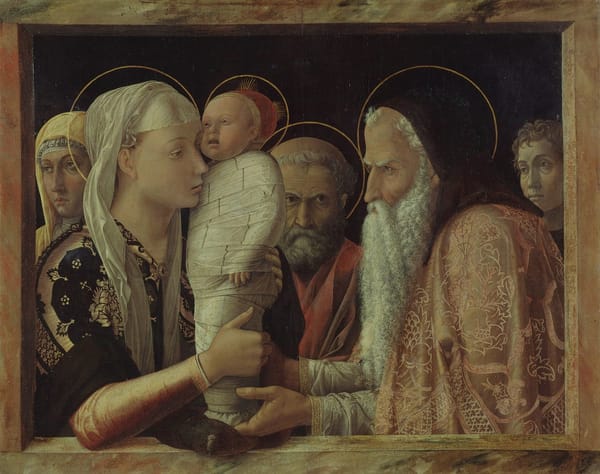
Including descriptions of the following:
THE Forty Days of Mary's Purification are now completed, and she must go up to the Temple, there to offer to God her Child Jesus. Before following the Son and his Mother in this their mysterious journey, let us spend our last few moments at Bethlehem, in lovingly pondering over the mysteries at which we are going to assist.
The Law commanded that a woman who had given birth to a son should not approach the Tabernacle for the term of forty days; after which time she was to offer a sacrifice for her purification. She was to offer up a lamb as a holocaust, and a turtle-dove or pigeon as a sin-offering. But if she were poor, and could not provide a lamb, she was to offer in its stead a second turtle-dove or pigeon.
By another ordinance of the Law, every first-born son was to be considered as belonging to God, and was to be redeemed by five sides, each side weighing, according to the standard of the Temple, twenty obols.1
Mary was a Daughter of Israel—she had given birth to Jesus—he was her First-born Son. Could such a Mother and such a Son be included in the laws we have just quoted? Was it becoming that Mary should observe them?
If she considered the spirit of these legal enactments, and why God required the ceremony of Purification, it was evident that she was not bound to them. They for whom these laws had been made were espoused to men; Mary was the chaste Spouse of the Holy Ghost, a Virgin in conceiving and a Virgin in giving birth to her Son; her purity had ever been spotless as that of the Angels; but it received an incalculable increase by her carrying the God of all sanctity in her womb, and bringing him into this world. Moreover, when she reflected upon her Child being the Creator and Sovereign Lord of all things, how could she suppose that he was to be submitted to the humiliation of being ransomed as a slave, whose life and person are not his own?
And yet the Holy Spirit revealed to Mary that she must comply with both these laws. She, the holy Mother of God, must go to the Temple like other Hebrew mothers, as though she had lost something which needed restoring by a legal sacrifice. He that is the Son of God and Son of Man must be treated in all things as though he were a servant, and be ransomed in common with the poorest Jewish boy. Mary adores the will of God, and embraces it with her whole heart.
The Son of God was only to be made known to the world by gradual revelations. For thirty years he led a hidden life in the insignificant village of Nazareth; and during all that time men took him to be the son of Joseph.2 It was only in his thirtieth year that John the Baptist announced him, and then only in mysterious words, to the Jews, who flocked to the Jordan, there to receive from the Prophet the baptism of penance. Our Lord himself gave the next revelation, the testimony of his wonderful works and miracles. Then came the humiliations of his Passion and Death, followed by his glorious Resurrection, which testified to the truth of his prophecies, proved the infinite merits of his Sacrifice, and in a word, proclaimed his Divinity. The earth had possessed its God and its Saviour for three and thirty years, and men, with a few exceptions, knew it not. The Shepherds of Bethlehem knew it; but they were not told, as were afterwards the Fishermen of Genesareth, to go and preach the Word to the furthermost parts of the world. The Magi, too, knew it; they came to Jerusalem and spoke of it, and the City was in a commotion; but all was soon forgotten, and the Three Kings went back quietly to the East. These two events, which would, at a future day, be celebrated by the Church as events of most important interest to mankind, were lost upon the world, and the only ones that appreciated them were a few true Israelites, who had been living in expectation of a Messias who was to be poor and humble, and was to save the world. The majority of the Jews would not even listen to the Messias having been born; for Jesus was born at Bethlehem, and the Prophets had distinctly foretold that the Messias was to be called a Nazarene.3
The same Divine plan which had required that Mary should be espoused to Joseph, in order that her fruitful Virginity might not seem strange in the eyes of the people, now obliged her to come, like other Israelite mothers, to offer the sacrifice of Purification for the birth of the Son, whom she had conceived by the operation of the power of the Holy Ghost, but who was to be presented in the Temple as the Son of Mary, the Spouse of Joseph. Thus it is that Infinite Wisdom delights in showing that his thoughts are not our thoughts, and in disconcerting our notions; he claims the submissiveness of our confidence, until the time that he has fixed for withdrawing the veil, and showing himself to our astonished view.
The Divine Will was dear to Mary in this as in every circumstance of her life. The Holy Virgin knew that by seeking this external rite of Purification, she was in no wise risking the honour of her Child, or failing in the respect due to her own Virginity. She was in the Temple of Jerusalem what she was in the house of Nazareth, when she received the Archangel's visit; she was the Handmaid of the Lord. She obeyed the Law because she seemed to come under the Law. Her God and her Son submitted to the ransom as humbly as the poorest Hebrew would have to do; he had already obeyed the edict of the emperor Augustus in the general census; he was to be obedient even unto death, even to the death of the Cross. The Mother and the Child both humbled themselves in the Purification, and man's pride received, on that day, one of the greatest lessons ever given it.
What a journey was this of Mary and Joseph, from Bethlehem to Jerusalem! The Divine Babe is in his Mother's arms; she had him on her heart the whole way. Heaven and earth and all nature are sanctified by the gracious presence of their merciful Creator. Men look at this Mother as she passes along the road with her sweet Jesus; some are struck with her appearance, others pass her by as not worth a look; but of the whole crowd, there was not one that knew he had been so close to the God who had come to save him.
Joseph is carrying the humble offering, which the Mother is to give to the Priest. They are too poor to buy a lamb; besides, their Jesus is the Lamb of God, who taketh away the sins of the world. The Law required that a turtledove or pigeon should be offered in the place of a lamb, when the mother was poor. Innocent birds! emblems of purity, fidelity and simplicity. Joseph has also provided the five sides, the ransom to be given for the First-born Son—Mary's only Son, who has vouchsafed to make us his brethren, and, by adopting our nature, to render us partakers of his.
At length the Holy Family enter Jerusalem. The name of this holy City signifies Vision of Peace; and Jesus comes to bring her Peace. Let us consider the names of the three places in which our Redeemer began, continued and ended his life on earth. He is conceived at Nazareth, which signifies a Flower; and Jesus is, as he tells us in the Canticle, the Flower of the field and the Lily of the valley,4 by whose fragrance we are refreshed. He is born at Bethlehem, the House of Bread; for he is the nourishment of our souls. He dies on the Cross in Jerusalem, and, by his Blood, he restores peace between heaven and earth, peace between men, peace within our own souls; and, on this day of his Mother's Purification, we shall find him giving us the pledge of this peace.
Whilst Mary, the Living Ark of the Covenant, is ascending the steps which lead up to the Temple, carrying Jesus in her arms, let us be attentive to the mystery; one of the most celebrated of the prophecies is about to be accomplished in this Infant. We have already had the other predictions fulfilled, of his being conceived of a Virgin, and born in Bethlehem; today he shows us a further title to our adoration—he enters the Temple.
This edifice is not the magnificent Temple of Solomon, which was destroyed by fire during the Jewish captivity. It is the second Temple, which was built after the return from Babylon, and is not comparable to the first in beauty. Before the century is out, it also is to be destroyed; and our Saviour will soon tell the Jews that not a stone shall remain on stone that shall not be thrown down.5 Now, the Prophet Aggeus, in order to console the Jews, who had returned from banishment and were grieving because they were unable to raise a House to the Lord equal in splendour to that built by Solomon, addressed these words to them, which mark the time of the coming of the Messias: Take courage, O Zorobabel, saith the Lord; and take courage, O Jesus, the son of Josedec, the High Priest; and take courage, all ye people of the land; for thus saith the Lord of hosts : Yet one little while, and I will move the heaven, and the earth, and the sea, and the dry land. And I will move all nations; and the Desired of all nations shall come; and I will fill this House with glory. Great shall be the glory of this House, more than of the first; and in this place I will give Peace, saith the Lord of hosts.6
The hour is come for the fulfilment of this prophecy. The Emmanuel has left Bethlehem; he has come among the people; he is about to take possession of his Temple, and the mere fact of his entering it will at once give it a glory, which is far above that of its predecessor. He will often visit it during his mortal life; but his coming to it to-day, carried as he is in Mary's arms, is enough for the accomplishment of the promise, and all the shadows and figures of this Temple at once pale before the rays of the Sun of Truth and Justice. The blood of oxen and goats will, for a few years more, flow on its altar; but the Infant, who holds in his veins the Blood that is to redeem the world, is at this moment standing near that very altar. Amidst the Priests who are there, and amidst the crowd of Israelites, who are moving to and fro in the sacred building, there are a few faithful ones, who are in expectation of the Deliverer, and they know that the time of his manifestation is at hand; but there is not one among them who knows that at this very moment the Messias has entered the House of God.
But this great event could not be accomplished without a prodigy being wrought by the Eternal God as a welcome to his Son. The Shepherds had been summoned by the Angel, and the Magi had been called by the Star, when Jesus was born in Bethlehem: this time it is the Holy Ghost himself who sends a witness to the Infant, now in the great Temple.
There was then living in Jerusalem an old man whose life was well nigh spent. He was a Man of desires,7 and his name was Simeon; his heart had longed unceasingly for the Messias, and at last his hope was recompensed. The Holy Ghost revealed to him that he should not see death without first seeing the rising of the Divine Light. As Mary and Joseph were ascending the steps of the Temple, to take Jesus to the altar, Simeon felt within himself the strong impulse of the Spirit of God: he leaves his house, and walks towards the Temple; the ardour of his desire makes him forget the feebleness of age. He reaches the porch of God’s House, and there, amidst the many mothers who had come to present their children, his inspired gaze recognizes the Virgin of whom he had so often read in Isaias, and he presses through the crowd to the Child she is holding in her arms.
Mary, guided by the same Divine Spirit, welcomes the saintly old man, and puts into his trembling arms the dear object of her love, the Salvation of the world. Happy Simeon! figure of the ancient world, grown old in its expectation, and near its end. No sooner has he received the sweet Fruit of Life, than his youth is renewed as that of the eagle, and in his person is wrought the transformation which was to be granted to the whole human race. He cannot keep silence; he must sing a Canticle; he must do as the Shepherds and Magi had done, he must give testimony: Now, says he, now, O Lord, thou dost dismiss thy servant in Peace, because my eyes have seen thy Salvation, which thou hast prepared—a Light that is to enlighten the Gentiles, and give glory to thy people Israel.8
Immediately there comes, attracted to the spot by the same Holy Spirit, the holy Anna, Phanuel's daughter, noted for her piety, and venerated by the people on account of her great age. Simeon and Anna, the representatives of the Old Testament, unite their voices, and celebrate the happy coming of the Child who is to renew the face of the earth; they give praise to the mercy of Jehovah, who in this place, in this second Temple, gives Peace to the world, as the Prophet Aggeus had foretold.
This was the Peace so long looked forward to by Simeon, and now in this Peace will he sleep. Now, O Lord, as he says in his Canticle, thou dost dismiss thy servant, according to thy word, in Peace! His soul, quitting its bond of the flesh, will now hasten to the bosom of Abraham, and bear to the elect, who rest there, the tidings that Peace has appeared on the earth, and will soon open heaven. Anna has some years still to pass on earth; as the Evangelist tells us, she has to go and announce the fulfilment of the promises to such of the Jews as were spiritually minded, and looked for the Redemption of Israel.9 The divine seed is sown; the Shepherds, the Magi, Simeon and Anna, have all been its sowers; it will spring up in due time; and when our Jesus has spent his thirty years of hidden life in Nazareth, and shall come for the harvest-time, he will say to his Disciples: Lift up your eyes, and see the countries, for they are white already for the harvest:10 pray ye the Lord of the harvest, that he send labourers into his harvest.11
Simeon gives back to Mary the Child she is going to offer to the Lord. The two doves are presented to the Priest, who sacrifices them on the Altar; the price for the ransom is paid; the whole law is satisfied; and after having paid her homage to her Creator in this sacred place, where she spent her early years, Mary, with Jesus pressed to her bosom, and her faithful Joseph by her side, leaves the Temple.
Such is the mystery of this fortieth day, which closes, by this admirable feast of the Purification, the holy season of Christmas. Several learned writers, among whom we may mention Henschenius and Pope Benedict the Fourteenth, are of opinion that this Solemnity was instituted by the Apostles themselves. This much is certain, that it was a long-established feast even in the fifth century.
The Greek Church and the Church of Milan count this feast among those of our Lord; but the Church of Rome has always considered it as a feast of the Blessed Virgin. It is true, it is our Saviour who is this day offered in the Temple; but this offering is the consequence of our Lady's Purification. The most ancient of the Western Martyrologies and Calendars call it The Purification. The honour thus paid by the Church to the Mother tends in reality to the greater glory of her Divine Son, for He is the Author and the End of all those prerogatives which we revere and honour in Mary.
First Vespers
The holy Church sings, in this Office, the celebrated Antiphons of the Feast of the Circumcision, which speak of the great Mystery of the Incarnation of the Word, and of Mary’s fruitful Virginity. We give the Psalms in the Second Vespers, inasmuch as they are more generally assisted at by the faithful than the First.
Psalm, Dixit Dominus, p. 488.
Psalm, Laudate pueri, p. 489.
Psalm, Lætatus sum, p. 490.
Psalm, Nisi Dominus, p. 490.
Psalm, Lauda Jerusalem, p. 491.
The Capitulum is the prophecy of Malachy, announcing the coming of the Lord, the Angel of the Testament, into his Temple. The prophecy was fulfilled on the day of Mary’s Purification.
Capitulum (Malach. iii)
Hymn12
Dei Mater alma,
Atque semper Virgo,
Felix cœli porta.
Ave Gabrielis ore,
Funda nos in pace,
Mutans Evæ nomen.
Profer lumen cæcis,
Mala nostra pelle:
Bona cuncta posce.
Sumat per te preces
Qui pro nobis natus,
Tulit esse tuus.
Inter omnes mitis:
Nos culpis solutos,
Mites fac et castos.
Iter para tutum,
Ut videntes Jesum,
Semper collætemur.
Summo Christo decus,
Spiritui Sancto,
Tribus honor unus.
Blessed Mother of God,
yet ever a Virgin!
O happy gate of heaven!
the Ave from Gabriel’s lips,
confirm us in peace,
and so let Eva be changed into an Ave of blessing for us.
bring light to the blind,
drive from us our evils,
and ask all good things for us.
and offer our prayers to Him,
who would be born of thee,
when born for us.
and meekest of the meek,
obtain us the forgiveness of our sins,
and make us meek and chaste.
and a safe pilgrimage;
that we may be united with thee
in the blissful vision of Jesus.
and to the Lord Jesus,
and to the Holy Ghost:
to the Three one self-same praise.
Antiphon of the Magnificat
THE BLESSING OF THE CANDLES
After Terce, follows the Blessing of the Candles, which is one of the three principal Blessings observed by the Church during the year; the other two are those of the Ashes and of the Palms. The signification of this ceremony bears so essential a connection with the mystery of our Lady’s Purification, that if Septuagesima, Sexagesima, or Quinquagesima Sunday fall on the 2nd of February, the Feast is deferred to tomorrow; but the Blessing of the Candles, and the Procession which follows it, always take place on this precise day.
In order to give uniformity to the three great Blessings of the year, the Church prescribes for that of the Candles the same colour for the vestments of the sacred Ministers as is used in the two other Blessings of the Ashes and Palms—namely, purple. Thus this solemn function, which is inseparable from the day on which our Lady’s Purification took place, may be gone through every year on the 2nd of February, without changing the colour prescribed for the three Sundays just mentioned.
It is exceedingly difficult to say what was the origin of this ceremony. Baronius, Thomassin, and others are of opinion that it was instituted towards the close of the 5th century, by Pope St Gelasius, in order to give a Christian meaning to certain vestiges still retained by the Romans of the old Lupercalia. St Gelasius certainly did abolish the last vestiges of the feast of the Lupercalia, which in earlier times the pagans used to celebrate in the month of February. Pope Innocent the Third, in one of his Sermons for the Feast of the Purification, attributes the institution of this ceremony of Candlemas to the wisdom of the Roman Pontiffs, who turned into the present religious rite the remnants of an ancient pagan custom, which had not quite died out among the Christians. The old pagans, he says, used to carry lighted torches in memory of those which the fable gives to Ceres, when she went to the top of Mount Etna in search of her daughter Proserpine. But against this we have to object that on the pagan Calendar of the Romans there is no mention of any Feast in honour of Ceres for the month of February. We therefore prefer adopting the opinion of Dom Hugh Menard, Rocca, Henschenius, and Pope Benedict the Fourteenth: that an ancient feast, which was kept in February, and was called the Amburbalia, during which the pagans used to go through the city with lighted torches in their hands, gave occasion to the Sovereign Pontiffs to substitute, in its place, a Christian ceremony, which they attached to the Feast of that sacred mystery, in which Jesus, the Light of the world, was presented in the Temple by his Virgin-Mother.
The mystery of today's ceremony has frequently been explained by liturgists, dating from the 7th century. According to St Ivo of Chartres,13 the wax, which is formed from the juice of flowers by the bee, always considered as the emblem of virginity, signifies the virginal flesh of the Divine Infant, who diminished not, either by his conception or his birth, the spotless purity of his Blessed Mother. The same holy Bishop would have us see, in the flame of our Candle, a symbol of Jesus, who came to enlighten our darkness. St Anselm,14 Archbishop of Canterbury, speaking on the same mystery, bids us consider three things in the blest Candle: the wax, the wick, and the flame. The wax, he says, which is the production of the virginal bee, is the Flesh of our Lord; the wick, which is within, is his Soul; the flame, which bums on the top, is his Divinity.
Formerly, the faithful looked upon it as an honour to be permitted to bring their wax tapers to the Church, on this Feast of the Purification, that they might be blessed together with those which were to be borne in the procession by the Priests and sacred Ministers; and the same custom is still observed in some congregations. It would be well if Pastors were to encourage this practice, retaining it where it exists, or establishing it where it is not known. There has been such a systematic effort made to destroy, or at least to impoverish, the exterior rites and practices of religion, that we find, throughout the world, thousands of Christians who have been insensibly made strangers to those admirable sentiments of faith, which the Church alone, in her Liturgy, can give to the body of the faithful. Thus, we shall be telling many what they have never heard before, when we inform them that the Church blesses the Candles, not only to be carried in the Procession, which forms part of the ceremony today, but also for the use of the faithful, inasmuch as they draw, upon such as use them with respect, whether on sea or on land, as the Church says in the Prayer, special blessings from heaven. These blest Candles ought also to be lit near the bed of the dying Christian, as a symbol of the immortality merited for us by Christ, and of the protection of our Blessed Lady.
As soon as all is prepared, the Priest goes up to the Altar, and thus begins the Blessing of the Candles.
These five Prayers having been said, the Celebrant sprinkles the Candles with holy water, saying the Asperges in secret, and then incenses them; after which, he distributes them to both clergy and laity.15 During the distribution, the Church, filled with emotion at the sight of these sacred symbols, which remind her of Jesus, shares in the joyous transports of the aged Simeon, who, whilst holding the Child in his arms, confessed him to be the Light of the Gentiles. She chants his sweet Canticle, separating each verse by an Antiphon, which is formed out of the last words of Simeon.
Canticle of Simeon (St Luke ii)
After the distribution of the Candles, the following Antiphon, and verse of the 43rd Psalm, are sung.
If it be in the season of Septuagesima, there is also added by the Deacon, Flectamus genua, Let us kneel down; to which the Subdeacon replies, Levate, Arise.
THE PROCESSION
Filled with holy joy, radiant with the mystic light, excited, like the venerable Simeon, by the impulse of the Holy Spirit, the Church goes forth to meet her Emmanuel. It is this meeting which the Greek Church calls the Hypaparite,16 under which name she also designates today’s Feast. The Church would imitate that wondrous Procession, which was formed in the Temple of Jerusalem on the day of Mary’s Purification. Let us listen to St Bernard.
On this day the Virgin-Mother brings the Lord of the Temple into the Temple of the Lord; Joseph presents to the Lord a Son, who is not his own, but the Beloved Son of that Lord himself, and in whom he is well pleased ; Simeon, the just man, confesses him for whom he had been so long waiting; Anna, too, the widow, confesses him. The Procession of this solemnity was first made by these four, which afterwards was to be made, to the joy of the whole earth, in every place and by every nation. Let us not be surprised at its then being so little; for he they carried was little! Besides, all who were in it were just, and saints, and perfect—there was not a single sinner.17
And yet let us join the holy procession. Let us go to meet Jesus, the Spouse of our souls, as did the Wise Virgins, carrying in our hands lamps burning with the flame of charity. Let us remember the command given us by our Lord: Let your loins be girt, and lamps burning in your hands: and you yourselves like to men who wait for their Lord.18 Guided by faith, and enlightened by charity, we shall meet and know him, and he will give himself to us.
The holy Church opens her chants in this Procession with the following Antiphon, which is found, word for word, in the Greek Liturgy of this same Feast.
Then is added the following Anthem, taken from the Gospel, in which is related the mysterious meeting between Jesus and Simeon.
On re-entering the Church, the Choir sings the following Responsory:
After the Procession, the Celebrant and his Ministers put off their purple vestments, and vest in white for the Mass of the Purification. But if it be any of the three Sundays, Septuagesima, Sexagesima, or Quinquagesima, the Mass of the Feast is deferred till the morrow, as we have already explained.
Mass
In the Introit, the Church sings the glory of Jerusalem's Temple, that was this day visited by Emmanuel. Great is the Lord in the City of David, great is he on his mount of Sion. Simeon, the representative of the whole human race, receives into his arms Him that is the Mercy sent us by God.
Introit
Ps. Magnus Dominus et laudabilis nimis, in civitate Dei nostri, in monte sancto ejus. ℣. Gloria Patri. Suscepimus.
Ps. Great is the Lord, and exceedingly to be praised: in the City of our God, in his holy Mountain. ℣. Glory, etc. We have.
In the Collect, the Church prays that her children may be presented, as Jesus was, to the Eternal Father; but, in order that they may meet with a favourable reception, she asks him to give them purity of heart.
Collect
Epistle
Cap. III.Hæc dicit Dominus Deus: Ecce ego mitto Angelum meum, et præparabit viam ante faciem meam. Et statini veniet ad Templum suum Dominator quem vos quæritis, et Angelus testamenti quem vos vultis. Ecce venit, dicit Dominus exercituum ; et quis poterit cogitare diem adventus ejus? et quis stabit ad videndum eum? Ipse enim quatti ignis conflans, et quasi herba fullonum ; et sedebit conflans, et emundans argentum, et purgabit filios Levi, et colabit eos quasi aurum et quasi argentum : et erunt Domino offerentes sacrificia in justitia. Et placebit Domino sacrificium Juda et Jerusalem, sicut dies sæculi et sicut anni antiqui, dicit Dominus omnipotens.
Ch. III.Thus saith the Lord God : Behold I send my Angel, and he shall prepare the way before my face. And presently the Lord whom you seek, and the Angel of the Testament whom you desire, shall come to his Temple. Behold he cometh, saith the Lord of hosts: and who shall be able to think of the day of his coming? and who shall stand to see him? For he is like a refining fire, and like the fuller's herb: and he shall sit refining and cleansing the silver, and he shall purify the sons of Levi, and shall refine them as gold and as silver, and they shall offer sacrifices to the Lord in justice. And the sacrifice of Juda and Jerusalem shall please the Lord, as in the days of old, and in the ancient years, saith the Lord Almighty.
All the Mysteries of the Man-God have for their object the purifying of our hearts. He sends his Angel, that is, his Precursor, before his face, that he may prepare his way; and we have heard this holy Prophet crying out to us, in the wilderness: Be humbled, O ye hills! and ye valleys, be ye filled up! At length, he that is the Angel of the Testament comes in person to seal the alliance with us. He comes to his Temple, and this temple is our heart. But he is like a refining fire, that takes away the dross of metals. He wishes to renew us, by purifying us; that thus we may be worthy to be offered to him, and with him, by a perfect sacrifice. We must therefore take care, and not be satisfied with admiring these sublime mysteries. We must hold as a principle of our spiritual lue, that the mysteries brought before us, feast after feast, are intended to work in us the destruction of the old, and the creation of the new man. We have been spending Christmas; we ought to have been born together with Jesus; this new Birth is now at its fortieth day. Today, we must be offered by Mary, who is also our Mother, to the Divine Majesty, as Jesus was. The moment is come for our offering, for it is the hour of the Great Sacrifice; let us redouble the fervour of our preparation.
In the Gradual the Church again celebrates the sweet Mercy who has appeared in the Temple of Jerusalem, and who is about to show himself to us in this more perfect manifestation of the Holy Sacrifice.
Gradual
If the season of Septuagesima has already begun, the Church, instead of the Alleluia-verse, sings the following Tract, which is composed of the words of the venerable Simeon.
Tract
Gospel
Cap. II.In illo tempore: Postquam impleti sunt dies purgationis Mariæ, secundum legem Moysi, tulerunt Jesum in Jerusalem, ut sisterent eum Domino, sicut scriptum est in Lege Domini : Quia omne masculinum adaperiens vulvam, sanctum Domino vocabitur. Et ut darent hostiam, secundum quod dictum est in Lege Domini, par turturum, aut duos pullos columbarum. Et ecce homo erat in Jerusalem. cui nomen Simeon: et homo iste justus et timoratus, exspectans consolationem Isræl; et Spiritus Sanctus erat in eo. Et responsum acceperat a Spiritu Sancto, non visurum se mortem nisi prius videret Christum Domini. Et venit in Spiritu in Templum. Et cum inducerent puerum Jesum parentes ejus, ut facerent secundum consuetudinem Legis pro eo: et ipse accepit eum in ulnas suas, et benedixit Deum, et dixit : Nunc dimittis servum tuum, Domine, secundum verbum tuum in pace; quia viderunt oculi mei salutare tuum, quod parasti ante faciem omnium populorum, lumen ad revelationem gentium, et gloriam plebis tuæ Isræl.
Ch. II.At that time: After the days of the purification of Mary, according to the law of Moses, were accomplished, they carried Jesus to Jerusalem, to present him to the Lord. As it is written in the law of the Lord, Every male opening the womb shall be called holy to the Lord. And to offer a sacrifice according as it is written in the law of the Lord, a pair of turtle-doves, or two young pigeons. And behold there was a man in Jerusalem named Simeon, and this man was just and devout, waiting for the consolation of Israel: and the Holy Ghost was in him. And he had received an answer from the Holy Ghost, that he should not see death, before he had seen the Christ of the Lord. And he came by the Spirit into the temple. And when his parents brought in the Child Jesus, to do for him according to the custom of the law, he also took him into his arms, and blessed God, and said: Now thou dost dismiss thy servant, O Lord, according to thy word, in peace. Because my eyes have seen thy salvation, which thou hast prepared before the face of all peoples: a light to the revelation of the Gentiles, and the glory of thy people Israel.
The Holy Spirit has led us to the Temple, as he did Simeon. There we see the Virgin-Mother offering at the Altar her Son, who is the Son of God. We are filled with admiration at this fidelity of the Child and his Mother to the Law; and we feel in our hearts a desire also to be presented to our Creator, who will accept our homage as he accepted that offered him by his Divine Son. Let us at once put ourselves in those same holy dispositions, which filled the Hearts of Jesus and Mary. The salvation of the world has this day gained ground; let the work of our individual sanctification also advance. From this feast forward, the mystery of the Infant-God will no longer be put before us by the Church as the special object of our devotion; the sweet season of Christmas will, in a few hours, have left us, and we shall have to follow Jesus in his combats against our enemies. Let us keep close to our dear King. Let us ever keep Simeon's spirit, and follow our Redeemer, walking in his footsteps, who is our Light. Let us love this Light, and merit, by our fidelity in using it, that it may unceasingly shine upon us.
During the Offertory, the Church speaks the praises of the grace put, by our Lord, on Mary's lips. She celebrates the favours poured out on Her, who was called by the Archangel Blessed among women.
Offertory
Secret
The Preface is that of Christmas, page 64.
After having distributed the Bread of Life—the Fruit of Bethlehem—which has been offered on our Altar, and has redeemed us from all our iniquities, the holy Church again reminds her children of the sentiments which filled Simeon’s soul. But in the Mystery of love, we not only, like Simeon, receive into our arms him who is the Consolation of Israel; he enters into our very breast and soul, and there he takes up his abode.
Communion
Let us, in the Postcommunion, unite with the Church in praying that the heavenly remedy of our regeneration may not only produce in our souls a passing grace, but may, by our fidelity, fructify in us to life eternal.
Postcommunion
Second Vespers
The Second Vespers of our solemnity are composed of the Psalms of our Lady's Office, which are sung to the Antiphons taken from the Gospel. Having elsewhere explained why the Church has applied these five Psalms to our Lady, we give them without any commentary. The Hymn is the same as in First Vespers,—the Ave maris Stella—which ever brings such sweet consolation to our hearts, and is so pleasing to Mary. When we come to the Magnificat, let us sing it with those sentiments wherewith our Lady herself sang it, when inspired by the Holy Spirit.
Psalm 109
Donec ponam inimicos tuos: * scabellum pedum tuorum.
Virgam virtutis tuæ emittet Dominus ex Sion: * dominare in medio inimicorum tuorum.
Tecum principium in die virtutis tuæ, in splendoribus sanctorum: * ex utero ante luciferum genui te.
Juravit Dominus, et non pœnitebit eum; * tu es sacerdos in æternum secundum ordinem Melchisedech.
Dominus a dextris tuis: * confregit in die iræ suæ reges.
Judicabit in nationibus, implebit ruinas: * conquassabit capita in terra multorum.
De torrente in via bibet: * propterea exaltabit caput.
Until, on the day of thy last coming, I make thy enemies thy footstool.
O Christ! the Lord, thy Father, will send forth the sceptre of thy power out of Sion: from thence rule thou in the midst of thy enemies.
With thee is the principality in the day of thy strength, in the brightness of the Saints, for the Father hath said to thee: From the womb, before the day-star, I begot thee.
The Lord hath sworn, and he will not repent; he hath said, speaking of thee, the God-Man: Thou art a Priest for ever, according to the order of Melchisedech.
Therefore, O Father! the Lord, thy Son, is at thy right hand: he hath broken kings in the day of his wrath.
He shall, also, judge among nations; he shall fill the ruins of the world: he shall crush the heads in the land of many.
He cometh now in humility; he shall drink, in the way, of the torrent of sufferings: therefore shall he lift up the head.
Ant. Responsum accepit Simeon a Spiritu Sancto, non visurum se mortem, nisi videret Dominum.
Ant. Simeon received an answer from the Holy Ghost, that he should not see death, before he had seen the Lord.
Psalm 112
Sit nomen Domini benedictum : * ex hoc nunc et usque in sæculum.
A solis ortu usque ad occasum : * laudabile nomen Domini.
Excelsus super omnes Gentes Dominus : * et super cœlos gloria ejus.
Quis sicut Dominus Deus noster qui in altis habitat: * et humilia respicit in cœlo et in terra?
Suscitans a terra inopem: * et de stercore erigens pauperem.
Ut collocet eum cum principibus: * cum principibus populi sui.
Qui habitare facit sterilem in domo: matrem filiornm lætantem.
Blessed be the name of the Lord: from henceforth, now, and for ever.
From the rising of the sun to the going down of the same, the name of the Lord is worthy of praise.
The Lord is high above all nations: and his glory above the heavens.
Who is as the Lord our God, who dwelleth on high: and looketh down on the low things in heaven and in earth? Nay, not content with this, he deigns to come down among us.
Raising up, from his divine Crib, the needy, and lifting up the poor out of the dunghill.
That he may place him with princes : with the princes of his people.
Who maketh a barren woman to dwell in a house, the joyful mother of children.
Ant. Accipiens Simeon Puerum in manibus, gratias agens benedixit Dominum.
Ant. Simeon taking the Child in his arms, giving thanks, blessed the Lord.
Psalm 121
Stantes erant pedes nostri; * in atriis tuis, Jerusalem.
Jerusalem quæ ædificatur ut civitas: * cujus participatio ejus in idipsum.
Illuc enim ascenderunt tribus, tribus Domini: * testimonium Isræl ad confitendum nomini Domini.
Quia illic sederunt sedes in judicio: * sedes super domum David.
Rogate quæ ad pacem sunt Jerusalem: * et abundantia diligentibus te.
Fiat pax in virtute tua: * et abundantia in turribus tuis.
Propter fratres meos et proximos meos: * loquebar pacem de te.
Propter domum Domini Dei nostri: * quæsivi bona tibi.
Our feet were standing in thy courts, O Jerusalem ! Our heart loves and confides in thee, O Mary!
Mary is like to Jerusalem, that is built as a City: which is compact together.
For thither did the tribes go up, the tribes of the Lord: the testimony of Israel, to praise the name of the Lord.
Because seats sat there in judgement: seats upon the house of David; and Mary is of a kingly race.
Pray ye, through Mary, for the things that are for the peace of Jerusalem: and may abundance be on them that love thee, O Church of our God!
The voice of Mary: Let peace be in thy strength, O thou new Sion! and abundance in thy towers.
I, a Daughter of Israel, for the sake of my brethren, and of my neighbours, spoke peace of thee.
Because of the house of the Lord our God, I have sought good things for thee.
Ant. Lumen ad revelationem gentium, et gloriam plebis tuæ Isræl.
Ant. A Light to the revelation of the Gentiles, and the glory of thy people Israel.
Psalm 126
Nisi Dominus custodierit civitatem: * frustra vigilat qui custodit eam.
Vanum est vobis ante lucem surgere: * surgite postquam sederitis, qui manducatis panem doloris.
Cum dederit dilectis suis somnum : * ecce hæreditas Domini, filii, merces, fructus ventris.
Sicut sagittæ in manu potentis: * ita filii excussorum.
Beatus vir, qui implevit desiderium suum ex ipsis: * non confundetur cum loquetur inimicis suis in porta.
Unless the Lord keep the city, he watches in vain that keepeth it.
It is vain for you to rise before light: rise after you have sitten, you that eat of the bread of sorrow.
When he shall give sleep to his beloved: behold the inheritance of the Lord are children; the reward, the fruit of the womb.
As arrows in the hands of the mighty, so the children of them that have been shaken.
Blessed is the man that hath filled his desire with them: he shall not be confounded, when he shall speak to his enemies in the gate.
Ant. Obtulerunt pro eo Domino par turturum, aut duos pullos columbarum.
Ant. They offered for him to the Lord a pair of turtledoves, or two young pigeons.
Psalm 147
Quoniam confortavit seras portarum tuarum: * benedixit filiis tuis in te.
Qui posuit fines tuos pacem: * et adipe frumenti satiat te.
Qui emittit eloquium suum terræ: * velociter currit sermo ejus.
Qui dat nivem sicut lanam: * nebulam sicut cinerem spargit.
Mittit crystallum suam sicut buccellas; * ante faciem frigoris ejus quis sustinebit?
Emittet verbum suum, et liquefaciet ea: * flabit spiritus ejus, et fluent aquæ.
Qui annuntiat verbum suum Jacob: * justitias, et judicia sua Isræl.
Non fecit taliter omni nationi: * et judicia sua non manifestavit eis.
Because he hath strengthened against sin the bolts of thy gates : he hath blessed thy children within thee.
He hath placed peace in thy borders, and filleth thee with the fat of corn, with Jesus, who is the Bread of Life.
Who sendeth forth by thee his Word to the earth: his Word runneth swiftly.
Who giveth snow like wool: scattereth mists like ashes.
He sendeth his crystal like morsels; who shall stand before the face of his cold?
He shall send forth his Word, by Mary, and shall melt them: his spirit shall breathe, and the waters shall run.
Who declareth his Word to Jacob: his justices and his judgements to Israel.
He hath not done in like manner to every nation: and his judgements he hath not made manifest to them.
Capitulum (Malach. iii)
For the Hymn, Versicle, and Response, see page 471.
Antiphon of the Magnificat
Let us now listen to the several Churches celebrating in their Liturgies the Mystery of the Purification. We will begin with the Mozarabic Breviary, where we find the five following prayers, in which the Gothic Church of Spain offers to God the sentiments inspired by the example of holy Simeon.
Prayer
Prayer
Prayer
Prayer
Prayer
The Ancient Liturgies contain but few Hymns on the Purification of the Blessed Virgin. One of these is the composition of St Paulinus, the Patriarch of Aquileia, and is not without its merits.
Hymn
Est adimpletus juxta Legem Domini,
Maria Virgo Jesum sanctum puerum
Ulnis sacratis templi nunc in atriis
Tulit, tremendi Genitoris unicum.
Deum ferebat humeris castissimis.
Dulcia strictim basia sub labiis
Deique veri hominisque impresserat
Ori, jubente quo sunt cuncta condita.
Pullos columbæ lacteolis plumulis,
Dedere in templo par pro eo turturum,
Legis veluti promulgabat sanctio,
Quales perustas consecrarent hostias.
Erat in urbe justus, senex optimus.
Felix, beatus Simeon cœlifluus,
Sanctoque plenus adfuit Spiramine
Sacra sub aula, nutu Dei concitus.
Sancto docente Spiritu, quod vinculo
Mortis resolvi non possit de corpore,
Donec videret Christum vivens Domini,
Quem misit altis Genitor de soliis.
Egit superno Genitori gratias.
Ulnis retentans benedixit Dominum,
Amore plenus cordis cum dulcedine
Addens et alto sermone subintulit:
In pace servum, quia meis merui
Videre tuum Salutare visibus,
Quod præparasti pietate unica
Ante tuorum populorum faciem.
Gloriam plebi Isræli germinis;
Positus hic est in ruinam scandali,
Et in salutem Jacob stirpis aureæ,
Donec secreta cordium se pallient.
Transibit ictus gladii per animam.
Servabat alta mystica sub pectore
Maria, verba conferens alacriter,
Dictis supernis credula fideliter.
Et tibi, Nate Patris unigenite,
Deus, potestas, virtus super æthera:
Sancto per omne sæculum Paraclito
Laus infinita, honor et imperium.
according to the Law of the Lord,
the Virgin Mary took the Holy Child Jesus,
the Only Begotten Son of the Eternal Father,
into the Temple, carrying him in her saintly arms.
God, who was hid under the veil of our flesh.
Sweetly and fondly does she kiss the lips
of him that was true God and Man,
and at whose bidding all things were made.
little milk-white doves,
which they offered for Jesus,
and which, by the prescription of the Law,
were consumed in a holocaust.
he was just, and, though old, was without a fault :
his name was Simeon, the happy, blessed, heavenly-minded Simeon,
who, being full of the Holy Ghost,
was urged by a divine impulse to enter the holy Temple.
that he should not be loosed by death
from the bonds of his flesh,
until he had seen in this present life the Christ of the Lord,
whom the Father was to send from his high throne.
he gave thanks to the heavenly Father:
and as he held the Babe in his arms, he blessed his Lord.
Then also, with his heart overflowing with love,
he thus sweetly cried aloud :
in peace, for I have now seen
with mine eyes the Saviour
thou hast in wondrous mercy prepared
before the face of every people.
and bring glory to the people of Israel.
He is set for the fall and the salvation of the rich race of Jacob,
as shall be seen on the day
when the secrets of hearts shall be revealed.
shall be pierced with a sword!’
Mary heard these high mysterious words,
pondering them joyfully in her heart,
for she ever took the words of heaven with ready faith.
And to thee, the Only Begotten Son of the Father,
to thee, O God! be power and heavenly virtue!
And to the Holy Paraclete be infinite praise,
honour, and empire, for endless ages.
Sequences for the Purification are as rare as Hymns in the ancient Liturgies. The one we give here is taken from the old Sequence-Book of the Monastery of St Gall, and was composed by Blessed Notker.
Sequence
Generosi Abrahæ tu filia veneranda, regia de Davidis stirpe genita.
Sanctissima corpore, castissima moribus, omniumque pulcherrima, Virgo virginum.
Lætare Mater et Virgo nobilis, Gabrielis Archangelico quæ oraculo credula, genuisti clausa filium.
Laus quoque Spiritui Sancto sit per ævum.
Thou art the Daughter of the noble Abraham, and of the kingly race of David.
O Virgin of virgins! thou wast pure above all creatures, most spotless in thy life, and of surpassing beauty.
Praise, too, be for ever to the Holy Ghost,
Amen.
The admirable Sequence we subjoin to this is one of the finest written by Adam of Saint-Victor. We are indebted for it to Gautier, who was the first to publish it in his beautiful edition of the great lyric poet's writings. But besides the interest it has as being so fresh a treasure, our readers will find in it so much beauty, that we should not be surprised if they gave it the first place among all the Hymns to our Lady written in the Middle Ages.
Sequence
Novo corde renovemus
Novum senis gaudium,
Quod dum ulnis amplexatur,
Sic longævi recreatur
Longum desiderium.
Templum luce, laude chorum,
Corda replens gloria,
Templo Puer præsentatus,
Post in cruce vir oblatus,
Pro peccatis hostia.
Puer pius, Mater pia,
Moveant tripudium;
Sed cum votis perferatur
Opus lucis, quod signatur
Luce luminarium.
Virginalis caro cera,
Christi splendens cereus;
Cor illustrat ad sophiam
Qua virtutis rapit viam,
Vitiis erroneus.
Bene juxta festi morem,
Gestat lumen cereum :
Sicut senex Verbum Patris
Votis, strinxit pignus Matris
Brachiis corporeum.
Simplex intus, munda foris,
Carens ruga, macula ;
A dilecto præelecta,
Ab electo prædilecta
Deo muliercula.
Deformatur et horrescit
Tuum intuentibus:
Omnis sapor amarescit,
Reprobatur et sordescit
Tuum prægustantibus.
Non videtur, sed olere
Tuum odorantibus;
Omnis amor aut deponi
Prorsus solet, aut postponi
Tuum nutrientibus.
Decus matrum singulare,
Vera parens veritatis,
Via vitæ pietatis,
Vena vini fontis vitæ,
Sitienda cunctis rite,
Sano dulcis et languenti,
Salutaris fatiscenti
Confortantis populi.
Sanctitate,
Rivos funde,
Nos infunde;
Fons hortorum
Internorum,
Riga montes
Arescentes,
Unda tui rivuli.
Sis inundans ;
Cordis prava
Quæque lava;
Fons sublimis,
Munde nimis,
Ab immundo
Munda mundo
Cor immundi populi.
and with new hearts bring back again|
that old man's joy,
whose long-cherished
wish is granted,
as his arms press Jesus to his breast.
filling the Temple with light, our choirs with praise,
and our hearts with jubilee.
This day is he presented in the Temple,
and will another day, when grown to manhood, be offered on the Cross,
the offering for sin.
here the sweet Infant, and there the sweet Mother ;
oh! what a glad sight!
But let us devoutly carry within us
that work of Light
which our lighted tapers symbolize.
his virginal flesh is the wax ;
our lighted taper is Christ himself,
who enlightens our hearts with that wisdom
which rescues the sinner from the error of his way,
and sets him on virtue’s path.
carries, as our Feast would have him do,
the Candle blest with light.
So did Simeon love the Father’s Word,
and fondly carry
in his arms the Mother’s Babe.
simple, pure, unwrinkled,
spotless Mother! O Maiden!
chosen by the God of thy love,
and loved by the God
of thy choice.
deformed, and displeasing
to him that has seen thine.
All sweetness seems bitter,
sour or insipid,
to the soul that has tasted of thine.
grows faint or foul;
all other love must cease,
or be but an afterthought,
in hearts
that feed on thine.
Thou beautiful honour of all mothers!
O true Mother of Truth!
O path of holy living!
Source of the fount of that Wine of Life,
for which all men should thirst,
and whose strength giving chalice
is sweet to the healthy and the sick,
and restores the drooping heart!
sealed up in holiness!
pour out on us
thy streams!
O Fount of inner gardens!
water with thy
rivulet’s wave
our parched
and stony hearts!
flow out on us,
and wash
our hearts' defilements.
O Fount sublime,
limpid above
our thoughts,
cleanse thy servants’ hearts
from an unclean world.
Now let us listen to the sweet hymn of the Greek Church. She thus celebrates the Purification in her Menæa.
In Hypapante Domini
We adore and thank thee, O Emmanuel! on this happy day, which saw thee enter into the Temple of thy Majesty, carried in the arms of thy incomparable Mother. Thou comest into the Temple that thou mayst offer thyself for our sakes. Thou deignest to be redeemed by the payment of a ransom, for one day thou hast to pay an infinite ransom for us. Thou comest now to offer a ceremonial sacrifice, because thou art soon to abolish every sacrifice by the one that alone is perfect. Thou enterest today into Jerusalem which is to be the place of thy passion and death. Our salvation urges thee on. Thou wast born for us, but thou art not satisfied; and every gift of this thy fortieth day must needs bespeak the future proofs thou hast yet to give of the love thou bearest us.
O thou, the Consolation of Israel on whom the Angels love to look! thou enterest into the Temple, and they who were living in expectation of their Redeemer redouble their hope. Oh! that we had something of that love which burned in Simeon's heart as he held thee in his arms! All he lived for was to see thee, O Divine Infant! and having seen thee, he longs to die. One brief moment's sight of thee makes him sleep in peace! What must it be to possess thee eternally, when a glance could satisfy the longings of a whole life!
But, O Saviour of our souls! if Simeon was thus satisfied by seeing thee present thyself for mankind in the Temple, how ought we to love thee, we who have seen the final consummation of thy Sacrifice? The day will come when, as thy devout servant Bernard expresses it, thou wilt be offered, not in the Temple and on Simeon's arms, but outside the City-gates and on the arms of the Cross. On that day, man will not offer up the blood of a victim for thee, but thou wilt offer up thine own Blood for man. Now it is the morning; then, it will be the evening sacrifice. Now thou art an Infant; then thou wilt have attained the fulness of manhood; and having loved us from the beginning, thou wilt love us even unto the end.
What return shall we make to thee, O Divine Infant? for thou bearest within thy heart, during this thy first offering, the same infinite love of us wherewith thou wilt consummate thy last! Can we do less than offer ourselves to thee from this very day to be wholly thine? Thou givest thyself to us in the Adorable Sacrament, with more perfection than thou didst give thyself to Simeon; and we receive thee, not in our arms, but in our very breast. Dismiss us, dear Jesus! break our chains. Give us thy Peace, and may we, like Simeon, enter now on a new life. In order to imitate thy virtues, and be united with thee, we have endeavoured during this holy season to gain that humility and simplicity which thou wishest to see within us. Assist us to persevere in the spiritual life, that like thee we may grow in age and wisdom before both God and men.19
And thou, O Mary! purest of Virgins, and Mother blessed above all mothers! O Daughter of the Prince! how beautiful are thy steps20 on this day of thy Purification, when thou enterest the Temple with Jesus in thy arms! Who could tell the joy and the humility of thy maternal heart, in this offering thou makest to the Eternal Father of his and thy Son? Looking around on the mothers who have come for their own purification on this same day, thou rejoicest at the thought that the babes they are now presenting in the Temple will one day see and know Jesus, their Saviour. What a privilege, that these children should be presented to the Lord together with thine! What honour for these mothers that they should be purified in thy holy company! If the Temple is glad at seeing enter within its walls the God in whose honour it has been built ; part of its joy is to see him throned there in thy arms, who art the holiest of creatures, the one child of Eve that has never known sin, the Virgin-Mother of God.
But whilst humbly keeping within thyself the secrets of the Eternal Father, and mingled in the throng of these Hebrew mothers, the holy Simeon advances towards thee, O Mary! Knowing that the Holy Ghost has revealed the mystery to him, thou affectionately placest in his hands the God of heaven and earth, who has come to be the Consolation of Israel. The holy Anna, too, approaches thee, and thou lovingly receivest her. Perhaps, in thy younger years, thou hadst received from her, in this very Temple, the affection and care of a second mother. Thy heart thrills with delight at hearing these two venerable Saints extolling God's faithfulness to his promises, and the glory of thy Child, and the splendour of the Light which is now to be shed forth on all nations. The happiness of thus hearing the praises of the God who is thy Child, fills thee with joy and thankfulness: but oh! what a sword of grief pierces thy heart, dear Mother, at the words of Simeon as he gives thee back thy Babe! Henceforth thou must weep as often as thou lookest on Him. He is to be a sign of contradiction,21 and the wounds men are to give him are to wound thy soul! The blood of victims which now is offered in the Temple one day must cease to flow, but it must be replaced by the Blood of the Child who is in thine arms.
O Mother of Sorrows! we were the cause of this. It was our sins that changed thy joy into mourning. And yet thou lovest us, because Jesus loves us! Love us now and for ever. Intercede for us with thy Son. Pray that we may never lose the graces granted us during these forty happy days. These graces drew us to the Crib of thy Child, and thy affection encouraged us to stay. We are resolved to maintain our position near Jesus, following him through all the mysteries which are now to succeed this of his Infancy. We are resolved to be faithful disciples of this dear Master, and follow him as thou didst, even to the foot of that Cross which was revealed to thee on this day.
- Lev. xii: Num. iii 47. The Obol was about three halfpence of English money. ↩︎
- St Luke iii 23. ↩︎
- St Matt. ii 23. ↩︎
- Cant. ii 1. ↩︎
- St Luke xxi 6. ↩︎
- Agg. ii 5. 7, 8, 10. ↩︎
- Dan. x 11. ↩︎
- St Luke ii 29 and following versts. ↩︎
- St Luke ii 38. ↩︎
- St John iv 33. ↩︎
- St Luke x 2. ↩︎
- In the Monastic Breviary, it is preceded by this Responsory: ℟. breve. Ave Maria, gratia plena, * Dominus tecum. Ave. ℣. Benedicta tu in mulieribus, et benedictus fructus ventris tui. Dominus. Gloria Patri. Ave. ↩︎
- In his Second Sermon on the Purification. ↩︎
- Commentary on St Luke. ↩︎
- In receiving the Candle, the Faithful should kiss first the Candle itself, and then the Priest’s hand. ↩︎
- Or Hypanic. ↩︎
- First Sermon On the Purification. ↩︎
- St Luke xii 35, 36. ↩︎
- St Luke ii 52. ↩︎
- Cant. vii 1. ↩︎
- St Luke ii 34. ↩︎
| Previous February 1: St. Ignatius, Bishop and Martyr | Next The Fourth Sunday after Epiphany |