Daily reading
Epiphanytide
Simple · Temporal
February 3, 2019
From Dom Guéranger’s The Liturgical Year.
The Sunday leads; St. Blaise is commemorated.Rubrics

|
The Fourth Sunday after Epiphany
Mass
Introit
Collect
Then are added the Collects special to the season of Christmas, in honour of our Lady, against the persecutors of the Church, or for the Pope; which are given above, page 251.
Epistle
Cap. XIII.Fratres, nemini quidquam debeatis, nisi ut invicem diligatis: qui enim diligit proximum, legem implevit. Nam: Non adulterabis; Non occides; Non furaberis; Non falsum testimonium dices; Non concupisces, et si quod est aliud mandatum, in hoc verbo instauratur: Diliges proximum tuum sicut teipsum. Dilectio proximi malum non operatur. Plenitudo ergo legis est dilectio.
Ch. XIII.Brethren, owe no man any thing, but to love one another; for he that loveth his neighbour hath fulfilled the law. For, 'Thou shalt not commit adultery: Thou shalt not kill: Thou shalt not steal: Thou shalt not bear false witness: Thou shalt not covet': and if there be any other commandment, it is comprised in this word: 'Thou shalt love thy neighbour as thyself.’ The love of our neighbour worketh no evil. Love, therefore, is the fulfilling of the law.
During this holy season, when the very Son of God is giving so great a proof of his love for man, whose nature he has assumed, the Church is continually exhorting the Faithful, in the words of the Apostle, to practise charity towards each other. Emmanuel comes to us as our Lawgiver: now he has resumed his whole Law in the precept of Love; he is come in order to unite what sin had divided. Let us comply with his divine intentions, and accomplish with earnestness the Law he has imposed upon us.
Gradual
Gospel
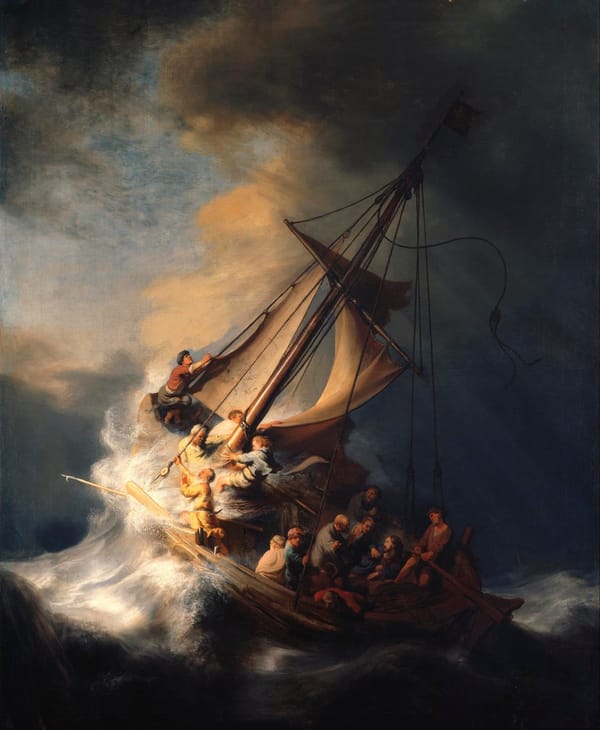
Cap. VIII.In illo tempore, Ascendente Jesu in naviculam, secuti sunt eum discipuli ejus. Et ecce motus magnus factus est in mari, ita ut navicula operiretur fluctibus; ipse vero dormiebat. Et accesserunt ad eum discipuli ejus, et suscitaverunt eum dicentes: Domine, salva nos. perimus. Et dicit eis Jesus: Quid timidi estis, modicæ fidei? Tunc surgens, imperavit ventis et mari, et facta est tranquillitas magna. Porro homines mirati sunt, dicentes: Qualis est hic, quia venti et mare obediunt ei?
At that time, when Jesus entered into the boat, his disciples followed him; and behold a great tempest arose in the sea, so that the boat was covered with waves; but he was asleep. And his disciples came to him, and awakened him, saying: Lord, save us, we perish. And Jesus saith to them: Why are ye fearful, O ye of little faith? Then rising up, he commanded the winds and the sea, and there came a great calm. But the men wondered, saying: What manner of man is this, for the winds and the sea obey him!
Let us adore the power of our Emmanuel, who is come to calm the tempest which threatened the human race with death. In the midst of their danger, the successive generations of men had cried out: Lord! save us; we perish. When the fulness of time had come, he awoke from his rest; he had but to command, and the power of our enemies was destroyed. The malice of the devils, the darkness of idolatry, the corruption of paganism—all yielded. Nation after nation was converted to Jesus. They had said, when in their misery and blindness: 'Who is this Jesus, whom no power can resist?' and then they embraced his Law. This power of Jesus to break down every obstacle, and that, too, at the very time when men were disquieted at his apparent slumbering, has often shown itself in the past ages of the Church. How many times has he not chosen for saving the world that period which seemed the least likely for rescue! The same happens in the life of each one among us. Oftentimes we are tossed to and fro by violent temptations; it would seem as though the billows must sink us; and yet our will is firmly anchored to God! And what is all this, if not Jesus sleeping in the storm-tossed boat, protecting us by this his sleeping? And if our cry for help at length awaken him, it is only to proclaim his own and our victory; for he has already conquered, and we have conquered in him.
Offertory
Secret
To this are added the other Secrets, as given on page 255. The Preface is that of the Blessed Trinity, page 256.
Communion
Postcommunion
Then are added the other Postcommunions, as given on page 257.
Vespers
The Psalms, Antiphons, Capitulum, Hymn and Versicle are given on pages 89-96.
Antiphon of the Magnificat
February 3: St. Blaise, Bishop and Martyr
Now that the Church has closed the joyous period of her forty days of Christmas, and is putting us through a course of meditations on subjects which are to excite a spirit of penance within us, each of the saints’ feasts must produce an impression, which shall be in accordance with that spirit. From this day till Easter, we will study the saints, as they come to us, in this special light: how much they laboured and suffered during their pilgrimage of life, and what was the plan they took for conquering the world and the flesh. ‘They went,’ says the psalmist, ‘and wept, casting their seeds: but coming they shall come with joyfulness, carrying their sheaves.’* It shall be the same with us; and at the end of our lenten labours, our risen Jesus will hail us as His living, regenerated children.
The calendar of this portion of the year abounds with martyrs; and, at the very outset, we meet with one of the most celebrated of these glorious champions of Christ. The scene of his pastoral virtues and of his martyrdom was Sebaste, a city of Armenia, the same that will give us forty martyred soldiers on a single day. The devotion to St. Blase is, even to this day, most fervently kept up in the east, especially in Armenia. The western Churches Boon began to love and honour his memory, and so universally, that we might call him one of the most popular of our saints. His feast, however, with us is only a simple, and the Church of Rome has given only one lesson on his life.
Accept, O glorious martyr, the praise which we, too, offer thee in union with that given thee by the whole Church. In return for this homage of our veneration, look down upon the Christian people, who are now preparing to enter on the season of penance, and to be converted to the Lord their God by holy compunction and tears. We ask it of thee by thine own combat: assist us in the one for which we are preparing. When duty required thee to undergo tortures and death, it found thee ready and brave; our duty is expiation by penance, and thy prayers must get us courage. Our enemies are not more cruel than thine, but they are more treacherous, and if we spare them we are lost. Obtain for us that heavenly assistance, which enabled thee to conquer. We are children of the martyrs; God forbid we should be degenerate! Pray, too, O holy pontiff, for the country thou didst water with thy blood. Armenia lost the faith for which thou didst lay down thy life. Intercede for her, that she may be restored to the Church, and let her conversion bring consolation to the few that have remained orthodox and faithful.
* Ps. cxxv. 6, 7. ↩︎
| Previous February 2: The Purification of the Blessed Virgin | Next February 3: St. Blaise, Bishop and Martyr |