Daily reading
Epiphanytide
Double · Temporal
February 10, 2019
From Dom Guéranger’s The Liturgical Year.

|
The Fifth Sunday after Epiphany
Mass
Introit
Collect
Second Collect
A third Collect is added, at the choice of the priest.
Epistle
Cap. iii.Fratres, induite vos, sicut electi Dei, sancti, et dilecti, viscera misericordiæ, benignitatem, humilitatem, modestiam, patientiam, supportantes invicem, et donantes vobismetipsis, si quis adversus aliquem habet querelam: sicut et Dominus donavit vobis, ita et vos. Super omnia autem liæc, charitatem habete, quod est vinculum perfections: et pax Christi exsultet in cordibus vestris, in qua et vocati estis in uno corpore: et grati estote. Verbum Christi habitet in vobis abundanter, in omni sapientia, docentes, et commonentes vosmetipsos, psalmis, hymnis, et canticis spiritualibus, in gratia cantantes in cordibus vestris Deo. Omne quodcumque facitis, in verbo aut in opere, omnia in nomine Domini nostri Jesu Christi, gratias agentes Deo et Patri per Jesum Christum Dominum nostrum.
Ch. iii.Brethren, put ye on therefore as the elect of God, holy, and beloved, the bowels of mercy, benignity, humility, modesty, patience; bearing with one another, and forgiving one another, if any have a complaint against another; even as the Lord hath forgiven you, so do you also. But above all these things have charity, which is the bond of perfection; and let the peace of Christ rejoice in your hearts, wherein also you are called in one body; and be ye thankful. Let the word of Christ dwell in you abundantly in all wisdom, teaching and admonishing one another in psalms, hymns, and spiritual canticles, singing in grace in your hearts to God. All whatsoever you do in word, or in work, all things do ye in the name of the Lord Jesus Christ, giving thanks to God and the Father, through Jesus Christ our Lord.
The Christian, trained as he has been in the school of the Man-God who deigned to dwell upon this earth, should ever show mercy towards his fellow-men. This world which has been purified by the presence of the Incarnate Word, would become an abode of peace, if we were but to live in such manner as to merit the titles, given us by the apostle, of elect of God, holy, and beloved. The peace here spoken of should, first of all, fill the heart of every Christian, and give it an uninterrupted joy, which would be ever pouring itself forth in singing the praises of God. But it is mainly on the Sundays, that the faithful, by taking part with the Church in her psalms, hymns, and spiritual canticles, fulfil this duty so dear to their hearts. Let us, moreover, in our every-day life, practise the advice given us by the apostle, of doing all things in the name of our Lord Jesus Christ, in order that we may, in all things, find favour with our heavenly Father.
Gradual
℣. Quoniam ædificavit Dominus Sion, et videbitur in majestate sua.
℣. For the Lord hath built up Sion, and he shall be seen in his glory.
Gospel
Cap. xiii.
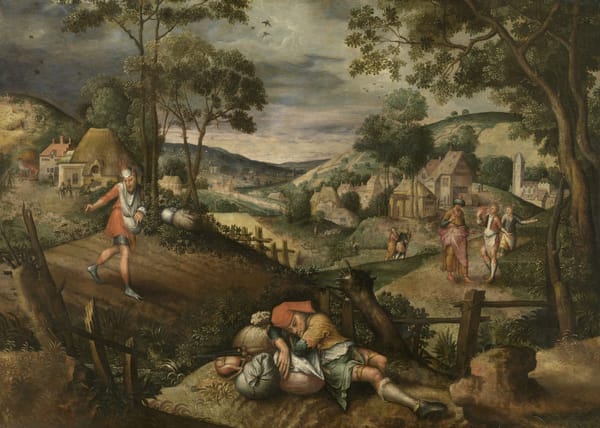
In illo tempore; Dixit Jesus turbis parabolani hanc: Simile factum est regnum cœlorum homini, qui seminavit bonum semen in agro suo. Cum autem dormirent homines, venit inimicus ejus, et superseminavit zizania in medio tritici, et abiit. Cum autem crevisset herba, et fructum fecisset, tunc apparuerunt et zizania. Accedentes autem servi patrisfamilias, dixerunt ei: Domine, nonne bonum semen seminasti in agro tuo? Unde ergo habet zizania? Et ait illis: Inimicus homo hoc fecit. Servi autem dixerunt ei: Vis, imus, et colligimus ea? Et ait: Non; ne forte colligentes zizania, eradicetis simul cum eis et triticum. Sinite utraque crescere usque ad messem, et in tempore messis dicam messoribus: Colligite primum zizania, et alligate ea in fasciculos ad comburendum, triticum autem congregate in horreum meum.
Ch. xiii.
At that time: Jesus spoke this parable to the multitude, saying: The kingdom of heaven is likened to a man that sowed good seed in his field. But while men were asleep, his enemy came and oversowed cockle among the wheat and went his way. And when the blade was sprung up, and had brought forth fruit, then appeared also the cockle. Then the servants of the goodman of the house, coming said unto him: Sir, didst thou not sow good seed in thy field? whence then hath it cockle? And he said to them: An enemy hath done this. And the servants said to him: Wilt thou that we go and gather it up? And he said: No, lest perhaps gathering up the cockle, you root up the wheat also together with it. Suffer both to grow until the harvest, and in the time of harvest I will say to the reapers: Gather up first the cockle, and bind it into bundles to burn, but the wheat gather ye into my barn.
The kingdom of heaven, here spoken of by our Lord, is the Church militant, the society of them that believe in Him. And yet, the field He has tilled with so much care is oversown with cockle; heresies have crept in, scandals have abounded; are we, on that account, to have misgivings about the foresight of the Master, who knows all things, and without whose permission nothing happens? Far from us be such a thought! He Himself tells us that these things must needs be. Man has been gifted with free-will; it is for him to choose between good and evil; but God will turn all to His own greater glory, Heresies, then, like weeds in a field, may spring up in the Church; but the day must come when they will be uprooted; some of them will wither on the parent stems, but the whole cockle shall be gathered into bundles to burn. Where are now the heresies that sprang up in the first ages of the Church? And in another hundred years, what will have become of the heresy, which, under the pretentious name of ‘the reformation,’ has caused incalculable evil? It is the same with the scandals which rise up within the pale of the Church: they are a hard trial; but trials must come. The divine Husbandman wills not that this cockle be torn up, lest the wheat should suffer injury. First of all, the mixture of good and bad is an advantage; it teaches the good not to put their hopes in man, but in God. Then, too, the mercy of our Lord is so great, that at times the very cockle is converted, by divine grace, into wheat. We must therefore have patience. But, whereas it is while the men are asleep that the enemy oversows the field with cockle, it behoves us to pray for pastors, and ask their divine Master to bless them with that vigilance, which is the primary condition of the flock being safe, and is so essential a quality in every bishop, that his very name is ‘one who watches.’
Offertory
Secret
Second Secret
A third Secret, at the choice of the priest, is added.
Communion
Postcommunion
Second Postcommunion
The third Postcommunion is at the choice of the priest.
Vespers
The psalms and antiphons as on page 72.
Capitulum (2 Cor. i.)
The hymn and versicle, page 79.
Antiphon of the Magnificat
February 10: St. Scholastica, Virgin
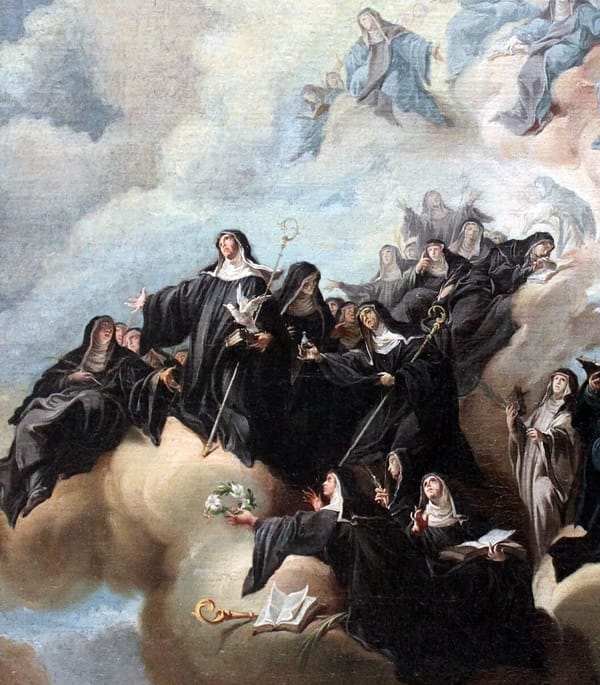 |
The sister of the patriarch St. Benedict comes to us to-day, sweetly inviting us to follow her to heaven. Apollonia the martyr is succeeded by Scholastica, the fervent daughter of the cloister. Both of them are the brides of Jesus, both of them wear crowns, for both of them fought hard, and won the palm. Apollonia’s battle was with cruel persecutors, and in those hard times when one had to die to conquer; Scholastica’s combat was the lifelong struggle, whose only truce is the soldier’s dying breath. The martyr and the nun are sisters now in the Heart of Him they both so bravely loved.
God, in His infinite wisdom, gave to St. Benedict a faithful co-operatrix, a sister of such angelic gentleness of character, that she would be a sort of counterpoise to the brother, whose vocation, as the legislator of monastic life, needed a certain dignity of grave and stern resolve. We continually meet with these contrasts in the lives of the saints; and they show us that there is a link, of which flesh and blood know nothing; a link which binds two souls together, gives them power, harmonizes their differences of character, and renders each complete. Thus it is in heaven with the several hierarchies of the angels; a mutual love, which is founded on God Himself, unites them together, and makes them live in the eternal happiness of the tenderest brotherly affection.
Scholastica’s earthly pilgrimage was not a short one; and yet it has left us but the history of the dove, which told the brother, by its flight to heaven, that his sister had reached the eternal home before him. We have to thank St. Gregory the Great for even this much, which he tells us as a sequel to the holy dispute she had with Benedict, three days previous to her death. But how admirable is the portrait thus drawn in St. Gregory’s best style! We seem to understand the whole character of Scholastica:—an earnest simplicity, and a child-like eagerness for what was worth desiring; an affectionate and unshaken confidence in God; a winning persuasiveness, where there was opposition to God’s will, which, when it met such an opponent as Benedict, called on God to interpose, and gained its cause. The old poets tell us strange things about the swan, how sweetly it can sing when dying; how lovely must have been the last notes of the dove of the Benedictine cloister, as she was soaring from earth to heaven!
But how came Scholastica, the humble retiring nun, by that energy, which could make her resist the will of her brother, whom she revered as her master and guide? What was it told her that her prayer was not a rash one, and that what she asked was a higher good than Benedict’s unflinching fidelity to the rule he had written, and which it was his duty to teach by his own observance of it? Let us hear St. Gregory’s answer: 'It is not to be wondered at, that the sister, who wished to prolong her brother’s stay, should have prevailed over him; for, whereas St. John tells us that God is charity, it happened, by a most just judgment, that she that had the stronger love had the stronger power.’
Our season is appropriate for the beautiful lesson taught us by St. Scholastica, fraternal charity. Her example should excite us to the love of our neighbour, that love for which God bids us labour, now that we are intent on giving Him our undivided service, and our complete conversion. The Easter solemnity for which we are preparing, is to unite us all in the grand banquet, where we are all to feast on the one divine Victim of love. Let us have our nuptial garment ready: for He that invites us insists on our having union of heart when we dwell in His house.1
The Church has inserted in her Office of this feast the account given by St. Gregory of the last interview between St. Scholastica and St. Benedict. It is as follows:
We select the following from the monastic Office for the feast of our saint:
Responsories and Antiphons
The same Benedictine breviary gives us these two hymns for this feast:
Hymn
Te columba virginum,
Siderum tollunt coloni
Laudibus, Scholastica:
Nostra te lætis salutant
Vocibus præcordia.
Docta quondam spernere,
Dogma fratris insecuta
Atque sanctæ regulæ,
Ex odore gratiarum,
Astra nosti quærere.
O decus victoriæ!
Dum fluentis lacrymarum
Cogis imbres currere,
Ore Nursini parentis
Verba cœli suscipis.
In polorum vertice,
Clara flammis charitatis
Cum nitore gratiæ:
Juncta Sponso conquiescis
In decore gloriæ.
Cordibus fidelium,
Ut serena fronte splendens
Sol perennis luminis,
Sempiternæ claritatis
Impleat nos gaudiis.
Unicoque Filio;
Par tributum proferamus
Inclyto Paraclito,
Nutibus cujus creantur,
Et reguntur sæcula.
O dove of the cloister!
the citizens of heaven proclaim thy merits,
and we, too, sing thy praises
with joyful hymns
and loving hearts.
the honours and glory of the world;
thou didst follow the teaching of thy brother
and his holy rule;
and, rich in the fragrance of every grace,
thou caredst for heaven alone.
and how glorious thy victory,
when thy tears drew rain from the skies,
and forced the patriarch of Nursia
to tell thee what he knew
of the land above!
in heaven’s longed for light;
thou art as a seraph in thy burning love,
beautiful in thy bright grace;
and united with thy divine Spouse,
thou art reposing in the splendour of glory.
and drive from us the miseries
which cloud our hearts;
that thus the Sun of light eternal
may sweetly shine upon us,
and fill us with the joys of his everlasting beams.
and to his only Son;
let us give an equal homage of our praise
to the blessed Paraclete:
yea, to God, the Creator and Ruler of all,
be glory without end.
Hymn
Dies cupita nascitur,
Qua virgini Scholasticæ
Sponsus perennis jungitur.
Fugantur imbres nubibus,
Vernantque campi siderum
Æternitatis fiori bus.
Dilecta pennas induit;
Ardens ad oris oscula
Columba velox evolat.
O chara proles Principis!
Nursinus Abbas aspicit,
Grates rependit Nummi.
Metit coronas debitas,
Immersa rivis gloriæ,
Deique pota gaudiis.
Patremque cum Paraclito,
Cunctos per orbis cardines
Adoret omne sæculum.
the longed-for day is come,
when the virgin Scholastica
is united to her God, her Spouse.
the rainy clouds are gone;
and the Spring of the starry land
yields its eternal flowers.
and she, taking the wings of a dove,
flies swiftly to the embrace
so ardently desired.
dear daughter of the King!
Thy brother, the abbot, sees thee,
and fervently thanks his God.
and the crown her works have won;
inebriated with the torrent of glory,
she drinks of the joys of her Lord.
of every age adore thee,
O Jesus, sweet Flower of the vale,
together with the Father and the Holy Ghost.
Dear bride of the Lamb! Innocent and simple dove! How rapid was thy flight to thy Jesus, when called home from thine exile! Thy brother’s eye followed thee for an instant, and then heaven received thee, with a joyous welcome from the choirs of the angels and saints. Thou art now at the very source of that love, which here filled thy soul, and gained thee everything thou askedst of thy divine Master. Drink of this fount of life to thy heart’s eternal content. Satiate the ambition taught thee by thy brother in his rule, when he says that we must ‘desire heaven with all the might of our spirit.’2 Feed on that sovereign Beauty, who Himself feeds, as He tells us, among the lilies.3
But forget not this lower world, which was to thee, what it is to us, a place of trial for winning heavenly honours. During thy sojourn here, thou wast the dove in the clefts of the rock,4 as the Canticle describes a soul like thine own; there was nothing on this earth which tempted thee to spread thy wings in its pursuit, there was nothing worthy of the love which God had put in thy heart. Timid before men, and simple as innocence ever is, thou knewest not that thou hadst wounded the Heart of the Spouse.5 Thy prayers were made to Him with all the humility and confidence of a soul that had never been disloyal; and He granted thee thy petitions with the promptness of tender love: so that thy brother, the venerable saint, who was accustomed to see nature obedient to his command, was overcome by thee in that contest, wherein thy simplicity was more penetrating than his profound wisdom.
And who was it, O Scholastica, that gave thee this sublime knowledge, and made thee, on that day of thy last visit, wiser than the great patriarch, who was raised up in the Church to be the living rule of them that are called to perfection? It was the same God, who chose Benedict to be one of the pillars of the religious state, but who wished to show that a holy and pure and tender charity is dearer to Him than the most scrupulous fidelity to rules, which are only made for leading men to what thou hadst already attained. Benedict, himself such a lover of God, knew all this; the subject so dear to thy heart was renewed, and brother and sister were soon lost in the contemplation of that infinite Beauty, who had just given such a proof that He would have thee neglect all else. Thou wast ripe for heaven, O Scholastica! Creatures could teach thee no more love of thy Creator; He would take thee to Himself. A few short hours more, and the divine Spouse would speak to thee those words of the ineffable Canticle, which the holy Spirit seems to have dictated for a soul like thine: 'Arise, make haste, my love, my dove, my beautiful one, and come! Show me thy face; let thy voice sound in mine ears; for thy voice is sweet, and comely is thy face.’6
Thou hast left us, O Scholastica! but do not forget us. Our souls have not the same beauty in the eyes of our God as thine, and yet they are called to the same heaven. It may be that years are still needed to fit them for the celestial abode, where we shall see thy grand glory. Thy prayer drew down a torrent of rain upon the earth; let it now be offered for us, and obtain for us tears of repentance. Thou couldst endure no conversation which had not eternity for its subject; give us a disgust for useless and dangerous talk, and a relish for hearing of God and of heaven. Thy heart had mastered the secret of fraternal charity, yea of that affectionate charity which is so well-pleasing to our Lord; soften our hearts to the love of our neighbour, banish from them all coldness and indifference, and make us love one another as God would have us love.
Dear dove of holy solitude! remember the tree, whose branches gave thee shelter here on earth. The Benedictine cloister venerates thee, not only as the sister, but also as the daughter of its sainted patriarch. Cast thine eye upon the remnants of that tree, which was once so vigorous in its beauty and its fruits, and under whose shadow the nations of the west found shelter for so many long ages. Alas! the hack and hew of impious persecutions have struck its root and branches. Every land of Europe, as well as our own, sits weeping over the ruins. And yet, root and branches, both must needs revive; for we know that it is the will of thy divine Spouse, O Scholastica, that the destinies of this venerable tree keep pace with those of the Church herself. Pray that its primitive vigour be soon restored; protect, with thy maternal care, the tender buds it is now giving forth; cover them from the storm; bless them; make them worthy of the confidence wherewith the Church deigns to honour them!
| Previous February 9 (the Same Day): St. Apollonia, Virgin and Martyr | Next February 10: St. Scholastica, Virgin |