lyp.network

Daily reading

Septuagesima

Double · February 23 · Sanctoral

February 23, 2019

From Dom Guéranger’s The Liturgical Year.

A Double leads the weekday.Rubric
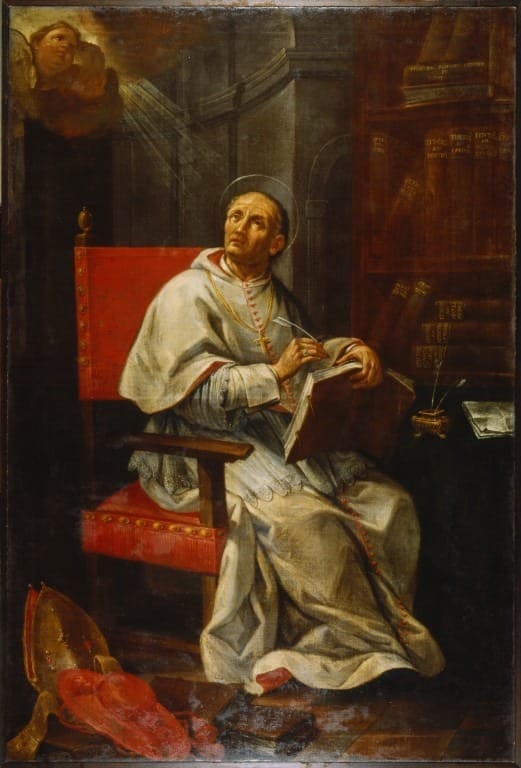
St Peter Damian in white Camaldolese habit writing, mitre and galero on floor
Saint Peter Damian, Andrea Barbiani (1708–1779), 18th century. Credits

February 23: St. Peter Damian, Cardinal and Doctor of the Church

It is the feast of the austere reformer of the eleventh century, Peter Damian, the precursor of the holy pontiff Gregory VII., that we are called upon to celebrate to-day. To him is due in part that glorious regeneration, which was effected at that troubled period when judgment had to begin at the house of God.1 The life he had led under the monastic rule had fitted him for the great contest. So zealously did he withstand the disorders and abuses of his times, that we may attribute to him, at least in great measure, the ardent faith of the two centuries which followed the scandals of the tenth. The Church ranks him among her doctors, on account of his admirable writings: and his penitential life ought to excite us to be fervent in the work we have in hand, the work of our conversion.

The following lessons, read by the Church, on this feast, give us a sketch of our saint’s life:

Petrus, Ravennæ honestis parentibus natus, adhuc lactens a matre numerosæ prolis pertæsa abjicitur, sed domesticæ mulieris opera semivivus exceptus ac recreatus, genitrici ad humanitatis sensum revocata redditur. Utroque orbatus parente, tamquam vile mancipium sub aspera fratria tutela duram servitutem exercuit. Religionis in Deum ac pietatis erga patrem egregium tunc specimen dedit; inventum siquidem forte nummum non propriæ mediæ sublevandæ, sed sacerdoti qui divinum sacrificium ad illius expiationem offerret, erogavit. A Damiano fratre, a quo, uti fertur, cognomentum accepit, benigne receptus, ejus cura litteris eruditur, in quibus brevi tantum profecit, ut magistris admirationi esset. Quum autem liberalibus scientiis floreret et nomine, eas cum laude docuit. Interim ut corpus rationi subderet, sub mollibus vesitibus cilicium adhibuit, jejuniis, vigiliis, et orationibus solerter insistens. Calente juventa, dum carnis stimulis acriter urgeretur, insultan tium libidinum faces rigentibus fluvii mersus aquis noctu extinguebat: tum venerabilia quæque loca obire, tofcumque psalterium recitare consueverat. Ope assidua pauperes levabat, quibus frequenter pastis convivio, propriis ipse manibus ministrabat.
Perficiendæ magis vitæ causa, in Avellanensi Eugubinæ diœcesis cœnobio, Ordini monachorum sanctæ Crucis Fontis Avellanæ, a beato Ludulpho sancti Romualdi discipulo fundato, nomen dedit. Non ita multo post in monasterum Pomposianum, mox in cœnobium Sancti Vincentii Petræ Pertusæ ab abbate suo missus, utrumque asceterium verbo sacro, præclaris institutionibus et moribus excoluit. Ad suos revocatus, post præsidis obitum Avellanitarurm familiæ præficitur, quam novis variis in locis extructis domiciliis, et sanctissimis institutis ita auxit, ut alter ejus Ordinis parens ac præcipuum ornamentum jure sit habitus. Salutarem Petri sollicitudinem alia quoque diversi instituti cœnobia, canonicorum conventus, et populi sunt experti. Urbinati diœcesi non uno nomine profuit: Theuzoni episcopo in causa gravissima assedit, ipsumque in recte administrando episcopatu consilio et opera juvit. Divinorum contemplatione, corporis macerationibus, cæterisque spectatæ sanctimoniæ exemplis excelluit. His motus Stephanus Nonus, Pontifex maximus, eum licet invitum et reluctantem sanctæ Komanæ Ecclesiæ Cardinalem creavit, et Ostiensem episcopum. Quas Petrus dignitates splendidissimis virtutibus, et consentaneis episcopali ministerio operibus gessit.
Difficillimo tempore Romanæ Ecclesiæ summisque Pontificibus doctrina, legationibus, aliisque susceptis laboribus mirifice adfuit. Adversus Nicolaitarum et Simoniacam hæreses ad mortem usque strenue decertavit. Hujusmodi depulsis malia, Mediolanen sem Ecclesiæ Komanæ conciliavit. Benedicto, et Cadaloo, falsis Pontificibus, fortiter restitit. Henricum quartum Germaniæ regem ab iniquo uxoris divortio deterruit: Ravennates ad debita Romano Pontifici obsequia revocatos sacris restituit. Canonicos Veliternos ad sanctioris vitæ leges composuit. In provincia prasertim Urbinate vix ulla fuit episcopalis ecclesia, de qua Petrus non sit bene meritus: Eugubinam, quam aliquan do creditam habuit, multis levavit incommodis: alias alibi, quando oportuit, perinde curavit, ac si suæ essent tutelæcommissæ. Cardinalatu, et episcopali dignitate depositis, nihil de pristina juvandi proximos sedulitate remisit. Jejunium sextæ feriæ in honorem sanctæ crucis Jesu Christi, horarias beatæ Dei Genitricis preces, ejusque die Sabbato cultum propagavit. Inferendæ quoque sibi verberationis morem ad patratorum scelerum expiationem provexit. Demum sanctitate, doctrina, miraeulis, et præclare actis illustris, dum e Ravennate legatione rediret, Faventiæ octavo Kalendas Martii migravit ad Christum. Ejus corpus ibidem apud Cistercienses multis miraculis darum frequenti populorum veneratione colitur. Ipsum Faventini non semel in præsenti discrimine propitium experti, patronum apud Deum delegerunt: Leo vero duodecimus, Pontifex maximus, Officium Missamque in ejus honorem tamquam confessoris pontificis, quæ aliquibus in diœcesibus, atque in Ordine Camaldulensium jam celebrabantur, ex Sacroram Rituum Congregationis consulto, addita doctoria qualitate, ad universam extendit Ecclesiam.
Peter was born at Ravenna, of respectable parents. His mother, wearied with the care of a large family, abandoned him when a babe; but one of her female servants found him in an almost dying state, and took care of him, until such time as the mother, repenting of her unnatural conduct, consented to treat him as her child. After the death of his parents, one of his brothers, a most harsh man, took him as a servant, or more truly as his slave. It was about this period of his life that he performed an action, which evinced his virtue and his filial piety. He happened to find a sum of money: but instead of using it for his own wants, he gave it to a priest, begging him to offer up the holy sacrifice for the repose of his father’s soul. Another of his brothers, called Damian (after whom, it is said, he was named), had him educated; and so rapid and so great was the progress he made in his studies, that he was the admiration of his masters. He became such a proficient in the liberal sciences, that he was made to teach them in the public schools, which he did with great success. During all this time, it was his study to bring his body into subjection to the spirit; and to this end, he wore a hair shirt under an out wardly comfortable dress, and practised frequent fasting, watching, and prayer. Being in the very ardour of youth, and being cruelly buffeted by the sting of the flesh, he, during the night, would go and plunge himself into a frozen pool of water, that he might quench the impure flame which tormented him; or he would make pilgrimages to holy sanctuaries, and recite the entire psalter. His charities to the poor were unceasing, and when he provided them with a meal, which was frequently, he would wait upon them himself.
Out of a desire to lead a still more perfect life, he became a religious in the monastery of Avellino, in the diocese of Gubbio, of the Order of the monks of holy Cross of Fontavellana, which was founded by the blessed Ludolphus, a disciple of St. Romuald. Being sent by his abbot, not very long after, first to the monastery of Pomposia, and then to that of Saint Vincent of PietraPertusa, he edified both houses by his preaching, admirable teaching, and holy life. At the death of the abbot of Avellino, he was recalled to that monastery, and was made its superior. The institute was so benefited by his government, not only by the new monasteries which he founded in several places, but also by the very saintly regulations he drew up, that he was justly looked upon as the second founder of the Order, and its brightest ornament. Houses of other Orders, canons, yea, entire congregations of the faithful, were benefited by Peter’s enlightened zeal. He was a benefactor, in more ways than one, to the diocese of Urbino: he aided the bishop Theuzo in a most important suit, and assisted him, both by advice and work, in the right administration of his diocese. His spirit of holy contemplation, his corporal austerities, and the saintly tenor of his whole conduct, gained for him so high a reputation, that Pope Stephen IX., in spite of Peter's extreme reluctance, created him Cardinal of the holy Roman Church and bishop of Ostia. The saint proved himself worthy of these honours by the exercise of the most eminent virtues, and by the faithful discharge of his episcopal office.
It would be impossible to describe the services he rendered to the Church and the sovereign Pontiffs, during those most trying times, by his learning, his prudence as legate, and his untiring zeal. His life was one continued struggle against simony, and the heresy of the Nicolaites. He purged the Church of Milan of these disorders, and brought her into subjection to the Holy See. He courageously resisted the anti-popes Benedict and Cadalous. He deterred Henry IV., king of Germany, from an unjust divorce of his wife. He restored the people of Ravenna to their allegiance to the Roman Pontiff, and absolved them from interdict. He reformed the abuses which had crept in among the canons of Vellotri. There was scarcely a single cathedral church in the province of Urbino that had not experienced the beneficial effects of Peter’s holy zeal: thus, that of Gubbio, which was for some time under his care, was relieved by him of many evils; and other churches, that needed his help, found him as earnest for their welfare as though he were their own bishop. When he obtained permission to resign his dignity as Cardinal and his bishopric, he relented nothing of his former charity, but was equally ready in doing good to all. He was instrumental in propagating many devout practices; among these may be mentioned, fasting on Fridays in honour of the holy cross; the reciting the Little Office of our Lady; the keeping the Saturday as a day especially devoted to Mary; the taking of the discipline in expiation of past Bins. At length, after a life which had edified the world by holiness, learning, miracles, and glorious works, on his return from Ravenna, whither he had been sent as legate, he slept in Christ, on the eighth of the Calends of March (February 23), at Faënza. His relics, which are kept in the Cistercian church of that town, are devoutly honoured by the faithful, and many miracles are wrought at the holy shrine. The inhabitants of Faënza have chosen him as the patron of their city, having several times experienced his protection when threatened by danger. His Mass and Office, which were kept under the rite of confessor and bishop, had been long observed in several dioceses, and by the Camaldolese Order; but they were extended to the whole Church by a decree of the Congregation of Sacred Rites, which was approved by Pope Leo XII., who also added to the name of the saint the title of Doctor.

Thy soul was inflamed by the zeal of God’s house, O Peter! God gave thee to His Church in those sad times when the wickedness of the world had robbed her of well-nigh all her beauty. Thou hadst the spirit of an Elias within thee, and it gave thee courage to waken the servants of the Lord: they had slept, and while they were asleep, the enemy came, and the field was oversown with tares.2 Then did better days dawn for the bride of Christ; the promises made by our Lord were fulfilled; but who was the friend of the bridegroom?3 Who was the chief instrument used by God to bring back to His house its ancient beauty? A saint who bore the glorious name of Peter Damian! In those days, the sanctuary was degraded by secular interference. The princes of the earth said: 'Let us possess the sanctuary of God for an inheritance.’4 The Church, which God intended to be free, was but a slave, in the power of the rulers of this world; and the vices, which are inherent to human weakness, defiled the temple. But God had pity on the bride of Christ, and for her deliverance He would use human agency: He chose thee, Peter, as His principal co-operator in restoring order. Thy example and thy labours prepared the way for Gregory, the faithful and dauntless Hildebrand, into whose hands the keys were no sooner placed, than the work of regeneration was completed. Thou hast fought the good fight; thou art now in thy rest; but thy love of the Church, and thy power to help, are greater than ever. Watch, then, over her interests. Obtain for her pastors that apostolic energy and courage, which alone can cope with enemies so determined as hers are. Obtain for her priests the holiness which God demands from them that are the salt of the earth.5 Obtain for the faithful the respect and obedience they owe to those who direct them in the path of salvation. Thou wast not only the apostle, thou wast moreover the model, of penance in the midst of a corrupt age; pray for us, that we may be eager to atone for our sins by works of mortification. Excite within our souls the remembrance of the sufferings of our Redeemer, that so His Passion may urge us to repentance and hope. Increase our confidence in Mary, the refuge of sinners, and make us, like thyself, full of filial affection towards her, and of zeal that she may be honoured and loved by those who are around us.


  1. 1 St. Peter iv. 17. ↩︎
  2. St. Matt. xiii. 25. ↩︎
  3. St. John iii. 29. ↩︎
  4. Ps. lxxxii. 13. ↩︎
  5. St. Matt. v. 13. ↩︎

Saturday of Septuagesima Week

The sentence pronounced by the Almighty upon our first parents was to fall upon their children to the end of time. We have been considering, during this week of Septuagesima, the penalties of the great sin; but the severest and most humiliating of them all remains to be told. It is the transmission to the whole human race of original sin. It is true that the merits of the promised Redeemer will be applied to each individual man, in the manner established by God at various periods of time: still, this spiritual regeneration, whilst cleansing us from the leprosy which covered us, and restoring us to the dignity of children of God, will not remove every scar of the old wound. It will save us from eternal death, and restore us to life; but, as long as our pilgrimage lasts, we shall be weak and sickly. Thus it is that ignorance makes us short-sighted in those great truths, which should engross all our thoughts; and this fills us with illusions, which, by an unhappy inclination of our will, we cling to and love. Concupiscence is ever striving to make our soul a slave to the body; and in order to escape this tyranny, our life has to be one continual struggle. An unruly love for independence is unceasingly making us desire to be our own masters, and forget that we were born to obey. We find pleasure in sin, whereas virtue rewards us with nothing, in this life, save the consciousness of our having done our duty.

Knowing all this, we are filled with admiration and love when we think of thee, O Mary! thou purest of God’s creatures. Thou art our sister in nature; thou art a daughter of Eve; but thou wast conceived without sin, and art therefore the honour of the human race. Thou art of the same flesh and blood as ourselves; and yet thou art immaculate. The divine decree, which condemned us to inherit the disgrace of original sin, could not include thy most pure conception; and the serpent felt, as thy foot crushed his haughty head, that thou hadst never been under his power. In thee, O Mary! we find our nature such as it was when our God first created it. Hail, then, spotless Mirror of justice!

O Mary! beautiful in thine unsullied holiness, pray for us who are weighed down by the consequences of that sin of our first parents, which God would not suffer to approach thee. Thou art the implacable enemy of the serpent; watch over us, lest his sting inflict death on our souls. We were conceived in sin, and born in sorrow; pray for us, that we may so live as to merit blessing. We are condemned to toil, to suffering, and to death; intercede for us, that our atonement may find acceptance with our Lord. We are exposed to the treachery of our evil inclinations; we are in love with this present life; we forget eternity; we are ever striving to deceive our own hearts: how could we escape hell, were the grace of thy divine Son not unceasingly offered to us, enabling us to triumph over all our enemies? Thou, O Immaculate Mother of Jesus, art the Mother of divine grace! Pray for us, that we, who glory in being thy kindred by nature, may be daily more and more enriched with this priceless gift.

Let us salute the blessed Mother of God in the words of the following sequence, taken from the ancient missal of Cluny. Catholic piety has consecrated to Mary the Saturday of each week.

Sequence

Ad laudem Matris Dei
Modulemur licet rei,
Poscentes remedia.
Hæc nostræ forma spei,
Spes mirandæ speciei,
Quæ vernat in gloria.
Hæc virtutis nutrimentum,
Spes Solaris, sola laris
Terreni fiducia.
Stella maria quæ vocaris,
Passus rectos et directos,
Da pacis suffragia.
Sicut sidus naufrago,
Fulgens dux in pelago,
Tu præclara.
Mundi lux in tenebris,
Stella nitens celebris,
Deo cara.
In sede cœlica
Residens, hæc mellica
Admitte cantica, Virgo pia.
Paventi psallere,
Trementi pro scelere
Des ausus, Tu plausus, Veri vena.
Tu cœli regina,
Mundi medicina,
Munda scelus nostrum,
Piissima.
In mortis ruina,
Nos ad vitam mina,
Placans Deum,
Tu benignissima.
Cara parens, O Maria,
Patria parens, Virgo pia,
Nos in umbræ mortis via
Sedentes illumina!
Ut te nobis stella duce,
Tui Nati tuti cruce,
Mereamur cœli luce
Per te frui, Domina.
Amen.
Let us, though sinners,
sing a hymn in praise of the Mother of God;
let us sing our prayer for help.
Oh! how well may we hope in her,
that beautiful Mother,
whose glory is bright as spring!
It is she that trains us to virtue,
and warms our earthly home
with the sunny beam of hope.
Thou that art called Star of the sea,
direct us, steer us,
get us the calm of peace.
Thou brightly shinest on life’s sea,
guiding us, as does the friendly star which leads
the shipwrecked into port.
Thou art a light to worldlings in their darkness,
thou art the shining well-known star,
so dear to God.
Seated on thy heavenly throne,
receive, O Virgin Mother,
these our sweet canticles.
To the sinner who fears to sing,
do thou, fount of truth,
give courage and applause.
Thou art the Queen of heaven,
thou art the solace of the world;
may thy loving prayers
cleanse us from our guilt.
We have merited death;
but intercede for us to God,
most merciful Queen!
and so lead us unto life.
O Mary, dear Mother!
Mother of thy Creator!
Virgin ever merciful! enlighten us
that are sitting in the shades of death.
That, guided by thee our star,
and protected by the cross of thy Son,
we may, through thy intercession,
be brought to the enjoyment of light eternal.
Amen.

Previous
Friday of Septuagesima Week
Next
Saturday of Septuagesima Week