Daily reading
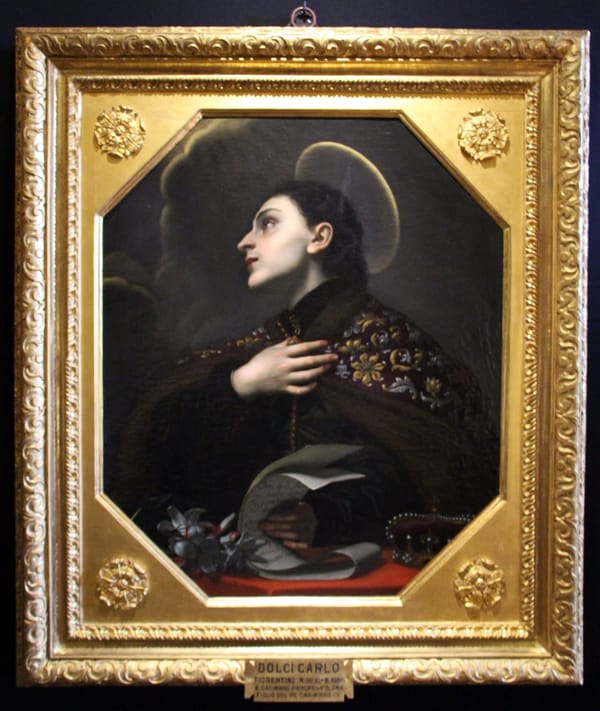
March 4: St. Casimir, Confessor
It is from a court that we are to be taught to-day the most heroic virtues. Casimir is a prince; he is surrounded by all the allurements of youth and luxury; and yet he passes through the snares of the world with as much safety and prudence, as though he were an angel in human form. His example shows us what we may do. The world has not smiled on us as it did on Casimir; but how much we have loved it! If we have gone so far as to make it our idol, we must now break what we have adored, and give our service to the sovereign Lord, who alone has a right to it. When we read the lives of the saints, and find that persons who were in the ordinary walks of life practised extraordinary virtues, we are inclined to think that they were not exposed to great temptations, or that the misfortunes they met with in the world made them give themselves up unreservedly to God’s service. Such interpretations of the actions of the saints are shallow and false, for they ignore this great fact, that there is no condition or state, however humble, in which man has not to combat the evil inclinations of his heart, and that corrupt nature alone is strong enough to iead him to sin. But in such a saint as Casimir we have no difficulty in recognizing that all his Christian energy was from God, and not from any natural source; and we rightly conclude that we, who have the same good God, may well hope that this season of spiritual regeneration will change and better us. Casimir preferred death to sin. But is not every Christian bound to be thus minded every hour of the day? And yet, such is the infatuation produced by the pleasures or advantages of this present life, that we every day see men plunging themselves into sin, which is the death of the soul; and this, not for the sake of saving the life of the body, but for a vile and transient gratification, which is oftentimes contrary to their temporal interests. What stronger proof could there be than this, of the sad effects produced in us by original sin? The examples of the saints are given us as a light to lead us in the right path, let us follow it, and we shall be saved. Besides, we have a powerful aid in their merits and intercession: let us take courage at the thought that these friends of God have a most affectionate compassion for us their brethren, who are surrounded by so many and great dangers.
The Church, in her liturgy, thus describes to us the virtues of our young prince:
Enjoy thy well-earned rest in heaven, O Casimir! Neither the world with all its riches, nor the court with all its pleasures, could distract thy heart from the eternal joys it alone coveted and loved. Thy life was short, but full of merit. The remembrance of heaven made thee forget the earth. God yielded to the impatience of thy desire to be with Him, and took thee speedily from among men. Thy life, though most innocent, was one of penance, for knowing the evil tendencies of corrupt nature, thou hadst a dread of a life of comfort. When shall we be made to understand that penance is a debt we owe to God, a debt of expiation for the sins we have committed against Him? Thou didst prefer death to sin; obtain for as a fear of sin, that greatest of all the evils that can befall as, because it is an evil which strikes at God Himself. Pray for as daring this holy season, which is intended as a preparation for penance; impress our minds with the truths now put before us. The Christian world is honouring thee to-day; repay its homage by thy blessing. Poland, thy fatherland, once the bulwark of the Church, which kept back the invasion of schism, heresy, and infidelity, beseeches thy prayers.
March 4 (the Same Day): St. Lucius, Pope and Martyr
On this day a commemoration is made of St. Lucius, Pope and Martyr. He was a Roman by birth, and succeeded Pope Cornelius in 252. Shortly after his accession he was sent into exile by the Emperor Gallus, but was soon recalled, to the great joy of the Roman people. St. Cyprian quotes decrees issued by him against the Novatians. He died after a very short pontificate on March 4, 253. His relics were translated to the church of St. Cecilia, where they are exposed to the veneration of the Faithful.
Antiphon
Monday of Quinquagesima Week
The life of a faithful Christian, like that of the patriarch Abraham, is neither more nor less than a courageous journeying onwards to the place destined for him by his Creator. He must put aside everything that could impede his progress, nor must he look back. This is, undoubtedly, hard doctrine; but if we reflect, for a moment, on the dangers which surround fallen man during his earthly pilgrimage, and on what our own sad experience has taught us, we shall not think it hard or strange, that our Saviour has made the renouncing and denying of ourselves an essential condition of our salvation. But, independently of this, is it not far better to put our life under God’s guidance, than to keep it in our own? Are we so wise or so strong, as to be able to guide ourselves? We may resist as we please, but God is our sovereign Lord and Master; and by giving us free-will, whereby we may either resist His will or follow it, He has not abdicated His own infinite rights to His creatures’ obedience. Our refusal to obey would not make Him less our Master.
Had Abraham, after receiving the divine call, chosen to remain in Chaldea, and refused to break up the home which God had bade him leave, God would then have selected some other man to be the patriarch of His chosen people, and father of that very family, which was to have the Messias as one of its children. This substitution of one for another in the order of grace is frequently forced upon divine justice; but what a terrible punishment it is for him that caused the substitution! When a soul refuses salvation, heaven does not therefore lose one of its elect: God, finding that He is despised by the one He called, offers the grace to another, until His call is followed.
The Christian life consists in this untiring, unreserved obedience to God. The first effect of this spirit of submission is, that it takes the soul from the region of sin and death, wherein she was wasting away her existence; it takes her from the dark Chaldea, and places her in the promised land of light. Lest she should faint on her way. along the narrow path, and fall a victim to the dangers which never leave her because they are within herself, God asks her for sacrifices, and these brace her. Here, again, we have Abraham for our model. God loves him, and promises him the richest of blessings; He gives him a son, as pledge of the promise; and then, shortly after, tests the holy patriarch's devotedness, by commanding him to slay with his own hand this dear child, on whom he has been told to build his hopes!
Man’s path on earth is sacrifice. We cannot go out from evil except by the way of self-resistance, nor keep our footing on good ground but by constant combating. Let us imitate Abraham: fix our eyes steadfastly on the eternal hills, and consider this world as a mere passing dwelling, a tent, put up for a few days. Our Jesus has said to us: ‘I came not to send peace, but the sword; for I came to separate.'1 Separation, then, and trials are sure to be sent us; but we are equally sure that they are for our good, since they are sent us by Him who so loved us, that He became one of ourselves. But this same Jesus has also said: ‘Where thy treasure is, there too is thy heart.’2 Christians! can our treasure be in this wretched world? No it must be in that fair land above. There, then, must we be, in desire and affection.
These are the thoughts the Church would have us meditate upon during these days, which immediately precede the forty of Lent. They will help to purify our hearts and make them long to be with their God. The noise of the world’s sins and scandals reaches our ears: let us pray, that the kingdom of God may come to us and to those poor sinners; for God’s infinite mercy can change them, if He will, into children of Abraham. Not a day passes but He so changes many a sinner. He has, perhaps, shown that miracle of His mercy to us, and those words of the apostle may be applied to us: 'You, who some time were afar off, are now made nigh (to God) by the Blood of Christ.'3
Let us pray for ourselves and for all sinners, in these beautiful words of the Mozarabic breviary.
Prayer
| Previous Quinquagesima Sunday | Next March 4 (the Same Day): St. Lucius, Pope and Martyr |