Daily reading
Lent
Double · March 12 · Sanctoral
March 12, 2019
From Dom Guéranger’s The Liturgical Year.
A Double leads the weekday.Rubric
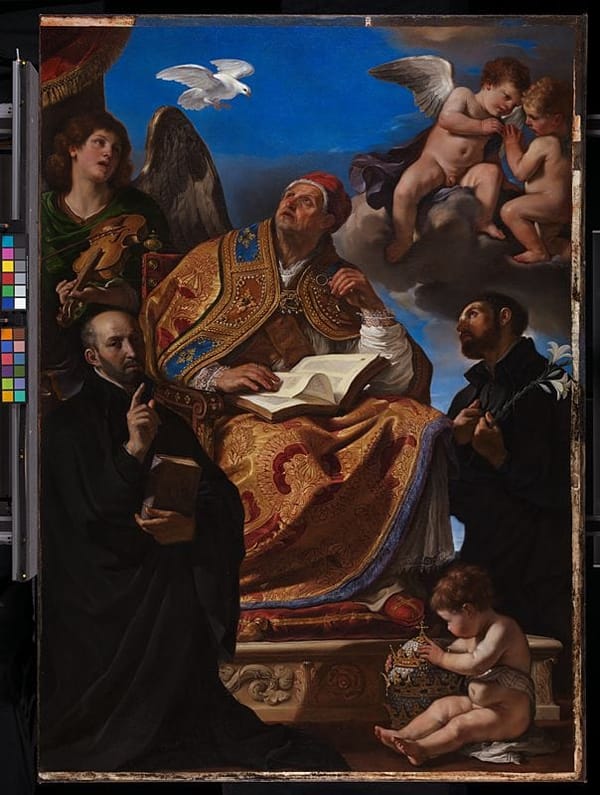 |
March 12: St. Gregory the Great, Pope and Doctor of the Church
Among all the pastors whom our Lord Jesus Christ has placed, as His vicegerents, over the universal Church, there is not one whose merits and renown have surpassed those of the holy Pope, whose feast we keep to-day. His name is Gregory, which signifies watchfulness; his surname is ‘the Great,’ and he was in possession of that title, when God sent the Seventh Gregory, the glorious Hildebrand, to govern His Church.
In recounting the glories of this illustrious Pontiff, it is but natural we should begin with his zeal for the services of the Church. The Roman liturgy, which owes to him some of its finest hymns, may be considered as his work, at least in this sense, that it is he who collected together and classified the prayers and rites drawn up by his predecessors, and reduced them to the form in which we now have them. He collected also the ancient chants of the Church, and arranged them in accordance with the rules and requirements of the divine Service. Hence it is, that our sacred music, which gives such solemnity to the liturgy, and inspires the soul with respect and devotion during the celebration of the great mysteries of our faith, is known as the Gregorian chant.
He is, then, the apostle of the liturgy, and this alone would have immortalized his name; but we must look for far greater things from such a Pontiff as Gregory. His name was added to the three, who had hitherto been honoured as the great Doctors of the Latin Church. These three are Ambrose, Augustine, and Jerome; who else could be the fourth but Gregory? The Church found in his writings such evidence of his having been guided by the Holy Ghost, such a knowledge of the sacred Scriptures, such a clear appreciation of the mysteries of faith, and such unction and authority in his teachings, that she gladly welcomed him as a new guide for her children.
Such was the respect wherewith everything he wrote was treated, that his very letters were preserved as so many precious treasures. This immense correspondence shows us that there was not a country, scarcely even a city, of the Christian world, on which the Pontiff had not his watchful eye steadily fixed; that there was not a question, however local or personal, which, if it interested religion, did not excite his zeal and arbitration as the Bishop of the universal Church. If certain writers of modern times had but taken the pains to glance at these letters, written by a Pope of the sixth century, they would never have asserted, as they have, that the prerogatives of the Roman Pontiff are based on documents fabricated, as they say, two hundred years after the death of Gregory.
Throned on the apostolic See, our saint proved himself to be a rightful heir of the apostles, not only as the representative and depositary of their authority, but as a fellow-sharer in their mission of calling nations to the true faith. To whom does England owe her having been, for so many ages, ‘the island of saints’? To Gregory, who, touched with compassion for those Angli, of whom, as he playfully said, he would fain make Angeli, sent to their island the monk Augustine with forty companions, all of them, as was Gregory himself, children of St. Benedict. The faith had been sown in this land as early as the second century, but it had been trodden down by the invasion of an infidel race. This time the seed fructified, and so rapidly that Gregory lived to see a plentiful harvest. It is beautiful to hear the aged Pontiff speaking with enthusiasm about the results of his English mission. He thus speaks in the twenty-seventh Book of his Morals: ‘Lo! the language of Britain, which could once mutter naught save barbarous sounds, has long since begun to sing, in the divine praises, the Hebrew Alleluia! Lo! that swelling sea is now calm, and saints walk on its waves. The tide of barbarians, which the sword of earthly princes could not keep back, is now hemmed in at the simple bidding of God’s priests.’*
During the fourteen years that this holy Pope held the place of Peter, he was the object of the admiration of the Christian world, both in the east and in the west. His profound learning, his talent for administration, his position, all tended to make him beloved and respected. But who could describe the virtue of his great soul? That contempt for the world and its riches, which led him to seek obscurity in the cloister; that humility, which made him flee the honours of the papacy, and hide himself in a cave, where, at length, he was miraculously discovered, and God Himself put into his hands the keys of heaven, which he was evidently worthy to hold, because he feared the responsibility; that zeal for the whole flock, of which he considered himself not the master, but the servant, so much so indeed that he assumed the title, which the Popes have ever since retained, of ‘servant of the servants of God’ that charity which took care of the poor throughout the whole world; that ceaseless solicitude, which provided for every calamity, whether public or private; that unruffled sweetness of manner, which he showed to all around him, in spite of the bodily sufferings which never left him during the whole period of his laborious pontificate; that firmness in defending the deposit of the faith, and crushing error wheresoever it showed itself; in a word, that vigilance with regard to discipline, which made itself felt for long ages after in the whole Church? All these services and glorious examples of virtue have endeared our saint to the whole world, and will cause his name to be blessed by all future generations, even to the end of time.
Let us now read the abridged life of our saint, as given us in the liturgy.
To these admirable lessons we subjoin a selection of antiphons and responsories, which are taken from an Office approved of by the holy See, for this feast of so great a saint.
Antiphons and Responsories*
St. Peter Damian, whose feast we kept a few days back, composed the following hymn in honour of our apostle:
Nunc angelorum eocius,
Ut tunc, Gregori, gentibus
Succurre jam credentibus.
Omnemque mundi gloriam
Spernis, ut inops inopem
Jesum sequaris principem.
Dum stipem petit angelus;
Tu munus jam post geminum,
Præbes et vas argenteum.
Suæ præfert Ecclesiæ:
Sic Petri gradum percipis,
Cujus et normam sequeris.
Lux et decus Ecclesiæ,
Non sinas in periculis,
Quos tot mandatis instruis.
Tua distillant labia,
Fragrantum vim aromatum
Tuum vincit eloquium.
Mire solvis ænigmata,
Theorica mysteria
Te docet ipsa Veritas.
Vicem simul et gloriam,
Nos solve culpæ nexibus,
Redde polorum sedibus.
Sit decus Unigenito,
Sit utriusque pariti
Majestas summa Flamini.
and now art a companion of the angels!
protect now, as of old, the nations
that believe in Christ.
and all the glory of the world,
that so thou, being poor,
mayst follow the Lord Jesus, who was poor.
in the garb of one that was shipwrecked, and asks an alms;
thou first makest him a double gift,
and then thou givest him a silver vase.
for thou didst imitate the virtues,
and now thou hast
the honours, of Peter.
Light and ornament of the Church!
Thou hast so richly instructed us,
assist us in our dangers.
that brings sweetness to the heart.
Thy words are more fragrant
than the richest perfume.
the obscure figures of sacred Writ.
The divine mysteries are taught thee
by him that is the very Truth.
the office and the glory of the apostles,
pray for us, that we may be loosed from the bonds of sin,
and obtain the thrones prepared for us above.
and to his only-begotten Son,
and to the Spirit of them
both be praise and highest kingship.
Father of the Christian people! Vicar of the charity, as well as of the authority, of Christ! O Gregory, vigilant Pastor! the Church, which thou hast so faithfully loved and served, turns to thee with confidence. Thou canst not forget the flock, which keeps up such an affectionate remembrance of thee; hear the prayer she offers thee on this thy solemnity. Protect and guide the Pontiff, who now holds the place of Peter, as thou didst; enlighten and encourage him in the difficulties wherewith he is beset. Bless the hierarchy of the pastors, which has received from thee such magnificent teachings and such admirable examples. Assist it to maintain inviolate the sacred trust of faith; bless the eSorts it is now making for the restoration of ecclesiastical discipline, without which all is disorder and confusion. God chose thee as the regulator of the divine service, the holy liturgy; foster, by thy blessing, the zeal which is now rising up among us for those holy traditions of prayer, which have been so neglected; teach us the long-forgotten secret, that the best way of praying is to use the prayers of the Church. Unite all Churches in obedience to the apostolic See, which is the ground and pillar of faith, and the fountain of spiritual authority.
But there is one country which was most dear to thee—our own native land. O apostle of England! look down with aSection on this island, which has now rebelled from Rome, and has become the resort of countless false religions. But now, after three centuries of apostasy from the true faith, the hand of God’s mercy is pressing her to conversion. She is thine own child in Christ Jesus: wilt thou not aid her to return to Him? Wilt thou not guide her, by thy prayers, to come forth out of the darkness, which still so thickly clouds her, and follow the light which heaven holds out to her? Oh! if England were once more Catholic, who can tell the good she would do? For what country is there that can do grander things for the propagation of the faith? Pray for her, then; she may regain her glorious title of Isle of Saints, for she has thee for her apostle!
These are the days of salvation; pray for the faithful, who have entered on their career of penance. Obtain for them compunction of heart, love of prayer, and an appreciation of the liturgy and its mysteries. The solemn ami devout homilies which thou didst address, at this season, to the people of Rome, are still read to ns; may they sink into our hearts and fill them with fear of God’s justice, and hope in His mercy, for His justice and mercy change not to suit the time. We are weak and timid, and this makes us count as harsh the laws of the Church which oblige us to fasting and abstinence; get us brave hearts, brave with the spirit of mortification. Thy holy life is an example to us, and thy writings are our instruction; what we still want is to be made true penitents, and this thy intercession must do for us: that so we may return, with the joy of a purified conscience, to the divine Alleluia, which thou hast taught us to sing on earth, and which we hope to chant together with thee in heaven.
* We may be permitted to express a hope, that the day is not far distant, when the Proper Offices, approved of by the holy See, will be adopted in England, for those saints in whom England has a special interest. Proper hymns, &c., have been composed and approved for St. Augustine of Canterbury and St. Anselm. [TRANSULATOR.]
* Moral, in Job. Lib. xxvii. Cap. xi. ↩︎
Tuesday of the First Week of Lent
At Rome, the Station is in the church of St. Anastasia, where, formerly, the Mass of the Aurora on Christmas Day was celebrated. It is under the protection of this holy martyr, who suffered death for Christ on the day of His birth, that we offer our prayers to-day to the Father of mercy.
Collect
Epistle
Cap. lv.In diebus illis, locutus est Isaias propheta dicens: Quærite Dominum, dum inveniri potest: invocate eum dum prope est. Derelinquat impius viam suam et vir iniquus cogitationes suas: et revertatur ad Dominum, et miserebitur ejus, et ad Deum nostrum, quoniam multus est ad ignoscendum. Non enim cogitationes meæ, cogitationes vestræ; neque viæ vestræ viæ meæ, dicit Dominus. Quia sicut exaltantur cœli a terra, sic exalatæ sunt viæ meæ a viis yestris, et cogitationes mese a cogitationibus vestris. Et quomodo descendit imber, et nix de cœlo, et illuc ultra non revertitur, sed inebriat terram, et infundit eam, et germinare eam facit, et dat semen serenti, et panem comedenti: sic erit verbum meum quod egredietur de ore meo: non revertetur ad me vacuum; sed faciet quæcumque volui, et prosperabitur in his ad quæ misi illud, ait Dominus omnipotens.
Ch. lv.In those days, Isaias the prophet spake, saying: Seek ye the Lord while he may be found; call upon him while he is near. Let the wicked forsake his way, and the unjust man his thoughts; and let him return to the Lord, and he will have mercy on him, and to our God, for he is bountiful to forgive. For my thoughts are not your thoughts, nor your ways my ways, saith the Lord. For as the heavens are exalted above the earth, so are my ways exalted above your ways, and my thoughts above your thoughts. And as the rain and the snow come down from heaven, and return no more thither, but soak the earth, and water it, and make it to spring, and give seed to the sower and bread to the eater; so shall my word be which shall go forth from my mouth. It shall not return to me void, but it shall do whatsoever I please and shall prosper in the things for which I sent it, saith the Lord almighty.
The prophet, speaking to us in God’s name, assures us that, if we sincerely desire our conversion, we shall find mercy. The infinite distance which lies between the sovereign holiness of God and the soul that is defiled by sin is no obstacle to the reconciliation between the creature and the Creator. The goodness of God is omnipotent; it can create a clean heart1 in him that repents, and where sin abounded it can make grace abound more than ever sin abounded.2 The word of pardon will come down from heaven, like plentiful rain upon parched land, and that land will yield a rich harvest. But let the sinner give ear to the rest of the prophecy. Is man at liberty to accept or refuse this word that comes from heaven? May he, for the present, neglect it, in the hope that he will give it a welcome later on, when his life is at its close? No; God says to us by fche prophet: Seek ye the Lord, while He may be found; call ye upon Him, while He is near. We cannot, therefore, find the Lord just when it suits our fickle humour; His nearness to us is not always the same. Let us take heed; God has His times; the time for mercy may be followed by the time for justice. Jonas went through the streets of the proud city, and cried out:’Yet forty days, and Ninive shall be destroyed.’3 Ninive did not allow the forty days to pass without returning to the Lord: she put on sackcloth and ashes, she fasted, and she was spared. Let us imitate the earnest repentance of this guilty city; let us not set divine justice at defiance by refusing to do penance, or by doing it negligently. This Lent is, perhaps, the last God’s mercy will grant us. If we put off our conversion, God may refuse us another such opportunity. Let us meditate upon these words of the apostle, which repeat the truth told us in to-day’s Epistle:’The earth that drinketh in the rain which cometh often upon it, and bringeth forth herbs, meet for them by whom it is tilled, receiveth blessing from God; but that which bringeth forth thorns and briars is reprobate, and very near unto a curse, whose end is to be burnt.’4
Gospel
Cap. xxi.In illo tempore: Cum intrasset Jesus Jerosolymam, commota est universa civitas, dicens: Quis est hic? Populi autem dicebant: Hic est Jesus Propheta a Nazareth Galilææ. Et intravit Jesus in templum Dei, et ejiciebat omnes vendentes et ementes in templo, et mensas nummulariorum, et cathedrae vendentium columbas evertit: et dicit eis: Scriptum est: Domus mea domus orationis vocabitur: vos autem fecistis illam speluncam latronum. Et accesserunt ad eum cæci et claudi in templo: et sanavit eos. Videntes autem principes sacerdotum et scribæ mirabilia quæ fecit, et pueros clamantes in templo et dicentes: Hosanna filio David; indignati sunt et dixerunt ei: Audis quid isti dicunt? Jesus autem dixit eis: Utique; nunquam legistis: Quia ex ore infantium et lactentium perfecisti laudem? Et relictis illis, abiit foras extra civitatem in Bethaniam, ibique mansit.
Ch. xxi.At that time: When he was come into Jerusalem, the whole city was moved, saying: Who is this? And the people said: This is Jesus the prophet, from Nazareth of Galilee. And Jesus went into the temple of God, and cast out all them that sold and bought in the temple, and overthrew the tables of the money-changers, and the chairs oi them that sold doves. And he saith to them: It is written: My house shall be called the house of prayer: but you have made it a den of thieves. And there came to him the blind and the lame in the temple: and he healed them. And the chief priests and scribes seeing the wonderful things that he did, and the children crying in the temple, and saying: Hosanna to the son of Dayia; were moved with indignation, and said to him: Hearest thou what these say? And Jesus said to them: Yea, have you never read: Out of the mouth of infants and of sucklings thou hast perfected praise? And leaving them, he went out of the city into Bethania, and remained there.
Our forty days have scarcely begun, and we find the implacable enemies of Jesus showing their hatred against Him: that hatred will soon work His death. But how is this? Have they not been witnesses of His wonderful works? True; but pride and jealousy have made them lose their senses. These faithless guardians of God’s temple saw Jesus exercise His authority in the holy place, and they opened not their lips; they were astonished at what He did, and they feared Him. They did not even protest when He called the temple His house, for they were awed by His great virtue and superhuman power. But these first impressions having subsided, their bold impiety returns. They hear the little children greeting our Saviour with Hosanna, and they are indignant. They affect to be shocked at this honour which is paid to the Son of David, who went about everywhere doing good. These doctors of the Law are blinded by passion, and can neither understand the prophecies, nor their fulfilment. It is the verification of the words of Isaias, which we have just been reading in the Epistle: they would not seek the Lord, while He was near them; and now that they are even speaking with Him, they do not recognize Him for their Messias. Little children know Him and bless Him; the sages of Israel see in Him but an enemy of God, and a blasphemer! Let us, at least, profit by the visit He is now granting us; lest He should treat us, as He did the chief priests and scribes, and leave us. He withdrew His presence from them, He went out of the city, and returned to Bethania, which was near Jerusalem. It is there that Lazarus was living with his two sisters, Martha and Mary Magdalene. Mary, the Mother of Jesus, had also retired thither, awaiting the terrible event. St. Jerome observes here, that the word Bethania signifies the’house of obedience’: this, says the holy Doctor, should remind us, that our Saviour withdraws from those who are rebels to His grace, and that He loves to be with them that are obedient.5 Let us learn the lesson well; and during these days of salvation let us show by our obedience to the Church and our submission to the guide of our conscience, that we are thoroughly convinced of this truth: that there is no salvation for us, except in humility and simplicity of heart.
The Gothic Church of Spain, in her Mozarabic missal, offers us this formula, which our readers will justly appreciate.
Supplication
(Dominica II. in Quadragesima)
| Previous Monday of the First Week of Lent | Next Tuesday of the First Week of Lent |