Daily reading
Lent
Double · March 27 · Sanctoral
March 27, 2019
From Dom Guéranger’s The Liturgical Year.
A Double leads the weekday.Rubric
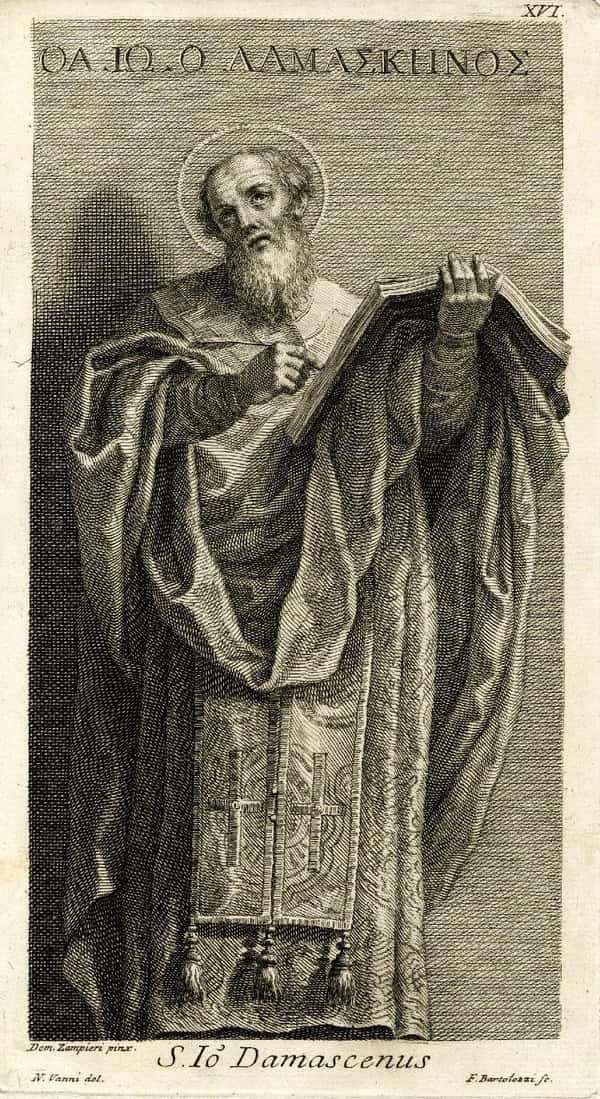 |
March 27: St. John Damascene, Confessor and Doctor of the Church
The faithful have not forgotten that on the first Sunday of Lent the Greeks keep one of their greatest solemnities, that of Orthodoxy. History proves that the Church of Constantinople, the new Rome, did not share the indefectibility of that of the old Rome, for it passed through a cycle of heresies on the dogma of the Incarnation. It rejected successively the consubstantiality of the Word, the unity of Person in Jesus Christ, and the integrity of His two natures. It seemed as though there were nothing left for heretical emperors and patriarchs to deny. Yet there was one more error to proclaim before the measure of false teaching was filled up.
Christ enthroned in heaven could not be belittled, but His images might be proscribed on earth. Heresy was powerless to touch the King even in these pictorial representations, but schism could at least shake off the yoke of His Vicar, and this last denial rolled the stone to the door of a tomb which the Crescent was one day to seal.
The heresy of the Iconoclasts or Image-breakers represents the last phase of Oriental error with regard to the Incarnation of the Son of God. It was right that the feast which commemorates the restoration of the holy Images should receive the glorious name of the Feast of Orthodoxy. It celebrates the last blow struck at Byzantine dogma, and recalls all those delivered by the councils of the Church between the first and second of Nicæa. A peculiar solemnity was given to this feast by the fact that all the anathemas formulated in previous times against the adversaries of revealed truth were renewed in the Church of St. Sophia while the Cross and the holy Images were exalted in triumph and the emperor stood at his throne.
Satan, the sworn foe of the Word, showed clearly that he looked upon the doctrine of the Iconoclasts as his last resource. There is no heresy which has caused more martyrdoms or more destruction. Nero and Diocletian seemed to be reincarnate in the baptized Caesars who defended it: Leo the Isaurian, Constantine Copronymus, Leo the Armenian, Michael the Stammerer and his son Theophilus. The edicts of persecution, published in defence of the idols of former times, were renewed for the destruction of the idolatry which was said to defile the Church.
In the early days of the heresy, St. Germanus of Constantinople reminded the crowned theologian of Isauria that Christians do not adore images but give them a relative honour, which is due to the persons of the saints whom they represent. The imperial pontiff replied by sending the patriarch into exile. The soldiers, whom the emperor charged to carry out his will, gave themselves up to the pillage of churches and private houses. On all sides venerated statues fell under the hammer of the destroyer. Mural paintings were covered with chalk, vestments and sacred vessels mutilated and destroyed on account of images in embroidery or enamel. Masterpieces of art, which had nourished the devotion of the people, were publicly burnt, and the artist who dared to represent Christ, Our Lady, or the saints, was himself subjected to fire and torture together with those of the faithful who had not been able to restrain their sorrow at the sight of such destruction. The shepherds bowed beneath the storm and yielded to re grettable compromises, and the reign of terror was soon supreme over the deserted flock.
But the noble family of St. Basil, both monks and consecrated virgins, rose en masse to withstand the tyrant. They passed through exile, imprisonment, starvation, scourging, death by drowning and the sword, but they saved the tradition of ancient art and the faith of their ancestors. The whole Order seems personified in the holy monk and painter Lazarus, who was first tempted by flattery and threats, then tortured and put in chains. It was impossible to repress him. His hands were burned with red-hot plates, but he still continued to exercise his art for the love of the saints, for the sake of his brethren, and for God, and he outlived his persecutors.
The heresy of the Iconoclasts helped, moreover to establish the temporal independence of the Roman pontiffs, for when the Isaurian threatened to enter Rome and destroy the statue of St. Peter, all Italy rose to repel the invasion of these new barbarians, defend the treasures of her basilicas and withdraw the Vicar of Christ from the yoke of Byzantium.
It was a glorious period, a hundred and twenty years, comprising the reigns of great popes, from St. Gregory II. to St. Paschal I. In the history of the Eastern Church it begins with John Damascene, who saw the opening of the conflict, and ends with Theodore the Studite, whose indomitable firmness secured the final triumph. For many centuries this period, which gave so many saints to the Greek Kalendar, was unrepresented in the Latin Liturgy. The feast of to-day was added by Pope Leo XIII. in 1892, and now John Damascene, the quondam vizier, the protege of Our Lady, the monk, whose excellent doctrine won for him the name of ‘Golden stream,’ commemorates in the Western cycle the heroic struggle in which the East rendered such glorious services to the Church and to the world.
The account given by the Liturgy of the life of this holy Doctor is so complete that we need add nothing further. But it will be well to give a short summary of the definitions by which in the eighth and sixteenth centuries the Church has avenged the holy Images from the attacks made on them by hell. The second Council of Nicæa declares that: ‘It is lawful to place in churches, in frescoes, in pictures, on vestments and the sacred vessels, on the walls of houses and in public streets, images, whether painted or mosaic or of other suitable material, representing Our Lord and Saviour Jesus Christ, our most pure Lady, the holy Mother of God, the angels and the saints; and it is equally lawful to burn incense before them and surround them with lights.’1 ‘Not that we must believe that these images have any divinity or virtue of their own,’ says the Council of Trent against the Protestants, ‘or that we must put our confidence in them as the pagans did in their idols. But the honour which is given to the images is referred to Christ the prototype,2 to whom through them all our adoration is addressed, and to the saints whom we venerate in their portraits.’3
O champion of the holy Images, obtain for us as the Church asks of thee,4 that we may imitate the virtues and experience the aid of those whom we see thus represented. The image directs our veneration and our prayers to those to whom they are due, to Christ the King and to the saints, who are the princes of His army and the most valiant of His soldiers, for it is right that the King should share with His army the honours of His triumph.5 The image is the book of those who cannot read, and even the learned may gain more from an instant’s gazing at an eloquent picture than from the prolonged study of many volumes.6 The work of the Christian artist is not only an act of religion but also an apostolate; thus it is easy to understand the opposition raised by hell in all times of disturbance against Christian art. We unite ourselves with thee, O glorious saint, in thy warfare against the devil, and cry: ‘Get thee behind us, Satan, with that envy which will not suffer us to look upon the image of Our Lord and thus be sanctified. Thou wilt not permit us to contemplate those sufferings which were the source of our salvation, to admire the gracious condescension of our God, to recognize and praise the power displayed in His miracles. Thou art envious of the saints and of the glory they have received from God, and wilt not have us contemplate this glory, lest the sight inspire us to imitate their courage and their faith. Thou canst not endure the thought that our confidence in them will profit us both in soul and in body. We will not follow thee, O jealous demon, thou enemy of mankind.’7
Be thou rather our guide, dear saint, whom sacred science salutes as one of her earliest Doctors.
‘Knowledge is the most precious of all treasures,’8 as thou didst once tell us, and it was thy desire to lead men to the only master who cannot lie, Christ the power and the wisdom of God. If they hear His voice in Holy Scripture, they will gain a true knowledge of all things. If they dispel all darkness of heart and mind, they will not stay on the threshold of the truth, but will pass into the secret of the nuptial chamber.9
Our Blessed Lady herself foretold the teaching and the works of John. She appeared to the master, whose voice he obeyed as that of God, and said to him: ‘Suffer the waters to flow, the clear sweet waters whose abundance will spread throughout the whole world, whose virtue will refresh souls athirst for knowledge and purity, whose power will stay the floods of heresy and transform them into a marvellous sweetness.’
The queen of the heavenly minstrels declared that thou, dear John, hadst received the prophetic harp and psaltery to sing the new canticle of the Lord our God in rivalry with the Cherubim.10 The daughters of Jerusalem, who are the Churches, sing the death and resurrection of Christ,11 and thou art one of the chief cantors. Lead us from the feasts of our exile— the Pasch of time—through the Red Sea and the desert to the eternal feast where all images of earth will vanish before the realities of heaven, where all knowledge will pass into vision, where reigns in glory the queen who inspired thy song, Mary, the mother of us all.
- Concil., Nic. II., sees. vii. ↩︎
- This formula, which gives the true theological basis of the cult of images, is borrowed by the Council of Trent from the second Council of Nicæa, and was originally taken word for word from St. John Damascene, De fide Orthodoxy iv. 16. ↩︎
- Concil., Trident,, sess. xxv. ↩︎
- Collect of the feast. ↩︎
- Damasc., De Imaginibus, i. 19-21. ↩︎
- Damasc., Comment, in Basil. ↩︎
- Ibid., De Imaginibus, iii. 3. ↩︎
- Ibid., Dialectica, i. ↩︎
- Ibid. ↩︎
- Joan. Hierosolymit., Vita J. Dama&ceni, xxxi. ↩︎
- Ibid ↩︎
Wednesday of the Third Week of Lent
The Station, at Rome, is in the church oi Saint Xystus on the Appian Road. It now goes under the name of Saint Xystus the Old, in order to distinguish it from another church that is dedicated to the same holy Pope and Martyr.
Collect
Epistle
Cap. xx.Hæc dicit Dominus Deus: Honora patrem tuum, et matrem tuam, ut sis longævus super terram, quam Dominus Deus tuus dabit tibi. Non occides. Non moechaberis. Non furtum facies. Non loqueris contra proximum tuum falsum testimonium. Non concupisces domum proximi tui, nec desiderable uxorem ejus, non servum, non ancillam, non bovem, non asinum, nec omnia quæ illius , sunt. Cunctus autem populus videbat veces, et lampades, et sonitum buccmæ, montem que fumantem et perterriti, ao pa vore concussi steterunt procul, dicentes Moysi: Loquere tu nobis, et audiemus: non loquatur nobis Dominus, ne forte moriamur. Et ait Moyses ad populum: Nolite timere: ut enim probaret vos venit Deus; et ut terror illius esset in vobis, et non peccaretis. Stetitque populus de longe. Moyses autem accessit ad caliginem, in qua erat Deus. Dixit præterea Dominus ad Moysen: Hæc dices filiia Israël: Vos vidistis quod de oælo locutus sim vobis. Non facietis deos argenteos, nec deos aureos facietis vobis. Altare de terra facietis mibi, et offeretis super eo holocausta et pacifica vestra, oves vestras, et boves, in omni loco in quo memoriam fuerit nominis men
Ch. xx.Thus saith the Lord God: Honour thy father and thy mother, that thou mayst be long-lived upon the land which the Lord thy God will give thee. Thou shalt not kill. Thou shalt not commit adultery. Thou shalt not steal. Thou shalt not bear false witness against thy neighbour. Thou shalt not covet thy neighbour’s house, neither shalt thou desire his wife, nor his servant, nor his handmaid, nor his ox, nor his ass, nor any thing that is his. And all the people saw the voices and the flames, and the sound of the trumpet, and the mount smoking: and being terrified and struck with fear, they stood afar off, saying to Moses: Speak thou to us, and we will hear; let not the Lord speak to us, lest we die. And Moses said to the people: Fear not; for God is come to prove you, and that the dread of him might be in you, and you should not sin. And the people stood afar off. But Moses went to the dark cloud wherein God was. And the Lord said to Moses: Thus shalt thou say to the children of Israel: You have seen that I have spoken to you from heaven. You shall not make gods of silver, nor shall you make to yourselves gods of gold. You shall make an altar of earth unto me, and you shall offer upon it your holocausts and peace-offerings, your sheep and oxen, in every place where the memory of my name shall be.
The Church reminds us to-day of the divine commandments which relate to our duties towards our neighbour, beginning with that which enjoins respect to parents. Now that the faithful are intent on the great work of the conversion and amendment of their lives, it is well that they should be reminded that their duties towards their fellow-men are prescribed by God Himself. Hence, it is God whom we offended, when we sinned against our neighbour. God first tells us what He Himself has a right to receive from our hands. He bids us adore and serve Him; He forbids the worship of idols; He enjoins the observance of the Sabbath, and prescribes sacrifices and ceremonies: but, at the same time, He commands us to love our neighbours as ourselves, and assures us that He will be their avenger when we have wronged them, unless we repair the injury. The voice of Jehovah on Sinai is not less commanding when it proclaims what our duties are to our neighbour, than when it tells us our obligations to our Creator. Thus enlightened as to the origin of our duties, we shall have a clearer view of the state of our conscience, and of the atonement required of us by divine justice. But if the old Law, that was written on tablets of stone, thus urges upon us the precept of the love of our neighbour; how much more will the new Law, that was signed with the Blood of Jesus when dying upon the cross for His ungrateful brethren, insist on our observance of fraternal charity! These are the two Laws, on which we shall be judged; let us, therefore, carefully observe what they command on this head, that thus we may prove ourselves to be Christians, according to those words of our Saviour: ‘By this shall all men know that you are My disciples, if you have love one for another.’*
Gospel
Cap. xv.In illo tempore: Accesserunt ad Jesum ab Jerosolymis scribæ et pharisæi, dicentes: Quare discipuli tui transgrediuntur traditionem seniorum? non enim lavant manus su.as cum panem manducant. Ipse autem respondens, ait illis: Quare et vos transgredimini mandatum Dei propter traditionem vestram? Nam Deus dixit: Honora patrem et matrem. Et: Qui maledixerit patri vel matri, morte moriatur. Vos autem dicitis: Quicumque dixerit patri vel matri: Munus quodcumque est ex me tibi proderit: et non honorificabit patrem suum aut matrem suam: et irritum fecistis mandatum Dei, propter traditionem vestram. Hypocritæ, bene prophetavit de vobis Isaias, dicens: Populus hic labiis me honorat: cor autem eorum longe est a me. Sine causa autem colunt me, docentes doctrinas et mandata hominum. Et convocatis ad se turbis, dixit eis: Audite, et intelligite. Non quod iritrat in os, coinquinat hominem: sed quod procedit ex ore, hoc coinquinat hominem. Tune accedentes discipuli ejus, dixerunt ei: Seis quia pharisæi, audito verbo hoc, scandalizati sunt? At lile respondens, ait: Omnis plantatio quam non plantavit Pater meus cælestis, eradicabitur. Sinite illos: cæci sunt, et duces cæcorum. Cæcus autem si cæco ducatum præstet, ambo in foveam cadunt. Respondens autem Petrus, dixit ei: Edissere nobis parabola istam. At ille dixit: Adhuc et vos sine intellectu estis? Non intelligitis quia omne quod in os intrat, in ventrem vadit, et in secessum emittitur? Quæ autem procedunt de ore, de corde exeunt, et ea coinquinant hominem: de corde enim exeunt cogitationes malæ, homicidia, adulteria, fornicationes, furta, falsa testimonia, blasphemiæ. Hæc sunt quæ coinquinant hominem. Non lotis autem manibus manducare, non coinquinat hominem.
Ch. xv.At that time: The scribes and pharisees came from Jerusalem to Jesus, saying: Why do thy disciples transgress the tradition of the ancients? for they wash not their hands when they eat bread. But he answering, said to them: Why do you also transgress the commandment of God for your tradition? For God said: Honour thy father and mother; and: He that shall curse father or mother, let him die the death. But you say: Whosoever shall say to father or mother, The gift whatsoever proceedeth from me, shall profit thee. And he shall not honour his father or his mother; and you have made void the commandment of God for your tradition. Hypocrites, well hath Isaias prophesied of you, saying: This people honoureth me with their lips, but their heart is far from me. And in vain do they worship me, teaching doctrines and commandments of men. And having called together the multitudes unto him, he said to them: Hear ye and understand. Not that which goeth into the mouth defileth a man; but what cometh out of the mouth, this defileth a man. Then came his disciples, and said to him: Dost thou know that the pharisees, when they heard this word, were scandalized? But he answering, said: Every plant which my heavenly Father hath not planted, shall be rooted up. Let them alone; they are blind, and leaders of the blind. And if the blind lead the blind, both fall into the pit. And Peter answering, said to him: Expound to us this parable. But he said: Are you also yet without understanding? Do you not understand that whatsoever entereth into the mouth, goeth into the belly, and is cast out into the privy? But the things which proceed out of the mouth, come forth from the heart, and those things defile a man. For from the heart come forth evil thoughts, murders, adulteries, fornications, thefts, false testimonies, blasphemies. These are the things that defile a man. But to eat with unwashed hands doth not defile a man.
The Law that was given by God to Moses enjoined a great number of exterior practices and ceremonies; and they that were faithful among the Jews, zealously and carefully fulfilled them. Jesus Himself, though He was the divine Law-Giver, most humbly complied with them. But the pharisees had added their own superstitious traditions to these divine laws and ordinances, and made religion consist in the observance of these fanciful inventions. Our Saviour here tells the people not to be imposed upon by such teaching, and instructs them as to what is the real meaning of the external practices of the Law. The pharisees prescribed a great many ablutions or washings to be observed during the course of the day. They would have it, that they who eat without having washed their hands (and indeed the whole body some time during the day), were defiled, and that the food they thus partook of was unclean, because, as they said, they themselves had become defiled by having come near or touched objects which were specified by their whims. According to the Law of God, these objects were perfectly innocent; but according to the law of the pharisees, almost everything was contagious, and the only escape was endless washings! Jesus would have the Jews throw off this humiliating and arbitrary yoke, and reproaches the pharisees for having corrupted and made void the Law of Moses.
He tells them that there is no creature which is intrinsically, and of its own nature, unclean; and that a man’s conscience cannot be defiled by the mere fact of his eating certain kinds of food. Evil thoughts, and evil deeds, these, says our Saviour, are the things that defile a man. Some heretics have interpreted these words as being an implicit condemnation of the exterior practices ordained by the Church, and more especially of abstinence. To such reasöners and teachers we may justly apply what our Saviour said to the pharisees: They are blind and leaders of the blind. From this, that the sins into which a man falls by his use of material things are sins only on account of the malice of the will, which is spiritual, it does not follow that therefore man may, without any sin, make use of material things, when God or His Church forbids their use. God forbade our first parents, under pain of death, to eat the fruit of a certain tree; they ate it, and sin was the result of their eating. Was the fruit unclean of its own nature? No; it was a creature of God as well as the other fruits of Eden; but our first parents sinned by eating it, because their doing so was an act of disobedience. Again, when God gave His Law on Mount Sinai, He forbade the Hebrews to eat the flesh of certain animals; if they ate it, they were guilty of sin, not because this sort of food was intrinsically evil or cursed, but because they that partook of it disobeyed the Lord. The commandments of the Church regarding fasting and abstinence are of a similar nature. It is that we may secure to ourselves the blessing of Christian penance— in other words, it is for our spiritual interest—that the Church bids us abstain and fast at certain times. If we violate her law, it is not the food we take that defiles us, but the resisting a sacred power, which our Saviour, in yesterday's Gospel, told us we are to obey under the heavy penalty which He expressed in those words: He that will not hear the Church, shall be counted as a heathen and publican.
Let us take for to-day one of the solemn supplications offered to God by the Gothic Church of Spain during Lent.
Supplication
(Breviar. Mozarah. Ad Sextam in IV. fer. V. hebdomadœ)
* St. John xiii. 35 ↩︎
| Previous Tuesday of the Third Week of Lent | Next Wednesday of the Third Week of Lent |