Daily reading
Semidouble · Movable from Easter · Temporal
March 28, 2019
From Dom Guéranger’s The Liturgical Year.
Thursday of the Third Week of Lent
This day brings us to the middle of Lent, and is called mid-Lent Thursday. It is the twentieth of the forty fasts imposed upon us, at this holy season, by the Church. The Greeks call the Wednesday of this week Mesonestios, that is, the mid-fast. They give this name to the entire week, which, in their liturgy, is the fourth of the seven that form their Lent. But the Wednesday is, with them, a solemn feast, and a day of rejoicing, whereby they animate themselves to courage during the rest of the season. The Catholic nations of the west, though they do not look on this day as a feast, have always kept it with some degree of festivity and joy. The Church of Rome has countenanced the custom by her own observance of it; but, in order not to give a pretext to dissipation, which might interfere with the spirit of fasting, she postpones to the following Sunday the formal expression of this innocent joy, as we shall see further on. Yet, it is not against the spirit of the Church that this mid-day of Lent should be marked by some demonstration of gladness; for example, by sending invitations to friends, as our Catholic forefathers used to do; and serving up to table choicer and more abundant food than on other days of Lent, taking care, however, that the laws of the Church are strictly observed. But alas! how many even of those calling themselves Catholics have been breaking, for the past twenty days, these laws of abstinence and fasting! Whether the dispensations they trust to be lawfully or unlawfully obtained, the joy of mid-Lent Thursday scarcely seems made for them. To experience this joy, one must have earned and merited it, by penance, by privations, by bodily mortifications; which is just what so many, nowadays, cannot think of doing. Let us pray for them, that God would enlighten them, and enable them to see what they are bound to do, consistently with the faith they profess.
At Rome, the Station is at the church of Saints Cosmas and Damian, in the forum. The Christians of the middle ages (as we learn from Durandus, in his Rational of the Divine Offices) were under the impression that this Station was chosen because these two saints were, by profession, physicians. The Church, according to this explanation, would not only offer up her prayers of this day for the souls, but also for the bodies of her children: she would draw down upon them—fatigued as she knew they must be by their observance of abstinence and fasting—the protection of these holy martyrs, who, whilst on earth, devoted their medical skill to relieving the corporal ailments of their brethren. The remarks made by the learned liturgiologist Gavantus, in reference to this interpretation, lead us to conclude that, although it may possibly not give us the real motive of the Church’s selecting this Station, yet it is not to be rejected. It will, at least, suggest to the faithful to recommend themselves to these saints, and to ask of God, through their intercession, that they may have the necessary courage and strength for persevering to the end of the holy season in what they have, so far, faithfully observed.
Collect
Epistle
Cap. vii.In diebus illis: Factum est verbum Domini ad me dicens: Sta in porta domus Domini, et prædica ibi verbum istud, et die: Audite verbum Domini, omnis Juda, qui ingredimini per portas has, ut adoretis Dominum. Hæc dicit Dominus exercituum, Deus Israël: Bonas facite vias vestras, et studia vestra: et habitabo vobiseum in loco isto. Nolite confidere in verbis mendaeii, dicentes: Templum Domini, templum Domini, templum Dominiest. Quoniam si bene direxeritis vias vestras, et studia vestra: ei feceritis judicium inter virum et proximum ejus: ad venae et pupillo, et viduae non foceritis calumniam, nec sanguinem innoeentem effuderitis in loco hoc, et post deos alienos non ambulaveritis in malum vobismetipeis: habitabo vobiscum in loco isto, in terra quam dedi patribus vestris, a sæculo et usque in saeculum, ait Dominus omnipotens.
Ch. viiIn those days: The word of the Lord came to me, saying: Stand in the gate of the house of the Lord, and proclaim there this word, and say: Hear ye the word of the Lord, all ye men of Juda, that enter in at these gates, to adore the Lord. Thus saith the Lord of hosts, the God of Israel: Make your ways and your doings good; and I will dwell with you in this place. Trust not in lying words, saying: The temple of the Lord, the temple of the Lord, it is the temple of the Lord. For if you will order well your ways and your doings; if you will execute judgment between a man and his neighbour; if you oppress not the stranger, the fatherless and the widow, and shed not innocent blood in this place, and walk not after strange gods to your own hurt; I will dwell with you in this place, in the land which I gave to your fathers from the beginning and for ever more, saith the Lord almighty.
There is not a single duty in which the Church does not instruct her children. If, on the one hand, she insists on their fulfilling certain exterior practices of penance, she, on the other, warns them against the false principle of supposing that exterior observances, however carefully complied with, can supply the want of interior virtues. God refuses to accept the homage of the spirit and the heart, if man, through pride or sensuality, refuse that other service which is equally due to his Creator, namely, his bodily service; but to make one’s religion consist of nothing but material works, is little better than mockery; for God bids us serve Him in spirit and in truth.1 The Jews prided themselves on having the temple of Jerusalem, which was the dwelling-place of God’s glory; but this privilege, which exalted them above other nations, was not unfrequently turned against themselves, inasmuch as many of them were satisfied with a mere empty respect for the holy place; they never thought of that higher and better duty, of showing themselves grateful to their divine Benefactor, by observing His Law. Those Christians would be guilty of a like hypocrisy, who, though most scrupulously exact in the exterior duty of fasting and abstinence, were to take no pains to amend their lives, and to follow the rules of justice, charity, and humility. They would deserve that our Lord should say of them what He said of Israel: ‘This people glorify Me with their lips; but their heart is far from Me.’2 This Christian pharisaism is very rare now-a-days. What we have to fear is a disregard for the exterior practices of religion. Those of the faithful who are diligent in the fulfilment of the laws of the Church, are not, generally speaking, behindhand in the practice of other virtues. Still, this false conscience is sometimes to be met with, and is a scandal which does much spiritual injury. Let us, therefore, observe the whole law. Let us offer to God a spiritual service, which consists in the heart's obedience to all His commandments; and to this let us join the homage of our bodies, by practising those things which the Church has prescribed. The body is intended to be an aid to the soul, and is destined to share in her eternal happiness; it is but just that it should share in the service of God.
Gospel
Cap. iv.In illo tempore: Surgens Jesus de synagoga, introivit in domum Simonis. Socrus autem Simonis tenebatur magnis febribus: et rogaverunt ilium pro ea. Et stans super illam, imperavit febri: et dimisit illam. Et continuo surgens, minist ra bat illis. Cum autem sol occidisset, omnes qui habebant infirmos variis languoribus, ducebant illos ad eum. At file singulis manus imponens, curabat eos. Exibant autem dæmonia a multis, clamantia et dicentia: Quia tu ee Filius Dei. Et increpans non sinebat ea loqui, quia sciebant ipsum esse Christum. Facta autem die egreseus ibat in desertum locum, et turbæ requirebant eum, et venerunt usque ad ipsum: et detinebant ilium ne discederet ab eis. Quibus file ait: Quia et aliis eivitatibus oportet me evangelizare regnum Dei, quia ideo missus sum; et erat prædicans in synagogis Galilææ.
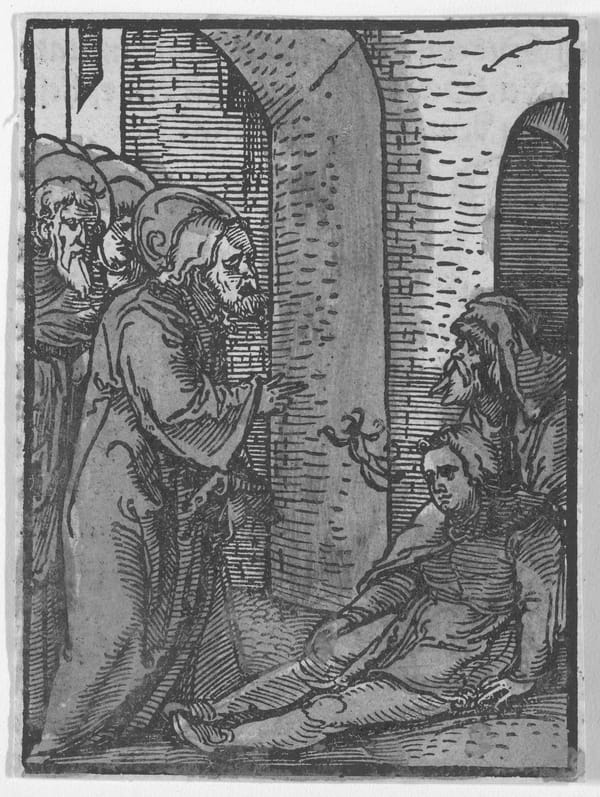
Ch. iv.At that time: Jesus rising up out of the synagogue, went into Simon’s house. And Simon’s wife’s mother was taken with a great fever, and they besought him for her. And standing over her, he commanded the fever, and it left her. And immediately rising, she ministered to them. And when, the sun was down, all they that had any sick with divers diseases, brought them to him. But he, laying his hands on every one of them, healed them. And devils went out from many, crying out and saying: Thou art the Son of God. And rebuking them, he suffered them not to speak, for they knew that he was Christ. And when it was day, going out, he went into a desert place, and the multitude sought him, and came unto him; and they stayed him that he should not depart from them. To whom he said: To other cities also I must preach the kingdom of God; for therefore am I sent. And he was preaching in the synagogues of Galilee.
Let us here admire the goodness of our Redeemer, who deigns to exercise His power for the cure of bodily infirmities. How much more ready will He be to heal our spiritual ailments! Our fever is that of evil passions; Jesus alone can allay it. Let us imitate the eagerness of these people of Galilee, who brought all their sick to Jesus; let us beseech Him to heal us. See with what patience He welcomes each poor sufferer! Let us also go to Him. Let us implore of Him not to depart from us, but abide with us for ever; He will accept our petition, and remain. Let us pray for sinners: the days of the great fast are quickly passing away: we have reached the second half of Lent, and the Passover of our deliverance will soon be here. Look at the thousands that are unmoved, with their souls still blind to the light, and their hearts hardened against every appeal of God’s mercy and justice; they seem resolved on making their eternal perdition lees doubtful than ever, by neglecting both the Lent and the Easter of this year. Let us offer up our penances for them; and beg of Jesus by the merits of His sacred Passion, to redouble His mercies towards them, and to deliver from satan these souls, for whose sake He is about to shed His Blood.
The Mozarabic liturgy offers us this beautiful exhortation. It will inspire us to persevere in our lenten penances and duties.
Missa
(Missale Gothicum. Dominica IV. in Quadragesima)
March 28: St. John Capistran, Confessor
|
The nearer the Church approaches to the end of her earthly existence, the more she seems to love to enrich her cycle with feasts that recall the glorious past. Indeed, one of the objects of the sacred Liturgy is to keep before our minds all that God has done for us. ‘Remember the days of old: think upon every generation,’1 said God to His people in the alliance of Sinai. It was a law in Jacob that the fathers should hand on these traditions to their children, who were in their turn to transmit them to their descendants.2 The Church has taken the place of the ancient Israel and her annals speak, even more than those of the Jewish people, of the manifestations of divine power. The children of the new Sion have more right than the sons and daughters of Juda to say, as they look back on the past: ‘Thou art thyself my king and my God, who commandest the saving of Jacob.’
At the time when the defeat of the Iconoclasts was being completed in the East, a new and most terrible war was beginning in which the West was to fight for the sake of civilization and for the cause of the Incarnate Word of God. Like a sudden torrent, Islam overwhelmed Eastern Europe, reaching even to Gaul, and for a thousand years it disputed, foot by foot, with Christ and His Chutch, the land occupied by the Latin races. The glorious Crusades of the twelfth and thirteenth centuries, which attacked this power in its very centre, only succeeded in paralyzing it for the time being. In Spain the struggle continued until the triumph of the Cross was complete, but in other parts of Europe Christian princes forgot the traditions of Charlemagne and St. Louis, grew weary of the holy war, and gave themselves up to the pursuit of their private ambition, so that the Crescent was able once more to defy the Christian powers and renew its plan of universal conquest.
In 1453 Byzantium, the capital of the Eastern empire, fell before the Turkish janissaries, and three years later Mahomet II. invested Belgrade on the very outskirts of the Western empire. It might have been expected that all Europe would hasten to the aid of the besieged fortress, for if this last dyke were to fall, Hungary, Austria and Italy would be overwhelmed and the peoples of the North and West would share the fate of the East, that life in death, that irremediable sterility of soil and intelligence which still holds captive the once brilliant Greece. But this imminent danger only resulted in deepening the breach in Christian unity, and the Christian nations were at the mercy of a few thousand infidels. Only the Papacy was true to itself in the midst of all this egoism and perfidy. Truly Catholic in its thoughts, its labours, its sufferings, as in its joys and triumphs, it took up the common cause which had been basely betrayed by kings and princes. The powerful were deaf to the Pope’s appeals, but he turned to the humble and, trusting more in prayer to the God of armies than in military tactics, he sought for the deliverers of Christendom among the poor.
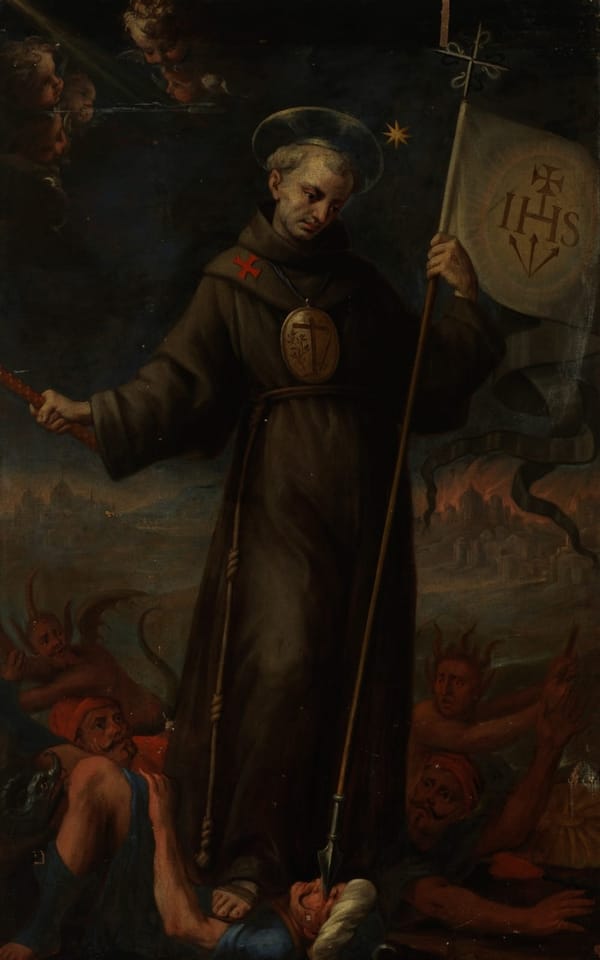
It was then that John Capistran, the saint of to-day, attained the consummation of his glory and his sanctity. At the head of a few poor men of good-will, unknown peasants gathered together by the Franciscan Friars, this ‘poor man of Christ’ undertook to defeat the strongest and best organized army of the century. On July 14, 1456, he broke through the Ottoman lines with John Hunyades, the only one of the Hungarian nobles who would accompany him, and revictualled Belgrade; and on July 22, feeling that he could no longer endure the defensive, he threw himself, to the stupefaction of Hunyades, on the enemy entrenchments. His troops were armed only with flails and pitchforks, and their only strategy was the name of Jesus. John had inherited this victorious battle-cry from his master, Bernardine of Siena. The Psalmist said: ‘Some trust in chariots and some in horses: but we will call upon the name of the Lord our God.’3 This name, so holy and so terrible, proved once more the salvation of the people. At the end of that memorable day twenty-four thousand Turks lay dead on the field of battle; three hundred cannon and all the spoils of the infidels were in the hands of the Christians, and Mahomet II. was seeking a distant hiding-place for his shame. The news of this victory, so like that of Gedeon,4 reached Rome on August 6, and Pope Callistus III. decreed that henceforth the Universal Church should keep a solemn commemoration of the Transfiguration of Our Lord on that day, for it was with the soldiers of the Cross as with the heroes of Israel,5 ‘they got not the possession of the land by their own sword: neither did their own arm save them, but thy right hand and thy arm and the light of thy countenance because thou wast pleased with them,’ as with Thy beloved Son on Mount Thabor.6
Let us read the life of St. John Capistran as related in the Liturgy:
‘The Lord is with thee, O most valiant of men. Go in this thy strength and thou shalt deliver Israel out of the hand of Madian. Know that I have sent thee.’7 Thus did the angel of the Lord salute Gedeon when he chose him from among the least of his people8 to fulfil a high destiny. Thus do we in our turn salute thee, O glorious son of St. Francis of Assisi, and we beseech thee to be our constant aid. The enemy whom thou didst defeat on the field of battle is no longer an imminent peril for the West, but there is a greater danger, as Moses said to his people after their deliverance from Egypt: ‘Take heed and beware lest at any time thou forget the Lord thy God . . . lest after thou hast eaten and art filled, hast built goodly houses . . . and shalt have herds of oxen and flocks of sheep and plenty of gold and of silver, and of all things; thy heart be lifted up and thou remember not the Lord who brought thee out of the house of bondage.’9 If the Turk had conquered in that struggle of which thou wert the hero, what would have become of the civilization of which we are so proud? Since thy day the Church has had once more to champion the cause of Society, which the heads of the nations no longer seem to understand. May the need of giving expression to the gratitude which is due to her preserve her children from the forgetfulness which is the great evil of the present generation. We thank God for the feast of to-day; it is a perpetual memorial of His goodness and of the noble deeds of His saints. Help us to conquer in that warfare which is being incessantly carried on within our own souls against the world, the flesh, and the devil. May the name of Jesus put our enemies to flight, may His Cross be our standard and lead us through the death of self-love to the triumph of the Resurrection.
| Previous Wednesday of the Third Week of Lent | Next March 28: St. John Capistran, Confessor |