Daily reading
Lent
Double · April 2 · Sanctoral
April 2, 2019
From Dom Guéranger’s The Liturgical Year.
A Double leads the weekday.Rubric
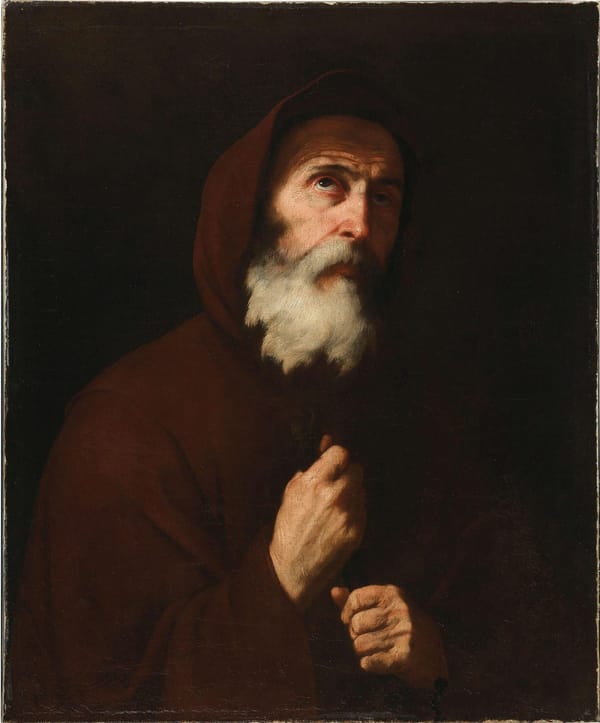 |
April 2: St. Francis of Paula
The founder of a religious Order, whose distinguishing characteristics were humility and penance, comes before us to-day; it is Francis of Paula. Let us study his virtues and beg his intercession. His whole life was one of great innocence; and yet we find him embracing, from his earliest youth, mortifications which, nowadays, would not be expected from the very worst sinners. How was it that he could do so much? and we, who have so often sinned, do so little? The claims of divine justice are as strong now as ever they were; for God never changes, nor can the offence we have committed against Him by our sins be pardoned, unless we make atonement. The saints punished themselves, with life-long and austere penances, for the slightest sins; and the Church can scarcely induce us to observe the law of Lent, though it is now reduced to the lowest degree of severity.
What is the cause of this want of the spirit of expiation and penance? It is that our faith is weak, and our love of God is cold, because our thoughts and affections are so set upon this present life, that we seldom if ever consider things in the light of eternity. How many of us are like the king of France, who having obtained permission from the Pope that St. Francis of Paula should come and live near him, threw himself at the saint's feet, and besought him to obtain of God, that he, the king, might have a long life! Louis XI. had led a most wicked life; but bis anxiety was, not to do penance for his sins, but to obtain, by the saint's prayers, a prolongation of a career which had been little better than a storing up of wrath for the day of wrath. We, too, love this present life; we love it to excess. The laws of fasting and abstinence are broken, not because the obeying them would endanger life, or even seriously injure health—for where either of these is to be feared, the Church does not enforce her lenten penances—but people dispense themselves from fasting and abstinence, because the spirit of immortification renders every privation intolerable, and every interruption of an easy comfortable life insupportable. They have strength enough for any fatigue that business or pleasure calls for; but the moment there is question of observing those laws which the Church has instituted for the interest of the body as well as of the soul, all seems impossible; the conscience gets accustomed to these annual transgressions, and ends by persuading the sinner that he may be saved without doing penance.
St. Francis of Paula was of a very different way of thinking and acting. The Church gives us the following abridged account of his life:
Apostle of penance: thy life was always that of a saint, and we are sinners: yet do we presume, during these days, to beg thy powerful intercession, in order to obtain of God that this holy season may not pass without having produced within us a true spirit of penance, which may give us a reasonable hope of receiving His pardon. We admire the wondrous works which filled thy life—a life that resembled, in duration, that of the patriarchs, and prolonged the privilege the world enjoyed of having such a saint to teach and edify it. Now that thou art enjoying in heaven the fruits of thy labours on earth, think upon us, and hearken to the prayers addressed to thee by the faithful. Gain for us the spirit of compunction, which will add earnestness to our works of penance. Bless and preserve the Order thou hast founded. Thy holy relics have been destroyed by the fury of heretics; avenge the injury thus offered to thy name, by praying for the conversion of heretics and sinners, and drawing down upon the world those heavenly graces, which will revive among us the fervour of the ages of faith.
Tuesday of the Fourth Week of Lent
The Station is in the church of Saint Laurence in Damaso; so called, because it was built, in the fourth century, in honour of the glorious archdeacon of Rome, by Pope St. Damasus, whose body rests here.
Collect
Epistle
Cap. xxxii.In diebus illis, locutus est Dominus ad Moysen, dicens: Descende de monte: peccavit populus tuus, quem eduxisti de terra Ægypti. Recesserunt cito de via, quam ostendisti eis: feceruntque sibi vitulum conflatilem, et adoraverunt, atque immolantes ei hostias, dixerunt: Isti sunt dii tui, Israël, qui te eduxerunt de terra Ægypti. Rursumque ait Dominus ad Moysen: Cemo quod populus iste duræ cervicis sit: dimitte me, ut irascatur furor meus contra eos, et deleam eos, faciamque te in gentem magnam. Moyses autem orabat Dominum Deum suum, dicens: Cur, Domine, irascitur furor tuus contra populum tuum, quem eduxisti de terra Ægypti in fortitudine magna, et in manu robusta? Ne, quæso, dicant Ægyptii: Callide eduxit eos, ut interficeret in montibus, et deleret e terra: quiescat ira tua, et esto placabilis super nequitia populi tui. Recordare Abraham, Isaac, et Israël, servorum tuorum, quibus jurasti per temetipsum, dicens: Multiplicabo semen vestrum sicut Stellas cceli; et universam terram hanc, de qua locutus sum, dabo semini vestro, et possidebitis eam semper. Placatusque est Dominus ne faceret malum, quod locutus fuerat adversus populum suum,
Ch. xxxii.In those days, the Lord spoke to Moses saying: Go, get thee down from the mountain: thy people, which thou hast brought out of the land of Egypt, hath sinned. They have quickly strayed from the way which thou didst show them; and they have made to themselves a molten calf, and have adored it, and sacrificing victims to it, have said: These are thy gods, O Israel, that have brought thee out of the land of Egypt. And again the Lord said to Moses: I see that this people is stiff-necked: let me alone that my wrath may be kindled against them, and that I may destroy them, and I will make of thee a great nation. But Moses besought the Lord his God, saying: Why, O Lord, is thy indignation enkindled against thy people, whom thou hast brought out of the land of Egypt, with great power, and with a mighty hand? Let not the Egyptians say, I beseech thee: He craftily brought them out, that he might kill them in the mountains, and destroy them from the earth; let thy anger cease and be appeased upon the wickedness of thy people. Remember Abraham, Isaac and Israël thy servants, to whom thou swarest by thy own self, saying: I will multiply your seed as the stars ofheaven; and this whole land that I have spoken of, I will give to your seed, and you shall possess it for ever. And the Lord was appeased from doing the evil which he had spoken against his people.
When the world first received the preaching of the Gospel, idolatry was the prevailing crime. For many centuries after, all the catechumens, who were instructed in the true faith, were tainted with it. It was in order to inspire them with a horror of their past lives, that the Church read to them, on this day, the terrible words of God, who, had not Moses interceded, was about to exterminate His people, because they had relapsed into idolatry; and this, after He had worked in their favour the most unheard-of miracles, and had come in person to give them His Law. The worship of false gods is no longer to be found amongst us; but it exists in all those countries, where the Gospel has been preached and rejected. Strange as it may sound, yet it is most true: Europe, with all its civilization, would return to idolatry, were it to lose the faith of our Lord Jesus Christ. Not much more than a centqry ago, an idol was erected to reason; it had its altar, its decorations and its incense; and they who paid homage to it were Europeans! Individuals or peoples, once slaves to Satan, are not their own masters to say, ‘We will go thus far in sin, and no farther’The descendants of Noe, notwithstanding the terrible lesson given to them by the deluge, fell into idolatry; nay, Abraham was called by God from the rest of men, lest he should be led away by the almost universal corruption. Let us be grateful to the Church, who, by her teachings of faith and morals, preserves us from this degrading abomination; and let us resist our passions, which, if the light of faith were taken from us, would lead us to idolatry.
Gospel
Cap. vii.In illo tempore: Jam die festo mediante, ascendit Jesus in templum, et docebat. Et mirabantur Judæi, dicentes: Quomodo hic litteras scit, cum non didicerit? Responds eis Jesus, et dixit: Mea doctrina non est mea, sed ejus qui misit me. Si quis voluerit voluntatem ejus facere, cognoscet de doctrina, utrum ex Deo sit an ego a meipso loquar. Qui a semetipso loquitur, gloriam propriam quærit: qui autem quærit gloriam ejus qui misit eum, hic verax est, et injustitia in illo non est. Nonne Moyses dedit vobis legem? et nemo ex vobis facit legem. Quid me quæritis interficere? Respondit turba, et dixit: Dæmonium habes: quis te quærit interficere? Respondit Jesus, et dixit eis: Unum opus feci, et omnes miramini. Propterea Moyses dedit vobis circumcisionem (non quia ex Moyse est, sed ex patribus): et in Sabbato circumciditis hominem. Si circumcisionem accipit homo in Sabbato, ut non solvatur lex Moysi: mihi indignamini quia totum hominem sanum feci in Sabbato? Nolite judicare secundum faciem, sed justum judicium judicate. Dicebant ergo quidam ex Jerosolymis: Nonne hic est quem quærunt interficere? Et ecce palam loquitur, et nihil ei dicunt. Numquid vere cognoverunt principes quia hic est Christus? Sed hunc scimus unde sit: Christus autem cum venerit, nemo scit unde sit. Clamabat ergo Jesus in templo docens, et dicens: Et me scitis, et unde sim scitis: et a meipso non veni, sed est verus qui misit me, quem vos nescitis. Ego scio eum: quia ab ipso sum, et ipse me misit. Quærebant ergo cum apprehendere: et nemo misit in ilium manus, quia nondum venerat hora ej us. De turba autem multi crediderunt in eum.
Ch. vii.At that time: About the midst of the feast, Jesus went up into the temple and taught. And the Jews wondered, saying: How doth this man know letters, having never leamed? Jesus answered them, and said: My doctrine is not mine, but his that sent me. If any man will do the will of him, he shall know of the doctrine whether it be of God, or whether I speak of myself. He that speaketh of himself, seeketh his own glory; but he that seeketh the glory of him that sent him, he is true, and there is no injustice in him. Did not Moses give you the law? And yet none of you keepeth the law. Why seek you to kill me? The multitude answered and said: Thou hast a devil: who seeketh to kill thee? Jesus answered, and said to them: One work I have done, and you all wonder. Therefore Moses gave you circumcision (not because it is of Moses, but of the fathers); and on the Sabbath-day you circumcise a man. If a man receive circumcision on the Sabbath-day that the law of Moses may not be broken, are you angry at me, because I have healed the whole man on the Sabbath-day? Judge not according to the appearance, but judge just judgment. Some therefore of Jerusalem said: Is not this he whom they seek to kill? And behold he speaketh openly, and they say nothing to him. Have the rulers known for a truth that this is the Christ? But we know this man whence he is. But when the Christ cometh, no man knoweth whence he is. Jesus therefore cried out in the temple, teaching and saying: You both know me, and you know whence I am; and I am not come of myself, but he that sent me is true, whom you know not; I know him because I am from him, and he hath sent me. They sought therefore to apprehend him; and no man laid hands on him, because his hour was not yet come. But of the people many believed in him.
This Gospel carries our thoughts to the sacrifice of ihe divine Lamb, which is to be offered up in Jerusalem. The hour has not yet come, but it is fast approaching. His enemies are already seeking how they may put Him to death. So blinded are they by their passions, that they accuse Him of being a violater of the Sabbath, because He healed the sick, by the simple act of His will, on the Lord’s day! In vain does Jesus refute their prejudices, by reminding them that they themselves have no scruple in fulfilling the law of circumcision on this day, or (as He said to them, on another occasion) in drawing out of the pit an ass or an ox that may have fallen in.1 They are deaf to all He says; they are men of one idea, and it is, that their victim shall not escape death. His miracles are incontestable, and all are wrought out of a motive of mercy and love. The only time He refuses to work one, is when His enemies ask Him to satisfy their curiosity and pride by letting them see a sign. This exercise of His power of working miracles, far from exciting them to admiration and gratitude, only incites them to envy, and in their envy, they declare, not only that He acts by Beelzebub,2 but that He has a devil within Him. We shudder at such a blasphemy. Yet, such is the pride of these Jewish doctors that they care neither for common sense nor for religion, and their hearts thirst more and more for the Blood of Jesus. Whilst some of the people allow themselves to be seduced by their leaders into the same feelings against Jesus, others, who affect to be indifferent, reason about Him, and then declare it to be their opinion that this Jesus does not realize in Himself the character of the promised Messias! They argue that, when the Christ cometh no one will know whence He is. But have not the prophets declared that He is to be of the family of David? Now every Jew knows well enough that Jesus is of that royal race. Besides, they own that there is to be something mysterious about the Messias, and that He is to come from God. Had they listened with docile attention to the teachings of Jesus—teachings which He had confirmed by numerous miracles—they would have been enlightened both as to His temporal birth, and to His being the Son of God. But indifference and the perversity of the human heart keep them in culpable ignorance; and, perhaps, on the day of His death, they will join in the cry: ‘Let His Blood be upon us and upon our children!’3
The Greek liturgy supplies us with the following humble act of contrition. We take it from the hymn composed by St. Andrew of Crete.
Canon Magnus
(Feria V. Hebdomadæ V. Jejuniorum)
April 2 (the Same Day, in Some Dioceses): St. Mary of Egypt, Penitent
One of the most striking examples of penance ever witnessed, is this day proposed for our consideration: Mary, the sinner and penitent of Egypt, comes to animate us to persevere in our lenten exercises. Like Magdalene and Margaret of Cortona, she had sinned grievously; like them she repented, atoned for her guilt, and is now the associate of angels. Let us adore the omnipotence of our God, who thus changed a vessel of dishonour into one of honour; let us lovingly contemplate the riches of His mercy, and hope for our own participation in them. At the same time, let us remember that pardon is not granted save where there is repentance; and that repentance is not genuine, unless it produce an abiding spirit and deeds of penance. Mary of Egypt had the misfortune to lead a life of sin for seventeen years; but her penance lasted forty: and what kind of penance must hers have been, living alone in a desert, under a scorching sun, without the slightest human consolation, and amidst every sort of privation! The pledge of pardon—the holy Communion —which we received so soon after our sins, was not granted to Mary, till she had done penance for nearly half a century. That pledge of Jesus' forgiveness, which He has given us in the Sacrament of His love, and which was communicated to us so promptly, was withheld from this admirable penitent, so that she received it for the second time only at the moment when death was on the point of separating her soul from her body which was worn out by austerities! Let us humble ourselves at such a comparison; let us think with fear on this great truth—that God’s justice will require an exact account of all the graces He has heaped upon us; and with this thought, let us rouse ourselves to a determination to merit, by the sincerity of our repentance, a place near the humble penitent of the desert.
We take the lessons of the Office of St. Mary of Egypt from the ancient Roman-French breviaries:
In praise of our incomparable penitent, we offer to the reader the following beautiful sequence, taken from the ancient missals of Germany:
Sequence
In amplexum Salomonis
Nostri transit filia;
Ex abjecta fit electa,
Ex rugosa fit formosa,
Ex lebete phiala.
Ad dilectum quam conduxit
Pacia nectens fædera;
Matre Dei mediante,
Peccatrici, Christo dante,
Sunt dimissa scelera.
Pervenit in Jerusalem,
Nuptura Pacifico;
Hinc excluso adultero
Maritatur Sponso vero
Ornata mirifico.
Dum laborat, mox redire
Necdum digna cogitur;
Ad cor suum revertitur,
Fletu culpa submergitur,
Fletu culpa teritur.
Leviathan conteritur,
Mundus, caro vincitur,
Domus patris postponitur,
Vultus mentis componitur,
Decor camis spernitur.
Tuia ornata tympanis,
Lauda quondam sterilis,
Gaude, plaude, casta, munda,
Virtutum prole fœcunda,
Vitis meri fertilis.
Umbilicus est præcisus
Tuus continentia;
Aquis lotam, pulchram totam
Te salivit, te condivit
Sponsi sapientia.
Intus tota delibuta
Oleo lætitiæ;
Croco rubene charitatis;
Bysso cincta castitatis,
Zona pudicitiæ.
Dum superna contemplaris,
Mutatis affectibus;
Vestiris discoloribus,
Cubile vernat floribus,
Fragat aromatibus.
Decoravit et amavit
Sic te Christi gratia,
Memor semper peccatorum,
Et cunctorum populorum,
Plaude nunc in gloria.
to the espousals with Jesus,
our true Solomon.
She that was abject, is made a chosen one;
she that was deformed, is made fair;
the vessel of dishonour is made one of honour.
and leading her to her beloved Son,
has knit the bond of peace.
The Mother of God interceded;
Christ forgave;
the sinner’s sins are pardoned.
came to Jerusalem,
to be espoused to the King of peace;
leaving her false lover,
she is united to the true Spouse,
honoured by the wonderful One.
but her unworthiness forbids it;
she is compelled to retire.
Then does she return to her own heart;
she weeps for her sins,
and her weeping blots them out.
tramples on Leviathan;
conquers the world and the flesh;
forgets her father’s house:
neglects the beauty of the body,
that her spirit may be made comely.
Thou, that once wast barren,
take up thy harp, and sing.
Exult and be joyful, for now thou art chaste and pure,
fruitful in virtue,
a vine that yields a precious fruit.
the shame of thy disorders
is effaced by the merit of thy purity.
The wisdom of thy heavenly Spouse has given thee,
cleansed and all fair,
the incorruption of his grace.
thou wast anointed with the oil of gladness.
The scarlet of charity,
the lily of chastity,
the girdle of modesty
—all were upon thee.
for thy affections were changed
from earthly to heavenly things.
Thy vesture was of every richest hue,
and thy couch was decked with flowers,
sweeter than those of spring.
in that Christ so loved thee,
and beautified thee with grace.
Be mindful of us sinners;
pray for all mankind;
feast now in thy eternal glory!
Thou wilt sing for all eternity, O Mary, the mercies of the Lord, who changed thee from a sinner into so glorious a saint; we join thee in thy praises, and we give Him thanks for having shown us so evidently, in thy person, that a true penitent, whatever and how great soever may have been his sins, may not only avoid eternal torments, but merit everlasting bliss. How light must now appear to thee, O Mary, that forty years’ penance, the very thought of which terrifies us! How short a time, when compared with eternity! How insignificant its austerity, if we think of hell! And how rich must its reward seem to thee, now that thou art face to face with infinite Beauty! We, too, are sinners; dare we say that we are penitents? Aid our weakness, O Mary! Thou wast made known to the world at the close of thy hidden life, in order that Christians might learn from thee the grievousness of sin, of which they make so little account; the justice of God, of which they are so apt to form so false an idea; ¿md the goodness of that Father, whom they cease not to offend. Pray for us, O Mary, that we may profit by the instructions given to us so profusely during this holy season. Pray that our conversion may be complete; that we may leave our pride and our cowardice; that we may appreciate the grace of reconciliation with our Maker; and, lastly, that we may ever approach to the holy Table with compunction and love such as thou hadst, when, in thy last happy Communion, Jesus gave Himself to thee in His Sacrament, and then took thee to Himself in the kingdom of everlasting rest and joy.
| Previous Monday of the Fourth Week of Lent | Next Tuesday of the Fourth Week of Lent |