Daily reading
Passiontide
Double · April 11 · Sanctoral
April 11, 2019
From Dom Guéranger’s The Liturgical Year.
A Double leads the weekday.Rubric
 |
April 11: St. Leo the Great, Pope and Doctor of the Church
ONE of the grandest Saints in the Church’s Calendar is brought before us to-day. Leo, the Pontiff and Doctor, rises on the Paschal horizon, and calls for our admiration and love. As his name implies, he is the Lion of Holy Church; thus representing, in his own person, one of the most glorious of our Lord’s titles. There have been thirteen Popes who have had this name, and five of the number are enrolled in the catalogue of Saints; but not one of them has so honoured the name as he whose feast we keep to-day: hence he is called ‘Leo the Great.’
He deserved the appellation by what he did for maintaining the faith regarding the sublime mystery of the Incarnation. The Church had triumphed over the heresies that had attacked the dogma of the Trinity, when the gates of hell sought to prevail against the dogma of God having been made Man. Nestorius, a bishop of Constantinople, impiously taught that there were two distinct Persons in Christ the Person of the Divine Word, and the Person of Man. The Council of Ephesus condemned this doctrine, which, by denying the unity of Person in Christ, destroyed the true notion of the Redemption. A new heresy, the very opposite of that of Nestorianism, but equally subversive of Christianity, soon followed. The monk Eutyches maintained that in the Incarnation the human nature was absorbed by the Divine. The error was propagated with frightful rapidity. There was needed a clear and authoritative exposition of the great dogma, which is the foundation of all our hopes. Leo arose, and, from the Apostolic Chair, on which the Holy Ghost had placed him, proclaimed with matchless eloquence and precision the formula of the ancient faith—ancient indeed, and ever the same, yet ever acquiring greater and fresher brightness. A cry of admiration was raised at the General Council of Chalcedon, which had been convened for the purpose of condemning the errors of Eutyches. ' Peter,' exclaimed the Fathers, ‘Peter has spoken by the mouth of Leo!’ As we shall see further on, the Eastern Church has kept up the enthusiasm thus excited by the magnificent teachings given by Leo to the whole world.
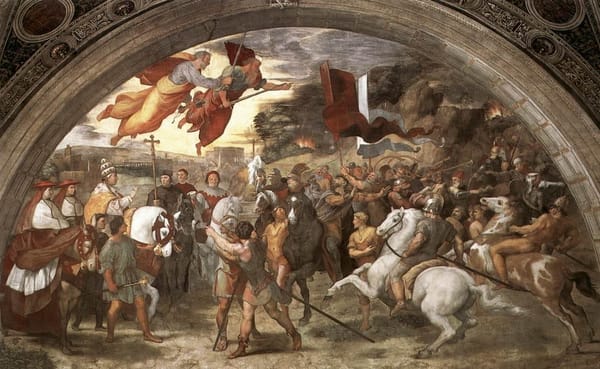
The barbarian hordes were invading the West; the Empire was little more than a ruin: and Attila, ‘the Scourge of God,’ was marching on towards Rome. Leo's majestic bearing repelled the invasion, as his word had checked the ravages of heresy. The haughty king of the Huns, before whose armies the strongest citadels had fallen, granted an audience to the Pontiff on the banks of the Mincio, and promised to spare Rome. The calm and dignity of Leo—who thus unarmed confronted the most formidable enemy of the Empire, and exposed his life for his flock—awed the barbarian, who afterwards told his people that, during the interview, he saw a venerable person standing in an attitude of defence, by the side of Rome’s intercessor: it was the Apostle St Peter. Attila not only admired, he feared the Pontiff. It was truly a sublime spectacle, and one that was full of meaning—a priest, with no arms save those of his character and virtues, forcing a king, such as Attila, to do homage to a devotedness which he could ill understand, and recognize by submission the influence of a power which had heaven on its side. Leo, singlehanded and at once, did what it took the whole of Europe several ages to accomplish in later times.
That the aureole of Leo’s glory might be complete, the Holy Ghost gifted him with an eloquence which, on account of its majesty and richness, might deservedly be called papal. The Latin language had at that time lost its ancient vigour; but we frequently come across passages in the writings of our Saint which remind us of the golden age.
In exposing the dogmas of our holy faith, he uses a style so dignified and so impregnated with the savour of sacred antiquity, that it seems made for the subject. He has several admirable sermons on the Resurrection; and speaking of the present season of the liturgical year, he says: ‘The days that intervened between our Lord's Resurrection and Ascension were not days on which nothing was done: on the contrary, great were the sacraments then confirmed, and great were the mysteries that were revealed.'1
Let us now read the sketch of the Saint’s life given by the Church in the Matins of the feast.
The Greek Church, in her Memea, has an office in honour of St Leo: we take from it the following stanzas. As they were composed before the Schism, they show us that the ancient Church of Constantinople believed the supremacy of the Roman Pontiff, and that it is not the Latins that have changed the faith. The Greeks keep the Feast of St Leo on February 18.
Hymn (Die XVIII Februarii)
Glory be to thee, O Jesus, Lion of the Tribe of Juda! that hast raised up in thy Church a Lion to defend her in those dark times, when holy Faith was most exposed to danger. Thou didst charge Peter to confirm his brethren2 and we have seen Leo, in whom Peter lived, fulfil his office with sovereign authority. We have heard the acclamation of the holy Council, which, in admiration at the heavenly teachings of Leo, proclaimed the signal favour thou didst confer on thy flock, when thou badest Peter feed both sheep and lambs.
O holy Pontiff Leo! thou worthily didst represent Peter in his Chair, whence thy apostolic teaching ceased not to flow, ever beautiful in its truth and majesty. The Church of thine own day honoured thee as the great teacher of faith; and the Church of every succeeding age has recognized thee as one of the most learned Doctors and preachers of the divine word. From thy throne in heaven, where now thou reignest, pour forth upon us the understanding of the great mystery, which thou wast called on to defend. Under thy inspired pen, this mystery grows clear; we see how sublimely it harmonizes with all other mysteries; and faith delights at gaining so close a view of the divine object of its belief. Oh! strengthen this faith within us. The Incarnate Word is blasphemed in our own times; avenge his glory, by sending us men of thy zeal and learning.
Thou didst triumph over barbarian invaders: Attila acknowledged the influence of thy sanctity and eloquence, by withdrawing his troops from the Christian land they infested. In these our days, there have risen up new barbarians—civilized barbarians, who would persuade us that religion should be eliminated from education. and that the State, in its laws and institutions, should simply ignore our Lord Jesus Christ, the King to whom all power has been given, not only in heaven but on earth also.3 Oh! help us by thy powerful intercession, for our danger is very great. Many are seduced, and have fallen into apostasy, whilst flattering themselves that they are still Christians. Pray that the light that is left within us may not be extinguished, and that the public scandals which now exist may be brought to an end. Attila was but a pagan; our modem statesmen and governments are, or at least call themselves, Christians: have pity cn them, and gain for them light to see the precipice to which they are hurrying society.
These days of Paschal Time remind thee, O holy Pontiff! of the Easters thou didst once spend here on earth, when, surrounded by the neophytes, thou gavest them the nourishment of thy magnificent discourses: pray for the faithful, who have this Easter risen to a new life with Christ. What they most need is a fuller and better knowledge of this their Saviour, in order that they may cling more closely to him, and persevere in his holy service. Thy prayers must obtain for them this knowledge; by thy prayers thou must teach them what he is both in his Divine and Human Nature: that as God he is their Last End, and their Judge after death; as Man, their Brother, their Redeemer, their Model. Bless, O Leo! and help the Pontiff who is now thy successor on the Chair of Peter. Show now thy love for that Rome whose sacred and eternal destinies were so frequently the subject of thy glowing and heavenly eloquence.
Thursday in Passion Week
The Station at Rome is in the church of Saint Apollinaris, who was a disciple of St. Peter, and afterwards bishop of Ravenna and martyr.
Collect
Epistle
Cap. iii.In diebus illis: Oravit Azarias Dominum dicens: Domine Deus noster, ne quæsumus, tradas nos in perpetuum propter nomen tuum, et ne dissipes testamentum tuum: neque auferas misericordiam tuam a nobis, propter Abraham dilectum tuum, et Isaac servum tuum, et Israel sanctum tuum; quibus locutus es, pollicens quod multiplicares semen eorum sicut stellae cœli, et sicut arenam quæ est in littore maris: quia, Domine, imminuti sumus plus quam omnes gentes, sumusque humiles in universa terra hodie propter peccata nostra. Et non est in tempore hoc princeps, et dux, et propheta, neque ho locaustum, neque sacrificium, neque oblatio, neque incensum, neque locus primitiarum coram te, ut possimus invenire misericordiam tuam: sed in animo contrito, et spiritu humilitatis suscipiamur. Sicut in holocausto arietum, et taurorum, et sicut in millibus agnorum pinguium: sic fiat sacrificium nostrum in conspectu tuo hodie, ut placeat tibi: quoniam non est confusio confidentibus in te. Et nunc sequimur te in toto corde, et timemus te, et quærimus faciem tuam. Ne confundas nos, sed fac nobiscum juxta mansuetudinem tuam, et secundum multitudinem misericordiæ tuæ. Et erue nos in mirabilibus tuis, et da gloriam nomini tuo, Domine: et confundantur omnes qui ostendunt servis tuis mala, confundantur in omnipotentia tua, et robur eorum conteratur; et sciant quia tu es Dominus Deus solus, et gloriosus super orbem terrarum, Domine Deus noster.
Ch. iii.In those days, Azarias prayed to the Lord saying: O Lord our God, deliver us not up for ever, we beseech thee, for thy name’s sake, and abolish not thy covenant: and take not away thy mercy from us, for the sake of Abraham thy beloved, and Isaac thy servant, and Israel thy holy one; to whom thou hast spoken, promising that thou wouldst multiply their seed as the stars of heaven, and as the sand that is on the sea shore. For we, O Lord, are diminished more than any nation, and are brought low in all the earth this day for our sins. Neither is there at this time prince, or leader, or prophet, or holocaust, or sacrifice, or oblation, or incense, or place of first-fruits before thee, that we may find thy mercy: nevertheless, in a contrite heart and humble spirit, let us be accepted. As in holocausts of rams, and bullocks, and as in thousands of fat lambs: so let our sacrifice be made in thy sight this day, that it may please thee: for there is no confusion to them that trust in thee. And now we follow thee with all our heart, and we fear thee, and seek thy face. Put us not to confusion, but deal with us according to thy meekness, and according to the multitude of thy mercies. And deliver us according to thy wonderful works, and give glory to thy name, O Lord; and let all them be confounded that show evils to thy servants, let them be confounded in all thy might, and let their strength be broken; and let them know that thou art the Lord, the only God, and glorious over all the world, O Lord our God.
Thus did Juda, when captive in Babylon, pour forth her prayers to God, by the mouth of Azarias. Sion was desolate beyond measure; her people were in exile; her solemnities were hushed. Her children were to continue in a strange land for seventy years; after which God would be mindful of them, and lead them, by the hand of Cyrus, back to Jerusalem, when the building of the second temple would be begun, that temple which was to receive the Messias within its walls. What crime had Juda committed, that she should be thus severely punished? The daughter of Sion had fallen into idolatry; she had broken the sacred engagements which made her the bride of her God. Her crime, however, was expiated by these seventy years of captivity; and when she returned to the land of her fathers, she never relapsed into the worship of false gods. When the Son of God came to dwell in her, He found her innocent of idolatry. But scarcely had forty years elapsed after the Ascension of this divine Redeemer, than Juda was again an exile; not, indeed, led captive into Babylon, but dispersed in every nation under the sun, after having first seen the massacre of thousands of her children. This time it is not merely for seventy years, but for eighteen centuries, that she is without prince, or leader, or prophet, or holocaust, or sacrifice, or temple. Her new crime must be greater than idolatry; for, after all these long ages of suffering and humiliation, the justice of the Father is not appeased! It is, because the Blood that was shed by the Jewish people on Calvary was not the blood of a man—it was the Blood of a God. The very sight of the chastisement inflicted on the murderers proclaims to the world that they were deicides. Their crime was an unparalleled one; its punishment is to be so too; it is to last till the end of time, when God, for the sake of Abraham His beloved, and Isaac His servant, and Jacob His holy one, will visit Juda with an extraordinary grace, and her conversion will console the Church, whose affliction is then to be great by reason of the apostasy of many of her children. This spectacle of a whole people bearing on itself the curse of God for having crucified the Son of God, should make a Christian tremble for himself. It teaches him that divine justice is terrible, and that the Father demands an account of the Blood of His Son, even to the last drop, from those that shed it. Let us lose no time, but go at once, and, in this precious Blood, cleanse ourselves from the share we have had in the sin of the Jews; and, throwing off the chains of iniquity, let us imitate those among them whom we see, from time to time, separating themselves from their people and returning to the Messias: let us, also, be converts, and turn to that Jesus, whose hands are stretched out on the cross, ever ready to receive the humble penitent.
Gospel
Cap. vii.In illo tempore: Rogabat Jesum quidam de pharisæis, ut manducaret cum illo. Et ingressus domum pharisæi, discubuit. Et ecce mulier quæ erat in civitate peccatrix, ut cognovit quod accubuisset in domo pharisæi, attulit alabastrum unguenti; et stans retro secus pedes ejus, lacrymis cœpit rigare pedes ejus, et capillis capitis sui tergebat, et osculabatur pedes ejus, et unguento ungebat. Videns autem pharisæus, qui vocaverat eum, ait intra se dicens: Hic si esset Propheta sciret utique, quæ, et qualis est mulier, quæ tangit eum: quia peccatrix est. Et respondens Jesus, dixit ad illum: Simon, habeo tibi aliquid dicere. At ille ait: Magieter, dic. Duo debitores erant cuidam fœneratori: unus debebat denarios quingentos, et alius quinquaginta. Non habentibus illis unde redderent, donavit utrisque. Quis ergo eum plus diligit? Respondens Simon, dixit: Æstimo quia is, cui plus donavit. At ille dixit ei: Recte judicasti. Et conversus ad mulierem, dixit Simoni: Vides hanc mulierem? Intravi in domum tuam: aquam pedibus meis non dedisti; hæc autem lacrymis rigavit pedes meos, et capillis suis tersit. Osculum mihi non dedisti; hæc autem ex quo intravit, non cessavit osculari pedes meos. Oleo caput meum non unxisti; hæc autem unguento unxit pedes meos. Propter quod dico tibi: Remittuntur ei peccata multa, quoniam dilexit multum. Cui autem minus dimittitur, minus diligit. Dixit autem ad illam: Remittuntur tibi peccata. Et coeperunt qui simul accumbebant, dicere intra se: Quis est hic, qui etiam peccata dimittit? Dixit autem ad mulierem: Fides tua te salvam fecit: vade in pace.
Ch. vii.At that time: one of the pharisees desired him to eat with him. And he went into the house of the pharisee, and sat down to meat. And behold a woman that was in the city, a sinner, when she knew that he sat at meat in the pharisee's house, brought an alabaster box of ointment; and standing behind at his feet, she began to wash his feet with tears, and wiped them with the hairs of her head, and kissed his feet, and anointed them with the ointment. And the pharisee, who had invited him, seeing it, spoke within himself, saying: This man, if he were a prophet, would know surely who and what manner of woman this is that touches him, that she is a sinner. And Jesus answering, said to him: Simon, I have somewhat to say to thee. But he said: Master, say it. A certain creditor had two debtors: the one owed him five hundred pence, and the other fifty. And whereas they had not wherewith to pay, he forgave them both. Which therefore of the two loveth him most? Simon answering, said: I suppose that he to whom he forgave most. And he said to him: Thou hast judged rightly. And turning to the woman, he said unto Simon: Dost thou see this woman? I entered into thy house; thou gavest me no water for my feet, but she with tears hath washed my feet and with her hairs hath wiped them. Thou gavest me no kiss; but she, since she came in, hath not ceased to kiss my feet. My head with oil thou didst not anoint; but she with ointment hath anointed my feet. Wherefore I say to thee: Many sins are forgiven her, because she hath loved much. But to whom less is forgiven, he loveth less. And he said to her: Thy sins are forgiven thee. And they that sat at meat with him began to say within themselves; Who is this that forgiveth sins also? And he said to the woman: Thy faith hath made thee safe: go in peace.
What consolation there is for us in this Gospel, and how different are the reflections it suggests, from those we were just making upon the Epistle! The event here related does not belong to the time of our Saviour’s Passion; but, during these days of mercy, does it not behove us to glorify the meekness of that divine Heart, which is preparing to grant pardon to countless sinners throughout the world? Besides, is not Magdalene the inseparable companion of her dear crucified Master, even to Calvary? Let us, then, study this admirable penitent, this type of love faithful even to death.
Magdalene had led a wicked life: as the Gospel tells us elsewhere,1 seven devils had taken up their abode within her. But, no sooner has she seen and heard Jesus, than immediately she is filled with a horror for sin; divine love is enkindled within her heart; she has but one desire: to make amends for her past life. Her sins have been public: her conversion must be so too. She has lived in vanity and luxury; she is resolved to give all up. Her perfumes are all to be for her God, her Jesus; that hair of hers, of which she has been so proud, shall serve to wipe His sacred feet; her eyes shall henceforth spend themselves in shedding tears of contrite love. The grace of the Holy Ghost urges her to go to Jesus. He is in the house of a pharisee, who is giving an entertainment. To go to Him now would be exposing herself to observation. She cares not. Taking with her an ointment of great worth, she makes her way in to the feast, throws herself at Jesus’ feet, washes them with her tears, wipes them with the hair of her head, kisses them, anoints them with the ointment. Jesus Himself tells us with what interior sentiments she accompanies these outward acts of respect: but even had He not spoken, her tears, her generosity, her position at His feet, tell us enough; she is heartbroken, she is grateful, she is humble: who but a pharisee could have mistaken her?
The pharisee, then is shocked! His heart has within it much of that Jewish pride which is soon to crucify the Messias. He looks disdainfully at Magdalene; he is disappointed with his Guest, and murmurs out his conclusion: This man, if He were a Prophet would surely know who and what manner of woman this is! Poor pharisee! If he had the spirit of God within him, he would recognize Jesus to be the promised Saviour, by this wonderful condescension shown to a penitent. With all his reputation as a pharisee, how contemptible he is compared with this woman! Jesus would give him a useful lesson, and draws the parallel between the two—Magdalene and the pharisee. He passes His own divine judgment on them, and the preference is given to Magdalene. What is it that has thus transformed her, and made her deserve, not only the pardon, but the praise, of Jesus? Her love: She hath loved her Redeemer, she hath loved Him much; and, therefore, she was forgiven much. A few hours ago this Magdalene loved but the world and its pleasures; now, she cares for nothing, sees nothing, loves nothing, but Jesus; she is a convert. Henceforward she keeps close to her divine Master; she is ambitious to supply His wants; but, above all, she longs to see and hear Him. When the hour of trial shall come, and His very apostles dare not be with Him, she will follow Him to Calvary, stand at the foot of the cross, and see Him die who has made her live. What an argument for hope is here, even for the worst of sinners! He to whom most is forgiven, is often the most fervent in love! You, then, whose souls are burdened with sins, think of your sins and confess them; but, most of all, think how you may most love. Let your love be in proportion to your pardon, and doubt it not: Your sins shall be forgiven.
Let us close this Thursday of Passion-week with the following devout hymn, taken from the Mozarabic breviary.
Hymn
Agnus Dei peccata mundi auferens;
Ad te venimus cernui, ut inclytum
Bibamus almæ Passionis sanguinem.
Exsurgat insignis crucis fortissimum
Signum, quod in vigore perpetim manens,
Credentibus salvationem conferat.
Corona spinarum, flagella, lancea,
Impressa sunt damnationis verbera:
Jam nostra pro his cuncta dele crimina.
Lavet cruor malitiæque contagia:
Sit vita præsens absque omni crimine:
Futura detur in beato munere.
Orbique regni claritas illuxerit,
Sequamur ætheris viam quæ nos trahat
In se receptos jam perennes incolas.
Uni Patri, ejusque soli Filio
Cum Spiritu; quæ Trinitas perenniter
Vivit potens in sæculorum sæculis.
to thee do we come, and, in prostrate adoration, beseech thee to give us
to drink of the Blood shed for us in thy sacred Passion.
Let the invincible standard of thy glorious cross be raised on high,
and, by its imperishable power,
bring salvation to them that believe.
the crown of thorns, the whips, the spear
—these were the instruments of thy sufferings:
oh! cleanse us by them from all our sins.
flow on our hearts and purify them from their stains of guilt,
enable us to pass through this world without sin,
and give us, in the next, the reward of bliss.
brightening it with the splendours of the eternal kingdom,
we may ascend by the path that leads above,
and dwell in heaven, citizens eternal.
to the one Father, and to his only Son,
together with the Holy Ghost: the almighty Trinity,
that liveth unceasingly for ever and ever.
Let us again borrow from the Greek Church the expression of our devotion to the holy cross.
Hymn (Feria V. mediæ Septimanæ)
| Previous Wednesday in Passion Week | Next Thursday in Passion Week |