Daily reading
Semidouble · Movable from Easter · Temporal
April 13, 2019
From Dom Guéranger’s The Liturgical Year.
Saturday in Passion Week
To-day we begin, as does the holy Gospel, to number the days which precede the death, the sacrifice, of the Lamb of God. St. John, in the twelfth chapter of his Gospel, tells us that this is the sixth day before the Pasch.
Jesus is in Bethania, where a feast is being given in His honour. Lazarus, whom Jesus has restored to life, is present at this repast, which is given in the house of Simon the leper. Martha is busy looking after the various arrangements; her sister, Mary Magdalene, has a heavenly presentiment that the death and burial of her beloved Master are soon to be, and she has poured upon Him a precious perfume. The holy Gospel, which ever preserves such a mysterious reserve with regard to the Mother of Jesus, does not tell us that Mary was at Bethania on this occasion, but there can be no doubt of her being present. The apostles were also there, and partook of the repast. Whilst the friends of our Saviour are thus grouped around Him, in this village, which is about two thousand paces from Jerusalem, the aspect of the faithless city becomes more and more threatening; and yet, though His disciples are not aware of it, Jesus is to enter the city to-morrow, and in a most public manner. The heart of Mary is a prey to sadness; Magdalene is absorbed in grief; everything announces that the fatal day is near.
The Church has reserved for Monday next the Gospel which relates the history of this Saturday. The reason is that, formerly, and up to the twelfth century, there was no Station held on this day in Rome: it was left free, in order that the Pope might rest before the great fatigues of Holy Week, whose long and solemn services were to begin on the morrow. But, although he did not preside over the assembly of the faithful, he had to observe two usages, which had been handed down by tradition, and had almost become of liturgical importance in the Church at Rome.
During the whole year, the Pope used, every Sunday, to send a portion of the sacred Species consecrated by him, to each of the priests of the presbyterial titles, or parochial churches of the city. But it was to-day that this distribution was made for the whole of Holy Week, perhaps on account of to-morrow’s long service. We know from the ancient liturgical books of Rome, that it was in the Lateran consistory that to-day’s sacred distribution was made, and it is probable (as the blessed Cardinal Tommasi and Benedict XIV tell us) that the bishops of the suburbicarian churches were of the number of those who received it. We have several instances proving that, formerly, bishops occasionally sent to one another the blessed Sacrament, as a sign of the union that existed between them. With regard to the priests of the city parochial churches, to whom a Particle was sent by the Pope, they put a portion of it in the chalice before receiving the precious Blood.
The other custom, peculiar to this day, consisted in giving alms to all the poor. The Pope presided at this distribution, which was no doubt made ample enough to last the whole of the coming week, when, on account of the long ceremonies, it would scarcely be possible to attend to individual cases of poverty. The liturgists of the middle-ages allude to the beautiful appropriateness of the Roman Pontiff’s distributing alms with his own hand to the poor, on this day, the same on which Mary Magdalene embalmed with her perfumes the feet of Jesus.
Since the twelfth century, a Station has been assigned to this Saturday; it takes place in the Church of St. John before the Latin Gate. This ancient basilica is built near the spot where the beloved disciple was, by Domitian’s order, plunged into the cauldron of boiling oil.
Collect
Epistle
Cap. xviii.In diebus illis: Dixerunt impii Judæi ad invicem: Venite, et cogitemus contra Justum cogitationes: non enim peribit lex a sacerdote, neque consilium a sapiente, nec sermo a propheta: venite, et percutiamus eum lingua, et non attendamus ad universos sermones ejus. Attende, Domine, ad me; et audi vocem adversariorum meorum. Numquid redditur pro bono malum, quia foderunt foveam animæ meæ? Recordare quod steterim in conspectu tuo, ut loquerer pro eis bonum, et averterem indignationem tuam ab eis. Propterea da filios eorum in famem, et deduc eos in manus gladii; fiant uxores eorum absque liberis, et viduæ: et viri earum interficiantur morte: juvenes eorum confodiantur gladio in prælio. Audiatur clamor de domibus eorum: adduces enim super eos latronem repente: quia foderunt foveam ut caperent me, et laqueos absconderunt pedibus meis. Tu autem, Domine, scis omne consilium eorum adversum me in mortem: ne propitieris iniquitati eorum, et peccatum eorum a facie tua non deleatur: fiant comientes in conspectu tuo, in tempore furoris tui abutere eis, Domine Deus noster.
Ch. xviii.In those days, the wicked Jews said to one another: Come, and let us invent devices against the Just: for the law shall not perish from the priest, nor counsel from the wise, nor the word from the prophet. Come, and let us strike him with the tongue, and let us give no heed to all his words. Give heed to me, O Lord, and hear the voice of my adversaries. Shall evil be rendered for good, because they have digged a pit for my soul? Remember that I have stood in thy sight to speak good for them, and to turn away thy indignation from them. Therefore deliver up their children to famine, and bring them into the hands of the sword; let their wives be bereaved of children, and widows; and let their husbands be slain by death; let their young men be stabbed with the sword in battle. Let a cry be heard out of their houses; for thou shalt bring the robber upon them suddenly, because they have digged a pit to take me, and have hid snares for my feet. But thou, O Lord, knowest all their counsel against me unto death; forgive not their iniquity, and let not their sin be blotted out from thy sight: let them be overthrown before thy eyes, in the time of thy wrath do thou destroy them, O Lord our God.
It makes us tremble to read these awful anathemas, which Jeremias, the figure of Christ, speaks against his enemies, the Jews. This prophecy, which was literally fulfilled at the first destruction of Jerusalem by the Assyrians, received a more terrible fulfilment at the second visitation of God’s anger upon this city of malediction. This time, it was not because the Jews had persecuted a prophet; it was because they had rejected and crucified the very Son of God. It was to their long-expected Messias that they had rendered evil for good. It was not a saint, like Jeremias, that had spoken good for them to the Lord, and besought Him to turn away His indignation from them; the Man-God Himself had, without ceasing, made intercession for them, and treated them with the tenderest mercy. But all was in vain; this ungrateful people seemed to hate their divine Benefactor in proportion to His love for them; and at length, in the transport of their fury, they cried out: ‘His Blood be upon us and upon our children!’1 What a frightful chastisement they entailed on themselves by this imprecation! God heard and remembered. Alas! the sinner, who knows Jesus and the worth of His Blood, yet who again sheds this precious Blood, does not he expose himself to the severity of that same justice which fell so heavily on the Jews? Let us tremble and pray: let us implore the divine mercy in favour of those many obstinately blind and hardened sinners, who are hastening to destruction. Oh! that by the fervour of our supplications addressed to the merciful Heart of our common Redeemer, we could obtain a reversion of their sentence, and secure them pardon!
Gospel
Cap. xii.In illo tempore: Cogitaverunt principes sacerdotum, ut et Lazarum interficerent: quia multi propter ilium abibant ex Judæis, et credebant in Jesum. In crastinum autem turba multa, quæ venerat ad diem festum, cum audissent quia venit Jesus Jerosolymam: acceperunt ramos palmarum, et processerunt obviam ei, et clamabant: Hosanna: benedictus qui venit in nomine Domini, Rex Israel. Et invenit Jesus asellum, et sedit super eum, sicut scriptum est: Noli timere, filia Sion: ecce Rex tuus venit sedens super pullum asinæ. Hæc non cognoverunt discipuli ejus primum: sed quando glorificatus est Jesus, tunc recordati sunt quia hæcerant scripta de eo: et hæc fecerunt ei.
Testimonium ergo perhibebat turba, quæ erat cum eo quando Lazarum vocavit de monumento, et suscitavit eum a mortuis. Propterea et obviam venit ei turba: quia audierunt eum fecisse hoc signum. Pharisæi ergo dixerunt ad semetipsos: Videtie quia nihil proficimus? Ecce mundus totus post eum abiit. Erant autem quidam Gentiles ex his, qui ascenderant ut adorarent in die festo. Hi ergo accesserunt ad Philippum, qui erat a Bethsaida Galilææ, et rogabant eum, dicentes: Domine, volumus Jesum videre. Venit Philippus, et dicit Andreæ: Andreas rursum et Philippus dixerunt Jesu.
Ch. xii.At that time: The chief priests thought to kill Lazarus also, because many of the Jews by reason of him went away, and believed in Jesus. And on the next day a great multitude, that was come to the festival day, when they had heard that Jesus was coming to Jerusalem, took branches of palm trees, and went forth to meet him, and cried: Hosanna, blessed is he that cometh in the name of the Lord, the King of Israel! And Jesus found a young ass, and sat upon it, as it is written: Fear not, daughter of Sion; behold thy king cometh sitting on an ass’s colt. These things his disciples did not know at first; but when Jesus was glorified, they then remembered that these things were written of him, and that they had done these things to him.
The multitude therefore gave testimony, which was with him, when he called Lazarus out of the grave, and raised him from the dead. For which reason also the people came to meet him, because they heard that he had done this miracle. The pharisees therefore said among themselves: Do you see that we prevail nothing? behold the whole world is gone after him. Now there were certain Gentiles among them, who came up to adore on the festival day. These therefore came to Philip, who was of Bethsaida of Galilee, and desired him saying: Sir, we would see Jesus. Philip cometh, and telleth Andrew. Again Andrew and Philip told Jesus.
The enemies of Jesus have come to that pitch of hatred, which robs a man of his senses. Lazarus, who has been restored from death to life, is here standing before them; and instead of his resuscitation convincing them of Jesus’ being the Messias, it sets them thinking how best to make away with this irresistible witness. O senseless men! that Jesus who raised him to life when dead, can again bring him to life if you murder him. Jesus’ triumphant entry into Jerusalem, which we are solemnly to commemorate to-morrow, adds to their jealousy and hatred. Behold! say they, 'We prevail nothing: the whole world goes after Him.' Alas! this ovation is to be soon followed by one of those reverses to which a populace is so subject. Meanwhile, however, we have certain Gentiles who desire to see Jesus. It is the beginning of the fulfilment of Jesus’ prophecy: ‘The kingdom of God shall be taken from you, and shall be given to a nation yielding the fruits thereof.’2 Then shall the Son of man be glorified; then shall all nations, by their humble homage to the Crucified, protest against the sinful blindness of the Jews. But, before this comes to pass, it is requisite that the divine Wheat be cast into the ground, and die. Then, the glorious harvest; and the beautiful seed shall yield a hundredfold.
And yet, Jesus feels, in His human nature, a momentary fear at the thought of this death He is to undergo. It is not the agony in the garden; it is a trouble of soul. Let us listen to His words: 'Father! save Me from this hour.' It is our God who foresees all that He is about to suffer for our sake, and it fills Him with fear: He asks to be freed from it, though His will has decreed and accepted it. He immediately adds: 'But for this cause I came unto this hour: Father! glorify Thy name.' His soul is now calm; He once more accepts the hard conditions of our salvation. After this, His words bespeak a triumph; by virtue of the sacrifice about to be offered, satan shall be dethroned: the prince of this world shall be cast out. But the defeat of satan is not the only fruit of our Saviour’s immolation: man, earthly and depraved creature as he is, is to be raised from this earth to heaven. The Son of God is to be the heavenly loadstone, attracting man to Himself: 'And I, if I be lifted up from the earth, will draw all things to Myself.' He forgets His sufferings, and the terrible death which just now troubled Him; He thinks but of the defeat of our implacable enemy, and of our being saved and glorified by His cross. These few words reveal the whole Heart of our Redeemer: if we attentively weigh them, they will suffice to inflame us with devotion as we celebrate the ineffable mysteries of Holy Week.
Let us sue for mercy from the Saviour of our souls, in these words of supplication used in the Gothic liturgy of Spain.
Supplication
(Feria VI Dominicæ V)
The following sequence, in praise of Mary, is most appropriate for this Saturday of Passion-week. It sweetly blends together the homages we owe to the cross of Jesus and to the dolours of Mary. We have taken it from the Horæ of the sixth century.
Sequence
Qui vitam amisimus
Fructu ligni vetiti.
Qui fructum non viderit
Adhærentem stipiti.
Pendet, sicut creditur,
Virginis ad ubera.
Inter viros scelerum,
Passus quinque vulnera.
Hic crux salutifera:
Ambo ligna mystica.
Illa cedrue nobilis:
Utraque vivifica.
Quo me vertam nescio.
Dulcis est collatio.
Modis vagit variis.
Complexurus omnia.
Novit hic tenere.
Nescit hie latere.
Pascitur ab ubere.
Pascit nos ex vulnere.
Fructu nos reficiens.
Fructum nobis nutriens.
Finalis sententia.
Quod nemo consequitur
Unam sine alia.
Nec sic Matrem deserit:
Cuna ad crucem venerit,
Matrem ibi poterit
Stantem invenire.
Crucem prorsus abigit,
Si modum intelligit
Quo per Matrem contigit
Gladium transire.
Matris crucifixæ,
Nos de cruce respice,
Fili crucifixe.
Fructus ligni vitæ,
Nos teipso refice,
Nobis da frui te.
lost our life,
now seek the tree of life.
who sees the branch
whereon is fixed the fruit.
that the fruit, that gives us life,
hangs on Mary’s breast.
between two thieves,
though here he is pierced with five wounds.
and the saving cross,
both are mystic trees;
Mary, noble as the cedar:
both are trees of life.
I know not to which to turn.
O sweet comparison!
a weeping little Babe;
calling all to his embrace.
sweet to a Mother’s love;
too ardent to be hid.
he is fed at her breast;
he feeds us from his wounds.
the food of its refreshing fruit;
feeding the very fruit, feeding him for us.
is my decision:
we cannot have the one
without the other.
must have the Mother;
for when he comes to the cross,
he will find the Mother
standing at the foot.
meets the cross as well,
for it was while standing at the cross,
that the Mother’s heart
was pierced.
of a crucified Mother!
look upon us
from thy cross.
O fruit of the tree of life!
refresh us with thyself,
give us the enjoyment of thine own dear self.
April 13: St. Hermenegild, Martyr
|
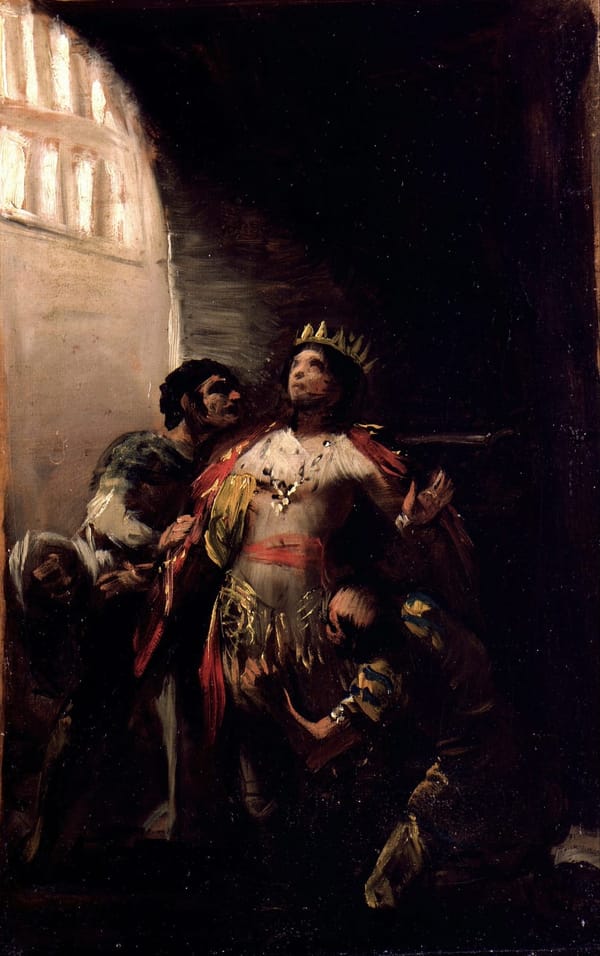
IT is through a martyr's palm-branch that we must to-day see the Paschal Mystery. Hermenegild, a young Visigoth prince, is put to death by his heretical father, because he courageously refused to receive his Easter Communion from an Arian bishop. The martyr knew that the Eucharist is the sacred symbol of Catholic unity; and that we are not allowed to approach the Holy Table in company with those who are not in the true Church. A sacrilegious consecration gives heretics the real possession of the divine Mystery, if the priestly character be in him who dares to offer sacrifice to the God whom he blasphemes; but the Catholic, who knows that he may not so much as pray with heretics, shudders at the sight of the profanation, and would rather die than share by his presence in insulting our Redeemer in that very Sacrifice and Sacrament which were instituted that we might all be made one in God.
The blood of the martyr produced its fruit: Spain threw off the chains of heresy that had enslaved her, and a Council, held at Toledo, completed the work of conversion begun by Hermenegild's sacrifice. There are very few instances recorded in history of a whole nation rising up as one man to abjure heresy; but Spain did it, for she seems to be a country on which heaven lavishes exceptional blessings. Shortly after this she was put through the ordeal of the Saracen invasion; she triumphed here again by the bravery of her children; and ever since then, her faith has been so staunch and so pure as to merit for her the proud title of The Catholic Kingdom.
St Gregory the Great, a contemporary of St Hermenegild, has transmitted to us the following account of the martyrdom. The Church has inserted it in her Lessons of today's Matins.
Pope Urban VIII composed the two following hymns for the feast of the holy martyr: we unite them under one conclusion.
Hymn
Hermenegilde jubar, gloria Martyrum,
Christi quos amor almis
Cœli cœtibus inserit.
Deo Servans obsequium! quo potius tibi
Nil proponis, et arces
Cautus noxia, quæ placent.
Surgentis vitii, non dubios agens
Per vestigia gressus
Quo veri via dirigit!
Non vitæ caperis divitis otio,
Gemmarumve nitore,
Regnandive cupidine.
Nec terret perimens carnificis furor:
Nam mansura caducis
Præfers gaudia cœlitum.
Clemens, atque preces, dum canimus tua
Quæsitam nece palmam,
Pronis auribus excipe.
Et natum celebrent ora precantium,
Divinumque supremis
Flamen laudibus efferant.
Hermenegild, as one of its glories:
so, too, do the martyrs,
whose love of Christ has numbered them among the blessed of heaven.
He was dear to thee above all things else;
and as to the dangerous pleasures of this world,
thou wisely didst reject them.
which excite and foster vice,
and march onwards, with unfaltering step,
whither the path of truth leads.
The luxuries of a life of ease and wealth,
the glitter of diamonds, the prospect of a throne
—they could not allure thee.
nor by the executioner's merciless rage;
for the everlasting joys of heaven
were dearer to thee than those of time.
from thy heavenly throne,
and graciously receive the prayers we present to thee
whilst celebrating the palm made thine by martyrdom.
Let the faithful assembled here in prayer, glorify the Son;
let them sing forth endless praise
to the Holy Ghost.
We offer thee, O brave witness to the truth of our holy faith! our admiration and gratitude. Thy courageous death was proof of the love thou hadst for Christ; and thy contempt of earthly honours teaches us to despise them. Though thou wert heir to a throne, a prison was thy abode here below. It was thence that thou didst ascend to heaven, wearing on thy brow the laurels of martyrdom, a crown far brighter than that which was offered thee on condition of thy apostatizing from the faith. Pray now for us: the Church asks it of thee, by inserting thy name in the Calendar of her Saints. The Pasch was the day of thy triumph; obtain for us that this may be a true Pasch to us, a real resurrection. which may lead us to the heaven above, where we may enjoy with thee the sight of our Risen Jesus. Intercede for us, that we may be firm in the faith, obedient to the teachings of holy Church, and enemies of every error and innovation. Protect Spain, thy fatherland, which owes to thy martyrdom long centuries of loyalty to the true faith. Pray for her, that she may ever continue to merit her glorious title of Catholic Kingdom.
| Previous Friday in Passion Week: The Seven Dolours of the Blessed Virgin | Next April 13: St. Hermenegild, Martyr |