Daily reading
Holy Week
Double of the I Class · Movable from Easter · Temporal
April 18, 2019
From Dom Guéranger’s The Liturgical Year.

|
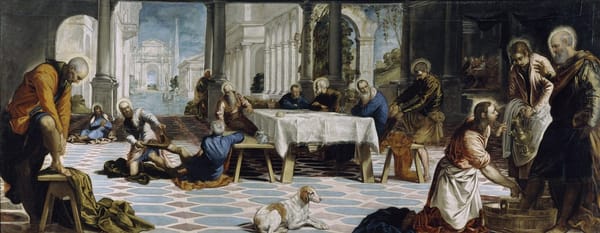
Maundy Thursday
Including descriptions of the following:
- Reconciliation of Penitents
- Blessing of the Holy Oils
- Mass of Maundy Thursday
- Vespers of Maundy Thursday
- Stripping of the Altars
- Washing of the Feet
- Tenebrae of Good Friday (but is given in detail in a separate article)
This is the first day of the Azymes, or feast of the unleavened bread. At sunset, the Jews must eat the Pasch in Jerusalem. Jesus is still in Bethania; but He will return to the city before the hour for the paschal supper. The Law commands this; and, until He has abrogated the Law by the shedding of His Blood, He wishes to observe its ordinances. He therefore sends two of His disciples to get everything ready for the Pasch, without, however, telling them the great mystery wherewith it is to terminate. We, who know that at this last Supper was instituted the Sacrament of the Eucharist, can understand why He sends Peter and John, in preference to any of the other disciples, to prepare what is needed.1 Peter, who was the first to confess the Divinity of Jesus, represents faith: and John, who leaned upon the breast of the Man-God, represents love. The mystery, which is to be instituted at to-night’s Supper, is revealed to love by faith. It is this that Jesus would have us learn from His choice of the two apostles; but they themselves see not the intention of their Master.
Jesus, who knows all things, tells them by what sign they are to know the house, which He intends to honour with His presence: they have but to follow a man, whom they will see carrying a pitcher of water. The house to which this man is going belongs to a rich Jew, who recognizes Jesus as the Messias. The two apostles apprise him of their Master’s wishes; and immediately he puts at their disposal a large and richly furnished room. It was fitting that the place where the most august mystery was to be instituted should be something above the common. This room, where the reality was to be substituted for all the ancient figures, was far superior to the temple of Jerusalem. In it was to be erected the first altar for the offering up of the clean oblation foretold by the prophet;2 in it was to commence the Christian priesthood; in it, finally, fifty days later on, the Church of Christ, collected together and visited by the Holy Ghost, was to make herself known to the world, and promulgate the new and universal Covenant of God with men. This favoured sanctuary of our faith is still venerated on Mount Sion. The infidels have profaned it by their false worship, for even they look on it as a sacred place; but, as though divine Providence, which has mercifully preserved unto us so many traces of our Redeemer, would give us an earnest of better days to come, this venerable sanctuary has recently been thrown open to several priests of the Church, and they have even been permitted to offer up the holy Sacrifice in the very place where the holy Eucharist was instituted.
During the course of the day, Jesus has entered Jerusalem, with the rest of His disciples: He has found all things prepared.
The Paschal Lamb, after being first presented in the temple, has been brought to the house, where Jesus is to celebrate the Supper; it is prepared together with the wild lettuce and the unleavened bread.
In a few hours, the divine Master and His disciples will be standing round the table, their loins girt, and staves in their hands: and, for the last time, they will observe the solemn rite prescribed by God to His people when they first went forth from Egypt.
But let us wait for the hour of Mass, before going further into the details of this last Supper. Meanwhile, let us seek edifioation and instruction in two holy functions, which belong to this great day. The first is the reconciliation of penitents, which, although not now in use, needs to be described, in order that our readers may have a proper idea of the lenten liturgy. The second is the consecration of the holy oils, which is a ceremony confined to cathedral churches, but so interesting to the faithful that we should have scrupled to exclude it from our volume. After having briefly described these, we will return to the history of the institution of the blessed Sacrament, and assist at Mass. Then we shall have to speak of the preparation for the Mass of the Presanctified for to-morrow’s service, of the stripping of the altars, and of the Mandatum, or washing of the feet. We proceed, therefore, to explain these several ceremonies, which make Maundy Thursday to be one of the most sacred days of the liturgical year.
THE RECONCILIATION OF PENITENTS
Three solemn Masses were anciently celebrated on this day; and the first was preceded by the absolution of the public penitents, and their readmission into the Church. The following was the order of the service for the reconciliation of penitents. They presented themselves at the church door, clad in penitential garb, and bare-footed. The hair of both head and beard had been allowed to grow from Ash Wednesday, the day on which they had received their penance. The bishop recited, in the sanctuary, the seven psalms in which David expresses his sorrow for having offended God. These were followed by the litany of the saints.
During these prayers the penitents were prostrate in the porch, for entrance into the church was forbidden them. Thrice during the litany the bishop deputed some of the clergy to go and visit them, in his name, and bear them words of hope and consolation. The first time, two subdeacons went to them and said: ‘As I live, saith the Lord, I will not the death of the sinner, but rather that he be converted and live.’ The second time, two other subdeacons were sent, with this message: ‘Thus saith the Lord: Do penance; for the kingdom of heaven is at hand.’ Finally, a deacon was commissioned to go to them and say: ‘Lift up your heads: lo! your redemption is nigh.’
After these announcements of approaching pardon, the bishop left the sanctuary and went towards the penitents, as far as half way down the centre nave, where was prepared a seat, turned towards the door which led into the porch where the penitents were still lying prostrate. The pontiff being seated, the archdeacon addressed him in these words:
Venerable pontiff! The acceptable time has come, the day of God’s mercy and of man’s salvation, when death was destroyed, and eternal life began. This is the time when, in the vineyard of the Lord of Sabaoth, new plants are to be set, and the detestableness of the old growth is to be pruned away. For though there is no period of time, which is not rich in the goodness and mercy of God, yet now indulgence produces a more abundant remission of sins, and grace yields a more plentiful number of the regenerated. Those that are regenerated add to our ranks; those that return, increase our numbers. There is a laver of water; there is a laver of tears. From the one, there is joy because of the admittance of them that are called; from the other, there is gladness because of them that repent. Therefore it is that these thy suppliant servants—after having fallen into sundry kinds of sins, by the neglect of the divine commandments, and the transgression of the moral law—humbled and prostrate, cry out to the Lord in these words of the prophet: ‘We have sinned: we have done unjustly; we have committed iniquity: have mercy on us, O Lord!’ It has not been in vain, that they have heard the words of the Gospel: Blessed are they that mourn; for they shall be comforted. As it is written, they have eaten the bread of sorrow; they have watered their couch with tears; they have afflicted their hearts with mourning, and their bodies with fasting, that thus they might recover the health of soul, which they had lost. The grace of penance, therefore, is one; but it profits each one that receives it, and gives help to all in common.
The bishop then rose, and advanced towards the penitents. He spoke to them concerning the mercy of God, and how they should live for the time to come. After this exhortation, he thus addressed them: ‘Come, come, come, my children! I will teach you the fear of the Lord.’ The choir then sang this antiphon, taken from Psalm xxxiii: ‘Come ye to Him and be enlightened, and your faces shall not be confounded.’ Hereupon, the penitents rose up, and, coming to the bishop, threw themselves at his feet. The archpriest then pleaded for them in these words:
Make good in them, O apostolic pontiff, all that has been corrupted in them by the temptation of the devil. By the merit of thy prayers and intercession, and by the grace of the divine reconciliation, bring these men nigh unto God. Thus they, who heretofore suffered by the sins they committed, may now be happy in the hope that, having overcome the author of their death, they may please the Lord in. the land of the living.
The bishop answered: ‘Knowest thou, if they be worthy of reconciliation?’ The archpriest replied: ‘I know and bear witness, that they are worthy.’ A deacon then ordered the penitents to rise. This done, the bishop took one of them by the hand, who did the same to his neighbour; and thus all, hand in hand, followed the bishop to the place prepared in the centre of the nave. Meanwhile, the choir sang the following antiphons: ‘I say unto you, there is joy to the angels of God over one sinner doing penance. It behoveth thee, my son, to rejoice; for thy brother was dead, and has come to life again; he was lost, and is found.’ The bishop then offered up to God this prayer, which he sang to the solemn tone of the Preface.
It is truly meet and just, right and available to salvation, that we should always and in all places give thanks to thee, O holy Lord, almighty Father, eternal God, through Christ our Lord: whom thou, almighty Father, didst will to be born among us by an ineffable birth, that so he might pay to thee, his eternal Father, the debt contracted by Adam, and put our death to death by his own, and bear our wounds in his own flesh, and cleanse away our stains by his Blood; hereby enabling us, who had fallen by the envy of the old enemy, to rise again by his mercy. Through him, O Lord, we suppliantly beseech and pray thee that thou graciously hear us making intercession for the sins of others, who are not worthy to plead for our own. Do thou, O most merciful Lord, recall to thyself, with thy wonted goodness, these thy servants, who have separated themselves from thee by their sins. For neither didst thou reject the most wicked Achab when he humbled himself before thee, but didst avert from him the punishment he had deserved. So, likewise, didst thou graciously hear Peter, when he wept, and didst afterwards give to him the keys of the kingdom of heaven; and thou didst promise the reward of that same kingdom to the thief when he trusted in thee. Therefore, O most merciful Lord! mercifully welcome back these for whom we offer to thee our prayers, and restore them to the bosom of the Church, that the enemy may not triumph over them, but that they may be reconciled unto thee by thy coequal Son, and by him be cleansed from their guilt, and graciously admitted by him to the banquet of thy most holy Supper. May he in such wise refresh them by his Flesh and Blood, as to lead them, after this life’s course is run, to the kingdom of heaven.
After this prayer, all, both clergy and laity, prostrated themselves, together with the penitents, before the divine Majesty, and recited the three psalms which begin with the word Miserere, that is, psalms l, lv, and lvi. The bishop then stood up, and said over the penitents (who remained prostrate, as did also all the assistants) six prayers, from which we select the following sentences.
Give ear, O Lord, to our supplications, and mercifully hear me, though I myself need mercy above all others. Thou hast chosen me to be the minister of this work, not from any merits thou didst see in me, but by the pure gift of thy grace. Grant me courage to fulfil my office, and do thou work, by my ministry, the effects of thine own mercy. It is thou that didst bring back, on thy shoulders, the lost sheep to the fold, and that didst mercifully hear the prayers of the publican: do thou, also, restore to life these thy servants, whom thou wouldst not have die unto thee. O thou, who abandonest not them that are gone astray, receive these who have returned to thee. We beseech thee, O Lord, let the tearful sighs of these thy servants move thee to clemency: heal their wounds: stretch out thy saving hand to them, and raise them up. Permit not thy Church to be injured in any of her members: let not thy flock suffer loss; let not the enemy exult over the destruction of any of thy family, nor the second death lay hold of them that have been regenerated in the laver of salvation. Pardon, O Lord, these that confess their sins to thee: let them not fall into the punishments of the judgment to come; let them never know the horrors of darkness, or the torments of the flames of hell. They have returned from the way of error to the path of justice; let them not again be wounded, but maintain ever within themselves both what thy grace hath conferred upon them, and what thy mercy hath reformed within them.
Having said these prayers, the bishop stretched forth his hands over the penitents, and pronounced the reconciliation, in this solemn formula:
May our Lord Jesus Christ, who vouchsafed to take away the sins of the whole world, by delivering himself up for us, and shedding his spotless Blood; who also said unto his disciples: Whatsoever ye shall bind on earth, shall be bound also in heaven; and whatsoever ye shall loose on earth, shall be loosed also in heaven: and who hath numbered me, though unworthy, among these his ministers: may he deign, by the intercession of Mary, the Mother of God, of the blessed Archangel Michael, of holy Peter the apostle (to whom he gave the power of binding and loosing), and of all the saints, to absolve you, by the merits of his Blood shed for the remission of sins, from all whatsoever you have negligently committed in thought, or word, or action; and, having loosed you from the bonds of sin, may he graciously lead you to the kingdom of heaven. Who, with God the Father, and the Holy Ghost, liveth and reigneth for ever and ever. Amen.
The bishop then advanced towards the penitents, who were still lying prostrate: he sprinkled them with holy water, and thurified them. Finally, he addressed them in these words of the apostle: ‘Arise, ye that sleep! arise from the dead, and Christ shall enlighten you!’ The penitents stood up; and, in order to express the joy they felt at being reconciled with their God, they immediately went and changed their penitential garb for one more in accordance with gladness, and with the holy Communion they were now to receive together with the rest of the faithful.
This reconciliation of penitents has given rise to the magnificent ceremony, which takes place at Rome on this day, the papal benediction. After Mass, the sovereign Pontiff, vested in cope, and wearing the tiara, goes to the balcony over the centre door of the Vatican basilica. In the Piazza of St. Peter’s there stands an immense crowd of people, come from every country of the world, awaiting the appearanoe of the vicar of Christ, who is about to grant them the remission of the punishment due to their sins. One of the prelates who surround the Pope’s throne recites the usual form of the confession of sins; he recites it in the name of the assembly below, whom one and the same holy faith has thus brought before the father of the Christian world. After a few seconds of silence, the Pontiff beseeches God to show the riches of His mercy upon the multitude, who have already purified their conscience in the tribunal of reconciliation; he invokes upon them the assistance of the holy apostles Peter and Paul; and then rising, he raises up his hands to heaven, as though to draw thence the treasures of eternal indulgence; and immediately lowering them, he blesses the assembled multitude. This blessing,3 which grants a plenary indulgence to all that have fulfilled the requisite conditions, was, originally, given only on Maundy Thursday; afterwards, it was given also on Easter Sunday; and again, later on, was extended to two other days in the year, namely, the Ascension (at St. John Lateran), and the Assumption (at St. Mary Major).
THE BLESSING OF THE HOLY OILS
The second Mass, which used formerly to be said on Maundy Thursday, was that of the blessing of the holy oils. This holy function, which takes place but once each year, requires a bishop as the consecrator. For now many centuries, this great ceremony is celebrated at the single Mass, which is said on this day in commemoration of our Lord’s Supper. As this blessing takes place only in cathedral churches, we will not enter into each detail; and yet we would not deprive our readers of what they ought to know with regard to the holy oils. Faith teaches us that, as we are regenerated by water, so are we confirmed and fortified by oil; and that oil is one of the chief elements chosen by the divine Author of the Sacraments, whereby to signify and produce grace in our souls.
The reason of the Church’s selecting Maundy Thursday for the blessing of the holy oils, was that they would be so much needed for the Baptism of the neophytes on Easter Eve. It behoves the faithful to understand the mystery of those sacred elements. We will, therefore, briefly explain it to them, in order that we may excite their hearts to gratitude to our blessed Lord, who has made material things the instruments of grace, and, by His Blood, has given them the sacramental power which resides within them.
Oil of the Sick
The first of the holy oils, that is, the first that is blessed by the bishop, is the one called the oil of the sick. It is the matter of the Sacrament of Extreme Unction. It takes away from the dying Christian the remnants of sin; it strengthens him in his last combat; and, by the supernatural power it possesses, sometimes restores to him the health of the body. Formerly, it used to be blessed on any day of the year, as often as required: but, later on, its blessing was fixed for this day, that thus the three oils might be blessed all together. The faithful should assist, with much devotion, at this ceremony; for the element that is thus sanctified is one day to anoint and purify our bodies, sinking under sickness. Let them, as they see it being blessed, think upon their last hour, and praise the infinite goodness of their Saviour, ‘whose Blood streams so plentifully through this precious fluid.’4
Chrism
The noblest of the three oils is the chrism, and its consecration is more solemn, and fuller of mystery, than those of the other two. It is by the chrism that the Holy Ghost imprints His indelible seal on the Christian that has already been made a member of Christ by Baptism. The water gives us our spiritual birth; the chrism gives us strength; and, until such time as we have received its holy anointing, we have not as yet the perfect character of a Christian. Anointed with this holy oil, the Christian has a visible sign given him of his being a member of the Man-God, whose name of Christ signifies the unction He has received both as King and Pontiff. This consecration of a Christian by chrism is so much in accordance with the spirit of our holy religion, that, immediately after Baptism, the child receives upon its head an anointing (though it is not a sacramental one) of this oil, to show that he is already a sharer of the kingly character of Jesus Christ.
In order to express, by an outward sign, the sacredness of chrism, an apostolic tradition requires the bishop to mix balm with it. This balm represents what the apostle calls the good odour of Christ,5 of whom it is written: ‘We will run after Thee, to the odour of Thy ointments.’6 The scarcity and high price of other perfumes has obliged the Latin Church to be content with balm alone in the mixture of holy chrism: but in the eastern Church, where the climate is more favourable than ours, three and thirty species of precious perfumes are put into the oil, and it thus becomes an ointment of exquisite fragrance.
The holy chrism, besides its sacramental use in Confirmation, and its being put upon the head of the newly baptized, is also used by the Church in the consecration of her bishops, in the consecration of chalices and altars, in the blessing of bells, and in the dedication of a church; in which last most imposing ceremony, the bishop pours out the chrism on the twelve crosses which are to attest to all succeeding ages the glory of God’s house.
Oil of the Catechumens
The third of the holy oils is that which is called the oil of catechumens. Though it be not the matter of any Sacrament, it is, nevertheless, apostolic institution. Its blessing is less solemn than that of the chrism, but more so than that of the oil of the sick. The oil of catechumens is used in the ceremonies of Baptism, for anointing the breast and shoulders. It is used also for the anointing of a priest’s hands in Ordination, and for the coronation of a king or queen.
These few words of explanation will give the faithful some idea of the importance of the blessing of the holy oils. By this threefold blessing, says St. Fortunatus in the beautiful hymn which is used during the ceremony, the bishop acquits the debt he owes, and which none but he can pay.
The holy Church seldom employs such pomp as she does on this occasion. Twelve priests, seven deacons, and seven subdeacons are present. The Roman pontifical tells us that the twelve priests assist as witnesses and co-operators of the holy chrism. The Mass commences, and goes on as far as the prayer of the Canon which immediately precedes the Pater noster. The bishop then leaves the altar, and goes to the place prepared for the blessing. The first phial of oil that is brought to him, is that which is intended for the sick. He prefaces the blessing by pronouncing the words of exorcism over this oil, in order to drive from it the influence of the wicked spirits, who, out of hatred for man, are ever seeking to infest the creatures given to us for our use. This done, he blesses it in these words:
We beseech thee, O Lord, send forth from heaven thy holy Spirit the Paraclete upon this rich juice of the olive, which thou hast graciously produced from the green wood, for the solace of both mind and body. By thy holy blessing, may all they that are anointed with this ointment of heavenly virtue, receive help to mind and body; may it remove from them all pains, all infirmities, and all sickness of mind and body, for it was with oil that thou didst anoint thy priests, kings, prophets, and mart yrs. May this, being blessed by thee, O Lord, become unto us an ointment of perfection, and abide within our whole being. In the name of our Lord Jesus Christ.
One of the seven subdeacons then carries the phial back, and the bishop returns to the altar, and continues the Mass. As soon as he has given holy Communion to the clergy, he returns to the place prepared for the blessing of the oils. The twelve priests, the seven deacons, and the seven subdeacons, repair to the place where the other two phials have been put. One contains the oil which is to become the chrism of salvation; the other, the oil which is to be sanctified as the oil of catechumens. The procession is soon seen returning towards the pontiff. The two phials are carried by two deacons; a subdeacon carries the vase of balm. The bishop begins by blessing the balm: he calls it ‘the fragrant tear of dry bark, the cozing of a favoured branch, that gives us the priestly unction’. Before proceeding to bless the oil of the chrism, he thrice breathes upon it, in the form of a cross. The twelve priests do the same. The Gospel tells us that our blessed Saviour used this same ceremony over His apostles. It signifies the power of the Holy Ghost, and expresses His name, which is the Spirit. This holy Spirit is about to make this oil become an instrument of His divine power. The bishop first prepares it for the heavenly dignity, by exorcising it. He then celebrates the praises of the chrism, by this magnificent Preface, which has been handed down to us from the earliest ages of our faith.
It is truly meet and just, right and available to salvation, that we should always, and in all places, give thanks to thee, O holy Lord, almighty Father, eternal God: who in the beginning, among the rest of thy bounteous gifts, didst command the earth to yield fruitbearing trees, among which should be the olive, which produces this most rich liquour, and whose fruit was to serve for making holy chrism. Hence it was that David, foreknowing by a prophetic spirit the Sacraments of thy grace, sang that our faces were to be made glad with oil: and when the sins of the world were expiated of old by the deluge, a dove announced that peace was restored to the earth, by bearing an olive branch, the type of the gift to come, which has been manifested in these latter ages; for after the waters of Baptism have washed away the sins of men, this anointing of oil gives us joy and calm. Hence, too, thou didst command thy servant Moses to ordain his brother Aaron priest, by pouring oil upon him, after he had been cleansed with water. A greater honour still was, that when thy Son, our Lord Jesus Christ, bade John baptize him in the waters of the Jordan, thou didst send upon him the Holy Ghost in the form of a dove; that thus by a voice that bore testimony, thou mightest designate thine only-begotten Son, in whom thou wast well pleased, and mightest prove, beyond all doubt, that this was the fulfilment of what the prophet David had foretold, when he sang, that he was to be anointed with the oil of gladness above his fellows. We, therefore, beseech thee, O holy Lord, almighty Father, eternal God, through the same Jesus Christ, thy Son, our Lord, that thou vouchsafe to sanctify, by thy blessing, this thy creature oil, and infuse into it the virtue of the Holy Ghost, through the co-operating power of Christ, thy Son, from whose name it hath borrowed its own of chrism, and wherewith thou didst anoint the priests, kings, prophets, and martyrs. Raise this chrism into a Sacrament of perfect salvation and life, to them that are to be renewed by the spiritual laver of Baptism. That thus, the corruption of their first birth being absorbed by the infusion of this holy anointing, they may become a holy temple, redolent with the fragrance of the innocence of holy living. According to what thou hast appointed in this mystery, bestow upon them the honour of kings, priests, and prophets, by vesting them in the robe of incorruption. May this oil be to them, that are born again from water and the Holy Ghost, a chrism of salvation, making them partakers of life everlasting, and coheirs of heavenly glory.
The bishop then takes the balm; and having mixed it, on a paten, with a little oil, he pours it into the phial. The consecration of the chrism thus completed, he salutes it with these words: ‘Hail, O holy chrism!’ This he does with the intention of honouring the Holy Ghost, who is to work by this sacramental oil. The same is done by each of the twelve priests.
The bishop then proceeds to bless the oil of catechumens. After having breathed upon it and pronounced the exorcism, as before in the blessing of the holy chrism, he says this prayer:
O God, the rewarder of every spiritual increase and growth! who strengthenest the beginnings of weakly souls by the power of the Holy Ghost: we beseech thee, O Lord, that thou vouchsafe to pour out thy blessing upon this oil, and grant to them, that come to the laver of holy regeneration, the cleansing of soul and body, by the anointing they receive from this thy creature; that so, if there should be any stains fixed upon them by their spiritual enemies, they may be effaced by the touch of this holy oil. May the wicked spirits find no room there; may the powers, that have been put to flight, have no further sway; may there be no lurking place left to insidious evil ones. May thy servants that come to the faith, and are to be cleansed by the operation of thy holy Spirit, find in this anointing a preparation for that salvation, which they are to receive in the Sacrament of Baptism, by the birth of a heavenly regeneration. Through our Lord Jesus Christ, thy Son, who is to come to judge the living, and the dead, and the world by fire. Amen.
The bishop then salutes the oil, on which he has conferred these wonderful prerogatives, saying: ‘Hail, O holy oil!’ The same act of reverence is repeated by each of the priests. One of the deacons takes the chrism, another the oil of catechumens, and a procession is again formed for taking them to the place prepared for them. They are covered with veils of silk: the holy chrism, with white; the oil of catechumens, with purple.
We will conclude our outline of this imposing ceremony, by giving our readers the beautiful hymn, composed in the sixth century, by St. Venantius Fortunatus, bishop of Poitiers. The Church has adopted it for the two processions, which we have already described.
Hymn
Repeat: O Redemptor.
Una spes mortalium,
Audi voces proferentum
Donum pacis prævium.
O Redemptor.
Hoc sacrandum protulit:
Fert hoc prona praesens turba,
Salvatori sæculi.
O Redemptor.
Infulatus Pontifex,
Debitum persolvit omne,
Consecrato chrismate.
O Redemptor.
Rex perennis patriae,
Hoc olivum, signum vivum,
Jura contra dæmonum.
O Redemptor.
Unctione chrismatis,
Ut sanetur sauciata
Dignitatis gloria.
O Redemptor.
Aufugantur crimina:
Uncta fronte, sacrosancta
Influunt charismata.
O Redemptor.
Alvum implens Virginis,
Præsta lucem, claude mortem,
Chrismatis consortibus.
O Redemptor.
Sæculorum sæculis:
Sit sacrata, digna laude,
Nec senescat tempore.
O Redemptor.
Repeat: O Redeemer.
thou only hope of men!
hear the prayers of them that carry
the emblem of the gift of peace.
O Redeemer.
produced this oil that is now to be blessed,
which we, the adorers of his holy name,
bring to the Saviour of the world.
O Redeemer.
standing humbly before the altar,
is about to pay his debt,
by consecrating the chrism.
O Redeemer.
deign to consecrate this oil,
this instrument of life,
that breaks the demon’s power.
O Redeemer.
by the unction of the chrism;
and their glorious dignity that had been wounded,
is healed by the same.
O Redeemer.
her crimes are put to flight:
and holiest graces come upon them,
whose brow is anointed with this oil.
O Redeemer.
and Son of the Virgin-Mother!
grant light and life to us
whom thou hast made to share in thine own anointing.
O Redeemer.
an everlasting feast.
May it be sacred, praiseworthy,
nor grow old with time.
O Redeemer.
THE MASS OF MAUNDY THURSDAY
The Church intends, on this day, to renew, in a most solemn manner, the mystery of the last Supper: for our Lord Himself, on this occasion of the institution of the blessed Sacrament, said to His apostles: ‘Do this for a commemoration of Me.’7 Let us, therefore, resume the Gospel narrative.
Jesus is in the supper chamber, where the Paschal lamb is to be eaten. All the apostles are with Him; Judas is there, also, but his crime is not known to the rest. Jesus approaches the table, on which the lamb is served. His disciples stand around Him. The ceremonies prescribed by God to Moses are religiously observed. At the beginning of the repast, Jesus speaks these words to His apostles: ‘With desire I have desired to eat this Pasch with you, before I suffer.’8 In saying this, He does not imply that the Pasch of this year is intrinsically better than those that have preceded it; but that it is dearer to Him, inasmuch as it is to give rise to the institution of the new Pasch, which He has prepared for mankind, and which He is now going to give them as His last gift; for, as St. John says, having loved His own, who were in the world, He loved them unto the end.9
During the repast, Jesus, who reads the hearts of all men, utters these words, which cause great consternation among the disciples: ‘Amen I say to you that one of you is about to betray Me:—he that dippeth his hand with Me in the dish, he shall betray Me.’10 The sadness with which He speaks is enough to soften any heart; and Judas, who knows his Master’s goodness, feels that they imply a merciful pardon, if he will but ask it. But no: the passion of avarice has enslaved his soul, and he, like the rest of the apostles, says to Jesus: ‘Is it I, Rabbi?’ Jesus answers him in a whisper, in order not to compromise him before his brethren: ‘Thou hast said it!’ But Judas yields not. He intends to remain with Jesus, until the hour comes for betraying Him. Thus, the august mystery, which is on the point of being celebrated, is to be insulted by his presence! The legal repast is over. It is followed by a feast, which again brings the disciples around their divine Master.
It was the custom in the east, that guests should repose two and two on couches round the table: these have been provided by the disciple who has placed his house at Jesus’ service. John is on the same couch as Jesus, so that it is easy for him to lean his head on his Master’s breast. Peter is on the next couch, on the other side of Jesus, who is thus between the two disciples whom He had sent, in the morning, to prepare the Pasch, and who, as we have already observed, represent faith and love. The second repast is a sorrowful one, in consequence of Jesus having told the guests that one of them is a traitor. The innocent and affectionate John is overwhelmed with grief, and seeks consolation on the Heart of his dear Lord, whom some one is about to deliver to His enemies.
But the apostles little expect a third supper; Jesus has not told them of His intention; but He had made a promise, and He would fulfil it before His Passion. Speaking, one day, to the people, He had said: ‘I am the living bread which came down from heaven: if any man eat of this bread, he shall live for ever, and the bread that I will give, is My Flesh for the life of the world... My Flesh is meat indeed, and My Blood is drink indeed. He that eateth My Flesh and drinketh My Blood, abideth in Me, and I in him.’11 The time has come for the fulfilment of this His loving promise. But as it was both His Flesh and His Blood that He promised us, He waited till the time of His sacrifice. His Passion has begun; He is sold to His enemies; His life is already in their hands:—He may at once, therefore, offer Himself in sacrifice, and give to His disciples the very Flesh and Blood of the Victim.
As soon as the second repast is over, Jesus suddenly rises, and, to the astonishment of His apostles, takes off His upper garment, girds Himself as a servant with a towel, pours water into a basin, and prepares to wash the feet of the guests. It was the custom, in the east, to wash one’s feet before taking part in a feast; it was considered as the very extreme of hospitality, when the master of the house himself did this service to his guest. Jesus is about to regale His apostles with a divine banquet; He wishes to treat them with every possible mark of welcome and attention. But in this, as in every other action of His, there is a fund of instruction: He would teach us, by what He is now doing, how great is the purity wherewith we should approach the holy Table. ‘He that is washed,’ says He, ‘needeth not but to wash his feet;’12 as though He would say: ‘The holiness of this Table is such, that those who come to it should not only be free from grievous sins, but they should, moreover, strive to cleanse their souls from those lesser faults, which come from contact with the world, and are like the dust that covers the feet of one that walks on the high-way.’ We will explain further on the other teachings conveyed by this action of our Lord.
It is with Peter, the future head of His Church, that Jesus begins. The apostle protests; he declares that he will never permit his Master to humble Himself so low as this: but he is obliged to yield. The other apostles (who, as Peter himself, are reclining upon their couches) receive the same mark of love: Jesus comes to each of them in turn, and washes their feet. Judas is not excepted: he has just received a second warning from his merciful Master; for Jesus, addressing Himself to all the apostles, said to them: ‘You are clean, but not all’:13 but the reproach produced no effect upon this hardened heart. Having finished washing the feet of the twelve, Jesus resumes His place, side by side with John.
Then taking a piece of the unleavened bread, that had remained over from the feast, He raises His eyes to heaven, blesses the bread, breaks it, and distributes it to His disciples saying to them: ‘Take ye, and eat; this is My Body’.14 The apostles take the bread, which is now changed into the Body of their divine Master; they eat: and Jesus is now not only with them, but in them. But, as this sacred mystery is not only the most holy of the Sacraments, but moreover a true Sacrifice; and as a Sacrifice requires the shedding of blood; our Jesus takes the cup, and changing the wine into His own Blood, He passes it round to His disciples, saying to them: ‘Drink ye all, of this; for this is My Blood of the new testament, which shall be shed for many, unto remission of sins’.15 The apostles drink from the sacred chalice thus proffered them! When it comes to Judas, he too partakes of it, but he drinks his own damnation, as he ate his own judgment when he received the Bread of life.16 Jesus, however, mercifully offers the traitor another grace, by saying, as He gives the cup to His disciples: ‘The hand of him that betrayeth Me is with Me on the table’.17
Peter is struck by Jesus thus frequently alluding to the crime, which is to be committed by one of the twelve. He is determined to find out who the traitor is. Not daring himself to ask Jesus, at whose right hand he is sitting, he makes a sign to John, who is on the other side, and begs him to put the question. John leans on Jesus’ breast, and says to Him in a whisper: ‘Lord, who is it?’ Jesus answers him in an equally suppressed tone: ‘He to whom I shall reach bread dipped.’ And having taken one of the pieces of bread that remained over from the repast, He dipped it, and gave it to Judas. It was one more grace offered and refused, for the evangelist adds: ‘And after the morsel, satan entered into him.’18 Jesus again addresses him saying: ‘That which thou dost, do quickly.’19 The wretch then leaves the room, and sets about the perpetration of his crime.
Such is the history of the last Supper, of which we celebrate the anniversary on this day. But there is one circumstance of the deepest interest to us, to which we have, so far, made only an indirect allusion. The institution of the holy Eucharist, both as a Sacrament and a Sacrifice, is followed by another: the institution of a new priesthood. How could our Saviour have said: ‘Except you eat the Flesh of the Son of man, and drink His Blood, you shall not have life in you,’20 unless He had resolved to establish a ministry upon earth, whereby He would renew, even to the end of time, the great mystery He thus commands us to receive? He begins it to-day, in the cenacle. The twelve apostles are the first to partake of it; but observe what He says to them: ‘Do this for a commemoration of Me.’21 By these words, He gives them power to change bread into His Body, and wine into His Blood; and this sublime power shall be perpetuated in the Church, by holy Ordination, even to the end of the world. Jesus will continue to operate, by the ministry of mortal and sinful men, the mystery of the last Supper. By thus enriching His Church with the one and perpetual Sacrifice, He also gives us the means of abiding in Him, for He gives us, as He promised, the Bread of heaven. To-day, then, we keep the anniversary, not only of the institution of the holy Eucharist, but also of the equally wonderful institution of the Christian priesthood.
To offer the faithful an outward expression of the greatness and the unity of this Supper, which our Saviour gave to His disciples, and, through them, to us, the Church forbids her priests to say private Masses on this day, except in cases of necessity. She would have but one Sacrifice to be offered in each church, at which the other priests are to assist, and receive holy Communion from the hands of the celebrant. When approaching the altar, they put on the stole, the emblem of their priesthood.
The Mass of Maundy Thursday is one of the most solemn of the year; and although the feast of Corpus Christi is the day for solemnly honouring the mystery of the holy Eucharist, still, the Church would have the anniversary of the last Supper to be celebrated with all possible splendour. The colour of the vestments is white, as it is for Christmas day and Easter Sunday; the decorations of the altar and sanctuary all bespeak joy, and yet, there are several ceremonies during this Mass which show that the holy bride of Christ has not forgotten the Passion of her Jesus, and that this joy is but transient. The priest entones the angelic hymn, Glory be to God in the highest! and the bells ring forth a joyous peal, which continues during the whole of the heavenly canticle: but from that moment they remain silent, and their long silence produces, in every heart, a sentiment of holy mournful ness. But why does the Church deprive us, for so many hours of, the grand melody of these sweet bells, whose voices cheer us during the rest of the year? It is to show us that this world lost all its melody and joy when its Saviour suffered and was crucified. Moreover, she would hereby remind us, how the apostles (who were the heralds of Christ, and are figured by the bells, whose ringing summons the faithful to the house of God), fled from their divine Master and left Him a prey to His enemies.
The holy Sacrifice continues as usual; but at the solemn moment of the elevation of the holy Host and the Chalice of salvation, the bell is silent, and outside the church there is not given to the neighbourhood the usual signal of the descent of Jesus upon the altar. When the time of the holy Communion is near, the priest does not give the kiss of peace to the deacon, who, according to the apostolic tradition, should transmit it, by the subdeacon, to those who are about to communicate. Our thoughts turn to the traitor Judas, who on this very day profaned the sign of friendship by making it an instrument of death. It is out of detestation for this crime, that the Church omits, to-day, the sign of fraternal charity: it would too painfully remind us of the sacrilegious hypocrisy.
Another rite peculiar to to-day, is the consecration of two Hosts during the Mass. One of these the priest receives in Communion; the other he reserves, and reverently places it in a chalice, which he covers with a veil. The reason of this is that to-morrow the Church suspends the daily Sacrifice. Such is the impression produced by the anniversary of our Saviour’s death, that the Church dares not to renew upon her altars the immolation which was then offered on Calvary; or rather, her renewal of it will be by fixing all her thoughts on the terrible scene of that Friday noon. The Host reserved from to-day’s Mass, will be her morrow’s participation. This rite is called the Mass of the Presanctified, because, in it, the priest does not consecrate, but only receives the Host consecrated on the previous day. Formerly, as we shall explain more fully further on, the holy Sacrifice was not offered up on Holy Saturday, and yet the Mass of the Presanctified was not celebrated as it was on the Friday.
But although the Church suspends, for a few short hours, the oblation of the perpetual Sacrifice, she would not that her divine Spouse should lose aught of the homage that is due to Him in the Sacrament of His love. Catholic piety has found a means of changing these trying hours into a tribute of devotion to the holy Eucharist. In every church is prepared a richly ornamented side-chapel or pavilion, where, after to-day’s Mass, the Church places the Body of her divine Lord. Though veiled from their view, the faithful will visit Him in this His holy restingplace, pay Him their most humble adorations, and present Him their most fervent supplications. Wheresoever the Body shall be, there shall the eagles be gathered together.22 In every part of the Catholic world, a concert of prayer, more loving and earnest than at any other period of the year, will be offered to our Jesus, in reparation for the outrages He underwent, during these very hours, from the Jews. Around this anticipated tomb will be united both His long-tried and fervent servants, and those who are newly converted, or are preparing for their reconciliation.
At Rome, the station is in the Lateran basilica. The metropolitan church both of the holy city and of the world was deservedly chosen for this great day of the reconciliation of sinners and of the consecration of the chrism. The papal function, however, now takes place at the Vatican; and, as we have already stated, the apostolic benediction is given by the sovereign Pontiff from the loggia of St. Peter’s.
Mass
In the Introit, the Church makes use of the words of St. Paul, in praise of the cross of Christ. She is filled with gratitude for this her Redeemer, who has made Himself our salvation, by dying for us; our life, by the Bread of heaven He has given us; and our resurrection, by His having risen from the grave.
Introit
In the Collect, the Church reminds us of Judas and the good thief: both are guilty; and yet, the one is condemned, the other is pardoned. She prays for us to God, that the Passion of His Son, during which were thus shown the divine justice and mercy, may procure us the forgiveness of our sins, and the fulness of grace.
Collect
Epistle
I. Cap. xi.Fratres: Convenientibus vobis in unum, jam non est dominicam cœnam manducare. Unusquisque enim suam cœnam præsumit ad manducandum. Et alius quidem esurit: alius autem ebrius est. Numquid domos non habetis ad manducandum et bibendum? Aut Ecclesiam Dei contemnitis, et confunditis eos, qui non habent? Quid dicam vobis? Laudo vos? In hoc non laudo. Ego enim accepi a Domino, quod et tradidi vobis: quoniam Dominus Jesus, in qua nocte tradebatur, accepit panem, et gratias agens fregit, et dixit: Accipite et manducate: hoc est Corpus meum, quod pro vobis tradetur; hoc facite in meam commemorationem. Similiter et calicem postquam cœnavit, dicens: Hic calix novum testamentum eat in meo Sanguine. Hoc facite quotiescumque bibetis, in meam commeinorationem. Quotiescumque enim manducabitis panem hunc, et calicem bibetis, mortem Domini annuntiabitis donec veniat. Itaque quicumque manducaverit panem hunc, vel biberit calicem Domini indigne, reus erit Corporis et Sanguinis Domini. Probet autem seipsum homo, et sic de pane illo edat, et de calice bibat. Qui enim manducat et bibit indigne, judicium sibi manducat et bibit, non dijudicans Corpus Domini. Ideo inter vos multi infirmi et imbecilles, et dormiunt multi. Quod si nosmetipsos dijudicaremus, non utique judicaremur. Dum judicamur autem, a Domino corripimur, ut non cum hoc mundo damnemur
I. Ch. xi.Brethren: When you come, therefore, together, into one place, it is not now to eat the Lord’s Supper. For every one taketh before his own supper to eat. And one indeed is hungry, and another is drunk. What, have you not houses to eat and to drink in? Or despise ye the Church of God, and put them to shame that have not? What shall I say to you? Do I praise you? In this I praise you not. For I have received of the Lord that which also I delivered unto you, that the Lord Jesus, the same night in which he was betrayed, took bread, and giving thanks, broke, and said: Take ye and eat: this is my Body which shall be delivered for you: this do for the commemoration of me. In like manner also the chalice, after he had supped, saying: This chalice is the new testament in my Blood: this do ye, as often as ye shall drink, for the commemoration of me. For as often as you shall eat this bread, and drink the chalice, you shall show the death of the Lord, until he come. Therefore whosoever shall eat this bread or drink the chalice of the Lord unworthily, shall be guilty of the Body and of the Blood of the Lord. But let a man prove himself, and so let him eat of that bread, and drink of the chalice. For he that eateth and drinketh unworthily, eateth and drinketh judgment to himself, not discerning the Body of the Lord. Therefore are there many infirm and weak among you, and many sleep. But if we would judge ourselves, we should not be judged. But whilst we are judged, we are chastised by the Lord, that we be not condemned with this world.
After having rebuked the Christians of Corinth for the abuses into which they had fallen at the feasts (called Agape), which had been introduced by a spirit of fraternal charity but were soon abolished, the holy apostle relates the history of the last Supper. His account, which corresponds throughout with that given by the evangelists, rests upon the testimony of our blessed Saviour Himself, who deigned to appear to him and instruct him in person, after his conversion. The apostle does not omit to give the words, whereby our Lord empowered His apostles to renew what He Himself had done: he tells us that, as often as the priest consecrates the Body and Blood of Christ, he shows the death of the Lord, thus expressing the oneness there is between the Sacrifice of the cross and that of the altar. We have explained this important doctrine in the sixth chapter of the introduction to this present volume. The consequence to be drawn from this teaching is evident; it is contained in these words of the apostle: Let a man prove himself and so let him eat of that bread and drink of the chalice. What could be more just, than that, having to be initiated in so intimate a manner to the mystery of the redemption and to contract so close a union with the divine Victim, we should banish from our hearts sin and affection to sin? ‘He that eateth My Flesh and drinketh My Blood, abideth in Me, and I in Him,’ says our Lord.23 Could there be a closer union? God and man abiding in each other? Oh! how carefully ought we to purify our soul, and render our will conformable with the will of Jesus, before approaching this divine banquet, to which He invites us! Let us beseech Him to prepare us Himself, as He did His apostles by washing their feet. He will grant us our request, not only today, but as often as we go to holy Communion, provided we are docile to His grace.
The Gradual is made up of those admirable words, which the Church so often repeats during these three days, and by which St. Paul warms us to gratitude towards the Son of God, who delivered Himself up for us.
Gradual
Gospel
Cap. xiii.Ante diem festum Paschæ, sciens Jesus, quia venit hora ejus, ut transeat ex hoc mundo ad Patrem: cum dilexisset suos, qui erant in mundo, in finem dilexit eos. Et cœna facta, cum diabolus jam misisset in cor, ut traderet eum Judas Simonis Iscariotæ: sciens quia omnia dedit ei Pater in manus, et quia a Deo exivit et ad Deum vadit, surgit a cœna, et ponit vestimenta sua. Et cum accepisset linteum, præcinxit se. Deinde mittit aquam in pelvim, et cœpit lavare pedes discipulorum, et extergere linteo, quo erat præcinctus. Venit ergo ad Simonem Petrum, et dicit ei Petrus: Domine, tu mihi lavas pedes? Respondit Jesus, et dixit ei: Quod ego facio, tu nescis modo: scies autem postea. Dicit ei Petrus: Non lavabis mihi pedes in æternum. Respondit ei Jesus: Si non lavero te, non habebis partem mecum. Dicit ei Simon Petrus: Domine, non tantum pedes meos, sed et manus et caput. Dicit ei Jesus: Qui lotus est, non indiget nisi ut pedes lavet, sed est mundus totus. Et vos mundi estis, sed non omnes. Sciebat enim quisnam esset qui traderet eum; propterea dixit: Non estis mundi omnes. Postquam ergo lavit pedes eorum, et accepit vestimenta sua, cum recubuisset iterum, dixit eis: Scitis quid fecerim vobis? Vos vocatis me Magister et Domine: et bene dicitis: sum etenim. Si ergo ego lavi pedes vestros, Dominus et Magister, et vos debetis alter alterius lavare pedes. Exemplum enim dedi vobis, ut quemadmodum ego feci vobis, ita et vos faciatis.
Ch. xiii.Before the festival day of the Pasch, Jesus knowing that his hour was come that he should pass out of this world, to the Father: having loved his own who were in the world he loved them unto the end. And when supper was done (the devil having now put it into the heart of Judas Iscariot, the son of Simon, to betray him), knowing that the Father had given him all things into his hands, and that he came from God and goeth to God: he riseth from supper, and layeth aside his garments, and having taken a towel, girded himself. After that, he putteth water into a basin, and began to wash the feet of the disciples, and to wipe them with the towel wherewith he was girded. He cometh therefore to Simon Peter. And Peter saith to him: Lord, dost thou wash my feet? Jesus answered, and said to him: What I do, thou knowest not now, but thou shalt know hereafter. Peter saith to him: Thou shalt never wash my feet. Jesus answered him: If I wash thee not, thou shalt have no part with me. Simon Peter saith to him: Lord not only my feet, but also my hands and my head. Jesus saith to him: He that is washed, needeth not but to wash his feet, but is clean wholly. And you are clean, but not all. For he knew who he was that would betray him: therefore he said: You are not all clean. Then after he had washed their feet, and taken his garments, being sat down again, he said to them: Know you what I have done to you? You call me Master and Lord: and you say well, for so I am. If then I, being your Lord and Master, have washed your feet: you also ought to wash one another’s feet. For I have given you an example, that as I have done to you, so you do also.
Our Saviour’s washing the feet of His disciples before permitting them to partake of His divine mystery, conveys an instruction to us. The apostle has just been telling us, that we should prove ourselves: and here we have Jesus saying to His disciples: you are clean. It is true, He adds: but not all: just as the apostle assures us, that there are some who render themselves guilty of the Body and Blood of the Lord. God forbid we should ever be of the number! Let us prove ourselves; let us sound the depths of our conscience, before approaching the holy Table. Mortal sin, and the affection to mortal sin, would change the Bread of life into a deadly poison for our souls. But if respect for the holiness of God, who is about to enter within us by holy Communion, should make us shudder at the thought of receiving Him in the state of mortal sin which robs the soul of the image of God and gives her that of satan, ought not that same respect to urge us to purify our souls from venial sins, which dim the beauty of grace? He, says our Saviour, that is washed needeth not but to wash his feet. The feet are those earthly attachments, which so often lead us to the brink of sin. Let us watch over our senses, and the affections of our hearts. Let us wash away these stains by a sincere confession, by penance, by sorrow, and by humility; that thus we may worthily receive the adorable Sacrament, and derive from it the fullness of its power and grace.
In the Offertory-antiphon, the soul, confiding in the promise made to her by Christ that He will feed her with the Bread of life, gives way to a transport of joy. She praises her God for this divine nourishment, which keeps death from them that eat.
Offertory
In the Secret, the Church reminds our heavenly Father that the august Sacrifice, which she is now celebrating, was instituted on this very day.
Secret
After the priest has received under both kinds, he puts into a chalice the Host reserved for to-morrow: he then gives Communion to the clergy, and afterwards to the laity. As soon as the Communion is finished, the choir sings the following antiphon, which tells how Jesus prepared His disciples for the great mystery by humbly washing their feet.
Communion
Our holy mother prays for us, in the Postcommunion, that we may preserve in ourselves, for all eternity, the divine Gift just bestowed upon us.
Postcommunion
As soon as the Mass is over, a procession is formed to the place prepared for the sacred Host, which is to be reserved for the morrow. The celebrant carries it beneath a canopy, as on the feast of Corpus Christi; it is not however exposed, as on that day of its triumph, but concealed in a chalice closely veiled. Let us adore this divine Sun of justice, whose rising at Bethlehem brought gladness to our hearts: He is now near His setting: a few hours more, and His light will be eclipsed. Our earth will then be buried in gloom, until, on the third day, He will rise again with renewed splendour.
During the procession, the choir sings the well-known hymn of the blessed Sacrament.
Hymn
Corporis mysterium,
Sanguinisque pretiosi,
Quem in mundi pretium,
Fructus ventris generosi,
Rex eifudit gentium.
Ex intacta Virgine,
Et in mundo conversatus,
Sparso verbi semine,
Sui moras incolatus
Miro clausit ordine.
Recumbens cum fratribus,
Observata lege plene
Cibis in legalibus,
Cibum turbæ duodenæ
Se dat suis manibus.
Verbo carnem efficit:
Fitque sanguis Christi merum:
Et si sensus deficit,
Ad firmandum cor sincerum
Sola fides sufficit.
Veneremur cernui:
Et antiquum documentimi
Novo cedat ritui:
Præstet fides supplementum
Sensuum defectui.
Laus et jubilatio,
Salus, honor, virtus quoque
Sit et benedictio:
Procedenti ab utroque
Compar sit laudatio.
the mystery of the glorious Body
and precious Blood!
that Blood which the King of all nations,
the Fruit of Mary’s womb,
shed for the world’s redemption.
for us was he born from a pure Virgin;
he lived among men,
sowing the seed of his word,
and closed his career on earth
by a gift of wondrous love.
he assembled his brethren around him;
and having observed the law,
and eaten the Pasch prescribed,
he, with his own hands,
gave himself to the twelve as their food.
by his word, into his own Flesh,
and the wine becomes the Blood of Christ.
Our senses fail us here:
but faith has power to take all wavering
from the Christian heart.
Sacrament in prostrate adoration!
Let the ancient form
give place to the new rite!
Let faith supply
what the senses cannot give.
to the Father and the Son!
Salvation, honour, power,
yea and benediction be to them;
and to the Spirit that proceeds from both,
be one coequal praise!
Having reached the place prepared, the priest places the chalice upon the altar, and censes the sacred Host. The deacon takes the chalice, and puts it in the tabernacle. After a short prayer in silence, the procession returns to the choir, and Vespers are immediately begun. This Office, which on feast days is celebrated with so much solemnity, is, to-day and to-morrow, deprived of everything that betokens joy. The psalms are recited, without the slightest chant or even inflexion. The Church, as a disconsolate widow, mourns the loss of her Jesus.
Vespers
Pater and Ave are said in secret.
The first psalm alludes to the chalice of salvation, which Jesus prepared for His Church by shedding His Blood for our redemption. It was on this day, at His last Supper, that He gave her the chalice of the new Testament.
Psalm 115
Ego dixi in excessu meo: omnis homo mendax.
Quid retribuam Domino: pro omnibus quæ retribuit mihi?
Calicem salutaris accipiam: et nomen Domini invoeabo.
Vota mea Domino reddam coram omni populo ejus: pretiosa in conspectu Domini mors sanctorum ejus.
O Domine, quia ego servus tuus: ego servus tuus, et filius ancillæ tuæ.
Dirupisti vincula mea: tibi sacrificabo hostiam laudis, et nomen Domini invocabo.
Yota mea Domino reddam in conspectu omnis populi ejus: in atriis domus Domini, in medio tui Jerusalem.
I said in my excess: every man is a liar.
What shall I render to the Lord for all the things that he hath rendered to me?
I will take the chalice of salvation: and I will call upon the name of the Lord.
I will pay my vows to the Lord before all his people: precious in the sight of the Lord is the death of his saints.
O Lord, for I am thy servant: I am thy servant, and the son of thy handmaid.
Thou hast broken my bonds: I will sacrifice to thee the sacrifice of praise, and I will call upon the name of the Lord.
I will pay my vows to the Lord in the sight of all his people: in the courts of the house of the Lord, in the midst of thee, O Jerusalem.
The second psalm shows us our Lord patiently bearing the calumnies of His enemies, and the trials of His earthly sojourn.
Psalm 119
Domine, libera animam meam a labiis iniquis: et a lingua dolosa.
Quid detur tibi, aut quid apponatur tibi: ad linguam dolosam?
Sagittæ potentis acutæ: cum carbonibus desolatoriis.
Heu mihi quia incolatus meus prolongatus est! habitavi cum habitantibus Cedar: multum incoia fuit anima mea.
Cum his qui oderunt pacem eram pacificus: cum loquebar illis, impugnabant me gratis.
O Lord, deliver my soul from wicked lips, and a deceitful tongue.
What shall be given to thee, or what shall be added to thee, to a deceitful tongue?
The sharp arrows of the mighty, with coals that lay waste.
Wo is me that my sojourning is prolonged: I have dwelt with the inhabitants of Cedar: my soul has been long a sojourner.
With them that hated peace I was peaceable; when I spoke to them, they fought against me without cause.
In the third psalm, the Messias complains of the perfidy of Judas, and of the persecutions He met with from the Synagogue.
Psalm 139
Qui cogitaverunt iniquitates in corde: tota die constituebant prælia.
Acuerunt linguas suas sicut serpentis: venenum aspidum sub labiis eorum.
Custodi me. Domine, de manu peccatone: et ab hominibus iniquis eripe me.
Qui cogitaverunt supplantare gressus meos: absconderunt superbi laqueum mihi.
Et funes extenderunt in laqueum: juxta iter scandalum posuerunt mihi.
Dixi Domino: Deus meus es tu: exaudi, Domine, vocem deprecationis meæ.
Domine, Domine, virtus salutis meæ; obumbrasti super caput meum in die belli.
Ne tradas me, Domine, a desiderio meo peccatori: cogita verunt contra me, ne derelinquas me, ne forte exaltentur.
Caput circuitus eorum; labor labiorum ipsorum operiet eos.
Cadent super eos carbones, in ignem dejicies eos: in miseriis non subsistent.
Vir linguosus non dirigetur in terra: virum injustum mala capient in interitu.
Cognovi quia faciet Dominus judicium inopia: et vindictam pauperum.
Verumtamen justi confitebuntur nomini tuo: et habitabunt recti cum vultu tuo.
Who have devised iniquities in their hearts: all the day long they designed battles.
They have sharpened their tongues like a serpent: the venom of asps is under their lips.
Keep me, O Lord, from the hands of the wicked: and from unjust men deliver me.
Who have proposed to supplant my steps: the proud have hid a net for me.
And they have stretched out cords for a snare: they have laid for me a stumblingblock by the way side.
I said to the Lord: Thou art my God: hear, O Lord, the voice of mv supplication.
O Lord. O Lord, the strength of my salvation: thou hast overshadowed my head in the day of battle.
Give me not up, O Lord, from my desire to the wicked: they have plotted against me; do not thou forsake me, lest they should triumph.
The head of their compassing me about: the labour of their lips shall overwhelm them.
Burning coals shall fall upon them; thou wilt cast them down into the fire: in miseries they shall not be able to stand.
A man full of tongue shall not be established in the earth: evils shall catch the unjust man unto destruction.
I know that the Lord will do justice to the needy, and will revenge the poor.
But as for the just, they shall give glory to thy name: and the upright shall dwell with thy countenance.
The fourth psalm represents our Saviour offering His prayer to God as evening incense: His hands are stretched out upon the cross. His bones are disjointed; the tomb, which the psalmist here calls hell, is soon to receive Him as its victim; and yet, He hopes in the promised aid.
Psalm 140
Dirigatur oratio mea sicut incensum in conspectu tuo: elevatio manuum mearum, sacrificium vespertinum.
Pone, Domine, custodiam ori meo: et ostium circumstantiæ labiis meis.
Non declines cor meum in verba malitiæ: ad excusandas excusationes in peccatis.
Cum hominibus operantibus iniquitatem: et non communicabo cum electis eorum.
Corripiet me justus in misericordia, et increpabit me: oleum autem peccatoris non impinguet caput meum.
Quoniam adhuc et oratio mea in beneplacitis eorum: absorpti sunt juncti petræ judices eorum. Audient verba mea quoniam potuerunt: sicut crassitudo terræ erupta est super terram.
Dissipata sunt ossa nostra secus infernum: quia ad te Domine, Domine oculi mei: in te speravi, non auferas animam meam.
Custodi me a laqueo quem statuerunt mihi: et a scandalis operantium iniquitatem.
Cadent in retiaculo ejus peccatores: singulariter sum ego, donec transeam.
Let my prayer be directed as incense in thy sight: the lifting up of my hands as an evening sacrifice.
Set a watch, O Lord, before my mouth: and a door round my lips.
Incline not my heart to evil words: to make excuses for sins.
With men that work iniquity: and I will not communicate with the choicest of them.
The just man shall correct me in mercy, and reprove me: but let not the oil of the sinner fatten my head.
For my prayer also shall still be against the things with. which they are well pleased: their judges falling upon the rock have been swallowed up. They shall hear my words, for they have prevailed; as when the thickness of the earth is broken up upon the ground.
Our bones are scattered by the side of hell; but on thee, O Lord, Lord, are my eyes: in thee have I put my trust, take not away my soul.
Keep me from the snare, which they have laid for me, and from the stumbling-blocks of them that work iniquity.
The wicked shall fall in his net: I am alone until I pass.
In the fifth psalm, tho Messias complains of being abandoned by all. No one takes His part; His enemies have Him in their power, and are determined He shall not escape. He turns towards His eternal Father, and beseeches Him to deliver Him from the prison of the tomb, into which He is soon to descend.
Psalm 141
Effundo in conspectu ejus orationem meam: et tribulationem meam ante ipsum pronuntio.
In deficiendo ex me spiritimi meum: et tu cognovisti semitas meas.
In via hac qua ambulabam: absconderunt laqueum mihi.
Considerabam ad dexteram, et videbam: et non erat qui cognosceret me.
Periit fuga a me: et non est qui requirat animam meam.
Clamavi ad te, Domine: dixi: Tu es spes mea, portio mea in terra viventium.
Intende ad deprecationem meam: quia humiliatus sum nimis.
Libera me a persequentibus me: quia confortati sunt super me.
Educ de custodia animam meam ad confitendum nomini tuo: me exspectant justi, donec retribuas mihi.
In his sight I pour out my prayer: and before him I declare my trouble.
When my spirit failed me, then thou knewest my paths.
In this way wherein I walked they have hidden a snare for me.
I looked on my right hand, and beheld: and there was no one that would know me.
Flight hath failed me: and there is no one that hath regard to my soul.
I cried to thee, O Lord: I said: Thou art ray hope, my portion in the land of the living.
Attend to my supplication: for I am brought very low.
Deliver me from my persecutors, for they are stronger than I.
Bring my soul out of prison, that I may praise thy name: the just wait for me until thou reward me.
Antiphon of the Magnificat
Then is said the canticle Magnificat (see page 90).
The antiphon is repeated, and then is added the following versicle:
After the Pater noster has been said secretly, the psalm Miserere (page 336) is recited with a suppressed voice. The following prayer concludes the Vespers.
(then the rest in secret:)
THE STRIPPING OF THE ALTARS
As soon as Vespers are over, the celebrant returns to the sanctuary, assisted by the deacon and subdeacon. He goes to the altar, and takes off the cloths and ornaments. This ceremony signifies the suspension of the holy Sacrifice. The altar should be left in this denuded state, until the daily offering can be again presented to the divine Majesty; that is, when the Spouse of the holy Church shall arise from the grave, the Conqueror of death. He is now in the hands of His enemies, the Jews, who are about to strip Him of His garments, just as we strip the altar. He is to be exposed naked to the insults of the rabble; and for this reason, the psalm selected to he recited during this mournful ceremony is the twenty-first, wherein the Messias speaks of the Roman soldiers dividing His garments among them.
Psalm 21
Deus meus, clamabo per diem, et non exaudies: et nocte, et non ad insipientiam mihi.
Tu autem in sancto habitas: laus Israël.
In te speraverunt patres nostri: speraverunt, et liberasti eos.
Ad te clamaverunt, et salvi facti sunt: in te speraverunt, et non sunt confusi.
Ego autem sum vermis, et non homo: opprobrium hominum, et abjectio plebis.
Omnes videntes me deriserunt me: locuti sunt labiis, et moverunt caput.
Speravit in Domino, eripiat eum: salvum faciat eum, quoniam vult eum.
Quoniam tu es, qui extraxisti me de ventre: spes mea ab uberibus matris meæ.
In te projectus sum ex utero: de ventre matris meæ
Deus meus es tu: ne discesseris a me.
Quoniam tribulatio proxima est: quoniam non est qui adjuvet.
Circumdederunt me vituli multi: tauri pingues obsederunt me.
Aperuerunt super me os suum: sicut leo rapiens et rugiens.
Sicut aqua effusus sum: et dispersa sunt omnia ossa mea.
Factum est cor meum tamquam cera liquescens: in medio ventris mei.
Aruit tamquam testa virtus mea, et lingua mea adhæsit faucibus meis: et in pulverem mortis deduxisti me.
Quoniam circumdederunt me canes multi: concilium malignantium obsedit me.
Foderunt manus meas et pedes meos: dinumeraverunt omnia ossa mea.
Ipsi vero consideraverunt et inspexerunt me: diviserunt sibi vestimenta mea, et super vestem meam miserunt sortem.
Tu autem, Domine, ne elongaveris auxilium tuum a me: ad defensionem meam conspice.
Erue a framea, Deus, animam meam: et de manu canis unicam meam.
Salva me ex ore leonis: et a cornibus unicornium humilitatem meam.
Narrabo nomen tuum fratribus meis: in medio ecclesiæ laudabo te.
Qui timetis Dominum, laudate eum: universum semen Jacob, glorificate eum.
Timeat eum omne semen Israel: quoniam non sprevit, neque despexit deprecationem pauperis.
Nec avertit faciem suam a me: et cum clamarem ad eum, exaudivit me.
Apud te laus mea in ecclesia magna: vota mea reddam in conspectu timentium eum.
Edent pauperes, et saturabuntur, et laudabunt Dominum qui requirunt eum: vivent corda eorum in sæculum sæculi.
Reminiscentur et convertentur ad Dominum: universi fines terræ.
Et adorabunt in conspectu ejus: universæ familiæ gentium.
Quoniam Domini est regnum: et ipse dominabitur gentium.
Manducaverunt, et adoraverunt omnes pingues terræ: in conspectu ejus cadent omnes, qui descendunt in terram.
Et anima mea illi vivet: et semen meum serviet ipsi.
Annuntiabitur Domino generatio ventura: et annuntiabunt cœli justitiam ejus, populo qui nascetur, quem fecit Dominus.
O my God, I shall cry by day, and thou wilt not hear: and by night, and it shall not be reputed as folly in me.
But thou dwellest in the holy place, the praise of Israel.
In thee have our fathers hoped: they have hoped and thou hast delivered them.
They cried to thee, and they were saved: they trusted in thee, and were not confounded.
But I am a worm, and no man: the reproach of men, and the outcast of the people.
All they that saw me have laughed me to scorn: they have spoken with the lips, and wagged the head.
He hoped in the Lord, let him deliver him: let him save him, seeing he delighted in him.
For thou art he that hast drawn me out of the womb: my hope from the breasts of my mother.
I was cast upon thee from the womb: from my mother’s womb thou art my God, depart not from me.
For tribulation is very near: for there is none to help me.
Many calves have surrounded me: fat bulls have besieged me.
They have opened their mouths against me, as a lion ravening and roaring.
I am poured out like water: and all my bones are scattered.
My heart is become like wax melting in the midst of my bowels.
My strength is dried up like a potsherd, and my tongue hath cleaven to my jaws: and thou hast brought me down into the dust of death.
For many dogs have encompassed me: the council of the malignant hath besieged me.
They have dug my hands and feet: they have numbered all my bones.
And they have looked and stared upon me: they parted my garments amongst them, and upon my vesture they cast lots.
But thou, O Lord, remove not thy help to a distance from me: look towards my defence.
Deliver, O God, my soul from the sword: my only one from the hand of the dog.
Save me from the lion’s mouth: and my lowness from the horns of the unicorns.
I will declare thy name to my brethren: in the midst of the church will I praise thee.
Ye that fear the Lord, praise him: all ye the seed of Jacob, glorify him.
Let all the seed of Israel fear him: because he hath not slighted nor despised the supplication of the poor man.
Neither hath he turned away his face from me: and when I cried to him he heard me.
With thee is my praise in the great church: I will pay vows in the sight of them that fear him.
The poor shall eat and shall be filled, and they shall praise the Lord that seek him: their hearts shall live for ever and ever.
All the ends of the earth shall remember, and shall be converted to the Lord.
And all the kindreds of the Gentiles shall adore in his sight.
For the kingdom is the Lord's: and he shall have dominion over the nations.
All the fat ones of the earth have eaten and have adored: all they that go down to the earth shall fall before him.
And to him my soul shall live: and my seed shall serve him.
There shall be declared to the Lord a generation to come: and the heavens shall show forth his justice to a people that shall be born, which the Lord hath made.
After having stripped the high altar, the celebrant takes off the cloths from the other altars that are in the church. An air of desolation pervades the temple of God. The very tabernacle has lost its divine Guest. The ciborium (in which the blessed Sacrament is reserved for Viaticum) has been taken to the place where reposes the chalice containing the Body of our Lord. The Majesty of our God has withdrawn to that mysterious sanctuary, into which we enter not but with silence and compunction.
It was the custom, in some churches, for the priest to wash the altars, in the afternoon, with wine and water, which he sprinkled upon them with a branch of hyssop. This ceremony, which has now ceased to be observed in almost every church excepting Saint Peter’s in Rome, was intended as a homage offered to our blessed Lord, in return for the humility wherewith He deigned to wash the feet of His disciples. We find it so explained by St. Isidore of Seville,24 and St. Eligius, bishop of Noyon.25
THE WASHING OF THE FEET
After having, on this day, washed the feet of His disciples, Jesus said to them: 'Know ye what I have done to you? You call Me Master and Lord: and you say well, for so I am. If then I, being your Lord and Master, have washed your feet; you, also, ought to wash one another’s feet. For I have given you an example, that as I have done to you, so you do also.’26 Although the meaning of these words is that, after the example of our divine Master, we should practise works of fraternal charity towards our neighbour, yet the literal imitation of this our Saviour’s act has always been observed in the Church.
At the commencement, it was almost a daily practice. St. Paul, when mentioning the qualities which should adorn the Christian widow, includes that of washing the feet of the saints,27 that is, of the faithful. We find this act of humble charity practised in the ages of persecution, and even later. The Acts of the saints of the first six centuries, and the homilies and writings of the holy fathers, are filled with allusions to it. Afterwards, charity grew cold, and this particular way of exercising it was confined, almost exclusively, to monasteries. Still, from time to time it was practised elsewhere. We occasionally find kings and queens setting this example of humility. The holy king Robert of France, and, later, Saint Louis, used frequently to wash the feet of the poor. The holy queen St. Margaret of Scotland, and Saint Elizabeth of Hungary, did the same. The Church, with that spirit which makes her treasure up every recommendation of her divine Lord, has introduced this act of humility into her liturgy, and it is to-day that she puts the great lesson before her children. In every church of any importance, the prelate, or superior, honours our Saviour’s condescension, by the ceremony called the washing of the feet. The bishops throughout the world follow the example set them by the sovereign Pontiff, who performs this ceremony in the Vatican. Yea, there are still to be found kings and queens who, on this day, wash the feet of the poor, and give them abundant alms.
The twelve apostles are represented by the twelve poor who, according to the most general practice, are chosen for this ceremony. The Pope, however, washes the feet of thirteen priests of as many different countries; and this is the reason of the ceremonial requiring this number for cathedral churches. But, why thirteen? Some have interpreted it thus: that it represented the full number of the apostolic college, which is thirteen; for St. Mathias was elected in Judas’s place, and our Lord Himself, after His Ascension, called St. Paul to be an apostle. Other authors, however, and among them the learned Pope Benedict XIV,28 assert that the reason of this number being chosen was the miracle related in the life of St. Gregory the Great. This holy Pope used, every day, to wash the feet of twelve poor men, whom he afterwards invited to his own table. One day, a thirteenth was present: it was an angel, whom God had sent, that He might thereby testify how dear to Him was the charity of His servant.
The ceremony of the washing of the feet is also called the Mandatum, from the first word of the first antiphon. After the deacon has chanted the Gospel of the Mass of Maundy Thursday (page 378), the celebrant takes off the cope, girds himself with a towel, and, kneeling down, begins to wash the feet of those who have been chosen. He kisses the right foot of each one after having washed it. Meanwhile, the choir sings the following antiphons:
V. Beati imma culati in via: *qui ambulant in lege Domini. Mandatum.
V. Magnus Dominus et laudabilis nimis: * in civitate Dei nostri, in monte sancto ejus. Postquam.
V. Quod ego facio tu nescis modo: scies autem postea. Domine.
V. Dixit Jesus discipulis suls. In hoc.
V. Nunc autem manent fides, spes, chantas, tria hæc: * major horum est charitas. Maneant.
V. Benedicamus Patrem et Filium, * cum sancto Spiritu.
V. Quam dilecta tabernacula tua, Domine virtutum! * concupiscit et deficit anima mea in atria Domini. Benedicta.
V. Blessed are the immaculate in the way: who walk in the law of the Lord. I give, &c.
V. Great is the Lord, and exceedingly to be praised: in the city of our God, in his holy mountain. After, &c.
V. Thou hast blessed, 0 Lord, thy land; thou hast delivered Jacob from captivity. Our Lord, &c.
V. He came to Simon Peter, and Peter said to him: Lord, &c. V. What I do thou knowest not now: but thou shalt know it afterwards. Lord, &c.
V. Hear these things, all ye nations: hearken to them all ye that inhabit the world. If I, &Ac.
V. Said Jesus to his disciples. In this, &c.
V. But now remain faith, hope, and charity, these three: but the greatest of them is charity. Let, &c.
After these antiphons, the choir sings the following canticle. It is a fervent exhortation to fraternal charity, of which the washing of the feet is a symbol.
Canticle
The celebrant, having resumed his cope, concludes the ceremony with the following prayers:
The rest of the Lord’s Prayer is said in silence, as far as the last two petitions.
THE OFFICE OF TENEBRÆ
At a late hour in the afternoon, the night Office of Good Friday is anticipated, as was done yesterday. The faithful repair to the church at the time specified. Let them remember that the bells are not rung from this till Saturday.
The Office of Tenebræ for Good Friday is given below, page 413.
THE EVENING
Judas has left the cenacle, and, profiting by the darkness, has reached the place where the enemies of his Saviour are assembled. Jesus then turns to His faithful apostles, and says to them: ‘Now is the Son of Man glorified.’29 Yes, His Passion is to be followed by triumph and glory; and the Passion has already begun, for Judas has commenced his work of betraying Him. Meanwhile, the apostles, forgetting the trouble into which they had been thrown by Jesus’ telling, them that one of the twelve was about to betray Him, begin to dispute among themselves, which of them should seem to be greater.30 They have not forgotten the words spoken by Jesus to Peter, when He made him the rock on which He would build His Church; and here at the supper, they have seen the divine Master wash the feet of Peter first. On the other hand, John’s affectionate familiarity with Jesus, during this same supper, has made some of them argue that he who was most loved would be most honoured.
Jesus puts an end to this dispute, by giving to these future pastors of His Church a lesson of humility. There shall, it is true, be a head among them, but, says our Redeemer, ‘let him that is the greater among you, become as the younger; and he that is the leader, as he that serveth’. He bids them look at Him: He is their Master, and yet, says He, ‘I am in the midst of you, as he that serveth’.31 Then turning towards Peter, He thus addresses him: ‘Simon, Simon! behold Satan hath desired to have you, that he may sift you as wheat. But I have prayed for thee, that thy faith fail not: and thou, being once converted, confirm thy brethren’.32 This last interview is, as it were, our Saviour’s testament; He provides for His Church, before leaving her. The apostles are to be Peter’s brethren, but Peter is to be their head. This sublime dignity is to be enhanced by the humility of him that enjoys it: he shall be ‘the servant of the servants of God.’ The apostolic college is to be exposed to the fury of hell; but Peter alone is to confirm his brethren in the faith. His teaching shall ever be conformable to divine truth; it shall ever be infallible: Jesus has prayed that it may be so. Such a prayer is all-powerful; and thereby, the Church, ever docile to the voice of Peter, shall for ever maintain the doctrine of Christ.
Jesus, after having provided for the future of His Church by the words He addressed to Peter, thus speaks affectionately to all the eleven: ‘Little children! yet a little while I am with you. Love one another. By this shall all men know that ye are my disciples, if ye have love one for another’ Peter says to him: ‘Lord! whither goest Thou?’ ‘Whither I go’, answers Jesus, ‘thou canst not now follow Me; but thou shalt follow hereafter’. ‘Why cannot I follow thee now?’ again asks Peter: ‘I will lay down my life for Thee’. ‘Wilt thou,’ replies Jesus, ‘lay down thy life for Me? Amen, amen, I say to thee: the cock shall not crow, till thou deny Me thrice’.33 Peter’s love for Jesus had too much of the human about it, for it was not based on humility. Presumption comes from pride: it almost always results in a fall. In order to prepare Peter for his future ministry of pardon, as also to give us a useful lesson, God permits that he, who was soon to be made prince of the apostles, should fall into a most grievous and humiliating sin.
But let us return to the instructions contained in the last words spoken by our Jesus before He leaves His disciples. ‘I am,’ says He, ‘the way, the truth, and the life. If you love Me, keep My commandments. I will ask the Father, and He shall give you another Paraclete, that He may abide with you for ever. I will not leave you orphans; I will come to you. Peace I leave with you, My peace I give unto you: not as the world giveth, do I give unto you. Let not your heart be troubled, nor let it be afraid. If you loved Me, you would indeed be glad, because I go to the Father. I will not now speak many things with you, for the prince of this world cometh, and in Me he hath not anything. But that the world may know that I love the Father, and as the Father hath given Me commandment, so do I: arise, let us go hence.’34 Deeply impressed by these words, the disciples arise, and, after the hymn of thanksgiving has been said, they accompany Jesus to Mount Olivet.
He continues His instructions as they go. along. He takes occasion from their passing by a vine to speak of the effect produced by divine grace, in the soul of man. ‘I am the true vine' He says, ‘and my Father is the husbandman. Every branch in Me, that beareth not fruit, He will take away, and every one that beareth fruit, He will purge it, that it may bring forth more fruit. Abide in Me, and I in you. As the branch cannot bear fruit of itself, unless it abide in the vine; so neither can you, unless you abide in Me. I am the vine, you are the branches: he that abideth in Me, and I in him, the same beareth much fruit: for without Me you can do nothing. If any one abideth not in Me, he shall be cast forth as a branch, and shall wither, and they shall gather him up, and cast him into the fire, and he burneth. You have not chosen Me: but I have chosen you, and have appointed you, that you should go, and should bring forth fruit, and your fruit should remain.’35
He next speaks to them of the persecutions that await them, and of the hatred the world will have of them. He renews the promise He had made them of the holy Spirit, the Comforter, and tells them that it is to their advantage that He Himself should leave them. He assures them that they shall obtain whatever they ask of the Father in His name. ‘The Father,’ He adds, ‘loveth you, because you have loved Me, and have believed that I came from God. I come forth from the Father, and am come into the world; again I leave the world, and I go to the Father’ The disciples say to Him: ‘Now we know that Thou knowest all things, and Thou needest not that any man should ask Thee. By this we believe that Thou camest forth from God.’ ‘Do you now believe?’ answers Jesus: ‘Behold! the hour cometh, and it is now come, that you shall be scattered every man to his own, and shall leave Me alone.36 All you shall be scandalized in Me this night; for it is written: “ I will strike the shepherd, and the sheep of the flock shall be dispersed.” But after I shall be risen again, I will go before you into Galilee.’37
Peter again protests that he will be faithful to his Master; the rest may abandon Him, if they will, but he will keep with Him to the last! It should, indeed, be so, for he has received so much more from Jesus than the others have: but he is again humbled by being told of his coming speedy fall. Jesus then calmly raising up his eyes to heaven, says: ‘Father! the hour is come; glorify Thy Son, that Thy Son may glorify Thee. I have finished the work which Thou gavest Me to do; I have manifested Thy name to the men whom Thou hast given Me. They have known that I came out from Thee, and they have believed that Thou didst send Me. I pray for them; I pray not for the world. And now I am not in the world, and these are in the world, and I come to Thee. Holy Father! keep them in Thy name, whom Thou hast given Me; that they may be one, as We also are. While I was with them, I kept them in Thy name. Those whom Thou gavest Me, have I kept; and none of them is lost, but the son of perdition, that the Scripture may be fulfilled. I have given them Thy word; and the world hath hated them, because they are not of the world, as I also am not of the world. I pray not that Thou shouldst take them out of the world, but that Thou shouldst keep them from evil. Not for them only do I pray, but for them also who, through their word, shall believe in Me: that they all may be one, as Thou, Father! in Me, and I in Thee: that they also may be one in Us: that the world may know that Thou hast sent Me. Father, I will that where I am, they also, whom Thou hast given Me, may be with Me; that they may see the glory which Thou hast given Me, because Thou hast loved Me before the creation of the world. Just Father! the world hath not known Thee; but I have known Thee, and these have known that Thou hast sent Me. And I have made known Thy name to them, and will make it known, that the love, wherewith Thou hast loved Me, may be in them, and I in them.’38
Such are the out-pourings of the loving Heart of of our Jesus, as He crosses the brook of Cedron, and ascends, with His disciples the Mount of Olives. Having come as far as Gethsemani, He goes into a garden, whither He had often led His apostles and rested there with them. Suddenly, His Soul is overpowered with grief; His human Nature experiences, as it were, a suspension of that beatitude which results from its union with the Divinity. This His Humanity will be interiorly supported, even to the very last moment of His Passion; but it must bear everything that it is possible for it to bear. Jesus feels such intense sadness, that the very presence of His disciples is insupportable; He leaves them, taking with Him only Peter, James, and John, who, a short time before, had been witnesses of His glorious Transfiguration:—will they show greater courage than the rest, when they see their divine Master in the hands of His enemies P His words show them what a sudden change has come over Him. He whose language was, a few moments before, so calm, His look so serene, and His tone of voice so sweet, now says to them: ‘My soul is sorrowful even unto death: stay you here, and watch with Me.’39
He leaves them, and goes to a grotto, which is about a stone’s throw distant. Even to this day it exists, perpetuating the memory of the terrible event. There does our Jesus prostrate Himself and pray saying: ‘Father! all things are possible to Thee. Remove this chalice from Me:—but not what I will, but what Thou wilt.’40 While He is thus praying, a sweat of Blood flows from His Body and bathes the ground. It is not merely a swooning, it is an agony, that He suffers. God sends help to His sinking frame, and it is an angel that is entrusted with the office. Jesus is treated as man; His Humanity, exhausted as it is, is to receive no other sensible aid than that which is now brought Him by an angel (whom tradition affirms to have been Gabriel). Hereupon He rises, and again accepts the chalice prepared for Him. But what a chalice! Every pain that body and soul can suffer; the sins of the whole world taken upon Himself, and crying out vengeance against Him; the ingratitude of men, many of whom will make His sacrifice useless: Jesus has to accept all this, and at the very time when He seems to be left to His human Nature. The power of the Divinity, which is in Him, supports Him: but it does not prevent Him from feeling every suffering, just as though He had been mere Man. He begins His prayer by asking that the chalice may be taken from Him: He ends it by saying to His Father: ‘Not My will, but Thine be done!’41
Jesus then rises, leaving the earth covered with the Blood of His agony: it is the first bloodshedding of His Passion. He goes to His three disciples, and, finding them asleep, says to them: 'What! could you not watch one hour with Me?’42 This is the beginning of that feature of His sufferings which consists in His being abandoned. He twice returns to the grotto, and repeats His sorrowful, but submissive, prayer; twice He returns to His disciples, whom He had asked to watch near Him, but at each time finds them asleep. At length, He speaks to them saying: ‘Sleep ye now, and take your rest! Behold, the hour is at hand, and the Son of Man shall be betrayed into the hands of sinners.’ Then resuming the energy of His divine courage, He adds: ‘Rise! let us go! Behold, he is at hand that will betray Me.’43
While He is speaking these last few words, a numerous body of armed men enter the garden with torches in their hands. Judas is at their head. The betrayal is made by a profanation of the sign of friendship. ‘Judas! dost thou betray the Son of Man with a kiss?’44 These piercing words should have made the traitor throw himself at his Master’s feet, and ask pardon; but it was too late: he feared the soldiers. But the servants of the high priest cannot lay hands on Jesus, unless He, their Victim, permit them to do so. With a single word, He casts them prostrate on the ground. Then permitting them to rise, He says to them with all the majesty of a King: ‘If you seek Me, let these go their way. You are come out, as it were against a thief with swords and clubs. When I was daily with you in the temple, you did not stretch forth your hands against Me: but this is your hour, and the power of darkness.' Then turning to Peter, who has drawn and used his sword, He says to him: ‘Thinkest thou that I cannot ask My Father, and He will give Me presently twelve legions of angels? How then shall the Scriptures be fulfilled?’45
And now, Jesus permits Himself to be led. Whereupon, His apostles run away in fear. Peter and another disciple follow Him, but as far off as they can. The soldiers lead Jesus by the same road, along which He had passed on the previous Sunday, when the people met Him with palm and olive branches in their hands. They cross the brook Cedron; and there is a tradition of the Church of Jerusalem that the soldiers, as they passed the bridge, threw Jesus into the water. Thus was fulfilled the prophecy of David: He shall drink of the torrent in the way.46
They reach the city walls. The gate is opened, and the divine prisoner enters. It is night, and the inhabitants know not the crime that has been committed. It is only on the morrow that they will learn that Jesus of Nazareth, the great Prophet, has fallen into the hands of the chief priests and pharisees. The night is far advanced; but many hours must elapse before the dawn of day. The enemies of Jesus have arranged to take Him, in the morning, to Pontius Pilate, and accuse Him as being a disturber of the peace: but in the meanwhile, they intend to condemn Him as guilty in matters of religion! Their tribunal has authority to judge in cases or this nature, only they cannot pass sentence of death upon a culprit, how guilty soever they may prove him. They, consequently, hurry Jesus to Annas, the father-inlaw of the high priest Caiphas. Here is to take place the first examination. These blood-thirsty men have spent these hours in sleepless anxiety. They have counted the very minutes since the departure of their minions for Mount Olivet. They are not without some doubt as to whether their plot will succeed. At last, their Victim is brought before them, and He shall not escape their vengeance!
Here let us interrupt our history of the Passion, till the morrow shall bring us to the solemn hour, when the great mystery of our instruction and salvation was accomplished. What a day is this that we have been spending! How full of Jesus’ love! He has given us His Body and Blood to be our food; He has instituted the priesthood of the new Testament; He has poured out upon the world the sublimest instructions of His loving Heart. We have seen Him struggling with the feelings of human weakness, as He beheld the chalice of the Passion that was prepared for Him; but He triumphed over all, in order to save us. We have seen Him betrayed, fettered, and led captive into the holy city, there to consummate His Sacrifice. Let us adore and love this Jesus, who might have saved us by one and the least of all these humiliations; but whose love for us was not satisfied unless He drank, to the very dregs, the chalice He had accepted from His Father.
The following beautiful Preface of the Gothic missal of Spain will assist us in our devotion towards the mysteries we have been celebrating.
Illation
- St. Luke xxii. 8. ↩︎
- Mal. i. 11. ↩︎
- It is incorrectly called a blessing Urbi et Orbi, inasmuch as it is given only to the faithful who are present at it. ↩︎
- Bossuet, Oraison funèbre d' Henriette d'Angleterre. ↩︎
- 2 Cor. ii. 15. ↩︎
- Cant. i. 3. ↩︎
- St. Luke xxii. 19. ↩︎
- St. Luke xxii. 15. ↩︎
- St. John xiii. 1. ↩︎
- St. Matt. xxvi. 21, 23. ↩︎
- St. John vi. 51, 52, 56, 57. ↩︎
- St John xiii. 10. ↩︎
- Ibid ↩︎
- St. Matt. xxvi. 26. ↩︎
- Ibid. 27, 28. ↩︎
- 1 Cor. xi. 29. ↩︎
- St. Luke xxii. 21. ↩︎
- St. John xiii. 27. ↩︎
- Ibid ↩︎
- Ibid vi. 54 ↩︎
- St. Luke xxii. 19. ↩︎
- St. Matt. xxiv. 28. ↩︎
- St. John vi. 57. ↩︎
- De ecclesiasticis Officiis, lib. I. cap. xxviii. ↩︎
- Homily viii. De cæna Domini. ↩︎
- St. John xiii. 12-15. ↩︎
- 1 Tim. v. 10. ↩︎
- De Festis D.N.J.C. lib. I. cap. vi. no. 57. ↩︎
- St. John xiii. 31. ↩︎
- St. Luke xxii. 24. ↩︎
- Ibid. 26, 27. ↩︎
- Ibid. 31, 32. ↩︎
- St. John xiii. 33-38. ↩︎
- St. John xiv. ↩︎
- Ibid. xv. ↩︎
- St. John xvi. ↩︎
- St. Matt. xxvi. 31, 32. ↩︎
- St. John xvii. ↩︎
- St. Matt. xxvi. 38. ↩︎
- St. Mark xiv. 36. ↩︎
- St. Luke xxii. 42. ↩︎
- St. Matt. xxvi. 40. ↩︎
- Ibid, 45, 46. ↩︎
- St. Luke xxii. 48. ↩︎
- St. John xviii. 8. St. Luke xxii. 52, 53. St. Matt. xxvi. 53, 54. ↩︎
- Ps. cix. 7. ↩︎
The Night Office of Good Friday (Tenebrae of Maundy Thursday Evening)
The ceremonies used by the Church for the Office of Tenebræ having been already explained, we deem it unnecessary to repeat our instructions. The reader may refer to them, should he require to refresh his memory. They are given on pages 301—303.
Pater noster, Ave, and Credo, in secret.
The First Nocturn
The first psalm, after having spoken of the eternal generation of the Son of God, prophesies His kingship over the nations, and the vengeance He will take on His enemies, at the last day. As this magnificent canticle also foretells the revolt of earthly princes against Christ, the Church uses it on this day, when the Synagogue has plotted His death.
Psalm 2
Adstiterunt reges terræ, et principes convenerunt in unum: adversus Dominum et adversus Christum ejus.
Dirumpamus vincula eorum: et projiciamus a nobis jugum ipsorum.
Qui habitat in cœlis irridebit eos: et Dominus subsannabit eos.
Tunc loquetur ad eos in ira sua: et in furore suo conturbabit eos.
Ego autem constitutus sum rex ab eo super Sion montem sanctum ejus: prædicans præceptum ejus.
Dominus dixit ad me: Filius meus es tu, ego hodie genui te.
Postula a me, et dabo tibi Gentes hæreditatem tuam: et possessionem tuam terminos terræ.
Reges eos in virga ferrea: et tamquam vas figuli confringes eos.
Et nunc reges intelligite: erudimini qui judicatis terrain.
Servite Domino in timore: et exsultate ei cum tremore.
Apprehendite disciplinam: nequando irascatur Dominus: et pereatis de via justa.
Cum exarserit in brevi ira ejus: beati omnes qui confidunt in eo.
The kings of the earth stood up, and the princes met together, against the Lord, and against his Christ.
They said: Let us break their bonds asunder: and let us cast away their yoke from us.
He that dwelleth in heaven shall laugh at them: and the Lord shall deride them.
Then shall he speak to them in his anger: and trouble them in his rage.
But I am appointed king by him over Sion his holy mountain, preaching his commandment.
The Lord hath said to me: Thou art my Son, this day have I begotten thee.
Ask of me, and I will give thee the Gentiles for thy inheritance: and the utmost parts of the earth for thy possession.
Thou shalt rule them with a rod of iron: and shalt break them in pieces like a potter’s vessel.
And now, O ye kings, understand: receive instruction, you that judge the earth.
Serve ye the Lord with fear: and rejoice unto him with trembling.
Embrace discipline, lest at any time the Lord be angry: and you perish from the just way.
When his wrath shall be kindled in a short time, blessed are all they that trust in him.
The second psalm is pre-eminently the psalm of the Passion. The first verse contains one of the seven words spoken by our Saviour on the cross. The rest of the psalm mentions so many circumstances of the Passion, and with such clearness, that we almost seem to be reading the account of an eyewitness. Thus it tells us, among other particulars of our Lord’s sufferings, of His hands and feet being pierced, of His Body being violently stretched upon the cross, of His garments being divided, of lots being cast for His vesture, of His agony, and of His being insulted by them that crucified Him.
Psalm 21
Deus meus, clamabo per diem, et non exaudies: et nocte, et non ad insipientiam mihi.
Tu autem in sancto habitas: laus Israël.
In te speraverunt patres nostri: speraverunt, et liberasti eos.
Ad te clamaverunt, et salvi facti sunt: in te speraverunt, et non sunt confusi.
Ego autem sum vermis, et non homo: opprobrium hominum, et abjectio plebis.
Omues videntes me deriserunt me: locuti sunt labiis, et moverunt caput.
Speravit in Domino, eripiat eum: salvum faciat eum, quoniam vult eum. Quoniam tu es, qui extraxisti me de ventre: spes mea ab uberibus matris meæ.
In te projectus sum ex utero: de ventre matris meæ Deus meus es tu: ne discesseris a me.
Quoniam tribulatio proxima est: quoniam non est qui adjuvet.
Circumdederunt me vituli multi: tauri pingues obsederunt me.
Aperuerunt super me os suum: sicut leo rapiens et rugiens.
Sicut aqua effusus sum: et dispersa sunt omnia ossa mea.
Factum est cor meum tamquam cera liquescens: in medio ventris mei.
Aruit tamquam testa virtus mea, et lingua mea adhæsit faucibus meis: et in pulverem mortis deduxisti me.
Quoniam circumdederunt me canes multi: concilium malignantium obsedit me.
Foderunt manus meas et pedes meos: dinumeraverunt omnia ossa mea.
Ipsi vero consideraverunt et inspexerunt me: diviserunt sibi vestimenta mea, et super vestem meam miserunt sortem.
Tu autem, Domine, ne elongaveris auxilium tuum a me: ad defensionem meam conspice. Erue a framea, Deus, animam meam: et de manu canis unicam meam.
Salva me ex ore leonis: et a cornibus unicornium humilitatem meam.
Narrabo nomen tuum fratribus meis: in medio ecclesiæ laudabo te.
Qui timetis Dominum, laudate eum: universum semen Jacob, glorificate eum.
Timeat eum omne semen Israel: quoniam non sprevit, neque despexit deprecationem pauperis.
Nec avertit faciem suam a me: et cum clamarem ad eum, exaudivit me.
Apud te laus mea in ecclesia magna: vota mea reddam in conspectu timentium eum.
Edent pauperes, et saturabuntur, et laudabunt Dominum qui requirunt eum: vivent corda eorum in sæculum sæculi.
Reminiscentur et convertentur ad Dominum: universi fines terræ.
Et adorabunt in conspectu ejus: universæ familiæ gentium.
Quoniam Domini est regnum: et ipse dominabitur gentium.
Manducaverunt, et adoraverunt omnes pingues terræ: in conspectu ejus cadent omnes, qui descendunt in terram. Et anima mea illi vivet: et semen meum serviet ipsi.
Annuntiabitur Domino generatio ventura: et annuntiabunt cœli justitiam ejus, populo qui nascetur, quem fecit Dominus.
O my God. I shall cry by day, and thou wilt not hear: and by night, and it shall not be reputed as folly in me.
But thou dwellest in the holy place, the praise of Israel.
In thee have our fathers hoped: they have hoped and thou hast delivered them.
They cried to thee, and they were saved: they trusted in thee, and were not confounded.
But I am a worm, and no man: the reproach of men, and the outcast of the people.
All they that saw me have laughed me to scorn: they have spoken with the lips, and wagged the head.
He hoped in the Lord, let him deliver him: let him save him, seeing he delighted in him. For thou art he that hast drawn me out of the womb: my hope from the breasts of my mother.
I was cast upon thee from the womb: from my mother’s womb thou art my God, depart not from me.
For tribulation is very near: for there is none to help me.
Many calves have surrounded me: fat bulls have besieged me.
They have opened their mouths against me, as a lion ravening and roaring.
I am poured out like water: and all my bones are scattered.
My heart is become like wax melting in the midst of my bowels.
My strength is dried up like a potsherd, and my tongue hath cleaven to my jaws: and thou hast brought me down into the dust of death.
For many dogs have encompassed me: the council of the malignant hath besieged me.
They have dug my hands and feet: they have numbered all my bones.
And they have looked and stared upon me: they parted my garments amongst them, and upon my vesture they cast lots.
But thou, O Lord, remove not thy help to a distance from me: look towards my defence. Deliver, O God, my soul from the sword: my only one from the hand of the dog.
Save me from the lion’s mouth: and my lowness from the horns of the unicorns.
I will declare thy name to my brethren: in the midst of the church will I praise thee.
Ye that fear the Lord, praise him: all ye the seed of Jacob, glorify him.
Let all the seed of Israel fear him: because he hath not slighted nor despised the supplication of the poor man.
Neither hath he turned away his face from me: and when I cried to him he heard me.
With thee is my praise in the great church: I will pay vows in the sight of them that fear him.
The poor shall eat and shall be filled, and they shall praise the Lord that seek him: their hearts shall live for ever and ever.
All the ends of the earth shall remember, and shall be converted to the Lord.
And all the kindreds of the Gentiles shall adore in his sight.
For the kingdom is the Lord’s: and he shall have dominion over the nations.
All the fat ones of the earth have eaten and have adored: all they that go down to the earth shall fall before him. And to him my soul shall live: and my seed shall serve him.
There shall be declared to the Lord a generation to come: and the heavens shall show forth his justice to a people that shall be born, which the Lord hath made.
The third psalm was composed by David, when fleeing from Saul’s persecution. It shows us how this holy prophet kept up his confidence in the Lord, in spite of all the dangers that threatened him. David is here a figure of Christ in His Passion.
Psalm 26
Dominus protector vitæ meæ: a quo trepidabo?
Dum appropiant super me nocentes: ut edant carnes meas.
Qui tribulant me inimici mei: ipsi infirmati sunt et ceciderunt.
Si consistant adversum me castra: non timebit cor meum.
Si exsurgat adversum me prœlium: in hoc ego sperabo.
Unam petii a Domino, hanc requiram: ut inhabitem in domo Domini omnibus diebus vitæ meæ.
Ut videam voluptatem Domini: et visitem templum ejus.
Quoniam abscondit me in tabernaculo suo: in die malorum protexit me in abscondito tabernaculi sui.
In petra exaltavit me: et nunc exaltavit caput meum super inimicos meos.
Circuivi, et immolavi in tabernaculo ejus hostiam vociferationis: cantabo, et psalmum dicam Domino.
Exaudi, Domine, vocem meam, qua clamavi ad te: miserere mei, et exaudi me.
Tibi dixit cor meum, exquisivit te facies mea: faciem tuam, Domine, requiram.
Ne avertas faciem tuam a me: ne declines in ira a servo tuo.
Adjutor meus esto: ne derelinquas me, neque despicias me, Deus salutaris meus.
Quoniam pater meus et mater mea dereliquerunt me: Dominus autem assumpsit me.
Legem pone mihi, Domine, in via tua: et dirige me in semitam rectam propter inimicos meos.
Ne tradideris me in animas tribulantium me: quoniam insurrexerunt in me testes iniqui, et mentita est iniquitas sibi.
Credo videre bona Domini: in terra viventium.
Exspecta Dominum, viriliter age: et confortetur cor tuum, et sustine Dominum.
The Lord is the protector of my life, of whom shall I be afraid?
Whilst the wicked draw near against me, to eat my flesh.
My enemies that troubled me have been weakened, and have fallen.
If armies in camp should stand together against me, my heart shall not fear.
If a battle should rise up against me, in this will I be confident.
One thing have I asked of the Lord, this will I seek after, that I may dwell in the house of the Lord all the days of my life.
That I may see the delight of the Lord, and may visit his temple. For he hath hid me in his tabernacle; in the day of evils he hath protected me in the secret place of his tabernacle.
He hath exalted me upon a rock: and now he hath lifted up my head above my enemies.
I have gone round, and have offered up in his tabernacle a sacrifice of jubilation: I will sing, and recite a psalm to the Lord.
Hear, O Lord, my voice, with which I have cried to thee: have mercy on me, and hear me.
My heart hath said to thee, my face hath sought thee: thy face, O Lord, will I still seek.
Turn not away thy face from me: decline not in thy wrath from thy servant.
Be thou my helper: forsake me not, do not thou despise
me, O God my Saviour.
For my father and my mother have left me: but the Lord hath taken me up.
Set me, O Lord, a law in thy way: and guide me in the right path, because of my enemies.
Deliver me not over to the will of them that trouble me: for unjust witnesses have risen up against me, and iniquity hath belied itself.
I believe to see the good things of the Lord in the land of the living.
Expect the Lord, do manfully: and let thy heart take courage, and wait thou for the Lord.
Here is said, in secret, the Pater noster.
The lessons of the first nocturn are to-day, also, taken from the Lamentations of Jeremias. We have already (page 311) explained why the Church reads them on these three days. The first two of the following lessons refer to the destruction of Jerusalem; the third we will explain in its proper place.
First Lesson
Cap. ii.Heth. Cogitavit Dominus dissipare murum filiæ Sion: tetendit funiculum suum, et non avertit manum suam a perditione: luxitque antemurale, et murus pariterdissipatus est.
Ch. ii.Heth. The Lord hath purposed to destroy the wall of the daughter of Sion: he hath stretched out his line, and hath not withdrawn his hand from destroying: and he bulwark hath mourned, and the wall hath been destroyed together.
Recording of the Lamentation (Palestrina) Heth-Teth:
https://www.youtube.com/watch?v=a6TrHTkY5XM
Second Lesson
Recording of the Lamentation (Palestrina) Lamed-Nun:
https://www.youtube.com/watch?v=N_MR_-Bh7xk
In the third lesson, which now follows, Jeremias passes to another subject. According to the usage of the prophets, he leaves Jerusalem, to speak of Him who is the expectation of Israel—the Messias. But it is not of the glory of the Messias that he now speaks: it is of the sufferings He endures: He has made Himself the object of God’s severest justice, by taking upon Himself the sins of the whole world.
Third Lesson
Recording of the Lamentation (Palestrina) Aleph-Beth (1):
https://www.youtube.com/watch?v=CJObRSvJM6I
Here is repeated: Vinea mea.
Here is repeated: O my chosen.
The Second Nocturn
In the fourth psalm, David humbly acknowledges that the rebellion of his son Absolom was a just punishment of the sins he himself had committed. He is a figure of the Messias, who, in His agony, confesses that the iniquities, which He has taken upon Himself, are a heavy burthen upon Him, that His heart is troubled, and that His strength hath left Him.
Psalm 37
Quoniam sagittæ tuæ infixæ sunt mihi: et confirmasti super me manum tuam. Non est sanitas in carne mea a facie iræ tuæ: non est pax ossibus meis a facie peccatorum meorum.
Quoniam iniquitates meæ supergressæ sunt caput meum: et sicut onus grave gravatæ sunt super me.
Putruerunt, et corruptæ sunt cicatrices meæ: a facie insipientiæ meæ.
Miser factus sum, et curvatus sum usque in finem: tota die contristatus ingrediebar.
Quoniam lumbi mei impleti sunt illusionibus: et non est sanitas in carne mea.
Afflictus sum et humiliatus sum nimis: rugiebam a gemitu cordis mei.
Domine, ante te omne degiderium meum: et gemitus meus a te non est absconditus.
Cor meum conturbatum est, dereliquit me virtus mea: et lumen oculorum meorum, et ipsum non est mecum.
Amici mei et proximi mei: adversum me appropinquaverunt et steterunt.
Et qui juxta me erant, de longe steterunt: et vim faciebant qui quærebant animam meam.
Et qui inquirebant mala mihi, locuti sunt vanitates: et dolos tota die meditabantur.
Ego autem tamquam surdus non audiebam: et sicut mutus non aperiens os suum. Et factus sum sicut homo non audiens: et non habens in ore suo redargutiones.
Quoniam in te Domine, speravi: tu exaudies me, Domine Deus meus.
Quia dixi: Nequando supergaudeant mihi inimici mei: et dum commoventur pedes mei super me magna locuti sunt.
Quoniam ego in flagella paratus sum: et dolor meus in conspectu meo semper.
Quoniam iniquitatem meam annuntiabo: et cogitabo pro peccato meo.
Inimici autem mei vivunt, et confirmati sunt super me: et multiplicati sunt qui oderunt me inique.
Qui retribuunt mala pro bonis detrabebant mihi: quoniam sequebar bonitatem.
Ne derelinquas me, Domine Deus meus: ne discesseris a me.
Intende in adjutorium meum: Domine, Deus salutis meæ.
For thy arrows are fastened in me: and thy hand hath been strong upon me. There is no health in my flesh, because of thy wrath: there is no peace for my bones, because of my sins.
For my iniquities are gone over my head: and as a heavy burthen are become heavy upon me.
My sores are putrefied and corrupted, because of my foolishness.
I am become miserable, and am bowed down even to the end: I walked sorrowful all the day long.
For my loins are filled with illusions: and there is no health in my flesh.
I am afflicted and humbled exceedingly: I roared with the groaning of my heart.
Lord, all my desire is before thee: and my groaning is not hid from thee.
My heart is troubled, my strength hath left me: and the light of my eyes itself is not with me.
My friends and my neighbours have drawn near, and stood against me.
And they that were near me stood afar off: and they that sought my soul used violence.
And they that sought evils to me spoke vain things: and studied deceits all the day long.
But I, as a deaf man, heard not: and was as a dumb man not opening his mouth. And I became as a man that heareth not: and that; hath no reproofs in his mouth.
For in thee, O Lord, have I hoped: thou wilt hear me, O Lord my God.
For I said: Lest at any time my enemies rejoice over me: and whilst my feet are moved, they speak great things against me.
For I am ready for scourges: and my sorrow is continually before me.
For I will declare my iniquity: and I will think for my sin.
But my enemies live, and are stronger than I: and they that hate me wrongfully are multiplied.
They that render evil for good have detracted me, because I followed goodness.
Forsake me not, O Lord my God: do not thou depart from me.
Attend unto my help, O Lord, the God of my salvation.
The fifth psalm also represents David, under persecution, as the figure of the Messias. But there is one verse in it, which refers to Christ only, and not to David: it is the tenth, wherein it is said: burnt-offerings and sin-offerings thou didst not require; then said I; ‘Behold I come!’
Psalm 39
Et exaudivit preces meas: et eduxit me de lacu miseriæ et de luto fæcis.
Et statuit super petram pedes meos: et direxit gressus meos.
Et immisit in os meum canticum novum: carmen Deo nostro.
Videbunt multi, et timebunt: et sperabunt in Domino.
Beatus vir, cujus est nomen Domini spes ejus: et non respexit in vanitates et insanias falsas.
Multa fecisti tu Domine Deus meus, mirabilia tua: et cogitationibus tuis non est qui similis sit tibi.
Annuntiavi et locutus sum: multiplicati sunt super numerum.
Sacrificium et oblationem noluisti: aures autem perfecisti mihi.
Holocaustum et pro peccato non postulasti: tunc dixi: Ecce venio.
In capite libri scriptum est de me, ut facerem voluntatem tuam: Deus meus, volui, et legem tuam in medio cordis mei. Annuntiavi justitiam tuam in ecclesia magna: ecce labia mea non prohibebo: Domine, tu scisti.
Justitiam tuam non abscondi in corde meo: veritatem tuam et salutare tuum dixi.
Non abscondi misericordiam tuam, et veritatem tuam: a concilio multo.
Tu autem, Domine, ne longe facias miserationes tuas a me: misericordia tua et veritas tua semper susceperunt me.
Quoniam circumdederunt me mala, quorum non est numerus: comprehenderunt me iniquitates meæ, et non potui ut viderem.
Multiplicati sunt super capillos capitis mei: et cor meum dereliquit me.
Complaceat tibi Domine, et eruas me: Domine, ad adjuvandum me respice.
Confundantur et revereantur simul, qui quærunt animam meam: ut auferant eam.
Convertantur retrorsum et revereantur: qui volunt mihi mala.
Ferant confestim confusionem suam: qui dicunt mihi: Euge, euge.
Exsultent et lætentur super te omnes quærentes te: et dicant semper:
Magnificetur Dominus, qui diligunt salutare tuum. Ego autem mendicus sum, et pauper: Dominus sollicitus est mei.
Adjutor meus et protector meus tu es: Deus meus, ne tardaveris.
And he heard my prayers and he brought me out of the pit of misery, and the mire of dregs.
And he set my feet upon a rock, and directed my steps.
And he put a new canticle into my mouth, a song to our God.
Many shall see this, and shall fear: and they shall hope in the Lord.
Blessed is the man whose trust is in the name of the Lord: and who hath not had regard to vanities and lying follies.
Thou hast multiplied thy wonderful works, O Lord my God: and in thy thoughts there is no one like to thee.
I have declared, and I have spoken: they are multiplied above number.
Sacrifice and oblation thou didst not desire: but thou hast pierced ears for me.
Burnt-offerings and sinofferings thou didst not require: then said I: Behold I come.
In the head of the book it was written of me, that I should do thy will: O my God, I have desired it, and thy law in the midst of my heart. I have declared thy justice in the great Church: lo! I will not restrain my lips: O Lord, thou knowest it.
I have not hid thy justice within my heart. I have declared thy truth and thy salvation.
I have not concealed thy mercy and thy truth from the great council.
Withhold not thou, O Lord, thy tender mercies from me: thy mercy and thy truth have always upheld me.
For evils without number have surrounded me: my iniquities have overtaken me, and I was not able to see.
They are multiplied above the hairs of my head: and my heart hath forsaken me.
Be pleased, O Lord, to deliver me: look down, O Lord, to help me.
Let them be confounded and ashamed together, that seek after my soul, to take it away.
Let them be turned backward, and be ashamed, that desire evils to me.
Let them immediately bear their confusion that say to me: ’Tis well, ’tis well.
Let all that seek thee rejoice and be glad in thee: and let such as love thy salvation, say always, The Lord be magnified. But I am a beggar and poor: the Lord is careful for me.
Thou art my helper and my protector: O my God, be not slack.
In the sixth psalm, David, persecuted by Saul, is a figure of our Saviour, against whom the Synagogue prepares its wicked plots.
Psalm 53
Deus, exaudi orationem meam: auribus percipe verba oris mei.
Quoniam alieni insurrexerunt adversum me, et fortes quæsierunt animam meam: et non proposuerunt Deum ante conspectum suum.
Ecce enim Deus adjuvat me: et Dominus susceptor est animæ meæ.
Averte mala inimicis meis: et in veritate tua disperde illos.
Voluntarie sacrificabo tibi: et confitebor nomini tuo, Domine, quoniam bonum est.
Quoniam ex omni tribulatione eripuisti me: et super inimicos meos despexit oculus meus.
O God, hear my prayer: give ear to the words of my mouth.
For strangers have risen up against me: and the mighty have sought after my soul: and they have not set God before their eyes.
For behold God is my helper: and the Lord is the protector of my soul.
Turn back the evils upon my enemies: and cut them off in thy truth.
I will freely sacrifice to thee, and will give praise, O God, to thy name: because it is good.
For thou hast delivered me out of all trouble: and my eye hath looked down upon my enemies.
Here is said, in secret, the Pater noster.
For the second nocturn lessons the Church continues the Enarrations of St. Augustine on the psalms prophetic of our Lord’s Passion.
Fourth Lesson
Fifth Lesson
Sixth Lesson
Here is repeated: Animara meam dilectam.
Here is repeated: I have delivered.
The Third Nocturn
The seventh psalm was composed by David at the time when he was being persecuted by Saul. The prophet, by describing the fury of his own persecutor, shows us what kind of men were the enemies of the Messias.
Psalm 58
Quia ecce ceperunt animam meam: irruerunt in me fortes.
Neque iniquitas mea, neque peecatum meum, Domine: sine iniquitate cucurri, et direxi.
Exsurge in occursum meum, et vide: et tu, Domine, Deus virtutum, Deus Israel.
Intende ad visitandas omnes Gentes: non miserearis omnibus qui operantur iniquitatem.
Convertentur ad vesperam, et famem patientur ut canes: et circuibunt civitatem.
Ecce loquentur in ore suo, et gladius in labiis eorum: quoniam quis audivit?
Et tu, Domine, deridebis eos: ad nihilum deduces omnes Gentes.
Fortitudinem meam ad te custodiam, quia Deus susceptor meus es: Deus meus, misericordia ejus præveniet me.
Deus ostendit mihi super inimicos meos, ne occidas eos: nequando obliviscantur populi mei.
Disperge illos in virtute tua: et depone eos, protector meus, Domine. Delictum oris eorum, sermonem labiorum ipsorum: et comprehendantur in superbia sua.
Et de execratione et mendacio annuntiabuntur in consummatione: in ira consummationis, et non erunt.
Et scient quia Deus dominabitur Jacob: et finium terræ.
Convertentur ad vesperam, et famem patientur ut canes: et circuibunt civitatem.
Ipsi dispergentur ad manducandum: si vero non fuerint saturati, et murmurabunt.
Ego autem cantabo fortitudinem tuam: et exaltabo mane misericordiam tuam.
Quia factus es susceptor meus: et refugium meum, in die tribulationis meæ.
Adjutor meus tibi psallam, quia Deus susceptor meus es: Deus meus, misericordia mea.
Deliver me from them that work iniquity: and save me from bloody men.
For behold they have caught my soul: the mighty have rushed in upon me.
Neither is it for my iniquity, nor for my sin, O Lord: without iniquity have I run and directed my steps.
Rise up thou to meet me, and behold: even thou, O Lord, the God of hosts, the God of Israel.
Attend to visit all the nations: have no mercy on all them that work iniquity.
They shall return at evening, and shall suffer hunger like dogs: and shall go round about the city.
Behold they shall speak with their mouth, and a sword is in their lips: for who, say they, hath heard us?
But thou, O Lord, shalt laugh at them: thou shalt bring all the nations to nothing.
I will keep my strength to thee, for thou art my protector: my God, his mercy shall prevent me.
God shall let me see over my enemies: slay them not, lest at any time my people forget.
Scatter them by thy power: and bring them down, O Lord, my protector. For the sin of their mouth, and the word of their lips: and let them be taken in their pride.
And for their cursing and lying they shall be talked of, when they are consumed: when they are consumed by thy wrath, and they shall be no more.
And they shall know that God will rule Jacob: and all the ends of the earth.
They shall return at evening, and shall suffer hunger like dogs: and shall go round about the city.
They shall be scattered abroad to eat: and shall murmur if they be not filled.
But I will sing thy strength: and will extol thy mercy in the morning.
For thou art become my support and my refuge, in the day of my trouble.
Unto thee, O my helper, will I sing, for thou art God, my defence: my God, my mercy.
In the eighth psalm, the royal prophet shows us the Messias threatened with death, and complaining of His disciples having abandoned Him.
Psalm 87
Intret in conspectu tuo oratio mea: inclina aurem tuam ad precem meam.
Quia repleta est malis anima mea: et vita mea inferno appropinquavit.
Æstimatus sum cum descendentibus in lacum: factus sum sicut homo sine adjutorio, inter mortuos liber.
Sicut vulnerati dormientes in sepulchris, quorum non es memor amplius: et ipsi de manu tua repulsi sunt.
Posuerunt me in lacu inferiori: in tenebrosis, et in umbra mortis.
Super me confirmatus est furor tuus: et omnes fluctus tuos induxisti super me.
Longe fecisti notos meos a me: posuerunt me abominationem sibi.
Traditus sum, et non egrediebar: oculi mei languerunt præ inopia.
Clamavi ad te, Domine, tota die: expandi ad te manus meas.
Numquid mortuis facies mirabilia: aut medici suscitabunt, et confitebuntur tibi?
Numquid narrabit aliquis in sepulchro misericordiam tuam: et veritatem tuam in perditione?Numquid cognoscentur in tenebris mirabilia tua: et justitia tua in terra oblivionis?
Et ego ad te, Domine, clamavi: et mane oratio mea præveniet te.
Ut quid, Domine, repellis orationem meam: avertis faciem tuam a me?
Pauper sum ego, et in laboribus a juventute mea: exaltatus autem, humiliatus sum et conturbatus.
In me transierunt iræ tuæ: et terrores tui conturbaverunt me.
Circumdederunt me sicut aqua tota die: circumdederunt me simul.
Elongasti a me amicum et proximum: et notos meos a miseria.
Let my prayer come in before thee: incline thy ear to my petition.
For my soul is filled with evils: and my life hath drawn nigh to hell.
I am counted among them that go down to the pit: I am become as a man without help, free among the dead.
Like the slain sleeping in the sepulchres, whom thou rememberest no more: and they are cast off from thy hand.
They have laid me in the lower pit: in the dark places and in the shadow of death.
Thy wrath is strong over me: and all thy waves thou hast brought in upon me.
Thou hast put away my acquaintance far from me: they have set me an abomination to themselves.
I was delivered up, and came not forth: my eyes languished through poverty.
All the day I cried to thee, O Lord: I stretched out my hands to thee.
Wilt thou show wonders to the dead: or shall physicians raise to life, and give praise to thee?
Shall any one in the sepulchre declare thy mercy, and thy truth in destruction?Shall thy wonders be known in the dark: and thy justice in the land of forgetfulness?
But I, O Lord, have cried to thee, and in the morning my prayer shall prevent thee.
Lord, why castest thou off my prayer: why turnest thou away thy face from me?
I am poor and in labours from my youth: and being exalted, have been humbled and troubled.
Thy wrath hath come upon me: and thy terrors have troubled me.
They have come round about me like water all the day: they have compassed me about together.
Friend and neighbour thou hast put far from me: and my acquaintance because of misery.
The ninth psalm invokes the vengeance of God upon the unjust judges, who shed the Blood of the innocent Jesus, and forget that there is One in heaven who is witness of their injustice and of His immolation. The high priests, the doctors of the Law, the dastardly Pontius Pilate, are here described as unjust judges, upon whose heads will fall the wrath of heaven.
Psalm 93
Exaltare qui judicas terram: redde retributionem superbis.
Usquequo peccatores Domine: usquequo peccatores gloriabuntur?
Effabuntur et loquentur iniquitatem: loquentur omnes qui operantur injustitiam?
Populum tuum, Domine, humiliaverunt: et hæreditatem tuam vexaverunt.
Viduam et advenam interfecerunt: et pupillos occiderunt.
Et dixerunt: Non videbit Dominus: nec intelliget Deus Jacob.
Intelligite insipientes in populo: et stulti aliquando sapite.
Qui plantavit aurem, non audiet: aut qui finxit oculum, non considerat?
Qui corripit gentes, non arguet: qui docet hominem scientiam?
Dominus scit cogitationes hominum: quoniam vanæ sunt.
Beatus homo, quem tu erudieris, Domine: et de lege tua docueris eum.
Ut mitiges ei a diebus malis: donec fodiatur peccatori fovea.
Quia non repellet Dominus plebem suam: et hæreditatem suam non derelinquet.
Quoadusque justitia convertatur in judicium: et qui juxta illam omnes qui recto sunt corde.
Quis consurget mihi adversus malignantes: aut quis stabit mecum adversas operantes iniquitatem?
Nisi quia Dominus adjuvit me: paulo minus habitasset in inferno anima mea.
Si dicebam: Motus est pes meus: misericordia tua, Domine, adjuvabat me.
Secundum multitudinem dolorum meorum in corde meo: consolationes tuæ lætificaverunt animam meam.
Numquid adhæret tibi sedes iniquitatis: qui fingis laborem in præcepto?
Captabunt in animam justi: et sanguinem innocentem condemnabunt.
Et factus est mihi Dominus in refugium: et Deus meus in adjutorium spei meæ.
Et reddet illis iniquitatem ipsorum: et in malitia eorum disperdet eos: disperdet illos Dominus Deus noster.
Lift up thyself, thou that judgest the earth: render a reward to the proud.
How long shall the wicked, O Lord, how long shall the wicked make their boast?
How long shall they utter and speak wrong things: how long shall the workers of iniquity talk?
Thy people, O Lord, they have brought low: and they have afflicted thy inheritance.
They have slain the widow and the stranger: and they have murdered the fatherless.
And they have said: The Lord shall not see: neither shall the God of Jacob understand.
Understand, ye senseless among the people: and you fools be wise at last.
He that planted the ear, shall he not hear: or he that formed the eye, doth he not consider?
He that chastiseth nations, shall he not rebuke: he that teacheth man knowledge?
The Lord knoweth the thoughts of men, that they are vain.
Blessed is the man whom thou shalt instruct, O Lord: and shalt teach him out of thy law.
That thou mayst give him rest from the evil days: till a pit be dug for the wicked.
For the Lord will not cast off his people: neither will he forsake his own inheritance.
Until justice be turned into judgment: and they that are near it are all the upright of heart.
Who shall rise up for me against the evil doers? or who shall stand with me against the workers of iniquity?
Unless the Lord had been my helper: my soul had almost dwelt in hell.
If I said: my foot is moved: thy mercy, O Lord, assisted me.
According to the multitude of my sorrows in my heart: thy comforts have given joy to my soul.
Doth the seat of iniquity stick to thee, who framest labour in commandment?
They will hunt after the soul of the just: and will condemn innocent blood.
But the Lord is my refuge: and my God the help of my hope.
And he will render to them their iniquity: and in their malice he will destroy them: yea, the Lord our God will destroy them.
℟. Et sermonibus odii circumdederunt me, et expugnaverunt me gratis.
Here is said the Pater noster in secret.
For the lessons of this nocturn, the Church has selected a passage from the Epistle to the Hebrews, where St. Paul speaks of the Son of God having become our High Priest and Mediator with the Father, by the shedding of His Blood. This precious Blood blots out our sins, and opens heaven to us, which Adam’s sin had closed against us.
Seventh Lesson
Cap. iv. et v.Festinemus ingredi in illam requiem: ut ne in idipsum quis incidat incredulitatis exemplum. Vivus est enim sermo Dei, et efficax, et penetrabilior omni gladio ancipiti: et pertingens usque ad divisionem animæ ac spiritus, compagum quoque ac medullarum, et discretor cogitationum et intentionum cordis. Et non est ulla creatura invisibilis in conspectu ejus: omnia autem nuda et aperta sunt oculis ejus, ad quem nobis sermo. Habentes ergo Pontificem magnum, qui penetravit cœlos, Jesum Filium Dei, teneamus confessionem. Non enim habemus Pontificem qui non possit compati infirmitatibus nostris: tentatum autem per omnia pro similitudine absque peccata.
Ch. iv. and v.Let us hasten therefore to enter into that rest: lest any man fall into the same example of unbelief. For the word of God is living and effectual, and more piercing than any twoedged sword, and reaching unto the division of the soul and the spirit, of the joints also, and the marrow, and is a discerner of the thoughts and intents of the heart. Neither is there any creature invisible in his sight: but all things are naked and open to his eyes, to whom our speech is. Having therefore a great High Priest that hath passed into the heavens, Jesus the Son of God, let us hold fast our confession. For we have not a High Priest who cannot have compassion on our infirmities: but one tempted in all things like as we are, without sin.
Eighth Lesson
Ninth Lesson
Here is repeated: Caligaverunt oculi mei.
Here is repeated: My eyes are darkened.
Lauds
The first psalm of Lauds is the Miserere, as yesterday, page 336. It is sung to the following antiphon:
The second psalm is one of those that were composed by David during the time of Absalom’s rebellion. It is one of the psalms of Friday’s ferial Lauds throughout the year; and is appropriate to the mystery of to-day, inasmuch as it expresses how the Messias was abandoned by His disciples, and how confidently He hoped in God.
Psalm 142
Et non intres in judicium cum servo tuo: quia non justificabitur in conspectu tuo omnis vivens.
Quia persecutus est inimicus animam meam: humiliavit in terra vitam meam.
Collocavit me in obscuris sicut mortuos sæculi: et anxiatus est super me spiritus meus, in me turbatum est cor meum.
Memor fui dierum antiquorum, meditatus sum in omnibus operibus tuis: in factis manuum tuarum meditabar.
Expandi manus meas ad te: anima mea sicut terra sine aqua tibi.
Velociter exaudi me Domine: defecit spiritus meus.
Non avertas faciem tuam a me: et similis ero descendentibus in lacum.
Auditam fac mihi mane misericordiam tuam: quia in te speravi.
Notam fac mihi viam in qua ambulem: quia ad te levavi animam meam.
Eripe me de inimicis meis, Domine, ad te confugi: doce me facere voluntatem tuam, quia Deus meus es tu.
Spiritus tuus bonus deducet me in terram rectam: propter nomen tuum, Domine, vivificabis me in æquitate tua.
Educes de tribulatione animam meam: et in misericordia tua disperdes inimicos meos.
Et perdes omnes qui tribulant animam meam: quoniam ego servus tuus sum.
And enter not into judgment with thy servant: for in thy sight no man living shall be justified.
For the enemy hath persecuted my soul; he hath brought down my life to the earth.
He hath made me to dwell in darkness, as those that have been dead of old; and my spirit is in anguish within me, my heart within me is troubled.
I remembered the days of old, I meditated on ail thy works, I mused upon the works of thy hands.
I stretched forth my hands to thee: my soul is as earth without water unto thee.
Hear me speedily, O Lord: my spirit hath fainted away.
Turn not away thy face from me, lest I be like unto them that go down into the pit.
Cause me to hear thy mercy in the morning: for in thee have I hoped.
Make the way known to me wherein I should walk: for I have lifted up my soul to thee.
Deliver me from my enemies, O Lord, to thee have I fled: teach me to do thy will, for thou art my God.
Thy good spirit shall lead me into the right land: for thy name’s sake, O Lord, thou wilt quicken me in thy justice.
Thou wilt bring my soul out of troubles: and in thy mercy thou wilt destroy my enemies.
And thou wilt cut off all them that afflict my soul: for I am thy servant.
The third psalm celebrates the great mystery of the Redemption accomplished on this day, the destruction of sin, and the propitiation of God’s offended majesty. It is sung to the following antiphon:
Psalm 84
Remisisti iniquitatem piebis tuæ: operuisti omnia peccata eorum.
Mitigasti omnem iram tuam: avertisti ab ira indignationis tuæ.
Converte nos, Deus, salutaris noster: et averte iram tuam a nobis.
Numquid in æternum irasceris nobis? aut extendes iram tuam a generatione in generationem?
Deus, tu conversus vividcabis nos: et plebs tua lætabitur in te.
Ostende nobis, Domine, misericordiam tuam: et salutare tuum da nobis.
Audiam quid loquatur in me Dominus Deus: quoniam loquetur pacem in plebem suam.
Et super sanctos suos: et in eos qui convertuntur ad cor.
Verumtamen prope timentes eum salutare ipsius: ut inhabitet gloria in terra nostra.
Misericordia et veritas obviaverunt sibi: justitia et pax osculatæ sunt.
Veritas de terra orta est: et justitia de cœlo prospexit.
Etenim Dominus dabit benignitatem: et terra nostra dabit fructum suum.
Justitia ante eum ambulabit: et ponet in via gressus suos.
Thou hast forgiven the iniquity of thy people: thou hast covered all their sins.
Thou hast softened all thine anger: thou hast turned away from the wrath of thine indignation.
Convert us, 0 God our Saviour: and turn away thine anger from us.
Wilt thou be angry with us for ever: or wilt thou stretch out thy wrath from generation to generation?
Thou shalt turn again, O God, and quicken us: and thy people shall rejoice in thee.
Show us thy mercy, O Lord; and grant us thy salvation.
I will hearken to what the Lord shall say within me: for he will speak peace unto his people:
And unto his saints: and unto them that are converted in heart.
Surely his salvation is nigh unto them that fear him: that glory may dwell in our land.
Mercy and truth have met together: justice and peace have kissed each other.
Truth is sprung out of the earth: and justice hath looked down from heaven.
For the Lord shall give goodness: and our earth shall yield her fruit.
Justice shall walk before him; and shall set his steps in the way.
The following canticle is that of the prophet Habacuc; it comes in the ferial Lauds of Friday, for penitential seasons. It celebrates the victory of Christ over His enemies, when He shall come to judge the world; and forms a sublime contrast with the humiliations which the Man-God suffers on this the day of His death.
Canticle of Habacuc
Domine, opus tuum: in medio annorum vivifica illud.
In medio annorum notum facies: cum iratus fueris, misericordiæ recordaberis.
Deus ab austro veniet: et Sanctus de monte Pharan.
Operuit cœlos gloria ejus: et laudis ejus plena est terra.
Splendor ejus ut lux erit: cornua in manibus ejus.
Ibi abscondita est fortitudo ejus: ante faciem ejus ibit mors.
Et egredietur diabolus ante pedes ejus: stetit et mensus est terram.
Aspexit et dissolvit Gentes: et contriti sunt montes sæculi.
Incurvati sunt colles mundi: ab itineribus æternitatis ejus.
Pro iniquitate vidi tentoria Æthiopiæ: turbabuntur pelles terræ Madian.
Numquid in fluminibus iratus es, Domine: aut in fluminibus furor tuus, vel in mari indignatio tua?
Qui ascendes super equos tuos: et quadrigæ tuæ salvatio.
Suscitans suscitabis arcum tuum: juramenta tribubus, quæ locutus es.
Fluvios scindes terræ; viderunt te et doluerunt montes: gurges aquarum transiit.
Dedit abyssus vocem suara: altitudo manus suas levavit.
Sol et luna steterunt in habitaculo suo: in luce sagittarum tuarum, ibunt in splendore fulgurantis hastæ tuæ.
In fremitu conculcabis terram: et in furore obstupefacies Gentes.
Egressus es in salutem populi tui: in salutem cum Christo tuo.
Percussisti caput de domo impii: denudasti fundamentum ejus usque ad collum.
Maledixisti sceptris ejus, capiti bellatorum ejus: venientibus ut turbo ad dispergendum me.
Exsultatio eorum: sicut ejus qui devorat pauperem in abscondito.
Viam fecisti in mari equis tuis: in luto aquarum multarum.
Audivi et conturbatus est venter meus: a voce contremuerunt labia mea.
Ingrediatur putredo in ossibus meis: et subter me scateat.
Ut requiescam in die tribulationis: ut ascendam ad populum accinctum nostrum.
Ficus enim non florebit: et non erit germen in vineis.
Mentietur opus olivæ: et arva non afferent cibum.
Abscindetur de ovili pecus: et non erit armentum in præsepibus.
Ego autem in Domino gaudebo: et exsultabo in Deo Jesu meo.
Deus Dominus fortitudo mea: et ponet pedes meos quasi cervorum.
Et super excelsa mea deducet me victor: in psalmis canentem.
O Lord, thy work, in the midst of the years bring it to life.
In the midst of the years thou shalt make it known: when thou art angry, thou wilt remember mercy.
God will come from the south, and the Holy One from mount Pharan.
His glory covered the heavens: and the earth is full of his praise.
His brightness shall be as the light: horns are in his hands.
There is his strength hid: death shall go before his face.
And the devil shall go forth before his feet: he stood and measured the earth.
He beheld, and melted the nations: and the ancient mountains were crushed to pieces.
The hills of the world were bowed down, by the journeys of his eternity.
I saw the tents of Æthiopia for their iniquity: the curtains of the land of Madian shall be troubled.
Wast thou angry, O Lord, with the rivers? or was thy wrath upon the rivers? or thy indignation in the sea?
Who wilt ride upon thy horses: and thy chariots are salvation.
Thou wilt surely take up thy bow according to the oaths which thou hast spoken to the tribes.
Thou wilt divide the rivers of the earth: the mountains saw thee and were grieved: the great body of waters passed away.
The deep put forth its voice: the deep lifted up its hands.
The sun and the moon stood still in their habitation, in the light of thy arrows, they shall go in the brightness of thy glittering spear.
In thy anger thou wilt tread the earth under foot: in thy wrath thou wilt astonish the nations.
Thou wentest forth for the salvation of thy people, for salvation with thy Christ.
Thou struckest the head of the house of the wicked: thou hast laid bare his foundation even to the neck.
Thou hast cursed his sceptres, the head of his warriors, them that came out as a whirlwind to scatter me.
Their joy was like that of him that devoureth the poor man in secret.
Thou madest a way in the sea for thy horses, in the mud of many waters.
I have heard, and my bowels were troubled: my lips trembled at the voice.
Let rottenness enter into my bones, and swarm under me.
That I may rest in the day of tribulation: that I may go up to our people that are girded,
For the fig-tree shall not blossom: and there shall be no spring in the vines.
The labour of the olive-tree shall fail: and the fields shall yield no food.
The flock shall be cut off from the fold: and there shall be no herd in the stalls.
But I will rejoice in the Lord: and I will rejoice in God my Jesus.
The Lord God is my strength: and he will make my feet like the feet of harts.
And he the conqueror will lead me upon my high places, singing psalms.
The last psalm, which belongs to the Lauds of Fridays, is sung to-day to the following antiphon:
Psalm 147
Quoniam confortavit seras portarum tuarum: benedixit filiis tuis in te.
Qui posuit fines tuos pacem: et adipe frumenti satiat te.
Qui emittit eloquium suum terræ: velociter currit sermo ejus.
Qui dat nivem sicut lanam: nebulam sicut cinerem spargit.
Mittit crystallum suam sicut buccellas: ante faciem frigoris ejus quis eustinebit?
Emittet verbum suum, et liquefaciet ea: flabit spiritus ejus et fluent aquæ.
Qui annuntiat verbum suum Jacob: justitias et judicia sua Israel.
Non fecit taliter omni nationi: et judicia sua non manifestavit eis.
For He hath strengthened the bars of thy gates: he hath blessed thy children within thee.
Who hath made peace in thy borders: and filleth thee with the fat of corn.
Who sendeth forth his speech upon the earth; his word runneth very swiftly.
Who giveth snow like wool; he scattereth mists like ashes.
He sendeth his crystal like morsels: who shall stand before the face of his cold?
He shall send out his word and shall melt them: his wind shall blow, and the waters shall run.
Who declareth his word unto Jacob: his justice and judgments unto Israel.
He hath not done in like manner to every nation: and his judgments he hath not made manifest to them.
After this versicle, is sung the canticle Benedictus (see page 347) with the following antiphon:
This antiphon having been repeated after the canticle, the choir sings, to a touching melody, the following words. She repeats them at the end of all the Canonical Hours of these three days, adding to them each day. The addition for to-day is, that the death which our Saviour deigned to suffer for us was the most disgraceful and painful of all deaths— the death of the cross.
Then is said, in secret, the Pater noster, which is followed by the Miserere (page 336). This psalm is not sung, but only recited as explained in yesterday’s Tenebræ. As soon as the Miserere is finished, the following prayer is said by the first in dignity:
(then the rest in secret:)
| Previous Wednesday in Holy Week | Next The Night Office of Good Friday (Tenebrae of Maundy Thursday Evening) |