Daily reading
Holy Week
Double of the I Class · Movable from Easter · Temporal
April 19, 2019
From Dom Guéranger’s The Liturgical Year.

|
Good Friday
Including descriptions of the following:
- Lessons
- The Passion and Gospel according to St. John
- Prayers
- Veneration of the Cross
- Mass of the Presanctified
- Vespers
- Tenebrae of Holy Saturday (but is given in detail in a separate article)
The sun has risen upon Jerusalem. But the priests and scribes have not waited all this time without venting their rage upon Jesus. Annas, who was the first to receive the divine Captive, has had Him taken to his son-in-law Caiphas, the high priest. Here He is put through a series of insulting questions, which disdaining to answer, He receives a blow from one of the high priest’s servants. False witnesses had already been prepared: they now come forward, and depose their lies against Him who is the very Truth: but their testimony is contradictory. Then Caiphas, seeing that this plan for convicting Jesus of blasphemy is only serving to expose his accomplices, turns to another. He asks Him a question, which will oblige our Lord to make an answer; and in this answer he, Caiphas, will discover blasphemy, and blasphemy will bring Jesus under the power of the Synagogue. This is the question: ‘I adjure Thee, by the living God, that Thou tell us, if Thou be the Christ the Son of God!1 Our Saviour, in order to teach us that we should show respect to those who are in authority, breaks the silence He has hitherto observed, and answers: ‘Thou hast said it: I am: and hereafter ye shall see the Son of Man sitting on the right hand of the power of God, and coming in the clouds of heaven.’2 Hereupon, the impious pontiff rises, rends his garments, and exclaims: ‘He hath blasphemed! What further need have we of witnesses? Behold! now ye have heard the blasphemy: what think ye?’ The whole place resounds with the cry: ‘He is guilty of death!’3
The Son of God has come down upon the earth in order to restore man to life; and yet, here we have this creature of death daring to summon his divine Benefactor before a human tribunal, and condemning Him to death! And Jesus is silent, and bears with these presumptuous, these ungrateful, blasphemers! Well may we exclaim, in the words wherewith the Greek Church frequently interrupts to-day’s reading of the Passion: ‘Glory be to thy patience, O Lord!’
Scarcely have the terrible words, 'He is guilty of death,’ been uttered, than the servants of the high priest rush upon Jesus. They spit upon Him, and blindfolding Him, they strike Him, saying: ‘Prophesy, who is it that struck Thee?’4 Thus does the Synagogue treat the Messias, who, they say, is to be their glory! And yet, these outrages, frightful as they are, are but the beginning of what our Redeemer has to go through.
But there is something far more trying than all this to the heart of Jesus, and it is happening at this very time. Peter has made his way as far as the court of the high priest’s palace. He is recognized by the bystanders as a Galilean, and one of Jesus’ disciples. The apostle trembles for his life; he denies his Master, and affirms with an oath that he does not even know Him. What a sad example is here of the punishment of presumption! But Jesus has mercy on His apostle. The servants of the high priest lead Him near to the place where Peter is standing; He casts upon him a look of reproach and pardon; Peter immediately goes forth, and weeps bitterly. From this hour forward he can do nothing but lament his sin; and it is only on Easter morning, when Jesus shall appear to him after His Resurrection, that he will admit any consolation to his afflicted heart. Let us make him our model, now that we are spending these hours, with our holy mother the Church, in contemplating the Passion of Jesus. Peter withdraws, because he fears his own weakness; let us remain to the end, for what have we to fear? May our Jesus give us one of those looks, which can change the hardest and worst of hearts!
Meanwhile, the day-dawn breaks upon the city, and the chief priests make arrangements for taking Jesus before the Roman governor. They themselves have found Him guilty; they have condemned Him as a blasphemer, and according to the Law of Moses a blasphemer must be stoned to death. But they cannot apply the law: Jerusalem is no longer free, or governed by her own laws. The power over life and death may be exercised only by her conquerors, and that in the name of Cæsar. How is it that these priests and scribes can go through all this, and never once remember the prophecy of Jacob, that the Messias would come when the sceptre should be taken away from Juda?5 They know off by heart, they are the appointed guardians of, those prophecies, which describe the death to which this Messias is to be put; and yet, they are the very ones who bring it about! How is all this? They are blind, and it is jealousy that blinds them.
The rumour of Jesus’ having been seized during the night, and that He is on the point of being led before the Roman governor, rapidly spreads through the city, and reaches Judas’ ears. This wretched man had a passion for money, but there was nothing to make him desire the death of his divine Master. He knew Jesus’ supernatural power. He perhaps flattered himself that He, who could command nature and the elements, would easily escape from the hands of His enemies. But now when he sees that He does not escape, and that He is to be condemned to death, he runs to the temple, and gives back the thirty pieces of silver to the chief priests. Is it that he is converted, and is about to ask his Master to pardon him? Alas, no! Despair has possession of him, and he puts an end to his existence. The recollection of all the merciful solicitations made to him, yesterday, by Jesus, both during the last Supper, and in the garden, gives him no confidence; it only serves to increase his despair. Surely, he well knew what a merciful Saviour he had to deal with! And yet, he despairs, and this at the very time when the Blood, which washes away the sins of the whole world, is about to be shed! He is lost, because he despaired.
The chief priests, taking Jesus with them present themselves at the governor’s palace, demanding audience for a case of importance. Pilate comes forward, and peevishly asks them: ‘What accusation bring ye against this Man?’ They answer: ‘If He were pot a malefactor, we would not have delivered Him up to thee.’ It is very evident, from these first words, that Pilate has a contempt for these Jewish priests; it is not less evident that they are determined to gain their cause. ‘Take Him you,’ says Pilate, ‘and judge Him according to your Law.’ The chief priests answer: ‘It is not lawful for us to put any man to death.’6
Pilate leaves the hall, in order to speak with these men. He returns, and commands Jesus to be brought in. The Son of God and the representative of the pagan world are face to face. Pilate begins by asking Him: ‘Art Thou the King of the Jews?’ To this Jesus thus replies: ‘My kingdom is not of this world. If My kingdom were of this world, My servants would certainly strive that I should not be delivered to the Jews. But now My kingdom is not from hence’. ‘Art Thou a King, then?’ says Pilate. ‘Thou sayest,’ answers Jesus, ‘that I am a King.’ Having, by these last words, confessed His august dignity, our Lord offers a grace to this Roman; He tells him that there is something worthier of man’s ambition than earthly honours. ‘For this,’ says Jesus, ‘was I born, and for this came I into the world; that I should give testimony to the truth. Every one that is of the truth heareth My voice.’ ‘What is truth?’ asks Pilate; but without waiting for the answer, he leaves Jesus, for he is anxious to have done with this case. He returns to the Jews, and says to them: ‘I find no cause in Him.’7 Pilate fancies that this Jesus must be a leader of some Jewish sect, whose teachings give offence to the chief priests, but which are not worth his examining into them: yet at the same time, he is convinced that He is a harmless Man, and that it would be foolish and unjust to accuse Him of disturbing the state.
Scarcely has Pilate expressed his opinion in favour of Jesus, than a long list of accusations is brought up against Him by the chief priests. Pilate is astonished at Jesus’ making no reply, and says to Him: ‘Dost Thou not hear how great testimonies they allege against Thee?’8 These words are kindly meant, but Jesus still remains silent: they, however, excite His enemies to fresh fury, and they cry out: ‘He stirreth up the people, teaching throughout all Judea, beginning from Galilee, even to this place.’9 This word Galilee suggests a new idea to Pilate. Herod, the tetrarch of Galilee, happens to be in Jerusalem at this very time. Jesus is his subject; He must be sent to him. Thus Pilate will get rid of a troublesome case, and this act of courteous deference will re-establish a good understanding between himself and Herod.
The Saviour is therefore dragged through the streets of Jerusalem, from Pilate’s house to Herod’s palace. His enemies follow Him with relentless fury; but Jesus still observes His noble silence. Herod, the murderer of John the Baptist, insults Him, and ordering Him to be clothed in a white garment, as a fool, he sends Him back to Pilate. Another plan for ridding himself of this troublesome case now strikes the Roman governor. At the feast of the Pasch, he had the power of granting pardon to any one criminal the people may select. They are assembled together at the court-gates. He feels sure that their choice will fall upon Jesus, for it is but a few days ago that they led Him in triumph through the city: besides, he intends to make the alternative one who is an object of execration to the whole people; he is a murderer, and his name Barabbas. ‘Whom will you that I release to you?’ says Pilate:
‘Barabbas, or Jesus, that is called the Christ?’ He has not long to wait for the answer: the crowd exclaim: ‘Not this man, but Barabbas!’ ‘What then,’ replies Pilate, ‘shall I do with Jesus, that is called the Christ?’ ‘Crucify Him.’ ‘Why, what evil hath He done? I will chastise Him, therefore, and let Him go.’ But they, growing irritated at this, cry out so much the louder: ‘Crucify Him! Crucify Him!’10
Pilate’s cowardly subterfuge has failed, and left him in a more difficult position than he was before. His putting the innocent on a level with a murderer was in itself a gross injustice; and yet, he has not gone far enough for a people that is blind with passion. Neither does his promise to chastise Jesus satisfy them: they want more than His Blood; they insist on His death.
Here let us pause, and offer our Saviour a reparation for the insult He here receives. He is put in competition with a murderer, and the murderer is preferred! Pilate makes an attempt to save Jesus: but on what terms! He must be put on a footing with a vile wretch, and even so be worsted! Those very lips that, a few days back, sang ‘Hosannah to the Son of David,’ now clamour for His cruoifixion! The city magistrate and governor pronounces Him innocent, and yet condemns Him to be scourged, because he fears a disturbance!
Jesus is made over to the soldiers to be scourged. They rudely strip Him of His garments, and tie Him to the pillar which is kept for this kind of torture. Fiercely do they strike Him; the Blood flows down His sacred Body. Let us adore this the second bloodshedding of our Jesus, whereby He expiates the sins we and the whole world have committed by the flesh. This scourging is by the hands of Gentiles: the Jews delivered Him up to be punished, and the Romans were the executioners: thus have we all had our share in the awful deicide.
At last the soldiers are tired; they loose their Victim; but it is not out of anything like pity. Their cruelty is going to rest, and their rest is derision. Jesus has been called King of the Jews: a king, say they, must have a crown! Accordingly, they make one for the Son of David! It is of thorns. They press it violently upon His head, and this is the third boodshedding of our Redeemer. Then, that they may make thier scoffing perfect, the soldiers throw a scarlet cloak over His shoulders, and put a reed, for a sceptre, into His hand; and bending their knee before Him, they thus salute Him: ‘Hail, King of the Jews!’ This insulting homage is accompanied with blows upon His face; they spit upon Him; and, from time to time, take the reed from His hand, wherewith to strike the thorns deeper into His head.
Here, the Christian prostrates himself before his Saviour, and says to Him with a heart full of compassion and veneration: ‘Yes! my Jesus! Thou art King of the Jews! Thou art the Son of David, and therefore our Messias and our Redeemer! Israel, that hath so lately proclaimed Thee King, now unkings Thee; the Gentiles scoff at Thy royalty, making it a subject for keener insult; but reign Thou must, and over both Jews and Gentiles: over the Jews, by Thy justice, for they are soon to feel the sceptre of Thy revenge; over the Gentiles, by Thy mercy, for Thine apostles are soon to lead them to Thy feet. Receive, dearest King! our homage and submission! Reign now and for ever over our hearts, yea, over our whole being!’
Thus mangled and bleeding, holding the reed in His hand, and with the scarlet tatters on His shoulders, Jesus is led hack to Pilate. It is just the sight that will soften the hearts of the people; at least, Pilate thinks so; and taking Him with him to a balcony of the palace, he shows Him to the crowd below, saying: ‘Behold the Man!’11 Little did Pilate know all that these few words conveyed! He says not: ‘Behold Jesus!’ nor, ‘Behold the King of the Jews!’ He says: ‘Behold the Man!’ Man—the Christian understands the full force of the word thus applied to our Redeemer. Adam, the first man, rebelled against God, and, by his sin, deranged the whole work of the Creator: as a punishment for his pride and intemperance, the flesh tyrannized over the spirit; the very earth was cursed, and thorns were to be its growth. Jesus, the new Man, comes into this world, bearing upon Him, not the reality, but the appearance, the likeness, of sin: in Him, the work of the Creator regains the primeval order; but the change was not wrought without violence. To teach us that the flesh must be brought into subjection to the spirit, Jesus’ Flesh was torn by the scourges; to teach us that pride must give way to humility, the only crown that Jesus wears is made of thorns. Yes, ‘Behold the Man!’ the triumph of the spirit over the flesh, the triumph of humility over pride.
Like the tiger that grows fiercer as he sees blood, so is Israel at the sight of Jesus after His scourging. ‘Crucify Him! Crucify Him!’—The cry is still the same. ‘Take Him you,’ says Pilate, ‘and crucify Him; for I find no cause in Him.’ And yet, he has ordered Him to be scourged enough to cause His death! Here is another device of the base coward; but it, too, fails. The Jews have their answer ready; they put forward the right granted by the Romans to the nations that are tributary to the empire.
‘We have,’ say they, ‘a law, and according to the law He ought to die; because He made Himself the Son of God.’ Disconcerted by this reply, Pilate takes Jesus aside into the hall, and says to Him: ‘Whence art Thou?’ Jesus is silent; Pilate was not worthy to hear the answer to his question. This silence irritates him. ‘Speakest Thou not to me?’ says he. ‘Knowest Thou not, that I have power to crucify Thee, and I have power to release Thee?’ Here Jesus deigns to speak; and He speaks in order to teach us that every power of government, even where pagans are in question, comes from God, and not from a pretended social compact: ‘Thou shouldst not have any power against Me, unless it were given thee from above. Therefore, he that hath delivered Me to thee, hath the greater sin.’12
This dignified reply produces an impression upon Pilate: he resolves to make another attempt to save Jesus. But the people vociferate a threat which alarms him: ‘If thou release this Man, thou art not Cæsar’s friend; for whosoever maketh himself a king, speaketh against Cæsar.’ Still, he is determined to try and pacify the crowd. He leaves the hall, sits upon the judgment-seat, orders Jesus to be placed near him, and thus pleads for Him: ‘Behold your King!’ as though he would say, ‘What have you or Cæsar to fear from such a pitiable object as this?’ The argument is unavailing, and only provokes the cry: ‘Away with Him! Away with Him! Crucify Him!’ As though he did not believe them to be in earnest, Pilate says to them: ‘Shall I crucify your King?’ This time the chief priests answer: ‘We have no king but Cæsar.’13 When the very ministers of God can talk thus, religion is at an end. No king but Cæsar! Then, the sceptre is taken from Juda, and Jerusalem is cast off, and the Messias is come!
Pilate, seeing that nothing can quell the tumult, and that his honour as governor is at stake, decides on making Jesns over to His enemies. Though against his own inclination, he passes the sentence, which is to cause him such remorse of conscience that he will afterwards seek relief in suicide. He takes a tablet, and with a style writes the inscription which is to be fastened to the cross. The people demand that two thieves should be crucified at the same time; it would be an additional insult to Jesus: this, too, he grants, fulfilling the prophecy of Isaias: And with the wicked was He reputed.14 Having thus defiled his soul with the most heinous of crimes, Pilate washes his hands before the people, and says to them: ‘I am innocent of the Blood of this just Man; look ye to it!’ They answer him with this terrible self-imprecation: ‘His Blood be upon us and upon our children!’15 The mark of parricide here fastens on this ungrateful and sacrilegious people; Cain-like, they shall wander fugitives on the earth. Eighteen hundred years have passed since then; slavery, misery, and contempt, have been their portion; but the mark is still upon them. Let us Gentiles—upon whom the Blood of Jesus has fallen as the dew of heaven’s mercy—return fervent thanks to the goodness of our heavenly Father, who hath so loved the world, as to give it His only-begotten Son.16 Let us give thanks to the Son, who, seeing that our iniquities could not be blotted out save by His Blood, shed it, on this day, even to the very last drop.
Here commences ‘the way of the cross’: the house of Pilate, where our Jesus receives the sentence of death, is the first station. Our Redeemer is consigned, by the governor’s order, into the hands of the Jews. The soldiers seize Him, and drag Him from the court. They strip Him of the scarlet cloak and bid Him clothe Himself with His own garments as before the scourging. The cross is ready and they put it on His wounded shoulders. The place where the new Isaac loads Himself with the wood of His sacrifice, is the second station. To Calvary!—this is the word of command, and it is obeyed: soldiers, executioners, priests, scribes, people—these form the procession. Jesus moves slowly on; but after a few paces, exhausted by the loss of Blood and by His sufferings, He falls under the weight of His cross. It is the first fall, and marks the third station.
He falls, not so much by the weight of His cross, as by that of our sins! The soldiers roughly lay their hands on Him, and force Him up again. Scarcely has He resumed His steps, than He is met by His afflicted Mother. The ‘valiant woman’, whose love is stronger than death, was not to be absent at such an hour as this. She must see her Son, follow Him, keep close to Him, even to His last breath. No tongue can tell the poignancy of her grief. The anxiety she has endured during the last few days has exhausted her strength. All the sufferings of Jesus have been made known to her by a divine revelation; she has shared each one of them with Him. But now she cannot endure to be absent, and makes her way through the crowd. The sacrifice is nigh its consummation; no human power could keep such a Mother from her Jesus. The faithful Magdalene is by her side, bathed in tears; John, Mary the mother of James the Less, and Salome the mother of John, are also with her: they weep for their divine Master, she for her Son. Jesus sees her, but cannot comfort her, for all this is but the beginning of what He is to endure. Oh! what an additional suffering was this for His loving Heart, to see His Mother agonizing with sorrow! The executioners observe the Mother of their Victim, but it would be too much mercy in them to allow her to speak to Him; she may follow, if she please, with the crowd; it is more than she could have expected, to be allowed this meeting, which we venerate as the fourth station of the way of the cross.
But from this to the last there is a long distance, for there is a law that all criminals are to be executed outside the city walls. The Jews are afraid of Jesus’ expiring before reaching the place of sacrifice. Just at this time, they behold a man coming from the country, by name Simon of Cyrene; they order him to help Jesus to carry His cross. It is out of a motive of cruelty to our Lord, but it gives Simon the honour of sharing with Him the fatigue of bearing the instrument of the world’s salvation. The spot where this happens is the fifth station.
A little farther on, an incident occurs which strikes the executioners themselves with astonishment. A woman makes her way through the crowd, and setting the soldiers at defiance, comes close up to Jesus. She holds her veil in her hands, and with it respectfully wipes the face of our Lord, for it is covered with blood, sweat, and spittle. She loves Jesus, and cares not what may happen to her, so she can offer Him this slight comfort. Her love receives its reward: she finds her veil miraculously impressed with the likeness of Jesus’ Face. This courageous act of Veronica marks the sixth station of the way of the cross.
Jesus grows weaker at each step: He falls a second time: it is the seventh station. Again do the soldiers violently raise Him up, and push Him along the road. It is easy to follow in His footsteps, for a streak of Blood shows where He has passed. A group of women is following close behind the soldiers; they heed not the insults heaped upon them; their compassion makes them brave. But the last brutal treatment shown to Jesus is more than they can bear in silence; they utter a cry of pitiful lamentation. Our Saviour is pleased with these women, who, in spite of the weakness of their sex, are showing more courage than all the men of Jerusalem put together. He affectionately turns towards them, and tells them what a terrible chastisement is to follow the crime they are now witnessing. The chief priests and scribes recognize the dignity of the Prophet that had so often spoken to them: they listen with indignation; and, at this the eighth station of the great way, they hear these words: ‘Daughters of Jerusalem! weep not over Me, but weep for yourselves and for your children. For behold the days shall come, wherein they will say: Blessed are the barren, and the wombs that have not borne, and the paps that have not given suck. Then shall they begin to say to the mountains: Fall upon us! And to the hills: Cover us!’17
At last, they reach the foot of the hill. Calvary is steep; but it is the place of Jesus’ Sacrifice. He begins the ascent, but falls a third time: the hallowed spot is counted as the ninth station. A third time the soldiers force Jesus to rise and continue His painful journey to the summit of the hill, which is to serve as the altar for the holocaust that is to surpass all others in holiness and power. The executioners seize the cross and lay it upon the ground, preparatory to nailing the divine Victim to it. According to a custom practised both by the Romans and the Jews, a cup containing wine and myrrh is offered to Jesus. This drink, which had the bitterness of gall, was given as a narcotic, in order to deaden, in some degree, the feeling of the criminal, and lessen his pain. Jesus raises to His lips the cup, which is proffered Him rather from custom than from any idea of kindness; but He drinks not its contents, for He wishes to feel the full intensity of the suffering He accepts for our sake. Then the executioners, having violently stripped Him of His garments, which had fastened to His wounds, lead Him to the cross. The place where He was thus stripped of His garments, and where the cup of bitter drink was presented to Him, is venerated as the tenth station of the way of the cross. The first nine, from Pilate’s hall to the foot of Calvary, are still to be seen in the streets of Jerusalem; but the tenth and the remaining four are in the interior of the church of Holy Sepulchre, whose spacious walls enclose the spot where the last mysteries of the Passion were accomplished.
But we must here interrupt our history: we have already anticipated the hours of this great Friday, and we shall have to return, later on, to the hill of Calvary. It is time to assist at the service of our holy mother the Church, in which she celebrates the Death of her divine Spouse. We must not wait for the usual summons of the bells; they are silent; we must listen to the call of our faith and devotion. Let us, then, repair to the house of God.
THE MORNING SERVICE
The service of this morning consists of four parts which we now proceed to explain. First of all, we have the lessons; next, the prayers; thirdly, the veneration of the cross; and lastly, the Mass of the Presanctified. These solemn and unusual rites announoe to the faithful the sacredness of this day, as also the suspension of the holy Sacrifice, for which they are substituted. The altar is stripped; the cross is covered with a black veil; the candles are of yellow wax; everything in the sanctuary bespeaks mournfulness. As soon as the choir have recited None, the celebrant and sacred ministers approach the altar; their black vestments denote the grief of holy Church. On reaching the foot of the altar, they prostrate, and pray in silence, while the acolytes cover the altar with a single cloth, instead of the three which are always required when Mass is celebrated. The celebrant and ministers then rise, and the lessons are begun.
THE LESSONS
The first portion of this morning’s function consists of two prophetic passages from the old Testament, and of the Passion according to St. John. The passage from the prophet Osee tells us of the merciful designs of God in favour of His new people, the Gentiles, who were dead, and who, nevertheless, were to rise again in three days with Christ, whom they do not yet so much as know. Ephraim and Juda are to be treated otherwise: their material sacrifices have not been acceptable to a God, who loves mercy above every other gift, and rejects the offerings of those whose hearts are filled with bitterness.
Lesson (Osee, Chap, vi.)
The Tract is taken from the canticle of the prophet Habacuc, which we have already sung at Lauds. It foretells the second coming of Christ, when He shall come in glory and majesty to judge them that have crucified Him.
Tract
The Church sums up, in the following Collect, the prayers of her children She reminds our heavenly Father of His justice towards Judas and His mercy towards the good thief, and begs that every remnant of the old man may be removed from us, and we may rise again with our Lord Jesus Christ.
The deacon says:
The subdeacon:
Collect
The second lesson now follows. It is taken from the Book of Exodus, and desoribes to us the ancient rite of the paschal lamb, which was the figure of the reality that is given us to-day. It is to be a lamb without spot or blemish. Its blood has the power of preserving from death those whose dwellings are sprinkled with it. It is not only to be immolated; it is to be eaten by them that have been saved by it. It is to be the food of the wayfarer; and they who partake of it must stand while they eat, like unto men who have no time to lose during this passing life. Its immolation is the signal of the Pasch; the immolation of our Emmanuel, the Lamb of God, is the signal of our Pasch.
Lesson (Exod. Chap, xii)
This magnificent prophecy is followed by a Tract taken from Psalm cxxxix, in which the Church represents our Redeemer (who has been betrayed into the hands of His enemies) praying to His eternal Father.
Tract
The prophets have prepared us for the fulfilment of their types. Holy Church is now going to relate to us the history of our Saviour’s Passion. It is St. John, the fourth of the evangelists, and an eyewitness of what took place on Calvary, who is about to describe to us the last moments of Jesus’ mortal life. Let us be all attention, and beg our Lord to give us something of that devotion, which filled the soul of His beloved disciple as he stood at the foot of the cross.
THE PASSION
Cohors ergo et tribunus et ministri Judæorum comprehenderunt Jesum, et ligaverunt eum, et adduxerunt eum ad Annam primum: erat enim socer Caiphæ, qui erat pontifex anni illius. Erat autem Caiphas, qui consilium dederat Judæis: Quia expedit unum hominem mori pro populo. Sequebatur autem Jesum Simon Petrus, et alius discipulus. Discipulus autem ille erat notus pontifici: et introivit cum Jesu in atrium pontificis. Petrus autem stabat ad ostium foris. Exivit ergo discipulus alius, qui erat notus pontifici: et dixit ostiariæ, et introduxit Petrum. Dicit ergo Petro ancilla ostiaria: Numquid et tu ex discipulis es hominis istius? Dicit ille: Non sum. Stabant autem servi et ministri ad prunas, quia frigus erat: et calefaciebant se. Erat autem cum eis et Petrus stans, et calefaciens se.
Here a pause is made, as on Palm Sunday.
All kneel down, and if such be the custom of the place, they prostrate and kiss the ground.
Here the deacon kneels at the foot of the altar, and prays, in silence, that the blessing of God may descend upon him; but he does not ask the blessing, as usual, from the celebrant, either upon the incense or upon himself. Neither do the acolytes hold their torches while he sings the Gospel. The subdeacon does not offer the missal to the priest, at the end of the Gospel. The omission of all these ceremonies is expressive of the grief which fills the soul of the bride of Christ, the Church.
The Prayers
Having thus described to us the Passion and Death of her divine Spouse, the Church would follow the example set her by this the Mediator of the world. St. Paul tells us that Jesus, when dying on the cross, offered up to His eternal Father, for all mankind, prayers and supplications, with a strong cry and tears.18 Therefore it is that, from the earliest ages, the Church has presented to the divine Majesty, upon this day, a solemn formula of prayers, in which she intercedes for the necessities of the whole world. How truly is she the mother of men, and the affectionate bride of Jesus! All, even the Jews, are included in this her intercession, which she makes, under the shadow of the cross, to the Father of all ages.
Each of these prayers is prefaced by a few words, which show its object. The deacon then bids the faithful kneel down; and the subdeacon tells them to rise, and unite in the prayer made by the priest.
The subdeacon: Levate.
The deacon: Flectamus genua.
The subdeacon: Levate.
Oremus.
The deacon: Flectamus genua.
The subdeacon: Levate.
Omnipotens sempiterne Deus, cujus Spiritu totum corpus Ecclesiæ sanctificatur et regitur: exaudi nos pro universis Ordinibus supplicantes: ut gratiæ tuæ munere, ab omnibus tibi gradibus fideliter serviatur. Per Dominum.℟. Amen.
The deacon: Let us kneel down.
The subdeacon: Stand up again.
The deacon: Let us kneel down.
The subdeacon: Stand up again.
The deacon: Let us kneel down.
The subdeacon: Stand up again.
O almighty and eternal God, by whose Spirit the whole body of the Church is sanctified and governed; hear our prayers for all Orders thereof; that by the operation of thy grace, thou mayst be served by every rank and condition. Through, &c.℟. Amen.
The Church of Rome, in the following prayer, had in view the emperor of Germany, who was formerly the head of the germanic confederation, and, in the middle ages, was entrusted by the Church with the charge of propagating the faith among the northern nations. This prayer is now omitted, excepting in those countries which are subject to Austria.
The subdeacon: Levate.
The deacon: Flectamus genua.
The subdeacon: Levate.
The subdeacon: Levate.
The deacon: Flectamus genua.
The subdeacon: Levate.
The deacon: Let us kneel down.
The subdeacon: Stand up again.
The deacon: Let us kneel down.
The subdeacon: Stand up again.
The subdeacon: Stand up again.
The subdeacon: Stand up again.
Here the deacon does not invite the faithful to kneel. The Church has no hesitation in offering up a prayer for the descendants of Jesus’ executioners; but in doing so she refrains from genuflecting, because this mark of adoration was turned by the Jews into an insult against our Lord during the Passion. She prays for His scoffers; but she shrinks from repeating the act wherewith they scoffed at Him.
The deacon: Flectamus genua.
The subdeacon: Levate.
The deacon: Let us kneel down.
The subdeacon: Stand up again.
THE VENERATION OF THE CROSS
The prayers are ended. The charity and zeal of the Church have embraced the whole universe of men, invoking upon them the merciful effusion of that precious Blood, which is now flowing from the Wounds of her crucified Lord. She turns next to her faithful children. Filled with holy indignation at the humiliations heaped upon her Jesus, she invites us to a solemn act of reparation: it is to consist in venerating that cross which our divine Lord has borne to the summit of Calvary, and to which He is to be fastened with nails. The cross is a stumblingblock to the Jews, and foolishness to the Gentiles;19 but to us Christians it is the trophy of Jesus’ victory, and the instrument of the world’s redemption. It is worthy of our deepest veneration, because of the honour conferred upon it by the Son of God: He consecrated it by His own Blood, He worked our salvation by its means. No time could be more appropriate than this for honouring it with the humble tribute of our veneration.
The holy ceremony of venerating the cross on Good Friday was first instituted in Jerusalem, in the fourth century. Owing to the pious zeal of the empress St. Helen, the true cross had then recently been discovered, to the immense joy of the whole Church. The faithful, as might be expected, were desirous of seeing this precious relic, and accordingly it was exposed every Good Friday. This brought a very great number of pilgrims to Jerusalem; and yet how few, comparatively, could hope to have the happiness of such a visit, or witness the magnificent ceremony! An imitation of what was done on this day at Jerusalem was a natural result of these pious desires. It was about the seventh century, that the practice of publicly venerating the cross on Good Friday was introduced into other churches. True, it was but an image of the true cross that these other churches could show to the people; but as the respect that is paid to the true cross refers to Christ Himself, the faithful could offer Him a like homage of adoration, even though not having present before their eyes the sacred wood which had been consecrated by the Blood of Jesus. Such was the origin of the imposing ceremony at which holy Church now invites us to assist.
The celebrant takes off the chasuble; which is the badge of the priesthood; it is in order that the reparation, which he is to be the first to offer to our outraged Jesus, may be made with all possible humility. He then stands on the step near the Epistle side of the altar, and turns his face towards the people. The deacon takes down the cross from the altar, and gives it to the celebrant, who then unveils the upper part as far as the arms. He raises it a little, and sings these words:
Then he continues, joined by the deacon and subdeacon:
The people then kneel down, and venerate the cross, while the choir sings these words:
This first exposition, which is made at the side of the altar, and in a low tone of voice, represents the first preaching of the cross, that, namely, which the apostles made, when, for fear of the Jews, they dared not to speak of the great mystery except to the few faithful disciples of Jesus. For the same reason, the priest but slightly elevates the cross. The homage here paid to it is intended as a reparation for the insults and injuries offered to our Redeemer in the house of Caiphas.
The priest then comes to the front of the step, and is thus nearer to the people. He unveils the right arm of the cross, and holds up the holy sign of our redemption higher than the first time. He then sings. and on a higher note:
Then he continues, joined by the deacon and subdeacon:
The people then fall upon their knees, and continue in that posture, while the choir sings:
This second elevation of the holy cross signifies the apostles’ extending their preaching of the mystery of our redemption to the Jews, after the descent of the Holy Ghost; by which preaching they made many thousand converts, and planted the Church in the very midst of the Synagogue. It is intended as a reparation to our Saviour, for the treatment He received in the court of Pilate.
The priest then advances to the middle of the altar, and, with his face still turned towards the people, he removes the veil entirely from the cross. He elevates it more than he did the two preceding times, and triumphantly sings on a still higher note:
The deacon and subdeacon here unite their voices with his:
The people fall down upon their knees, and the choir sings:
This third and unreserved manifestation represents the mystery of the cross being preached to the whole earth, when the apostles, after being rejected by the majority of the Jewish people, turned towards the Gentiles, and preached Jesus crucified even far beyond the limits of the Roman empire. It is intended as a reparation to our Lord for the outrages offered to Him on Calvary.
There is also another teaching embodied in this ceremony of holy Church. By this gradual unveiling of the cross, she would express to us the contrast of the Jewish and the Christian view. The one finds nothing in Christ crucified but shame and ignominy: the other discovers in Him the power and the wisdom of God.20 Honour, then, and veneration to His cross, now that the veil is removed by faith! Unveiled let it be upon our altar, for He that died upon it is soon to triumph by a glorious Resurrection! Yea, let every crucifix in our church be unveiled, and every altar beam once more with the vision of the glorious standard!
But the Church is not satisfied with showing her children the cross that has saved them; she would have them approach, and kiss it. The priest leads the way. He has already taken off his chasuble; he now takes off his shoes also, and then advances towards the place where he has put the crucifix. He makes three genuflections at intervals, and finally kisses the cross. The deacon and subdeacon follow him, then the clergy, and lastly the people.
The chants which are used during this ceremony are exceedingly fine. First of all, there are the Improperia, that is, the reproaches made by our Saviour to the Jews. Each of the first three stanzas of this plaintive hymn is followed by the Trisagion, or prayer to the thrice-holy God, who, as Man, suffers death for us. Oh! let us fervently proclaim Him to be the Holy, the Immortal! This form of prayer was used at Constantinople, so far back as the fifth century. The Roman Church adopted it, retaining even the original Greek words, to which, however, she adds a Latin translation. The rest of this beautiful chant contains the comparison made by our Lord between the favours He has bestowed upon the Jewish people, and the injuries He has received from them in return.
THE ‘IMPROPERIA,’ OR ‘REPROACHES’
Sanctus Deus.
Agios ischyros.
Sanctus fortis.
Sanctus immortalis, miserere nobis.
Agios o Theos, &c.
Agios o Theos, &c.
Popule meus, &c.
Popule meus, &c.
Popule meus, &c.
Popule meus, &c.
Popule meus, &c.
Popule meus, &c.
Popule meus, &c.
Popule meus, &c.
O Holy God!
O Holy and Strong!
O Holy and Strong!
O Holy and Immortal, have mercy on us.
O Holy God, &c.
O Holy God, &c.
I led thee out of Egypt, having drowned Pharaoh in the Red Sea; and thou hast delivered me up to the chief priests.
My people, &c.
My people, &c.
My people, &c.
My people, &c.
My people, &c.
My people, &c.
My people, &c.
My people, &c.
The Improperia are followed by this solemn antiphon, in which the two great mysteries are blended together: the Crucifixion and the Resurrection. This union eloquently expresses the triumph of our Redeemer.
If the adoration of the cross is not yet finished, the following hymn is sung. It was composed by Mamertus Claudianus, in the sixth century. One of the stanzas is repeated after each six verses, as the burden of the hymn.
Hymn
Arbor una nobilis:
Nulla silva talem profert,
Fronde, flore, germine.
Dulce lignum, dulces clavos,
Dulce pondus sustinet.
Lauream certaminis,
Et super crucis trophæo
Dic triumphum nobilem;
Qualiter Redemptor orbis
Immolatus vicerit.
Repeat: Crux fidelis.
Fraude factor condolens,
Quando pomi noxialis
In necem morsu ruit,
Ipse lignum tunc notavit,
Damna ligni ut solveret.
Repeat: Dulce lignum.
Ordo depoposcerat,
Multiformis proditoris
Ars ut artem falleret;
Et medelam ferret inde,
Hostis unde læserat.
Repeat: Crux fidelis.
Plenitudo temporis,
Missus est ab arce
Patris Natus orbis conditor:
Atque ventre virginali
Carne amictus prodiit.
Repeat: Dulce lignum.
Conditus præsepia:
Membra pannis involuta
Virgo mater alligat,
Et Dei manus, pedesque
Stricta cingit fascia.
Repeat: Crux fidelis.
Tempus implens corporis:
Sponte libera Redemptor
Passioni deditus:
Agnus in crucis levatur
Immolandus stipite.
Repeat: Dulce lignum.
Spina, davi, lancea,
Mite corpus perforarunt;
Unda manat et cruor:
Terra, pontus, astra, mundus
Quo lavantur flumine.
Repeat: Crux fìdelis.
Tensa laxa viscera:
Et rigor lentescat ille,
Quem dedit nativitas:
Et superni membra Regis
Tende miti stipite.
Repeat: Dulce lignum.
Ferre mundi victimam,
Atque portum præparare
Arca mundo naufrago:
Quam sacer cruor perunxit,
Fusus Agni corpore.
Repeat: Crux fidelis.
Trinitati gloria:
Æqua Patri, Filioque,
Par decus Paraclito;
Unius Trinique nomen
Laudet universitas.
Repeat: Dulce lignum.
thou noblest of all trees.
No forest yields thy like,
in leaf, or flower, or fruit.
Sweet is the wood, that hath nails so sweet,
and bears so sweet a weight!
the victory of the glorious combat!
Tell how was won the noble triumph
on the trophy of the cross,
and how the world’s Redeemer,
when immolated, conquered.
Repeat: O faithful cross.
our first parent, when, being deceived,
he became a victim of death
by eating the fatal fruit:
and even then he chose the tree, whereby to make good
the evils brought on us by that other tree.
Repeat: Sweet is the wood.
that artifice divine should foil
the artifice of satan, the archseducer;
and turn the very instrument,
wherewith the enemy had wounded us,
into our remedy.
Repeat: O faithful cross.
time had come, the Son,
by whom the world was made,
was sent from heaven;
and having clothed himself with our flesh,
in the Virgin’s womb, he came among us.
Repeat: Sweet is the wood.
Babe in a little crib.
His Virgin Mother
swathes his limbs with clothes.
The hands and feet of God
are tied with bands!
Repeat: O faithful cross.
and his mortal life was nigh its end.
He, our Redeemer,
willingly gave himself up to his Passion;
he, the Lamb of Sacrifice,
was raised upon the cross.
Repeat: Sweet is the wood.
his tender flesh is pierced with thorns,
and nails, and spear;
and from it flows a stream of water and blood,
wherewith the earth and sea,
the stars and world, are washed.
Repeat: O faithful cross.
lofty tree!
unstring thy sinews,
soften thine inborn hardness,
and gently welcome the Body
of our almighty King!
Repeat: Sweet is the wood.
worthy to bear the Victim of the world!
Thou wast the ark that led this ship-wrecked world
into the haven of salvation!
The sacred Blood that flowed from the Lamb
covered and anointed thee.
Repeat: O faithful cross.
be glory everlasting!
To the Father, Son, and Holy Ghost,
be equal praise!
May heaven and earth praise
the name of the triune God!
Repeat: Sweet is the wood.
Towards the end of the veneration of the cross, the candles are lighted, and the deacon spreads a corporal upon the altar, for the blessed Sacrament is to be placed there. As soon as the faithful have finished their adoration, the priest takes the cross and replaces it over the altar.
MASS OF THE PRESANCTIFIED
So vividly is the Church impressed with the remembrance of the great Sacrifice offered to-day on Calvary, that she refrains from renewing on her altars the immolation of the divine Victim: she contents herself with partaking of the sacred mystery by Communion. The deacon takes the chalice which contains it, and places it on the altar. Formerly the clergy and laity were also permitted to communicate; but the present discipline is that only the priest shall receive. After the priest has resumed his chasuble, the clergy go in procession to the altar, where the consecrated Host has been reserved since yesterday’s Mass. The priest, having offered the homage of his adoration to our Redeemer, takes into his hands the chalice wherein He is inclosed whom heaven and earth cannot contain. The clergy, with lighted tapers in their hands, return to the high altar, and sing, during the procession, the hymn of the cross.
Hymn
Fulget crucis mysterium,
Qua Vita mortem pertulit,
Et morte vitam protulit.
Mucrone diro, criminum
Ut nos lavaret sordibus,
Manavit unda et sanguine.
David fideli carmine,
Dicendo nationibus:
Regnavit a ligno Deus.
Ornata regia purpura,
Electa digno stipite
Tam sancta membra tangere.
Pretium pependit sæculi,
Statera facta corporis,
Tulitque prædam tartari.
Hoc Passionis tempore,
Piis adauge gratiam,
Reisque dele crimina.
Collaudet omnis spiritus:
Quibus crucis victoriam
Largiris, adde præmium.
the mystery of the cross shines upon us,
that cross on which Life suffered death,
and by his death gave life.
that, by the Water and the Blood
which flowed from the wound,
he might cleanse us from sin.
was fulfilled the prophecy
foretold in David’s truthful words:
‘God hath reigned from the tree.’
beautified by the scarlet of the King,
and chosen as the noble trunk
that was to touch such sacred limbs!
hung the ransom of the world!
It was the balance, wherein was placed the Body of Jesus,
and thereby hell lost its prey.
During these days of the Passion,
increase to the good their grace,
and cleanse sinners from their guilt.
O holy Trinity, thou fount of salvation!
and by the cross, whereby thou gavest us victory,
give us, too, our recompense.
As soon as the priest has reached the altar, the deacon receives the sacred Host upon a paten, and pours wine and water into the chalice. Let us reverently fix our eyes upon the altar. The priest censes the offerings and the altar, as usual; but, to express the grief which now fills the soul of the Church, he himself is not thurified. He says, secretly, the following prayers.
Giving the thurible to the deacon, he says:
Here he washes his hands, and then returns to the middle of the altar, where he says the following prayer in secret:
He then turns towards the people, and asks their prayers, saying:
The usual answer, Suscipiat, is omitted; and the celebrant immediately sings, on the ferial tone, the Pater noster. Let us join, with earnest confidence, in the seven petitions. Our Jesus, with His arms extended on the cross, is now offering them for us, to His eternal Father. This is the solemn hour, when every prayer offered to heaven, through His mediation, is sure to be granted.
The celebrant, having answered Amen in secret, says aloud the following prayer, which is said secretly in every Mass. He there prays that we may be delivered from every evil, set free from sin, and established in peace.
But before receiving the sacred Host in holy Communion, the priest invites us to adore it. Taking, then, in his right hand, the adorable Body of our Redeemer, he raises it on high, as Jesus was raised up on the cross. The faithful, who are kneeling during this part of the Service, bow down in profound adoration before their crucified Lord.
The priest then divides the Host into three parts, one of which he puts into the chalice, that thus he may sanctify the wine and water which he is to take after having communicated. The wine is not changed into the Blood of Jesus by contact with the consecrated particle; but it thereby receives a very special benediction, similar to that which attached to the garments worn by our Saviour.
After this, the celebrant recites, in secret, the last of the three prayers which precede the Communion; and then, taking the two portions of the Host into his left hand, he says thrice:
He then communicates. After which, he takes also the wine and water, and the sacred particle which he had put into the chalice. He then washes his fingers, returns to the middle of the altar, and says, in secret, the following prayer:
Thus terminates the Mass of the Presanctified. The priest, with the sacred ministers, makes a genuflection at the foot of the altar to the cross, and retires to the sacristy. The choir immediately begins Vespers, which are simply recited.
Vespers
After the Pater and Are have been said in secret, the five antiphons and psalms of yesterday are recited: page 384. The Magnificat has the following antiphon:
Antiphon of the Magnificat
Then is said the canticle Magnificat (see page 90). The antiphon is repeated, and the following versicle is added:
This is followed by the Pater noster, in secret; after which, the Psalm Miserere (page 336) is recited with a suppressed voice; and then the prayer Respice:
(then the rest in secret:)
AFTERNOON
Holy Church will soon be calling us once more to join with her in the holy Offices: meanwhile, let us, as it behoves us, keep our hearts and thoughts upon our Redeemer, for these are the very hours when He wrought our salvation. Our morning’s meditation brought us to Calvary, where we were considering how the executioners stripped Jesus of His clothes, preparatory to nailing Him to the cross. Let us reverently assist at the consummation of the Sacrifice, which He offers for us to the justice of His eternal Father.
The executioners lead Jesus to the spot where the cross is lying on the ground: it is the eleventh station. Like a lamb destined for a holocaust, He lays Himself on the wood that is to serve as the altar. They violently stretch His hands and feet to the places marked for them, and fasten them with nails to the wood. The Blood gushes forth from these four life-giving founts, wherein our souls are to find their purification. This is the fourth blood-shedding. Mary hears the strokes of the hammer, and every blow wounds her heart. Magdalene’s grief is intensified by her incapability of helping her tortured Master. Jesus is heard to speak: it is His first word on Calvary: ‘Father, forgive them, for they know not what they do!’21 O infinite goodness of our Creator! He has come into this world, which is the work of His hands, and men nail Him to a cross: and on that cross He prays for them, and in His prayer He seems to excuse them!
The Victim is fastened to the wood, whereon He is to die. But the cross is not to be left, as it is, lying on the ground. Isaias has foretold that the Root of Jesse is to be raised up as a standard of all nations.22 Our crucified God must be raised up, and, by that elevation, purify the polluted atmosphere of this world, infested as it is by the spirits of wickedness. He is the Mediator between God and men; He is our High Priest; our Intercessor: He is lifted up23 between earth and heaven, making reconciliation between them.24 Not far from the spot where the cross now lies on the ground, they have made a hole in the rock, wherein to fix it, so that all may have a sight of Him that hangs upon it. It is the twelfth station. It needs a great effort to raise and plant the Tree of the world’s Redemption. The soldiers lift it up, and then, with impatient vehemence, let it fall into the hole. The shock tears the four wounds. Oh! see Him now exposed naked before the multitude, this good Jesus who has come to clothe the nakedness that sin had caused in us!
The soldiers have done their work, and now they claim His garments. They tear them into four lots, and each takes a share. But a strange feeling induces them to respect His tunic, which was without a seam, and, as we are told by a pious tradition, was woven by the hand of His blessed Mother. ‘Let us not out it,’ say they, ‘but let us cast lots for it, whose it shall be.’25 It is a symbol of the unity of the Church, which is never to be broken under any pretext whatsoever.
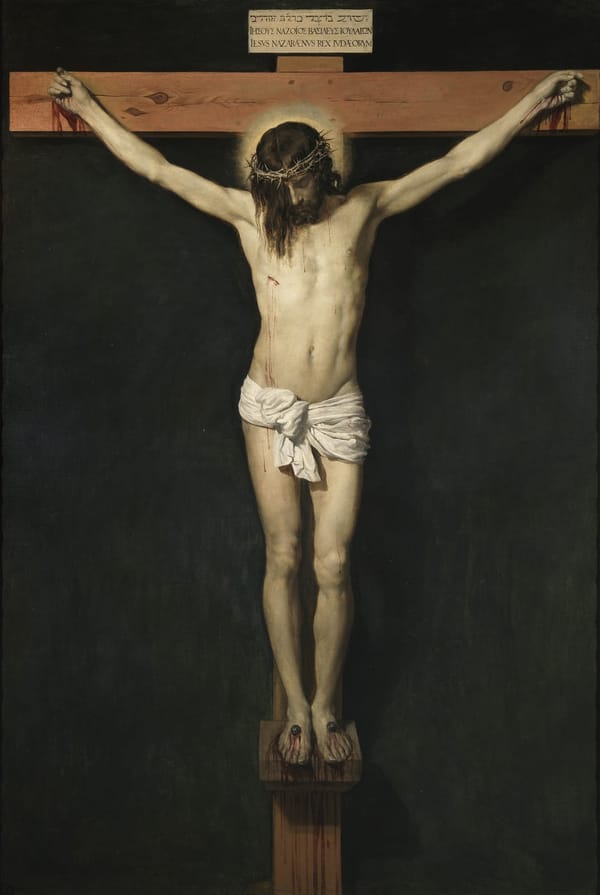
Above our Redeemer’s head there are written these words, in Hebrew, Greek, and Latin: Jesus of nazareth, king of the jews. The people read this inscription, and say it to each other; without wishing it, they are once more proclaiming the royalty of the Son of David. The enemies of Jesus are quick enough to perceive this: they hasten to Pilate, and beseech him to have the title changed. The only answer he deigns to make them is: ‘What I have written, I have written.’26 The holy fathers have noticed a circumstance of the crucifixion, which expresses how this King of the Jews is, indeed, rejected by His chosen people, but will reign all the more gloriously over the nations of the earth, whom the Father has given to Him for His inheritance. The circumstance we allude to is this: the soldiers, when fixing the cross in the rock, have so placed it that Jesus has His back to Jerusalem, and is stretching out His arms towards the countries of the west. The Sun of truth is setting on the deicide city, and rising upon the new Jerusalem, that proud Rome, which feels that she is destined to be the eternal city, yet knows not that she is to be so by the cross.
The tree of our salvation, as it falls into the hole prepared for it, strikes against a tomb: it is that of our first parent. The Blood of the Redeemer flows down the cross and falls upon a skull: it is the skull of Adam, whose sin has called for this great expiation. In His mercy, the Son of God wills that the instrument wherewith He has gained pardon for the guilty world should rest amidst the very bones of him that first caused its guilt. Thus is satan confounded: the creation is not, as he has hitherto thought, turned by his artifice to the shame of its Creator. The hill on which is raised the standard of our salvation, is called Calvary, which signifies a skull. Here, according to the tradition of the Jews, was buried our first parent, the first sinner. Among the holy fathers of the early ages, who have handed down this interesting tradition to us, we may cite St. Basil, St. Ambrose, Saint John Chrysostom, St. Epiphanius, St. Jerome. Origen, too, who had such opportunities of knowing the Jewish traditions, mentions this among the number. At a very early period Christian art introduced the custom of placing a human skull at the feet of Jesus’ image on the cross: it was done to commemorate the great fact to which we have been alluding.
But let us look up and see our Jesus, whose life is so soon to end upon this instrument of torture. Here we behold Him exposed to the view of the Jewish people, as the serpent was, of old, lifted up by Moses in the desert.27 His enemies pass before Him, making insulting gestures, and saying: ‘Vah! Thou that destroyest the temple of God, and in three days dost rebuild it: save Thine own self! If Thou be the Son of God, come down from the cross!’28 The chief priests and the ancients continue the blasphemy, adding their own emphasis to it: ‘He saved others; Himself He cannot save! If He be King of Israel, let Him now come down from the cross, and we will believe in Him. He trusted in God; let Him now deliver Him, if He will have Him; for He said: I am the Son of God.’29 The two thieves crucified with Him insult Him in like manner.
Never had God conferred on His creatures a blessing compared to this: and yet, never did man so boldly insult his God! Let us Christians, who adore Him whom the Jews blaspheme, offer Him, at this moment, the reparation He so infinitely deserves. These impious men cite His own words,. and turn them against Him: let us reverently remind our Jesus of an expression He once deigned to use, which should fill us with hope: ‘And I, if I be lifted up from the earth, will draw all things to Myself.’30 Sweet Jesus! the time has come; Thou art lifted up from the earth: fulfil Thy promise, draw us to Thyself! Alas! this earth has such hold upon us, we are chained fast to it by so many ties; self-love fetters us; and when we attempt to fly towards Thee, our flight is checked. Oh! break our chains, and draw us to Thyself, that we may at length reach Thee, and Thou mayst be consoled by the conquest of our souls!
It is the sixth hour, or, as we call it, midday. The sun immediately withdraws his light, and darkness covers the face of the earth. The stars appear in the heavens, and a gloomy silence pervades throughout the world. It is said that the celebrated Denys the Areopagite of Athens, who was afterwards a disciple of St. Paul, exclaimed, on witnessing this awful eclipse: ‘Either the God of nature is suffering, or the world is coming to an end.’ Phlegon, a pagan author, who wrote a century later, tells us that this sudden darkness spread consternation throughout the Roman empire, and that the astronomers owned it baffled all their calculations.
So terrible an indication of the wrath of heaven produces a panic of fear among the spectators on Calvary. Blasphemers are struck dumb, and the blasphemies of them that were just now insulting our Redeemer cease. All is silent as death. The thief whose cross is at the right of Jesus’, feels himself touched with repentance and hope. Turning to his companion, he upbraids him for what he has been saying: ‘Dost thou not fear God, seeing thou art under the same condemnation? And we, indeed, justly, for we receive the due reward of our deeds: but this Man hath done no evil.’31 Jesus defended by a thief, at the very time that He is being insulted by those who boast that they know every iota of God’s Law, and are sitting in the chair of Moses! Nothing could give us a dearer idea of the blindness to which the Synagogue has voluntarily brought itself. This poor criminal, whose name is Dimas, represents the Gentile world, which now is steeped in ignorance and crime, yet is soon to be cleansed from all its abominations by confessing Jesus crucified to be the Son of God. Turning his head towards our Saviour’s cross, he thus prays to Him: ‘Lord! remember me, when Thou shalt come into Thy kingdom!’ He believes Jesus to be king; and the chief priests and ancients were, but a moment ago, deriding this King! Dimas sees the divine calmness and dignity of the innocent Victim: it is evidence enough; he gives Him his faith, and begs a remembrance from Him when the day of His glory comes. Grace has made him a true Christian: and who can doubt that the grace was asked and obtained for him by Mary, the Mother of mercy, who is now uniting herself in sacrifice together with her Jesus? Jesus is pleased to find in this poor criminal the faith He had vainly sought for from Israel: He thus grants his humble prayer: ‘Amen I say to thee, this day thou shalt be with Me in paradise.’32 It is the second of Jesus’ words on the cross. The happy penitent is filled with joy, and awaits in patient silence the blissful moment when death shall set him free.
Meanwhile, Mary draws near to the cross, whereon hangs her Son. She recognizes Him, in spite of all the darkness; her love is her light. The eclipse has dispersed the crowd; all is silent; and the soldiers can find no reason for keeping the afflicted Mother from approaching her Son. Jesus looks with tenderest affection on Mary; the sight of her sorrow is a new grief to His sacred Heart. He is dying, and His Mother cannot console or embrace Him. Magdalene, too, is there, distracted with grief. Those feet, which, a few days before, she had anointed with her most precious perfumes, are now pierced through with nails, and the Blood is clotting round the wounds. They are near enough to the ground for her to reach and bathe them with her tears; but her tears cannot stay the pain. She has come to see the death of Him who forgave her all her sins. John, the beloved disciple, the only apostle that has followed Jesus to Calvary, is overwhelmed with sorrow. He thinks of the favour bestowed upon him last night, when he rested his head on the breast of this dear Master; and the remembrance intensifies his grief. He grieves for the Son, he grieves for the Mother. He little knows the reward he is soon to receive for this his love! Mary of Cleophas has followed the holy Mother up to the foot of the cross. At some distance off there stands a group of women, who loved Jesus and ministered unto Him during His life.33
The silence is again broken: Jesus speaks His third word, and it is to His Mother; but He does not call her by that dear name, for it would redouble her pain: 'Woman!' He says, ‘behold thy son!’ Then looking upon John, He says to him: ‘Son! behold thy Mother!’34 What an exchange was here for Mary! but oh! what a blessing it brought upon John, and through him to all mankind: the Mother of God was made our Mother! This was the subject of our meditation on the Friday of Passion-week: let us, to-day, gratefully receive this last testament of our Jesus, who, having by His Incarnation made us the adopted children of His heavenly Father, now, in His dying moments, makes us children of His own blessed Mother.
It is close upon the ninth hour—the third hour after midday—the hour fixed by the eternal decree of God for the death of Jesus. The feeling of abandonment, which had caused our Redeemer to suffer an agony in the garden, now returns. He has taken upon Himself the sins of mankind: the whole weight of God’s justice now presses upon His Soul. The bitter chalice of God’s anger, which He is drinking to the very dregs, extorts from His lips this plaintive cry: ‘My God! My God! why hast Thou forsaken Me?’35 It is the fourth word. He does not say ‘My Father!’ He speaks as though He were but a poor sinner, trembling before the judgment-seat of God. A burning thirst elicits from Him the fifth word: ‘I thirst!’36 Whereupon, one of the soldiers presents to His dying lips a sponge full of vinegar; and this is all the refreshment He receives from that earth, on which lie daily pours a heavenly dew, and to which He has given ever-flowing fountains and rivers.
The moment has at length come, when Jesus is to yield up His Soul to His Father. He has fulfilled every single prophecy that bad been foretold of Him, even that of His receiving vinegar when parched with thirst. He therefore speaks this His sixth word: ‘It is consummated!’37 He has, then, but to die; His death is to put the finishing stroke to our redemption, as the prophet assures us. But He must die as God. This Man, worn out by suffering, exhausted by His three hours’ agony, whose few words were scarce audible to them that stood round His cross, now utters a loud cry, which is heard at a great distance, and fills the centurion, who commands the guard, with fear and astonishment: ‘Father! into Thy hands I commend My Spirit!’38 This is His seventh and last word; after which He bows down His head and dies.
At this awful moment, the sun reappears in the heavens, and darkness ceases: but the earth is shaken by an earthquake, and the rocks are split. The space between the cross of Jesus and that of the bad thief is violently rent asunder, and the opening is shown to this day. The Jewish priests, who are in the temple, are terrified at seeing the veil, which hides the Holy of holies, torn from top to bottom: the time for figures and types is over, the great realities are come. Many holy personages arise from their graves, and return to life. But it is in hell itself that the death of Jesus is most felt. Satan now sees who He is, against whom he has excited all this persecution. He sees that the Blood, which he has caused to be shed, has saved mankind and opened the gates of heaven. This Jesus, whom he dared to tempt in the desert, he now recognizes as the Son of God, whose precious Blood has purchased for men a redemption that was refused to the rebel angels!
O Jesus! Son of the eternal Father! we adore Thee now lying dead on the wood of Thy sacrifice. Thy bitter death hath given us life. Like those Jews who saw Thee expire and returned to Jerusalem striking their breasts, we, also, confess that our sins have caused Thy death. Thou hast loved us as none but a God could love. Henceforth, we must be Thine, and serve Thee, as creatures redeemed at the infinite price of Thy Blood. Thou art our God; we are Thy people. Accept, we beseech Thee, our most loving thanks for this final proof of Thy goodness towards us. Thy holy Church now silently invites us to celebrate Thy praise. We leave Calvary for a time; but will soon return thither, to assist at Thy holy burial. Mary, Thy Mother, remains immovable at the foot of Thy cross. Magdalene clings to Thy feet. John and the holy women stand around Thee. Once more, dearest Jesus! we adore Thy sacred Body, Thy precious Blood, and Thy holy cross, that have brought us salvation.
THE OFFICE OF TENEBRÆ
At a late hour in the afternoon, the Night Office of Holy Saturday is anticipated, as on the two previous days.
The faithful are not summoned to the church by the bells, for, as we have already explained, they are not rung till the Gloria in excelsis of to-morrow’s Mass.
The Office of Tenebræ for Holy Saturday is given below, page 520.
THE EVENING
Let us return to Calvary, and there close this mournful day. We left Mary there, with Magdalene and other holy women, and the beloved disciple John. An hour has scarcely elapsed since Jesus died, when a troop of soldiers, led on by a centurion, come up the hill, breaking the silence with their tramp and voices. They are sent by Pilate. The chief priests lost no time in returning to the governor’s house: and he, at their request, has sent these men to break the legs of the three crucified, detach them from their crosses, and bury them before night. The Jews count the days of their week from sunset; so that the great Sabbath day is close upon them. The soldiers come to the crosses; they begin with the two theives, and put an end to their sufferings and their life by breaking their legs. Dimas dies in saintly dispositions, for the promise made to him by Jesus is his consolation; his companion dies blaspheming. The soldiers now advance towards Jesus. Mary’s heart sinks within her. What fresh outrage are these men about to offer to the lifeless and bleeding Body of her Son? On inspection, they find that He is dead; but, that no doubt may be left, and no blame for neglect of orders fall upon them, one of the company raises up his spear and thrusts it into the right side of the divine Victim, even to the Heart; and when he draws his spear out, there gushes forth a stream of Water and Blood. This is the fifth bloodshedding, and the fifth wound inflicted on our Jesus upon the cross. The Church honours this mystery on the Feast of the sacred Heart; let us reserve our reflections till then.
The soul of the holy Mother is pierced by this cruel spear; and they that are with her redouble their sobs and tears. How is this terrible day to end? Who will take the Body of her Jesus from His cross? Who will enable her to give it a last embrace? The soldiers return to the city, and with them Longinus, he that pierced Jesus’ side, but is already feeling within himself the workings of that faith for which he is one day to lay down his life as a martyr. But lo! two other men are seen coming towards the cross; they are not enemies, they are faithful disciples of Jesus: one is the wealthy counsellor Joseph of Arimathea; the other is Nicodemus, a ruler among the Jews. Mary gratefully welcomes their arrival: they have come to take the Body of Jesus from the cross, and give it an honourable burial. They have the requisite authorization, for Pilate has given permission to Joseph to take the Body of Jesus.39
They lose no time in doing so, for the sun is near to setting, and then begins the Sabbath. Within a few yards from where stands the cross, at the foot of the hillock which forms the summit of Calvary, there is a garden, and in this garden a sepulchre cut into the rock. No one has yet been buried in this tomb. It is to be Jesus’ sepulchre. Hither Joseph and Nicodemus carry the sacred Body: they lay it upon a slab of stone, near to the sepulchre. It is here that Mary receives into her arms the Body of her Jesus: she kisses each wound, and bathes it with her tears. John, Magdalene, and all that are present, compassionate the holy Mother. She resigns it into the hands of the two disciples, for they have but a few moments left. Upon this slab which, even to this day, is called the stone of the anointing, and designates the thirteenth station of the way of the cross, Joseph unfolds a piece of fine linen,40 and Nicodemus, whose servants have brought a hundred pound weight of myrrh and aloes,41 makes every arrangement for the embalming. They reverently wash the Body, for it is covered with Blood; they remove the crown of thorns from the Head; and after embalming it with their perfumes, they wrap it in the windingsheet. Mary gives a last embrace to the remains of her Jesus, who is now hidden under these swathing-bands of the tomb.
Joseph and Nicodemus take the Body into their arms, and enter the sepulchre. It is the fourteenth station of the way of the cross. It consists of two open cells; it is into the one on the right hand that they enter, and there, in a cavity cut into the side of the rook, they lay the Body of Jesus. They then retire; and, with the assistance of their servants, they close up the entrance of the sepulchre with a large square stone, which Pilate, at the request of the Jews, orders to be fastened with his own seal, and guarded by a patrol of soldiers.
The sun is just setting; the great Sabbath, with its severe legal prescriptions, is just about to begin. Magdalene and the other women carefully notice the place where Jesus’ Body has been laid, and return with all speed to Jerusalem that they may have time to purchase and prepare a quantity of materials for a more careful embalming of the Body early on the Sunday morning, that is, immediately after the Sabbath is over. The holy Mother takes a farewell-look at the tomb wherein lies her Jesus, and then follows the rest into the city. John, her adopted son, keeps close to her. He is the guardian of her, who, without ceasing to be Mother of God, has been made also Mother of men. But oh! how much this second maternity cost her! She was standing at the foot of the cross, seeing her Jesus die, when she received us as her children. Let us imitate St. John, and keep our blessed Mother company during these trying hours which she has to pass before her Son rises from the grave.
How, O most merciful Redeemer! shall we leave Thy holy sepulchre, without offering Thee the tribute of our adoration and repentance? Death, which is the consequence of sin, has extended its dominion over Thee, for Thou didst submit Thyself to the sentence pronounced against Thee, and wouldst become like to us even to the humiliation of the tomb. It was Thy love for us, that led to all this! What return can we make Thee? The holy angels stand around Thy Body, thus lying in its rooky grave. They are lost in amazement at Thy having loved, to such an excess as this, Thy poor ungrateful creature, man. Thou hast made them, as well as us, out of nothing, and they loved Thee with all the intensity of their mighty spirits; but the sight of Thy tomb reveals to them a fresh abyss of Thine infinite goodness: Thou hast suffered death, not for their fallen fellowangels, but for us men, who are so inferior to the angels! Oh! what a bond of love between us and Thee must result from this sacrifice of Thy life for us! Thou hast died, O Jesus, for us: we must, henceforth, live for Thee. We promise it upon this tomb, which alas! is the handiwork of our sins. We, too, wish to die to sin, and live to grace. For the time to come, we will follow Thy precepts and Thine examples; we will avoid sin, which has made us accomplices in Thy Passion and Death. We will courageously bear, in union with Thine own, the crosses of this life: they are indeed light compared with Thine, but our weakness makes them heavy. And our death, too: when the moment comes for us to undergo that sentence which even Thou didst submit to, we will accept it with resignation. Terrible as that last hour is to nature, our faith tells us that Thy death has merited for it graces rich enough to make it sweet. Thy death, dearest Jesus! has made our death become but a passing into life: and as we now leave Thy holy sepulchre with the certain hope of speedily seeing Thee glorious in Thy Resurruction; so, when our body descends into the tomb, our soul shall confidently mount up to Thee, and there blissfully await the day of the resurrection of the flesh made pure by the humiliation of the grave.
We will close our day by offering to our readers the following stanzas from the Greek liturgy of Good Friday.
Hymn (In Parasceve)
The ancient Gallican liturgy contains, in to-day’s Office, the following eloquent and devout prayer.
Prayer (Oratio ad Nonam)
- St. Matt. xxvi. 63. ↩︎
- Ibid. 64.—St. Mark xiv. 62. ↩︎
- St. Matt, xxvi. 65, 66. ↩︎
- St. Luke xxii. 64. ↩︎
- Gen. xlix. 10. ↩︎
- St. John xviii. 29-31. ↩︎
- Ibid. 33, 36, 37, 38. ↩︎
- St. Matt, xxvii. 13. ↩︎
- St. Luke xxiii. 5. ↩︎
- St. Matt, xxvii.—St. Luke xxiii.—St. John xviii. ↩︎
- St. John xix. 5. ↩︎
- St. John xix. ↩︎
- Ibid ↩︎
- Is. liii. 12. ↩︎
- St. Matt, xxvii. 24, 25. ↩︎
- St. John iii. 16. ↩︎
- St. Luke xxiii. 28-30. ↩︎
- Heb. v 7. ↩︎
- 1 Cor. i. 23. ↩︎
- 1 Cor. i. 24. ↩︎
- St. Luke xxiii. 34. ↩︎
- Is. xi. 10. ↩︎
- St. John xii. 32. ↩︎
- Rom. v. 11. ↩︎
- St. John xix. 24. ↩︎
- St. John xix. 22. ↩︎
- St. John iii. 14. ↩︎
- St. Matt, xxvii. 40. ↩︎
- Ibid. 42, 43. ↩︎
- St. John xii. 32. ↩︎
- St. Luke xxiii. 40, 41. ↩︎
- St. Luke xxiii. 42, 43. ↩︎
- St. Matt, xxvii. 65. ↩︎
- St. John xix. 26, 27. ↩︎
- St. Matt, xxvii. 46. ↩︎
- St. John xix. 26, 27. ↩︎
- Ibid. 30. ↩︎
- St. Luke xxiii. 46. ↩︎
- St. John xix. 38. ↩︎
- St. Mark xv. 46. ↩︎
- St. John xix. 39. ↩︎
The Night Office of Holy Saturday (Tenebrae of Good Friday Evening)
The ceremonies used by the Church for the Office of Tenebræ having been already explained, we deem it unnecessary to repeat our instructions. The reader may refer to them, should he require to refresh his memory. They are given on pages 301—303.
Pater noster, Ave, and Credo, in secret.
The First Nocturn
The first psalm is one which the Church daily recites in her Compline, because it expresses the confidence wherewith the Christian takes his rest. She uses it in to-day’s Tenebræ, to remind us of the rest taken by Christ in the sepulchre, where He sleeps with the assurance of wakening to a glorious Resurrection.
Psalm 4
Miserere mei: et exaudi orationem meam.
Filii hominum usquequo gravi corde: ut quid diligitis vanitatem, et quæritis mendacium?
Et scitote quoniam mirificavit Dominus sanctum suum: Dominus exaudiet me, cum clamavero ad eum.
Irascimini, et nolite peccare: quæ dicitis in cordibus vestris in cubilibus vestris compungimini.
Sacrificate sacrificium justitiae, et sperate in Domino: multi dicunt: Quis ostendit nobis bona?
Signatum est super nos lumen vultis tui, Domine: dedisti lætitiam in corde meo.
A fructu frumenti, vini et olei sui: multiplicati sunt.
In pace in idipsum: dormiam et requiescam.
Quoniam tu, Domine, singulariter in spe: constituisti me.
Have mercy upon me, and hear my prayer.
O ye sons of men, how long will ye be dull of heart? why do you love vanity, and seek after lying?
Know ye also that the Lord hath made his Holy One wonderful: the Lord will hear me when I shall cry unto him.
Be ye angry and sin not: the things you say in your hearts, be sorry for them on your beds.
Offer up the sacrifice of justice, and trust in the Lord: many say: Who showeth us good things?
The light of thy countenance, O Lord, is signed upon us: thou hast given gladness in my heart.
By the fruit of their corn, their wine and oil, they are multiplied.
In peace, in the self-same, I will sleep, and I will take my rest.
For thou, O Lord, singularly hast settled me in hope.
The second psalm speaks of the happiness that is in reserve for the just man, and of the rest which is to be the reward of his labours. The Church applies it to Christ, the Just One by excellence, who went about doing good.
Psalm 14
Qui loquitur veritatem in corde suo: qui non egit dolum in lingua sua.
Nec fecit proximo suo malum: et opprobrium non accepit adversus proximos suos.
Ad nihilum deductus est in conspectu ejus malignus: timentes autem Dominum glorficat.
Qui jurat proximo suo, et non decipit: qui pecuniam suam non dedit ad usuram, et munera super innocentem non accepit:
Qui facit hæc, non movebitur in æternum.
He that walketh without blemish, and worketh justice.
He that speaketh truth in his heart, who hath not used deceit in his tongue.
Nor hath done evil to his neighbour, nor taken up a reproach against his neighbours.
In his sight the malignant is brought to nothing: but he glorifieth them that fear the Lord.
He that sweareth to his neighbour, and deceiveth not: he that hath not put out his money to usury, nor taken bribes against the innocent.
He that doth these things, shall not be moved for ever.
The third psalm, composed by David during his exile under Saul, is a prophecy of our Saviour’s Resurrection, and was quoted as such by St. Peter in his address to the Jews on the day of Pentecost. He that speaks in this psalm, says that his flesh shall rest in hope, and that the Lord will not give him to see corruption. This was not verified in David, but in Christ.
Psalm 15
Sanctis qui sunt in terra ejus: mirificavit omnes voluntates meas in eis.
Multiplicatæ sunt infirmitates eorum: postea acceleraverunt.
Non congregabo conventicula eorum de sanguinibus: nec memor ero nominum eorum per labia mea.
Dominus pars hæreditatis meæ et calicis mei: tu es qui restitues hæreditatem meam mihi.
Funes ceciderunt mihi in præclaris: etenim hæreditas mea præclara est mihi.
Benedicam Dominum, qui tribuit mihi intellectum: insuper et usque ad noctem increpuerunt me renes mei.
Providebam Dominum in conspectu meo semper: quoniam a dextris est mihi ne commovear.
Propter hoc Iætatum est cor meum, et exsultavit lingua mea: insuper et caro mea requiescet in spe.
Quoniam non derelinques animam meam in inferno: nec dabis Sanctum tuum videre corruptionem.
Notas mihi fecisti vias vitæ, adimplebis me lætitia cum vultu tuo: delecta tiones in dextera tua usque in finem.
To the saints who are in his land, he hath made wonderful all my desires in them.
Their infirmities were multiplied: afterwards they made haste.
I will not gather together their meetings for blood-offerings: nor will I be mindful of their names by my lips.
The Lord is the portion of my inheritance and of my cup: it is thou that wilt restore my inheritance to me.
The lines are fallen unto me in goodly places: for my inheritance is goodly to me.
I will bless the Lord, who hath given me understanding: moreover my reins also have corrected me even till night.
I set the Lord always in my sight: for he is at my right hand that I be not moved.
Therefore my heart hath been glad and my tongue hath rejoiced: moreover my flesh also shall rest in hope.
Because thou wilt not leave my soul in hell: nor wilt thou give thy Holy One to see corruption.
Thou hast made known to me the ways of life, thou shalt fill me with joy with thy countenance: at thy right hand are delights even to the end.
The Pater noster is here recited in secret.
The lessons of the first nocturn are again taken from the Lamentations of Jeremias. The first refers to our Saviour. It speaks of His fidelity to His Father, and of His resignation. It foretells the buffets He received during His Passion.
First Lesson
Cap. iii.Heth. Misericordiæ Domini, quia non sumus consumpti: quia non defecerunt miserationes ejus.
Ch. iii.Heth. The mercies of the Lord that we are not consumed: because his tender mercies have not failed.
Recording of the Lamentation (Palestrina) Heth-Teth (1):
https://www.youtube.com/watch?v=_7mG230eNnA
The second lesson is an elegy upon Jerusalem. The grievousness of the sins of this ungrateful city is expressed in forcible terms.
Second Lesson
Recording of the Lamentation (Palestrina) Aleph-Ghimel:
https://www.youtube.com/watch?v=5JDDVVA-jRs
The third lesson is a portion of the prayer made by the prophet for the Jewish people, after they had been led into captivity. It gives a faithful, but terrible, description of their miseries after they had committed the crime of deicide.
Third Lesson
Cap. v.Recordare, Domine, quid acciderit nobis: intuere, et respice opprobrium nostrum. Hæreditas nostra versa est ad alienos, domus nostræ ad extraneos. Pupilli facti sumus absque patre: matres nostræ quasi viduæ. Aquam nostram pecunia bibimus; ligna nostra pretio comparavimus. Cervicibus nostris minabamur: lassis non dabatur requies. Ægypto dedimus manum, et Assyriis, ut saturaremur pane. Patres nostri peccaverunt, et non sunt: et nos iniquitates eorum portavimus. Servi dominati sunt nostri: non fuit qui redimeret de manu eorum. In animabus nostris afferebamus panem nobis, a facie gladii in deserto. Pellis nostra quasi clibanus exusta est, a facie tempestatum famis. Mulieres in Sion humiliaverunt, et virgines in civitatibus Juda.
Ch. v.Remember, O Lord, what is come upon us: consider and behold our reproach. Our inheritance is turned to aliens: our houses to strangers. We are become orphans without a father, our mothers are as widows. We have drunk our water for money: we have bought our wood. We were dragged by the necks, we were weary and no rest was given us. We have given our hand to Egypt, and to the Assyrians, that we might be satisfied with bread. Our fathers have sinned, and are not: and we have borne their iniquities. Servants have ruled over us: there was none to redeem us out of their hand. We fetched our bread at the peril of our lives, because of the sword in the desert. Our skin was burnt as an oven, by reason of the violence of the famine. They oppressed the women in Sion, and the virgins in the cities of Juda.
Recording of the Lamentation (Palestrina):
https://www.youtube.com/watch?v=Tzk13HJICI8
Here is repeated: Plange.
Here is repeated: Mourn, O my people.
The Second Nocturn
The fourth psalm speaks of the triumphant entry which the Son of God, after having risen from His tomb, shall make into heaven.
Psalm 23
Quia ipse super maria fundavit eum: et super flumina præparavit eum.
Quis ascendet in montem Domini: aut quis stabit in loco sancto ejus?
Innocens manibus et mundo corde: qui non accepit in vano animam suam, nec juravit in dolo proximo suo.
Hic accipiet benedictionem a Domino: et misericordiam a Deo salutari suo.
Hæc est generatio quærentium eum: quærentium faciem Dei Jacob.
Attollite portas principes vestras, et elevamini portæ æternales: et introibit Rex gloriæ.
Quis est iste Rex gloriæ? Dominus fortis et potens, Dominus potens in prælio.
Attollite portas principes vestras, et elevamini portæ æternales: et introibit Rex gloriæ.
Quis est iste Rex gloriæ? Dominus virtutum, ipse est Rex gloriæ.
For he hath founded it upon the seas: and hath prepared it upon the rivers.
Who shall ascend into the mountain of the Lord? or who shall stand in his holy place?
The innocent in hands, and clean of heart, who hath not taken his soul in vain, nor sworn deceitfully to his neighbour.
He shall receive a blessing from the Lord: and mercy from God his Saviour.
This is the generation of them that seek him, of them that seek the face of the God of Jacob.
Lift up your gates, O ye princes, and be ye lifted up, O eternal gates: and the King of glory shall enter in.
Who is this King of glory? the Lord, who is strong and mighty, the Lord mighty in battle.
Lift up your gates, O ye princes, and be ye lifted up, O eternal gates: and the King of glory shall enter in.
Who is this King of glory? the Lord of hosts, he is the King of glory.
The fifth psalm was sung in yesterday's Office, and expressed the confidence in His Father’s love and assistance which never left our Jesus during His Passion: we repeat it to-day, because it speaks of His speedy deliverance. The Church changes the antiphon, which gave us the words of our Saviour complaining of His false witnesses, into the following, wherein we have our divine Master telling us that He is soon to be in the land of the living.
Psalm 26
Dominus protector vitæ meæ: a quo trepidabo?
Dum appropiant super me nocentes: ut edant carnes meas.
Qui tribulant me inimici mei: ipsi infirmati sunt et ceciderunt.
Si consistant adversum me castra: non timebit cor meum.
Si exsurgat adversum me prœlium: in hoc ego sperabo.
Unam petii a Domino, hanc requiram: ut inhabitem in domo Domini omnibus diebus vitæ meæ.
Ut videam voluptatem Domini: et visitem templum ejus.
Quoniam abscondit me in tabernaculo suo: in die malorum protexit me in abscondito tabernaculi sui.
In petra exaltavit me: et nunc exaltavit caput meum super inimicos meos.
Circuivi, et immolavi in tabernaculo ejus hostiam vociferationis: cantabo, et psalmum dicam Domino.
Exaudi, Domine, vocem meam qua clamavi ad te: miserere mei, et exaudi me.
Tibi dixit cor meum exquisivit te facies mea: faciem tuam, Domine, requiram.
Ne avertas faciem tuam a me: ne declines in ira a servo tuo.
Adjutor meus esto: ne derelinquas me, neque despicias me, Deus salutaris meus.
Quoniam pater meus et mater mea dereliquerunt me: Dominus autem assumpsit me.
Legem pone mihi, Domine, in via tua: et dirige me in semitam rectam propter inimicos meos.
Ne tradideris me in animas tribulantium me: quoniam insurrexerunt in me testes iniqui, et mentita est iniquitas sibi.
Credo videre bona Domini: in terra viventium.
Exspecta Dominum, viriliter age: et confortetur cor tuum, et sustine Dominum.
The Lord is the protector of my life, of whom shall I be afraid?
Whilst the wicked draw near against me, to eat my flesh.
My enemies that troubled me have been weakened, and have fallen.
If armies in camp should stand together against me, my heart shall not fear.
If a battle should rise up against me, in this will I be confident.
One thing have I asked of the Lord, this will I seek after, that I may dwell in the house of the Lord all the days of my life.
That I may see the delight of the Lord, and may visit his temple.
For he hath hid me in his tabernacle; in the day of evils, he hath protected me in the secret place of his tabernacle.
He hath exalted me upon a rock: and now he hath lifted up my head above my enemies.
I have gone round, and have offered up in his tabernacle a sacrifice of jubilation: I will sing, and recite a psalm to the Lord.
Hear, O Lord, my voice, with which I have cried to thee: have mercy on me, and hear me.
My heart hath said to thee, my face hath sought thee: thy face, O Lord, will I still seek.
Turn not away thy face from me: decline not in thy wrath from thy servant.
Be thou my helper: forsake me not, do not thou despise me, O God my Saviour.
For my father and my mother have left me: but the Lord hath taken me up.
Set me, O Lord, a law in thy way: and guide me in the right path, because of my enemies.
Deliver me not over to the will of them that trouble me: for unjust witnesses have risen up against me, and iniquity hath belied itself.
I believe to see the good things of the Lord in the land of the living.
Expect the Lord, do manfully, and let thy heart take courage, and wait thou for the Lord.
The sixth psalm tells us that Jesus, the divine Captive of death, will soon rise from the grave. The prophet speaks of the weeping which shall last till evening, and of the gladness that shall follow in the morning.
Psalm 29
Domine Deus meus, clamavi ad te: et sanasti me.
Domine eduxisti ab inferno animam meam: salvasti me a descendentibus in lacum.
Psallite Domino sancti ejus: et confitemini memoriæ sanctitatis ejus.
Quoniam ira in indignatione ejus: et vita in voluntate ejus.
Ad vesperum demorabitur fletus: et ad matutinum lætitia.
Ego autem dixi in abundantia mea: Non movebor in æternum.
Domine in voluntate tua: præstitisti decori meo virtutem.
Avertisti faciem tuam a me: et factus sum conturbatus.
Ad te, Domine, clamabo: et ad Deum meum deprecabor.
Quæ utilitas in sanguine meo: dum descendo in corruptionem?
Numquid confitebitur tibi pulvis: aut annuntiabit veritatem tuam?
Audivit Dominus, et misertus est mei: Dominus factus est adjutor meus.
Convertisti planctum meum in gaudium mihi: conscidisti saccum meum, et circumdedisti me lætitia.
Ut cantet tibi gloria mea, et non compungar: Domine Deus meus, in æternum confitebor tibi.
O Lord, my God, I have cried to thee, and thou hast healed me.
Thou hast brought forth, O Lord, my soul from hell: thou hast saved me from them that go down into the pit.
Sing to the Lord, O you his saints: and give praise to the memory of his holiness.
For wrath is in his indignation: and life in his good will.
In the evening, weeping shall have place: and in the morning, gladness.
And in my abundance I said: I shall never be moved.
O Lord, in thy favour, thou gavest strength to my beauty.
Thou turnedst away thy face from me, and I became troubled.
To thee, O Lord, will I cry: and I will make supplication to my God.
What profit is there in my blood, whilst I go down to corruption?
Shall dust confess to thee, or declare thy truth?
The Lord hath heard, and hath had mercy on me: the Lord became my helper.
Thou hast turned for me my mourning into joy: thou hast cut my sackcloth, and hast compassed me with gladness.
To the end that my glory may sing to thee, and I may not regret. O Lord my God, I will give praise to thee for ever.
Here is said the Pater noster in secret.
For the second nocturn lessons, the Church continues the Enarrations of St. Augustine on the psalms prophetic of our Lord’s Passion.
Fourth Lesson
Fifth Lesson
Sixth Lesson
Here is repeated; Ecce quomodo.
Here is repeated: Behold!
The Third Nocturn
The seventh psalm is one we sang yesterday, when commemorating the persecution our Saviour met with from the Jews. We repeat it, to-day, because of His approaching triumph, for the eternal Father is His helper and protector.
Psalm 53
Deus, exaudi orationem meam: auribus percipe verba oris mei.
Quoniam alieni insurrexerunt adversum me. et fortes quæsierunt animam meam: et non proposuerunt Deum ante conspectum suum.
Ecce enim Deus adjuvat me: et Dominus susceptor est animæ meæ.
Averte mala inimicis meis: et in ventate tua disperde illos.
Voluntarie sacrificabo tibi: et confitebor nomini tuo, Domine, quoniam bonum est.
Quoniam ex omni tribulatione eripuisti me: et super inimicos meos despexit oculus meus.
O God. hear my prayer: give ear to the words of my mouth.
For strangers have risen up against me: and the mighty have sought after my soul: and they have not set God before their eyes.
For behold God is my helper: and the Lord is the protector of my soul.
Turn back the evils upon my enemies: and cut them off in thy truth.
I will freely sacrifice to thee, and will give praise. O God. to thy name: because it is good.
For thou hast delivered me out of all trouble: and my eye hath looked down upon my enemies.
The eighth psalm is one that was sung in the Tenebræ of Maundy Thursday: then, it was an allusion to the divine vengeance that was to fall on the enemies of Jesus; to-day, we must rejoice in its prophecy of the sleep of peace which this our Saviour is taking in Sion. A few more hours, and He will rise from His tomb. His enemies, who boast of having Him in their power, will find, on awaking, that they have nothing in their hands. The earth shall tremble, and our Lord shall arise, an object of terror to His enemies, but a Saviour to the meek, that is, to the humble and faithful ones, who will then praise Him as the God ever faithful to His word.
Psalm 75
Et factus est in pace locus ejus: et habitatio ejus in Sion.
Ibi confregit potentias arcuum: scutum, gladium, et bellum.
Illuminans tu mirabiliter a montibus æternis: turbati sunt omnes insipientes corde.
Dormierunt somnum suum: et nihil invenerunt omnes viri divitiarum in manibus suis.
Ab increpatione tua, Deus Jacob: dormitaverunt qui ascenderunt equos.
Tu terribilis es, et quis resistet tibi: ex tunc ira tua.
De cœlo auditum fecisti judicium: terra tremuit et quievit.
Cum exurgeret in judicium Deus: ut salvos faceret omnes mansuetos terrae.
Quoniam cogitatio hominis confitebitur tibi: et reliquiae cogitationis diem festum agent tibi.
Vovete et reddite Domino Deo vestro: omnes qui in circuitu ejus affertis munera.
Terribili et ei qui aufert spiritum principum: terribili apud reges terræ.
And his place is in peace, and his abode in Sion.
There hath he broken the power of bows, the shield, the sword, and the battle.
Thou enlightenest wonderfully from the everlasting hills: all the foolish of heart were troubled.
They have slept their sleep: and all the men of riches have found nothing in their hands.
At thy rebuke, O God of Jacob, they have all slumbered that mounted on horseback.
Thou art terrible, and who shall resist thee? from that time thy wrath.
Thou hast caused judgment to be heard from heaven: the earth trembled and was still.
When God arose in judgment, to save all the meek of the earth.
For the thought of man shall give praise to thee: and the remainders of the thought shall keep holiday to thee.
Vow ye, and pay to the Lord your God: all you that round about him bring presents.
To him that is terrible, even to him that taketh away the spirit of princes; to the terrible with the kings of the earth.
The ninth psalm is the Domine, Deus salutis meœ, repeated from yesterday’s Office page 437. It shows us our Saviour praying to His Father, that He will raise Him, and free Him from among the dead. The time fixed for His lying in the darkness of the sepulchre is over, the hour of His Resurrection to life is at hand.
It is sung to the following antiphon.
℟. And his abode in Sion.
The Pater noster is here recited in secret.
The third nocturn lessons are again from the Epistle to the Hebrews. In the passage chosen for to-day, the apostle shows us the divine efficacy of the Blood of Jesus, and how His testament, or last will, could not be applied to us save by His death.
Seventh Lesson
Cap. ix.Christus assistens Pontifex futurorum bonorum, per amplius et perfectius tabernaculum non manufactum, id est non hujus creationis; neque per sanguinem hircorum aut vitulorum, sed per proprium Sanguinem, introivit semel in sancta, aeterna redemptione inventa. Si enim sanguis hircorum et taurorum, et cinis vitulæ aspersus inquinatos sanctificat ad emundationem carnis: quanto magis Sanguis Christi qui per Spiritimi sanctum semetipsum obtulit immaculatum Deo, emundabit conscientiam nostram ab operibus mortuis ad serviendum Deo viventi?
Ch. ix.Christ being come a High Priest of the good things to come, by a greater and more perfect tabernacle not made with hands, that is, not of thiscreation: neither by the blood of goats, nor of calves, but by his own Blood, entered once into the holies having obtained eternal redemption. For if the blood of goats and of oxen, and the ashes of an heifer being sprinkled, sanctify such as are defiled, to the cleansing of the flesh: how much more shall the Blood of Christ, who by the Holy Ghost offered himself unspotted unto God, cleanse our conscience from dead works, to serve the living God?
Eighth Lesson
Ninth Lesson
Here is repeated: Sepulto Domino.
℣. The chief priests went to Pilate, and sought his permission.* Placing soldiers to guard him.
Here is repeated: Having buried.
Lauds
The first psalm of Lauds is the Miserere (page 336 ). Its antiphon is the following:
The second psalm, which according to its title in the Psalter is to be sung on the Sabbath day, celebrates the magnificence of the Lord in His works, the fruitlessness of the plots laid by sinners, the triumph of Christ the Just One, and the blessed hope of His followers.
Psalm 91
Ad annuntiandum mane misericordiam tuam: et veritatem tuam per noctem.
In decachordo, psalterio: cum cantico in cithara.
Quia delectasti me, Domine, in factura tua: et in operibus manuum tuarum exsultabo.
Quam magnificata sunt opera tua Domine! nimis profundæ factæ sunt cogitationes tuæ.
Vir insipiens non cognoscet: et stultus non intelliget hæc.
Cum exorti fuerint peccatores sicut fœnum: et apparuerint omnes qui operantur iniquitatem:
Ut intereant in sæculum sæculi: tu autem Altissimus in æternum, Domine.
Quoniam ecce inimici tui, Domine, quoniam ecce inimici tui peribunt: et dispergentur omnes, qui operantur iniquitatem.
Et exaltabitur sicut unicornis cornu meum: et senectus mea in misericordia uberi.
Et despexit oculus meus inimicos meos: et in insurgentibus in me malignantibus audiet auris mea.
Justus ut palma florebit: sicut cedrus Libani multiplicabitur.
Piantati in domo Domini, in atriis domus Dei nostri florebunt.
Adhuc multplicabunturin senecta uberi: et bene patientes erunt, ut annuntient.
Quoniam rectus Dominus Deus noster: et non est iniquitas in eo.
To show forth thy mercy in the morning: and thy truth in the night.
Upon an instrument of ten strings, upon the psaltery: with a song upon the harp.
For thou hast given me, O Lord, delight in thy doings: and in the works of thy hands shall I rejoice.
O Lord, how great are thy works! thy thoughts are exceeding deep.
The unwise man shall not know: nor will the fool understand these things.
When the wicked shall spring up as the grass: and all the workers of iniquity shall appear.
That they may perish for ever and ever: but thou, O Lord, art Most High for evermore.
For behold thine enemies, O Lord, for behold thine enemies shall perish: and all the workers of iniquity shall be scattered.
But my horn shall be exalted like that of the unicorn: and my old age in plentiful mercy.
Mine eye also hath looked down upon mine enemies: and mine ear shall hear of the downfall of the malignant that rise up against me.
The just shall flourish like the palm-tree: he shall grow up like the cedar of Libanus.
They that are planted in the house of the Lord: shall flourish in the courts of the house of our God.
They shall still increase in a fruitful old age: and it shall be well with them.
That they may show that the Lord our God is upright: and there is no iniquity in him.
Psalm 63
Protexisti me a conventu malignantium: a multitudine operantium iniquitatem.
Quia exacuerunt ut gladium linguas suas: intenderunt arcum rem amaram, ut sagittent in occultis immaculatum.
Subito sagittabunt eum, et non timebunt: firmaverunt sibi sermonem nequam.
Narraverunt ut absconderent laqueos: dixerunt: Quis videbit eos?
Scrutati sunt iniquitates: defecerunt scrutantes scrutinio.
Accedet homo ad cor altum: et exaltabitur Deus.
Sagittæ parvulorum factæ sunt plagæ eorum: et infirmatæ sunt contra eos linguae eorum.
Conturbati sunt omnes qui videbant eos: et timuit omnis homo.
Et annuntiaverunt opera Dei, et facta ejus intellexerunt.
Lætabitur justus in Domino, et sperabit in eo, et laudabuntur omnes recti corde.
Thou hast protected me from the assembly of the malignant: from the multitude of the workers of iniquity.
For they have whetted their tongues like a sword: they have bent their bow a bitter thing, to shoot in secret the undefiled.
They will shoot at him on a sudden, and will not fear: they are resolute in words of wickedness.
They have talked of hiding snares: they have said: Who shall see them?
They have searched after iniquities: they have failed in their search.
Man shall come to a deep heart: and God shall be exalted.
The arrows of children are their wounds: and their tongues are made weak against them.
All that saw them were troubled: and every man was afraid.
And they declared the works of God: and understood his doings.
The just shall rejoice in the Lord, and shall hope in him: and all the upright in heart shall be praised.
The canticle of Ezechias, which is always sung in Tuesday’s Lauds, is here substituted for that of Deuteronomy, which is the proper one for Saturdays, but which is not in harmony with to-day’s mystery. Ezechias lying on his sick-bed, and praying God to restore him to health, is a figure of Christ in His tomb, beseeching His Father to give Him a speedy Resurrection to life.
Canticle of Ezechial (Is. xxxviii)
Quæsivi residuum annorum meorum: dixi: Non videbo Dominum Deum in terra viventium.
Non aspiciam hominem ultra: et habitatorem quietis.
Generatio mea ablata est, et convoluta est a me: quasi tabernaculum pastorum.
Præcisa est velut a texente vita mea, dum adhuc ordirer succidit me: de mane usque ad vesperam finies me.
Sperabam usque ad mane: quasi leo sic contrivit omnia ossa mea.
De mane usque ad vesperam finies me: sicut pullus hirundinis sic clamabo, meditabor ut columba. Attenuati sunt oculi mei: suspicientes in excelsum.
Domine, vim patior, responde pro me: Quid dicam, aut quid respondebit mihi, cum ipse fecerit?
Recogitabo tibi omnes annos meos: in amaritudine animæ meæ.
Domine, si sic vivitur, et in talibus vita spiritus mei, corripies me, et vivificabis me: ecce in pace amaritudo mea amarissima.
Tu autem eruisti animam meam ut non periret: projecisti post tergum tuum omnia peccata mea.
Quia non infernus confitebitur tibi, neque mors laudabit te: non exspectabunt qui descendunt in lacum veritatem tuam.
Vivens, vivens, ipse confitebitur tibi, sicut et ego hodie: pater filiis notam faciet veritatem tuam.
Domine, salvum me fac, et psalmos nostros cantabimus cunctis diebus vitæ nostræ in domo Domini.
I sought for the residue of my years: I said, I shall not see the Lord God in the land of the living.
I shall behold man no more, nor the inhabitant of rest.
My generation is at an end, and it is rolled away from me as a shepherd’s tent.
My life is cut off as by a weaver; whilst I was but beginning, he cut me off: from morning even till night thou wilt make an end of me.
I hoped till morning: as a lion so hath he broken my bones.
From morning even till night thou wilt make an end of me: I will cry like a young swallow, I will meditate like a dove. My eyes are weakened with looking upward.
Lord, I suffer violence, answer thou for me. What shall I say, or what shall he answer for me, whereas he himself hath done it?
I will recount to thee all my years, in the bitterness of my soul.
O Lord, if man’s life be such, and the life of my spirit be in such things as these, thou shalt correct me, and make me to live. Behold in peace is my bitterness most bitter.
But thou hast delivered my soul that it should not perish: thou hast cast all my sins behind thy back.
For hell shall not confess to thee, neither shall death praise thee: nor shall they that go down into the pit look for thy truth.
The living, the living, he shall give praise to thee, as I do this day: the father shall make thy truth known to the children.
O Lord, save me, and we will sing our psalms all the days of our life in the house of the Lord.
The last psalm of Lauds, which is also the last of the Psalter, is a short hymn of praise sung by all creatures to their Creator. It is accompanied by the following antiphon:
Psalm 150
Laudate eum in virtutibus ejus: laudate eum secundum multitudinem magnitudinis ejus.
Laudate eum in sono tubæ: laudate eum in psalterio et cithara.
Laudate eum in tympano et choro: laudate eum in chordis et organo.
Laudate eum in cymbalis benesonantibus: laudate eum in cymbalis jubilationis: omnis spiritus laudet Dominum.
Praise ye him for his mighty acts: praise ye him according to the multitude of his greatness.
Praise him with sound of trumpet: praise him with psaltery and harp.
Praise him with timbrel and choir: praise him with strings and organs.
Praise him on high-sounding cymbals: praise him on cymbals of joy: let every spirit praise the Lord.
After this versicle, the Benedictus (page 347) is sung, to the following antiphon
The antiphon having been repeated after the canticle, the choir sings, to a touching melody, the following words, which are repeated at the end of all the Canonical Hours of these three days. But to-day the Church is not satisfied with announcing the death of her Jesus: she adds the remaining words of the apostle, wherein he tells us of the glory of the Man-God, the Conqueror of the tomb.
Then is said, in secret, the Pater noster, which is followed by the Miserere (page 336). As soon as the psalm is finished, the following prayer is recited by the first in dignity:
(then the rest in secret:)
| Previous Maundy Thursday | Next The Night Office of Holy Saturday (Tenebrae of Good Friday Evening) |