Daily reading
Paschal Time
Double of the II Class · Movable from Easter · Temporal
April 25, 2019
From Dom Guéranger’s The Liturgical Year.

|
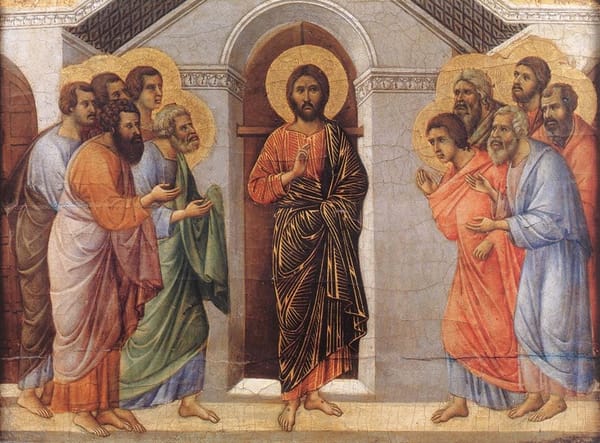
Thursday in Easter Week
AFTER having glorified the Lamb of God, and the Passover whereby our Lord destroyed our enemies; after having celebrated our deliverance by water, and our entrance into the Promised Land; let us now fix our respectful gaze upon him whose triumph is prefigured by all these prodigies. So dazzling is the glory that now beams from this Man-God, that, like the prophet of Patmos, we shall fall prostrate before him. But he is so wonderful, too, in his love, that he will encourage us to enjoy the grand vision: he will say to us, as he did to his disciple: ‘Fear not! I am the First, and the Last; and alive, and was dead; and behold! I am living for ever and ever, and have the keys of death and of hell.’1
Yes, he is now Master of death, which had held him captive; he holds in his hand the keys of hell. These expressions of Scripture signify that he has power over death and the tomb; he has conquered them. Now the first use he makes of his victory is to make us partakers of it. Let us adore his infinite goodness; and, in accordance with the wish of holy Church, let us meditate to-day upon the effects wrought in each one of ourselves by the mystery of the Pasch. Jesus says to his beloved disciple: 'I am alive, and was dead the day will come when we also shall triumphantly say: 'We are living, and we were dead!
Death awaits us; it is daily advancing towards us; we cannot escape its vengeance. ‘The wages of sin is death’:2 in these few words of Scripture, we are taught how death is not only universal, but even necessary; for we have all sinned. This, however, does not make the law less severe; nor can we help seeing a frightful disorder in the violent separation of soul and body, which were united together by God himself. If we would truly understand death, we must remember that God made man immortal: this will explain the instinctive dread we have of death, a dread which one thing alone can conquer; and that is, the spirit of sacrifice. In the death, then, of each one of us there is the handiwork of sin, and consequently a victory won by Satan: nay, there would be a humiliation for our Creator himself, were it not that, by sentencing us to this punishment, he satisfied his justice.
This is man’s well-merited but terrible condemnation. What can he hope for? Never to die? It would be folly: the sentence is clear, and none may escape. Can he hope that this body, which is to become first a corpse, and then be turned into a mere handful of dust, will one day return to life, and be reunited to the soul for which it was made? But who could bring about the reunion of an immortal substance with one that was formerly united with it, but has now seemingly been annihilated? And yet, O man! this is to be thy lot! Thou shalt rise again; that poor body of thine, which is to die, to be buried, forgotten, and humbled, shall be restored to life. Yea, it even now comes forth from the tomb, in the person of our Lord Jesus Christ; our future resurrection is accomplished in his; it is to-day that we are made as sure of our resurrection as we are of our death. This, too, makes part of our glorious feast, our Pasch!
God did not, at the beginning, reveal this miracle of his power and goodness: all he said to Adam was: ‘In the sweat of thy face shalt thou eat bread, till thou return to the earth, out of which thou wast taken; for dust thou art, and into dust thou shalt return.’3 Not a word, not an allusion, which gives the culprit the least hope with reference to that portion of himself which is thus doomed to death and the grave. It was fitting that the ungrateful pride, which had led man to rebel against his Maker, should be humbled. Later on the great mystery was revealed at least partially. Four thousand years ago, a poor sufferer, whose body was covered with ulcers, spoke these words of hope: ‘I know that my Redeemer liveth, and in the last day I shall rise out of the earth. And I shall be clothed again with my skin, and in my flesh I shall see God: this my hope is laid up in my bosom.’4
But, in order that Job’s hope might be realized, this Redeemer, of whom he spoke, had to come down to this earth, give battle to death, feel its pang, and finally conquer it. He came at the time fixed by the divine decree. He came, not indeed to prevent us from dying (for the sentence of God’s justice was absolute), but to die himself, and so take away from death its bitterness and humiliation. Like to those devoted physicians, who have been known to inoculate themselves with the virus of contagion, our Jesus 'swallowed down death,’5 as the Apostle forcibly expresses it. But the enemy’s joy was soon at an end; for the Man-God rose to die no more; and by his Resurrection, he won that same right for us.
Henceforth, then, we must see the grave under a new aspect. The earth will receive our bodies, but only to yield them back again, just as she yields back a hundredfold the seed that was confided to her. Her great Creator will, at some future day, bid her restore the deposit he entrusted to her. The archangel's trumpet will give the signal of his command; and in the twinkling of an eye, the whole human race will rise up from the grave, and proclaim the final defeat of death. For the just it will be a Pasch, a continuation of the Pasch we are now celebrating.
Who could describe the joy we shall experience at such a meeting! Our soul, after, it may be, a separation of hundreds of years, united once more to that essential part of her being, the body! She, perhaps, has been all that time enjoying the beatific vision; but the whole man was not there; our happiness was not complete, because that of the body was wanting; and in the midst of the soul's rapturous felicity, there was a trace still left of the punishment to which man was condemned, when our first parents sinned. Our merciful God would not, now that his Son has opened the gates of heaven, wait till the general resurrection to reward the souls of his elect with the vision; and yet these elect have not their whole glory and happiness until that last day comes and puts the last finish to the mystery of man's redemption. Jesus, our King and our Head, wills that we his members shall sing with him the song that comes from his own divine lips, and that each of us shall say for all eternity: 'I am living, and I was dead!' Mary, who on the third day after her death was united to her sinless body, longs to see her devoted children united with her in heaven; but wholly and entirely, soul and body: and this will be, when the tomb has done its work of purification.
The holy angels, whose ranks are waiting to be filled up by the elect among men, are affectionately looking forward to that happy day, when the glorified bodies of the just will spring up, like the loveliest of earth's flowers, to beautify the land of spirits. One of their joys consists in gazing upon the resplendent bodies of Jesus and Mary—of Jesus, who, even as Man, is their King as well as ours, and of Mary, whom they reverence as their Queen. What a feast-day, then, will they count that, whereon we, their brothers and sisters, whose souls have been long their companions in bliss, shall be revested with the robe of flesh, sanctified, and fitted for union with our radiant souls! What a canticle of fresh joy will ring through heaven, as it then receives within itself all the grandeur and beauty of creation! The angels who were present at Jesus' Resurrection were filled with admiration at the sight of this Body, which was, indeed, of a lower nature than themselves, but whose dazzling glory exceeded all the splendour of the angelic host together: will they not gladly hail our arrival, after our resurrection? Will they not welcome us with fraternal congratulations, when they see us, members as we are of this same risen Jesus, clad in the same gorgeous robe of glory as he, who is their God?
The sensual man never gives a thought to the eternal glory and happiness of the body: he acknowledges the resurrection of the flesh as an article of faith, but it is not an object of his hope. He cares but for the present; material, carnal pleasures being all he aspires to, he considers his body as an instrument of self-gratification, which, as it lasts so short a time, must be the more quickly used. There is no respect in the love he bears to his body; hence he fears not to defile it; and after a few years of insult, which he calls enjoyment, it becomes the food of worms and corruption. And yet this sensual man accuses the Church of being an enemy to the body! the Church that so eloquently proclaims its dignity, and the glorious destiny that awaits it! He is a tyrant, and a tyrant is ever an impudent calumniator. The Church warns us of the dangers to which the body exposes the soul; she tells us of the infectious weakness that came to the flesh by original sin; she instructs us as to the means we should employ for making it ‘serve justice unto sanctification’;6 but far from forbidding us to love the body, she reveals to us a truth which should incite us to true charity, namely, that it is destined to endless glory and happiness. When laid on the bed of death, the Church honours it with the Sacrament of Extreme Unction, fitting it for immortality by anointing it with holy oil; she is present at the departure of the soul from this the companion of her combats, and from which she is to be separated till the day of the general judgement; she respectfully bums incense over the body when dead; for, from the hour of its Baptism, she has regarded it as something holy; and to the surviving friends of the departed one, she addresses these inspired words of consolation: ‘Be not sorrowful, even as others, who have no hope!’7 But what is this hope? That same which comforted Job: ‘In my flesh I shall see my God.’
Thus does our holy faith reveal to us the future glory of our body; thus does it encourage, by supernatural motives, the instinctive love borne by the soul for this essential portion of our being. It unites together the two dogmas: our Lord's Pasch, and the resurrection of our body. The Apostle assures us of the close relation that exists between them, and says: ‘If Christ be not risen again, your faith is vain; if the dead rise not again, neither is Christ risen again:’8 so that Jesus' Resurrection and our resurrection seem to be parts of one and the same truth. Hence the sort of forgetfulness, which is nowadays so common, of this important dogma of the’resurrection of the body,' is a sad proof of the decay of lively faith. Such people believe in a future resurrection, for the Creed is too explicit to leave room for doubt; but the hope which Job had is seldom the object of their thoughts or desires. They say that what they are anxious about, both for themselves and for those that are dear to them, is what will become of the soul after this life: they do well to look to this; but they should not forget what religion teaches them regarding the resurrection of the body; by professing it, they not only have a fresh incentive to virtue, but they also render testimony to the Resurrection of Jesus, whereby he gained victory over death, both for himself and for us. They should remember that they are in this world only to confess, by their words and actions, the truths that God has revealed. It is therefore not enough that they believe in the immortality of the soul; the resurrection of the body must also be believed and professed.
We find this article of our holy faith continually represented in the catacombs: its several symbols formed, together with the Good Shepherd, quite the favourite subject of primitive Christian art. In those early ages of the Church, when to receive Baptism was to break entirely with the sensuality of previous habits of life, this consoling dogma of the resurrection of the body was strongly urged upon the minds of the neophytes. Any of them might be called upon to suffer martyrdom: the thought of the future glory that awaited their flesh inspired them with courage when the hour of trial came. Thus we read so very frequently in the Acts of the Martyrs, how, when in the midst of their most cruel torments, they declared that what supported them was the certain hope of the resurrection of the body. How many Christians are there nowadays who are cowardly in the essential duties of their state of life, simply because they never think of this important dogma of their faith!
The soul is more than the body; but the body is an essential portion of our being. It is our duty to treat it with great respect, because of its sublime destiny. If we at present chastise it and keep it in subjection, it is because its present state requires such treatment. We chastise it because we love it. The martyrs and all the saints loved their bodies far more than does the most sensual voluptuary: they, by sacrificing it, saved it; he, by pampering it, exposes it to eternal suffering. Let us be on our guard: sensualism is akin to naturalism. Sensualism will have it that there is no happiness for the body but such as this present life can give; and with this principle its degradation causes no remorse. Naturalism is that propensity we have to judge of everything by mere natural light, whereas we cannot possibly know the glorious future for which God has created us except by faith. If, therefore, the Christian can see what the Son of God has done for our bodies by the divine Resurrection we are now celebrating, and feel neither love nor hope, he may be sure that his faith is weak; and if he would not lose his soul, let him henceforth be guided by the word of God, which alone can teach him what he is now, and what he is called to be hereafter.
At Rome, the Station is in the basilica of the twelve Apostles. The neophytes were brought, to-day, into the church dedicated to the witnesses of the Resurrection, where repose the bodies of two out of the twelve: St Philip and St James the Less. In the Mass, frequent allusions are made to the apostolic labours of these heralds of our risen Jesus; they preached his Name throughout the world, and all ages shall hear their teachings.
Mass
The Introit is taken from the Book of Wisdom. It tells us of the heavenly eloquence of the Apostles, who, at first, were dumb and timid as little children. Divine wisdom changed them into other men, so that they everywhere published the victory of the Man-God.
Introit
Ps. Cantate Domino canticum novum: quia mirabilia fecit.℣. Gloria Patri.
Victricem.
Ps. Sing to the Lord a new song: for he hath done wonderful things.℣. Glory, etc.
They praised, etc.
The Collect alludes to the effect produced by the preaching of the Apostles—the union of all nations into one family. The neophytes, by their Baptism, have been admitted into this great unity: the Church prays that God would preserve them in it, by his grace.
Collect
Then is added one of the two Collects given in yesterday's Mass, p. 218.
Epistle
Cap. viii.In diebus illis: Angelus Domini locutus est ad Philippum, dicens: Surge et vade contra meridianum ad viam, quæ descendit ab Jerusalem in Gazam: hæc est deserta. Et surgens abiit. Et ecce vir Æthiops, eunuchus potens Candacis reginæ Æthiopum, qui erat super omnes gazas ejus, venerat adorare in Jerusalem: et revertebatur sedens super currum suum, legensque Isaiam prophetam. Dixit autem Spiritus Philippo: Accede, et adjunge te ad currum istum. Accurrens autem Philippus, audivit eum legentem Isaiam prophetam, et dixit: Putasne intelligis quæ legis? Qui ait: Et quomodo possum, si non aliquis ostenderit mihi? Rogavitque Philippum ut ascenderet, et sederet secum. Locus autem Scripturæ quam legebat, erat hic: Tanquam ovis ad occisionem ductus est: et sicut agnus coram tondente se, sine voce, sic non aperuit os suum. In humilitate judicium ejus sublatum est. Generationem ejus quis enarrabit, quoniam tolletur de terra vita ejus? Respondens autem eunuchus Philippo, dixit: Obsecro te, de quo propheta dicit hoc? de se, an de alio aliquo? Aperiens autem Philippus os suum, et incipiens a Scriptura ista, evangelizavit illi Jesum. Et dum irent per viam, venerunt ad quamdam aquam: et ait eunuchus: Ecce aqua, quid prohibet me baptizan? Dixit autem Philippus: Si credis ex toto corde, licet. Et respondens ait: Credo Filium Dei esse Jesum Christum. Et jussit stare currum: et descenderunt uterque in aquam, Philippus et eunuchus, et baptizavit eum. Cum autem ascendissent de aqua, Spiritus Domini rapuit Philippum, et amplius non vidit eum eunuchus. Ibat autem per viam suam gaudens. Philippus autem inventus est in Azoto, et pertransiens evangelizabat civitatibus cunctis, donec veniret Cæsaream, nomen Domini Jesu Christi.
Ch. viii.In those days: An angel of the Lord spoke to Philip saying: Arise, go towards the south, to the way that goeth down from Jerusalem to Gaza: this is desert. And rising up he went. And behold a man of Ethiopia, an eunuch of great authority under Candace, queen of the Ethiopians, who had charge over all her treasures, had come to Jerusalem to adore. And he was returning, sitting in his chariot, and reading Isaias the prophet. And the Spirit said to Philip: Go near, and join thyself to this chariot. And Philip running thither, heard him reading the prophet Isaias, and he said: Thinkest thou that thou understandest what thou readest? Who said: And how can I, unless some man show me? and he desired Philip that he would come up and sit with him. And the place of the Scripture which he was reading was this: 'He was led as a sheep to the slaughter: and like a lamb without voice before his shearer, so opened he not his mouth. In humility his judgement was taken away. His generation who shall declare, for his life shall be taken from the earth?' And the eunuch answering Philip, said: I beseech thee, of whom doth the prophet speak this? of himself, or of some other man? Then Philip opening his mouth, and beginning at this Scripture, preached unto him Jesus. And as they went on their way, they came to a certain water; and the eunuch said: See, here is water, what doth hinder me from being baptized? And Philip said: If thou believest with all thy heart, thou mayest, And he answering, said: I believe that Jesus Christ is the Son of God. And he commanded the chariot to stand still: and they went down into the water, both Philip and the eunuch, and he baptized him. And when they were come up out of the water, the Spirit of the Lord took away Philip, and the eunuch saw him no more. And he went on his way rejoicing. But Philip was found in Azotus, and passing through, he preached the Gospel to all the cities till he came to Cesarea.
The Church, by this passage from the Acts of the Apostles, would remind her neophytes of the sublime grace of their Baptism, and under what condition they have been regenerated. God put the opportunity of salvation in their path, as he sent Philip to the eunuch. He gave them a desire to know the truth, in the same manner as he inspired this servant of Queen Candace to read what was to occasion his being instructed in the faith of Christ. This pagan, had he chosen, might have received the instructions of God’s messenger with mistrust and indifference, and so have resisted the grace that was offered him; but no, he opened his heart, and faith filled it. Our neophytes did the same; they were docile, and God’s word enlightened them; they went on from light to light, until at length the Church recognized them as true disciples of the faith. Then came the feast of the Pasch, and this mother of souls said to herself: ‘Lo here is water—the water that purifies, the water that issued from Jesus’ side when opened by the spear: what hinders them from being baptized?' Having confessed that Jesus Christ is the Son of God, they were baptized, as was the Ethiopian of our Epistle, in the life-giving waters: like him, they are about to continue the journey of life, rejoicing, for they are risen with Christ, who has graciously vouchsafed to associate the joy of their new birth with that of his own triumph.
Gradual
The Sequence, Victimæ Paschali, p. 145.
Gospel
Cap. xx.In illo tempore: Maria stabat ad monumentum foris, plorans. Dum ergo fleret, inclinavit se, et prospexit in monumentum: et vidit duos angelos in albis sedentes, unum ad caput, et unum ad pedes, ubi positum fuerat corpus Jesu. Dicunt ei illi: Mulier, quid ploras? Dicit eis: Quia tulerunt Dominum meum: et nescio ubi posuerunt eum. Hæc cum dixisset, conversa est retrorsum, et vidit Jesum stantem: et non sciebat quia Jesus est. Dicit ei Jesus: Mulier, quid ploras? quem quæris?Illa existimans quia hortulanus esset, dicit ei: Domine, si tu sustulisti eum, dicito mihi ubi posuisti eum: et ego eum tollam. Dicit ei Jesus: Maria. Conversa illa, dicit ei: Rabboni (quod dicitur magister). Dicit ei Jesus: Noli me tangere, nondum enim ascendi ad Patrem meum. Vade autem ad fratres meos, et dic eis: Ascendo ad Patrem meum et Patrem vestrum, Deum meum et Deum vestrum. Venit Maria Magdalene annuntians discipulis: quia vidi Dominum, et hæc dixit mihi.
Ch. xx.At that time: Mary stood at the sepulchre without, weeping. Now as she was weeping, she stooped down, and looked into the sepulchre: and she saw two angels in white sitting one at the head, and one at the feet, where the body of Jesus had been laid. They say to her: Woman, why weepest thou? She saith to them: Because they have taken away my Lord, and I know not where they have laid him. When she had thus said, she turned herself back, and saw Jesus standing; and she knew not that it was Jesus. Jesus saith to her: Woman, why weepest thou? whom seekest thou? She thinking that it was the gardener, saith to him: Sir, if thou hast taken him hence, tell me where thou hast laid him: and I will take him away. Jesus saith to her: Mary, She, turning, saith to him: Rabboni (which is to say, Master). Jesus saith to her: Do not touch me, for I am not yet ascended to my Father: but go to my brethren, and say to them: I ascend to my Father, and to your Father, to my God. and your God. Mary Magdalen cometh, and telleth the disciples: I have seen the Lord, and these things he said to me.
To-day’s Station is in the basilica of the twelve Apostles; and, instead of patting before us any of the apparitions related by the Gospel as having been made to his Apostles by our Saviour, after his Resurrection, the Church reads to us the one wherewith Magdalen was honoured. Why thus apparently forget the very heralds and ambassadors of the New Law? The reason is obvious. By thus honouring her, whom our Lord selected as the Apostle of his Apostles, the Church would put before us, in their full truth, the circumstances of the day of the Resurrection. It was through Magdalen and her companions that the apostolate of the grandest mystery of our Jesus’ life upon earth began; they have every right, therefore, to be honoured to-day in the basilica which is sacred to the holy Apostles.
God is all-powerful, and delights in showing himself in that which is weakest; he is infinitely good and glorious in rewarding such as love him. This explains how it was that our Jesus gave to Magdalen and her companions the first proofs of his Resurrection, and so promptly consoled them. They were even weaker than the Bethlehem shepherds; they were, therefore, the objects of a higher preference. The Apostles themselves were weaker than the weakest of the earthly powers they were to bring into submission; hence, they too were initiated into the mystery of Jesus’ triumph. But Magdalen and her companions had loved their Master even to the Cross and in his tomb, whereas the Apostles had abandoned him; they therefore had a better claim than the Apostles to Jesus’ generosity, and richly did he satisfy the claim.
Let us attentively consider the sublime spectacle of the Church receiving the knowledge of that mystery, which is the basis of her faith, the Resurrection. After Mary—in whom the light of faith never waned, and to whom, as the sinless Mother, was due the first manifestation—who were the first to be illumined with that faith whereby the Church lives? Magdalen and her companions. For several hours, this was the ‘little flock’ on which Jesus looked with complacency: little, indeed, and weak in the world’s estimation, but grand, as being the noblest work of grace. Yet a short time, and the Apostles will be added to the number; yea, the whole world will form a part of this elect group. The Church now sings these words in every country of the earth: 'Tell us, O Mary! what thou sawest on the way!' And Mary Magdalen tells the Church the mystery: 'I saw the sepulchre of Christ, and the glory of him that rose.’
Nor must we be surprised that women were the first to form, around the Son of God, the Church of believers, the Church resplendent with the brightness of the Resurrection: it is the continuation of that divine plan, the commencement of which we have already respectfully studied. It was by woman that the work of God was marred in the beginning; he willed that it should berepaired by woman. On the day of the Annunciation, we found the second Eve making good by her own obedience the disobedience of the first; and now, at Easter, God honours Magdalen and her companions in preference even to the Apostles. We repeat it: these facts show us not so much a personal favour conferred upon individuals, as the restoration of woman to her lost dignity. 'The woman,' says St Ambrose, ‘was the first to taste the food of death; she is destined to be the first witness of the Resurrection. By proclaiming this mystery, she will atone for her fault;9 therefore is it that she, who heretofore had announced sin to man, was sent by the Lord to announce the tidings of salvation to men, and to make known to them his grace.’10 Others of the holy Fathers speak in the same strain. They tell us that God, in the distribution of the gifts of his grace, gives woman the first place. And in what happened at the Resurrection, they recognize not merely an act of the supreme will of the Master, but, moreover, a well-deserved reward for the love Jesus met with from these humble women; a love which he did not receive from his Apostles, though he had treated them, for the last three years of his life, with every mark of intimacy and affection, and had every right to expect them to be courageous in their devotedness towards him.
Magdalen stands as a queen amidst her holy companions. She is most dear to Jesus; she has loved him more than did all the rest of his friends; she has been more heart-broken at seeing him suffer; she has been more earnest in paying honour to the sacred Body of her buried Master. She is well-nigh beside herself, until she has found him; and when she at length meets him and finds Jesus himself, still living, and still full of love for Magdalen, she could die for very joy I She would show him her delight, but Jesus checks her, saying: Touch me not! for I am not yet ascended to my Father!
Jesus is no longer subject to the conditions of mortality. True, his human will be eternally united with his divine nature; but his Resurrection tells the faithful soul that his relations with her are no longer the same as before During his mortal life, he suffered himself to be approached as man; there was little in his exterior to indicate his divinity; but now his eternal splendour gleams through his very Body, and bespeaks the Son of God. Henceforth, then, we must see him with the heart rather than with the eye, and offer him a respectful love, rather than one of sentiment, however tender. He allowed Magdalen to touch him so long as she was weak in her conversion, and he himself was mortal; but now she must aspire to that highest spiritual good, which is the life of the soul—Jesus, in the bosom of the Father. In her first estate, Magdalen is the type of the soul when commencing its search after Jesus. But her love needs a transformation: it is ardent, but not wise; so that the angel has to chide her: ‘Why,’ says he, ‘seekest thou the living among the dead?’11 The time is come for her to ascend to something more perfect, and seek in spirit him who is Spirit.
Jesus says to Magdalen: I am not yet ascended to my Father! as though he would say: The mark of love thou wouldst show me is not what I now wish to receive from thee. When I have ascended into heaven, and thou art there with me, the sight of my human nature shall be no obstacle to thy soul’s vision of my divinity: then thou shalt embrace me!’ Magdalen takes in the lesson of her dear Master; she loves him more, because her love is spiritualized. After his Ascension, she retires into the holy cave.12 There she lives, pondering upon all the mysteries of her Jesus’ life. Her love feeds on the memory of all he has done for her, from his first word which converted her, to the favour he showed her on the morning of his Resurrection. Each day she advances in the path of perfect love. The angels visit and console her. Her probation completed, she follows her Jesus to heaven, where she lavishes on him the ardour of her love in an unrestrained and eternal embrace.
The Offertory alludes to the land flowing with milk and honey, into which the preaching of the Apostles has led our neophytes. But the altar, whereon the holy Sacrifice is now being offered, will give them a still more delicious nourishment.
Offertory
In the Secret, the Church beseeches God to accept the gifts presented him by his new people. The bread will be changed, by the words of Consecration, into a food that will fortify them in their journey towards that heavenly country.
Secret
To this is added one of the two Secrets given in yesterday's Mass, p. 224.
In the Communion Anthem, it is the Apostolic College that speaks by the mouth of St Peter to the newly made children of God. With paternal affection, the Apostles congratulate our neophytes on the favours they have received from God, the author of light.
Communion
The Postcommunion tells us of the grand effects produced in us by this adorable Sacrament. It enriches us with every blessing; it is our support during this life’s pilgrimage; and it gives us a foretaste of heaven, even in our exile.
Postcommunion
To this is added one of the Postcommunions given in yesterday’s Mass, p. 225.
The work of the Son of God, the creation, advances towards completion. To-day there appear living beings in the waters and in the air. Countless varieties of fishes sport in the sea; and the thrilling melody of birds breaks that solemn silence, which hitherto had nothing to disturb it save the wind rustling amidst the trees. Here, again, the visible is the type of the invisible. The waters of Baptism are to give birth to other fishes; and from this our earth, souls, like birds of heaven, are to soar aloft on the wings of contemplation. This shall be, when the Creator shall come, in human form, into the world he is now forming. As our prayer of thanksgiving for this fifth day of the creation, let us use the following beautiful one, taken from the Mozarabic breviary:
Capitula
As the Liturgy of to-day speaks to us of Mary Magdalen, we will insert here two of the many sequences composed in her honour during the Middle Ages, and sung by our forefathers during the Easter Octave. They are exquisite in their simplicity, and express a tender devotion towards this favoured penitent, whose name is inseparable from the mystery of the Resurrection, and who was so dear to our blessed Lord that he chose her to be the first to announce to the Apostles and mankind the tidings of his victory over death.
First Sequence
Jam ex agno factus leo
Solemni victoria.
Reseravit seram portæ
Suae mortis gratia.
Et in cruce redimebat
Totum gregem ovium.
Magdalenam consumebat
Doloris incendium.
Contemplando crucem Christi?
Et in cruce sublevari
Peccatorum manibus.
Contemplando crucem Christi?
Vultum sputis maculatum,
Et plenum livoribus.
Contemplando crucem Christi?
Hastam latus vulnerare,
Vivi fontis exitum.
Contemplando crucem Christi?
Et quod caput inclinavit,
Et emisit spiritum.
Postquam Jesum amisisti?
Cum qua domum remeavi,
Et in terram me prostravi,
Et utrumque deploravi.
Postquam Jesum amisisti?
Et sepulchrum visitavi,
Planctus meos duplicavi.
Postquam Jesum amisisti?
O Maria noli flere;
Jam surrexit Christus vere.
Postquam Jesum amisisti?
Vidi signa resurgentis
Filii omnipotentis.
Quid vidisti in via?
Et gloriam vidi resurgentis.
Angelicos testes,
Sudarium et vestes.
Præcedet suos in Galilæam.
Quam Judæorum turbæ fallaci.
A mortuis vere;
Tu nobis, victor rex, miserere.
rises with his trophy,
the glorious conqueror.
by his death,
he opened heaven’s gate.
upon the Cross,
and redeemed the whole flock.
save Magdalen,
who pined with burning grief.
when looking at the Cross of Christ?
and raised on the Cross,
by the hands of sinners.
when looking at the Cross of Christ?
his face disfigured
with spittle and blows.
when looking at the Cross?
his side wounded by a spear,
and a fount of living water gushing from the wound.
when looking at the Cross?
he bowed down his head;
he gave up the ghost.
after losing Jesus?
and returned with her to the house:
I prostrated myself on the ground,
and compassionated both Son and Mother.
after losing Jesus?
and visiting the tomb,
I redoubled my tears.
after losing Jesus?
‘Weep not, Mary!
For Christ hath truly risen.’
after losing Jesus?
and signs of the Resurrection
of the Son of God.
what sawest thou on the way?
I saw the glory of him that had risen.
I saw the angels that were the witnesses;
I saw the winding-sheet and the cloths.
He shall go before you into Galilee.
rather than the whole wicked host of the Jews.
truly risen from the dead.
Do thou, O Conqueror and King! have mercy upon us.
Second Sequence
Surgens Filius Dei,
Nostra spes et gloria.
Rediit ab inferis,
Cum summa victoria.
Maria Magdalene
Facta est prænuntia.
Ejus morte tristibus,
Exspectata gaudia.
Quibus regem sæculi,
Morte jam deposita,
Primum est intuita!
Cujus cuncta crimina
Ad Christi vestigia
Ejus lavit gratia.
Facto clamat quod cor amat,
Jesum super omnia.
Quod precatur jam deletur,
Quod mens timet conscia.
Stella maris appellaris,
Operum per merita.
Dum fuisti sic vocata,
Sed honore subdita.
Ista beata peccatrix:
Lætitiæ primordia
Fuderunt in Ecclesia.
Per quam salus est exorta:
Hæc resurgentis nuntia
Mundum replet lætitia.
Audi vota laude plena,
Apud Christum chorum istum
Clementer concilia.
Qui te lavit a peccatis,
Servos suos atque tuos
Mundet data venia.
the Son of God, our hope and glory,
rose from the dead.
and returned from limbo
with all the glory of his victory upon him.
of his Resurrection
was Mary Magdalen.
who were sad
for the death of Jesus.
that first beheld
the King of Ages,
after he had laid death aside!
who threw herself at Jesus' feet,
and had all her sins
washed away by his grace.
her life proclaims what her heart most loves
—Jesus above all else.
What she prays for is at once granted
—the forgiveness of the sins that weighed her down with fear.
Thou hast deserved thy name of star of the sea,
because of thy holy deeds.
with the Mother of Christ,
though thy honours are not as hers.
Magdalen is the favoured sinner:
they gave to the Church
her earliest joy.
through which salvation came into the world;
Magdalen was the messenger of the Resurrection,
and filled the world with joy at its tidings.
our prayer and praise;
pray to Jesus for the choir that thus sings to thee,
and draw down his mercy upon us,
who cleansed thee from thy sins,
may purify us by his pardon,
for we are his and thy servants.
April 25: St. Mark, Evangelist (and the Greater Litanies)
|
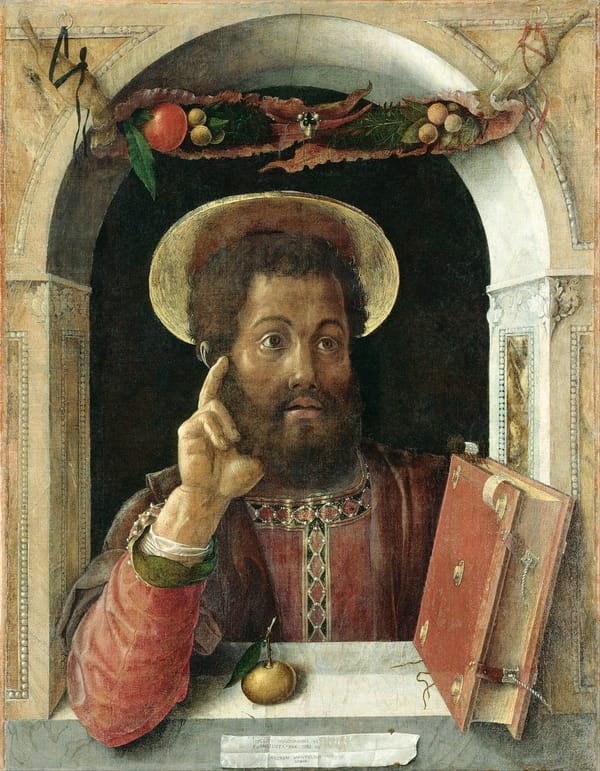
THE cycle of holy Mother Church brings before us to-day the Lion, who, together with the Man, the Ox, and the Eagle, stands before the throne of God.1 It was on this day that Mark ascended from earth to heaven, radiant with his triple aureole of Evangelist, Apostle and Martyr.
As the preaching made to Israel had its four great representatives—Isaias, Jeremias, Ezechiel, and Daniel —so, likewise, would God have the New Covenant to be embodied in the four Gospels, which were to make known to the world the life and teachings of his divine Son. The holy Fathers tell us that the Gospels are like the four streams which watered the garden of pleasure.2 and that this garden was a figure of the future Church. The first of the Evangelists—the first to register the actions and words of our Redeemer—is Matthew, whose star will rise in September; the second is Mark, whose brightness gladdens us today; the third is Luke, whose rays will shine upon us in October; the fourth is John, whom we have already seen in Bethlehem, at the crib of our Emmanuel.
Mark was the beloved disciple of Peter; he was the brilliant satellite of the sun of the Church. He wrote his Gospel at Rome, under the eyes of the Prince of the Apostles. The Church was already in possession of the history given by Matthew; but the faithful of Rome wished their own Apostle to narrate what he had witnessed. Peter refused to write it himself, but he bade his disciple take up his pen, and the Holy Ghost guided the hand of the new Evangelist. Mark follows the account given by Matthew; he abridges it, and yet he occasionally adds a word, or an incident, which plainly prove to us that Peter, who had seen and heard all, was his living and venerated authority. One would have almost expected that the new Evangelist would pass over in silence the history of his master’s fall, or at least have said as little as possible about it; but no—the Gospel written by Mark is more detailed on Peter's denial than is that of Matthew; and as we read it, we cannot help feeling that the tears elicited by Jesus’ look when in the house of Caiphas, were flowing down the Apostle’s cheeks as he described the sad event. Mark’s work being finished, Peter examined it and gave it his sanction; the several Churches joyfully received this second account of the mysteries of the world’s redemption, and the name of Mark was made known throughout the whole earth.
Matthew begins his Gospel with the human genealogy of the Son of God, and has thus realized the prophetic type of the Man; Mark fulfils that of the Lion, for he commences with the preaching of John the Baptist, whose office as precursor of the Messias had been foretold by Isaias, where he spoke of the voice of one crying in the wilderness—as the Lion that’ makes the desert echo with his roar.
Mark, having written his Gospel, was next to labour as an Apostle. Peter sent him first to Aquileia, where he founded an important Church: but this was not enough for an Evangelist. When the time designed by God came, and Egypt, the source of countless errors, was to receive the truth, and the haughty and noisy Alexandria was to be raised to the dignity of the second Church of Christendom—the second see of Peter—Mark was sent by his master to effect this great work. By his preaching, the word of salvation took root, grew up, and produced fruit in that most infidel of nations; and the authority of Peter was thus marked, though in different degrees, in the three great cities of the Empire: Rome, Alexandria and Antioch.
St Mark may be called the first founder of the monastic life by his instituting, in Alexandria itself, what were called the Therapeutes. To him, also, may be justly attributed the origin of that celebrated Christian school of Alexandria which was so flourishing even in the second century.
But glorious as were these works of Peter's disciple, the Evangelist and Apostle Mark was also to receive the dignity of martyr. The success of his preaching excited against him the fury of the idolaters. They were keeping a feast in honour of Serapis; and this gave them an opportunity which they were not likely to lose. They seized Mark, treated him most cruelly, and cast him into prison. It was there that our Risen Lord appeared to him during the night, and addressed him in these words, which afterwards formed the arms of the Republic of Venice: ' Peace be to thee, Mark, my Evangelist!' To which the disciple answered: ‘Lord '—for such were his feelings of delight and gratitude that he could say but that one word, as it was with Magdalen, when she saw Jesus on the morning of the Resurrection. On the following day Mark was put to death by the pagans. He had fulfilled his mission on earth, and heaven opened to receive the Lion, who was to occupy the place allotted to him near the throne of the Ancient of days, as shown to the Prophet of Patmos in his sublime vision.3
In the ninth century the West was enriched with the relics of St Mark. They were taken to Venice; and, under the protection of the sacred Lion, there began for that city a long period of glory. Faith in so great a patron achieved wonders; and from the midst of islets and lagoons there sprang into existence a city of beauty and power. Byzantine art raised up the imposing and gorgeous church, which was the palladium of the Queen of the Seas; and the new Republic stamped its coinage with the Lion of St Mark. Happy would it have been for Venice had she persevered in her loyalty to Rome and in the ancient severity of her morals.
Let us listen to the Churches of the East and West speaking his praise. We will begin with a hymn composed in the ninth century by St Paulinus, one of St Mark’s successors as bishop of Aquileia.
Hymn
Lux ilia Patris quæ iucet de solio,
Quæ fons, origo, splendor lucis aureæ,
Habensque semper lumen indeficiens,
Cœlum serenat arcens mundi tenebras.
Suscepit almum radium sub pectore
Marcus beatus, doctor evangelicus;
Factus lucerna more tanti luminis,
Ardens fugavit sæculi caliginem.
Aureis septem unum de candelabris,
Cingitque totum mundum claro sidere:
Ecciesiarum nititur sub culmine,
Sustentat altæ fundamenta fabricæ.
Propheta sanctus, animai lætissimum
Vidit Joannes, ceu Christi recubitor,
Leonis hoc et typice sub specie
Clamore multo per deserta frendere.
Aquileiensem dudum famosissimam
Urbem sacrati Verbi pullulantia
Disseminavit, satosque centuplices
Fructus ad alta vexit felix horrea.
Nam fundamentum fidei fortissimum
Fixerat unum petram super limpidam,
Quam flumen undans, nec ventorum fulmina
Quassare possunt, torrentes nec pluviæ.
Athleta Chris ti compta pulchris liliis,
Mistumque palmis, lauro atque rosulis,
Portabat gaudens diadema vertice
Ingressus urbem Romam Christo comite.
Sancto repletus Spiritu, lætissimos
Fines per omnes jugiter Memphiticos
Patris tremendi prædicabat unicum
Venisse mundi pro salute Filium.
Tumens parabat tormentorum spicula:
Vinxit catenis, transfixit aculeis,
Dilaniando flagris sancta viscera:
Carceris umbras misit ad phantasticas.
Dedit in urbem Marcus Alexandriam:
Christi dicavit mox ibi basili cam,
Quam expiavit pretioso sanguine:
Vallavit almæ fidei munimine.
Sit Nate semper tibi super sidera
Honor, potestas, Sanctoque Spiritui;
Sit Trini tati virtus individuæ,
Per infinita sæculorum sæcula.
the light which shines from the Father's throne:
the light which is the fount and source and splendour of the golden light:
the light that never fails,
beautifies heaven, and expels darkness from the world.
received into his heart
a lovely ray of this sparkling sacred light.
He became as a lamp reflecting that great light
and dispelling the gloom of this world by his brilliant flame.
and one of the seven golden candlesticks
whose brightness shines as a star throughout the universe.
He was one of the foundations
that support lofty structure of the Church
seen of old by the holy prophet Ezechiel,
and by John, the disciple that leaned on Jesus' breast.
Mark was prefigured under the type of a lion,
whose wild roar is heard in the wilderness.
that city of ancient fame.
There he sowed the seed of the divine word,
and with joy garnered into heaven
a hundredfold of fruit.
He gave it solidity of unshaken faith
by building it on that faultless Rock,
against which the billows and storms
and floods vent their rage in vain.
wearing a wreath of fair lilies,
with palm and laurel and roses:
and thus crowned, he joyfully entered Rome,
led thither by Christ.
and, filled with the Holy Ghost,
traverses the ever fertile land of Egypt,
preaching that the only begotten Son of the Father Almighty
had come into the world for the world's salvation.
prepared various torments for him:
he was bound with chains, pierced with arrows,
and after his holy flesh had been torn by scourges,
he was thrust into a dismal dungeon.
Alexandria to know the true God.
He there built a church, which he dedicated to Christ,
consecrated by the shedding of his own blood,
and fortified by the solidity of holy faith.
To thee, O Jesus, who reignest in heaven above,
and to the Holy Ghost, be honour and power!
To the undivided Trinity be adoration paid
for endless ages!
The Greek Church celebrates the memory of the holy Evangelist in the Menæa: we extract the following stanzas:
Hymn (Die XXV Aprilis)
Thou, O Mark, art the mystic Lion, who, with the Man, the Ox and the Eagle, art yoked to the chariot whereon the King of kings pursues his triumphant course through the earth. Ezechiel, the prophet of the Ancient Testament, and John, the prophet of the New Law, saw thee standing nigh the throne of Jehovah. How magnificent is thy glory! Thou art the historian of the Word made Flesh, and thou publishest to all generations his claims to the love and adoration of mankind. The Church reveres thy writings, and bids us receive them as inspired by the Holy Ghost.
It was thou that, on the glad day of Easter, didst announce to us the Resurrection of our Lord: pray for us, O holy Evangelist, that this divine mystery may work its effects within us; and that our hearts, like thine own, may be firm in their love of our Risen Jesus, that so we may faithfully follow in him that new life which he gave us by his Resurrection. Ask him to give us his peace, as he did to his Apostles when he showed himself to them in the Cenacle, and as he did to thee when he appeared to thee in thy prison.
Thou wast the beloved disciple of Peter; Rome was honoured by thy presence: pray for the successor of Peter, thy master; pray for the Church of Rome, against which the wildest storm is now venting its fury. Pray to the Lion of the Tribe of Juda: he seems to sleep; and yet we know that he has but to show himself, and the victory is gained.
Apostle of Egypt! what has become of thy flourishing Church of Alexandria, Peter’s second see, the hallowed scene of thy martyrdom? Its very ruins have perished. The scorching blast of heresy made Egypt a waste, and God, in his anger, let loose upon her the torrent of Mahometanism. Twelve centuries have passed since then, and she is still a slave to error and tyranny: is it to be thus with her till the coming of the Judge? Pray, we beseech thee, for the countries thou didst so zealously evangelize, but whose deserts are now the image of her loss of faith.
And can Venice be forgotten by thee, who art her dearest patron? Her people still call themselves thine for the faith; bless her with prosperity; obtain for her that she may be purified by her trials, and return to the God who had chastised her in his justice. A nation that is loyal to the Church must prosper: let Venice, then, return to her former fidelity to Rome, and who knows but that the sovereign Ruler of the world, being appeased by thy powerful intercession, may make thy Venice what she was before she rebelled against the Holy See and tarnished the glories she won at Lepanto!
April 25 (the Same Day): The Greater Litanies
SAINT MARK’S PROCESSION
This day is honoured in the Liturgy by what is called Saint Mark's Procession. The term, however, is not a correct one, inasmuch as a procession was a privilege peculiar to April 25 previously to the institution of our Evangelist’s feast, which even so late as the sixth century had no fixed day in the Roman Church. The real name of this procession is The Greater Litanies. The word Litany means Supplication, and is applied to the religious rite of singing certain chants whilst proceeding from place to place in order to propitiate heaven. The two Greek words Kyrie eleison (Lord, have mercy on us) were also called Litany, as likewise were the invocations which were afterwards added to that cry for mercy, and which now form a liturgical prayer used by the Church on certain solemn occasions.
The Greater Litanies (or processions) are so called to distinguish them from the Minor Litanies, that is, processions of less importance as far as the solemnity and concourse of the faithful were concerned. We gather from an expression of St Gregory the Great that it was an ancient custom in the Roman Church to celebrate, once each year, a Greater Litany, at which all the clergy and people assisted. This holy Pontiff chose April 25 as the fixed day for this procession, and appointed the Basilica of St Peter as the Station.
Several writers on the Liturgy have erroneously confounded this institution with the processions prescribed by St Gregory for times of public calamity. It existed long before his time, and all that he did was to fix it on April 25. It is quite independent of the feast of St Mark, which was instituted at a much later period. If April 25 occur during Easter week, the procession takes place on that day (unless it be Easter Sunday), but the feast of the Evangelist is not kept till after the octave.
The question naturally presents itself—why did St Gregory choose April 25 for a procession and Station in which everything reminds us of compunction and penance, and which would seem so out of keeping with the joyous season of Easter? The first to give a satisfactory answer to this difficulty was Canon Moretti, a learned liturgiologist of the eighteenth century. In a dissertation of great erudition, he proves that in the fifth, and probably even in the fourth, century, April 25 was observed at Rome as a day of great solemnity. The faithful went, on that day, to the Basilica of St Peter, in order to celebrate the anniversary of the first entrance of the Prince of the Apostles into Rome, upon which he thus conferred the inalienable privilege of being the capital of Christendom. It is from that day that we count the twenty-five years, two months and some days that St Peter reigned as Bishop of Rome.* The Sacramentary of St Leo gives us the Mass of this solemnity, which afterwards ceased to be kept. St Gregory, to whom we are mainly indebted for the arrangement of the Roman Liturgy, was anxious to perpetuate the memory of a day which gave to Rome her grandest glory. He therefore ordained that the Church of St Peter should be the Station of the Great Litany, which was always to be celebrated on that auspicious day. April 25 comes so frequently during the octave of Easter that it could not be kept as a feast, properly so called, in honour of St Peter’s entrance into Rome; St Gregory, therefore, adopted the only means left of commemorating the great event.
But there was a striking contrast resulting from this institution, of which the holy Pontiff was fully aware, but which he could not avoid: it was the contrast between the joys of Paschal Time and the penitential sentiments wherewith the faithful should assist at the procession and Station of the Great Litany. Laden as we are with the manifold graces of this holy season, and elated with our Paschal joys, we must sober our gladness by reflecting on the motives which led the Church to cast this hour of shadow over our Easter sunshine. After all, we are sinners, with much to regret and much to fear; we have to avert those scourges which are due to the crimes of mankind; we have, by humbling ourselves and invoking the intercession of the Mother of God and the Saints, to obtain the health of our bodies, and the preservation of the fruits of the earth; we have to offer atonement to divine justice for our own and the world’s pride, sinful indulgences, and insubordination. Let us enter into ourselves, and humbly confess that our own share in exciting God’s indignation is great; and our poor prayers, united with those of our holy Mother the Church, will obtain mercy for the guilty, and for ourselves who are of the number.
A day, then, like this, of reparation to God’s offended majesty, would naturally suggest the necessity of joining some exterior penance to the interior dispositions of contrition which filled the hearts of Christians. Abstinence from flesh meat has always been observed on this day at Rome; and when the Roman Liturgy was established in France by Pepin and Charlemagne, the Great Litany of April 25 was, of course, celebrated, and the abstinence kept by the faithful of that country. A Council of Aix-la-Chapelle, in 836, enjoined the additional obligation of resting from servile work on this day: the same enactment is found in the Capitularia of Charles the Bald. As regards fasting, properly so called, being contrary to the spirit of Paschal Time, it would seem never to have been observed on this day, at least not generally. Amalarius, who lived in the ninth century, asserts that it was not then practised even in Rome.
During the procession, the Litany of the Saints is sung, followed by several versicles and prayers. The Mass of the Station is celebrated according to the Lenten Rite, that is, without the Gloria in excelsis, and in purple vestments. We have inserted the Litany of the Saints in the following volume, for the Rogation Days.
We take this opportunity of protesting against the negligence of Christians on this subject. Even persons who have the reputation of being spiritual think nothing of being absent from the Litanies said on St Mark’s and the Rogation Days. One would have thought that when the Holy See took from these days the obligation of abstinence, the faithful would be so much the more earnest to join in the duty still left—-the duty of prayer. The people’s presence at the Litanies is taken for granted: and it is simply absurd that a religious rite of public reparation should be one from which almost all should keep away. We suppose that these Christians will acknowledge the importance of the petitions made in the Litanies; but God is not obliged to hear them in favour of such as ought to make them and yet do not. This is one of the many instances which might be brought forward of the strange delusions into which private and isolated devotion is apt to degenerate. When St Charles Borromeo first took possession of his see of Milan, he found this negligence among his people, and that they left the clergy to go through the Litanies of April 25 by themselves. He assisted at them himself, and walked barefooted in the procession. The people soon followed the sainted pastor’s example.
* Moretti, De Festo in honorem Principis Apostolorum Romæ ad diem XXV Aprilis instituto. Romæ, 1742, 10. ↩︎
| Previous April 24: St. Fidelis of Sigmaringen, Martyr | Next April 25: St. Mark, Evangelist (and the Greater Litanies) |