Daily reading
Paschal Time
Double · Movable from Easter · Temporal
April 28, 2019
From Dom Guéranger’s The Liturgical Year.

|
Quasimodo or Low Sunday
THE OCTAVE OF THE PASCH
OUR neophytes closed the Octave of the Resurrection yesterday. They were before us in receiving the admirable mystery; their solemnity would finish earlier than ours. This, then, is the eighth day for us who kept the Pasch on the Sunday, and did not anticipate it on the vigil. It reminds us of all the glory and joy of that feast of feasts, which united the whole of Christendom in one common feeling of triumph. It is the day of light, which takes the place of the Jewish Sabbath. Henceforth, the first day of the week is to be kept holy. Twice has the Son of God honoured it with the manifestation of his almighty power. The Pasch, therefore, is always to be celebrated on the Sunday; and thus every Sunday becomes a sort of Paschal feast, as we have already explained in the Mystery of Easter.
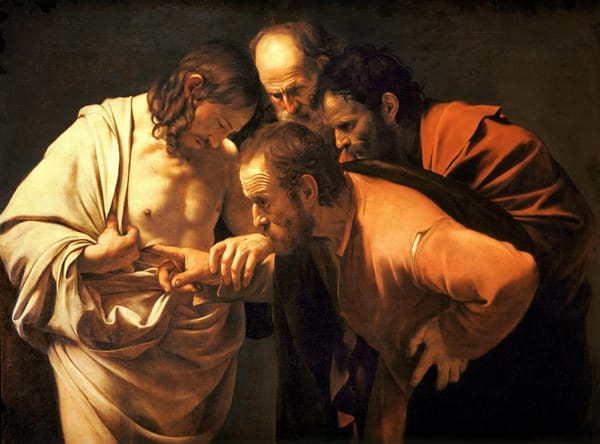
Our risen Jesus gave an additional proof that he wished the Sunday to be, henceforth, the privileged day. He reserved the second visit he intended to pay to all his disciples for this the eighth day since his Resurrection. During the previous days, he has left Thomas a prey to doubt; but to-day he shows himself to this Apostle, as well as to the others, and obliges him, by irresistible evidence, to lay aside his incredulity. Thus does our Saviour again honour the Sunday. The Holy Ghost will come down from heaven upon this same day of the week, making it the commencement of the Christian Church: Pentecost will complete the glory of this favoured day.
Jesus’ apparition to the eleven, and the victory he gains over the incredulous Thomas—these are the special subjects the Church brings before us to-day. By this apparition, which is the seventh since his Resurrection, our Saviour wins the perfect faith of his disciples. It is impossible not to recognize God in the patience, the majesty, and the charity of him who shows himself to them. Here, again, our human thoughts are disconcerted; we should have thought this delay excessive; it would have seemed to us that our Lord ought to have at once either removed the sinful doubt from Thomas's mind, or punished him for his disbelief. But no: Jesus is infinite wisdom, and infinite goodness. In his wisdom, he makes this tardy acknowledgement of Thomas become a new argument of the truth of the Resurrection; in his goodness, he brings the heart of the incredulous disciple to repentance, humility, and love; yea, to a fervent and solemn retractation of all his disbelief. We will not here attempt to describe this admirable scene, which holy Church is about to bring before us. We will select, for our to-day’s instruction, the important lesson given by Jesus to his disciple, and through him to us all. It is the leading instruction of the Sunday, the Octave of the Pasch, and it behoves us not to pass it by, for, more than any other, it tells us the leading characteristic of a Christian, shows us the cause of our being so listless in God’s service, and points out to us the remedy for our spiritual ailments.
Jesus says to Thomas: ‘Because thou hast seen me, thou hast believed: blessed are they that have not seen, and have believed!’ Such is the great truth, spoken by the lips of the God-Man: it is a most important counsel, given, not only to Thomas, but to all who would serve God and secure their salvation. What is it that Jesus asks of his disciple? Has he not heard him make profession that now, at last, he firmly believes? After all, was there any great fault in Thomas’s insisting on having experimental evidence before believing in so extraordinary a miracle as the Resurrection? Was he obliged to trust to the testimony of Peter and the others, under penalty of offending his divine Master? Did he not evince his prudence, by withholding his assent until he had additional proofs of the truth of what his brethren told him? Yes, Thomas was a circumspect and prudent man, and one that was slow to believe what he had heard; he was worthy to be taken as a model by those Christians who reason and sit in judgement upon matters of faith. And yet, listen to the reproach made him by Jesus. It is merciful, and withal so severe! Jesus has so far condescended to the weakness of his disciple as to accept the condition on which alone he declares that he will believe: now that the disciple stands trembling before his risen Lord, and exclaims, in the earnestness of faith,’My Lord and my God!' oh! see how Jesus chides him! This stubbornness, this incredulity, deserves a punishment: the punishment is, to have these words said to him:’Thomas! thou hast believed, because thou hast seen!
Then was Thomas obliged to believe before having seen? Yes, undoubtedly. Not only Thomas, but all the Apostles were in duty bound to believe the Resurrection of Jesus even before he showed himself to them. Had they not lived three years with him? Had they not seen him prove himself to be the Messias and the Son of God by the most undeniable miracles? Had he not foretold them that he would rise again on the third day? As to the humiliations and cruelties of his Passion, had he not told them, a short time previous to it, that he was to be seized by the Jews in Jerusalem, and be delivered to the gentiles? that he was to be scourged, spit upon, and put to death?1
After all this, they ought to have believed in his triumphant Resurrection, the very first moment they heard of his Body having disappeared. As soon as John had entered the sepulchre, and seen the windingsheet, he at once ceased to doubt; he believed. But it is seldom that man is so honest as this; he hesitates, and God must make still further advances, if he would have us give our faith! Jesus condescended even to this: he made further advances. He showed himself to Magdalen and her companions, who were not incredulous, but only carried away by natural feeling, though the feeling was one of love for their Master. When the Apostles heard their account of what had happened, they treated them as women whose imagination had got the better of their judgement. Jesus had to come in person: he showed himself to these obstinate men, whose pride made them forget all that he had said and done, sufficient indeed to make them believe in his Resurrection. Yes, it was pride; for faith has no other obstacle than this. If man were humble, he would have faith enough to move mountains.
To return to our Apostle. Thomas had heard Magdalen, and he despised her testimony; he had heard Peter, and he objected to his authority; he had heard the rest of his fellow-Apostles and the two disciples of Emmaus, and no, he would not give up his own opinion. How many there are among us who are like him in this! We never think of doubting what is told us by a truthful and disinterested witness, unless the subject touch upon the supernatural; and then we have a hundred difficulties. It is one of the sad consequences left in us by original sin. Like Thomas, we would see the thing ourselves: and that alone is enough to keep us from the fulness of the truth. We comfort ourselves with the reflection that, after all, we are disciples of Christ; as did Thomas, who kept in union with his brother-Apostles, only he shared not their happiness. He saw their happiness, but he considered it to be a weakness of mind, and was glad that he was free from it!
How like this is to our modem rationalistic Catholic! He believes, but it is because his reason almost forces him to believe; he believes with his mind, rather than from his heart. His faith is a scientific deduction, and not a generous longing after God and supernatural truth. Hence how cold and powerless is this faith! how cramped and ashamed! how afraid of believing too much! Unlike the generous unstinted faith of the saints, it is satisfied with fragments of truth, with what the Scripture terms diminished truths.2 It seems ashamed of itself. It speaks in a whisper, lest it should be criticized; and when it does venture to make itself heard, it adopts a phraseology which may take off the sound of the divine. As to those miracles which it wishes had never taken place, and which it would have advised God not to work, they are a forbidden subject. The very mention of a miracle, particularly if it have happened in our own times, puts it into a state of nervousness. The lives of the saints, their heroic virtues, their sublime sacrifices—it has a repugnance to the whole thing! It talks gravely about those who are not of the true religion being unjustly dealt with by the Church in Catholic countries; it asserts that the same liberty ought to be granted to error as to truth; it has very serious doubts whether the world has been a great loser by the secularization of society.
Now it was for the instruction of persons of this class that our Lord spoke those words to Thomas:’Blessed are they who have not seen, and have believed.' Thomas sinned in not having the readiness of mind to believe. Like him, we also are in danger of sinning, unless our faith have a certain expansiveness, which makes us see everything with the eye of faith, and gives our faith that progress which God recompenses with a superabundance of light and joy. Yes, having once become members of the Church, it is our duty to look upon all things from a supernatural point of view. There is no danger of going too far, for we have the teachings of an infallible authority to guide us. ‘The just man liveth by faith.’3 Faith is his daily bread. His mere natural life becomes transformed for good and all, if only he be faithful to his Baptism. Could we suppose that the Church, after all her instructions to her neophytes, and after all those sacred rites of their Baptism which are so expressive of the supernatural life, would be satisfied to see them straightway adopt that dangerous system which drives faith into a nook of the heart and understanding and conduct, leaving all the rest to natural principles or instinct? No, it could not be so. Let us therefore imitate St Thomas in his confession, and acknowledge that hitherto our faith has not been perfect. Let us go to our Jesus, and say to him: 'Thou art my Lord and my God! But alas! I have many times thought and acted as though thou wert my Lord and my God in some things, and not in others. Henceforth I will believe without seeing; for I would be of the number of those whom thou callest blessed!’
This Sunday, commonly called with us Low Sunday, has two names assigned to it in the Liturgy: Quasimodo, from the first word of the Introit; and Sunday in albis (or, more explicitly, in albis depositis), because on this day the neophytes assisted at the Church services attired in their ordinary dress. In the Middle Ages it was called Close-Pasch, no doubt in allusion to its being the last day of the Easter Octave. Such is the solemnity of this Sunday that not only is it of Greater Double rite, but no feast, however great, can ever be kept upon it.
At Rome, the Station is in the basilica of St Pancras, on the Aurelian Way. Ancient writers have not mentioned the reason of this Church being chosen for to-day's assembly of the faithful. It may, perhaps, have been on account of the saint's being only fourteen years old when put to death: a circumstance which gave the young martyr a sort of right to have the neophytes round him, now that they were returning to their everyday life.
Mass
The Introit repeats those beautiful words of St Peter, which were addressed, in yesterday's Epistle, to the newly baptized. They are like new-born babes, lovely in their sweet simplicity, and eager to drink from the breasts of their dear mother, the Church, the spiritual milk of faith—that faith which will make them strong and loyal.
Introit
On this the last day of the great Octave, the Church, in her Collect, bids farewell to the glorious solemnities that have so gladdened us, and asks our Lord to grant that our lives and actions may ever reflect the holy influence of our Pasch.
Collect
Epistle
I Cap. v.Charissimi, omne, quod natum est ex Deo, vincit mundum: et hæc est victoria, quæ vincit mundum, fides nostra. Quis est, qui vincit mundum, nisi qui credit quoniam Jesus est Filius Dei? Hic est qui venit per aquam et sanguinem, Jesus Christus: non in aqua solum, sed in aqua et sanguine. Et spiritus est, qui testificatur, quoniam Christus est veritas. Quoniam tres sunt, qui testimonium dant in cœlo: Pater, Verbum et Spiritus Sanctus: et hi tres unum sunt. Et tres sunt, qui testimonium dant in terra: Spiritus et aqua et sanguis: et hi tres unum sunt. Si testimonium hominum accipimus, testimonium Dei majus est: quoniam hoc est testimonium Dei quod majus est, quoniam testificatus est de Filio suo. Qui credit in Filium Dei, habet testimonium Dei in se.
I Ch. v.Dearly beloved: Whatsoever is born of God, overcometh the world: and this is the victory which overcometh the world, our faith. Who is he that overcometh the world, but he that believeth that Jesus is the Son of God? This is he that came by water and blood, Jesus Christ: not by water only, but by water and blood. And it is the spirit which testifieth, that Christ is the truth. And there are three who give testimony in heaven, the Father, the Word, and the Holy Ghost. And these three are one. And there are three that give testimony on earth: the spirit, the water, and the blood, and these three are one. If we receive the testimony of men, the testimony of God is greater. For this is the testimony of God which is greater, because he hath testified of his Son. He that believeth in the Son of God, hath the testimony of God in himself.
The Apostle St John here tells us the merit and power of faith: it is, says he, a victory, which conquers the world, both the world outside, and the world within us. It is not difficult to understand why this passage from St John's Epistles should have been selected for to-day's Liturgy: it is on account of its being so much in keeping with the Gospel appointed for this Sunday, in which our Lord passes such eulogy upon faith. If, as the Apostle here assures us, they Overcome the world who believe in Christ, that is not sterling faith which allows itself to be intimidated by the world. Let us be proud of our faith, esteeming ourselves happy that we are but little children when there is a question of receiving a divine truth; and let us not be ashamed of our eager readiness to admit the testimony of God. This testimony will make itself heard in our hearts, in proportion to our willingness to hear it. The moment John saw the winding-bands which had shrouded the Body of his Master, he made an act of faith; Thomas, who had stronger testimony than John (for he had the word of the Apostles, assuring him that they had seen their risen Lord), refused to believe: he had not overcome the world and its reasonings, because he had not faith.
The two Alleluia Versicles are formed of two texts alluding to the Resurrection. The second speaks of the scene which took place on this day, in the cenacle.
Gospel
Cap. xx.In illo tempore: Quum sero esset die illo, una sabbatorum, et fores essent clausæ, ubi erant discipuli congregati propter metum Judaeorum: venit Jesus, et stetit in medio, et dixit eis: Pax vobis. Et cum hoc dixisset, ostendit eis manus et latus. Gavisi sunt ergo discipuli, viso Domino. Dixit ergo eis iterum: Pax vobis. Sicut misit me Pater, et ego mitto vos. Hæc cum dixisset, insufflavit et dixit eis: Accipite Spiritum Sanctum; quorum remiseritis peccata, remittuntur eis: et quorum retinueritis, retenta sunt. Thomas autem unus ex duodecim, qui dicitur Didymus, non erat cum eis quando venit Jesus. Dixerunt ergo et alii discipuli: Vidimus Dominum. Ille autem dixit eis: Nisi videro in manibus ejus fixuram clavorum, et mittam digitum meum in locum clavorum, et mittam manum meam in latus ejus, non credam. Et post dies octo, iterum erant discipuli ejus intus: et Thomas cum eis. Venit Jesus januis clausis, et stetit in medio, et dixit: Pax vobis. Deinde dicit Thomæ: Infer digitum tuum huc, et vide manus meas, et after manum tuam, et mitte in latus meum: et noli esse incredulus, sed fidelis. Respondit Thomas, et dixit ei: Dominus meus, et Deus meus. Dixit ei Jesus: Quia vidisti me, Thoma, credidisti: beati qui non viderunt et crediderunt. Multa quidem et alia signa fecit Jesus in conspectu discipulorum suorum, quæ non sunt scripta in libro hoc. Hæc autem scripta sunt, ut credatis, quia Jesus est Christus Filius Dei: et ut credentes, vitam habeatis in nomine ejus.
Ch. xx.At that time: When it was late that same day, being the first day of the week, and the doors were shut where the disciples were gathered together for fear of the Jews, Jesus came and stood in the midst, and said to them: Peace be to you. And when he had said this, he showed them his hands and his side. The disciples therefore were glad when they saw the Lord. He said therefore to them again: Peace be to you. As the Father hath sent me, I also send you. When he had said this, he breathed on them; and he said to them: Receive ye the Holy Ghost: whose sins you shall forgive, they are forgiven them; and whose sins you shall retain, they are retained. Now Thomas, one of the twelve, who is called Didymus, was not with them when Jesus came. The other disciples therefore said to him: We have seen the Lord. But he said to them: Except I shall see in his hands the print of the nails, and put my finger into the place of the nails, and put my hand into his side, I will not believe. And after eight days again his disciples were within, and Thomas with them. Jesus cometh, the doors being shut, and stood in the midst, and said: Peace be to you. Then he said to Thomas: Put in thy fingers hither, and see my hands, and bring hither thy hand, and put it into my side; and be not faithless, but believing. Thomas answered and said to him: My Lord and my God! Jesus saith to him: Because thou hast seen me, Thomas, thou hast believed: blessed are they that have not seen, and have believed. Many other signs also did Jesus in the sight of his disciples, which are not written in this book. But these are written, that you may believe that Jesus is the Christ, the Son of God: and that believing you may have life in his name.
We have said enough about St Thomas’ incredulity; let us now admire his faith. His fault has taught us to examine and condemn our own want of faith; let us learn from his repentance how to become true believers. Our Lord, who had chosen him as one of the pillars of his Church, has been obliged to treat him with an exceptional familiarity: Thomas avails himself of Jesus’ permission, puts his finger into the sacred wound, and immediately he sees the sinfulness of his past incredulity. He would make atonement, by a solemn act of faith, for the sin he has committed in priding himself on being wise and discreet: he cries out, and with all the fervour of faith: My Lord and my God! Observe, he not only says that Jesus is his Lord, his Master, the same who chose him as one of his disciples: this would not have been faith, for there is no faith where we can see and touch. Had Thomas believed what his brother-Apostles had told him, he would have had faith in the Resurrection; but now he sees, he has experimental knowledge of the great fact; and yet, as our Lord says of him, he has faith. In what? In this, that his Master is God. He sees but the humanity of Jesus, and he at once confesses him to be God. From what is visible, his soul, now generous and repentant, rises to the invisible:’Thou art my God!' Now, O Thomas! thou art full of faith! The Church proposes thee to us, on thy feast, as an example of faith. The confession thou didst make on this day is worthy to be compared with that which Peter made, when he said:’Thou art Christ, the Son of the living God!’4 By this profession, which neither flesh nor blood had revealed to him, Peter merited to be made the rock whereon Christ built his Church: thine did more than compensate thy former disbelief; it gave thee, for the time, a superiority over the rest of the Apostles, who, so far at least, were more taken up with the visible glory, than with the invisible divinity, of their risen Lord.
The Offertory gives us another text of the Gospel relative to the Resurrection.
Offertory
In the Secret, the Church expresses the holy enthusiasm wherewith the Paschal mystery fills her; she prays that this joy may lead her to the never-ending one of the eternal Easter.
Secret
While giving the Bread of heaven to her neophytes and other children, the Church sings in her Communion Antiphon the words spoken by Jesus to Thomas. This Apostle was permitted to touch our Lord's sacred wounds; we, by the holy Eucharist, are brought into still closer intimacy with this same Jesus: but that we may derive the profit intended by such condescension, we must have a faith lively and generous, like that which he exacted from his Apostles.
Communion
The Church concludes the prayers of her Sacrifice by asking that the divine mystery, instituted to be a support to our weakness, may give us untiring perseverance.
Postcommunion
Vespers
When the feast of the Annunciation is deferred till after Easter, it is kept on the Monday following Low Sunday: its First Vespers are now sung, and a commemoration only is made of the Sunday, at the end of the Office. We have given these below, p. 310. Other years, the Vespers are those of Paschal time, which will be found at p. 81.
Antiphon of the Magnificat
Oremus.
Let us Pray.
As an appropriate prayer wherewith to close the day, we offer to our readers the following beautiful one, wherein the Gothic Church of Spain celebrates the mystery of the eighth day—the Octave of Easter.
Once more let us listen to the devout Adam of St Victor. His sequences were great favourites with our Catholic forefathers of the Middle Ages. The triumph of our Redeemer over death was a subject which this great liturgical poet has often treated in a most masterly way.
Sequence
Nova parit gaudia;
Resurgenti Domino
Conresurgunt omnia.
Elementa serviunt,
Et auctoris sentiunt
Quanta sit potentia.
Et aer volubilis:
Fluit aqua labilis,
Terra manet stabilis:
Alta petunt levia,
Centrum tenent gravia,
Renovantur omnia.
Et mare tranquillius;
Spirat aura levius,
Vallis nostra floruit.
Revirescunt arida,
Recalescunt frigida,
Postquam ver intepuit.
Princeps mundi tollitur,
Et ejus destruitur
In nobis imperium;
Dum tenere voluit
In quo nihil habuit,
Jus amisit proprium.
Homo jam recuperat
Quod prius amiserat,
Paradisi gaudium:
Viam præbet facilem,
Cherubim versatilem
Amovendo gladium.
Et captivos liberat,
Quos culpa ligaverat
Sub mortis interitu.
Pro tanta victoria
Patri, Proli gloria
Sit cum Sancto Spiritu!
creates new joy.
All creatures rise together
with their Lord.
The elements obey him,
and feel their Creator's
mighty power.
air is swift;
water is flowing;
earth is firm;
light things tend aloft,
and those that are heavy seek their centre:
but all are now renewed.
the sea more tranquil,
the winds breathe softer.
Our valley is filled with flowers;
and now that gentle spring is come,
the dry things have put on green again,
and the cold a genial warmth.
The prince of this world
is made captive,
and has no longer power over us:
by striving to take him over
whom he had no claim,
he lost his own.
man now regains
what he had lost
—the joys of heaven;
the angel sheathes
his two-edged sword,
and leaves the passage free.
and liberates them
whom sin had
made captives of death.
For this great victory,
be glory to Father, Son,
and Holy Ghost.
April 28: St. Paul of the Cross, Confessor
SPLENDIDLY adorned with the sacred sign of the Passion, Paul of the Cross comes to-day to pay homage to the Conqueror of Death. It behoved Christ to suffer and so enter into his glory. It behoves the Christian, the member of Christ, to follow his Head in suffering that he may share his triumph. Even as a child Paul penetrated deeply into the ineffable mystery of the suffering of a God. He was filled with an ardent love for the cross, and ran with giant strides along this royal road. He passed through the torrent, following his divine Head, he was buried with him in death, and has won a share in his Resurrection.
The diminution of truths among the children of men seemed to have dried up the fount of sanctity, when Italy, ever fruitful in her vivid faith, gave birth to the Christian hero, who stands out in the arid waste of the eighteenth century, like a saint of olden times. God never deserts his Church. He confronts a century of revolt and sensualism veiled under the name of philosophy with the Cross of his Son. A new Paul, recalling both in his name and his works the great Apostle of the Gentiles, rises in the midst of a generation intoxicated with pride and falsehood, to whom the Cross has become once more a folly and a scandal. This apostle was weak, poor, isolated and long misunderstood, but his heart was full of love and self-abnegation, and he sought to put to confusion the wisdom of sages and the prudence of prudent men. Clad in a coarse habit, with bare feet, his head crowned with thorns and a heavy cross on his shoulder, he journeyed through cities, claiming the attention of both the humble and the mighty, and desiring to know nothing but Jesus Crucified. The Cross made his zeal fruitful and showed itself to be indeed the power and the wisdom of God. Those who prided themselves on having banished the miraculous from history and the supernatural from the life of the people, might exult in their triumph, but, unknown to them, wonderful prodigies, countless miracles, were making whole peoples submissive to the voice of this man who, by completely destroying sin in his own person, had regained the power which Adam once had over nature, and seemed to possess in his mortal flesh the qualities of a glorified body.
But the apostolate of the Cross was not to end with Paul’s death. The resources of ancient times were no longer sufficient for a decrepit age. We are far from the days when the exquisite delicacy of Christian sentiment was strongly moved by the sight of the cross amid flowers, as it is seen in the paintings of the catacombs. Man’s senses have been dulled by unhealthy emotions, and there is need of a stimulant in the form of a constant representation of the tears, the Blood, and the gaping wounds of our divine Redeemer. Paul of the Cross received the mission to supply this need. At the cost of unspeakable sufferings he became the father of a new religious family, which adds to the three ordinary vows of religion a fourth vow—to propagate devotion to the sacred Passion of our Lord, the badge of which each Religious wears visibly on his breast.
We must not forget that the Passion of our Lord is for the Christian soul only a preparation for the great mystery of the Pasch, the glorious term of the manifestations of the Word, the supreme end of the elect, whose piety finds therein its completion and its crown. The Holy Spirit, who guides the Church throughout the admirable course of the liturgical cycle, has no other end in view for the souls who abandon themselves unreservedly to his sanctifying power. Paul's desire was to be nailed to the cross on Calvary, but he was often carried thence to the heights of heaven where he heard mysterious words such as it is not granted to man to utter.1 He assisted at the triumph of the Son of Man, who, after having lived on earth a mortal life and passed through death, is living now for ever and ever.2 He saw on the throne of God the Lamb standing as though slain, and giving light to the heavenly city,3 and this sublime vision of the realities of heaven inspired him with that divine enthusiasm, that intoxication of love, which, in spite of his terrifying austerities, gives an incomparable charm to his whole person. ‘Fear not,' he said to his children who were terrified by the furious attacks of the Devil, ' fear not, cry “Alleluia.” The devil is afraid of the Alleluia; it is a word that comes from Paradise.' He could not restrain his feelings when he saw nature born again with her Saviour in these days of spring, the flowers blossoming under the steps of his Risen Lord, the birds celebrating his victory in their harmonious songs. His heart was full to overflowing with love and poetry; he touched the flowers gently with his stick and upbraided them, saying: ‘Hold your peace, hold your peace.’ ‘To whom do these lands belong?’ he said one day to a companion, ‘to whom do these lands belong, I say? You do not understand. They belong to our great God.’ And his biographer relates that he was rapt in an ecstasy of love and carried some distance through the air. ‘Love God, my brethren,' he repeated to all those whom he met, ‘love God, who so well deserves our love. Do you not hear the very leaves on the trees telling you to love God? O love of God, love of God!'
We yield to the charm of a sanctity which is so sweet and yet so strong. It is a divine attraction, such as could never be exercised by the false spirituality, so much in vogue in the eighteenth century, even among the holiest. Under pretext of subduing man's evil nature and avoiding possible excesses, the new teachers allied themselves, though unwittingly, with Jansenism, checked the flight of the soul, disciplined it, remade it according to their own fashion, and confined it within the limits of certain rules which were supposed to lead all souls to perfection at the same rate. But saints are made by the divine Spirit, the spirit of love and holiness, to whose essence liberty belongs. He does not confine himself within the bounds of human methods. Our Lord says: ' The Spirit breatheth where he will . . . but thou knowest not whence he cometh and whither he goeth. So is every one that is bom of the Spirit.'4 The Holy Ghost chose Paul in his earliest infancy. He took possession of this child, so richly endowed by nature, destroyed nothing and sanctified everything. He formed him according to ancient models, always ardent, always attractive, and exceedingly holy. Such a one could never have been produced by a school whose over-correct methods wear the soul out by a barren and self-centred asceticism.
The Liturgy gives the following short account of St Paul of the Cross:
Romam profectus, theologicis disciplinis rite imbutus, a summo Pontifice Benedicto Decimo tertio ex obedientia sacerdotio auctus est. Facta sibi ab eodem potestate aggregandi socios, in solitudinem recessit Argentarii montis, quo eum beata Virgo jampridem invitaverat, veste illi simul ostensa atri coloris, Passionis Filli sui insignibus decorata, ibique fundamenta jecit novæ Congregationis. Quæ brevi, plurimis ab eo toleratis laboribus, præclaris aucta viris, cum Dei benedictione valde succrevit; a Sede Apostolica non semel confirmata una cum regulis, quas orando ipse a Deo acceperat, et quarto addito voto pergratam Dominicæ Passionis memoriam promovendi. Sacras Virgines quoque instituit, quæ excessum caritatis divini Sponsi sedulo meditarentur. Hæc inter, animarum inexhausta aviditate ab Evangelii prsedicatione numquam deficiens, homines pene innumeros etiam perditissimos aut in hæresim lapsos, in salutis tramitem adduxit. Præsertim Christi enarranda Passione, mirifica ejus prationis vis erat, qua una cum adstantibus in fletum effusus quælibet obdurata corda ad poenitentiam scindebat.
Thou hadst but one thought, O Paul. Hidden in those ‘clefts of the rock,’5 which are the sacred Wounds of the Saviour, thou wouldst bring all men to these divine fountains which quench the thirst of the true Israel in the desert of this life. Happy were they who could hear thy victorious word and save themselves by the Cross in the midst of a perverse generation. But in spite of thy apostolic zeal, thy voice could not make itself heard in all lands, and where thou wast absent evil was let loose upon the world. False science and mistaken piety, mistrust of Rome and the corruption of the great had prepared the way for the destruction of the old Christian social order, and the world was given over to teachers of lies. Thy prophetic gaze saw the abyss in which kings and peoples were soon to be engulfed. The successor of St Peter, unable to quell the storm which raged against the Church, sought by his efforts and sacrifices to hold back the floods, even for a time. Thou wert the friend of the Pontiffs and their support in those sad days, the witness of Christ suffering in his Vicar. What sorrows were confided to thee! And what must have been thy thoughts when at thy death thou didst bequeath the venerated image of the Mater Dolorosa to a Pontiff who was destined to drain the cup of bitterness and die a captive in a strange land! Thou didst promise to watch over the Church from thy throne in heaven with that tender compassion which identified thee on earth with her suffering Spouse. Keep this promise to-day, O Paxil! This age of social disintegration has neither made atonement for the sins of the past nor learnt wisdom from misfortune. The Church is the victim of oppression on all sides, the power is in the hands of her persecutors, and the Vicar of Christ is a prisoner in his palace and lives on alms. The Bride has no bed but the Cross of her Spouse, she lives on the memory of his sufferings. The Holy Spirit who guards her and is preparing her for the final summons, has raised thee up to keep her perpetually in mind of those sufferings which are to strengthen her in the trials of the last days.
Thy children all the world over are true to the spirit of their father and continue thy work on earth. They have gained a footing in England where thy prophetic gaze foresaw their labours, and this kingdom, for which thou didst pray so earnestly, is being gradually freed, through their influence, from the bonds of schism and heresy. Bless their apostolate. May they grow and be multiplied to meet the ever-increasing needs of these unhappy times! May their zeal ever continue to minister to the Church, and may the holiness of their lives ever redound to the glory of their father!
Thou, O Paul, wast faithful to thy crucified Master in his humiliation, and he has been faithful to thee in his triumphant Resurrection. In the hour of darkness thou didst live hidden in the clefts of the mysterious Rock. But what must be thy glory, now that Christ victorious ‘enlighteneth wonderfully from the everlasting hills’!6 Enlighten and perfect us, we beseech thee. We give thanks to God for thy triumph. Do thou in return help us to be faithful to the standard of the Cross, so that we, like thee, may be illuminated by its glory, when it appears in the clouds of heaven on the day of judgement.7 O Apostle of the Cross, initiate us into the mystery of the Pasch, which is so closely connected with that of Calvary. Only he who has shared the combat can comprehend the victory and have part in the triumph.
April 28 (the Same Day): St. Vitalis, Martyr
THERE are few martyrs of the West whose names are more celebrated than those of SS Gervasius and Protasius. The veneration in which they aie held by the Roman Church has led her to honour the memory of their father, who also won the palm under the persecution of Nero. She has chosen for his feast the glad season of Easter. The account given by the Liturgy of St Vitalis is short; but we can gather, from the few circumstances related, what fine characters these primitive Christians were who received the crown of martyrdom under the first of all the persecutions—the one that numbers among its choicest victims the two Apostles SS Peter and Paul.
Sin is the enemy of the soul; it throws her back again into that death whence Jesus had drawn her by his Resurrection. To preserve one of thy brethren from this misery, thou, O Vitalis, didst bravely raise a cry of zealous warning to him in the midst of his torments, and thy words awakened him to self-possession and courage. Show this same fraternal charity to us. We are living the life of our Risen Jesus; but the enemy is bent on robbing us of this life. He will seek to intimidate us; he will lay all manner of snares wherewith to deceive us; he will give us battle, and this untiringly. Pray then for us, O holy martyr, that we may be on our guard, and that the mystery of the Pasch may be fully accomplished within us, now and for ever!
| Previous Saturday in Easter Week | Next April 28: St. Paul of the Cross, Confessor |