lyp.network

Daily reading

Paschal Time

Double of the II Class · May 1 · Sanctoral

May 1, 2019

From Dom Guéranger’s The Liturgical Year.

A Double of the II Class leads the weekday.Rubric

Gold cross ornament
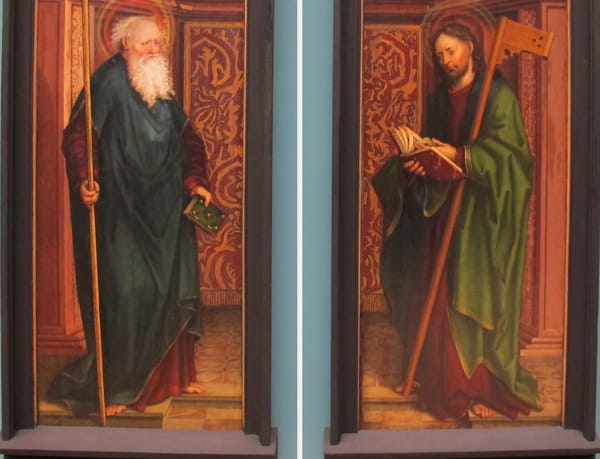
Saints Philip and James the Less (companion panels)
Gold cross ornament
Apostles Philip and James the Less, Martin Schaffner, c. 1520. Photo: Sailko. Credits

May 11 [May 1]: Sts. Philip and James the Less, Apostles

[This feast day, previously kept on May 1, was moved to May 11 when the feast of St. Joseph the Worker was established on May 1. The Solemnity of St. Joseph, which was replaced by St. Joseph the Work, was originally celebrated on the Third Sunday after Easter, as it was in the time of Dom Guéranger, whose article on that feast can be found here.-Ed.]

From Dom Guéranger's The Liturgical Year.

TWO of the favoured witnesses of our beloved Jesus' Resurrection come before us on this first day of May. Philip and James are here, bearing testimony to us that their Master is truly risen from the dead, that they have seen him, that they have touched him, that they have conversed with him,1 during these forty days. And, that we may have no doubt as to the truth of their testimony, they hold in their hands the instruments of the martyrdom they underwent for asserting that Jesus, after having suffered death, came to life again and rose from the grave. Philip is leaning upon the cross to which he was fastened, as Jesus had been; James is holding the club wherewith he was struck dead.

Philip preached the Gospel in the two Phrygias, and his martyrdom took place at Hierapolis. He was married when he was called by our Saviour; and we learn from writers of the second century that he had three daughters, remarkable for their great piety, one of whom lived at Ephesus, where she was justly revered as one of the glories of that early Church.

James is better known than Philip. He is called, in the sacred Scripture, Brother of the Lord,2 on account of the close relationship that existed between his own mother and the blessed Mother of Jesus. He claims our veneration during Paschal Time, inasmuch as he was favoured with a special visit from our Risen Lord, as we learn from St Paul.3 There can be no doubt but that he had done something to deserve this mark of Jesus’ predilection. St Jerome and St Epiphanius tell us that our Saviour, when ascending into heaven, recommended to St James’s care the Church of Jerusalem, and that he was accordingly appointed the first bishop of that city. The Christians of Jerusalem, in the fourth century, had possession of the chair on which St James used to sit when he assisted at the assemblies of the faithful. St Epiphanius also tells us that the holy Apostle used to wear a lamina of gold upon his forehead as the badge of his dignity. His garment was a tunic made of linen.

He was held in such high repute for virtue that the people of Jerusalem called him ' The Just and when the time of the siege came, instead of attributing the frightful punishment they then endured to the deicide they or their fathers had .committed, they would have it to be a consequence of the murder of James, who, when dying, prayed for his people. The admirable Epistle he has left us bears testimony to the gentleness and uprightness of his character. He there teaches us, with the eloquence of an inspired writer, that works must accompany our faith if we would be just with that justice which makes us like our Risen Lord.

The bodies of SS Philip and James repose in the Basilica of the Holy Apostles at Rome. These relics are counted as one of the richest treasures of the Holy City, and there is reason to believe that this first of May is the real anniversary of their translation. For a long period the Church of Rome kept special feasts in honour of four only of the Apostles: SS Peter and Paul, St John the Evangelist, and St Andrew (Peter’s brother): the rest were united in the solemnity of June 29, and a vestige of this is still to be found in the office of that day, as we shall see later on. The reception of the bodies of SS Philip and James, which were brought from the East somewhere about the sixth century, gave rise to the institution of to-day's feast; and this led gradually to the insertion into the Calendar of special feasts for the other Apostles and Evangelists.

Let us now read the brief account given of St Philip in the Liturgy.

Philippus Bethsaidæ natus, unus ex duodecim Apostolis, qui primum a Christo Domino vocati sunt: a quo cum accepisset Nathanael, venisse Messiam in Lege promissum, ad Dominum deductus est. Quam vero Christus eum familiariter adhiberet, illud facile declarat, quod Gentiles Salvatorem videre cupientes, ad Philippum accesserunt: et Dominus cum in solitudine hominum multitudinem pascere vellet, sic Philippum affatus est: Unde ememus panes ut manducent hi? Is accepto Spiritu Sancto, cum ei Scythia ad prædicandum Evangelium obtigisset, omnem fere illam gentem ad Christianam fidem convertit. Postremo cum Hierapolim Phrygiæ venisset, pro Christi nomine cruci affixus lapidibusque obrutus est Kalendis Maii. Ejus corpus ibidem a Christianis sepultum, postea Romam delatum, in Basilica duodecim Apostolorum una cum corpore beati Jacobi Apostoli conditum est.
Philip was born in Bethsaida, and was one of the twelve Apostles that were first called by Christ our Lord. It was from Philip that Nathanael learned that the Messias who was promised in the Law had come; and by him also he was led to our Lord. We have a clear proof of the familiarity wherewith Philip was treated by Christ, in the fact that the Gentiles addressed themselves to this Apostle when they wished to see the Saviour. Again when our Lord was about to feed the multitude in the desert, he spoke to Philip, and said: ‘Whence shall we buy bread, that these may eat?' After having received the Holy Ghost, he went into Scythia, which was the country allotted to him, wherein to preach the Gospel; and converted almost the entire people to the Christian faith. Having finally reached Hierapolis in Phrygia, he was crucified there for the name of Christ, and then stoned to death on the Kalends of May (May I). The Christians buried his body in the same place; but it was afterwards taken to Rome, and, together with the body of the Apostle St James, was placed in the Basilica of the Twelve Apostles.

The Breviary then gives the two following Lessons upon St James:

Jacobus frater Domini, cognomento Justus, ab ineunte ætate vinum et siceram non bibit, carne abstinuit, numquam tonsus est, nec unguento, nec balneo usus. Huic uni licebat ingredi in Sancta Sanctorum. Idem lineis vestibus utebatur, cui etiam assiduitas orandi ita callum genibus obduxerat, ut duritie cameli pellem imitaretur. Eum post Christi Ascensionem Apostoli Hierosolymorum Episcopum creaverunt: ad quem etiam Princeps Apostolorum misit qui nuntiaret se e carcere ab Angelo eductum fuisse. Cum autem in Concilio Jerosolymis controversia esset orta de lege et circumcisione, Jacobus Petri sententiam secutus, ad Fratres habuit concionem, in qua vocationem Gentium proba vit: Fratribusque absentibus scribendum esse dixit ne Gentibus jugum Mosaicæ legis imponerent. De quo et loquitur Apostolus ad Galatas: Alium autem Apostolorum vidi neminem, nisi Jacobum fratrem Domini.
Tanta autem erat Jacobi vitæ sanctitas, ut fimbriam vestimenti ejus certatim homines cuperent attingere. Nam is nonaginta sex annos natus, cum triginta annis illi Ecclesiæ sanctissime præfuisset, Christum Dei Filium constantissime prædicans, lapidibus primum appetitur; mox in altissimum Templi locum adductus, inde præcipitatus est. Qui confractis cruribus, jacens semivivus, manus tendebat ad cœlum, Deumque pro illorum salute deprecabatur his verbis: Ignosce eis. Domine, quia nesciunt quid faciunt. Qua in oratione, graviter ejus capite fullonis fuste percusso, animam Deo reddidit, septimo Neronis anno, et juxta Templum, ubi præcipitatus fuerat, sepultus est. Unam scripsit Epistolam, quæ de septem Catholicis est.
James, the brother of our Lord, was called the Just. From his childhood he never drank wine or strong drink; he abstained from flesh meat: he never cut his hair, or used oil to anoint his limbs, or took a bath. He was the only one permitted to enter the Holy of holies. His garments were of linen. So assiduous was he in prayer, that the skin of his knees was as hard as that of a camel. After Christ’s Ascension, the Apostles made him bishop of Jerusalem; and it was to him that the Prince of the Apostles sent the news of his having been delivered out of prison by an angel. A dispute having arisen in the Council of Jerusalem concerning the Mosaic Law and circumcision, James sided with Peter, and in a speech which he made to the brethren, proved the vocation of the Gentiles, and said that the absent brethren were to be told not to impose the yoke of the Mosaic Law upon the Gentiles. It is of him that the Apostle speaks in his Epistle to the Galatians, when he says: Bat other of the Apostles I saw none, saving James, the brother of the Lord.
Such was James's holy life, that people used to strive with each other to touch the hem of his garment. At the age of ninety-six years—of which he had spent thirty governing the Church of Jerusalem in the most saintly manner—as he was one day preaching, with great courage, Christ the Son of God, he was attacked by stones being thrown at him; after which he was taken to the highest part of the Temple, and cast headlong down. His legs were broken by the fall; and as he was lying half dead upon the ground, he raised up his hands towards heaven, and thus prayed for his executioners: ' Forgive them, O Lord! for they know not what they do.’ Whilst thus praying, he received a blow on the head with a fuller’s club, and gave up his soul to his God, in the seventh year of Nero's reign. He was buried near the Temple, from which he had been thrown down. He wrote a Letter, which is one of the seven Catholic Epistles.

The Greek Church celebrates the memory of these two Apostles on distinct days, which are the anniversaries of their martyrdom. The following stanzas are from the hymn in honour of St Philip:

Hymn (Die XIV Novembris)

Magnæ lucis fulgoribus illuminatus, Philippe, ut sidus magnificum resplenduisti, Patrem luminum in Filio quærens invenisti: in lumine enim lumen invenitur; nam ipse est signaculum ejusdem formæ ostendens archetypum. Ilium exora, Apostole, ut salventur qui divino sanguine signati fuerunt.
O admirabile prodigium! Philippus apostolus in medio luporum agnus impavide nunc ambulat; feras fide agnos reddidit; mundum divinitus commutavit. O fidei opera! o admirandæ virtutes! Ejus precibus, salva animas nostras, ut solus misericors.
O admirabile prodigium! puteus aquæ vivæ ex quo hauritur sapientia, omnibus in mundo apparuit apostolus Philippus; ex quo dogmatum rivuli profluunt, ex quo prodigiorum bibimus flumina. O qualia et quam admiranda operatus es miracula, divinorum factor, cujus memoriam cum fide veneramur!
Omnia quæ in terra sunt relinquens, Christum sequutus es, et Spiritus Sancti inspiratione repletus, ab eo ad perditas gentes missus fuisti, ut homines ad lucem cognitionis divinæ converteres, Philippe; et divini desiderii tui agonem per diversa supplicia perficiens, animam tuam Deo reddidisti. Ilium exora, beatissime, ut nobis concedat magnam misericordiam.
Fugator daemonum factus, et velut aster in tenebris degentium apparens Solem ex Virgine lucidum proceden tem ostendisti; et idolorum templa subvertens, Ecclesias ad gloriam Dei nostri collegisti. Ideo te veneramur, et divinam tuam memoriam magnifice celebramus, et unanimi voce tibi clamamus: Apostole Philippe, exora Christum Deum, ut peccatorum remissionem concedat ardenter nobis tuam sanctam memoriam celebrantibus.
Spiritualis nubes abundanti repleta imbre realiter hominibus in terra apparuisti, mystice irrigans velut arva animas nostras; percurrens enim sermone tuo illuminas terminos terræ, et imbres velut pretiosa aromata profundis. Ideo cordibus infidelium Spiritus Sancti odorem inspirans, in eis cœlestes sparsisti thesauros. Apostole Philippe, exora Christum Deum, ut peccatorum remissionem concedat nobis tuam sanctam memoriam ardenti anima celebrantibus.
Illumined with the rays of the great light, O Philip! thou didst shine as a magnificent star. Thou soughtest the Father of lights in his own Son, and didst find him; for the light is found in the Light, for he is the figure of his Father’s substance, reflecting in himself the Father as his archetype. Beseech him, O Apostle, that he would save them that have been signed with his divine Blood!
O wondrous prodigy! The Apostle Philip was as a lamb in the midst of wolves, but he feared them not; he turned them from wild beasts into lambs, by giving them faith; he changed the world by God's power. O admirable workings of faith! O admirable power! Do thou, O Christ, our only Saviour, hear his prayers for us, and save our souls.
O wondrous prodigy! The Apostle Philip was in the world as a well of living water, whence all might draw wisdom. We have received of the teachings *that flowed in streams from this well; we have drunk of its miraculous flowings. O thou doer of heavenly things, whose memory we now devoutly celebrate, what great and astounding miracles didst thou not work!
Leaving all earthly things, thou didst follow Christ, and wast filled with the inspiration of the Holy Ghost. He sent thee to the nations that were lost, that thou, O Philip, mightest convert men to the light of the knowledge of God. Through divers tortures thou didst complete the battle thou hadst so holily desired and give back thy soul to God. Beseech him, O most blessed one! that he grant to us his great mercy.
Thou wast the disperser of demons. Thou wast the star of them that were dwelling in darkness, and didst show them the bright Sun, that came forth from the Virgin. Thou didst overturn the temples of idols and gather Churches together for the glory of our God. Therefore do we venerate thee, and solemnly celebrate thy holy memory, and cry out to thee with one voice: O Apostle Philip! beseech Christ our God, that he grant forgiveness of sins to us who fervently celebrate thy saintly memory.
Thou wast verily given to men upon earth as a spiritual cloud, laden with abundant rain, and watering the mystic land of our souls; for thy word has gone through the world, filling it with light, and pouring out upon it as it were showers of precious fragrance. Breathing, therefore, the fragrance of the Holy Spirit into the hearts of unbelievers, thou didst enrich them with the treasures of heaven. O Apostle Philip! beseech Christ our God that he grant forgiveness of sin to us, who fervently celebrate thy holy memory.

Let us now make a selection from the Menæa in honour of St James, whose memory is so affectionately cherished by the Eastern Churches:

Hymn (Die XXIII Octobris)

Venite, memoriam Fratris Domini veneremur, sancti Deo inspirati; jugum enim accipiens ardenter Christi Evangelii, bonitatis ejus et regni præco effectus est, et ineffabilis œconomia ejus illi commissa fuit. Omnipotens Deus, per ejus orationem concede nobis misericordiam.
Per universos orbis terminos intonuit verborum ejus sonitus, quibus illuminamur ad omnem virtutis divinæ contemplationem, et confidenter ad divinam Trinitatis cognitionemperducimur. Ideo te deprecamur, velut pontifex ad Jesum hominis amatorem intercede, ut salventur animæ nostræ.
Martyrii sanguine tuam sacerdotalem dignitatem decorasti, sanete martyr Apostole; stans enim super pinnacula templi, Deum Verbum præicasti velut omnium creatorem; unde a Judæis præcipitatus cœlorum palatia intrare meruisti; frater Domini Jacobe, Deum Christum exora ut animæ nostræ salventur.
Domine, quamvis Apostoli caput olim in Ugno contritum fuerit, nunc in paradiso super lignum vitæ tuæ elevatur; rebus enim terrenis liberatus, in ætemum gaudens exsultat; ejus orationibus ecclesiis tuam pacem concede.
Omne datum optimum, et omne donum perfectum a Patre luminum mortaiibus descendere sapienter doces, Jacobe; ut illorum participationem donorum accipiant qui te hymnis celebrant, deprecare Deum, Apostole.
Frater Jesu Christi secundum carnem factus, Apostole, sanctam apud ipsum gratiam accepisti; et omnibus divini luminis gratias et cognitionis communicasti, Jacobe, et idolorum errorem radicitus extirpasti; unde mendaces tenebrarum principes te injuste interficiunt prædicantem Salvatoris divinitatem.
Unigenitus Patris Filius, Deus, Verbum, qui apud nos in extremis diebus peregrinatus est, sancte Jacobe, te primum ostendit Hierosolymæ pastorem, et magistrum, et fidelem spiritualium mysteriorum dispensatorem. Ideo te omnes veneramur, Apostole.
Apostolorum chorus elegit te, ut primus in Sion sancta, velut Pontifex Christo benefactori servires; quia ejus generationis frater secundum camem, vestigia ejus fidelis viator comitatus fueras Jacobe.
Ignita divini Spiritus illuminatione resplendens, frater Dei Jacobe, divinæ bonitatis zelator visus es. Ideo stolam venerabiliorem vestimento legalis sacerdotii, ut olim Aaron, accepisti a Domino, qui per misericordiam suam te in fraternitatem adoptaverat. Illum deprecare, ut animas nostras salvare dignetur, gloriose Apostole.
Come, let us venerate the memory of the brother of the Lord, the divinely inspired James! Fervently did he take up the yoke of the Gospel of Christ, whose goodness and kingdom he announced to the world. The ineffable Mystery was entrusted to him. O Almighty God! through his intercession have mercy upon us.
Through all the ends of the earth the sound of his words was heard, whereby we are enlightened to contemplate the wonderful things of God, and are safely brought to the sacred knowledge of the Trinity. Therefore, we beseech thee, O Apostle, intercede for us, as a priest, with Jesus, the lover of mankind, that he would save our souls.
Thou didst add beauty to thy priestly dignity by the blood of martyrdom, O holy Apostle and Martyr! for when, on the pinnacle of the temple, thou didst preach that God, the Word, was the Creator of all things, the Jews cast thee down, and thou didst enter the courts of heaven. O James! brother of the Lord, pray for us to Christ our God, that he save our souls.
The head of thine Apostle, O Lord, was broken by a club; but now in heaven, he is exalted on the tree of thy life, for he is freed from all earthly things, and rejoices in eternal gladness. Through his prayers, grant thy peace to the Churches.
Thou, O James, wisely teachest us that every best gift, and every perfect gift comes down upon mankind from the Father of lights. Beg of him, we beseech thee, that they who celebrate thy memory may partake of those gifts.
Thou wast Jesus' brother according to the flesh, and wast favoured with his holy friendship. Thou didst communicate to all men the grace of the divine light and knowledge, and didst root up the error of idols. Therefore did the false princes of darkness unjustly slay thee, whilst thou wast preaching the divinity of the Saviour.
The Only Begotten Son of the Father, God, the Word, who dwelt among us during this last age, appointed thee, O holy James, as the first pastor of Jerusalem; he willed thee to be her master, and faithful dispenser of the divine mysteries. Therefore do we venerate thee, O Apostle!
The choir of the Apostles chose thee to be the first who, on holy Sion, should minister as priest to their great benefactor Christ; for thou wast his brother according to the flesh, and the faithful companion of his journeys.
Resplendent with the bright light of the Holy Spirit, thou, O James, brother of our God, wast the zealous minister of the divine goodness. Like unto Aaron of old, thou didst therefore receive from the Lord, who, in his mercy, admitted thee into the Brotherhood of his Apostles, a garment more sacred than that of the priesthood of the Law. Beseech him, O glorious Apostle, that he mercifully save our souls!

Holy Apostles! you saw our Risen Jesus in all his glory. He said to you on the evening of that great Sunday: Peace be to you! He appeared to you during the forty days following, that he might make you certain of his Resurrection. Great indeed must have been your joy at seeing once more that dear Master, who had admitted you into the number of his chosen Twelve; and his return made your love of him more than ever fervent. We address ourselves to you as our special patrons during this holy season, and most earnestly do we beseech you to teach us how to know and love the great mystery of our Lord’s Resurrection. May our hearts glow with Paschal joy, and may we never lose the new life that our Jesus has now given unto us.

Thou, O Philip! wast devoted to him, even from the first day of his calling thee. Scarcely hadst thou come to know him as the Messias, than thou didst announce the great tidings to thy friend Nathanael. Jesus treated thee with affectionate familiarity. When about to work the great miracle of the multiplication of the loaves, it was to thee that he addressed himself, and said to thee: Whence shall we buy bread, that these may eat?4 A few days before the Passion of thy divine Master, some of the Gentiles wished to see this great Prophet, of whom they had heard such wonderful things, and it was to thee that they applied. How fervently didst thou not ask him, at the Last Supper, to show thee the Father! Thy soul longed for the divine light; and when the rays of the Holy Ghost had inflamed thy spirit, nothing could daunt thy courage. As a reward of thy labours, Jesus gave thee to share with him the honours of the Cross. O holy Apostle! intercede for us, that we may imitate thy devotedness to Jesus; and that, when he deigns to send us the Cross, we may reverence and love it.

We also honour thy love of Jesus, O thou that art called the brother of the Lord, on whose venerable features was stamped the likeness of our Redeemer. If, like the rest of the Apostles, thou didst abandon him in his Passion, thy repentance was speedy and earnest, for thou wast the first, after Peter, to whom he appeared after his Resurrection. We affectionately congratulate thee, O James, for the honour thus conferred upon thee; do thou, in return, obtain for us that we may taste and see how sweet is our Risen Lord.5 Thy ambition was to give him every possible proof of thy gratitude; and the last testimony thou didst bear, in the faithless city, to the divinity of thy dear Master (when the Jews took thee to the top of the Temple) opened to thee, by martyrdom, the way that was to unite thee to him for eternity. Pray for us, O thou generous Apostle, that we also may confess his holy Name with the firmness which befits his disciples; and that we may ever be brave and loyal in proclaiming his rights as King over all creatures.

O holy Apostles! we beseech you to unite your prayers, and intercede for the Churches of the East, to which you preached the Gospel. Have compassion on Jerusalem, the dupe of schism and heresy; obtain her purification and her liberty; and rid her Holy Places of the sacrileges that have so long polluted them. Lead back the Christians of Asia Minor to union with the fold governed by the one supreme pastor. And lastly, pray for Rome, the city where your bodies repose, awaiting their glorious Resurrection. In return for the long hospitality she has given you, shield her with your protection; and permit not that the city of Peter, your venerable Head, should be deprived of its grandest glory—the presence of the Vicar of Christ.


  1. 1 St John i 1. ↩︎
  2. Gal. i 19, and elsewhere ↩︎
  3. 1 Cor. xv 7. ↩︎
  4. St John vi 5. ↩︎
  5. Ps. xxxiii 9. ↩︎

Wednesday of the Second Week after Easter

℣. In resurrectione tua, Christe, alleluia.℟. Cœli et terra laetentur, alleluia.
℣. In thy resurrection, O Christ, alleluia.℟. Let heaven and earth rejoice, alleluia.

WE are not to suppose that because the sacred Humanity of our Risen Jesus is resplendent with glory and majesty, it is therefore less accessible to mortals. His kindness and condescension are the same as before; nay, he seems to have become more affectionate than ever, and more desirous to be with the children of men. Surely we have not forgotten what happened during the joyous octave of the Pascli! His affectionate greeting to the holy Women, when on their way to the sepulchre; his appearing to Magdalen under the form of a gardener; his conversation with the two disciples of Emmaus, and the means he took to make them recognize him; his showing himself, on the Sunday evening, to the Ten, greeting them with his Peace be to you, allowing them to touch him, and even condescending to eat with them; his amiably bidding Thomas, on the eighth day, convince himself of the reality of the Resurrection by feeling the Wounds; his meeting his disciples at the Lake of Genesareth, blessing their fishing, and providing them with a repast on the bank—all this is proof of the tender love and intimacy wherewith our Saviour treated his creatures during the forty days after his Resurrection.

As to his visits to his blessed Mother, we shall have another occasion for speaking of them; to-day we will consider him in the midst of his disciples. So frequently is he with them, that St Luke calls it an appearing to them for forty days.1 The apostolic college is reduced to eleven; for the place of the traitor Judas is not to be filled up till after our Lord’s Ascension, immediately before the descent of the Holy Ghost. How beautiful in their simplicity are these future messengers of the Good Tidings to mankind!2 A short while ago they were weak and hesitating in their faith; they forgot all they had seen and heard; they fled from their Master in the hour of trial. As he had foretold it to them, they were scandalized at his humiliations and death. The news of his Resurrection made little impression upon them; they even disbelieved it. And yet they found him so affectionate, so gentle in his reproaches, that they soon resumed the confidence and intimacy they had had with him during his mortal life. Peter, who had been the most unfaithful, as well as the most presumptuous, of all, has now regained his position of the most honoured of the Apostles, and, in a few days hence, is to receive a special proof of Jesus’ having forgotten his past disloyalty. He and his fellow Apostles can think of nothing now but Jesus. When he is with them they feast on the beauty and glory of his appearance. His words are dearer to them than ever, for they understand them better, now that they have been enlightened by the mysteries of the Passion and Resurrection. They eagerly listen to all that he says, and he says more than formerly, because he is so soon to leave them. They know that the day will soon come when they will no longer be able to hear his voice; they, therefore, treasure up his words as though they were his last will, and how could they better fit themselves for the mission he has entrusted to them? It is true they do not, as yet, fully enter into all the mysteries they are to preach to the world—they could not even remember so many sublime things—but Jesus tells them that he will soon send upon them the Holy Ghost, who will not only give them courage, but will also bless them with spiritual understanding, and will enable them to remember all that he, Jesus, has taught them.3

Nor must we forget the holy women, those faithful companions of Jesus, who followed him up to Calvary, and were the first to be rewarded with the joys of the Resurrection. Their divine Master could not overlook them now: he praises their devotedness, he encourages them; he takes every opportunity of repaying them. Heretofore, as the Gospel tells us,4 they provided him with food; now that he needs no earthly nourishment he feasts them with his dear presence; they see him, they hear his words; the very thought that he is soon to be taken from them makes these happy days doubly precious to them. They are the venerable mothers of the Christian people; they are our illustrious ancestors in the Faith; and on the day of the descent of the Holy Ghost, we shall find them with the Apostles in the Cenacle receiving the Tongues of Fire. Woman is to be represented on that glorious occasion, when the Church is to be made manifest before the world; the women of Calvary and the sepulchre are chosen for this office, and right well do they deserve to share in the bright joys of Pentecost.

Let us recite the following sequence in honour of our dear Jesus, who passes these forty days with his Apostles and the holy women. It was composed by Adam of St Victor:

Sequence

Ecce dies celebris!
Lux succedit tenebris,
Morti resurrectio;
Lætis cedant tristia,
Cum sit major gloria
Quam prima confusio;
Umbram fugat veritas,
Vetustatem novitas,
Luctum consolatio.
Pascha novum colite;
Quod praeit in capite,
Membra sperent singula.
Pascha novum Christus est,
Qui pro nobis passus est,
Agnus, sine macula.
Hosti qui nos circuit
Prædam Christus eruit.
Quod Samson praecinuit.
Dum leonem lacerat.
David, fortis viribus,
A leonis unguibus
Et ab ursi faucibus
Gregem patris liberat.
Quod in morte plures stravit
Samson, Christum figuravit,
Cujus mors victoria.
Samson dictus Sol eorum:
Christus lux est electorum Quos illustrat gratia.
Jam de crucis sacro vecte,
Botrus fluit in dilectae penetrai Ecclesiae.
Jam, calcato torculari,
Musto gaudent debriari
Gentium primitiae.
Saccus scissus et pertusus.
In regales transit usus:
Saccus fit soccus gratiæ,
Caro victrix miseriae.
Quia regem peremerunt,
Dei regnum perdiderunt;
Sed non deletur penitus
Cain, in signum positus.
Reprobatus et abjectus,
Lapis iste nunc electus,
In trophæum stat erectus et in caput anguli.
Culpam delens, non naturam,
Novam creat creaturam,
Tenens in se ligaturam
Utriusque populi.
Capiti gloria,
Membrisque concordia!
Amen.
Lo, the great day is come!
Light follows darkness,
and resurrection death.
Sorrow gives place to joy,
for our glory is greater than
was our former shame.
Truth dispels the shadow;
the new what was old;
and consolation mourning.
Celebrate the new Pasch!
Let the members hope to have
what now their Head enjoys.
Our new Pasch is Christ
—the spotless Lamb
that was slain for us.
Christ has taken the prey
from the enemy that surrounded us.
It is the victory prefigured by Samson,
when he tore the lion to pieces;
and by the powerful David,
when he rescued his father’s flock
from the lion’s grasp
and the bear's jaw.
When Samson killed his enemies by his own death,
he was a type of Christ, whose death was a victory.
Samson signifies their Sun:
so is Christ the Light of his elect,
for he makes his grace shine upon them.
Under the holy beam of the Cross,
the vine-stream flows into the store-house of the beloved Church.
The wine-press is trodden,
and the first-fruits of the Gentiles
drink their fill and are glad.
The garment that was rent and torn
is made a robe for kings:
that garment is the Flesh that triumphed over suffering,
and became an ornament of grace.
The Jews forfeited God’s kingdom,
because they put the King to death;
they are not utterly destroyed,
for, like Cain, they are set as a sign.
The Stone that they rejected and despised
is now the chosen one,
set up as a trophy, and made the chief corner-stone.
Taking away sin, but not our nature,
he creates us new creatures;
he unites in himself the two peoples (Jew and Gentile).
Be glory
to our head!
and to the members peace!
Amen.

  1. Acts i 3. ↩︎
  2. Isa. lii 7. ↩︎
  3. St John xiv 26. ↩︎
  4. St Matt. xxvii 55. ↩︎
Previous
Tuesday of the Second Week after Easter
Next
Wednesday of the Second Week after Easter