Daily reading
Paschal Time
Double · May 2 · Sanctoral
May 2, 2019
From Dom Guéranger’s The Liturgical Year.
A Double leads the weekday.Rubric
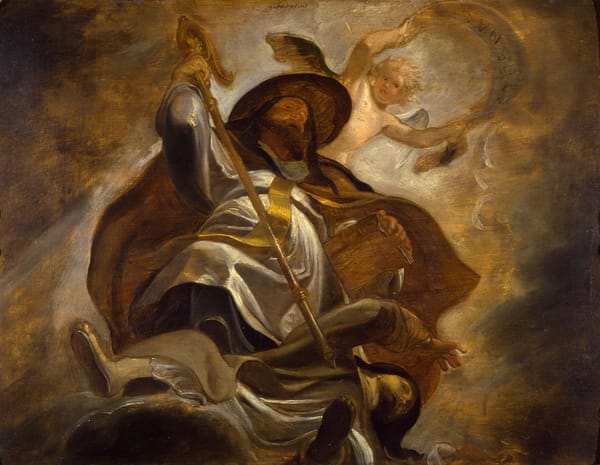 |
May 2: St. Athanasius, Bishop and Doctor of the Church
THE court of our divine King, during this grandest of seasons, is brilliant beyond measure; and, to-day, it is gladdened by the arrival of one of the most glorious champions that ever fought for his holy cause. Among the guardians of the word of truth, confided by Jesus to the earth, is there one more faithful than Athanasius? Does not his very name remind us of dauntless courage in the defence of the sacred deposit, of heroic firmness and patience in suffering, of learning, of talent, of eloquence—in a word, of everything that goes to form a Saint, a Bishop, and a Doctor of the Church? Athanasius lived for the Son of God; the cause of the Son of God was that of Athanasius: he who blessed Athanasius, blessed the eternal Word; and he who insulted Athanasius insulted the eternal Word.
Never did our holy faith go through a greater ordeal than in the sad times immediately following the peace of the Church, when the bark of Peter had to pass through the most furious storm that hell has, so far, let loose against her. Satan had vainly sought to drown the Christian race in a sea of blood; the sword of persecution had grown blunt in the hands of Diocletian and Galerius; and the Cross appeared in the heavens, proclaiming the triumph of Christianity. Scarcely had the Church become aware of her victory when she felt herself shaken to her very foundation. Hell sent upon the earth a heresy which threatened to blight the fruit of three hundred years of martyrdom. Arius began his impious doctrine, that he who had hitherto been adored as the Son of God was only a creature, though the most perfect of all creatures. Immense was the number, even of the clergy, that fell into this new error; the Emperors became its abettors; and had not God himself interposed, men would soon have set up the cry throughout the world that the only result of the victory gained by the Christian religion was to change the object of idolatry, and put a new idol, called Jesus, in place of the old ones.
But he who had promised that the gates of hell should never prevail against his Church, faithfully fulfilled his promise. The primitive faith triumphed; the Council of Nicæa proclaimed the Son to be consubstantial with the Father; but the Church stood in need of a man in whom the cause of the consubstantial Word should be, so to speak, incarnated—a man with learning enough to foil the artifices of heresy, and with courage enough to bear every persecution without flinching. This man was Athanasius: and everyone that adores and loves the Son of God, should love and honour Athanasius. Five times banished from his See of Alexandria by the Arians, who even sought to put him to death, he fled for protection to the West, which justly appreciated the glorious confessor of Jesus' divinity. In return for the hospitality accorded him by Rome, Athanasius gave her of his treasures. Being the admirer and friend of the great St Antony, he was a fervent admirer of the monastic life, which, by the grace of the Holy Ghost, had flourished so wonderfully in the deserts of his vast patriarchate. He brought the precious seed to Rome, and the first monks seen there were the ones introduced by Athanasius. The heavenly plant became naturalized in its new soil; and though its growth was slow at first, it afterwards produced fruit more abundantly than it had ever done in the East.
Athanasius, who has written so admirably upon that fundamental dogma of our faith—the divinity of Christ —has also left us most eloquent treatises on the mystery of the Pasch: they are to be found in the Festal Letters which he addressed each year to the churches of his patriarchate of Alexandria. The collection of these Letters, which were once thought to have been irretrievably lost, was found, a few years back, in the monastery of St Mary of Scete, in Egypt. The first, for the year 329, begins with these words, which beautifully express the sentiments we should feel at the approach of Easter: ' Come, my beloved brethren, celebrate the feast; the season of the year invites you to do so. The Sun of justice, by pouring out his divine rays upon you, tells you that the time of the solemnity is come. At such tidings, let us keep a glad feast; let not the joy slip from us with the fleeting days, without our having tasted of its sweetness.’ During almost every year of his banishment, Athanasius continued to address a Paschal Letter to his people. The one in which he announces the Easter of 338, and which he wrote at Treves, begins thus: ' Though separated from you, my brethren, I cannot break through the custom which I have always observed, and which I received from the tradition of the Fathers. I will not be silent; I will not omit announcing to you the time of the holy annual feast, and the day on which you must keep the solemnity. I am, as you have doubtless been told, a prey to many tribulations; I am weighed down by heavy trials; I am watched by the enemies of truth, who scrutinize everything I write, in order to rake up accusations against me and thereby add to my sufferings; yet notwithstanding, I feel that the Lord strengthens and consoles me in my afflictions. Therefore do I venture to address to you the annual celebration; and from the midst of my troubles, and despite the snares that beset me, I send you, from the furthermost part of the earth, the tidings of the Pasch, which is our salvation. Commending my fate into God’s hands, I will celebrate this feast with you; distance of place separates us, but I am not absent from you. The Lord who gives us these feasts, who is himself our feast, who bestows upon us the gift of his Spirit—he unites us spiritually to one another, by the bond of concord and peace.’
How grand is this Pasch, celebrated by Athanasius, an exile on the Rhine, in union with his people who keep their Easter on the banks of the Nile! It shows us the power of the Liturgy to unite men and make them, at one and the same time, and despite the distance of countries, enjoy the same holy emotions and feel the same aspirations to virtue. Greeks or Barbarians, we have all the same mother-country, the Church; but that which, after faith, unites us all into one family, is the Church’s Liturgy. Now there is nothing in the whole Liturgy so expressive of unity as the celebration of Easter. The unhappy Churches of Russia and the East, by keeping Easter on a different day from that on which it is celebrated by the rest of the Christian world, show that they are not a portion of the One Fold of which our Risen Jesus is the One Shepherd.
We will now read the sketch of the life of St Athanasius, given in the Breviary.
The Greek Church, which celebrates the feast of our Saint at another season of the year, is enthusiastic in her admiration of his virtues. The following stanzas are from the hymn she sings in his praise:
Hymn (Die XVIII Januarii)
Thou wast throned, O Athanasius! on the Chair of Mark in Alexandria; and thy name is emblazoned near his on the sacred cycle. He left Rome, sent by Peter himself to found the second patriarchal See; and thou, three centuries later, didst visit Rome, as successor of Mark, to seek protection from Peter's successor against them that were disturbing thy venerable See by injustice and heresy. Our Western Church was thus honoured by thy presence, O intrepid defender of the faith. She looked on thee with veneration as the glorious exile, the courageous confessor; and she has chronicled thy sojourning in her midst as an event of the greatest interest.
Intercede for the country over which was extended thy patriarchal jurisdiction; but forget not this Europe of ours, which gave thee hospitality and protection. Rome defended thy cause; she passed sentence in thy favour, and restored thee thy rights; make her a return, now that thou art face to face with the God of infinite goodness and power. Protect and console her Pontiff, the successor of that Julius who so nobly befriended thee fifteen hundred years ago. A fierce tempest is now raging against the Rock on which is built the Church of Christ; and our eyes have grown wearied looking for a sign of calm. Oh! pray that these days of trial be shortened, and that the See of Peter may triumph over the calumnies and persecutions which are now besetting her, and endangering the faith of many of her children.
Thy zeal, O Athanasius! checked the ravages of Arianism; but this heresy has again appeared, in our own times, and in almost every country of Europe. Its progress is due to that proud superficial learning which has become one of the principal perils of the age. The Eternal Son of God, consubstantial with the Father, is blasphemed by our so-called philosophers, as being only Man—the best and greatest of men, they say, but still only Man. They despise all the proofs which reason and history adduce of Jesus' divinity; they profess a sort of regard for the Christian teaching which has hitherto been held, but they have discovered (so they tell us) the fallacy of the great dogma which recognizes in the Son of Mary the Eternal Word who became incarnate for man’s salvation. O Athanasius, glorious Doctor of holy Mother Church! humble these modem Arians; expose their proud ignorance and sophistry; undeceive their unhappy followers, by letting them see how this false doctrine leads either to the abyss of the abominations of pantheism, or to the chaos of scepticism, where all truth and morality are impossibilities.
Preserve within us, by the influence of thy prayers, the precious gift of faith, wherewith our Lord has mercifully blessed us. Obtain for us that we may ever confess and adore Jesus Christ as our eternal and infinite God; ' God of God; Light of Light; True God of True God; Begotten, not made; who, for us men, and for our salvation, took Flesh, of the Virgin Mary.’ May we grow each day in the knowledge of this Jesus, until we join thee in the face-to-face contemplation of his perfections. Meanwhile, by means of holy faith, we will live with him on this earth that has witnessed the glory of his Resurrection. How fervent, O Athanasius, was thy love of this Son of God, our Creator and Redeemer! This love was the very life of thy soul, and the stimulus that urged thee to heroic devotedness to his cause. It supported thee in the combats thou hadst to sustain with the world, which seemed leagued together against thy single person. It gave thee strength to endure endless tribulations. Oh! pray that we may obtain this love—a love which is fearless of danger, because faithful to him for whom we suffer—a love which is so justly due, seeing that he, though the Brightness of his Father's glory, and Infinite Wisdom, emptied himself, taking the form of a servant, and humbled himself, becoming obedient unto death, even to the death of the Cross.* How else can we make him a return for his devotedness to us except by giving him all our love, as thou didst, O Athanasius! and by ever singing his praise in compensation for the humiliations which he endured in order to save us?
* Philipp, ii 7, 8. ↩︎
Thursday of the Second Week after Easter
THE Apostles and holy women are not the only ones to enjoy the presence of our Risen Jesus: a countless people of the just made perfect claim and have the happiness of seeing and reverencing the sacred humanity of their beloved King. The magnificence of the Resurrection has caused us somewhat to forget those venerable captives of Limbo, with whom the soul of our Redeemer spent the hours that elapsed between his Death and Resurrection. They were the friends of God, and were awaiting in Abraham's bosom (as the Scripture expresses it) the dawning of light eternal. From the hour of None (three o'clock) of the great Friday till the daybreak of Sunday, the soul of our Emmanuel abode with these holy prisoners, who were thus put in possession of infinite happiness. But when the hour of his triumph came, how was the Conqueror of Death to leave behind him these souls whom he had enfranchised by his Death and Resurrection? At the moment fixed by the eternal decree, Jesus' Soul passes from Limbo to the sepulchre, and is reunited to his Body; but he is accompanied by a jubilant choir of other souls—the souls of the long-imprisoned Saints.
On the day of the Ascension, they will form his court, and rise together with him; but Heaven’s gate is not yet open, and they must needs wait for these forty days to pass, during which our Redeemer will organize his Church. They are invisible to the eyes of men, but they dwell in the space above this lowly earth, where once they passed their days, and merited an eternal recompense. Adam again sees the land which he had tilled in the sweat of his brow; Abel is in admiration at the power of the divine Blood, which has sued for mercy, whereas his prayed but for vengeance;1 Noe looks upon this globe, and finds it covered with an immense multitude of men, all of whom are descendants of his three sons; Abraham, the father of believers, Isaac also, and Jacob, hail the happy moment when is to be fulfilled the promise which was made to them, that all generations should be blessed in him who was to be bom of their race; Moses recognizes his people, in whose midst the Messias (whom he had announced,2 and who is greater than he),3 has found so few followers and so many enemies; Job, who represents the elect among the Gentiles, is filled with joy at seeing his Redeemer living,4 in whom he had hoped in all his trials; David, fired with holy enthusiasm, is preparing canticles for heaven, grander far than those he has left us, to be sung in praise of the Incarnate God, who has espoused our human nature; Isaias and the other Prophets behold the literal fulfilment of all they had foretold; in a word, this countless army of saints, formed from the elect of all times and countries, is grieved at finding the earth a slave to the worship of false gods; they beseech our Lord, with all the earnestness of prayer, that he would hasten the time for the preaching of the Gospel, which is to rouse from their sleep them that are seated in the shadow of death.
As the elect, when they rise from their graves on the last day, will ascend through the air to meet Christ5 as eagles who gather together wheresoever the body may be;6 so now these holy souls cluster around their divine Deliverer. He is their attraction; seeing him, speaking with him, is truly a heaven on earth to them. Jesus indulges these Blessed of his Father, who are soon to possess the Kingdom prepared for them from the foundation of the world;7 he allows them to follow and accompany him; and thus does he pass the days which are to be spent before that glorious one of his triumphant Ascension.
What must not have been the happiness of the faithful and chaste Joseph in being thus near his adopted Son—his Creator? with what affection must he not have looked upon his virginal Spouse, who has been made, at the foot of the Cross, the Mother of men! Who could describe the delight wherewith Anne and Joachim gaze upon their daughter, the august Mother whom all generations shall call ‘blessed’?8 And John, the Precursor—how must he not have exulted at seeing her, at whose voice he was sanctified in his Mother’s womb, and who has given to the world the Lamb that taketh all sin away! How affectionately must not these ransomed souls have looked upon the Apostles, those future conquerors of the world, who are now being prepared for the combat by their divine Master! It is through them that the earth once brought to the knowledge of the true God will be ever sending up elect ones to heaven until time shall give place to eternity.
Let us to-day honour these hidden but august witnesses of what God's mercy is preparing for the world’s salvation. We shall soon see them ascending to heaven, of which they will take possession in the name of mankind, that has been redeemed by Christ. Let us not forget how, on their way from Limbo to Heaven, they rested with Jesus for forty days on this earth of ours, where they themselves had once lived and merited an eternal crown. Their visit brought a blessing with it; and their departure was the signal for us to follow them—it opened the way to the blissful home, which is one day to be ours!
The following sequence, taken from the Cluny Missal of 1523, is appropriate to the reflections we have just been making:
Sequence
Concio cantica,
Organa subnectens
Hypodorica.
Deo tartarea
Rumpenti, decanta
Nunc symphonia.
Resurgens, gaudia
Mundo gestat colenda.
Mirantes perdita
Cocyti confinia,
Intrante illo
Vita beata.
Tremescit daemonum
Plebs valida.
Fletuum alta:
Repagula
Quis sic audax fregerit,
Mirantur nunc fortia.
Redit cum turma
Gloriosa,
Et timida
Refovet discipulorum corda.
Hujus trophæa
Admirantes,
Flagitamus nunc
Voce decliva.
Mereamur pretiosa
Colere ut pascha:
In qua sacrata
Prae fulgore contueri
Lucis exordia.
O holy choir,
mourning,
but full of hope.
to the divine King,
who has broken down
the gates of hell.
and rising from the tomb,
brings festive joy to the world.
wonder
at the strange event.
he is Eternal Life,
and they see his power.
of demons
tremble with fear,
and weep,
asking each other,
who this may be that dares to break
the massive bolts.
our Lord returns to earth,
surrounded by a glorious troop;
and hastens to console
the timid hearts of his disciples.
who celebrate
his noble victory,
beseech him
in humble prayer,
to celebrate the great Pasch,
in the choir of Virgins.
sanctified by light,
to see
the Source of Light.
| Previous Wednesday of the Second Week after Easter | Next Thursday of the Second Week after Easter |