Daily reading
Paschal Time
Double of the II Class · May 3 · Sanctoral
May 3, 2019
From Dom Guéranger’s The Liturgical Year.
A Double of the II Class leads the weekday; Sts. Alexander I, Eventius and Theodulus, and Juvenal are commemorated.Rubrics

|
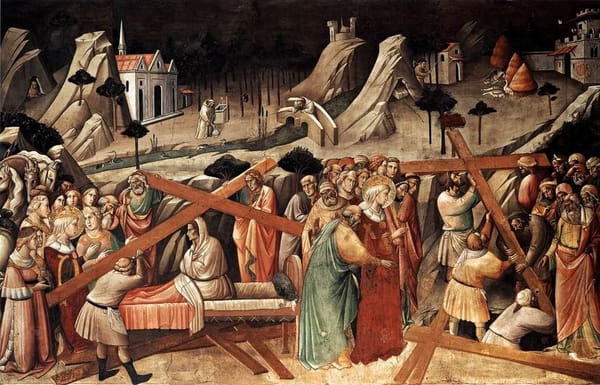
May 3: The Finding of the Holy Cross
IT was most just that our divine King should show himself to us with the sceptre of his power, to the end that nothing might be wanting to the majesty of his empire. This sceptre is .the Cross; and Paschal Time was to be the season for its being offered to him in glad homage. A few weeks back, and the Cross was shown to us as the instrument of our Emmanuel's humiliation and as the bed of suffering whereon he died; but has he not since then conquered Death? and what is his Cross now but a trophy of his victory? Let it then be brought forth to our gaze and let every knee bend before this sacred Wood, whereby our Jesus won the honour and praise we now give him!
On the day of his birth at Bethlehem we sang these words of the Prophet Isaias: A child is bom unto us, and a son is given unto us, and his government is upon his shoulder.1 We have seen him carrying this Cross upon his shoulder; as Isaac carried the wood for his own immolation; but now it is no longer a heavy burthen. It is shining with a brightness that ravishes the eyes of the angels; and after having received the veneration of man as long as the world lasts, it will suddenly appear in the clouds of heaven, near the Judge of the living and the dead—a consolation to them that have loved it, but a reproach to such as have treated it with contempt or forgetfulness.
Our Saviour did not think the time between his Resurrection and Ascension a fitting one for glorifying the instrument of his victory. The Cross was not to be brought into notice until it had subjected the world to him whose glory it so eloquently proclaimed. Jesus was three days in the tomb; his Cross is to lie buried, unknown to men, for three centuries: but it is to have its resurrection, and the Church celebrates this resurrection to-day. Jesus would, in his own good time, add to the joy of Easter by miraculously revealing to us this sacred monument of his love for mankind. He entrusts it to our keeping—it is to be our consolation—as long as this world lasts: is it not just that we should love and venerate it?
Never had Satan's pride met with such a humiliation as when he saw the instrument of our perdition made the instrument of our salvation. As the Church expresses it in her Preface for Passiontide: ‘He that overcame mankind by a Tree, was overcome by a Tree.' Thus foiled, he vented his fury upon this saving Wood, which so bitterly reminded him both of the irresistible power of his conqueror and of the dignity of man who had been redeemed at so great a price. He would fain have annihilated the Cross; but knowing that this was beyond his power, he endeavoured to profane it, and hide it from view. He therefore instigated the Jews to bury it. At the foot of Calvary, not far from the sepulchre, was a deep hole. Into this was the Cross thrown, together with those of the two thieves, the Nails, the Crown of Thoms, and the Inscription or Title written by Pilate. The hole was then filled up with rubbish and earth, and the Sanhedrim exulted in the thought of its having effaced the memory of the Nazarene, who could not save himself from the ignominious death of the Cross.
Forty years after this, Jerusalem was destroyed by the Romans, the instruments of God’s vengeance. The Holy Places were desecrated by the idolaters. A small temple to Venus was erected on Calvary, and another to Jupiter over the Holy Sepulchre. By this, the pagans intended derision; whereas, they were perpetuating the knowledge of two spots of most sacred interest. When peace was restored under Constantine, the Christians had but to remove these pagan monuments, and their eyes beheld the holy ground that had been bedewed with the Blood of Jesus, and the glorious Sepulchre. As to the Cross, it was not so easily found. The sceptre of our divine King was to be raised up from its tomb by a royal hand. The saintly Empress Helen, Constantine's mother, was chosen by heaven to pay to Jesus—and that, too, on the very spot where he had received his greatest humiliations—the honours which are due to him as the King of the world. Before laying the foundations of the Basilica of the Resurrection, this worthy follower of Magdalen and the other holy women of the sepulchre was anxious to discover the instrument of our salvation. The Jews had kept up the tradition of the site where it had been buried: the Empress had the excavations made accordingly. With what holy impatience she must have watched the works! and with what ecstasy of joy did she behold the redeeming Wood, which, though not at first distinguishable, was certainly one of the three Crosses that were found! She addressed a fervent prayer to the Saviour, who alone could reveal to her which was the trophy of his victory; the bishop, Macarius, united his prayers with hers; and their faith was rewarded by a miracle that left them no doubt as to which was the true Cross.
The glorious work was accomplished, and the Church was put in possession of the instrument of the world’s Redemption. Both East and West were filled with joy at the news of this precious discovery, which heaven had set on foot, and which gave the last finish to the triumph of Christianity. Christ completed his victory over the pagan world by raising thus his standard—not a figurative one, but his own real standard—his Cross, which, up to that time, had been a stumbling-block to the Jews, and foolishness to the Gentiles; but before which every Christian is henceforth to bend his knee.
Helen placed the holy Cross in the Basilica which had been built by her orders, and which covered both the glorious Sepulchre and the hill of the Crucifixion. Another Church was erected on the site where the Cross had lain concealed for three hundred years, and the faithful are enabled, by long flights of steps, to go down into the deep grotto which had been its tomb. Pilgrims came from every part of the world to visit the hallowed places where our Redemption had been wrought, and to venerate the sacred Wood of the Cross. But God’s merciful providence willed not that the precious pledge of Jesus’ love for mankind should be confined to one sanctuary only, however venerable it might be. Immediately after its discovery, Helen had a very large piece cut from the Cross; and this fragment she destined for Rome, the new Jerusalem. The precious gift was enshrined in the Basilica built by her son Constantine in the Sessorian garden, which was afterwards called the Basilica of Holy-Cross-in-Jerusalem.
By degrees, other places were honoured by the presence of the Wood of the Holy Cross. So far back as the fourth century, we have St Cyril of Jerusalem attesting that many of the pilgrims used to obtain small pieces of it, and thus carried the precious treasure into their respective countries; and St Paulinus of Nola, who lived in the same century, assures us that these many gifts lessened not the size of the original relic. In the sixth century, the holy Queen St Radegonde obtained from the Emperor Justin II a large piece from the fragment that was in the imperial treasury of Constantinople. It was for the reception of this piece of the True Cross into France that Venantius Fortunatus composed the Vexilla Regis—that beautiful hymn which the Church uses in her Liturgy as often as she celebrates the praise of the Holy Cross. After several times losing and regaining it, Jerusalem was at length for ever deprived of the precious relic. Constantinople was a gainer by Jerusalem’s loss. From Constantinople, especially during the Crusades, many churches of the West procured large pieces. These again supplied other places; until at length the Wood of the Cross was to be found in almost every town of any importance. There is scarcely to be found a Catholic who, some time or other in his life, has not had the happiness of seeing and venerating a portion of this sacred object. How many acts of love and gratitude have not been occasioned by this? And who could fail to recognize, in this successive profusion of our Jesus’ Cross, a plan of divine providence for exciting us to us appreciation of our Redemption, on which rest all our hopes of eternal happiness?
How dear, then, to us should this day be, which blends together the recollection of the holy Cross and the joys of the Resurrection of that Jesus who by the Cross has won the throne to which we shall soon see him ascend! Let us thank our Heavenly Father for his having restored to mankind a treasure so immensely precious as is the Cross. Until the day comes for it to appear with himself in the clouds of heaven, Jesus has entrusted it to his Spouse, as a pledge of his second coming. On that day, he will collect together all the fragments by his divine power; and the Tree of Life will then gladden the elect with its dazzling beauty, and invite them to eternal rest beneath its refreshing shade.
The Liturgy gives us the following history of the great event we are celebrating today:
Both the Eastern and Western Churches abound in liturgical compositions in honour of the holy Cross. We offer our readers a selection from these, beginning with the glorious verses of Venantius Fortunatus:
Fulget Crucis mysterium,
Qua Vita mortem pertulit,
Et morte vitam protulit.
Mucrone diro, criminum
Ut nos lavaret sordibus,
Manavit unda et sanguine.
David fideli cannine,
Dicendo nationibus:
Regnavit a ligno Deus.
Ornata Regis purpura,
Electa digno stipite,
Tam sancta membra tangere.
Pretium pependit sæculi,
Statera facta corporis,
Tulitque praedam tartari.
Paschale quæ fers gaudium,
Piis adauge gratiam,
Reisque dele crimina.
Collaudet omnis spiritus;
Quibus Crucis victoriam
Largiris, adde præmium.
the mystery of the Cross shines upon us
—that Cross on which Life suffered death,
and by his Death gave life.
that by the Water and the Blood
which flowed from the wound
he might cleanse us from sin.
the prophecy foretold
in David’s truthful words:
‘God hath reigned ffom the Tree.’
beautified by the scarlet of the King,
and chosen as the noble trunk
that was to touch such sacred limbs.
on whose arms hung the ransom of the world!
It was the balance wherein was placed the Body of Jesus,
and thereby hell lost its prey.
that bringest us the Paschal joy.
Increase the grace of the good
and cleanse sinners from their guilt.
thou fount of salvation!
and by the Cross, whereby thou gavest us victory,
give us too our recompense.
The Roman Church has the following Responsories and Antiphons in her Office for this feast. They are full of unction, and breathe a fragrance of antiquity:
Our Latin Churches of the Middle Ages are fervent in their hymns in honour of the holy Cross. The first we select is the celebrated sequence of Adam of Saint-Victor:
Sequence
Nos qui Crucis exsultamus speciali gloria:
Nam in Cruce triumphamus,
Hostem ferum superamus
Dulce melos
Tangat cœlos;
Dulce lignum
Dulci dignum
Credimus melodia:
Cum vox vitam non remordet, dulcis est symphonia.
Per quam Crucem sibi gaudent vitæ dari munera.
Dicant omnes, et dicant singuli:
Ave salus totius sæculi, arbor salutifera!
Fuit hæc salutis ara
Rubens Agni sanguine,
Agni sine macula,
Qui mundavit sæcula
Ab antiquo crimine!
Per quam Christus, rex cœlorum,
Ad se trahit omnia;
Forma cujus hoc ostendit
Quæ terrarum comprehend it quatuor confinia.
Nec recenter est inventa crucis hæc religio:
Ista dulces aquas fecit;
Per hanc silex aquas jecit Moysis officio.
Nisi Cruce munit homo superliminaria:
Neque sensit gladium,
Nec amisit filium
Quisquis egit talia.
Spem salutis est adepta
Pauper muliercula:
Sine lignis fidei
Nec lecythus olei
Valet, nec farinula.
Sub figuris
Ista latent,
Sed jam patent
Crucis beneficia;
Reges credunt,
Hostes cedunt;
Sola Cruce,
Christo duce,
Unus fugat millia.
In profundum vidit mersas una cum Maxentio:
Fusi Thraces, caesi Persæ,
Sed et partis dux adversæ victus ab Hemclio.
Semper facit et victores;
Morbos sanat et languores, reprimit dæmonia;
Dat captivis libertatem,
Vitæ confert novitatem:
Ad antiquam dignitatem Crux reduxit omnia.
Vera mundi salus, vale!
Inter ligna nullum tale fronde, flore, germine;
Medicina Christiana,
Salva sanos, ægros sana:
Quod non valet vis humana fit in tuo nomine.
Consecrator Crucis, audi,
Atque servos tuæ Crucis
Post hanc vitam, veræ lucis transfer ad palatia;
Quos tormento vis servire,
Fac tormenta non sentire;
Sed quum dies erit iræ.
Confer nobis et largire sempiterna gaudia.
we who have so special a reason to exult in it;
for it is in the Cross that we triumph,
and gain the victory of life over our fierce enemy.
reach the heavens,
for our faith
tells us
that this sweet Wood
is worthy of sweet songs.
is not a reproach to the life we lead, then is our music sweet.
whereby they have been blessed with the gifts of life.
Let each and all thus sing:
Hail, thou saving Tree, thou salvation of the world!
was this altar of salvation,
that was crimsoned with the Blood
of the spotless Lamb,
who purified the world
from its old iniquity!
whereby Christ, the King of heaven,
draws all things to himself.
Its very shape shows
that it takes in the four parts of the earth.
nor does the honour that is paid it date from modern times.
It was the Cross that made the bitter waters sweet;
it was with the Cross that Moses struck the rock, and made the waters flow.
of him who marked not the door-posts with the Cross.
But he that so marked them
neither felt the destroying sword,
nor lost his first-born son.
found her salvation
whilst picking sticks.
Without the Wood of faith,
there is nor oil
nor meal.
hidden under
scriptural figures,
but now made manifest
to the world.
Kings have embraced the faith,
and enemies are put to flight.
With the Cross alone,
under the leader Christ,
one man routs a thousand.
and all his fleet drowned in the deep.
The Thracians were dispersed, the Persians slaughtered,
and the leader of the hostile troops vanquished.
and victory to its soldiers;
cures all disease and sickness; checks the devil;
sets captives free;
gives newness of life;
restores all things to their former dignity.
the world's true salvation!
No tree can yield such shade or flower or fruit as thine.
O Medicine of Christian life!
keep the healthy strong, and give health to the sick.
What man cannot, of his own strength, he can do in thy name.
hear the prayers of them that celebrate the praises of thy Cross.
We are the servants of thy Cross
—oh! take us, after this life, to the courts of true light.
Grant that we who honour the instrument of thy sufferings,
may escape the sufferings of hell:
and when the day of thy wrath comes,
give us to enjoy eternal bliss.
The following hymn is taken from the ancient Roman-French Breviaries for this feast:
Hymn
Vera spes nostra, vera ferens gaudia,
Signum salutis, salus in periculis,
Vitale lignum Vitam portans omnium.
In te redempti, dulce decus sæculi,
Semper laudamus, tibi semper canimus,
Per lignum servi, per te lignum liberi.
Nos a privatis, Christe, munda maculis,
Humilitatem miseratus fragilem,
Per Crucem sanctam lapsis dona veniam.
Populum cunctum Crucis per signaculum,
Morbos averte corporis et animæ;
Hoc contra signum nullum stet periculum.
Sit coæqualis laus Sancto Spiri tui,
Civibus summis gaudium sit Angelis,
Honor in mundo sit Crucis Inventio.
our true hope, that bringest us true joy,
the standard of salvation, our protection in danger,
the living Tree, that bearest him who is the life of all!
tire not in praising and hymning thee as the adorable and life-giving Cross.
We were made slaves by a tree;
by thee, O Tree, were we made freedmen.
by thy holy Cross, cleanse us from our own guilty stains,
have pity on our human frailty,
and grant pardon to them that have fallen.
bless, sanctify thy whole people;
avert from them every malady of body and mind;
let no danger prevail against this sign.
praise coequal be to the Holy Ghost!
May the Finding of the Cross be a joy to the angel citizens of heaven,
and a glory to the world!
From the liturgical compositions produced by the Greek Church in honour of the holy Cross, we select the following Canon, or hymn. It was written by St Theodore the Studite:
Hymn
Christ Crucified is the power and wisdom of God,2 Thus spoke thine Apostle, O Jesus! and we are witnesses of the truth of his words. The Synagogue thought to dishonour thee by nailing thee to a Cross, for it was written in the Law: Cursed is he that hangeth on a tree.3 But, lo! this gibbet, this tree of infamy, is become the trophy of thy grandest glory! Far from dimming the splendour of thy Resurrection, the Cross enhances the brilliance of thy magnificent triumph. Thou wast attached to the Wood—thou tookest on thyself the curse that was due to us; thou wast crucified between two thieves; thou wast reputed as an impostor, and thine enemies insulted thee in thine agony on this bed of suffering. Hadst thou been but man, O Son of David! all this would have disgraced thy name and memory; the Cross would have been the ruin of thy past glory: but thou art the Son of God, and it is the Cross that proves it. The whole world venerates thy Cross. It was the Cross that brought the world into submission to thee. The honours that are now paid it more than make amends for the insults that were once offered it. Men are not wont to venerate a cross; but if they do, it is the Cross on which their God died. Oh! blessed be he that hung upon the Tree! And do thou, dearest crucified Jesus! in return for the homage we pay to thy Cross, fulfil the promise thou madest us: And I, if I be lifted up from the earth, will draw all things unto myself.4
That thou mightest the more effectually draw us, thou this day permittedst us to find the very Wood, whereon thou didst stretch forth thy divine arms to embrace us. Thou hast deigned to give us this holy instrument of thy victory which is to shine near thee in the heavens on the day of judgement; thou hast mercifully confided it to our keeping, in order that we might thence derive a salutary fear of divine Justice, which demanded thy death on this Wood in atonement for our sins. Thou also gavest us this most precious relic, that it might excite us to a devoted love for thee, O divine Victim! who, that we might be blessed, didst take upon thyself the maledictions due to our sins. The whole world is offering thee to-day its fervent thanks for so inestimable a gift. Thy Cross, by being divided into countless fragments, is in all places, consecrating and protecting by its presence every country of the Christian world.
Oh! that we had St Helen's spirit, dear Jesus, and knew, as she did, the breadth, and length, and height, and depth of the mystery of thy Cross.5 Her love of the mystery made her so earnest in her search for the Cross. And how sublime is the spectacle offered to us by this holy Empress! She adorns thy glorious Sepulchre; she raises thy Cross from its |rave; who was there, that ever proclaimed with such solemnity as this, the Paschal Mystery? The Sepulchre cries out to us: ‘He is risen: he is not here!’ The Cross exclaims: ‘I held him captive but for a few passing hours: he is not here! He is resplendent in the glory of his Resurrection!’ O fross! O Sepulchre! how brief was the period of his humiliation, and how grand the kingdom he won by you! We will adore in you the place where his feet stood,6 making you the instruments of our Redemption, and thereby endearing you to our respectful love for ever. Glory, then, be to thee, O Cross! dear object of this day’s festival! Continue to protect this world where our Jesus has left thee. Be its shield against Satan. Help us to remember that union of sacrifice and triumph which will support us in all our crosses, for it is by thee, O Cross! that Christ conquers, and reigns, and commands. Christus vincit, Christus regnat, Christus imperat.
May 3 (the Same Day): Sts. Alexander I, Pope, Eventius and Theodulus, Martyrs, and Juvenal, Bishop and Confessor
A HOLY Pope and martyr comes to-day to lay his bright crown at the foot of the triumphant Cross whereby he won his victory. It is Alexander, the fifth successor of St Peter. Let us honour this venerable witness of the faith, who is now receiving the devout homage of the Church Militant, and who, for long ages past, has been enjoying in heaven the company of our Risen Jesus. The Passion of his divine Master was ever present to his mind, whilst here on earth; and the Church has registered in her annals his addition to the Canon of the Mass of four words in which he expresses the fact of our Lord’s having instituted the august mystery of the Eucharist the day before he suffered.
We owe to the same holy Pontiff another institution most dear to Catholic piety. It is by him that the Church received the sacramental which is such an object of terror to Satan, and which sanctifies everything it touches—Holy Water. This is an appropriate day for us to renew our faith in this powerful element of blessing, which heretics and infidels have so frequently made the subject of their blasphemies, but whose use will ever serve as one of the distinguishing marks between them that are and them that are not children of the Church. Water, the instrument of our regeneration, and salt, the symbol of immortality, form, under the Church’s blessing, this sacramental, in which we should have the greatest confidence. The sacramentais, like the sacraments, derive their efficacy from the blood of our Redeemer, the merits of which are applied to certain material objects by the power of the priesthood of the new law. Indifference for these secondary means of salvation would be not only an indiscretion, but a sin; and yet in these days of weak faith nothing is so common as this indifference. There are Catholics for whom Holy Water is as though there were no such thing in existence; the continual use made of it by the Church is a lesson lost to them; they deprive themselves, without a single regret, of the help wherewith God has thus provided them, both to strengthen their weakness and to purify their souls. May the holy Pontiff Alexander pray for them, that their faith may become more what it ought to be; and that they may begin to value the supernatural aids which God, out of pure mercy to them, has so profusely bestowed on his Church.
The Church commemorates with St Alexander two holy priests, Eventius and Theodulus, who suffered with him, and St Juvenal, bishop of Nami and Confessor, whose death occurred on the same day. A short account of the latter has been added to the lesson in commemoration of the martyrs.
Receive, O holy Pontiff, on this day, sacred to the Cross of thy divine Master, the devout homage of the Christian people. It was by the way of the Cross that thou didst this day ascend to heaven; it is but just that thy praise should be mingled with those which we are giving to the sacred instrument of our Redemption. Intercede for us with him who shed his blood for us upon this Tree of Life: may he graciously accept our celebration of his triumphant Resurrection and the hymns we sing in honour of his Cross. Pray for us that our faith may increase; that thus we may appreciate the divine economy of the Redemption, whereby our Lord Jesus Christ deigned to employ for our salvation those very elements which the enemy had perverted to our destruction. Drive far from us that wretched rationalism which, whilst approving of certain usages of the Church because they happen to fit in with its fancies, presumes to treat all the rest with disdain. Pray also for the holy Church of Rome! She invokes thy name on this thy feast; prove to her that she is still dear to thee.
Friday of the Second Week after Easter
LET us to-day turn to another subject. Let us think of that unfortunate Jerusalem, which, a few days since, re-echoed with the blasphemous cry: Away with him! Away with him! Crucify him! Is the city impressed by the great events that have taken place in her midst? Is the report still afloat of the sepulchre’s being found empty? Have Jesus’ enemies succeeded in tranquillizing the public mind by their lying scheme? They have summoned the soldiers who were set to guard the tomb, and have bribed them to say that they neglected their duty, that they fell asleep, and that the disciples came in the meanwhile, and stole away their Master’s corpse. As to the punishment due to this infraction of military discipline, the soldiers are told that they need be under no apprehension, inasmuch as they are assured that every excuse shall be made to the governor in case of need.1
Such is the final effort made by the Synagogue to make the world forget the name of Jesus of Nazareth! She would convince men that he was a mere contemptible impostor, who deserved his ignominious death, and will now be execrated for the posthumous attempt at a Resurrection! And yet, in a few years hence, the name of Jesus will be known and loved far beyond the walls of Jerusalem or the territory of Judea—it will be held in blessing in the furthermost parts of the earth. Let a hundred years pass, and the adorers of this Jesus will be found in every country. After three centuries paganism will own itself beaten; the idols will roll in the dust; the majesty of the Cæsars will humble itself before the Cross. And thou, O blind and obstinate Jew! wilt have it that he whom thou didst blaspheme and crucify is not risen, although he be now the King of the earth—the loved Monarch of a boundless empire! Read thy heaven-given prophecies, which thou hast handed down to us. Do they not tell thee that the Messias is to be despised—reputed with the wicked,2 and treated as one of them? But do they not likewise tell thee that his sepulchre shall he glorious?3 With all other men the grave puts an end to their name and their glory; whereas with Jesus his sepulchre is the trophy of his victory; we proclaim him to be the Messias, the King of ages, the Son of God, because by his own death he conquered death.
But Jerusalem is carnal-minded; and the humble Nazarene has not flattered her pride. His miracles were undeniable; the wisdom and authority of his words surpassed everything that had ever been heard; his goodness and compassion even exceed the miseries he is come to allay—but Israel has seen nothing, heard nothing, understood nothing; and now he remembers nothing. Alas! his fate is sealed, and it is himself that has sealed it. Five centuries before this, Daniel had thus prophesied: The people that shall deny him (Christ) shall not he his.4 Let them, therefore, that would escape the most terrible chastisement ever sent upon man, lose no time in recognizing the risen Jesus as the Messias.
A heavy atmosphere broods over the deicide city. Her people have said: Let his Blood he upon us and upon our children!—so indeed it is: it hangs like a storm-cloud of vengeance over Jerusalem, and, forty years hence, will send forth its thunderbolts of slaughter, fire, destruction, and a desolation which shall continue even to the end.5 Impostors will rise up, giving themselves out as the Messias. Jerusalem knows that the time for the fulfilment of the prophecies is come; and hence the credulity of her people in siding with these pretenders. Seditions are the consequence of this fanaticism. At length Rome is obliged to interfere. She sends her legions; and having drowned the rebellion with a deluge of blood, she banishes Israel from his country, making him a Cain-like wanderer on the face of the earth.
Why do not these unhappy Jews acknowledge, as the Messias, this Jesus whom they have crucified? Why still expect a fulfilment which has been so evidently accomplished? Why pass by, with sullen unrepentance, this empty sepulchre which is ever protesting against them? Have they not clamoured for the shedding of innocent Blood? They have but to confess this crime—this fruit of their pride—and they will be pardoned. But if they persist in defending what they have done, there is no hope for them—their chastisement will be blindness of heart, they will walk on in darkness even to the abyss, and hell will be their eternity. Bethphage and Mount Olivet are still echoing with the cry of Hosanna to the Son of David! O Israel! thou hast yet time! repeat this acclamation of thy loyalty! The hours are passing swiftly by; the solemnity of Pentecost will soon be upon us. On that day the law of the Son of David is to be promulgated, and the law of Moses will be abrogated, for its work is done and its figures are turned into realities. On that day thou wilt feel two peoples within thy womb6 one, weak in number, but destined to conquer all nations by leading them to the true God, will humbly and lovingly acknowledge for their King this Crucified and Risen Son of David; the other, proud and haughty, will obstinately blaspheme its Messias, and will become, by its ingratitude, the type of voluntary hardness of heart. It denies, even to this day, the Resurrection of its victim; but the chastisement which is to lie upon it to the end of time proves that he who punishes is God—the God of truth, whose anathemas are infallible.
Let us honour the Resurrection of our divine Messias by offering him this Easter sequence of the ancient Missal of St Gall.
Sequence
Atque pulchritudo
In cruce victoriam,
Est mortis principatus,
Est peccati veteris
Chirographum,
Immolatur victima
Pro ovili,
De Edom qui venerat,
Et de Bosra.
Serpentini vulneris
Sanat morsum.
Reconciliatur mundus:
Per lignum nunc redemptus,
Per lignum in Adam venditus.
Sociatur matutinis,
Factura novissima,
Restaurans cœli dispendia.
Vitam mundi portans
Atque pretium,
Tu vectis es botri
Nati in vineis
Engaddi.
Inimicitias solvens
Iis qui erant prope
Dans pacem,
Et his qui a longe.
Mundum attrahis,
Amplexando tuis
Hinc inde brachiis.
Ima perforans,
Vinctos, quos absolvis,
Ad summa erigis.
Hac dierum summa constructum,
Quam tetragrammaton
Adam græce colligit,
In te dissolvendum obtulit
Sed, ut mundum
Salvet quadrifidum,
Reaedificat post triduum.
Cruce tollens crimina mundi,
Da, ut in augmento
Charitatis, fidei, spei,
Crucis sacrosanctae valeamus,
Cum sanctis omnibus,
Dimensiones comprehendere,
Carnem macerantes,
Crucis almae bajulos
Tua trahas post vestigia.
Ibi ad tribunal, judex, tuum
Simus sanctae
Crucis per signaculum,
Quia regnavit a ligno Deus.
praise magnify
on the Cross.
the empire of death;
the handwriting
of the sin that was of old;
the Paschal Lamb
for the flock;
by him that came from Edom
and Bosra.
that cures the sting
of the serpent’s wound.
brought back into God's favour;
it was, in Adam, sold by a tree,
and by a tree is now redeemed.
the last made of creatures
is associated with the morning stars,
and repairs heaven’s losses.
that bearest the Life
and Ransom of the world
—thou art the staff,
bearing upon thee the cluster of grapes
from the vineyards of Engaddi.
who taketh enmities away,
and giveth peace
to them that are afar off,
and to them that are nigh.
thou drawest the whole world
to thyself, and, with thy two arms,
embracest all mankind.
thou penetratest into the depths below,
and raisest to heaven
the captives thou loosest.
—which had been built in the number of days
expressed by the four Greek letters composing Adam’s name
—he offered it that it might be destroyed;
but he raised it up again
in three days,
that he might save
the four quarters of the world.
that by the Cross takest away the sins of the world!
grant, that by our growth
in faith, hope, and charity,
we may be able to comprehend,
with all the Saints,
the measure of the Holy Cross;
and mortifying our flesh,
we may carry the dear Cross,
and be drawn by thee to walk in thy footsteps.
grant, O divine Judge,
that, by the sign of the holy Cross,
we may be so, when standing before thy tribunal,
‘That the Lord hath reigned from the Wood.’
| Previous Thursday of the Second Week after Easter | Next May 3 (the Same Day): Sts. Alexander I, Pope, Eventius and Theodulus, Martyrs, and Juvenal, Bishop and Confessor |