Daily reading
Paschal Time
Double · Movable from Easter · Temporal
May 5, 2019
From Dom Guéranger’s The Liturgical Year.

|
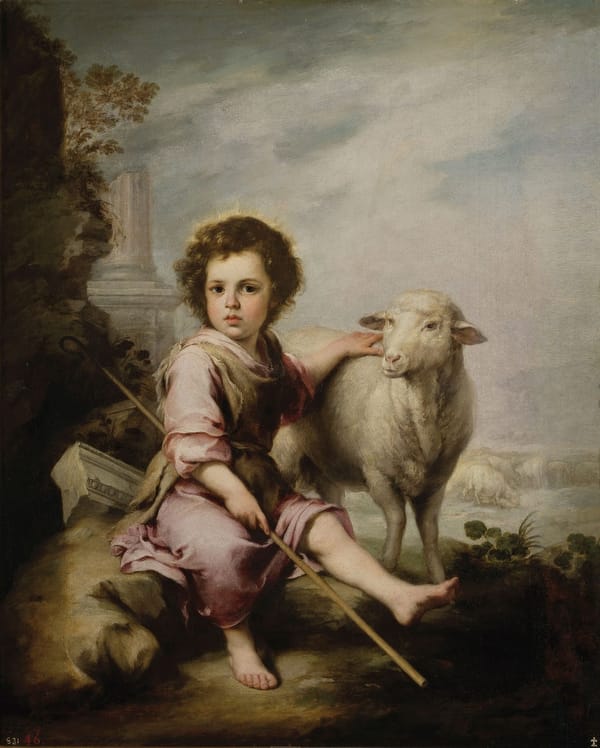
Second Sunday after Easter
THIS Sunday goes under the name of Good Shepherd Sunday, because in the Mass there is read the Gospel of St John, wherein our Lord calls himself by this name. How very appropriate is this passage of this Gospel to the present season, when our divine Master began his work of establishing and consolidating the Church, by giving it the pastor, or shepherd, who was to govern it to the end of time!
In accordance with the eternal decree, the Man-God, on the fortieth day after his Resurrection, is to withdraw his visible presence from the world. He is not to be again seen upon the earth till the last day, when he will come again to judge the living and the dead. And yet he could never abandon mankind, for which he offered himself on the Cross, and delivered from death and hell by rising triumphantly from the grave. He will continue to be its Head after his Ascension into heaven: but what shall we have on earth to supply his place? We shall have the Church. It is to the Church that he will leave all his own authority to rule us; it is into the hands of the Church that he will entrust all the truths he has taught; it is the Church that he will make the dispenser of all those means of salvation which he has destined for the world.
This Church is a society, unto which all mankind is invited. It is composed of two classes of members; the governing and the governed; the teaching and the taught; the sanctifying and the sanctified. This society is the Spouse of Christ; it is by her that he produces his elect. She is the one only Mother of the elect; out of her bosom there is no salvation.
But how is this society to subsist? how is it to persevere through the long ages of time, even to the last day? who is to give it unity and adhesion of its parts? what is to be the visible link between its members—the palpable sign of its being the true Spouse of Christ, in the event of other societies rising up and disputing her titles? If Jesus himself could have remained with us we should have had nothing to fear, for where he is, there also are truth and life; but, as he says, he is going, and we may not as yet follow him. Give ear, then, and learn what is the primary quality of the true Spouse of Christ.
Jesus was one day, previous to his Passion, in the country of Cesarea Philippi; his Apostles were standing around him, and he began questioning them about what they thought of him. One of them, Simon the son of John or Jonas, and brother to Andrew, answered in the name of all, and said: Thou art Christ, the Son of the living God!1 Jesus expressed his pleasure at receiving Simon’s testimony, which was not the result of any human knowledge, but the expression of a divine revelation there and then granted to him; and he immediately told this Apostle that from that time forward he was to be, not Simon, but Peter (which means a rock). Christ had been spoken of by the prophets under the name of a Rock, or Stone;2 by thus solemnly conferring upon his disciple a title so characteristically that of the Messias, Jesus would give us to understand that Simon was to have something in common with himself which the other Apostles were not to have. After saying to him: ‘Thou art Peter (that is, thou art the rock), he added:' And upon this rock I will build my Church.’3
Let us weigh the force of these words of the Son of God: I will build my Church. He has, then, a project in view—he intends to build a Church. It is not now that he will build it, but at some future period; but one thing we already know as a certainty—it is that this Church will be built on Peter. Peter will be its foundation; and whosoever is not on that foundation will not belong to the Church. Let us again give ear to the text: And the gates of hell shall not prevail against my Church. In scriptural language gates signify powers: the Church of Christ, therefore, is to be proof against all the efforts of hell. And why? Because the foundation which Jesus is to give to it shall be one that no power can shake. The Son of God continues: And I will give to thee the keys of the kingdom of heaven. In the language of the Jews, keys signify the power of governing; and in the Gospel Parables the kingdom of heaven is the Church built by Christ. By saying to Peter (which is henceforth to be Simon’s name), I will give to thee the keys of the kingdom of heaven, Jesus implied this: ‘I will make thee the King of my Church, of which thou art to be the foundation!’ Nothing could be clearer. But let us remember that all these magnificent promises regard the future.4
That future has now become the present. We are now come to the last days of Jesus’ visible presence here below. The time is come for him to make good his promise, and found the kingdom of God—that Church which he was to build upon the earth. The Apostles, in obedience to the order sent them by the angels, are come into Galilee. Our Lord appears to them on the shore of the lake of Tiberias: after providing them with a mysterious repast, and whilst they are all attentive to his words, he suddenly addresses himself to Peter: Simon, son of John, lovest thou me?5 Observe, he does not call him Peter; he, as it were, goes back to the day when he said to him: Simon, son of Jonas, thou art Peter; he would have his disciples note the connection between the promise and its actual fulfilment. Peter, with his usual eagerness, answers his Master’s question: Yea, Lord, thou knowest that I love thee. Jesus resumes, with a tone of authority: Feed my lambs! Then repeating the question, he says: Simon, son of John, lovest thou me? Peter is surprised at his Master’s urging such an inquiry; still he answers with the same simplicity as before: Yea, Lord, thou knowest that I love thee: and as soon as he has given answer, Jesus repeats the words of investiture: Feed my lambs!
The disciples respectfully listen to this dialogue; they see plainly that, here again. Peter is made an object of Jesus’ partiality, and is receiving something which they themselves are not to receive. They remember what happened at Cesarea Philippi and how. ever since that day, Peter has been treated by their Master with especial honour. And yet there is another privilege or office to be added to this of feeding the lambs. A third time, then, Jesus says to Peter: Simon, son of John, lovest thou me? This is too much for the Apostle. These three questionings of his love bring to his mind the three denials he had so sinfully made to the servant girl of Caiphas. He feels the allusion to his recent infidelity; and this third time, his answer implies a prayer for forgiveness; his reply bespeaks humility rather than assurance: Lord! says he, thou knowest all things! Thou knowest that I love thee! Then, making Peter’s authority complete, Jesus pronounces these imposing words: Feed my sheep!6
Here, then, we have Peter made shepherd by him who says of himself: I am the good Shepherd. Firstly, our Lord gives his Apostle, twice over, the care of his lambs; this does not make him the complete shepherd: but when he bids him feed his sheep too, the whole flock is subjected to his authority. Now, therefore, let the Church show herself, let her take her stand, let her spread herself through the length and breadth of the nations; Simon, the son of John, is proclaimed its visible head. Is the Church a building? he is the foundation-stone, the Petra, the rock. Is she a kingdom? he holds the keys, that is, the sceptre. Is she a fold? he is the shepherd.
Yes, this Church, which Jesus is now organizing, which is to be proclaimed to the world on the day of Pentecost, is to be a fold. The Word, the Second Person of the blessed Trinity, is come down from heaven, that he may gather together in one the children of God that were dispersed;7 and the time is at hand when there shall he but one fold and one shepherd.8 O Jesus! our divine Shepherd! we bless thee, we give thee thanks. It is by thee that the Church thou art now founding subsists and lives through every age, congregating and saving all that put themselves under her guidance. Her authority, her strength, her unity, all come from thee, her infinitely powerful and merciful shepherd! We likewise bless and thank thee that thou hast secured this authority, this strength, this unity, by giving us Peter as thy Vicar, Peter our shepherd in and by thee, Peter to whom all, both sheep and lambs, owe obedience, Peter in whom thou, our divine Head, wilt be for ever visible, even to the end of the world!
In the Greek Church, the second Sunday after Easter, which we call Good Shepherd Sunday, goes under the appellation of the Sunday of the holy Myrophorœ, that is Perfume-Bearers. The Office celebrates the devotion of the holy women who brought their perfumes to the sepulchre, that they might embalm the Body of Christ. Joseph of Arimathea is also commemorated in the Greek Liturgy of this week.
The Roman Church reads the Acts of the Apostles in her Matins, from last Monday to the third Sunday after Easter exclusively.
Mass
The Introit takes a tone of triumph. It celebrates in the words of the Royal Psalmist the mercy of the Lord, which by the foundation of the Church has filled the whole earth. The heavens (by which, in the mysterious language of the Scripture, is frequently meant the Apostles), were firmly established by the Word of the Lord, when Jesus (the Word) gave them Peter as their shepherd and their rock.
Introit
Ps. Exsultate justi in Domino: rectos decet collaudatio.℣. Gloria Patri.
Misericordia.
Ps. Rejoice in the Lord, O ye just! Praise becometh the upright.℣. Glory, etc.
The earth, etc.
In the Collect, the Church asks the grace of holy Joy for her children: it is the spirit of Eastertide. Surely, it is a duty to rejoice at our having been saved from death by our Jesus' Resurrection! Moreover, these Paschal joys are a preparation for those of eternity.
Collect
To this are added two of the following Collects:
Of the Blessed Virgin
Against the Persecutors of the Church
For The Pope
Epistle
1 Cap. ii.Charissimi, Christus passus est pro nobis, vobis relinquens exemplum, ut sequamini vestigia ejus. Qui peccatum non fecit, nec inventus est dolus in ore ejus: qui quum malediceretur, non maledicebat, quum pateretur, non comminabatur: tradebat autem judicanti se injuste: qui peccata nostra ipse pertulit in corpore suo super lignum: ut peccatis mortui, justitiae vivamus: cujus livore sanati estis. Eratis enim sicut oves errantes, sed conversi estis nunc ad pastorem et episcopum animarum vestrarum.
1 Ch. ii.Dearly beloved: Christ also suffered, leaving you an example, that you should walk in his steps. Who did no sin, neither was guile found in his mouth. Who, when he was reviled, did not revile; when he suffered, he threatened not: but delivered himself to him that judged him unjustly: who his own self bore our sins in his body upon the tree: that we being dead to sins, should live to justice: by whose stripes you were healed. For you were as sheep going astray; but you are now converted to the shepherd and bishop of your souls.
It is the prince of the Apostles, the visible shepherd of the universal Church, who addresses these words to us. Observe how he ends by turning our thoughts to the invisible shepherd, whose Vicar he is; and how carefully he avoids any allusion to himself. So, also, when assisting his disciple Mark to write his Gospel, he would not allow him to relate the history of Christ's having made him the shepherd of the whole flock; whereas, he insisted on his telling every circumstance of his thrice denying Jesus to be his Master. See, too. how feelingly the Apostle here speaks of his Saviour—of the sufferings he endured, of his patience, of his devotedness for those poor straying sheep of whom he was to form his fold! These words will one day be verified in Peter himself. The hour will come when, like his Master, he will be fastened to a cross, and patiently endure every insult and cruelty. Jesus told him that it was to be so. After entrusting him with the care of the sheep and lambs, our Lord told him that when he should have grown old, he would stretch forth his hands upon a cross, and suffer violence from men.9 This is to happen not merely to Peter, but to a considerable number of his successors, who are one with himself, and whom future generations are to see continually persecuted, exiled, imprisoned, and put to death. Let us also follow Jesus' steps, by cheerfully suffering for justice’ sake: we owe it to him who from all eternity, being equal in glory to God the Father, deigned to come down to our earth that he might be the shepherd and bishop of our souls.
The first Alleluia Versicle commemorates the repast at Emmaus: in a few moments we also shall know Jesus in the breaking of the Bread of Life.
The second proclaims, in Jesus’ own words, the dignity and qualities of a shepherd, his love for his sheep, and the eagerness wherewith his sheep recognize him as their Master.
Alleluia.℣. Ego sum Pastor bonus; et cognosco oves meas, et cognoscunt me meæ, alleluia.
Alleluia.℣. I am the good Shepherd, and I know my sheep, and my sheep know me, alleluia.
Gospel
Cap. x.In illo tempore: Dixit Jesus Pharisæis: Ego sum Pastor bonus. Bonus pastor animam suam dat pro ovibus suis. Mercenarius autem et qui non est pastor, cujus non sunt oves propriae, videt lupum venientem, et dimittit oves, et fugit: et lupus rapit et dispergit oves: mercenarius autem fugit, quia mercenarius est, et non pertinet ad eum de ovibus. Ego sum Pastor bonus: et cognosco oves meas, et cognoscunt me meae. Sicut novit me Pater, et ego agnosco Patrem: et animam meam pono pro ovibus meus. Et alias oves habeo, quæ non sunt ex hoc ovili: et illas oportet me adducere, et vocem meam audient, et fiet unum ovile, et unus pastor.
Ch. x.At that time: Jesus said to the Pharisees: I am the good Shepherd. The good shepherd giveth his life for his sheep. But the hireling, and he that is not the shepherd, whose own the sheep are not, seeth the wolf coming, and leaveth the sheep, and flieth, and the wolf catcheth, and scattereth the sheep: and the hireling flieth, because he is a hireling: and he hath no care for the sheep. I am the good Shepherd: and I know mine, and mine know me. As the Father knoweth me, and I know the Father: and I lay down my life for my sheep. And other sheep I have, that are not of this fold: them also I must bring, and they shall hear my voice, and there shall be one fold, and one shepherd.
Divine Shepherd of our souls! how great is thy love for thy sheep! Thou givest even thy life to save them. The fury of wolves does not make thee flee from us; thou becomest their prey, that we may escape. Thou didst die in our stead, because thou wast our Shepherd. We are not surprised at thy requiring from Peter a greater love than thou didst require from his brother Apostles: thou didst will to make him their and our shepherd. Peter answered thee without hesitation, that he loved thee; and thou didst confer upon him thine own name, together with the reality of thine office, in order that he might supply thy place after thy departure from this world. Be thou blessed, O divine Shepherd! for thy having thus provided for the necessities of thy fold, which could not be one, were it to have many shepherds without one supreme shepherd. In obedience to thy command, we bow down before Peter, with love and submission; we respectfully kiss his sacred feet; for it is by him that we are united to thee; it is by him that we are thy sheep. Preserve us, O Jesus, in the fold of Peter, which is thine. Keep far from us the hireling who usurps the place and rights of the shepherd. He has intruded himself, or been intruded by violence, into the fold, and would have us take him as the master; but he knows not the sheep, and the sheep do not know him. Led, not by zeal, but by avarice and ambition, he flieth at the approach of danger. He that governs through worldly motives is not a man to lay down his life for others. The schismatic pastor loves himself; he does not love thy sheep; how could he give his life for them? Protect us, O Jesus, from this hireling! He would separate us from thee, by separating us from Peter, whom thou hast appointed thy Vicar; and we are determined to recognize no other. Anathema to him who would command as in thy name, and yet not be sent by Peter! Such a pastor could be but an impostor; he would not rest on the foundation; he would not have the keys of the kingdom of heaven; to follow him would be our ruin. Grant, then, Good Shepherd, Jesus! that we may ever keep close to thee and to Peter; that as he rests upon thee, we may rest upon him; and thus we may defy every tempest, for thou, dear Lord, hast said: A wise man built his house upon a rock; and the rain fell, and the floods came, and the winds blew, and they beat upon that house, and it fell not; for it was founded on a rock.10
The Offertory is an aspiration to God. taken from the royal Prophet.
Offertory
In the Secret, the Church prays that the divine energy of the Mystery, about to be consummated on the Altar may produce within us the effect for which we long—death to sin. and resurrection to grace.
Secret
To this the priest adds two of the following Secrets.
Of the Blessed Virgin
Against The Persecutors Of The Church
For the Pope
The Communion Anthem speaks to us of the beautiful Mystery of to-day—the Good Shepherd. Let us once more offer our homage to the Son of God, who deigns to assume this endearing character; and let us ever be his devoted sheep.
Communion
Jesus, the Good Shepherd, has given himself, in this divine banquet, to his sheep: holy Church prays, in the Postcommunion, that we may ever be penetrated with sentiments of love for this august Sacrament; we ought to glory in it, as being the food that prepares us for immortality.
Postcommunion
To this the priest adds two of the following Postcommunions.
Of the Blessed Virgin
Against the Persecutors of the Church
For the Pope
Vespers
The Psalms, Hymn and Versicle are given on pages 81-90.
Antiphon of the Magnificat
Oremus.
We will close the day with this beautiful preface taken from the Mozarabic Missal. It commemorates the Resurrection.
Illatio
(Feria vi Paschœ)
May 5: St. Pius V, Pope
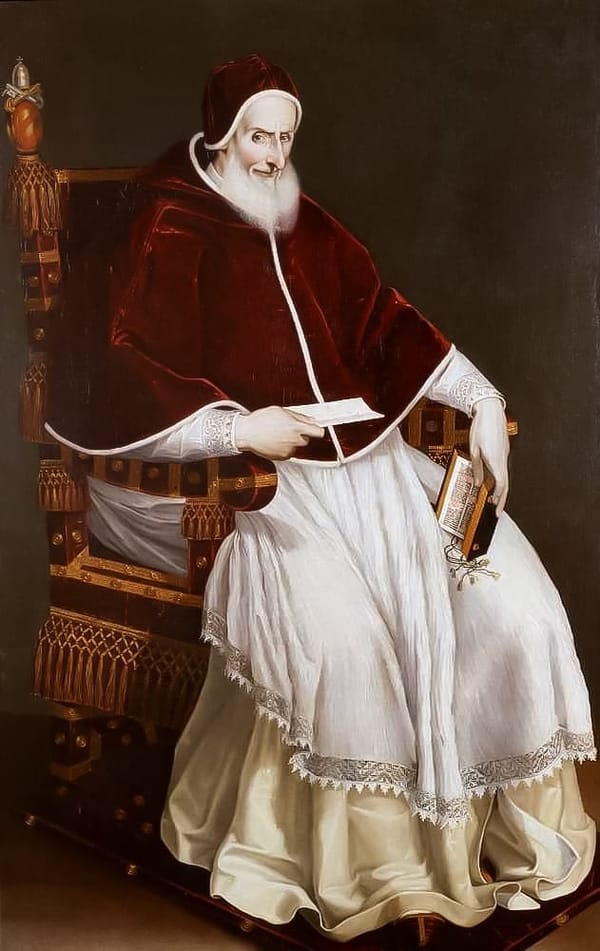 |
WE have already met with the names of several Pontiffs on the Paschal Calendar. They form a brilliant constellation around our Risen Jesus, who, during the period between his Resurrection and Ascension, gave to Peter, their predecessor, the keys of the kingdom of heaven. Anicetus, Soter, Caius, Cletus and Marcellinus, held in their hands the palm of martyrdom: Leo was the only one who did not shed his blood in the cause of his divine Master. To-day there comes before us a holy Pope who governed the Church in these latter times; he is worthy to stand amidst the Easter group of Pontiffs. Like Leo, Pius V was zealous in combating heresy; like Leo, he saved his people from the barbarian yoke.
The whole life of Pius V was a combat. His pontificate fell during those troubled times when Protestantism was leading whole countries into apostasy. Italy was not a prey that could be taken by violence: artifice was therefore used, in order to undermine the Apostolic See and thus develop the whole Christian world in the darkness of heresy. Pius defended the Peninsula with untiring devotedness from the danger that threatened her. Even before he was raised to the Papal Throne he frequently exposed his life by his zeal in opposing the preaching of false doctrines. Like Peter the Martyr, he braved every danger and was the dread of the emissaries of heresy. When seated on the Chair of Peter, he kept the innovators in check by fear, roused the sovereigns of Italy to energy and by measures of moderate severity drove back beyond the Alps the torrent that would have swept Christianity from Europe had not the Southern States thus opposed it. From that time forward, Protestantism has never made any further progress: it has been wearing itself out by doctrinal anarchy. We repeat it: this heresy would have laid all Europe waste, had it not been for the vigilance of the pastor who animated the defenders of truth to resist it where it already existed, and who set himself as a wall of brass against its invasion in the country where he himself was the master.
Another enemy, taking advantage of the confusion caused in the West by Protestantism, organized an expedition against Europe. Italy was to be its first prey. The Ottoman fleet started from the Bosphorus. This again would have meant the ruin of Christendom but for the energy of the Roman Pontiff, our Saint. He gave the alarm, and called the Christian Princes to arms. Germany and France, tom by domestic factions that had been caused by heresy, turned a deaf ear to the call. Spain alone, together with Venice and the little Papal fleet, answered the summons of the Pontiff. The Cross and Crescent were soon face to face in the Gulf of Lepanto. The prayers of Pius V decided the victory in favour of the Christians, whose forces were much inferior to those of the Turks. We shall return to this important event when we come to the Feast of the Rosary in October. But we cannot omit to mention to-day the prediction uttered by the holy Pope, on the evening of the great day of October 7, 1571. The battle between the Christian and Turkish fleets lasted from six o'clock in the morning till late in the afternoon. Towards evening, the Pontiff suddenly looked up towards heaven, and gazed upon it in silence for a few seconds. Then turning to his attendants, he exclaimed: ' Let us give thanks to God! The Christians have gained the victory!' The news soon arrived at Rome; and thus, Europe once more owed her salvation to a Pope! The defeat at Lepanto was a blow from which the Ottoman Empire has never recovered: its fall dates from that glorious day.
The zeal of this holy Pope for the reformation of Christian morals, his establishment of the observance of the laws of discipline prescribed by the Council of Trent and his publication of the new Breviary and Missal have made his six years' pontificate to be one of the richest periods of the Church’s history. Protestants themselves have frequently expressed their admiration of this vigorous opponent of the so-called Reformation.
‘I am surprised,’ said Bacon, ‘that the Church of Rome has not yet canonized this great man.’ Pius V did not receive this honour till about a hundred and thirty years after his death; so impartial is the Church, when she has to adjudicate this highest of earthly honours even to her most revered Pastors!
Of the many miracles which attested the merits of this holy Pontiff, even during his life, we select the two following: As he was one day crossing the Vatican piazza, which is on the site of the ancient Circus of Nero, he was overcome with a sentiment of enthusiasm for the glory and courage of the martyrs who had suffered on that very spot in the first persecution. Stooping down, he took up a handful of dust from the hallowed ground which had been trodden by so many generations of the Christian people since the peace of Constantine. He put the dust into a cloth which the Ambassador of Poland, who was with him, held out to receive it. When the Ambassador opened the cloth, after returning to his house, he found it all saturated with blood, as fresh as though it had been that moment shed: the dust had disappeared. The faith of the Pontiff had evoked the blood of the martyrs, which thus gave testimony against the heretics that the Roman Church, in the sixteenth century, was identically the same as that for which those brave heroes and heroines laid down their lives in the days of Nero.
The heretics attempted more than once to destroy a life which baffled all their hopes of perverting the faith of Italy. By a base and sacrilegious stratagem, aided by treachery, they put a deadly poison on the feet of the crucifix which the Saint kept in his Oratory, and which he was frequently seen to kiss with great devotion. In the fervour of prayer, Pius was about to give this mark of love to the image of his crucified Master, when suddenly the feet of the crucifix detached themselves from the Cross and eluded the proffered kiss of the venerable old man. The Pontiff at once saw through the plot whereby his enemies would fain have turned the life-giving Tree into an instrument of death.
In order to encourage the faithful to follow the sacred Liturgy, we will select another interesting example from the life of this great Saint. When, lying on his bed of death, and just before breathing his last, he took a parting look at the Church on earth, which he was leaving for that of heaven, he wished to make a final prayer for the flock which he knew was surrounded by danger; he therefore recited, but with a voice that was scarcely audible, the following stanza of the Paschal hymn: ‘We beseech thee, O Creator of all things! that in these days of Paschal joy, thou defend thy people from every assault of death!’1
Let us now read the eulogy of this saintly Pope of modern times, as given in the divine Office:
St Pius is one of the leading glories of the Dominican Order. We find the following Responsories and Hymns in the Breviary of that Order:
Responsories
Hymn
Canora pangant organa:
Nimbosque pellant nubilos
Sacræ diei gaudia.
Fregit draconis impetum:
Piique sumpto nomine,
Hostem repressit impium.
Umbone firmo depulit:
Sectariorum spicula
Mucrone forti messuit.
Sacris stetit pro mcenibus,
Ut barbaros acinaces
Arceret a fidelibus.
Cura revexit sedula:
Et impiis erroribus
Objecit hic repagula.
Non vinxit in sudario
Necessitates publicas
Toto juvans ærario.
Manus habens tomatiles,
Pavit greges famelicos
Effusione munerum.
In hoc paschali gaudio,
Ab omni mortis impetu
Tuum defende populum.
give forth their glad sound in honour of blessed Pius!
Let the joys of this sacred day
dispel all stormy clouds.
and he conquered the devil in battle:
he took the name of Pius
and repressed the impious foe.
against the dangers that attacked the Church:
he was the strong sword
that mowed down the ranks of the heretics.
who stood for the defence of the Holy City,
that he might protect the faithful
from the scimitar of the Turks.
redisciplined morals;
and to impious errors
he opposed a barrier of restraint.
to hide his wealth in a napkin;
he threw open his whole treasury,
that he might relieve the necessities of his people.
with his hands ever pouring forth charity,
he fed and amply provided for his subjects
when suffering famine.
that in these days of Paschal joy
thou defend thy people
from every assault of death.
The following hymn is placed near the tomb of our Saint, in the Church of Saint Mary Major, for the use of those who visit his shrine:
Hymn
Cultus Dei contemnitur:
Ultrixque culpam persequens,
Jam poena terris imminet.
Cœlestium de sedibus
Præsentiorem vindicem,
Quam te, Pie, invocabimus?
Intensiore robore
Quam tu, superni numinis
Promovit in terris decus;
Avertit a cervicibus,
Quod christianis gentibus
Jugum parabant barbari.
Tu supplices nunc aspice:
Tu civium discordias
Compesce et iras hostium.
Terras revisat, ut
Deo Tuti queamus reddere
Mox lætiora cantica.
Uni Deo sit gloria,
Laus et potestas omnia
Per sæculorum sæcula.
for the worship of God is despised:
the chastisement that avenges guilt
is menacing our earth.
which of the heavenly citizens
can we better invoke
in our defence than thee, O Pius?
no mortal ever laboured
with such zealous vigour
to promote God's glory on earth as thou didst;
to free Christian lands from the yoke
which barbarians were seeking
to put upon them.
that thou art in heaven:
look upon us thy clients!
Restrain civil discord and repel our enemies.
that in calm security
we may sing our canticles to God
with a gladder heart.
one God, be glory,
praise and power, for ever
and ever.
Pontiff of the living God! thou wast, whilst on earth, the pillar of iron and wall of brass, spoken of by the prophet.2 Thine unflinching firmness preserved the flock entrusted to thee from the violence arid snares of its many enemies. Far from desponding at the sight of the dangers thou didst redouble thy courage just as men raise the embankments higher when they see the torrent swell. By thee was the spread of heresy checked; by thee was the Mussulman invasion repelled, and the haughty Crescent humbled. God honoured thee by choosing thee as the avenger of his glory and the deliverer of the Christian people: receive our thanks and the homage of our humble praise! By thee were repaired the injuries .done to the Church during a period of unusual trial. The true reform—the reform that is wrought by authority—was vigorously applied by thy strong and holy hand. To thee is due the restoration of the Divine Service by the publication of the books of holy Liturgy. And all these glorious deeds were done in the six short years of thy laborious pontificate!
Hear now the prayers addressed to thee by the Church Militant, whose destinies were once in thy hands. When dying, thou didst beseech our Risen Jesus to grant her protection against the dangers which were then threatening her: oh! see the state to which licentious error has now reduced almost the whole Christian world! The Church has nothing left to her wherewith to make head against her countless enemies, save the promises of her divine Founder; all visible support is withdrawn from her; she has been deprived of everything except the merit of suffering and the power of prayer. Unite, O holy Pontiff, thy prayers to hers, and show how unchanged is thy love of the flock of Christ. Protect in Rome the Chair of thy successor attacked by open violence and astute hypocrisy. Princes and peoples seem to have conspired against God and his Christ: disconcert the schemes of sacrilegious ambition, and the plots of impiety which would fain give the lie to the word of God. Avert, by thine intercession, the scourges which are threatening those nations that have become ungrateful to the Church and indifferent to the attempts made against her to whom they owe all they possess. Pray that the blind may see and the wicked be confounded. Pray that the True Faith may enlighten those numberless souls that call error truth and darkness light.
In the midst of this dark and menacing night, thine eyes, O holy Pontiff, discern them that are the faithful sheep of Christ: bless them, aid them, increase their number. Graft them on the venerable Tree which dieth not, that they may not be carried away by the storm. Obtain for them docility to the Faith and traditions of Holy Church; it is their only stay amidst the tide of error which is now threatening to deluge the whole world. Preserve to the Church the holy Order in which thou wast trained for the high mission destined for thee; maintain within her that race of men, powerful in work and word, zealous for the faith and sanctification of souls, of which we read in her Annals, and which has yielded saints such as thyself. And lastly, O Pius, remember that thou wast once the Father of the faithful: continue to be so, by thy powerful intercession, till the number of the elect be filled up!
- The Stanza recited by the dying Pontiff was, in the Breviary of his time, as follows: Quæsumus, Auctor omnium, In hoc Paschali gaudio, Ab omni mortis impetus Tuum defende populum. When the hymns were corrected under the pontificate of Urban the Eighth, this stanza was totally changed: Ut sis perenne mentibus, etc. [The Monastic Breviary has retained the original.—Tr.] ↩︎
- Jer. i 18. ↩︎
| Previous Saturday the Second Week after Easter | Next May 5: St. Pius V, Pope |