Daily reading
Paschal Time
Greater Double · May 6 · Sanctoral
May 6, 2019
From Dom Guéranger’s The Liturgical Year.
A Greater Double leads the weekday.Rubric

|
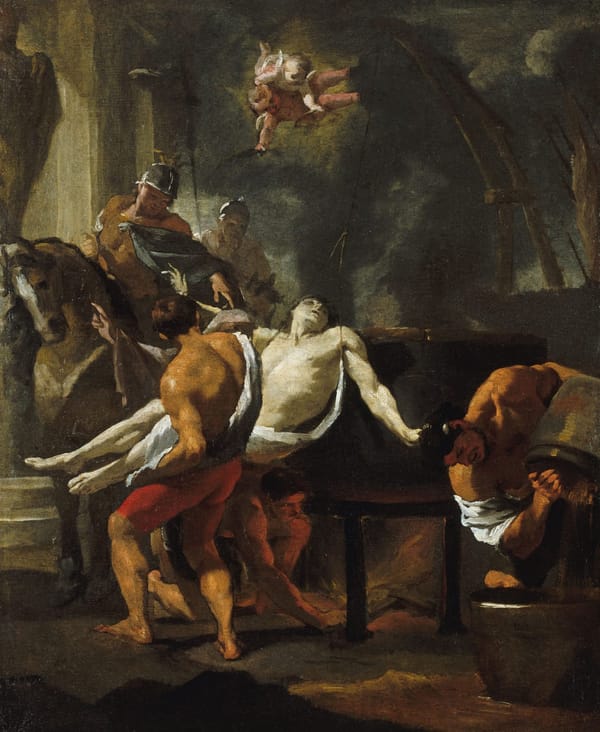
May 6: St. John before the Latin Gate
THE beloved Disciple John, whom we saw standing near the crib of the Babe of Bethlehem, comes before us again to-day; and this time he pays his delighted homage to the glorious Conqueror of death and hell. Like Philip and James, he is clad in the scarlet robe of martyrdom. The month of May, so rich in Saints, was to be graced with the palm of St John.
Salome one day presented her two sons to Jesus, and with a mother’s ambition asked him to grant them the highest places in his kingdom. The Saviour, in his reply, spoke of the chalice which he himself had to drink, and foretold that these two disciples would also drink of it. The elder, James the Great, was the first to give his Master this proof of his love; we shall celebrate his victory when the sun is in Leo: it was to-day that John, the younger brother, offered his life in testimony of Jesus’ divinity.
But the martyrdom of such an Apostle called for a scene worthy the event. Asia Minor, which his zeal had evangelized, was not a sufficiently glorious land for such a combat. Rome, whither Peter had transferred his Chair and where he died on his cross, and where Paul had bowed down his venerable head beneath the sword, Rome alone deserved the honour of seeing the beloved disciple march on to martyrdom, with that dignity and sweetness which are the characteristics of this veteran of the Apostolic College.
Domitian was then Emperor—a tyrant over Rome and the world. Whether it were that John undertook this journey of his own free choice, and from a wish to visit the Mother Church, or that he was led thither bound with chains, in obedience to an imperial edict—John, the august founder of the seven Churches of Asia Minor, appeared before the tribunal of pagan Rome. He was convicted of having propagated, in a vast province of the Empire, the worship of a Jew who had been crucified under Pontius Pilate. He was a superstitious and rebellious old man, and it was time to rid Asia of his presence. He was therefore sentenced to an ignominious and cruel death. He had somehow escaped Nero’s power: but he should not elude the vengeance of Caesar Domitian!
A huge cauldron of boiling oil is prepared in front of the Latin Gate. The sentence orders that the preacher of Christ be plunged into this bath. The hour is come for the second son of Salome to partake of his Master’s chalice. John’s heart leaps with joy at the thought that he—the most dear to Jesus, and yet the only Apostle that has not suffered death for him—is at last permitted to give him this earnest of his love. After cruelly scourging him, the executioners seize the old man, and throw him into the cauldron; but, lo! the boiling liquid has lost all its heat; the Apostle feels no scalding; on the contrary, when they take him out again he feels all the vigour of his youthful years restored to him. The Praetor’s cruelty is foiled, and John, a martyr in desire, is to be left to the Church for some few years longer. An imperial decree banishes him to the niggled Isle of Patmos, where God reveals to him the future of the Church, even to the end of time.
The Church of Rome, which counts among her most glorious memories the abode and martyrdom of St John, has marked with a Basilica the spot where the Apostle bore his noble testimony to the Christian faith. This Basilica stands near the Latin Gate, and gives a title to one of the Cardinals.
In honour of the great Apostle of love, we give the following Sequence, composed by Adam of Saint-Victor:
Sequence
Summum regem gloriæ
Videns mentis acie
Non repulsa,
Angelis parificat,
Spiritu qui indicat
Cœli summa.
Hic est potus recumbentis
Supra pectus Domini;
Hic expugnat vires ignis
Et ferventis olei.
Tormenti sævitia,
Quod martyr quis fiat
Et pœnas non sentiat.
O custos Virginis
Per quam mundo gloria,
Ex quo sunt, in quo sunt,
Per quem sunt omnia,
Per te det suffragia!
Christum, a quo diligeris,
Interpellans et exorans,
Nos ei concilia.
Tu qui collis, due ad montem;
Præsta Sponsum ad videndum,
Virgo totus gratia.
where the King of glory
is seen by the soul's
unfettered gaze,
and equality with the angels, to
John, whose revelations have made known
to men the mysteries of heaven.
that spring up to life eternal,
when he leaned on his Lord's breast.
have made him shine as a bright light in the Church.
He quenched the heat of the boiling oil.
for him are cruel beyond measure;
yet do they wonder within themselves,
how a man can be a martyr and feel no pain.
O guardian of the Virgin
by whom the world received him
who is its glory!
pray for us to Jesus, from whom, and in whom,
and by whom are all things.
by thine intercession and prayers,
render Jesus, by whom thou wast loved,
propitious unto us.
O thou that art a hill, lead us to the mountain!
O thou whom grace made wholly pure,
pray for us that we may see the Beloved.
We are delighted to meet thee again, dear disciple of our Risen Jesus! The first time we saw thee was at Bethlehem, where thou wast standing near the Expected of Nations, the promised Saviour, who was sweetly sleeping in his crib. We then thought of all thy glorious titles: Apostle, Evangelist, Prophet, highsoaring Eagle, Virgin, Doctor of charity, and above all, Jesus' Beloved Disciple. To-day we greet thee as martyr; for if the ardour of thy love quenched the fire prepared for thy torture, thy devotion to Christ had honestly and willingly accepted the chalice of which he spoke to thee in thy younger years. During these days of Paschal Time, which are passing so rapidly, we behold thee ever close to this divine Master, who treats thee with every mark of affection. Who could be surprised at his special love for thee? Wast thou not the only one of all the disciples who stood at the foot of the Cross? Was it not to thee that he gave the care of his Mother, making her thine? Wast thou not present when his Heart was opened on the Cross by a spear? When, on the morning of the great Sunday, thou didst repair with Peter to the Tomb, wast thou not, by thy faith, the first of all the disciples to honour Jesus' Resurrection? Oh, yes! thou hast a right to all the special love wherewith Jesus treats thee; but pray to him for us, O blessed Apostle!
We ought to love him for all the favours he has bestowed upon us; and yet we are tepid in his love—we humbly confess it. Thou hast taught us to know the infant Jesus, thou hast described to us the crucified Jesus; show us now the Risen Jesus, that we may keep close to him during these last few days of his sojourn on earth. And when he has ascended into heaven, procure us brave hearts, that like thee we may be prepared to drink the chalice of trials which he has destined for us.
Rome was the scene of thy glorious confession, O holy Apostle! She is most dear to thee; join, then, with Peter and Paul in protecting her. If the palm of martyrdom be in thy hand as well as the pen of the Evangelist, remember it was at the Latin Gate that thou didst obtain it. It was in the East that thou didst pass the greater part of thy life; but the West claims the honour of counting thee as one of her grandest martyrs. Bless our Churches, reanimate our faith, rekindle our love, and deliver us from the Antichrists against whom thou didst warn the faithful of thine own times, and who are causing such ravages among us. Adopted son of Mary! thou art now enjoying the sight of thy Mother's glory: present to her the prayers we are offering to her during this month, which is consecrated to her, and obtain for us the petitions which we presume to make to her.
Monday of the Third Week after Easter
THE first stone of the Church is laid; and on this foundation Jesus now begins to build. The shepherd of the sheep and lambs has been proclaimed; it is time to form the fold. The keys of the kingdom have been given to Peter; it is time to inaugurate the kingdom. Now this Church, this fold, this kingdom, designate a society which is to be called Christian, after the name of its Founder. This society, composed of the disciples of Christ, is destined to receive within it every individual of the human race; and if all do not actually enter, it is not in consequence of any ban of exclusion. It will subsist to the end of time; for there can be no elect out of its pale. It will be One; for Christ says not: ‘I will build my Churches he speaks but of One. It will be holy; for all the means of sanctification are in its keeping. It will be Catholic, that is, Universal, in order that, being known in all times and places, men may be able to hear its teachings and follow them. It will be Apostolic; that is to say, that how long soever this world may last, it will come down, by lawful succession, from these men with whom Jesus is, during these forty days, arranging everything that is connected with its establishment.
Such is to be the Church, out of which there is no salvation for those who, having known her, have refused to become her members. A few days hence, and the world will hear of her existence. The spark that is now but in Judea will soon become a fire spread throughout the whole earth. Before the close of the century, not only will there be members of the Church in every province of the vast Roman Empire, but even in countries where Rome has never planted the standard of her proud eagles. Nay more, this miraculous propagation is to be perpetual—in every page new apostles will set forth, and win new victories for this immortal Church. Nothing human is lasting; but the Church's ceaseless duration will excite the spleen of incredulity and baffle all its calculations. Persecutions, heresies, schisms, apostasies, and scandals—all will strive to work her ruin; but she will survive them all. The descendants of her bitterest foes will call her mother. Thrones and dynasties, nations, and even whole races, will be carried away by the tide of time: she alone will subsist throughout the ages, stretching out her arms to receive all men, teaching ever the same truths, repeating, even to the last day, the same symbol of faith, and ever faithful to the instructions given her by our Risen Jesus during these forty days preceding his Ascension.
How shall we worthily thank thee, O God our Saviour, for thy having, even at our first entrance into life, made us members of this thy immortal Spouse, which alone possesses thy heavenly teachings and the means whereby is wrought salvation? We have no need to search for thy Church; it is in and by her that we live, even here below, the supernatural life, the perfection of which is to be given to us in heaven, provided we be faithful to grace. Oh! show thy mercy to those countless souls who have not had the privilege we have enjoyed, and whose entrance into thy Church is to cost them many a painful sacrifice. Strengthen them with light; give them courage; rouse them from indifference; bless their efforts; that thus, O divine Shepherd! thy fold may increase, and thy Church, thy Spouse, may be, as thou hast promised she ever shall be, the joyful mother of children!
Let us continue our homage to the mystery of the Pasch, borrowing another canticle from the inexhaustible Adam of Saint-Victor.
Sequence
Lux insignis, lux unica,
Lux lucis et laetitiae,
Lux immortalis gloriae.
Commendat ab initio,
Quam Christi resurrectio
Ditavit privilegio.
Lucis exsultent filii,
Vindicent membra meritis
Conformitatem Capitis.
Et vota sunt solemnia;
Primae diei dignitas
Prima requirit gaudia.
Paschalis est victoria,
Sub multis aenigmatibus
Prius promissa patribus.
Quod vetus lex praecinuit
Figuram res exterminat,
Et umbram lux illuminat.
Quid hœdus gesserit,
Nostra purgans piacula,
Messias nobis aperit.
Solvit a morte debita;
Praedam captans illicitam,
Praeda privatur licita.
Caro peccati nescia;
Die reflorens tertia
Corda confirmat dubia.
Tu Christo nos vivifica!
Mors morti non obnoxia,
Da nobis vitæ praemia.
the brilliant light, the light above all other,
the light of light and joy,
the light of immortal glory.
from the very beginning of the world:
the day enriched
with the prerogative of Christ’s Resurrection.
exult with the hope of everlasting joy:
let the members so act as to merit
to be like their Head.
so are our prayers.
The grandest of days
should have the grandest joy.
is the most glorious of feasts.
It was promised to our fathers
under many types.
and all is made visible that was foretold in the Old Law.
The reality effaces the figure;
and light throws light on the shadow.
—has revealed to us
the mysteries of the spotless Lamb
and the Kid.
he delivered us from the death we so truly deserved.
Death, making a prey of him on whom he had no claim,
was deprived of the prey that was justly his own.
cancelled the sins of ours:
it rose again on the third day,
and, reblooming, refreshed all wavering hearts.
give us to live in Jesus.
O undying death!
give us the prize of life.
| Previous May 5: St. Pius V, Pope | Next Monday of the Third Week after Easter |