Daily reading
Paschal Time
Double · May 9 · Sanctoral
May 9, 2019
From Dom Guéranger’s The Liturgical Year.
A Double leads the weekday.Rubric
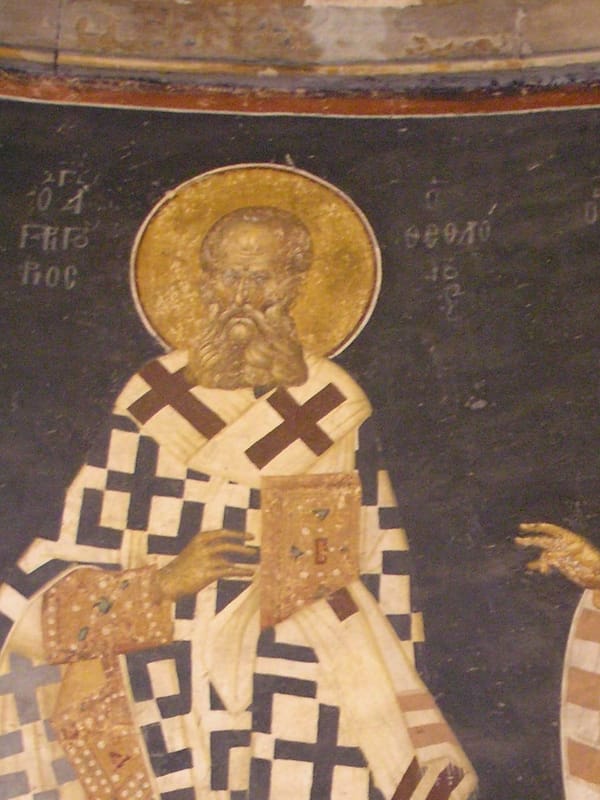 |
May 9: St. Gregory Nazianzen, Bishop, and Doctor of the Church
SIDE by side with Athanasius, another Doctor of the Church comes forward at this glad season to offer to the Risen Jesus the tribute of his learning and eloquence. It is Gregory of Nazianzum, the friend of Basil, the great orator, the admirable poet, whose style combines energy of thought with a remarkable richness and ease of expression; the one of all the Gregories who has merited and received the glorious name of Theologian, on account of the soundness of his teachings, the sublimity of his ideas, and the magnificence of his diction. Holy Church exults at being able to offer us so grand a Saint during Easter Time, for no one has spoken more eloquently than he on the Mystery of the Pasch. Let us listen to the commencement of his second Sermon for Easter; and then judge for ourselves:
I will stand upon my watch, says the admirable Prophet Habacuc.1 I, also on this day, will imitate him; I will stand on the power and knowledge granted me by the favour of the Holy Ghost, that I may consider and know what is to be seen, and what will be told unto me. And I stood and I watched: and lo! a man ascended to the clouds; and he was of exceeding high stature, and his face was the face of an angel, and his garment was dazzling as a flash of lightning. And he lifted up his hand towards the East, and cried out with a loud voice. His voice was as the voice of a trumpet, and around him stood, as it were, a multitude of the heavenly host, and he said: "To-day is salvation given to both the visible and the invisible world. Christ hath risen from the dead: do ye also rise. Christ hath returned to himself: do ye also return. Christ hath freed himself from the tomb: be ye set free from the bonds of sin. The gates of hell are opened, and death is crushed; the old Adam is laid aside, and the new one is created. Oh! if there be a new creature formed in Christ, be ye made new!”
Thus did he speak. Then did the other angels repeat the hymn they first sang when Christ was born on this earth, and appeared to us men: Glory be to God in the highest, and peace on earth to men of good will! I join my voice with them, and speak these things to you: oh! that I could have an angel’s voice, to make myself heard throughout the whole earth!
It is the Pasch of the Lord! the Pasch!—in honour of the Trinity, I say it a third time: the Pasch! This is our Feast of feasts, our Solemnity of solemnities. It is as far above all the rest, not only of those which are human and earthly, but of those even which belong to Christ and are celebrated on his account—yea, it as far surpasses them all as the sun surpasses the stars. Commencing with yesterday, how grand was the day with its torches and lights! . . . But how grander and brighter is all on this morning! Yesterday’s light was but the harbinger of the great Light that was to rise; it was but a foretaste of the joy that was to be given to us. But to-day we are celebrating the Resurrection itself, not merely in hope, but as actually come to pass, and drawing the whole earth to itself.2
This is a sample of the fervour and eloquence wherewith our Saint preached the mysteries of faith. He was a man of retirement and contemplation. The troubles of the world in which he had been compelled to live damped his spirits; the duplicity and wickedness of men fretted his noble heart; and leaving to another the perilous honour of the see of Constantinople, which he had reluctantly accepted a very short time previously, he retired to his dear solitude, there to enjoy his God and the study of holy things. And yet, during the short period of his episcopal government, notwithstanding all the obstacles that stood in his way, he confirmed the faith that had been shaken, and left behind him a light which continued even to the time when St John Chrysostom was chosen to fill the troubled Chair of Byzantium.
The holy Liturgy thus speaks to us of the virtues and actions of this great Saint:
The Greek Church, in her Menæa, gives the following magnificent encomium of St Gregory Nazianzen:
Hymn (Die XXV Januarii)
We salute thee, O glorious Doctor of the Church, on whom both East and West have conferred the title of Theologian! Illumined by the rays of the glorious Trinity, thou gavest us to share in the light thus imparted to thee—and a brighter was never granted to mortal eye. In thee was verified that saying of our Saviour: Blessed are the clean of heart, for they shall see God.3 The purity of thy soul prepared thee to receive the divine light, and thy inspired pen has transmitted to thy fellow-men something of thine own soul's enraptured knowledge. Obtain for us the gift of faith, which puts the creature in communication with its God; obtain for us the gift of understanding, which makes the creature relish what it believes. The object of all thy labours was to guard the faithful against the seductive wiles of heresy, by putting before them the magnificence of the divine dogmas. Oh! pray for us, that we may avoid the snares of false doctrines, and have our eye ever fixed on the ineffable light of the mysteries of faith; for, as St Peter tells us, it is as a lamp in a dark place, that shineth until the day dawn, and until the day-star arise in our hearts.4
There now seems to be a gleam of hope for the East, that has been, for so many long ages, a prey to error and slavery. Great changes are preparing for the unfortunate Byzantium, and politicians are studying how to profit by the crisis, and make her the prey of their respective Governments. Canst thou forget the city of which thou wast once the pastor, and where thy name is still held in veneration? Oh! help her to throw off the shackles of schism and heresy. Her being a slave to the infidel is the punishment of her having revolted against the Vicar of Christ! this yoke seems about to be broken; pray, O Gregory, that the more dangerous and humiliating one of error and schism may also be broken. A movement of return to the truth has already begun to show itself. Whole provinces are awakening to a knowledge of their misery, and are casting a look of hope towards the common Mother of all Churches, who opens her arms to receive them. Aid this long-desired conversion by thy prayers. Both East and West honour thee as one of the sublimest preachers of divine Truth; obtain by thy powerful intercession that East and West may be once more united in the one fold, and under the one shepherd, before our Risen Jesus returns to our earth to separate the cockle from the good seed, and lead back to heaven the Church, his Spouse and our Mother, out of whose pale there is no salvation.
Help us, during this season, to contemplate the glories of our Risen Lord. Oh! for something of the holy enthusiasm for this Pasch, which inebriated thee with its joys and inspired thee with such glowing eloquence! Jesus, the Conqueror of Death, was the object of thy fervent affections even from thy childhood; and when old age came, thy heart still beat with love for him. Pray for us, that we too may persevere in his service; that his divine mysteries may ever be our grandest joy; that this year’s Pasch may ever abide in our souls; that the renovation it has brought us may be visible throughout our lives; and that it may, each year as it returns, find us attentive and eager to receive its graces, until the eternal Easter comes with its endless joy!
Thursday of the Third Week after Easter
THIS Church founded and maintained by Christ —is it nothing more than a society of minds that know, and of hearts that love, the truths revealed to it by heaven? Have we adequately defined it, when we call it ‘a spiritual society'? No, most assuredly; for we are told that it was to spread, and actually has been spread, throughout the whole world. Now how could such progress and conquest have taken place, if the spiritual society founded by our Redeemer had not also been exterior and visible? On earth, souls cannot hold intercommunication without bodies. Faith cometh by hearing, says the Apostle: and how shall they hear without a preacher?1 When, therefore, our Risen Jesus says to his Apostles: Go, teach all nations!2 he distinctly implies that the word of God will be heard, that it will resound throughout the world, and that its sound will be heard both by them that obey and by them that reject the teaching of his ministers. Has this word a right to circulate thus freely, independently of any permission from earthly powers? Yes; for the Son of God has said: Go, teach all nations! He must be obeyed; the word of God cannot be fettered.3
The word, then, the exterior word is free; and being free, it obtains numerous disciples. Will these disciples live isolatedly? Will they not rather group around their apostle, the better to profit by his teaching? Will they not look on one another as brethren, and members of the same family? And if so, they must hold their assemblies. Thus the new people is brought before the notice of the world. It was necessary that this should be; for if this people, which is to attract all others to itself, be not visible, how can it do its work?
But the people thus assembled must have their buildings, their temples. Therefore do they erect houses of preaching and prayer. The stranger—that is, he who is not a Christian—seeing these new places of worship, asks: ‘What means all this? Whence come these people who pray aloof from their fellow-citizens? Would not one be inclined to say that we have a nation within the nation?’ The stranger is right; there is a nation within the nation, and it will continue to be so until the whole nation itself have passed into the ranks of this new people.
Every society stands in need of laws; the Church, therefore, will not be long without giving outward proof of her internal government. There are her festivals, her solemnities, which denote a great people; her ritual rules, forming a visible bond of union between the members of her society, and this not merely during the hours of divine service; there are commandments and orders made by the various degrees of the hierarchy, which are promulgated and claim obedience; there are institutions and corporations existing within the great society itself, and they add to her strength and beauty; in a word, there is everything that is needed, even penal laws against offending and refractory members.
But it does not suffice the Church that she have places where her children can assemble together; provision must also be made for the support of her clergy, for the expenses attendant on the divine worship, for the necessities of her indigent members. Aided by the generosity of her children, she enters into possession of certain landed properties, which become sacred by reason of their use, as also because of the superhuman dignity of her who owns them. Nay more; when the princes of this earth, tired of their vain efforts to stay the Church’s progress, shall ask to be admitted as her children, a new necessity will arise from this: the supreme Pontiff can be no longer the subject of any temporal sovereign, and he himself must become king. The Christian world hails with joy this crowning of the work of Christ, to whom all power has been given in heaven and on earth ,4 and who was one day to reign, with temporal power, in the person of his Vicar.
Such is the Church: a spiritual, but at the same time an exterior and visible society; just in the same way as man is spiritual because of his soul and material because of his body, which is an essential part of his being. The Christian, therefore, should love the Church such as God has made her; he should detest that false and hypocritical spiritualism which, with a view to subvert the work of Christ, would confine religion within the exclusively spiritual domain. We never can admit such a limitation. The Divine Word has assumed our fiesh; he permitted his creature man to hear and see and handle him;5 and when he organized his Church on earth, he made it speaking, visible, and so to say palpable. We are a vast state; we have our king, our magistrates, our fellow-citizens; and we should be willing to lay down our lives for this supernatural country, whose excellence is as far superior to that of our earthly country as heaven is better than the whole earth. Satan has an instinctive hatred for this country, which is to bring us to the Paradise whence he has been driven; he has used every means in his power to ruin it. He began by attacking the liberty of the word which is preached to men, and leads them to the Church. Did not his first agents forbid the Apostles to speak at all in the name of Jesus to any man?6 The strategy was shrewd enough; and although it failed to arrest the progress of the Gospel, it has ever been resorted to by the enemy, even to this very day.
The powers of the world have always been jealous of Christian assemblies; the jealousy began early, and has periodically manifested its fury during these eighteen centuries. Frequently during a fit of persecution we have been obliged to flee to caves and forests, and seek the hours of night for our celebrations of the mysteries of light, and for singing the praises of the divine Sun of Justice: Our dearest churches, which had been erected by the piety of our ancestors, and were sacred by innumerable memories—how many times have they not been made ruins! Satan's ambition is to efface every vestige of Christ's kingdom on earth, for that kingdom is his defeat.
The laws promulgated by the Church, and the communications of the pastors with one another and with the sovereign Pontiff—these, also, have excited the most tyrannical jealousy. The right of self-government has been denied to the Church; servile men have aided emperors and kings to fetter the Spouse of Christ. Her temporal possessions, too, have tempted the avarice of sovereigns. These possessions procured her independence; it was, therefore, considered necessary to rob her of them, that she might become the creature of the state. It was a wicked attempt, and has brought the most terrible chastisements upon the countries where it was perpetrated, yet there was one more wicked still, which aimed at depriving of his throne, venerable by its thousand years’ duration, the Pontiff who holds in his sacred hands the keys of the kingdom of God.
Meanwhile, the most detestable errors are being propagated. Among these, we would mention one, which in spite of its impious absurdity, finds favour with thousands: we mean the doctrine that the Church should be purely spiritual, or, if it is to be a visible Church, that it should be an instrument in the hands of government, for political purposes. Let us hold such doctrine in execration; let us think of those countless martyrs, who have shed their blood in order to maintain and secure to the Church of Christ her position as a society, visible, external, independent of every human power, in a word, complete in herself. It may be that we are the last inheritors of the promise; and if so, it would be an additional reason for our proclaiming the rights of the Spouse of Christ, upon whom he has conferred the empire of the world, which only exists because of her, and will be destroyed as soon as it refuses her a resting-place.
Let us close these reflections with a hymn of praise to our divine Head. The ancient Missal of Saint Gall gives us this other Sequence in honour of our paschal mystery.
Sequence
Socii, laudum resonis
Celebremus gaudia
Simul temporis,
Per Christum patet
Reserata spes nobis.
Quos afflixit vernaculos.
Grates regi,
Qui nos redemit Barathro.
More Judaeorum, solvimur pæno,
Mentes pariter praeparemus,
Typicam ut immolemus Victimam,
Insigniti mentis domo,
Non pavemus Angeli ensem
Plectentis reos vindicem.
Mysticis ut ejus
Epulemur carnibus,
Fermenta criminum purgemus,
Sinceriter vivamus.
Eremo vitæ quimus
Per coeleste lumen
De tetris hostibus;
Digne ipsum laudare hymno Moysi,
Qui suos maligno pressos Pharaone alumnos liberat, obstructo
Atris abyssis inimico.
Tantae potestatis Domino, et suae januam
Praecelsae pietatis pulsemus
Moriendo ut qui mortis legem rupit atrocis,
Hic redemptos custodiat,
Ne post tergum decidant,
Sed ut regnum scandant promissum.
in sweetest hymns of praise,
the joys of this
bright spring time,
our hopes
of heaven revive.
he tortured with the scourge of death.
to the divine king,
who delivered us from the abyss.
delivered by Christ from Egyptian tyranny,
let us prepare ourselves
to offer up the mystic Lamb.
shall mark the dwelling of our souls,
and we not fear the avenging sword
of the destroying angel.
partake of his sacred Flesh,
us put away the leaven of and
make our lives
the unleavened bread of sincerity.
we shall be delivered
from the wicked enemies
that fill the desert of this world.
and we will praise him in the canticle which Moses sang
when he rescued his Israelites from Pharaoh’s cruelty,
and saw the dark waves close upon the pursuant foe.
we sing to this almighty Lord;
and knocking at the door of his infinite mercy,
that having by his own dying broken the yoke of death,
he may watch over the people he has redeemed,
preserve them from lagging behind,
and aid them to reach the Promised Land above.
| Previous Wednesday of the Third Week after Easter | Next Thursday of the Third Week after Easter |