Daily reading
Paschal Time
Double · May 10 · Sanctoral
May 10, 2019
From Dom Guéranger’s The Liturgical Year.
A Double leads the weekday; Sts. Gordian and Epimachus are commemorated.Rubrics
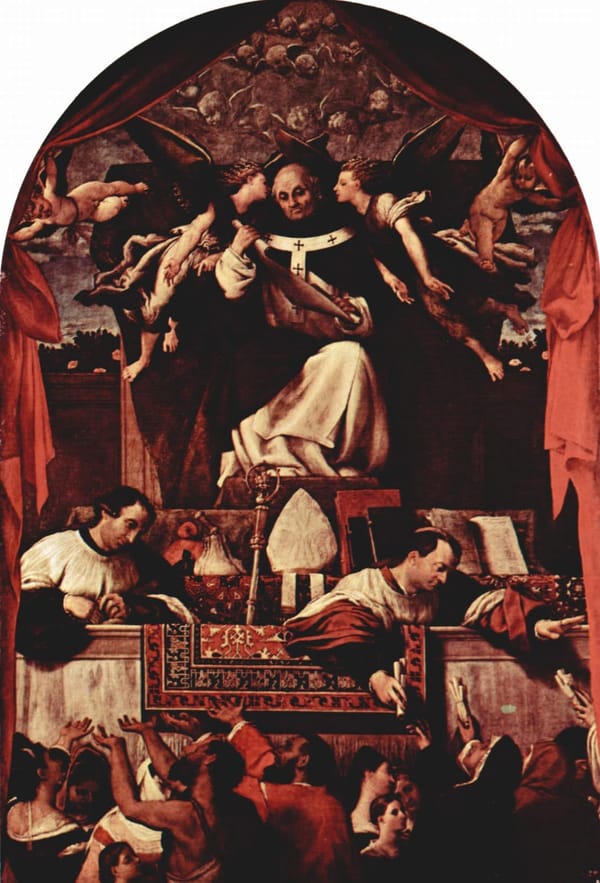 |
May 10: St. Antoninus, Bishop and Confessor
THE Order of St Dominic, which has already presented to our triumphant Jesus Peter the Martyr and Catharine the seraph of Siena, offers him to-day one of the many bishops trained and formed in its admirable school. It was in the fifteenth century, a period when sanctity was rare on the earth, that Antoninus realized in his own person the virtues of the greatest bishops of ancient times. His apostolic zeal, his deeds of charity, his mortified life, are the glory of the Church of Florence, which was confided to his care. Heaven blessed that illustrious city with temporal prosperity on account of its saintly archbishop. Cosmo de Medici was frequently heard to say that Florence owed more to Antoninus than to any other man. The holy prelate was also celebrated for his great learning. He defended the Papacy against the calumnies of certain seditious bishops in the Council of Basle: and, at the General Council of Florence, he eloquently asserted the truth of the Catholic faith, which was assailed by the abettors of the Greek schism. How beautiful is our holy Mother the Church, who produces such children as Antoninus, and has them in readiness to uphold what is true and withstand what is false!
She thus speaks the praises of the Saint of to-day:
Disciple of the great Dominic, inheritor of his burning zeal, protect the holy order which he founded, and of which thou art so bright an ornament. Show that thou still lovest it. Give it increase, and procure for its children the holiness that once worked such loveliness and fruit in the Church. Holy Pontiff, be mindful of the faithful, who implore thine intercession at this period of the year.
Thy eloquent lips announced the Pasch, so many years, to the people of Florence, and urged them to share in the Resurrection of our divine Head. The same Pasch, the immortal Pasch, has shone once more upon us. We are still celebrating it; pray that its fruits may be lasting in us, and that our Risen Jesus, who has given us life, may, by his grace, preserve it in our souls for all eternity.
May 10 (the Same Day): Sts. Gordian and Epimachus, Martyrs
TWO more martyrs ascend from our earth on this day and are admitted to share in Jesus’ glory. Again it is Rome that deputes them to bear her homage to the Conqueror of Death. Gordian was one of the magistrates who were commissioned, under Julian the Apostate, to persecute the Christians. One day, whilst exercising his office, he suddenly descended from the tribunal and took his place among the criminals. He was soon called upon to shed his blood for the faith. His martyrdom, together with that of the illustrious brothers, John and Paul, whose feast we shall keep in June, closes the period of the pagan persecutions in the West. The fact of his being buried in the crypts on the Latin Way awakened the memory of another martyr, whose relics, half consumed by fire, had long before been brought thither from Alexandria. His name was Epimachus; and on this day the two martyrs were inseparably united in the devotion of the faithful. Neither the place nor the period of their combat was the same; but both of them fought for the one cause and won the same victory. The two conquerors are buried in peace in the Eternal City; but he, for whose name they delivered their bodies to death, is mindful of their precious remains. Yet a little while, and he will fulfil, in their regard, the promise he made when he said: I am the Resurrection and the Life. He that believeth in me, although he he dead, shall live.1
Sleep your sleep of peace, O holy martyrs! Rest yet a little time, till your fellow-servants and brethren, who are to be slain even as you, shall be filled up.2 The number has been added to in every century; but the world is now near its end, and its last period is to be rich in martyrdom. When the reign of the man of sin3 begins its course, and the final tempest rages against the bark of holy Church, then, O martyrs of Christ, protect the Christian people, in return for the yearly tribute of honour that it has paid to your venerable names. Pray also for those living during these sad times, whose miseries seem like the distant howling of the storm that is to precede the end of the world. Strengthen our hearts, O holy martyrs! and whatever may be the lot prepared for us by Providence, obtain for us that we may be faithful to him, who would be to us what he has been to you—the Resurrection and the Life.4
Friday of the Third Week after Easter
CHURCH of Jesus! that wast promised by him to the earth during the days of his mortal life; that camest forth from his sacred Side when wounded by the spear upon the Cross; that wast organized and perfected by him during the last days of his sojourn here below; we lovingly greet thee as our mother; thou art the Spouse of our Redeemer, and it is through thee that we were born to him. It is thou that gavest us life by baptism; it is thou that givest us the word, which enlightens us; it is thou that ministerest to us the helps, whereby we are led, through our earthly pilgrimage, to heaven; it is thou that governest us, in the spiritual order, by thy holy ordinances.
Under thy maternal care we are safe; we have nothing to fear. What can error do against us? Thou art the pillar and ground of the truth!1 What effect can the revolutions of our earthly habitation have upon us? We know, that if everything else should fail us, thou wilt ever be with us. It was during these very days which precede the Ascension, that our Lord Jesus said to his Apostles, and through them, to their successors: Behold! I am with you all days, even to the consummation of the world.2 What a promise of duration was this! If we consult the history of these last eighteen hundred years, it will tell us that this promise has never once been broken. The gates of hell have risen up against thee innumerable times; but they have never prevailed against thee, no, not for one single moment!
And thus it is, O Church! that being founded on Christ thy Spouse, thou givest us a share in thine own divine immutability! Established as we are in thee, there is not a truth which the eye of our faith cannot see; there is not a blessing which, despite our weakness, we may not make our own; there is no object shown us by hope, which we may not attain. Thou holdest us in thine arms; and from the height whereto thou raisest us, we see the mysteries of time and the secrets of eternity. Our eye admiringly follows thee, whether we consider thee as militant on earth, suffering in thy dear ones who are in the temporary state of expiation, or triumphant in heaven. Thou art with us in our exile, and already art thou, in millions of thy children, heiress of the eternal kingdom. Keep us near thee, nay, within thee, O thou our Mother, who art the beloved Spouse of our Lord. To whom shall we go but to thee? Is it not to thee, and to thee alone, that he has entrusted the words of eternal life?
How much they are to be pitied, O Church! who do not know thee! And yet, if they are seeking God with all their heart, they will, one day, know thee. How much they are to be pitied who once knew thee, and afterwards, in their pride and ingratitude, denied thee! And yet no one ever fell into such misery, unless he first voluntarily shut his eyes against the light that was within him. How much they are to be pitied who know thee, and still live enjoying what thou givest thy children, and who yet take side with thine enemies in insulting and betraying thee! They are men whose character is shallowness of mind; they speak their opinions as though they were oracles; they have contracted the flippant effrontery of our age: and to hear them speak of thee, one would suppose that they look on thee as a human institution, which they may approve or blame according to their humour.
Instead of revering whatsoever thou hast taught regarding thyself and thy rights; instead of revering what thou hast ordained, regulated, and practised; these Catholics, whose sympathies are all with thine enemies, would have thee conform thy teachings and conduct with the so-called Progress of the times. The whole world is given to thee as thine inheritance; and yet these insolent children would have thee be content with what they think proper to assign to thee. Thou, the Mother of mankind, must be under their wise care! It is from them thou must, henceforth, learn how best to fulfil thy mission! Godless men, adorers of what they called the rights of man, dared, a century back, to expel thee from political life, which up till then thou hadst kept in harmony with its divine Master. These men have left disciples, who would have thee withdraw from everything that regards the outward world, and look on as a mere stranger. Thou must no longer exercise the rights given thee by the Son of God over both soul and body; this royalty of thine is out of date, and thou must be satisfied to enjoy the liberty which, in virtue of the law of Progress, is granted alike to error and to truth. The wise and powerful ones of this world have dethroned the Vicar of thy Spouse after a thousand years' reign; and instead of resenting such a project with holy indignation, as tending to the destruction of the last bulwark of Christendom—there are many among us who approve of it, and this on principles which are, it is true, in favour with rationalistic politicians, but which are formally condemned by thy teachings, thy acts, nay, by thy very existence. How short-sighted are such Catholics as these, who hope to make thee acceptable to the world by giving thee the semblance of a human institution! The world is too shrewd: it knows thee to be essentially supernatural, and this is what it never can tolerate.
Wiser and more Christian by far are they who, detesting such profane theories, have, like devoted Machabees, drawn the sword against thine enemies, O Church of Christ! and even in an age like this, when faith has grown weak, have so well understood their Christian duty as to die in thy defence, and, by so dying, to win the crown of martyrdom. Yes, it is our duty to confess thee: to disguise thee is to belie thee. Thou art one of the articles of our Creed: 'I believe the holy Catholic Church.' Thou hast been known these nineteen hundred years; and shall men now pretend that thou must conform to the world’s capricious views? This cannot be. Jesus made thee be like himself—a sign of contradiction:3 and as such we must receive thee. We must listen to thy protestations against false principles and practices, and not attempt to remodel thee. Only God has power to give his Church a form other than that he has already given her.
Blessed are they who share thy lot, dear Church of our Redeemer! In these unchristian times thou art unpopular. Thou wast so in ages long gone by, when men could not become thy children save at the risk of being despised. It is the same now, and we are resolved to espouse thy cause. We confess thee to be our mother, inaccessible to the changes of this world. Whether honoured or persecuted, thou continuest thy mission here below. Thus will it be until the time comes when this earth, which was created to be thy kingdom, shall see thee ascend to heaven, and flee from a world which will deserve the severest chastisements of God’s anger, because of its having despised and rejected thee.
In honour of the divine Spouse of our Mother, let us sing this paschal canticle, taken from the ancient Missals of Flanders.
Sequence
Alleluia, votis, voce solemnia
Celebrando paschalia.
Congaudeat turma,
Sacro fonte nivea,
Spernens Phlegethontis undas.
Aptemus fibras
Arte musica;
Voce sonora
Modificantes
Prorsus neumata
Voce satis tinnula.
Factus nostra ob remedia,
Crucis tulit robora;
Maneret, subiit lethalia.
Passus praelibare pocula.
Transfixus clavis et lancea.
Descendit ad ima Tartara.
Revehit potens ampla ovando trophæa.
Ac resumpta carne,
Resurgit victor
Die hodierna.
Ipsi canamus odas.
Redit æterna,
Et cœli clara
Nobis patescit aula.
Alleluia! and by its prayers and hymns,
celebrate the Paschal solemnity.
share in the common joy;
it comes, white as snow, from the sacred font,
having been rescued from the waters of the stream of hell.
string our harps
to tune;
And sing,
whilst going through
the many-varied modes,
with voices sweet and ringing.
has become the Victim of our salvation,
and has carried the wood of his Cross.
that we might have eternal life.
the bitter cup of gall.
with the nails and spear.
he descended into the depths below.
and brought back, in power and triumph, the richest trophies.
his Soul was reunited to his Body;
and this is the day
of his glorious Resurrection.
to him our lays of joy.
and heaven’s bright gate
thrown open to us
by him.
| Previous Thursday of the Third Week after Easter | Next May 10 (the Same Day): Sts. Gordian and Epimachus, Martyrs |