Daily reading
May 15 · Sanctoral
May 15, 2019
From Dom Guéranger’s The Liturgical Year.
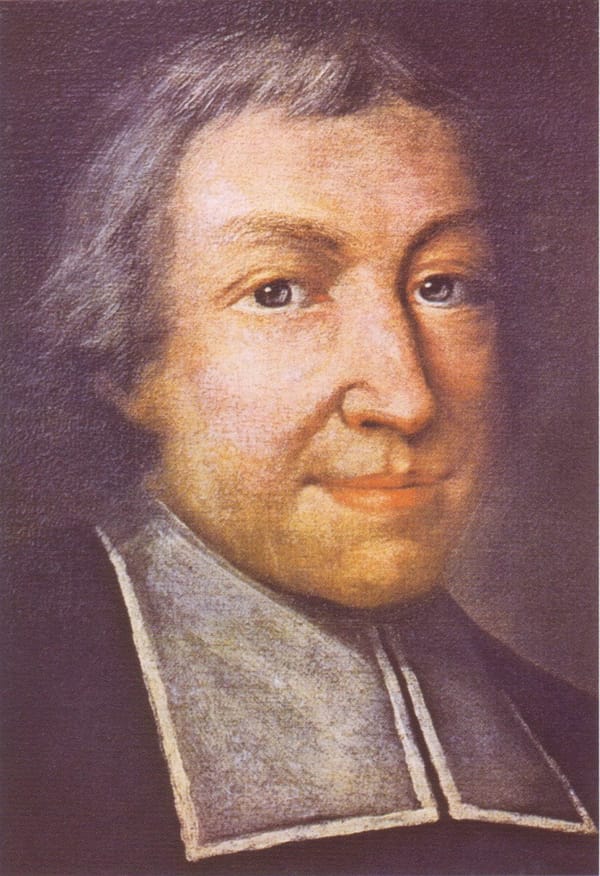
May 15: St. John Baptist de la Salle, Confessor
JOHN Baptist de la Salle, the teacher of the humble, takes his place to-day beside Leo the Great, Athanasius, and Gregory of Nazianzum. He has no fear. The victor of Paschal Time is the same Jesus who said during his mortal life: ‘Suffer the little children to come unto me,'1 and ‘unless you be converted and become as little children, you shall not enter into the kingdom of heaven,'2 that kingdom of heaven which, after entering into his glory, he manifests so fully upon earth. On the other hand, the Lion of Juda is never more terrible in his anger than when he beholds evil men conspiring to keep from him the little ones of whom he forms his court.3
The promise made in Holy Scripture that ' they that instruct many to justice shall shine as stars for all eternity'4 is addressed not only to the great doctors of the science of salvation, but also to the humblest Christian teacher, and the supreme Pontiff, when inscribing the name of the saint of to-day among those of the blessed, declared that the inspired words ' apply in an especial manner to those who, like him, have left all things and devoted themselves to the instruction of the baptized from earliest infancy in the teaching of the Gospel and the precepts which lead to life eternal.’5
John Baptist de la Salle was a true disciple of our blessed Lord, and entered so fully into the thought of his Master that no sacrifice was too great for him if only he might carry it out, and no suffering, humiliation, or persecution could hinder him from persevering in the accomplishment of his works of love. He suffered from misunderstanding and lack of support all through his life, but is he less great in heaven to-day on that account?
The following account of him is given in the Breviary:
O God, who hast raised up the holy Confessor John Baptist to promote the Christian education of the poor and to confirm the young in the way of truth, and, through him, hast gathered together a new family within thy Church: mercifully grant through his intercession and example that we may bum with zeal for thy glory in saving souls, and may share his crown in heaven. Through Christ our Lord.
Thus, O father of Christian schools, does Holy Church pray to-day in thy honour. She is as full of confidence as though the trials of thy mortal life had been sufficient to guard thy sons against similar sufferings; as serene as though the future of thy work were assured. And yet, might we not say that the culminating point of thy glorification on earth seems to have given the signal for the triumph of hell over thy labours? But the Church is strong in her experience of twenty centuries, and she fears no persecution. She knows that if the tree be planted by God, the hurricane will but strengthen its roots, and that a house built upon a rock can brave the wind and the floods. We too, like the Church, are full of hope, trusting in thy merits and thy intercession. Even if min seem complete, the divine Head of all who suffer persecution assures us that the tomb itself, though sealed by the powers of this world, cannot guarantee to Death the secure possession of his victim.
Wednesday of the Fourth Week after Easter
THE Son of God is soon to ascend to his Father. He has said to his Apostles: Going, teach all nations: preach the Gospel to every creature. Thus, then, the nations are not to receive the word from the lips of Jesus, but through his ministers. The glory and happiness of being instructed directly by the Man-God were for none but the Israelites, and even for them for only three short years.
The impious may murmur at this, and say, in their pride:’Why should there be men between God and us?' God might justly answer:’And what right have you to expect me to speak to you myself, seeing that you can otherwise be as certain of my word as though you heard it from myself V Was the Son of God to lose his claim to our faith unless he remained on this earth to the end of time? If we reflect on the infinite distance there is between the Creator and creature, we shall detest such a blasphemy. If we receive the testimony of men, the testimony of God is greater:1 and how can we reject it? Can we call that testimony human, which was given by the Apostles, when, in proof of their being sent by God, they showed the power, conferred on them by their divine Master, of working miracles? Of course the pride of reason may rebel; it may protest, and refuse to believe men who speak in God’s name. Did not the very Son of God meet with more unbelievers than believers? And why? Because he affirmed himself to be God, yet showed nothing exteriorly but his human nature. So that there was an act of faith to be made, even when Jesus himself spoke; and pride might rebel, and say:’I will not believe just as it will do when the Apostles speak in his name. The two cases are alike. God demands of us, as long as we are in this world, that we give him our faith; and faith is not possible without humility. God confirms his word by miracles; but man has always the power to resist, and for that very reason faith is a virtue.
If it be asked—why, when God took his Son from this earth, he did not commission his angels to teach us in his name, instead of giving such a sublime office to men, frail and mortal as we ourselves are who receive their teaching—the reason is, that man could not be raised up from the state of degradation into which he had fallen by pride, except by submission and humility; and consequently, it was fitting that the ministry of the divine word should not be entrusted to angels, inasmuch as our pride might have been flattered by our having for our teachers beings so noble and exalted. We believed the serpent when he spoke to us, and we had the pride to think that we might one day become gods: our merciful Creator, in order to save us, has imposed it as a law upon us, that we should yield submission to men, when they speak in his name.
These men, therefore, are to preach the Gospel to every creature; and he that believeth not, shall be condemned. O word of God! thou heavenly seed planted in the field of the Church, how fruitful hast thou not been! Yet one little while, and the harvest will be ripe. Faith will have spread throughout the world; the faithful shall be found in every land. And how came they by the faith? By hearing, answers the great Apostle of the Gentiles.2 They heard the word, and they believed. How honoured above the rest of our senses is our hearing, at least in this present life! Let us listen to St Bernard, speaking on this subject.’One would have thought that the Truth would have entered into our souls by that noblest of our senses, the eye: but no, my soul! that is reserved for the future life, when we shall see face to face. For the present, let the remedy come in by the same door through which crept the malady; let life, and light, and the antidote of truth, come to us in the track previously taken by death and darkness, and the serpent’s poison. Thus the troubled eye will be cured by the ear, and will see, when calm, what she cannot when troubled. The ear was the first door of death; let it be the first to be opened to life. The ear took away our Light; let it now restore our Light; for unless we believe, we shall not understand.3 Hearing, therefore, is the instrument of our merit; sight is to be our reward. . . . Observe, too, how the Holy Ghost follows this order in the spiritual education of the soul: he forms the ear, before he gladdens the eye. He says to her: Hearken, O daughter, and see!4 Forget thine eye for the present: it is thine ear I now ask for. Dost thou wish to see Christ? First hear him; hear what is said of him: that so, when thou dost see him, thou mayest say: As we have heard, so have we seen!5 The brightness is immense; thine eye is weak; and thou canst not bear the splendour. But what thine eye cannot do, thine ear can; . . . only let this ear of thine be fervent, and watchful, and faithful. Faith will give to thine eye the clearness it lost by sin; disobedience shut it, but obedience will open it.”6
To the glory of him who has sent us his word by his ambassadors, and whom we have received as himself, let us recite this ancient sequence of Saint Gall: it expresses the faith of our fathers, and this faith is ours also.
Sequence
Ac Regi Christo Deo
Solvant omnes insularum incolæ,
Quem exspectatum dies jam tenent, et leges ejus
Mentibus captent promptulis.
Quos derelicto populo
Delegit Judæo,
De Abrahæ carne genito,
Quos Abrahæ natos fecit, et cognatos
Suum sanctum per sanguinem.
O Christe,
Consanguinee naturae nostrae, nos fove,
Tuere ab omni incursu inimici, et insidiis.
Quem per carnis edulium
Delusisti hamo tuae majestatis, Fili Dei.
Tu resurgens imperitas,
Non moriturus amplius.
Tu mortalem nostram
Et terream naturam
Resurgens incorruptivam fecisti,
Atque cœlis invexisti.
render thanks to Christ,
our Saviour, King and God,
The Expected One, who is at length come,
and whose Law is now devoutly obeyed by mankind.
He cast off the Jewish people,
who were born
of Abraham according to the flesh;
And he chose, for his own,
them that he made children of Abraham by faith,
them that he had made his brethren by his precious Blood.
O Jesus
who art united to us by the bond of consanguinity! protect us,
And, by thy divine power,
defend us from every attack and snare of the enemy.
Thou, O Son of God! didst show him the Flesh thou hadst assumed,
and he, taking it, was taken by the hook of thy divinity.
Rising again, thou triumphest,
for death shall never more triumph over thee.
By thy Resurrection,
thou gavest incorruptibility
to our mortal and earthly nature,
and didst raise it to heaven.
| Previous Tuesday of the Fourth Week after Easter | Next Wednesday of the Fourth Week after Easter |