Daily reading
Paschal Time
Double · May 17 · Sanctoral
May 17, 2019
From Dom Guéranger’s The Liturgical Year.
A Double leads the weekday.Rubric
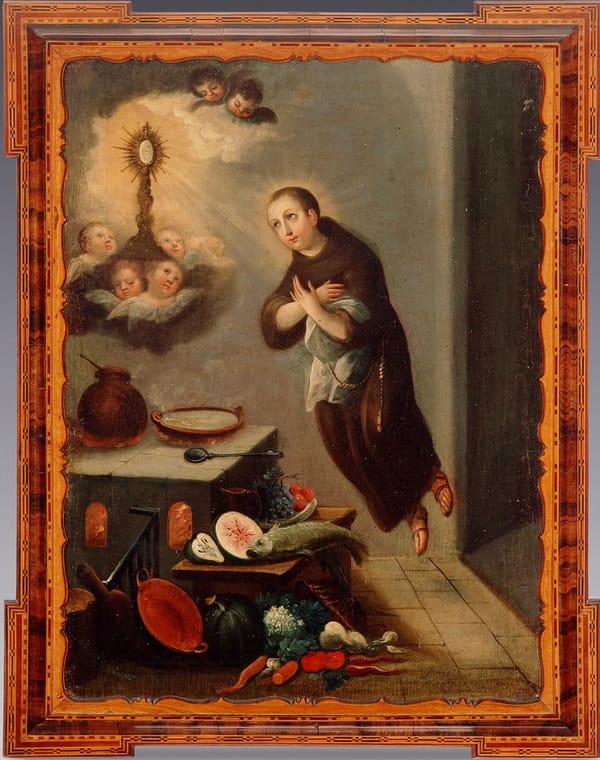 |
May 17: St. Paschal Baylon, Confessor
THE Seraph of Assisi was sure to depute some of his children to pay their court to his Risen Master. The one he sends to-day is the humblest and most obscure of men; another will follow, three days hence, powerful in word and work, and holding a palm in his hands, as a most devoted preacher of the Gospel. Paschal Baylon was a simple peasant. He was a shepherd-boy; and it was in tending his flock that he found the Lord Jesus. He had a great love for contemplation. Forests and fields spoke to him of their great Creator; and, in order that he might be the more closely united with him, he resolved to seek him in the highest paths of perfection. He was ambitious to imitate the humble, poor and suffering life of the Man-God; the Franciscan Cloister offered him the opportunity of satisfying this desire and he flew to it. On that blessed soil, he grew to be one of heaven's choicest plants, and the whole earth has now heard the name of the humble lay-brother of a little convent in Spain. Holy Church brings him before us to-day enraptured in the contemplation of Jesus' Resurrection. He had trod the path of humiliation and the cross; it was but just that he should share in his Master's triumph. It was of him, and of such as he, that this divine Saviour spoke, when he said: Ye are they that have continued with me in my temptations; and I dispose to you, as my Father hath disposed to me, a kingdom; that ye may eat and drink at my table in my kingdom, and may sit upon thrones, judging the twelve tribes of Israel.1
The account given by the Liturgy of the angelic life of this illustrious son of St Francis is as follows:
Heaven opened to receive thee, O Paschal! Even when here below, the fervour of thy contemplation often gave thee a foretaste of the delights of eternal bliss; but now every veil is drawn aside, and thou art face to face with him whom thou didst so ardently desire to possess. Thou hast no further need to unite thyself with him by humiliation and suffering; thou enjoyest his own glory, his own happiness, his own triumph, and he will have thee enjoy it for all eternity. Deign to cast an eye of pity on us, who have not thy eagerness to walk in our Redeemer’s footsteps, and who, as yet, have but the hope of being united to him for eternity. Gain for us courage. Gain for us that love which leads straight to Jesus, which surmounts every obstacle of flesh and blood, and gives to man an admirable resemblance to his divine Model. The pledge of this happy transformation has been given to us by our being permitted to partake of the Paschal Mystery; may it be perfected by our fidelity in keeping close to our divine conqueror and Lord! Though he leave us some time further in this vale of tears, his eye is ever upon us, he longs to see us persevere in our loyalty to him. Yet a little while, and we shall see him! Behold! says he, I come quickly; hold fast that which thou hast. Behold! I stand at the gate and knock. If any man shall hear my voice, and open to me the door, I will come in to him, and will sup with him, and he with me.2 Thus will the Pasch of time be changed into the Pasch of eternity. Pray for us, O Paschal, that like thee, we may hold fast that which, by the grace of our Risen Jesus, we already possess.
Friday of the Fourth Week after Easter
PRAISE be to our Risen Jesus, for his having said to us: He that believeth and is baptized, shall be saved!1 Thanks to his infinite mercy, we believe and have been baptized; we are, therefore, in the path of salvation. It is true that faith will not save us without good works; but, on the other hand, good works without faith cannot merit eternal salvation. With what transport of joy ought we not to give thanks to God, for his having produced in us, by his grace, this unspeakable gift,2 this first pledge of our everlasting happiness! How carefully ought we not to strive to keep it pure, yea and increase it by our fidelity! Faith, like other virtues, has its degrees: we should, therefore, frequently use the prayer addressed to Jesus by his Apostles: Lord! increase our faith!3
We are living in an age when faith is weak amongst the majority even of them that believe; and it is one of the greatest dangers that could befall us in this world. When faith is weak, charity must needs grow cold. Our Saviour one day asked his disciples if they thought that he would find faith upon the earth when he should come to judge mankind.4 Have we not reason to fear that we are fast approaching that awful time, when the want of faith will paralyze men's hearts?
Faith proceeds from our will moved by the Holy Ghost. We believe because we wish to believe; and for this reason it is a happiness to believe. The blind man to whom Jesus restored his sight said to him, when he bade him believe in the Son of God: Who is he, Lord? that I may believe in him.5 These same dispositions ought to animate us, when there is question of our making an act of faith—we should believe, in order that we may know that which, without faith, we could not know: then will God manifest himself to both our mind and heart.
You will meet with Christians who seem to make it their business to keep down the faith of their friends as much as possible. They seem to be jealous of faith getting too much; are ever talking about the rights of reason; and will have it that they who are so ready to believe are guilty of underrating the dignity, range, and divine origin of reason. Let them that are thus accused, answer: ‘We are far from denying the existence of that natural light within us, which is called reason. The teaching of the Church is too express on this point to admit of any doubt; but she also teaches us that this light—even had it retained its primal power, and had not been obscured by original sin—is incapable of discovering, by itself alone, the end for which man was created, and the means whereby that end is to be gained. Faith alone can enable man to attain to such sublime knowledge as this.’
Others, again, maintain that as soon as a Christian comes to the full age of reason, he has a right to suspend the exercise of his faith, in order that he may examine for himself whether it be reasonable or not to continue believing. Such an opinion is most false and has made many an apostate. The Church has ever taught from the days of the Apostles down to our own times, and will so teach to the end of the world, that the child who has received holy baptism has also, and at that same instant, received the gift of infused faith; that he thereby became a member of Christ, and child of his Church; and that if, when he comes to the age of reason, he should be tempted with doubts regarding matters of faith, he receives grace to resist those doubts by faith, and that he would be risking his salvation were he to suspend his faith. This does not imply that the Church forbids him to confirm his faith by study and science; far from it. This is a totally different thing from suspension of one’s faith; it is, according to the admirable saying of the great St Anselm,’faith seeking understanding,’ and, we may add, finding it, for God gives this recompense to faith.
You may probably meet with persons who think it right that there should be found among us a class of men, called free-thinking philosophers, that is to say, men without faith, who hold, with regard to God and creatures, doctrines which are wholly independent of revelation, and who teach a morality that entirely ignores the supernatural element. Is it possible that Catholics can not only countenance and praise such men as these, but even defend them, and be partial towards them?
And what must we say of the sad effects resulting from living with heretics? Most of us could give instances of the dangerous compromises and deplorable concessions made in consequence of much intercourse with those who are not of the faith. The terrible line of demarcation specified by St John, in his second Epistle,6 is being forgotten; the very mention of it is offensive to modern ears. A strong indication of this is to be found in the frequency of mixed marriages, which in a number of cases, though often by imperceptible degrees, result in leading the Catholic party to religious indifference. Let us listen to the energetic language of that illustrious ascetical writer, Father Faber:’The old-fashioned hatred of heresy is becoming scarce. God is not habitually looked at as the sole Truth; and so the existence of heresies no longer appals the mind. It is assumed that God must do nothing painful, and his dominion must not allow itself to take the shape of an inconvenience or a trammel to the liberty of his creatures. If the world has outgrown the idea of exclusiveness, God must follow our lead, and lay it aside as a principle in his dealings with us. What the many want they must have at last. This is the rule and the experience of a constitutional country. Thus discord in religion, and untruth in religion, have come to be less odious and less alarming to men, simply because they are accustomed to them. It requires courage, both moral and mental, to believe the whole of a grand nation in the wrong, or to think that an entire country can go astray. But theology, with a brave simplicity, concludes a whole world under sin, and sees no difficulty in the true Church being able to claim only a moderate share of the population of the earth. The belief in the facility of salvation outside the Church is very agreeable to our domestic loves and to our private friendships. Moreover, if we will hold this, the world will pardon a whole host of other superstitions in us, and will do us the honour of complimenting the religion God gave, as if it were some literary or philosophical production of our own. Is this such a huge gain? Many seem amazingly pleased with it, and pay dear for it quite contentedly. Now it is plain that this belief must lower the value of the Church in our eyes. It must relax our efforts to convert others. It must relax our efforts to convert ourselves. Those who use the system of the Church least will of course esteem it least, and see least in it; and are therefore least fitted to be judges of it. Yet it is just these men who are the most forward and the most generous in surrendering the prerogatives of the Church to the exigencies of modern smoothness and universalism.'7 Another sign of the decay of the spirit of faith, even among many of those who do not neglect their religion, is the disregard for, one might almost say the ignorance of, holy practices recommended by the Church. How many Catholic houses are there, where there is never a drop of Holy Water, or a blessed Candle, or a Palm to be seen? These sacred objects, given to us to be a protection, deserve from us that same reverence and love which our forefathers had when they defended them, even at the risk of their lives, against the Protestants of the sixteenth century. What a jeering look of incredulity is evinced by many amongst us, when mention is made of any miracle that is not found in the Bible! With what an air of contemptuous disbelief they hear or read of anything in connection with the mystic life, such as ecstasies, raptures, or revelations! How uneasy they seem, when the subject of the heroic acts of penance done by the Saints, or of the simplest practices of bodily mortification, happens to come across them! How loudly and pathetically do they not protest against the noble sacrifices which some favoured souls are inspired to make, whereby they break asunder the dearest ties, and shut themselves out of the world, behind the grille of a monastery or convent! The spirit of faith makes a true Catholic appreciate the beauty, the reasonableness, and the sublimity of all these practices and acts; whilst the want of this spirit makes them be condemned as extravagant, unmeaning, and folly.
Faith longs to believe; for believing is its life. It limits not itself to the strict Creed promulgated by the Church. It knows that the Spouse of Christ possesses all truths, though she does not solemnly declare them all, nor under the pain of anathema. Faith forestalls the declaration of a dogma; it believes piously, before believing under obligation. A secret instinct draws it towards this as yet veiled truth; and when the dogma is published by a definition of the supreme Pontiff, then does this same faith rejoice in the triumph of the truth which was revealed from the very commencement of the Church; and its joy is great in proportion to the fidelity wherewith it honoured the truth, when only generous and loyal hearts embraced it.
Glory, then, be to our Risen Jesus, who requited his Mother’s faith, who strengthened that of the disciples and the holy women, and who, as we humbly pray, will mercifully reward ours. Let us offer him our homage, in the words of a sequence from the ancient Missal of Saint Gall.
Sequence
Atque Redemptoris gloriam.
Astutia callidi serpentis,
Sua refecit gratia.
Futurum ut germen
Sancta proferret fœmina;
Nociva exsuperaret capita.
Cernunt saecula.
Novo pollet Maria.
Mire edidit miracula.
Sed statim inter suæ nativitatis primordia.
Per Simeonis verba
Judaica ad se vel corda, vel munera
Attrahens nutu gentilia.
Atque Spiritus Sanctus specie, glorificat.
Docent auctoritate sua.
Dona dedit multa,
Doctrinaeque perplura verba
Ore suo promulgavit saluberrima;
Colaphos, et flagella,
Vestem quoque ludo quæsitam,
Et spineum venit sertum
Ad crucis brachia.
A mortuis resurgens,
Sprevit victoria, ducens secum primitiva
Ad coelos membra,
Et nuper dispersa
Revocans ovilia.
Licet ultima membra simus, spondet dona.
of our Creator and Redeemer!
to them whom he had created aright,
yet who were seduced by the cunning of the crafty serpent.
that a holy Woman would,
one day, bring forth a Fruit,
the baneful head of the old enemy.
these promises that were long forgotten.
put forth a new Flower.
and miracles marked his life,
but immediately after his birth.
and by Simeon’s words,
he drew to himself the heart of the Jew
and the gift of the Gentile.
and by the visible form under which the Holy Ghost appeared.
were appointed to teach others in his name.
abundant gifts of salvation,
and promulgating, with his own lips,
the doctrine of eternal life,
in which he was insulted, spit upon,
buffeted, scourged, vested as a mock-king,
crowned with thorns,
and nailed to a Cross.
he rises triumphant from the grave;
he takes them that belonged to the generations of old,
and leads them with himself to heaven;
he forms into one fold
the scattered sheep.
he promises future gifts, and bids us hope.
| Previous Thursday of the Fourth Week after Easter | Next Friday of the Fourth Week after Easter |