Daily reading
Paschal Time
Double · Movable from Easter · Temporal
May 19, 2019
From Dom Guéranger’s The Liturgical Year.

|
Fourth Sunday after Easter
OUR Jesus has organized his Church, and confided to his Apostles the sacred deposit of the truths which are to form the object of our faith. We must now follow him in another work, of equal importance to the world, to which he gives his divine attention during these forty days: it is the institution of the sacraments. It is not enough that we believe; we must, moreover, be made just—that is, we must bear upon us the likeness of God’s holiness; we must receive, we must have incorporated within us that great fruit of the redemption which is called grace; that thus being made living members of our divine Head, we may be made join theirs with him of the kingdom of heaven. Now it is by means of the sacraments that Jesus is to produce in us this wondrous work of our justification; he applies to us the merits of his Incarnation and Sacrifice, but he applies them by certain means, which he himself, in his power and wisdom, has instituted.
Being the sovereign master of his own gifts, he can select what means he pleases whereby to convey grace to us; all we have to do is to conform to his wishes. Thus, each of the sacraments is a law; so that it is in vain that we hope for a sacrament to produce its effects, unless we fulfil the conditions specified by our Redeemer. And here, at once, we cannot but admire that infinite goodness which has so mercifully blended two such widely distinct operations in one and the same act—namely, on the one side the humble submission of man, and on the other the munificent generosity of God.
We were showing, a few days back, how the Church, though a spiritual society, is also visible and exterior, because man, for whose sake the Church was formed, is a being composed of body and soul. When instituting the sacraments, our Lord assigned to each an essential rite; and this rite is outward and sensible. He made the Flesh, which he had united to his divine Person, become the instrument of our salvation by his Passion and Death on the Cross; he redeemed us by shedding his Blood for us: so is it in the sacraments; he follows the same mysterious plan, taking physical things as his auxiliaries in effecting the work of our justification. He raises them to a supernatural state, and makes them the faithful and all-powerful conductors of his grace, even to the most intimate depths of our soul. It is the continuation of the mystery of the Incarnation, the object of which is to raise us, by visible things, to the knowledge of things invisible. Thus is broken the pride of Satan; he despised man because he is not purely a spirit, but is spirit and matter unitedly; and he refused to pay adoration to the word made Flesh.
Moreover, the sacraments, being visible signs, are an additional bond of union between the members of the Church: we say additional, because these members have the two other strong links of union—submission to Peter and to the pastors sent by him and profession of the same faith. The Holy Ghost tells us, in the sacred Volume, that a threefold cord is not easily broken.1 Now we have such a one; and it keeps us in the glorious unity of the Church: hierarchy, dogma, and sacraments, all contribute to make us one Body. Everywhere, from north to south, and from east to west, the sacraments testify to the fraternity that exists amongst us; by them we know each other, no matter in what part of the globe we may be, and by the same we are known by heretics and infidels. These divine sacraments are the same in every country, how much soever the liturgical formulae of their administration may differ; they are the same in the graces they produce, they are the same in the signs whereby grace is produced—in a word, they are the same in all the essentials.
Our Risen Jesus would have the sacraments be seven. As at the beginning he stamped the creation of the visible world with this sacred number, giving six days to work and one to rest, so, too, would he mark the great spiritual creation. He tells us, in the Old Testament, that Wisdom (that is, himself, for he is the Eternal Wisdom of the Father) will build to himself a house, which is the Church; and he adds that he will make it rest on seven pillars.2 He gives us a type of this same Church in the tabernacle built by Moses, and he orders a superb candlestick to be provided for giving light, by day and night, to the holy place; but there were to be seven branches to the candlestick, and on each branch were to be graven flowers and fruits.3 When he raises his beloved disciple to heaven, he shows himself to him surrounded by seven candlesticks, and holding seven stars in his right hand.4 He appears to him as a Lamb, bearing seven horns, which are the symbol of strength, and having seven eyes, which signify his infinite wisdom.5 Near him lies a Book, in which is written the future of the world; the Book is sealed with seven seals, and none but the Lamb is able to loose them.6 The disciple sees seven spirits, burning like lamps, before the throne of God,7 ready to do his biddings, and carry his word to the extremities of the earth.
Turning our eyes to the kingdom of Satan, we see him mimicking God's work, and setting up a seven of his own. Seven capital and deadly sins are the instruments whereby he makes man his slave; and our Saviour tells us that when Satan has been defeated and would regain a soul, he brings with him seven of the wickedest spirits of hell. We read in the Gospel that Jesus drove seven devils out of Mary Magdalen. When God’s anger bursts upon the world, immediately before the coming of the dread Judge, he will announce the approach of his chastisements by seven trumpets, sounded by seven angels;8 and seven other angels will then pour out upon the guilty earth seven vials filled with the wrath of God.9
We, therefore, who are resolved to make sure our election; who desire to possess the grace of our Risen Jesus in this life, and to enjoy his vision in the next; oh! let us reverence and love this merciful seven, these admirable sacraments! Under this sacred number he has included all the varied riches of his grace. There is not a want or necessity, either of souls individually, or of society at large, for which our Redeemer has not provided by these seven sources of regeneration and life. He calls us from death to life by Baptism and Penance; he strengthens us in that supernatural life by Confirmation, the Eucharist, and Extreme Unction; he secures to his Church both ministry and increase by Holy Orders and Matrimony. The seven sacraments supply everything needed; take one away, and you destroy the harmony. The Churches of the East, though severed now for long ages from Catholic unity, retain all seven; and when Protestantism broke the sacred number, it showed in this, as in all its other pretended reformations, that it was estranging itself from the spirit of the Christian religion. No: the doctrine of the sacraments is one that cannot be denied without denying the true faith. If we would be members of God’s Church, we must receive this doctrine as coming from him who has a right to insist on our humble submission to his every word. It is to the soul which thus believes that the sacraments appear in all their divine beauty and power: we understand, because we believe, Credite, et intelligetis! It is the fulfilment of the text from Isaias, as rendered by the Septuagint: Unless ye believe, ye shall not understand!10
Let us confine our considerations, for to-day, to the first of the sacraments—Baptism. It is during Paschal Time that we have it brought before us in all its glory. We remember how, on Holy Saturday, it filled the hearts of the catechumens with joy, giving them a right to heaven. But the great sacrament had had its preparations. On the Feast of the Epiphany, we adored our Emmanuel as we beheld him descending into the river Jordan, and by this contact with his sacred Body, communicating to the element of water the power of purifying men's souls from sin. The Holy Ghost, in the form of a dove, rested on Jesus' head, and by his divine influence gave fecundity to the life-giving element. The voice of the Eternal Father was heard in a cloud announcing his adoption of all such as should receive baptism; he adopted them in Jesus, his eternally wellbeloved Son.
During his sojourn on earth, our Redeemer thus explained the mystery of baptism to Nicodemus, who was a ruler among the Jews, and a master in Israel: Unless a man be born again of water and the Holy Ghost, he cannot enter into the kingdom of God11 Here, as in so many other instances, he foretells what he intends to do at a future time; he prepares us for the mystery by telling us that as our first birth was not pure, he is preparing a second for us; that this second birth will be holy, and that water is to be the instrument of so great a grace.
But after his Resurrection, our Emmanuel openly announced his having given to water the power of producing the sublime adoption to which mankind was invited by the Eternal Father. Speaking to his Apostles, he thus gives them the fundamental law of the kingdom he had come from heaven to establish: Going, teach ye all nations: baptizing them in the name of the Father, and of the Son, and of the Holy Ghost.12 This is the master-gift bestowed on the world by its Redeemer: salvation by water and the invocation of the blessed Trinity; for he adds: He that believeth and is baptized, shall be saved.13 What a revelation was here! It told us of the infinite mercy wherewith our Creator loved us: it was the inauguration of the sacraments by the announcement of the first of the seven—of that one which, according to the expression of the holy Fathers, is the gate to the rest.
Let us love this august mystery of baptism, to which we are indebted for the life of our souls, and for the indelible character which makes us members of our divine Head, Jesus. The holy King of France, St Louis, who was baptized in the humble village of Poissy, loved to sign himself’ Louis of Poissy.' He looked upon the baptismal font as the mother who had given him a life incomparably superior to that which made him the son of an earthly monarch: she gave him to be the child of God and heir to the kingdom of Heaven. We should imitate this saintly king.
But observe the exceeding considerateness of our Risen Jesus, when he instituted this the most indispensable of the sacraments. He chose for its matter the commonest that could be, and the most easily to be had. Bread, wine and oil are not so plentiful as water, which is to be found in every place; God made it thus plentiful, that when the appointed time came, the fount of regeneration might be within everyone's reach.
In his other sacraments, our Saviour would have priests alone to be the ministers: not so with baptism. Any one of the faithful, whatever may be his or her condition, may administer baptism. Nay more; an infidel can, by water and the invocation of the blessed Trinity, confer upon others the baptismal grace, which he or she does not possess, provided only that he really intends to do what Holy Church does, when she administers the sacrament of baptism.
Nor is this all. An unbaptized man or woman may be dying, and no one near him to administer this sacrament; he is on the brink of eternity, and there is no hand nigh to pour the water of regeneration upon him; our Saviour has lovingly provided for this necessity. Let this man or woman believe in baptism; let him desire it in all the sincerity of his soul; let him entertain sentiments of compunction and love, such as are required of an adult when receiving baptism; he is baptized in desire, and heaven is open to him.
But what if it be a child, who has not come to the use of reason? Our Saviour’s words are plain: He that believeth and is baptized, shall be saved. How, then, can this child be saved? The guilt of original sin is upon it, and it is incapable of making an act of faith. Fear not: the power of holy baptism extends even so far as this. The faith of the Church will be imputed to this child, which the Church is about to adopt as her own: let water be but poured on the child, in the name of the three divine Persons, and it is a Christian for ever. Baptized in the faith of the Church, this child now possesses (and, as we say, personally) Faith, Hope and Charity; the sacramental water has achieved this wondrous work. If the little innocent dies, it goes straight to heaven.
These, O Jesus! are the admirable effects of the first of thy sacraments. How truly does the Apostle say of thee, that thou wiliest all men to be saved!14 If this thy will be in some without its fulfilment, so that some children die without baptism, it is because of the consequences which sin produces in the parents, and which thy justice is not bound to prevent. And yet, how frequently does not thy mercy intervene, and procure the grace of regeneration for children who, naturally, would have been excluded! Thus, the water of baptism has been poured upon countless babes, who were dying in the arms of their pagan parents, and the angels received these little ones into their choirs. Knowing this, dear Saviour, we are forced to exclaim with the Psalmist: Let us that live bless the Lord!15
In the Greek Church, the fourth Sunday after Easter is called the Sunday of the Samaritan, because there is then read the passage of the Gospel which relates the conversion of this woman.
The Roman Church begins the Catholic Epistles in her Night Office of this Sunday, and continues them till Pentecost Sunday.
Mass
In the Introit, the Church makes use of one of the finest canticles of the royal prophet, in order to celebrate the wonderful graces bestowed upon her by her divine Spouse; she also rejoices at the thought that the Gentiles have been called to the knowledge of God, to justification and salvation.
Introit
Ps. Salvavit sibi dextera ejus: et brachium sanctum ejus.℣. Gloria Patri. Cantate.
Ps. His right hand, and his holy arm hath saved us.℣. Glory, etc. Sing, etc.
Laden with the blessings of God, who, by his divine sacraments has made them to be one people, the faithful should not be satisfied with observing the commandments—they should love them; they should also long after the heaven that is promised them. The Church prays, in the Collect, that her children may receive the grace to do all this.
Collect
To this are added two of the Collects given at page 135.
Epistle
Cap. i.Charissimi, omne datum optimum, et omne donum perfectum desursum est, descendens a Patre luminum, apud quem non est transmutatio nec vicissitudinis obumbratio. Voluntarie enim genuit nos verbo veritatis, ut simus initium aliquod creaturae ejus. Scitis, fratres mei dilectissimi. Sit autem omnis homo velox ad audiendum: tardus autem ad loquendum, et tardus ad iram. Ira enim viri, justitiam Dei non operatur. Propter quod abjicientes omnem immunditiam, et abundantiam malitiae, in mansuetudine suscipite insitum verbum, quod potest salvare animas vestras.
Ch. i.Dearly beloved: Every best gift, and every perfect gift, is from above, coming down from the Father of lights, with whom there is no change, nor shadow of alteration. For of his own will hath he begotten us by the word of truth, that we might be some beginning of his creatures. You know, my dearest brethren. And let every man be swift to hear, but slow to speak, and slow to anger. For the anger of man worketh not the justice of God. Wherefore casting away all uncleanness and abundance of naughtiness, with meekness receive the ingrafted word, which is able to save your souls.
The favours bestowed upon the Christian people proceed from the goodness of our heavenly Father. He is the source of everything in the order of nature; and if, in the order of grace, we are become his children, it is because he sent us his Consubstantial Word—the Word of Truth—whereby, by means of baptism, we were made children of God. Hence, we ought to imitate, as far as our weakness will permit, the divine calm of our Father who is in heaven; we ought to avoid that state of passionate excitement which savours of a terrestrial life, whereas ours should be of the heaven whither God calls us. The Apostle bids us receive, with meekness, the word, which makes us what we are. He tells us that this word is a germ of salvation grafted into our souls: only let us put no obstacle to its growth, and we shall be saved.
In the first Alleluia-Versicle, our Risen Jesus extols, in the words of the royal psalmist, the power of his Father, who gave him the victory of his Resurrection. In the second, we ourselves proclaim the praise of the immortal life of our divine Master; we proclaim it in the words of St Paul;
Gospel
Cap. xvi.In illo tempore: Dixit Jesus discipulis suis: Vado ad eum qui misit me: et nemo ex vobis interrogat me, Quo vadis? Sed quia hæc locutus sum vobis, tristitia implevit cor vestrum. Sed ego veritatem dico vobis: Expedit vobis ut ego vadam: si enim non abiero, Paraclitus non veniet ad vos: si autem abiero, mittam eum ad vos. Et cum venerit ille, arguet mundum de peccato, et de justitia, et de judicio. De peccato quidem, quia non crediderunt in me: de justitia vero, quia ad Patrem vado, et jam non videbitis me: de judicio autem, quia princeps hujus mundi jam judicatus est. Adhus multa habeo vobis dicere: sed non potestis portare modo. Cum autem venerit ille Spiritus veritatis, docebit vos omnem veritatem: non enim loquetur a semetipso: sed quæcumque audiet loquetur, et quæventura sunt annuntiabit vobis. Ille me clarificabit: quia de meo accipiet et annuntiabit vobis.
Ch. xvi.At that time: Jesus said to his disciples: I go to him that sent me; and none of you asketh me: Whither goest thou? But because I have spoken these things to you, sorrow hath filled your heart. But I tell you the truth: it is expedient to you that I go: for if I go not, the Paraclete will not come to you; but if I go, I will send him to you. And when he is come, he will convince the world of sin, and of justice, and of judgement. Of sin: because they believed not in me. And of justice: because I go to the Father; and you shall see me no longer. And of judgement: because the prince of this world is already judged. I have yet many things to say to you: but you cannot bear them now. But when he, the Spirit of truth, is come, he will teach you all truth. For he shall not speak of himself; but what things soever he shall hear, he shall speak: and the things that are to come he shall show you. He shall glorify me: because he shall receive of mine, and shall show it you.
The Apostles were sad at hearing Jesus say to them: I go. Are not we so, too? we who, thanks to the sacred Liturgy, have been in such close company with him ever since the day of his birth at Bethlehem. Yet a few days, and he is to ascend into heaven, and our year is to lose the charm it possessed of following, day by day, the actions and words of our Emmanuel. Still, he would have us moderate our sadness. He tells us that in his stead the Paraclete, the Comforter, is about to descend upon the earth, and abide with us to the end of time, in order that he may give us light and strength. Let us make good use of these last hours with our Jesus: we shall soon have to be preparing for the divine Guest who is to take his place.
By these words, which were spoken shortly before his passion, our Saviour does more than tell us of the coming of the Holy Ghost; he also shows us how terrible this coming will be to them that have rejected the Messias. His words are unusually mysterious: let us listen to the explanation given of them by St Augustine, the Doctor of doctors. When the Holy Ghost is come, says our Lord, he will convince the world of sin, because they believed not in me. How great must, indeed, be the responsibility of them that have been witnesses of Jesus' wonderful works, and yet will not receive his teaching! Jerusalem will be told that the Holy Ghost has come down upon the disciples: and she will receive the news with the same indifference as she did the miracles which proved Jesus to be her Messias. The coming of the Holy Ghost will serve as a sort of signal of the destruction of the deicide city. Jesus adds: The Paraclete will convince the world of justice, because I go to the Father, and ye shall see me no longer. The Apostles, and they that believe their word, shall be just and holy by faith: they will believe in him that is gone to the Father—in him whom they are to see no longer in this world. Jerusalem, on the contrary, will remember him only to blaspheme him: the holiness, the faith, the justice of them that shall believe, will be her condemnation, and the Holy Ghost will leave her to her fate. Jesus continues: The Paraclete will convince the world of judgement, because the prince of this world is already judged. They that follow not Christ Jesus, follow Satan: he is their prince, but his judgement is already pronounced. The Holy Ghost warns the followers of the world that their leader is already in eternal torments. Let them reflect well upon this; for, as St Augustine observes,’the pride of man has no right to reckon upon indulgence; let it but think of the hell into which even the angels were cast because they were proud.'16
In the Offertory, the Christian makes use of the psalmist's words, to celebrate the favours bestowed by God upon his soul. He invites the whole earth to join him in his gratitude, and he does well; for the favours received by this Christian are offered to the whole of mankind; Jesus has invited all men to share by means of the sacraments in the graces of the redemption.
Offertory
Holy Church delights in the contemplation of divine truth, so profusely communicated tø her by our Risen Lord; she prays, in the following prayer, that her children may lead such good lives in this world, as to merit the eternal enjoyment of the God of all truth.
Secret
To this are added two of the Secrets given at page 140.
The Communion-Anthem repeats the mysterious words of the Gospel, which we have already explained; they remind us that the coming of the Holy Ghost may be either a reward or a punishment, according to the dispositions of men.
Communion
Whilst giving thanks for the divine mystery just received, the Church, in the Postcommunion, teaches us that the Eucharist has the power of cleansing us from our sins, and preserving us from the dangers to which we are exposed.
Postcommunion
To this are added two of the Postcommunions given at page 141.
Vespers
The psalms, hymn and versicle are given on pages 81-90.
Antiphon of the Magnificat
We will close the day with the following fine Preface given in the ancient Gothic Missal, which was published by Dom Mabillon, and was formerly used in many of the Churches of Gaul.
Contestatio
May 19: St. Peter Celestine, Pope
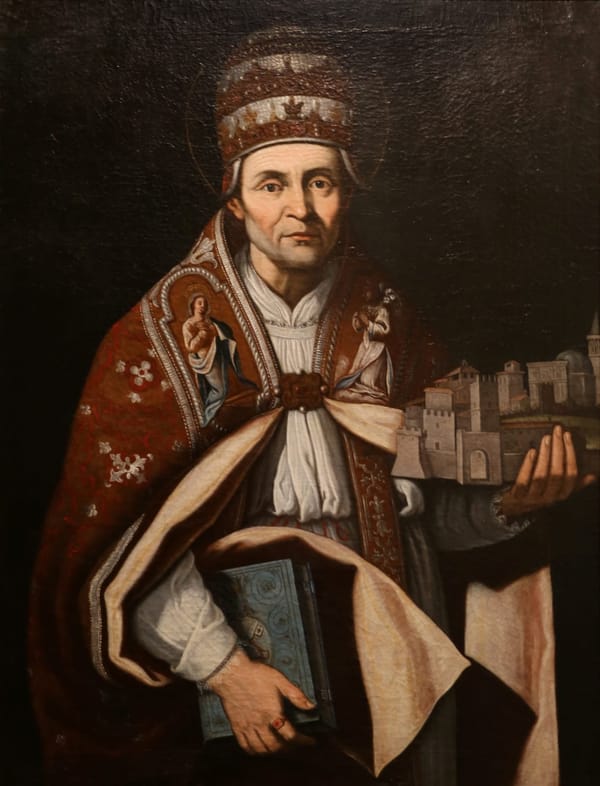 |
OUR Paschal season, which has already given us the admirable Doctor St Leo, brings before us to-day the humble Peter Celestine. He was, like Leo, sovereign pontiff, but no sooner was he throned on the chair of Peter than he left it and returned to solitude. Among the long list of sainted men who compose the venerable series of Roman Pontiffs, our Lord would have one in whose person was to be represented the virtue of humility; that honour was conferred on Peter Celestine. He was dragged from the quiet of his solitude, compelled to ascend the throne of St Peter, and made to hold in his trembling hand the keys of the kingdom of heaven. The holy hermit, whose eyes had been ever fixed on his own weakness, had then to provide for the necessities of the whole Church. In his humility, he judged himself to be unequal to so heavy a responsibility. He resigned the tiara, and begged to be permitted to return to his dear hermitage. His divine Master, Christ, had, in like manner, concealed his glory, first in thirty years of hidden life, and then, later on, under the cloud of his Passion and Sepulchre. The sunshine of the Pasch came; the gloom was dispersed, and the Conqueror of Death arose in all his splendour. He would have his servants share in his triumph and glory; but their share is to be greater or less, according to the measure in which they have, here on earth, imitated his humility. Who, then, could describe the glory which Peter Celestine receives in heaven, as a recompense for the profound humility which made him more eager to be unknown than the most ambitious of men could be for honour and fame? He was great on the pontifical throne, and still greater in his solitude; but his greatness, now that he is in heaven, surpasses all human thought.
Holy Church speaks his praise in these few lines; their simplicity admirably harmonizes with the hermit Pope, whose life they narrate:
Thou didst obtain, O Celestine, the object of thy ambition. Thou wast permitted to descend from the Apostolic Throne, and return to the quiet of that hidden life, which for so many years had been thy delight. Enjoy to thy heart's content the holy charm of being unknown to the world, and the treasures of contemplation in the secret of the face of God.1 But this life of obscurity must have an end; and then the Cross—the Cross which thou hast loved above all earthly possessions—will rise up in brightness before thy cell door, and summon thee to share in the Paschal triumph of him who came down from heaven to teach us this great truth, that he that humbleth himself shall be exalted.2 Thy name, O Celestine, will for ever shine on the list of Roman Pontiffs; thou art one of the links of that glorious chain which unites Holy Church with Jesus, her Founder and her Spouse; but a still greater glory is reserved for thee—the glory of being for ever with this same Risen Jesus. Holy Church, which during the short period of thy holding the keys of Peter, was obedient to thee, has now for centuries paid, and will continue to the end of the world to pay thee the tribute of her devotion, because she recognizes in thee one of God's elect, one of the princes of the heavenly court. And we, O Celestine, we also are invited to ascend where thou art, and contemplate, together with thee, the most beautiful among the children of men,3 the Conqueror of sin and hell. But there is only one path that can lead us thither; it is the path thou didst tread—the path of humility. Pray for us that we may be solidly grounded in this virtue, and desire it with all our hearts; that we may change our miserable self-esteem into an honest self-contempt; that we may despise all human glory, and be courageous, yea, cheerful under humiliation; and that thus having drunk of the torrent, as did our divine Master, we may one day, like him, lift up our heads,4 and cluster round his throne for all eternity.
May 19 (the Same Day): St. Pudentiana, Virgin
THIS same nineteenth of May has another glory attached to it; it is the day on which died the noble virgin Pudentiana. That name carries us back to the very first age of the Christian Church. She was a daughter of a wealthy Roman, called Pudens, a kinsman of the Pudens spoken of by St Paul, in his second Epistle to Timothy.1 She and her sister Praxedes had the honour of being numbered among the earliest members of the Church, and both of them consecrated their virginity to Jesus Christ. Upon their father’s death, the two sisters distributed their fortune to the poor, and devoted their whole time to good works. It was the eve of the persecution under Antoninus. Pudentiana, though scarcely sixteen years of age, was ripe for heaven, and winged her flight to her divine Spouse when the storm was at its height. Her sister survived her many years: we shall commemorate her saintly memory on July 21.
Pudentiana’s house, which in her grandfather’s time had been honoured by St Peter’s presence, was made over by the holy virgin herself to Pope Pius I, and the divine mysteries were celebrated in it. It is now one of the most venerable churches of Rome, and is the Station for the Tuesday of the third week of Lent.
Pudentiana is a tender floweret offered to our Risen Jesus by the Roman Church. Time has diminished nought of the fair lily’s fragrance; and pure as her very name, her memory will live in the hearts of the Christian people even to the end of the world.
The eulogy passed upon her by the holy Liturgy is but a commemoration; and yet says so much, and will say it each year, as long as time itself shall last.
Like the dove of Noe’s Ark, that found not where to rest her feet on the guilty earth, thou didst take thy flight, O Pudentiana, and rest in the bosom of Jesus, thy Spouse. Thus will it be at the end of the world, when the souls of the elect shall have been reunited to their bodies: they will fly like eagles to their King, and will cluster around him as the object of all their desires.2 They will flee from this sinful earth, as thou didst from the abominations of pagan Rome, that was drunk with the blood of the martyrs.3 We celebrate thy departure, dear youthful Saint, with a feeling of hope for our own future deliverance; we honour thy entrance into thy eternal home, and we long to be there, together with thee. Oh! gain for us detachment from all transitory things, intenser love of the new life which came to us with Easter, and indifference as to what concerns that other lower life, which is not that of our Risen Lord. Thou wast a daughter of the holy Church of Rome; pray, then, for thy mother. She is suffering now as she did during the pontificate of Pius I. After having reigned over Christian nations for centuries, she is now abandoned and disowned by the very people that owe all they have to her, and yet are now turning her own blessings against her. Use thine influence, O Pudentiana! assist and protect thine and our dearest mother.
| Previous Saturday of the Fourth Week after Easter | Next May 19: St. Peter Celestine, Pope |