Daily reading
Paschal Time
Simple · Movable from Easter · Temporal
June 2, 2019
From Dom Guéranger’s The Liturgical Year.
The Sunday leads; Sts. Marcellinus, Peter, and Erasmus are commemorated.Rubrics

|
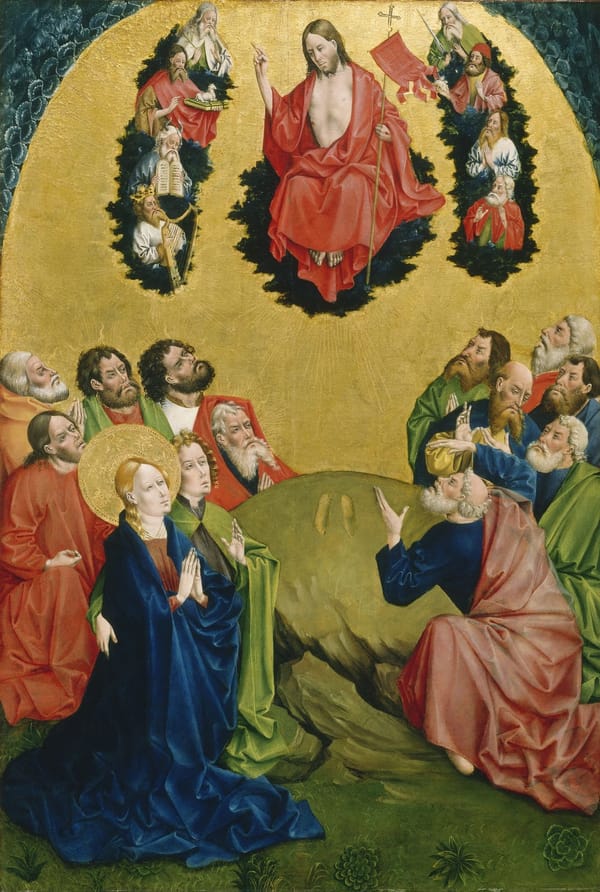
Sunday within the Octave of the Ascension
Jesus has ascended into heaven. His Divinity had never been absent; hut, by the Ascension, His Humanity was also enthroned there, and crowned with the brightest diadem of glory. This is another phase of the mystery we are now solemnizing. Besides a triumph, the Ascension gave to the sacred Humanity a place on the very throne of the eternal Word, to whom it was united in unity of Person. From this throne, it is to receive the adoration of men and of angels. At the name of Jesus, Son of Man, and Son of God,—of Jesus who is seated at the right hand of the Father almighty,—'Every knee shall bend, in heaven, on earth and in hell.’1
Give ear, O ye inhabitants of earth! This is the Man Jesus, who heretofore was a little Babe wrapped in swaddling clothes; who went through Judea and Galilee, not having where to lay His head; who was bound by the sacrilegious hands of his enemies, was scourged, crowned with thorns, nailed to a cross; who, whilst men thus trampled Him, as a worm, beneath their feet, submitted His will to that of His Father, accepted the chalice of suffering, and, that He might make amends to the divine glory, shed His Blood for the redemption of you sinners. This Man Jesus, child of Adam through Mary the immaculate, is the master-piece of God’s omnipotence. He is the most beautiful of the sons of men’;2 the angels love to fix their gaze upon Him;3 the blessed Trinity is well-pleased with Him; the gifts of grace bestowed on Him surpass all that men and angels together have ever received. But He came to suffer, and suffer for you; and though He might have redeemed you at a much lower price, yet would He generously overpay your debts by a superabundance of humiliation and suffering. What reward shall be given to Him? The apostle tells us in these words: 'He humbled Himself, becoming obedient unto death, even to the death of the cross; for which cause God also hath exalted Him, and hath given Him a name, which is above all names.’4
You, then, who compassionate with Him in the suffering whereby He wrought your redemption; you who devoutly follow Him in the stages of His sacred Passion; now raise up your heads, and look up to the highest heaven! Behold this Jesus ‘crowned with glory and honour because He suffered death’!5 See how the Father has magnified Him in return for His having 'emptied Himself, taking the form of a servant,’ though in His other nature, He was equal with God.6 His crown of thorns is replaced by a crown of precious stones.7 The cross that was laid on His shoulders is now the ensign of His power.8 The wounds made by the nails and the spear are now like five bright suns that light up all heaven. Glory, then, he to the justice of the Father, who has dealt thus with His Son! Let us rejoice at seeing the Man of sorrows9 become now the King of glory; and let us, with all the transport of our souls, repeat the hosanna wherewith the angels welcomed Him into heaven.
Nor must we suppose that the Son of Man now that He is seated on the throne of His Divinity, is inactive in His glorious rest. No; the sovereignty bestowed upon Him by the Father, is an active one. First of all, He is appointed Judge of the living and of the dead,10 before whose judgement-seat we must all stand.11 No sooner shall our soul have quitted the body, than she shall be presented before this tribunal, and receive from the lips of the Son of Man the sentence she will have deserved. O Jesus! by the glory Thou didst receive on the day of Thine Ascension, have mercy on us at that moment whereon depends eternity.
But the judgeship of our Lord Jesus Christ is not to be confined to this silent exercise of His sovereign power. The angels, who appeared to the apostles after His Ascension, told us that He is to come again upon the earth; that He is to descend through the clouds, as He ascended; and that then shall be the last judgement, at which the whole human race is to be present! Throned on a cloud, and surrounded by the angelic host, the Son of Man will show Himself to mankind, and this time with all majesty. Men shall see Him whom they pierced;12 the imprints of those wounds, which will give additional beauty to His sacred Body, will be an object of terror to the wicked, while to the good they will be a source of unspeakable consolation. The shepherd, seated on His ethereal throne, will separate the goats from the sheep. His voice, after so many ages of silence, will make itself once more heard upon this earth: He will speak to impenitent sinners, condemning them to eternal torments; He will speak to the just, calling them to approach Him, and ascend, body and soul, into the region of everlasting bliss.
Meanwhile, He exercises over all nations the royal power, which He received, as Man, on the day of His Ascension. He redeemed us all by His Blood; we are therefore His people, and He is our King. He is, and He calls Himself, 'King of kings and Lord of lords.’13 The kings of the earth reign not either by their own prowess, or by the boasted social compact; they lawfully reign by Christ alone. Peoples and nations are not their own masters; they belong to Christ and are His subjects. His law requires no sanction from man; it is above all human laws, and should be their guide and controller. ‘Why have the nations raged, and the people devised vain things? The kings of the earth stood up and the princes met together, against the Lord and against His Christ. They said: Let us break their bonds asunder, and let us cast away their yoke from us,’14 How vain all these efforts! For, as the apostle says, ‘He must reign, until He hath put all His enemies under His feet.’15 that is, until His second coming, when the pride of man and satan’s power shall both be at an end.
Thus, then, the Son of Man, crowned at His Ascension, must reign over the world to the end of time. But it will be objected: 'How can He be said to reign in these our times, when kings and emperors and presidents acknowledge that their authority comes from the people; and when the people themselves, carried away with the ideas of self-government and liberty and independence, have lost all idea of authority?’ And yet, He reigns; He reigns in His justice, since men refused to be guided by His clemency . They expunged His law from their statutes; they gave the rights of citizenship to error and blasphemy: then did He deliver them up, both people and rulers, to their own follies and lies. Authority and power have become ephemeral: and as they scorn to receive the consecration of the Church, the hand that holds them to-day, may be empty to-morrow. Then anarchy, then a new ruler, and then a fresh revolution. This will be the future, as it is the present, history of nations, until they once more acknowledge Jesus as their King, and resume the constitution of the ages of faith: ‘It is Christ that conquers! it is Christ that reigns! it is Christ that commands! May Christ preserve His people from all evil!'
On this Thy coronation-day, receive our devoted homage, O Jesus, our King, our Lord, our Judge! By our sins, we were the cause of Thy humiliations and sufferings; so much the more fervently, then, do we nite with the acclamations made to Thee by the angels when the royal diadem was placed on Thy head by the eternal Father. As yet, we but faintly see Thy grandeur; but the holy Spirit, whom Thou art about to send upon us, will teach us more and more of Thy sovereign power, for we are, and wish to be eternally, Thy humble and faithful subjects!
In the middle-ages, the Sunday within the octave of the Ascension was called the Sunday of roses, because it was the custom to strew the pavement of the churches with roses, as a homage to Christ who ascended to heaven when earth was in the season of flowers. How well the Christians of those times appreciated the harmony that God has set between the world of grace and that of nature! The feast of the Ascension, when considered in its chief characteristic, is one of gladness and jubilation, and spring’s loveliest days are made for its celebration. Our forefathers had the spirit of the Church; they forgot, for a moment, the sadness of poor earth at losing her Emmanuel, and they remembered how He said to His apostles: 'If ye loved Me, ye would be glad, because I go to the Father!’16 Let us do in like manner; let us offer to Jesus the roses wherewith He has beautified our earth: their beauty and fragrance should make us think of Him who made them, of Him who calls Himself the flower of the field and the lily of the valleys.17 He loved to be called Jesus of Nazareth; for Nazareth meaus a flower; and the symbol would tell us what a charm and sweetness there is in Him whom we serve and love as our God.
Mass
The Introit, which is taken from the Book of Psalms, expresses the longings of the Church to behold her Spouse, who has fled far from her. The faithful soul is possessed with the same desire; she unites in the prayer of our holy mother, and says to Jesus: ‘Oh! hearken to the wish of my heart, and show me Thy divine face!’
Introit
Ps. Dominus illuminatio mea, et salus mea: quem timebo? ℣. Gloria Patri. Exaudi.
Ps. The Lord is my light, and my salvation: whom shall I fear? Glory &c. Hear, &c.
The Church, in the Collect, teaches us to ask of God that good will, which will render us worthy of seeing our Jesus, by making us zealous in the service of His divine Majesty.
Collect
A commemoration of the Ascension is added, by the Collect, page 176.
Epistle
I Cap. iv.Charissimi, estote prudentes, et vigilate in orationibus. Ante omnia autem, mutuam in vobismetipsis caritatem continuam habentes: quia caritas operit multitudinem peccatorum. Hospitales invicem sine murmuratione. Unusquisque, sicut accepit gratiam, in alterutrum illam administrantes, sicut boni dispensatores multiformis gratiae Dei. Si quis loquitur, quasi sermones Dei: si quis ministrat, tamquam ex virtute, quam administrat Deus: ut in omnibus honorificetur Deus per Jesum Christum Dominum nostrum.
I Ch. iv.Dearly beloved: Be prudent, and watch in prayers. But before all things have a constant mutual charity among yourselves: for charity covereth a multitude of sins. Using hospitality one towards another, without murmuring. As every man hath received grace, ministering the same one to another: as good stewards of the manifold grace of God. If any man speak, let him speak as the words of God. If any man minister, let him do it as of the power which God administereth; that in all things God may be honoured through Jesus Christ our Lord.
The prince of the apostles, who presided over the holy assembly that awaited in the cenacle the descent of the divine Spirit, here addresses us, who are in expectation of the same great gift, and recommends us to practise fraternal charity. This virtue, says he, covereth a multitude of sins; could we make any better preparation for receiving the Holy Ghost? This Paraclete is coming that He may unite all men into one family; let us, then, put an end to all our dissensions, and prove ourselves to be members of the brotherhood established by the preaching of the Gospel. During these days of our preparing to receive the promised Comforter, the apostle bids us be prudent and watch in prayers. Let us follow his instruction; we must show our prudence by excluding everything that might be an obstacle to the Holy Ghost’s entering our hearts; and as to prayer, it is the means which will open our hearts to Him, that He may make them His own for ever.
The first of the two Alleluia-versicles is taken from the Psalms, and celebrates the majesty of Jesus upon His royal throne; the second is formed of the words of this same Saviour, promising us that He will return at the end of the world, when He comes to gather together His elect.
Gospel
Cap. xv., xvi.In illo tempore: dixit Jesus discipulis suis: cum venerit Paraclitus, quem ego mittam vobis a Patre, Spiritum veritatis, qui a Patre procedit, ille testimonium perhibebit de me: et vos testimonium perhibebitis, quia ab initio mecum estis. Hæc locutus sum vobis, ut non scandalizemini. Absque synagogis facient vos: sed venit hora ut omnis, qui interficit vos, arbitretur obsequium se præstare Deo. Et hæc facient vobis, quia non noverunt Patrem, neque me. Sed hæc locutus sum vobis: ut, cum venerit hora eorum, reminiscamini quia ego dixi vobis.
Ch. xv., xvi.At that time: Jesus said to his disciples: when the Paraclete cometh, whom I will send you from the Father, the Spirit of truth, who proceedeth from the Father, he shall give testimony of me; and you shall give testimony, because you are with me from the beginning. These things have I spoken to you, that you may not be scandalized. They will put you out of the synagogues; yea the hour cometh, that whosoever killeth you will think that he doth a service to God. And these things will they do to you, because they have not known the Father, nor me. But these things I have told you; that when the hour shall come, you may remember that I told you of them.
Here we have our Jesus telling us the effects, which the coming of the Holy Ghost will produce in our souls. These words were first addressed to the apostles, at the last Supper. He told them that the Paraclete would give testimony of Him, that is, would instruct them upon His Divinity, and teach them to be faithful to Him, even so as to lay down their lives for Him. A few moments before His Ascension, Jesus again spoke to them concerning the Paraclete, and called Him’the power from on high.’18 Severe trials were awaiting these apostles; they would have to resist unto blood.19 Who would be their support P For, of themselves, they were but weak men. The Holy Ghost, who was to abide with them. By Him they would conquer, and the Gospel would be preached to all nations. Now, this Spirit of the Father and of the Son is about to descend upon us; and what is the object of His visit, but that of arming us for the combat, and strengthening us against the attacks of our enemies? As soon as this holy season of Easter is over, and we no longer have the celebration of its mysteries to enlighten and cheer us, we shall find ourselves at the old work of battling with the three enemies: the devil, who is angered by the graces we have received; the world, to which we must unfortunately return; and our passions, which, after this calm, will again awaken, and molest us. If we be’endued with the power from on high’, we shall have nothing to fear. Let us, therefore, ardently desire to receive Him; let us prepare Him a worthy reception; let us use every endeavour to make Him abide with us; and we shall gain the victory, as did the apostles.
The Offertory gives us the words of the psalmist, describing the glories of Jesus’ Ascension. Holy Church wishes to impress the thought of this triumph well upon us, that our hearts may be fixed on the dear country, where our Jesus awaits us.
Offertory
While offering to God the bread and wine, which are soon to be changed into the Body and Blood of Christ, the Church, in the Secret, prays that we may not only be made pure by our contact with these divine mysteries, but may also receive the vigour and energy which are so indispensably needed by every Christian.
Secret
A commemoration is then made of the Ascension, by the Secret of the feast, given on page 182.
The Preface is that of the Ascension, page 182.
The Communion-anthem is formed of the words addressed by Jesus to His eternal Father, after having instituted the sacrament of the Eucharist, at the last Supper. They show us what His wishes are in our regard.
Communion
Thanksgiving is the Christian’s first duty after receiving, in holy Communion, the Body and Blood of Christ. The Church, which appreciates so much more perfectly than we can ever do the greatness of the favour thus bestowed on us, prays, in her Postcommunion, that we may ever be giving thanks to our divine benefactor.
Postcommunion
Vespers
Antiphon of the Magnificat
OREMUS
Omnipotens sempiterne Deus, fac nos tibi semper et devotam gerere voluntatem, et majestati tuæ sincero corde servire. Per Dominum.
LET US PRAY
O almighty and eternal God, inspire thy servants with true devotion, and grant that we may serve thy divine Majesty with sincere hearts. Through, &c.
Let us offer to our triumphant Jesus the following beautiful hymn, which is used by the Church at the Matins of the feast of the Ascension, and during the octave. It forcibly expresses the mystery, and shows us how fervently we ought to celebrate it.
Hymn
Redemptor et fidelium,
Cui mors perempta detulit
Summae triumphum gloriae.
Quo te vocabat cœlitus
Collata, non humanitus,
Rerum potestas omnium.
Cœlestium, terrestrium
Et inferorum condita,
Flectat genu jam subdita.
Versam vicem mortalium:
Peccat caro, mandat caro,
Regnat Deus Dei caro.
Manens Olympo præmium,
Mundi regis qui fabricam,
Mundana vincens gaudia.
Ignosce culpis omnibus,
Et corda sursum subleva
Ad te superna gratia.
Clarere nube judicis,
Poenas repellas debitas,
Reddas coronas perditas.
Qui victor in cœlum redis,
Cum Patre et almo Spiritu,
In sempiterna sæcula.
and Redeemer of the faithful!
thy victory over death won for thee
a triumph of highest glory.
there to exercise thy supreme
power over all creatures,
—a power conferred by heaven, not by man.
of heaven, earth, and hell,
is subject to thee; and all things in them
bow the knee in homage to thy power.
it was flesh that sinned,
and now Flesh taketh all sin away,
and the God that reigns is the God made Flesh.
to be our reward in heaven.
Thou art the ruler of this world;
our joy that surpasses all earthly joys.
that thou pardon all our sins,
and, by thy heavenly grace,
lift up our hearts to the things that are above.
suddenly on a bright cloud as our judge,
thou mayst forgive us the punishment we deserve,
and restore to us the crown we had lost.
who ascendest in triumph to heaven!
and to the Father, and to the Spirit of love,
for everlasting ages.
We may close the day with this prayer, taken from the Mozarabic breviary.
Prayer
- Philipp. ii. 10. ↩︎
- Ps. xliv. 3. ↩︎
- 1 St. Pet. i 21. ↩︎
- Philipp ii. 8, 9. ↩︎
- Heb. ii. 9. ↩︎
- Philipp. ii. 6,7. ↩︎
- Ps. xx. 4. ↩︎
- Is. ix. 6. ↩︎
- Is. liii. 3. ↩︎
- Acts, x. 42. ↩︎
- Rom. xiv. 10. ↩︎
- Zach. xii. 10. ↩︎
- Apoc. xix. 16. ↩︎
- Ps. ii. 1-3. ↩︎
- 1 Cor. xv, 25. ↩︎
- St. John, xiv. 28. ↩︎
- Cant. ii, 1. ↩︎
- St. Luke, xxiv. 49. ↩︎
- Heb. xii. 4. ↩︎
June 2: Sts. Marcellinus, Peter, and Erasmus, Martyrs
THE glory of martyrdom illumines this day with a profusion rarely met with in the cycle; and already we seem to descry the rosy dawn of that brightest day of this month, on which Peter and Paul will consummate in their blood their own splendid confession. Italy and Gaul, Rome and Lyons concur in forming a legion of heroes in the service of heaven. For to-day Lyons, the illustrious daughter of Rome, is keeping the special festival of a whole phalanx of warriors, headed by the veteran chief, St Pothinus, disciple of St Polycarp, who, in the second century, levied the brave recruits of his battalion on the banks of the Rhone.1 But to the mother Church are due the first honours. Let us, then, hail Marcellinus, together with the numerous progeny begotten by his fruitful priesthood, and rendered worthy by the Holy Ghost to share in his triumph. Let us hail, likewise, the exorcist, Peter, leading to the sacred font a long line of pagans whom he won over to Christ by proving to them the weakness of the demons.
When Christianity appeared on earth, Satan was visibly the prince of this world. To him was every altar reared; to his empire were all laws and customs subservient. From the depths of their famous temples, the demon chiefs directed the political affairs of the cities that came to consult their oracles; under divers names the lowest of the fallen angels found honour and influence at the domestic hearth; others had functions assigned to them, in forests, on mountains, at fountains, or on sea, occupying, in opposition to God, this world that had been created by him for his glory, but which Satan, through man’s connivance, had conquered. Four thousand years of abandonment on the part of heaven permitted the usurper to consolidate his conquest; and a strong defence had been planned in preparation for the day on which the lawful King should offer to re-enter on his rights.
The coming of the Word made Flesh was the signal for the assertion of the divine claim. The prince of this world, personally vanquished by the Son of God, understood well enough that he must needs return to the depths of hell. But the countless powers of darkness constituted by him would maintain the struggle through the length of ages, and dispute their position inch by inch. Driven from towns by the abjurations of holy Church and the triumph of martyrs, the infernal legions would fain marshal their ranks in the wilderness; there, under the leadership of an Anthony or a Pachomius, the soldiers of Christ must wage against them ceaseless and terrific battle. In the west, Benedict, the patriarch of monks, finds altars to the demons, and even demons themselves, on the heights of Cassino as late as the sixth century. Even in the seventh, they are found contending against St Gall for possession of the woods, lakes and rocks of what we now call Switzerland; and at last they are heard uttering mournful complaint, because, driven from the haunts of men, even such desolate spots as these are denied them. Verily, in the divine mind, the vocation of a monk to the desert has for itsend, not only flight from the world and its concerns, but likewise the pursuit of demons into their last entrenchments.
We have dwelt upon these considerations because their importance is extreme, and because this subject is now systematically ignored. True Christians firmly believe, now as formerly, in the spiritual combat which the soul has to sustain against hell, in the secrecy of conscience; but too many have no scruple in rejecting, as if belonging to the domain of the imagination, whatever is related of the public combats maintained by our fathers against the demons. The excuse for such Christians is, no doubt, the fact that they live in a land where this external war was ended centuries ago by the social victory of Christendom. But the Holy Ghost has declared that the old serpent, bound up for a thousand years, is at last to be again unchained for a while.2 If we be nearing this fatal epoch, it is high time to look about us; we shall be ill prepared for waging the old battles, if we persist in our ignorance, and in branding with the name of legend the best attested facts in the history of our ancestors. After all, what is history, since the revolt of Lucifer, but a picture of the war that is being waged between God and Satan? Now if Satan has, by divine permission, invaded the exterior world as well as that of souls, must not the struggle to cast him out3 be a hand to hand fight, an exterior and visible encounter?
‘The Word,’ says St Justin, ‘was made Flesh for two ends: to save believers, and to drive away demons.’4 So also, the expulsion of demons from the places they occupy in this material world, and specially in the noblest part thereof, the bodies of men, appears in the Gospel to have been one of the chief characteristics of our Saviour’s power. Again, when on quitting the earth he sent his apostles to continue his work amidst the nations, this is the very thing he singled out as a primary sign of the mission they were to fulfil.5 The world of that day made no mistake about it. Soon enough had the pagans to witness the cessation of the ancient oracles in every place;6 and the cause of a phenomenon of such import to the ancient religion was evident to all: the very demons themselves were not backward in ascribing to the Christians their enforced silence. As regards this power of Christianity against hell, the apologists of the second and third centuries appeal on the subject to public testimony, without fear of contradiction. ‘Before the eyes of everyone,’ says St Justin to the emperors, ‘ the Christians drive out demons in the name of Jesus Christ, not only in Rome, but in the whole universe.᾽7 The gods of Olympus beheld themselves shamefully unmasked, in the presence of their confused adorers, and Tertullian might well challenge the magistrates of the empire thus: ‘Let one of those men who declare themselves to be under the power of the gods, be brought before your tribunals: at the command of the first comer amongst us, the spirit whereby they are possessed will be constrained to confess what he is; if he avow not himself a demon and no god, fearing to lie to a Christian, at once shed the blood of this Christian blasphemer. But no; it is the terror they have of Christ that forces them to take flight at the mere touch or even the breath of one of his servants.᾽8
Baptism sufficed to give man such power as this; and this was the real meaning of our Lord’s promise, when speaking not only of the heads of the Church, but of all who would believe in him, he said: ‘In my name they shall cast out devils.᾽9 At an early date, however, the Church, organizing the holy war, constituted among her sons one special Order having for its direct mission the pursuit of Satan on every point of this visible world. The exorcists were, by this delegation, invested with a power that accelerates the downfall of the prince of this world; and to render this defeat more odious and humiliating the Church raised no higher than to the rank of inferior clergy an Order so terrible to hell. Lucifer had aimed at being equal to the Most High;10 hurled down from heaven, he flattered himself in his folly that he would be able to supplant God upon the earth: and lo! the charge of defeating him here is confided not to angels, his equals by nature, but to men, and even to the least of this credulous race which for long ages he had seen prostrate before him! Their hand of flesh constrains him, spirit though he be, to come off his throne; at their word he must needs cast away his vain adornments, he must unmask himself; the water they bless rekindles within him his eternal tortures; of the prince of this world and his pomps nought remains but mere Satan, the ugly-faced apostate, the condemned criminal wincing in the dust at the feet of the sons of men, or fleeing like a dry leaf before the breath of their mouth.
The archangel Michael recognizes, in these sons of Adam, the worthy allies of the faithful angels he led forward to victory. But amid those who continue the mighty battle begun on the heights of heaven,11 the exorcist Peter comes before us to-day radiant with matchless splendour. The triumph of martyrdom has been added to his victories won over Satan's cohorts. None better than he drove hell back; for, chasing the demons out of men’s bodies, he moreover made conquest of their souls. The priest Marcellinus, the companion of his victories and martyrdom, is likewise his associate in glory. The Church wishes that these two names, so formidable to the spirits of darkness, should shine in one same aureole here below as in heaven. Daily does she render them the most solemn homage in her power by naming them both, on the diptych of the holy Sacrifice, together with the apostles and her first sons. Such was the importance of the mission they fulfilled and the renown of their final combat, that their bodies, translated to the Via Latina, became the nucleus of an illustrious cemetery. In the age of peace, that came soon after their glorious confession, the Christians vied with one another in obtaining sepulture near these soldiers of Christ, whose protection they craved. Constantine the Great, the vanquisher of idolatry, deposited at their sacred feet the remains of his mother, St Helena, who had herself become a terror to the demons by her discovery of the true Cross. A celebrated inscription was composed in their honour by St Damasus, who in childhood had learned the details of their martyrdom from their executioner himself after his conversion; this inscription, near their tomb, completed the monuments of that catacomb wherein Christian art had multiplied its richest teachings.
To the memory of Saints Marcellinus and Peter is joined, in the liturgy of to-day, the name of a holy bishop and martyr, formerly well known to the faithful. If the acts of his life which have reached us are not free from all reproach from a critical point of view, the favours obtained by the intercession of St Erasmus or Elmo wafted his name over the whole of Christendom, as is attested by the numberless forms this name assumed in various countries of the west during the middle ages. He holds a place in the group of saints styled auxiliatores or helpers, whose cultus is widespread particularly in Germany and Italy. Mariners look upon him as their patron, because of a certain miraculous voyage related in his life; one of the tortures to which he was subjected during his martyrdom has caused him to be invoked for colic. Nor should we forget to mention here how great a veneration St Benedict, the patriarch of western monks, had for St Erasmus; when he quitted the Campagna for his solitude on the banks of the Anio, he marked his principal station between Subiaco and Monte Cassino, by building a church and monastery at Veroli under the invocation of this holy martyr; he dedicated another in Rome itself to St Erasmus.
Let us now read the few lines devoted by the Church to the memory of our three Saints.
Holy martyrs, you all confessed Jesus Christ, in the midst of the most terrific storm ever raised by the demon against the Church. Though all three in different grades of the hierarchy, you were alike guides of the Christian people, drawing them by thousands in your train, into the arena of martyrdom, and, by still more numerous conversions, filling up the void made in earth's chosen band by the departure of your victorious companions to heaven. Wherefore the Church this day joins her grateful homage here below, with the congratulation that rings through the Church triumphant. Be propitious, as of yore, in alleviating the ills that overwhelm mankind in this vale of tears. The excess of man's misery is that he seems to have forgotten how to call on such powerful protectors in his hour of need. Revive your memory, in our midst, by new benefits to our race.
As thou, O Erasmus, wast formerly protected by heaven, do thou now, in thy turn, succour those who are a prey to the tempest-tossed sea. In thy last hour of bitter anguish, thou didst suffer thine executioners to tear thy very bowels; lend a kindly aid to such as call upon thy name when racked by pains which bear some resemblance, though but faint, to what thou didst endure for Christ.
Peter and Marcellinus, linked one to another both in toil and in glory, cast gentle eyes upon us: one glance of yours would make all hell to tremble, and would drive far from us its cohorts. But how much is your aid needed in society at large, in the whole visible world! The foe you so mightily thrust backwards into the fiery pit is once more master. Alas! have we come to the time in which, again taking up war against the saints, it shall be granted him to overcome them?12 Scarce does he even hide himself nowadays. Societies which formerly worked in secret have now openly surrendered to him a thousand sources of evil; he may be seen trying to push his way into gatherings of all sorts, into the very bosom of homes, as a family guest, as a comrade in diversion or in business, with table-turning and all those processes for divination, such as Tertullian denounced in your early day.13 The expulsion of demons by Christianity had been so absolute that, up to more recent times, such fatal practices had fallen into utter oblivion amongst us. If at first, in Christian families, the warning voice of the pastors of God's Church has prevailed over the incitements of an unhealthy curiosity, a sect has since been formed, in which Satan is sole guide and oracle. The spiritists, as they are called, in concert with freemasonry, are preparing the way for the final invasion of the exterior world by infernal bands. Antichrist, with his usurped power and vain prestige, will be but the common product of political lodges and of this sect which proposes to bring back, under a new form, the ancient mysteries of paganism. Valiant soldiers of the Church, make us, we beseech you, worthy of our forefathers. If the Christian army must needs decrease in numbers, let its faith wax all the stronger; let its courage neither fail nor go astray; may its ranks be seen facing the foe, at that last hour in which the Lord Jesus will slay, with the breath of his mouth, the man of sin,14 and plunge once again and for ever the whole of Satan's crew down into the lowest depths of the bottomless pit.
- Note of the Translator. Ss. Pothinus, Blandina, and companions, martyrs of Lyons, are marked on this day in the Roman Martyrology, but as the feast is kept only in France, we have omitted in our translation the pages devoted to their memory in this place. ↩︎
- Apoc. xx 2, 3. ↩︎
- St John xii 31. ↩︎
- 2 Apol. vi. ↩︎
- St Mark xvi 17. ↩︎
- Plutarch, De oraculor. defectu. ↩︎
- 2 Apol. vi. ↩︎
- Apol. xxiii. ↩︎
- St Mark xvi 17. ↩︎
- Is. xiv 12-15. ↩︎
- Apoc. xii 7-9. ↩︎
- Apoc. xiii 7. ↩︎
- Apolog. xxiii. ↩︎
- 2 Thess. ii 8. ↩︎
| Previous Saturday within the Octave of the Ascension | Next June 2: Sts. Marcellinus, Peter, and Erasmus, Martyrs |