Daily reading
Paschal Time
Double · Movable from Easter · Temporal
June 5, 2019
From Dom Guéranger’s The Liturgical Year.
 |
Wednesday within the Octave of the Ascension
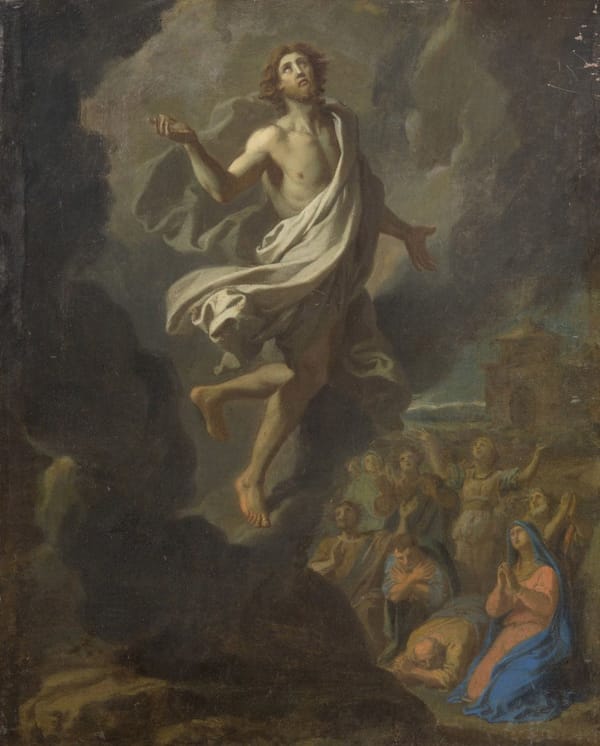
Let us now look upon the earth, for our eyes have hitherto been riveted upon the heaven into which our Jesus has entered. Let us see what effects the mystery of the Ascension has produced on this land of our exile. These effects are of the most extraordinary nature. This Jesus, who ascended into heaven unknown to the city of Jerusalem, and whose departure, when it did become known, excited neither regret nor joy among the men of that generation,—now, eighteen hundred years after His departure from us, finds the whole earth celebrating the anniversary of His glorious Ascension. Our age is far from being one of earnest faith; and yet there is not a single country on the face of the globe, where, if there be a church or chapel or even a Catholic home, the feast of Jesus’ Ascension is not being now kept and loved.
He lived for three-and-thirty years on our earth. He, the eternal Son of our God, dwelt among His creatures, and there was only one people that knew it. That one favoured people crucified Him. As to the Gentiles, they would have thought Him beneath their notice. True, this beautiful’light shone in the darkness; but the darkness did not comprehend it; He came unto His own, and His own received Him not.’1 He preached to His chosen people; but His word was that seed which falls on stony ground, and takes no root, or is cast among thorns and is choked; it could with difficulty find a plot of good ground, wherein to bring forth fruit.2 If, thanks to His infinite patience and goodness, He succeeded in keeping a few disciples around Him, their faith was weak and hesitating, and gave way when temptation came.
And yet, ever since the preaching of these same apostles, the name and glory of Jesus are every where; in every language, and in every clime, He is proclaimed the Incarnate Son of God; the most civilized, as well as the most barbarous nations, have submitted to His sweet yoke; in every part of the universe men celebrate His birth in the stable of Bethlehem, His death on the cross whereby He ransomed a guilty world, His resurrection whereby He strengthened the work He came to do, and His Ascension, which gives Him, the Man-God, to sit at the right hand of His Father. The great voice of the Church carries to the uttermost bounds of the earth the mystery of the blessed Trinity, which He came to reveal to mankind. This holy Church, founded by Him, teaches the truths of faith to all nations, and in every nation there are souls who are docile to her teaching.
How was this marvellous change brought about? What has given it stability during these eighteen hundred years? Our Saviour Himself explains it to us, by the words He spoke to His apostles after the last Supper: ‘It is,’ said He,’expedient to you that I go.’3 What means this, but that there is something more advantageous to us than having Him visibly present amongst us? This mortal life is not the time for seeing and contemplating Him, even in His human Nature. To know Him, and relish Him, even in His human Nature, we stand in need of a special gift; it is faith. Now, faith in the mysteries of the Incarnate Word did not begin its reign upon the earth, until He ceased to be visible here below.
Who could tell the triumphant power of faith? St. John gives it a glorious name; he says:’It is the victory which overcometh the world.’4 It subdued the world to our absent King; it subdued the power and pride and superstitions of paganism; it won the homage of the earth for Him who has ascended into heaven, the Son of God and the Son of Mary, Jesus.
St. Leo the Great, the sublime theologian of the mystery of the Incarnation, has treated this point with his characteristic authority and eloquence. Let us listen to his glorious teaching.’Having fulfilled all the mysteries pertaining to the preaching of the Gospel and to the new Covenant, our Lord Jesus Christ ascended into heaven, in the sight of His disciples, on the fortieth day after His Resurrection; hereby withdrawing His corporal presence, for He was to remain at the right hand of His Father until should be filled up the measure of time decreed by God for the multiplication of the children of the Church, and He (Jesus) should again come, and in the same Flesh wherewith He ascended, to judge the living and the dead. Thus, therefore, that which in our Redeemer had hitherto been visible passed into the order of mysteries. And to the end that faith might be grander and surer, teaching took the place of sight; which teaching was to be accepted by the faithful with hearts illumined by heavenly light.
This faith, increased by our Lord’s Ascension, and strengthened by the gift of the Holy Ghost, was proof against every trial; so that neither chains, nor prisons, nor banishment, nor hunger, nor fire, nor wild beasts, nor all the ingenuity of cruelty and persecution, could affright it. For this faith, not only men, but even women, not only beardless boys but even tender maidens, fought unto the shedding of their blood, and this in every country of the world. This faith cast out devils from such as were possessed, cured the sick, and raised the dead to life. The blessed apostles themselves,—who, though they had so often witnessed their Master’s miracles and heard His teachings, turned cowards when they saw Him in His sufferings, and hesitated to believe His Resurrection,—these same, I say, were so changed by His Ascension, that what heretofore had been a subject of fear, then became a subject of joy. And why? Because the whole energy of the soul’s contemplation was raised up to Jesus’ Divinity, now seated at the right hand of His Father; the vigour of the mind’s eye was not dulled by the bodily vision, and they came to the clear view of the mystery, namely, that He neither left the, Father when He descended upon the earth, nor left His disciples when He ascended into heaven.
Never, then, was Jesus so well known, as when He withdrew Himself into the glory of His Father’s majesty, and became more present by His Divinity in proportion as He was distant in His Humanity. Then did faith, made keener, approach to the Son coequal with His Father; she needed not the handling of the bodily substance of her Christ,—that bodily substance, whereby He is less than His Father, The substance of His glorified Body is the same; but our faith was to be of so generous a kind, that we were to go to the coequal Son, not by a corporal feeling, but by a spiritual understanding. Hence, when Mary Magdalene, who represented the Church, threw herself at the feet of the risen Jesus, and would have embraced them, He said to her: Touch Me not, for I am not yet ascended to My Father; as though He would say: I will not that thou come to Me corporally, or that thou know Me by the testimony of thy senses. I have a sublimer recognition in store for thee; I have prepared something far better for thee. When I shall have ascended to My Father, then shalt thou feel Me in a higher and truer way; for thou shalt grasp what thou touchest not, and believe what thou seest not.’5
The departure of our Emmanuel was, therefore, the opening of that reign of faith, which is to prepare us for the eternal vision of the sovereign Good; and this blessed faith, which is our very life, gives us, at the same time, all the light compatible with our mortal existence, for knowing and loving the Word consubstantial with the Father, and for the just appreciation of the mysteries which this Incarnate Word wrought here below in His Humanity. It is now eighteen hundred years since He lived on the earth; and yet we know Him better than His disciples did before His Ascension. Oh! truly it was expedient for us that He should go from us; His visible presence would have checked the generosity of our faith; and it is our faith alone that can bridge over the space which is to be between Himself and us until our ascension comes, and then we shall enter within the veil.
How strangely blind are those who see not the superhuman power of this element of faith, which has not only conquered, but even transformed, the world! Some of them have written long treatises to prove that the Gospels were not written by the evangelists: we pity their ravings. But these great discoverers have another difficulty to get over, and so far they have not attempted to grapple with it; we mean the living Gospel which is the production of the unanimous faith of eighteen centuries, and is the result of the courageous confession of so many millions of martyrs, of the holiness of countless men and women, of the conversion of so many both civilized and uncivilized nations. Assuredly He,—who after having spent a few short years in one little spot of earth, had but to disappear in order to draw men’s hearts to Himself so that the brightest intellects and the purest minds gave Him their faith,—must be what He tells us He is: the eternal Son of God. Glory, then, and thanks to Thee O Jesus! who to console us in Thine absence, hast given us faith, whereby the eye of our soul is purified, the hope of our heart is strengthened, and the divine realities we possess tell upon us in all their power! Preserve within us this precious gift of Thy gratuitous goodness; give it increase; and when our death comes,—that solemn hour which precedes our seeing Thee face to face,—Oh, give us the grand fullness of our dearest faith!
One of the most northern of the Churches, now, alas! a slave to Lutheranism, shall provide us to-day with a hymn in honour of the mystery we are celebrating. It is a sequence taken from the last missal of Abo, in Finland. It was composed in the fourteenth or fifteenth century.
Sequence
Festos choros ducite,
Christo triumphante;
Redit cum victoria,
Capta ducens spolia,
Tuba jubilante.
Hodie dominicum
Germen gloriatur!
Terrae fructus hodie
Super thronos curiæ
Cœli sublimatur.
Moyses, et populum
Trahit ad spectaculum
Stant suspensis vultibus,
Intendentes nubibus
Jesum subducentibus,
Viri Galilaei.
Elisaeo duplex datur
Spiritus et pallium:
Alta Christus dum conscendit,
Servis suis mnas appendit
Gratiarum omnium.
Luctum gerens non inanem,
Crucis usus baculo;
Redit turmis cum duabus,
Angelis et animabus,
Et thesauri sacculo.
Qui de mortis
Victor portis
Introit cum gloria;
Rex virtutum,
Cujus nutum
Et obtutum
Trina tremit regia.
Ad consessus solium,
Donec suppedaneos,
Victos vel spontaneos,
Ponat inimicos.
Fruitur potissimis;
Redit ex novissimis,
Judicans ex intimis
Justos et iniquos.
Veni cum clementia:
Dum sistemur ante thronum
Tua in præsentia:
Fac misericordiam;
In perennem transfer vitam
Ad futuram gloriam.
and sing your festive songs,
for it is the triumph of Christ!
He returns to heaven, leading thither
the trophies he has won; and as he ascends,
the jubilant sound of the trumpet is heard.
that is this day conferred on the Son of God!
The fruit of our earth
is this day exalted
above all the thrones
of the heavenly court.
and people flock to see
the grandeur of the mystery:
stand looking up
to the cloud
that received him
out of their sight.
he gave his twofold
spirit and his mantle to Eliseus:
when Jesus ascended into heaven,
he gave to his servants
the talents of his grace.
enduring sufferings of wondrous avail to us,
and the staff he used was the cross.
He returned to heaven with two troops,
—of angels, and of souls (set free from limbo),
—and laden with treasures.
who, having conquered
the gates of death,
entered heaven with glory.
He is the King of hosts,
at whose bidding
and presence
the triple creation trembles.
to sit with him on his throne,
until he make his enemies
bow down before him,
vanquished by force or love.
he receives supreme honour;
he is to come again upon our earth
to judge the consciences of all,
saints and sinners.
come in thy mercy,
when we are to appear
before thee seated on thy throne.
and give us to ascend
to the endless life
of future glory.
Again the Mozarabic breviary offers us one of its beautiful prayers for this octave.
Prayer
June 5: St. Boniface, Apostle of Germany, Bishop and Martyr
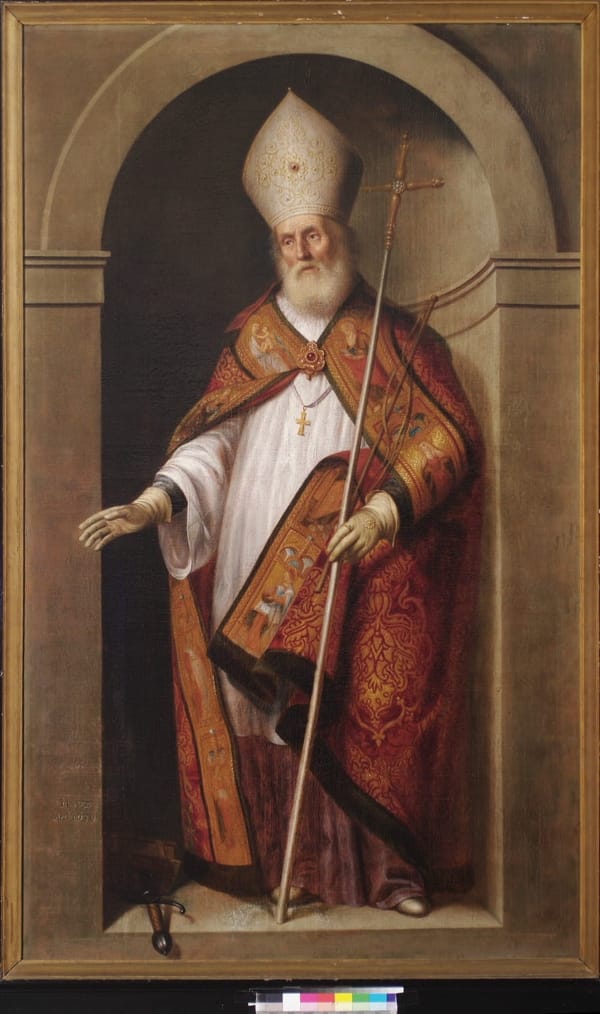 |
THE Son of Man, proclaimed King in the highest heavens on his triumphant Ascension day, leaves to his bride on earth the task of making his sovereign dominion recognized here below: this is her glory. Pentecost gives the signal for the Church's work of conquest; now does she awake, aroused by the breath of the Holy Ghost; replenished with this Spirit of love, she is all eagerness, as he is, to be possessed at once of the whole earth. We have already seen the Franks and the Anglo-Saxons pledging in her hands their oath of fealty to Christ, ‘to whom is given all power on earth and in heaven.’1 To-day we see how Winfrid realizes the fair name of Boniface, or well-doer, given him by Pope Gregory II. He presents himself before us, surrounded by the multitudes he has snatched at one blow from paganism and barbarism. Thanks to the Apostle of Germany, the hour is nigh when the Church may constitute in this world, apart from the spiritual dominion of souls, an empire more powerful than any that has ever been or is to be.
The eternal Father draws to his Son2 not men only but nations; these are his inheritance on earth no less than heaven is in eternity. The good pleasure that God takes in the Word made Flesh could never be content with merely seeing nations come, one here, another there, offering an isolated homage of recognition to Christ, as their Lord and Master. It was the whole world that was promised as his possession, without distinction of nations, without limits, save those of the earth itself:3 recognized or not, his power is universal. In the case of many, no doubt, the contempt or the ignorance of this regal claim of the Man-God is to last on throughout ages; for revolt, alas! is always possible to all. But it was the duty of the Church to exercise her influence over baptized nations, so as to gather them together in one public acknowledgement of the royalty of Christ, which is the source of every kingly power. At the Pontiff’s side there seemed to be a fitting place for a mailed chieftain of Christendom to be the lieutenant of Christ, who alone is Lord of lords and King of kings. Thus would be realized, in all its plenitude, the magnificent principality announced by the prophets for the Son of David.4
Such an institution was indeed worthy of the name it was to receive, that of the Holy Empire: in it we have the final result of our glorious Pentecost, the consummation of the testimony rendered by the Holy Ghost to Jesus, both as Pontiff and as King.5 In a few days, Leo III, the illustrious Pope called by the Holy Spirit to crown this his divine work, will proclaim, to the joy of the whole world, the establishment of this new empire beneath the sceptre-sway of the Man-God, in the person of Charlemagne, the representative of the King of kings. This marvellous work was not prepared all at once. Vast regions, destined to form the very nucleus of this future empire, for long centuries knew not so much as the very name of the Lord Jesus; or, at best, preserved but confused notions of truth, derived from some earlier evangelization that had been stifled in its birth by the turmoil of invasions—a mere mixture of Christian practices and idolatrous superstitions. At length we behold Boniface arise, endued with power from on high,6 the worthy precursor of St Leo III. Bom of those angelfaced Angles, by whom ancient Britain was transformed into the Island of Saints, he bums to carry into the heart of Germany, whence his ancestors had sprung, the light which first shone upon them in the land of their conquest.
Thirty years of monastic life, begun in childhood despite the tears and caresses of a tender father, had braced his soul. Prepared by this long period of retreat and silence, filled with divine science, and accompanied by the prayers of his cloistered brethren, he could now in all security set forth to follow the attraction of a divine call. But, first and foremost, Rome beholds him at the feet of the Sovereign Pontiff, submitting his plans and prospects to him who is the only source of all mission in the Church. Gregory II, in every way worthy of the great Popes that have borne that name, was at that time watching with apostolic vigilance over the Christian world, and preparing for the glorious sovereignty that awaited the Church in the coming eighth century. In the humble monk prostrate at his feet, the immortal Pontiff recognizes a powerful auxiliary sent to him by heaven; and so, armed with the apostolic benediction, Winfrid, now become Boniface, feels the powerful attraction of the Holy Spirit drawing him irresistibly to conquests of which ancient Rome had never dreamed.
Beyond the Rhine, farther than Roman legions ever penetrated, the Church now advances into this barbarous land, along pathways tracked for her by Boniface; overturning in her victorious march the last idols of the false gods, civilizing and sanctifying those savage hordes, the scourge of the old world. This Anglo-Saxon, a true son of St Benedict, gives to his work a stability that will defy the lapse of ages. Everywhere monasteries arise, taking root in the very soil, for God's sake; and, by force of example and beneficence, fixing around them its various nomad tribes. From the river banks, from the forest depths, instead of cries of war and of vengeance, is wafted the accent of prayer and of praise to the Most High. Sturm, the beloved disciple of St Boniface, presides over these peaceful colonies far superior to those of pagan Rome, planted though they were by her noblest veterans and manned by the best forces of her empire.
Here, too, where violence has hitherto reigned supreme, in these savage wilds, a novel kind of army is organized, formed of the gentle brides of Christ. The Spirit of Pentecost, like a mighty wind, has blown over the land of the Angles; and, even as in the cenacle holy women had a share in its influence, consecrated virgins, obedient to the heavenly impulse, have quitted the land of their birth, even the monastery that has sheltered them from childhood. Having for a while administered only at a distance to Winfrid's needs, and copied out for him the sacred books in letters of gold, they at length come to join the apostle. Fearlessly have they crossed the sea, and, guided by their divine Spouse, have come to share the labours undertaken for his glory. Lioba is at their head; she whose gentle majesty, whose heavenly aspect, uplifts the mind from earthly thoughts, and who by her knowledge of the scriptures, of the fathers, and of the sacred canons, is equal to any of the most celebrated doctors. But the Holy Ghost has still more richly gifted the soul of Lioba with humility and Christian heroism. Behold the chosen mother of the German nation! Germany's proud daughters, athirst for blood, who on their wedding-day disdained all other gift save a steed, a buckler, and a lance,7 are to learn from her the true qualities of the valiant woman. No more shall they be seen, intoxicated with slaughter, leading back to the field of battle their vanquished husbands; but the virtues of the wife and of the mother shall replace in them the fury of the camp; family life is to be founded on German soil, and through it the fatherland.
This was Boniface's intention when he called to his aid Lioba, Walburga, and their companions. Worn out with toil, but still more with the incessant wear and fret of petty jealousies (never spared to men of God by such as would cover their paltry complaints under the cloak of false zeal), our athlete of Christ was not ashamed to come to Lioba, his well-beloved daughter, humbly seeking from her that enlightened counsel and comfort which was never denied. Estimating at its true worth the share she had borne in his work, he was desirous that she should be laid to rest in the same tomb prepared for him in his abbey of Fulda.
But not yet was his labour ended, nor was the evening of life at hand. The spiritual welfare of his numberless converts must be secured, and at their head must be placed such as the Holy Ghost designated for the government of God's Church.8 By his means the hierarchy was constituted and developed; the land was covered with churches; and, beneath the rule of holy bishops chosen by God, these once wandering tribes now began to live a life to the glory of the most blessed Trinity, in a country but recently pagan, wherein Satan had hoped to perpetuate his own domination.
Nor was this our saint’s only work in Germany; in certain isolated parts, the seeds of Arianism and Manichæism had been silently taking root, by means of an intruded clergy, half pagan and half Christian in their rites; and these would inevitably prove a serious scandal to his recent converts that came within reach of their influence. Even as Christ, armed with a whip of cords, drove the buyers and sellers from the temple, so did Boniface, by vigorous measures, rid the land of these sectarian priests, who, with hands polluted by heathenish sacrifices to the vanquished deities of Valhalla, dared to offer also the spotless victim to the Most High.
The powerful action of Boniface, as the precursor of the Holy Empire, was not confined to preparing the German race alone for its share in so high a destiny. His beneficent influence was now to be exercised, at a most critical moment, upon France, the eldest daughter of the Church; for she was chosen, in the person of her princes, to be the first to bear the emblem of Christ’s universal kingship. The descendants of Clovis had preserved nought of his royal inheritance, save the vain title of a power that had now passed into the hands of a new family, a more vigorous branch of his stock. Charles Martel, the head of this race, measuring his strength with the Moors, had crushed their entire army near Poitiers: but, in the flush of victory, the hero of the day had wellnigh brought the Church of France to the brink of ruin, by distributing to his comrades in arms the episcopal sees and abbeys of the land. Unless a situation no less disastrous than would have been the triumph of Abderahman was to be accepted, these usurped croziers must at once be wrested from the hands of such strange titularies. To effect this, as much gentleness as firmness was needed, together with an ascendancy belonging only to virtue, if the hero of Poitiers and his noble race were to be gained over to respect the rights of holy Church. This victory, more glorious than had been the defeat of the Moors, was won by Boniface, a veritable triumph of unarmed holiness, as profitable to the vanquished as to the Church herself. Of this fierce warrior he was to make the worthy father of a second dynasty, the glory whereof should far surpass the brilliant hopes of the first race of the Frankish kings.
Boniface, now legate of Pope St Zachary as he had formerly been of Gregory III, fixed his episcopal see at Mainz, the better to keep within the fold both Germany the conquest of his earlier apostolate, and France more recently rescued by his labours. Like another Samuel, he himself, with his own hands, consecrated this new regal dynasty, by conferring the sacred unction on Pepin le Bref, son of Charles Martel. This was in the year 752. Another Charles, as yet a child, who was one day to inherit that throne thus firmly established, attracted the notice of the aged saint, and received his benediction; it was the future Charlemagne. But to the hand of a Sovereign Pontiff would be reserved the anointing of that royal brow; and a diadem more glorious still than that of a king of the Franks was one day to be his, exhibiting in his person the head of the new Roman Empire, the lieutenant of the King of kings.
The personal work of Boniface was now accomplished; like the old man Simeon, his eyes had seen the object of all his ambition, of his life-long toil, the salvation prepared by God for this new Israel. He too had now no desire left save that of departing in peace to our Lord; but could such an apostle enter into peace by any other gate than that of martyrdom? He understands this well: his hour has sounded: the old warrior has chosen his last battlefield. Friesland is still pagan: half a century ago, at the opening of his apostolic career, he had avoided this country, in order to escape the bishopric which St Willibrord, at that early date, was anxious to bestow upon him: but now that it has nought save death to offer him, he will enter this land. In a letter of sublime humility, prostrate at the feet of Pope Stephen III, he submits to the correction of the Apostolic See, the 'awkward mistakes,' as he terms them, and the many faults of his long life;9 to Lullus, his dearest son, he leaves the Church of Mainz; he recommends to the care of the Frankish king the several priests scattered all through Germany, the monks and virgins, who from distant homes have followed him hither. Then ordering to be placed amongst the few books which he is taking with him the winding sheet that is to enwrap his body, he designates the companions chosen by him for the journey, and sets out to win the martyr's palm.
Let us now read the liturgical record of this grand life.
Thou wast, O great apostle, the faithful servant of him who chose thee as the minister of his word and the propagator of his kingdom. When the Son of Man quitted earth to receive the delighted homage of the heavenly hosts in recognition of his kingship over them, he none the less remained King of this lower world which he has left but for a little while.10 He counted on his Church to guard his principality here below. Small indeed was the number of those who recognized him, on the day of his glorious Ascension, as their Master and Lord. But that faith deposited in those first chosen souls was a treasure which they, like skilful bankers, knew how to work with, and how to multiply by apostolic commerce. Transmitted from generation to generation, up to the day of the Lord's return, this precious capital was to go on yielding to the absent Lord more and more accumulated interest. Thus was it with thee, O Winfrid, in that age wherein thou didst bring into the Church that tribute of labour which she requires, though in very different proportion, from each of her sons. In her gratitude, for thy works which appeared to her well done and profitable above those of others, forestalling the Spouse himself, she would, even in this world, call thee by that new name11 whereby thou art known in heaven.
Indeed, when did riches, such as thou didst bring, come pouring at once into the hands of the bride? When did the Spouse appear to be so fully and truly head of the whole world, as in the eighth century, in which the Frankish princes, formed by thee to their noble destinies, constituted the temporal sovereignty of the Church, and gloried in being the lieutenants of Christ standing at the side of his Vicar on earth? To thee, O Boniface, is the Holy Empire indebted for its very existence. But for thee, France would have perished, debased by a simoniacal clergy, even before a Charlemagne had appeared; but for thee, Germany would have remained a prey to pagan barbarians, enemies of all civilization and progress. O thou that didst rescue both Germans and Franks, receive our grateful homage.
At the sight of thy works, and remembering the great popes and magnificent princes, whose glory is indeed derived from thee, our admiration equals our gratitude. But pardon us, dear saint, if the thought of those grand centuries of yore, so far removed, alas, from these our days, should mingle sadness with our joy. Viewed in the light of thy holy policy and its results, O glorious precursor of the confederation of Christian nations, how we must bewail the fatal errors of those princes and statesmen, so renowned in the seventeenth century, and so foolishly admired by a world whose ruin they were hastening! For, by the isolation of Catholic nations from one another, the ties that bound them to the Vicar of Christ became loosened: princes, forgetful of their true position as representatives of the divine King, made friends with heresy, in order to assert their independence of Rome, or to lower one another’s power. Therefore Christendom is no more. Upon its ruins, like a woful mimicry of the Holy Empire, Protestantism has raised its false evangelical empire, formed of nought but encroachments, and tracing its recognized origin to the apostasy of that felon knight Albert of Brandenburg.
The complicities that rendered such a thing possible have received their chastisement. May God’s justice be satisfied at last! O Boniface, cry out with us unto the God of armies for mercy. Raise up in the Church servants of Christ, powerful in word and work, as thou wast. Save France from anarchy; and restore to Germany a right appreciation of true greatness, together with the faith of her ancient days.
| Previous June 4: St. Francis Caracciolo, Confessor | Next June 5: St. Boniface, Apostle of Germany, Bishop and Martyr |