Daily reading
Paschal Time
Double · Movable from Easter · Temporal
June 6, 2019
From Dom Guéranger’s The Liturgical Year.
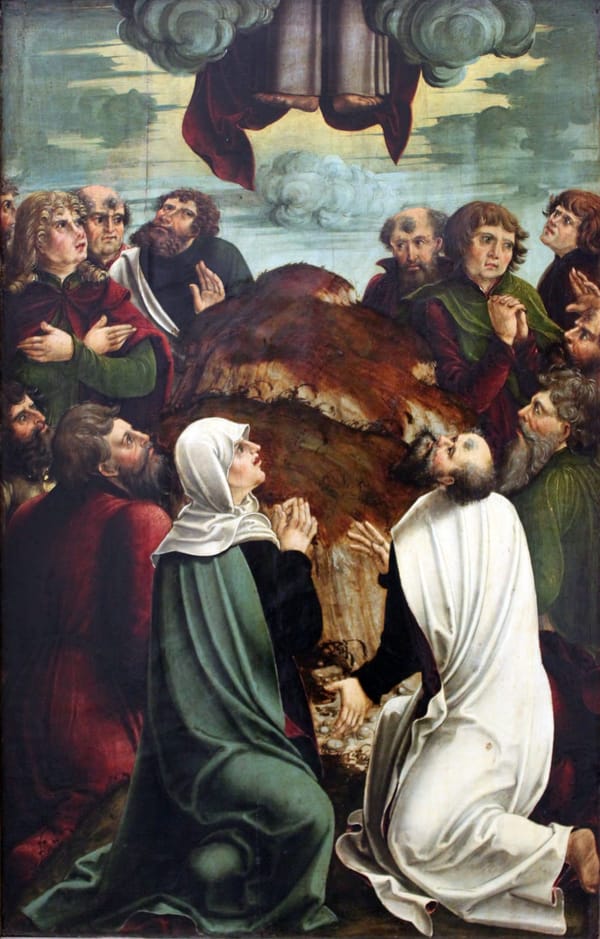 |
Thursday within the Octave of the Ascension
We have already seen how the Ascension of our Emmanuel won Him the empire over our understanding: it was the triumph of faith. The same mystery gave Him a second victory: the victory of love, which makes Him reign in our hearts. For eighteen hundred years, in whom have men believed, firmly and universally, except Jesus? In what have men agreed, except the dogmas of faith? What countless errors has this divine torch dispelled! What light has it given to the nations that received it! And in what darkness has it left those which rejected it after having once received it!
In like manner, no one has been loved as our Jesus has been, ever since the day of His Ascension; no one is so loved now or ever will be, as He. But that He might thus win our love He had to leave us, just as He had to do in order to secure our faith. Let us return to our text, that we may get deeper into the beautiful mystery.’It is expedient for you that I go!’1 Before the Ascension, the disciples were as inconstant in their love as they were in their faith. Jesus could not trust them. But no sooner had He left them, than they became warmly devoted to Him. Instead of complaining of their bereavement, they returned full of joy to Jerusalem. The thought of their master’s triumph made them forget their own loss, and they hastened, as He bade them, to the cenacle, where they were to be endued with power from on high. Watch these men during the subsequent years; examine what their conduct was from that time to the day of their death; count, if you can, their acts of devotedness in the arduous labour of preaching the Gospel; and say, if any other motive than love for their master could have enabled them to do what they did. With what cheerfulness did they drink His chalice!2 With what raptures did they hail His cross, when they saw it being prepared for themselves!
But let us not stop at these first witnesses; they had seen Jesus, and heard Him, and touched Him.3 Let us turn to those who came after them, and knew Him by faith only; let us see if the love, which burned in the hearts of the apostles, has been kept up by the Christians of the past eighteen centuries. First of all, there is the contest of martyrdom, which has never been altogether interrupted since the Gospel began to be preached. The opening campaign lasted three hundred years. What was it that induced so many millions to suffer, not only patiently but gladly, every torture that cruelty could devise? Was it not their ambition to testify how much they loved their Jesus? Let us not forget how these frightful ordeals were cheerfully gone through, not only by men hardened to suffering, but also by delicate women, by young girls, yea even by little children. Let us call to mind the sublime answers they gave to their persecutors, whereby they evinced their generous ardour to repay the death of Jesus by their own. The martyrs of our own times, in China, Japan, the Corea, and elsewhere, have repeated, without knowing it, the very same words to their judges and executioners as were addressed to the proconsuls of the third and fourth centuries by the martyrs of those days.
Yes, our divine King who has ascended into heaven, is loved as no other ever was or could be. Think of those millions of generous souls, who, that they might be exclusively His, have despised all earthly affections, and would know no other love than His. Every age,—even our own, in spite of all its miseries,—has produced souls of this stamp, and God alone knows how many.
Our Emmanuel has been, and to the end of time will ever be, loved on this earth. Have we not reason to say so, when we consider how many there have always been, even among the wealthiest ones of the world, who, in order that they might bear a resemblance to the Babe of Bethlehem, have given up everything they possessed? What an irresistible proof of the same truth we have in the countless sacrifices of self-love and pride, made with a view to imitate the obedience of the God-Man on earth! And what else but an ardent love of Jesus could have prompted those heroic acts of mortification and penance, whereby the sufferings of His Passion have been emulated, and, as the apostle says, filled up?4
But grand as all this is, it was not enough to satisfy man’s devoted love of His absent Lord. Jesus had said: ‘Whatsoever you do to the least of your brethren, you do it to Me.’5 Love is ever quick at catching the meaning of our Redeemer’s words. It took advantage of these, and saw in them another means for reaching Jesus,—reaching Him through the poor. And as the worst of poverties is the ignorance of divine truths, because it would make a man poor and miserable for eternity, therefore have there risen up in every age zealous apostles, who, bidding farewell to home and fatherland, have carried the light of the Gospel to them that sat in darkness and in the shadow of death. They heeded not the fatigues or the perils of such a mission: what cared they for all these things, if they could but make Jesus known and honoured and loved by one poor savage or Hindoo?
But what of those other poor ones, the sick, in whom Jesus suffers? Fear not: He is too much loved to be forgotten there. Once let the Church be free enough to develop her plans of charity, and there will be an institute of relief for every class of sufferers. The poor, the sick, all will be cared for and comforted. There will be vocations to charity, to meet every want; and women, too, urged by the love of their divine Lord, will deem it an honour to be the nurses and attendants of a suffering or dying Lazarus. The world itself is in admiration at their heroism; and though it knows not the divine principle which originates these charitable institutions, yet is it obliged to acknowledge the extraordinary good they effect.
But man’s observation can only reach the exterior; the interior is the far grander reality, and it is beyond his notice. What we have said so far is, therefore, but a very feeble description of the ardour wherewith our Lord Jesus Christ has been, and still is, loved on this earth. Let us picture to ourselves the millions of Christians who have lived since the first foundation of the Church. Many, it is true, have had the misfortune to be unfaithful to the object of their existence; but what an immense number have loved Jesus with all their heart and soul and strength!
Some have never flagged in their love; others have needed a conversion from vice or tepidity, returned to Him, and slept in the kiss of peace. Count, if you can, the virtuous actions, the heroic sacrifices, of those countless devoted servants of His, who are to be arrayed before Him in the valley of Josaphat. His memory alone can hold and tell the stupendous total of what has been done. This well-nigh infinite aggregate of holy deeds and thoughts, from the seraphic ardour of the greatest saint down to the cup of cold water given in the name of the Redeemer, what is it all but the ceaseless hymn of our earth to its beloved absent One, its never-forgotten Jesus? Who is the man, how dear soever his memory may be, for whom we would be devoted, or sacrifice our interests, or lay down our lives, especially if he had been ten or twenty ages gone from us? Who is that great Dead, the sound of whose name can make the hearts of men vibrate with love, in every country, and in every generation? It is Jesus, who died, who rose again, who ascended into heaven.
But we humbly confess, O Jesus, that it was necessary for us that Thou shouldst go from us, in order that our faith might soar up to Thee in heaven, and that our hearts, being thus enlightened, might burn with Thy love. Enjoy thine Ascension, O Thou King of angels and of men! We, in our exile, will feast on the fruits of the great mystery, waiting for it to be fulfilled in ourselves. Enlighten those poor blind infidels, whose pride will not permit them to recognize Thee, notwithstanding these most evident proofs. They continue in their errors concerning Thee, though they have such superabundant testimony of Thy Divinity in the faith and love Thou hast received in every age. The homage offered Thee by the universe, represented, as it has ever been, by the chief nations of the earth and by the most virtuous and learned men of each generation, is as nought in the eyes of these unbelievers. Who are they, to be compared with such a cloud of faithful witnesses? Have mercy on them, O Lord! save them from their pride; then will they unite with us in saying:’It was indeed expedient for this world to lose Thy visible presence, O Jesus! for never were Thy greatness, Thy power, and Thy Divinity, so recognized and loved, as when Thou didst depart from us. Glory, then, be to the mystery of Thine Ascension, whereby, as the psalmist prophesied, Thou receivedst gifts, that Thou mightest bestow them upon men!’6
We will take a hymn to-day from the Greek Church: it is the one she sings in honour of our Redeemer’s triumph, at her evening Office of Ascension day.
Hymn (In Assumptione Domini, ad magnum Vespertinum.)
As a close to this glorious octave, we offer the eighth and last of the beautiful prayers given by the Mozarabic breviary in honour of our Lord’s Ascension.
Prayer
June 6: St. Norbert, Bishop and Confessor
 |
THE helpful influence of the Holy Ghost is more and more multiplied along the Church's path. It seems as though he would show us to-day how the divine power of his action is not crippled by lapse of years: for here we have, twelve centuries after his first coming among us, miracles of grace and conversion quite as brilliant as those that marked his glorious descent upon earth.
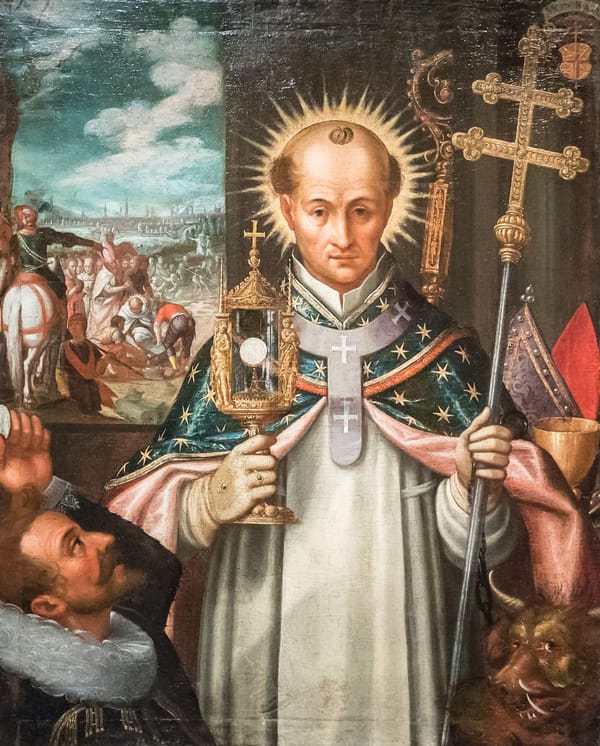
Norbert, in whose veins flowed the blood of emperors and kings, was, from the very breast of his mother Hedwige, supernaturally invited to a nobility loftier still: yet did he devote to the unreserved enjoyment of pleasure three-and-thirty years of a life that was to number but fifty in all. The Holy Ghost at length hastened to the conquest. There burst a sudden storm, a thunderbolt falls right in front of the prodigal, throwing him to the ground and making a frightful chasm between him and the point whither, a moment ago, he was hastening in pursuit of new vanities, that needs must fail, as all others had done, to fill the hopeless void in his heart. Then, in the very depths of his soul resounds a voice, such as Saul once heard on his way to Damascus: ‘Norbert, whither goest thou?' Like another Paul he replies: ‘Lord, what wilt thou have me to do?' He is answered: ‘Depart from evil and do good; seek after peace and pursue it.' Twenty years later, Norbert is in heaven, seated amidst pontiffs, upon a glorious throne, and all radiant with that special brilliancy that distinguishes the founders of the great religious Orders, when they have reached the eternal home.
Deep are the traces left by him on earth of his few years of penitential life. Germany and France receive his preaching; Antwerp is delivered from a shameful heresy; Magdeburg is rescued, by her archbishop, from the irregularities that were sullying the house of God: such are his works; and though these alone would have sufficed to a long life of holiness, yet they are not the only claims, nor the most brilliant, which Norbert has to the Church's gratitude. Before being called, against his will, to the honours of the episcopate, this once gay courtier made choice of an uninhabitable solitude amidst the forests of the diocese of Laon where he devoted himself to prayer and to the maceration of his flesh. The renown of this holy penitent gained rapidly; and Prémontré soon beheld her swampy marshes invaded by a vast multitude, formed of the fairest names of the nobility, pressing thither to learn the science of salvation from the lips of the saintly anchorite. There, too, did our Lady show to him, in vision, the white habit wherewith his disciples were to be clothed; and St Augustine, in like manner, delivered to him his own rule. Thus was founded the most illustrious branch of the Order of Canons Regular. They add to the obligation of solemnizing the Divine Office the austerities of an uninterrupted penance; and devote themselves, moreover, to the service of souls, by preaching and the administration of parishes.
In the foregoing century, the episcopacy and papacy had been raised by the monks above the danger of feudal servitude; and Norbert was now raised up to give the needed completion to their work. Although, in principle, the monastic life excludes no sort of labour useful to the Church, the monks could not (however numerous they might be) quit their cloisters in order to undertake charge of souls. Yet great were the wants of the lambs of the flock at that time; for many unworthy pastors of secondary order, slaves to simony and immorality, still continued to lead astray the simple laity. The religious life was alone capable of raising the priesthood from such degradation, whether on the pinnacles of the hierarchy, or amongst the lowest degrees of sacred Orders. Norbert was the man chosen by God to effect, in part at least, this immense work; and the importance of his mission explains the sublime prodigality wherewith the Holy Ghost multiplied vocations to his standard. The number and rapidity of foundations permitted succour to be promptly and everywhere afforded. Even into the far east did the light of Prémontré reach, almost at its first dawn. In the eighteenth century, notwithstanding the devastations of the Turks and the ravages of the pretended Reformation, the Order, divided into twenty-eight provinces, still contained, in almost every one of its houses, as many as from fifty to one hundred and twenty canons, and the parishes that continued under their care might be counted by thousands.
Nuns, whose holy life and prayers are the ornament and aid of the Church militant, occupied from the very beginning the place deservedly their due in this numerous family. In the time of the founder, or soon after his death, there were more than a thousand of them at Prémontré alone. Such an incredible number gives us an idea of the prodigious propagation of the Order from its very origin. Norbert moreover extended his charity to persons who, like Thibault Count of Champagne, would gladly have followed him into the desert, but who were retained by God’s will in the world; he thus made a prelude to those pious associations, which we shall see St Francis and St Dominic organizing in the thirteenth century, under the name of Third Orders.
The liturgy thus condenses the life of this great servant of God:
Thou didst indeed know how to redeem the time,1 as was fitting in those evil days, wherein thou thyself, O Norbert, led away by the example of the senseless crowd, hadst for so long frustrated the designs of God's love. Those years, at first refused by thee to the true Master of the world, were at length returned unto him, multiplied a hundredfold, through those countless sons and daughters thou didst train up in sanctity. Even thy personal works, in but twenty years' space, filled the whole earth. Schism crushed; heresy confounded to the greater glory of the most holy Sacrament which it had already dared to attack; the rights of the Church intrepidly defended against worldly princes and unjust retentions; the priesthood restored to its primitive purity; the Christian life established on its true basis, of prayer and penance; such and so many victories achieved in so few years, are due to the generosity which prevented thee from looking back for one moment, once the Holy Ghost had touched thy heart. Do thou make all understand that it is never too late to begin to serve God. Were it even, as in thy case, the evening of life, what yet remains of time would suffice to make us saints, if we would but generously give that little fully to heaven.2
Faith and patience were thy cherished virtues; make them flourish once more in this sad world, which boasts of its disbelief, and with jibe and jeer hurries onward to the abyss of hell. Forget not, dear apostle, now that thou art in heaven, the countries thou didst formerly evangelize; we implore this of thee, in spite of their forgetfulness and deliberate return to the deceits of the devil.
Holy Pontiff, Magdeburg has lost her ancient faith, and with it the precious relics of thy body, which she no longer deserved to possess: Prague is now the favoured place of thy repose. But, whilst blessing this hospitable city, pray still for the ungrateful one that has cast aside her double treasure. O thou founder of Prémontré, smile once more on France, which derives from thee one of her fairest glories. Obtain of God that, for the salvation of these calamitous times, thine Order may recover something of its former splendour. Bless, few as they are, those sons and daughters of thine who, in spite of the hostility of the 'powers that be,' seek to shed once more their beneficent influence on France. May England benefit also by their return to her midst, and may their fruits be multiplied in every direction. Maintain thine own spirit among them; may they find in interior peace the secret of triumph over Satan and his crew; may the full magnificence of the divine worship solemnly carried out be ever to their souls as the dearly loved mount, whence, Moses-like, they may declare the will of the Lord to the new Israel, the Christian people.
| Previous June 5: St. Boniface, Apostle of Germany, Bishop and Martyr | Next June 6: St. Norbert, Bishop and Confessor |