Daily reading
Paschal Time
Major vigil · Movable from Easter · Temporal
June 8, 2019
From Dom Guéranger’s The Liturgical Year.

|
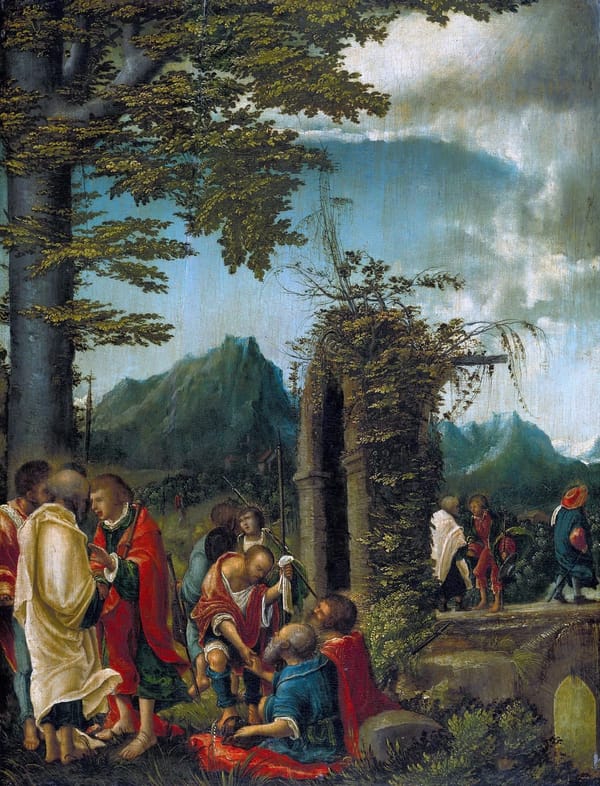
Vigil of Pentecost
The dazzling splendour of to-morrow’s solemnity forecasts its beauty on this day of its vigil. The faithful are preparing themselves by fasting to celebrate the glorious mystery. But the Mass of the neophytes, which formerly was said during the night, is now anticipated, as on Easter Eve; so that by to-day’s noon, we shall have already begun the praises of the Holy Ghost. The Office of Vespers, in the afternoon, will solemnly open the grand festival. The reign of the holy Spirit is, therefore, proclaimed by the liturgy of this very day. Let us unite ourselves in spirit with the holy ones, who are awaiting the fulfilment of Jesus’ promise.
Whilst following the mysteries of the past seasons of the liturgical year, we have been frequently told of the action of the Third Person of the blessed Trinity. The lessons read to us, from both the old and the new Testament, have more than once excited our respectful attention towards this divine Spirit, who seemed to be shrouded in mystery, the time for Him to be made manifest not having yet arrived. The workings of God in His creatures do not come all at once; there is a succession in their coining, but come they certainly will. The sacred historian describes how the heavenly Father, acting through His Word, employed six days in arranging, into its several parts, this world which He had created; but he also tells us, though under the veil of a mysterious expression, that the Spirit moved over the waters, which the Son of God was about to divide from the earth.
If, then, the Holy Ghost’s visible reign on our earth was deferred until such time as the Man-God should be enthroned on the Father’s right hand, we must not conclude that this divine Spirit has been inactive. What are the sacred Scriptures, from which the liturgy has selected so many sublime passages for our instruction, but the silent production of Him, who, as the venerable Symbol has it, ‘spoke by the prophets?’1 He gave us the Word, the Wisdom of God, by the Scripture, who gave us, at a later period, this same Word, in the flesh of human nature.
He has never been a moment of all the past ages without working. He prepared the world for the reign of the Incarnate Word; He did so by bringing together the various races of once separate nations, and by keeping up that universal expectation of a Redeemer, which was held alike by the most barbarous and by the most highly civilized. The earth had not as yet heard the name of the Holy. Ghost, but He moved over the universe of mankind, as He moved over the dead mass of water at the beginning of the world.
Meanwhile, the prophets spoke of Him in several of the prophecies wherein they foretold the coming of the Son of God. The Lord thus spoke by the lips of Joel:’I will pour out My Spirit upon all flesh.’2 He said to us through Ezechiel:’I will pour upon you clean water, and you shall be cleansed from all your filthiness, and I will cleanse you from all your idols. And I will give you a new heart, and put a new spirit within you: and I will take away the stony heart out of your flesh, and I will give you a heart of flesh; and I will put My Spirit in the midst of you.’3
But previously to the manifestation of Himself, the Holy Ghost was to effect that of the divine Word. When infinite power called into existence the body and soul of the future Mother of God, it was He that prepared the dwelling for the sovereign Majesty, by sanctifying Mary from the instant of her conception, and taking possession of her as the temple into which the Son of God was soon to enter. When the ever blessed day of the Annunciation came, the archangel declared unto Mary that the Holy Ghost would come upon her, and that the power of the Most High would overshadow her. No sooner did the Virgin consent to the fulfilment of the eternal decree, than the operation of the divine Spirit produced within her the most ineffable of mysteries: the Word was made Flesh, and dwelt among us!
Upon this flower that sprang from the branch of the tree of Jesse, upon this Humanity divinely produced in Mary, there rested complacently the Spirit of the Father and of the Son: He enriched it with His gifts, He fitted it for its glorious and everlasting destiny.4 He that had so filled the Mother with the treasures of His grace, that it seemed to border on infinity, gave incomparably more to her Child. And, as ever, the holy Spirit worked these stupendous wonders silently; for the time of His manifestation had not come. The earth is to catch but a glimpse of Him on the day of Jesus’ baptism, when He will rest with outstretched wings on the head of the well-beloved Son of the Father. The holy Baptist John will understand the glorious vision, as he had felt, when yet unborn, the presence of the blessed fruit in Mary’s womb; but as to the bystanders, they saw but a dove, and the dove revealed not his eternal secrets.
The reign of the Son of God, our Emmanuel, is established upon its predetermined foundations. In Him we have a brother, for He has assumed our weak human nature; a teacher, for He is the Wisdom of the Father, and leads us into all truth; a physician, for He heals all our infirmities; a mediator, for by His sacred Humanity He brings all creation to its Creator. In Him we have our Redeemer, and in His Blood our ransom; for sin had broken the link between God and ourselves, and we needed a divine Redeemer. In Him we have a Head, who is not ashamed of His members, however poor they may be; a King whom we have seen crowned with an everlasting diadem; a Lord, whom the Lord hath made to sit on His right hand.5
But if He rules over this earth for all ages, it is from His throne in heaven that He is to rule, until the angel’s voice is heard proclaiming that ‘time is no more’;6 and then He will return to ‘crush the heads’7 of sinners. Meanwhile, long ages are to flow onwards in their course, and these ages are to be the reign of the Holy Ghost. But as we learn from the evangelist, the Spirit was not given until such time as Jesus was glorified.8 So that our beautiful mystery of the Ascension stands between the two divine reigns on earth: the visible reign of the Son of God, and the visible reign of the Holy Ghost. Nor is it only the prophets who announce the succession of the second to the first; it is our Emmanuel Himself, who, during the days of His mortal life, heralded the approaching reign of the divine Spirit.
We have not forgotten His words: ‘It is expedient for you that I go; for if I go not, the Paraclete will not come to you.’9 Oh! how much the world must have needed this divine guest, of whom the very Son of God made Himself the precursor! And that we might understand how great is the majesty of this new master who is to reign over us, Jesus thus speaks of the awful chastisements which are to befall them that offend Him: ‘Whosoever shall speak a word against the Son of Man, it shall be forgiven him; but he that shall speak against the Holy Ghost, it shall not be forgiven him, neither in this world nor in the world to come.’10 This divine Spirit is not, however, to assume our human nature, as did the Son; neither is He to redeem the world, as did the Son; but He is to come among men with a love so immeasurable, that woe to them who despise it! It is to Him that Jesus intends to confide the Church, His bride, during the long term of her widowhood; to Him will He make over His own work, that He may perpetuate and direct it in all its parts.
We, then, who are to receive a few hours hence the visit of this Spirit of love, who is to renew the face of the earth,11 must be all attention, as we were at Bethlehem when we were awaiting the birth of our Emmanuel. The Word and the Holy Ghost are coequal in glory and power, and their coming upon the earth proceeds from the one same eternal and merciful decree of the blessed Trinity, who, by this twofold visit, would’make us partakers of the divine nature.’12 We, who were once nothingness, are destined to become, by the operation of the Word and the Spirit, children of the heavenly Father. And if we would know what preparation we should make for the visit of the Paraclete, lot us return in thought to the cenacle, where we left the disciples assembled, persevering with one mind in prayer, and waiting, as their Master had commanded them, for the power of the Most High to descend upon them, and arm them for their future combat.
The first we look for in this sanctuary of recol- lectedness and peace, is Mary, the Mother of Jesus, the master-piece of the Holy Ghost, the Church of the living God, from whom is to be born on the morrow, and by the action of the same divine Spirit, the Church, militant; for this second Eve represents and contains it within herself. Well, indeed, does this incomparable creature now deserve our honour! Have we not seen her glorious share in all the mysteries of the Man-God? And is she not to be the dearest and worthiest object of the Paraclete’s visit? Hail, then, O Mary full of grace! Thou art our mother, and we rejoice in being thy children. The holy Church expresses this joy of ours, when she thus comments the words of David’s canticle: ‘Our dwelling in thee, O holy Mother of God! is as of them that are all rejoicers!’13 In vain wouldst thou decline the honours that await thee on the morrow! Mother Immaculate! Temple of the Holy Ghost! there is no escape, and receive thou must a new visit of the Spirit, for a new work is entrusted to thee: the care of the infant Church for several years to come!
The apostolic college is clustered around the holy Mother; it is such a feast to them to look upon her, for they see the likeness of their Jesus in her face! In the very cenacle where they are now assembled, and in Mary’s presence, an event occurs which is of deep importance. As God, when He formed His Israelite people, chose the twelve sons of Jacob that they might be the fathers of that privileged race, so did Jesus choose twelve men, and they, too, were Israelites, that they might be the foundations of the Church, of which He Himself, and Peter together with and in Him, is the chief corner-stone. The terrible fall of Judas has reduced the number to eleven; the mysterious number is broken, and the Holy Ghost is about to descend upon the college of the apostles. Jesus had not thought proper to fill up the vacanoy before His Ascension into heaven: and yet the number must be completed, before the coming of the Power from on high. The Church surely could not be less perfect than the Synagogue. Who, then, will take Christ’s place in designating the new apostle? Such a right, says St. John Chrysostom, could not belong to any but Peter; but he humbly waived his right, and expressed his wish that there should be an election. The choice fell upon Mathias, who immediately took his place among the apostles, and awaited the promised Comforter.
In the cenacle, and in the blessed Mother’s company, there are also the disciples, less honoured, it is true, than the twelve, yet have they been witnesses of the works and mysteries of the Man-God; they, too, are to share in preaching the good tidings. And finally, Magdalene and the other holy women are there, preparing, as the Master had prescribed, for the visit from on high, which is to tell upon them also. Let us honour this fervent assembly of the hundred and twenty disciples. They are our models. The holy Spirit is to descend first upon them, for they are His first-fruits; but He is to come down upon us also, and it is with a view to prepare us for our Pentecost that the Church imposes on us to-day the obligation of fasting.
Formerly, this vigil was kept like that of Easter. The faithful repaired to the church in the evening, that they might assist at the solemn administration of Baptism. During the night, the Sacrament of regeneration was conferred upon such catechumens as sickness or absence from home had prevented from receiving it on Easter night. Those, also, who had then been thought insufficiently tried or instructed, and had, during the interval, satisfied the conditions required by the Church, now formed part of the group of aspirants to the new birth of the sacred font. Instead of the twelve prophecies, which were read on Easter night while the priests were performing over the catechumens the rites preparatory to Baptism, six only were now read; at least, such was the usual custom, and it would lead us to suppose that the number of those baptized at Pentecost was less than at Easter.
The Paschal Candle was again brought forward during this night of grace, in order to impress the newly baptized with respect and love for the Son of God, who became Man that He might be the light of the world.14 The rites already described and explained for Holy Saturday were repeated on this occasion, and the Sacrifice of the Mass, at which the neophytes assisted, began before the break of day.
In later times, when the charitable custom of conferring Baptism on children immediately after their birth passed into a general law, the Mass of Whitsun-Eve was said early in the morning, as was done in the case of Easter-Eve. The six prophecies, of which we have just spoken, are now read before the celebration of the holy Sacrifice; after which, the baptismal water is solemnly blessed. The Paschal Candle is used at this ceremony, at which the faithful should consider it a duty to assist.
First Vespers are sung in the afternoon. We do not insert them, because Whitsun-Eve can never occur on a Sunday; whereas, for other feasts, for which we have given the first Vespers, the vigil may be a Sunday. Moreover, the first and second Vespers of Whit-Sunday are almost exactly alike.
We will close this day by inserting one of the finest sequences composed by Adam of Saint Victor on the mystery of Pentecost. This great liturgical poet of the western Church has surpassed himself in what he has written on the Holy Ghost; and more than once, during the octave, we will select from his rich store. But the hymn we give to-day is not merely a composition of poetic worth; it is a sublime and fervent prayer to the Paraclete, whom Jesus has promised to send us, and whom we are now expecting. Let us make these sentiments of the devout poet of the twelfth century our own; let us imitate him in his longings for the holy Spirit, who is coming that He may renew the face of the earth, and dwell within us.
Sequence
Genitore Genitoque,
Pariter Paraclite,
Redde linguas eloquentes,
Fac ferventes in te mentes
Flamma tua divite.
Par amborum, et utrique
Compar et consimilis,
Cuncta reples, cuncta foves,
Astra regis, cœlum moves,
Permanens immobilis.
Internarum tenebrarum
Effugas caliginem;
Per te mundi sunt mundati;
Tu peccatum et peccati
Destruis rubiginem.
Et ostendis viam pacis
Et iter justitiæ.
Perversorum corda vitas,
Et bonorum corda ditas
Munere scientiae.
Te praesente nil impurum;
Gloriatur mens jucunda;
Per te laeta,
Per te munda
Gaudet conscientia.
Per te suam sacramenta
Habent efficaciam:
Tu nocivam vim repellis,
Tu confutas et refellis
Hostium nequitiam.
Quando subis, atrae nubis
Effugit obscuritas;
Sacer ignis, pectus uris;
Non comburis, sed a curis
Purgas, quando visitas.
Et sopitas et oblitas
Erudis et excitas.
Foves linguas, formas sonum,
Cor ad bonum facit pronum
A te data charitas.
O solamen miserorum,
Pauperum refugium,
Da contemptum terrenorum:
Ad amorem supernorum
Trahe desiderium.
Habitator et amator
Cordium humilium,
Pelle mala, terge sordes,
Et discordes fac concordes,
Et affer præsidium.
Docuisti, confortasti
Timentes discipulos,
Visitare nos digneris;
Nos, si placet, consoleris
Et credentes populos.
Par potestas est earum,
Et communis deitas:
Tu procedens a duobus
Coæqualis es ambobus:
In nullo disparitas.
Quantus Pater est et qualis;
Servorum humilitas
Deo Patri, Filioque
Redemptori, tibi quoque
Laudes reddat debitas.
who proceedest equally from the Father
and the Son! with thy glowing fire,
give eloquence to our tongues,
and make our hearts fervent
in their love for thee.
equal and coequal with them in essence!
thou fillest and fosterest all things:
and though in thyself immovable,
thou governest the stars,
and givest motion to the heavens.
thou puttest to flight
the gloom of our soul’s darkness.
‘Tis thou that purifiest the pure,
and takest away
sin and its rust.
thou showest us the way of peace
and the path of justice.
Thou shunnest the hearts of perverse sinners;
thou enrichest the hearts of the good
with the gift of knowledge.
when thou art present, there is no impurity.
The soul that possesses thee,
is cheerful:
and her conscience
is joyful and pure.
by thee have the Sacraments
their efficacy:
thou drivest away all evil power:
thou bringest to nought
the wickedness of our enemies.
our hearts are soothed;
when thou enterest, dark clouds are put to flight.
O sacred Fire! when thou visitest us,
thou inflamest our souls; not burning them,
but purging them from the dross of care.
that once were ignorant and drowsy and heedless.
Thou inspirest the tongue,
thou formest its speech;
and the charity thou givest,
makes the heart prompt to all that is good.
O Comforter of the afflicted!
O refuge of the poor!
Give us a contempt for earthly things,
and draw our affections
to the love of what is heavenly.
and guest, and lover
of humble souls!
Drive all evil from us, cleanse our sins,
bring concord where now is discord,
and support us by thy protection.
teach, and strengthen
the timid disciples,
deign to visit us;
vouchsafe to console us
and the faithful throughout the world.
equal the power,
and one the divinity,
of the Three Persons.
Thou proceedest from the Father and the Son,
and art coequal in all things with them.
in all perfections as is the Father,
accept from us thy poor servants
the praise that is due to thee,
equally with the Father
and the Son.
- Qui locutus est per prophetas. (Symbol of Nicœa and Constantinople.) ↩︎
- Joel, ii. 28. ↩︎
- Ezech. xxxvi. 25-27. ↩︎
- Is. ad. 1-3. ↩︎
- Ps. cix. 1. ↩︎
- Apoc. x. 6. ↩︎
- Ps. cix. 6. ↩︎
- St. John, vii. 39. ↩︎
- St. John, xvi. 7. ↩︎
- St. Matth. xii. 32. ↩︎
- Ps. ciii. 30. ↩︎
- 2 St. Peter, i. 4. ↩︎
- The 2nd Nocturn of the Office of the Blessed Virgin; Antiphon to the 86 th Psalm. ↩︎
- St. John, viii. 12. ↩︎
June 8: St. William, Bishop and Confessor
AT the head of the holy confessors commemorated by the Church in her martyrology for to-day, is inscribed the illustrious name of William. ‘At York, in England,’ it says, ‘the memory of St William, Archbishop and Confessor, who, amongst other miracles wrought at his tomb, raised three dead persons to life; and who was inscribed amongst the saints by Honorius III.’ The divine Spirit, who adorns the Church with variety in the virtues of her sons,1 reproduces in them the life of the divine Spouse under many forms. Thus there is no situation in life that cannot find some teaching drawn from the example given by our Lord and his saints under similar circumstances. However vast be the field of trial for the elect here below; however multiplied and unexpected be the limits of endurance, or the circumstances; herein, as ever, does that word of eternal Wisdom hold good: ‘Nothing under the sun is new, neither is any man able to say: Behold this is new: for it hath already gone before, in the ages that were before us.’2
The election of William to the metropolitan see of York was signalized by the apparition of a miraculous cross, a presage of what his life was to be. The heaviest cross one can have to bear is that which originates from the servants of God; from our own brethren, or from our own superiors, in the spiritual order: this cross was not to be spared to William. For our instruction (especially for us who so easily believe that we have gone to the farthest limits of endurance in point of suffering) God permitted that, after the example of his divine Master, William should drink the chalice to the dregs, and should become even to the saints a sign of contradiction and a rock of scandal.3
Both to the more numerous portion of the flock, as well as to the better-minded among them, the promotion of the archbishop elect of York was indeed a cause of great joy; but others considered it contrary to their interests. They were foolish enough to listen to certain perfidious insinuations and whisperings, and were led to suppose that it would be a good deed to prevent his consecration. Finally they allowed themselves to be so far worked upon as to make formal and grave accusations against their shepherd, and even the virtuous, deceived by the craftiness of the intriguers, espoused their cause. After hearing from the lips of holy Church in the martyrology her own judgement, glorious as it stands and without appeal, it is not without feelings of wonder and even of bewilderment, that we read passages such as the following, in letters written at the time.
'To our well beloved father and lord, Innocent, by the grace of God Sovereign Pontiff, Bernard of Clairvaux. The archbishop of York hath approached you; that man regarding whom we have so often already written to your Holiness. A sorry cause indeed is his; as we have learned from such as are worthy of credit, from the sole of his foot to the top of his head there is not a sound place in him. What can this man, stripped of all justice, have to seek at the hands of the guardian of justice?’4 Then recommending the accusers to the Pontiff, the abbot of Clairvaux fears not to add: 'If any one be of God, let him join himself unto them! If the barren tree still occupy the ground, to whom must I attribute the fault, save to him unto whom the hatchet belongs?’5
The Vicar of Christ, who can look at things from a higher level and can see more exactly than even saints, took no step to prevent William's consecration, and St Bernard wrote, confidentially, to the abbot of Rievaulx, in Yorkshire: ‘I have learned what has become of this archbishop, and my sorrow is extreme.6 We have laboured all we could against this common pest, and we have not obtained the desired measure; but for all that, the fruit of our labour is none the less assured from him, who never suffers any good deed to pass unrewarded. What men have refused to us, I am confident we shall obtain from the mercy of our Father who is in heaven, and that we shall yet see this cursed fig-tree rooted up.’7
Such grave mistakes as these can sometimes be made by saints. Cruel mistakes indeed they are, but very sanctifying for those saints on whom the blow falls; and, though veritable persecutions, yet they are not without consolation for such saints as these, inasmuch as there has been no offence to God on either side.
Innocent II being dead, Bernard, convinced that the honour of the Church was at stake, repeated his supplications, more urgently than ever, to Pope Celestine II and the Roman court: ‘The whole world is aware of the devil's triumph,’ he exclaimed, with such fiery zeal that we somewhat modify the strength of his expression. ‘The applause of the uncircumcised and the tears of the good, resound far and wide. ... If such were to be the end of this ignominious cause, why not have left it in obscurity? Could not that infamous man, the horror of England and the abomination of France, have been made bishop without Rome also witnessing the general infection spread as far as the very tombs of the apostles?8. . . . Well, be it so; this man has received sacrilegious consecration; but still more glorious will it be to precipitate Simon from midair, than to have prevented his mounting thus far. Otherwise, what will you do with the faithful, whose sense of religion makes them suppose that they cannot, with a safe conscience, receive the sacraments from this leprous hand? Are they, then, to be forced by Rome to bend the knee to Baal?’9
Rome, however, was slow in letting herself be convinced, and neither Celestine, nor Lucius II who succeeded him, was willing to find in the great services of the powerful abbot of Clairvaux a sufficient reason to pronounce a condemnation, the justice of which was far from being proved to their eyes. It was only under the pontificate of Eugenius III, his former disciple, that St Bernard, by new10 and reiterated instances,11 at last obtained the deposition of William, and the substitution, in the see of York, of Henry Murdach, a Cistercian, and abbot of Fountains near Ripon.
‘All the time that his humiliation lasted,’ writes John, prior of Hexham, 'William never let a murmur of complaint escape him; but with a silent heart and with his soul at peace, knew how to keep patience. He protested not against his adversaries; nay, further still, he would turn aside his ear and his very thought from those who judged them unfavourably. None of those who shared his disgrace, showed themselves so continually given up as he to prayer and labour.’12
Five years afterwards13 Eugenius III died, as also the abbot of Clairvaux and Henry Murdach. The canons of York once more elected William, and he was reinstated in the plenitude of his metropolitan rights by Anastasius IV. But God had willed to do no more than affirm the justice of his cause: thirty days after his triumphal return to York, he died, having only just solemnized the festival of the Holy Trinity for whom he had suffered.
We here give the few lines wherein the liturgy records the trials and virtues of St William.
O William, thou didst know how to possess thy soul! Under the assaults of contradiction thou didst join the aureole of sanctity to the glorious character of a bishop. For well didst thou understand the twofold duty incumbent on thee from the day thou wast called by the suffrages of an illustrious Church to defend her here below, under most difficult circumstances; on the one hand, not to refuse the perilous honour of upholding to the last the rights of that noble bride who proffered thee her alliance: on the other, to show to thy flock, by the example of thy own submission, that even the best of causes can never be dispensed from that absolute obedience owed by sheep, just as much as by lambs, to the supreme Shepherd. He who searcheth the heart and the reins14 knew how far the trial could go, without either altering the admirable simplicity of thy faith, or troubling, in consequence, the divine calm wherein lay thy strength. Yearning to raise thee to the highest degree of glory in heaven, fain was he to assimilate thee fully, even here below, to the eternal Pontiff, himself misunderstood, denied and condemned by the very princes of his own people. Thy refuge was in that maxim, from the lips of this divine Head: 'Learn of me, because I am meek and humble of heart, and ye shall find rest to your souls,’15 and thus the yoke that would bear down such weak shoulders as ours, a burthen beneath which the strongest of us well might quail, far from daunting thee, seemed fraught with such sweetness, that thy step became all the lighter16 for it, and from that hour thou didst appear not only to walk, but to run like a giant,17 in the way of heroism wherein saints are formed.
Help us, O William, to follow thy steps at least afar off, in the paths of gentleness and energy. Teach us to count for little all personal injuries. Our Lord indeed probed the delicacy of thy great soul, when he permitted that to befall thee, which to us would have proved a very core of bitterness, namely, that thy hottest adversaries should really be true saints, who, in every measure they undertook against thee, wished only for the honour and glory of their divine Master. The mysterious oil, that for so long flowed from thy tomb, was at once a sign of the ineffable meekness which earned for thee that constant simplicity of thy soul's glance, and a touching testimony rendered by heaven in favour of thy pontifical unction, the legitimacy of which was so long contested. God grant that this sweet oil may ooze out once again! Spread it lovingly on so many wounded souls, whom the injustice of men embitters and drives to desperation; let it freely flow in thine own Church of York, alien though she now be to thine exquisite submission to Rome and to her ancient traditions. Oh! would that Albion might cast aside her windingsheet at that blessed tomb of thine, whereat the dead have oft returned to life! May the whole Church receive from thee, this day, increase of light and grace, to the honour and praise of the undivided and ever tranquil Trinity, to whom was paid thy last solemn homage here below.
- Ps. xliv 10; Apoc. xix 8. ↩︎
- Eccles. i 10. ↩︎
- St Luke ii 34: Rom. ix 33. ↩︎
- Bern. Epist. 346, al. 377. ↩︎
- Ibid 347, al. 378. ↩︎
- Bern. Epist. 353, al. 379. ↩︎
- Ibid. 360, al. 380. ↩︎
- Epist. 235. ↩︎
- Epist. 236. ↩︎
- Ibid. 239. ↩︎
- Ibid. 240, al. 252. ↩︎
- John Hag. Hist, coæv. ↩︎
- 1153. ↩︎
- Jer. xvii 10. ↩︎
- St Matt. xi 29. ↩︎
- Ibid. x 30. ↩︎
- Ps. xviii 6. ↩︎
| Previous Friday after the Octave of the Ascension | Next June 8: St. William, Bishop and Confessor |