Daily reading
After Pentecost
Double · June 18 · Sanctoral
June 18, 2019
From Dom Guéranger’s The Liturgical Year.
A Double leads the weekday; Sts. Mark and Marcellian are commemorated.Rubrics
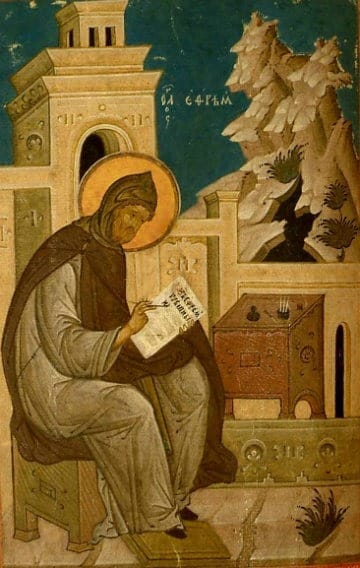 |
June 18: St. Ephraem the Syrian, Deacon, Confessor, and Doctor of the Church
ST EPHRAEM, monk and deacon, the contemporary of St Athanasius, St Basil, St Gregory of Nazianzen and St Gregory of Nyssa, was with them one of the glories of the Christian East so rich in testimonies to faith and sanctity during the first centuries. He takes his place in the liturgical cycle among the doctors of the Universal Church. It is only fitting that the ancient piety of Edessa and Nisibis should be represented in the Roman calendar.
by him who was always held to be the most illustrious of her sons. St Ephraem was honoured by the whole Church for the depth and vastness of his doctrine, and the whole Catholic world rejoiced when Pope Benedict XV pronounced him worthy to be placed among the great doctors of the Church both Greek and Latin. No one was more worthy than the celebrated Deacon of Edessa of such an honour. Even during his lifetime men delighted to honour him with such titles as illustrious ‘ doctor of the universe,' ‘prophet and sun of the Syrians,’ ‘pillar of the Church,' and ‘harp of the Holy Spirit.’1 All the Orthodox fathers and doctors from St Basil, St John Chrysostom and St Jerome down to St Francis de Sales and St Alphonsus Liguori are unanimous in his praise.2 Seldom has reputation been more brilliant, authority more universally acknowledged than that of the humble Syrian monk: less than twenty years after his death his writings were read publicly in church after the Scriptures.3 As theologian, poet and orator his literary work was immense. His writings comprise commentaries on the Scriptures, theological discourses and poems, moral and ascetic treatises, hymns in praise of Almighty God, our Lady and the saints. These form an inestimable treasure where successive generations have found not only weapons wherewith to combat error but also food to strengthen their souls. The works of St Ephraem, written in Syriac, were at an early date translated not only into Greek, but also into all the languages of the East—Coptic, Ethiopian, Arabic and Armenian—so that his hymns and canticles are to be found in all the liturgical books of the Syriac Church, both Orthodox and Uniate, which thus remains indebted to his fruitful genius.
St Ephraem was bom in Mesopotamia, very probably at Nisibis, on the frontier of the Roman Empire and Persia, at the beginning of the fourth century. Tradition says that his father fulfilled the duties of a priest to an idol in that town, but that his mother may have been a Christian.4 In any case he does not appear ever to have taken part in idolatrous worship, for we know that in his youth he was a member of the household of James, the bishop of Nisibis, one of the three hundred and eighteen fathers of the Council of Nicæa. He received baptism, and under the guidance of this bishop gave himself to prayer, to all the practices of Christian asceticism, to reading and profound study of the Scriptures. It was during this time that he acquired his remarkable knowledge and love of the Holy Scriptures so noticeable in all his writings and which is one of his chief characteristics. Later on he said: 'He who applies himself with simplicity and purity of heart to the study of the Sacred Books will receive the knowledge of God. Some people glory in conversing familiarly with the great ones of the earth, with princes and kings, but let it be your glory to converse with the Holy Ghost in the presence of the angels of God by reading the divine Scriptures, for it is the Holy Ghost who there speaks to you. Spare no pains to become familiar with this study.’5
The first verses of 'Hymns of Nisibis' show us what Ephraem was to James and his successors. These poems, the earliest of his that have come down to us, give us a picture of the times in which he lived. James, Babou and Vologesus found him a zealous auxiliary, intent upon upholding their authority, drawing men to them and ardently desirous of reform. His great influence on the people was shown especially when Nisibis was besieged by Sapor, king of the Persians. During those perilous days he incessantly encouraged the citizens to resist the enemy, strengthening the besieged by his word and example, until his courage and his prayer forced the enemy to acknowledge their powerlessness and retire. Later on, when as a result of the disastrous campaign of the emperor Julian against the Persians, his successor Jovian was forced to cede Eastern Mesopotamia with Nisibis to Sapor, Ephraem joined the emigrants who left for ever a town where Christians could no longer dwell in security.
From Nisibis St Ephraem went to Edessa, which name is for ever associated with his. On the west of the town there rises a hill on whose rocky slopes are numerous caves and tombs in which lived many anchorites. St Ephraem in his turn came to seek, among the rocks of the holy mountain, a retreat which would enable him to devote himself to prayer, study and penitential exercises. His knowledge of sacred sciences, however, could not long remain hidden, and disciples soon began to gather around him. This was the period of his literary activity, which was so great as to be almost miraculous. It was during the ten years that he passed in the capital of Osrhoene that he wrote most of his works. It was also the period of his greatest activity in religious affairs, and it seems certain that the School of Edessa, famous under the name of the Persian School, owes to him, if not its existence, at least a great part of its renown.
However, Edessa could not escape the ravages to which the spread of the heresies of Arms, Manes, Marcion and other sowers of discord subjected the whole world, and we owe a great number of St Ephraem’s theological discourses and poems to his solicitude in combating heresy under all its forms, and to his care in safeguarding the purity of faith among the Christians of the town. In obedience to the inspiration of divine grace,6 he left his solitude for a time to pour forth to the faithful exhortations so rich in imagery, so full of unction and of doctrine, that to this day the heart of the reader is moved. The holy doctor inveighs with much vigour against the Arians, who deny the Divinity of Christ. The following passage occurs in one of his sermons on the Passion: ‘The King of kings who is above all kings is the only Saviour Jesus, who sits at the right hand of his Father. He is his Word, his strength, his mighty arm; he descended from the height of heaven to the depths of the earth and ascended into heaven. He came down in secret, he ascended openly, he came down as the Word, he ascended with a human body, he descended and ascended according to his own will. Blessed be he who has acted according to his power. Men should be astonished and should admire the providence of the author of all grace who has abased himself even to us. Blessed be he who in his goodness has drawn from the ocean of his mercy the life that he has bestowed upon us. The Son of God is God, and God of God, he descended from heaven and conversed upon earth, he the power of preaching. The consuming fire which fell from heaven has become a dew for mankind, he who is all on fire has hidden his flame, the vehement God has restrained himself, there is no thunder in his voice nor lightning in his movements, the terrible God has hidden his majesty, the powerful God his force, wholly in heaven, he was wholly upon earth. When you consider him in heaven there is nothing to which you can liken him; when you consider him upon earth he seems to you to be simply a man. If you look towards heaven millions of angels serve him, and seraphim without number cry before him, Holy, holy, holy. If you look towards earth he is confined in a human body. “The foxes have holes, and the birds of the air have nests, but he who is the Son of God has not where to lay his head.”7 Indeed, where could he, who is the refuge of all, have sought shelter? Where could he have rested his head, he who is the pillar that sustains the universe, who upholds the earth and the heavens in either hand, and who in the hollow of his hand holds the seas and the world?’8
With equal energy and with remarkable doctrinal precision, St Ephraem asserts the prerogatives of St Peter. In the person of our Lord speaking to Simon Peter he says: ‘I have established you, Simon my disciple, as the foundation of holy Church. Formerly I called you Peter because you upheld my building, you are the overseer of those who construct the Church upon earth. If they wish to build that which is evil, you, who are the foundation, will prevent them. You are at the source of my doctrine, you are the chief of my disciples, it is through you that I will quench the thirst of all nations, the quickening sweetness that I give belongs to you, I have chosen you as the firstfruits of my disciples to be the inheritor of my treasures. I have given you the keys of my kingdom; I have given all my treasures into your power.’9
It is interesting to receive such testimony from the mouth of him whom all the Eastern Christians reverence as their greatest doctor and consider their special glory. But few of the fathers of the first centuries of Christianity have spoken so explicitly on the subject of the Holy Eucharist as the Deacon of Edessa. He discredits in advance all the sophistry put forth at the time of the Reformation, and thus comments on the words of the institution of the Sacrament of the Body and Blood of our Lord: ‘Do not believe that what I have just given to you is bread, receive it, eat it, do not crumble it away. That which I have called my Body, truly is so. The smallest morsel is sufficient to sanctify millions of souls and suffices to give life to those who receive it. Receive and eat with faith, do not waver, for it is my Body, and he who partakes of it with faith partakes of the fire of the Holy Spirit. It seems to him who partakes without faith to be but ordinary bread, but to him who with faith partakes of the Bread consecrated in my name, if he be pure it preserves his purity, if a sinner it obtains his pardon. Let those who reject, despise or outrage this Bread know that of a certainty they do outrage to the Son, who has called and has made bread to be his Body. Take and eat, and by it partake of the Holy Spirit, for it is truly my Body, and he who eats thereof has eternal life. It is the Bread of heaven come down from on high unto us. The manna which the Israelites ate in the desert, the manna which they gathered and which they despised although it fell from heaven, was a figure of the spiritual food you have just received. Take ye all of it and eat, in eating this Bread you eat my Body, the true source of the redemption.’10
In St Ephraem's time the people of Edessa still took pleasure in the poetical compositions of Bardesanes and his son Harmonius. A hundred and fifty years previously these impious men had spread abroad the errors of Gnosticism by means of these writings, and therefore St Ephraem, in his indefatigable zeal for the purity of the faith, resolved to defeat the heresy with its own arms. ‘When he saw how the inhabitants of Edessa delighted in songs,’ says his biographer, ‘he instituted plays and dances of his own for the young folk. He established choirs of nuns, whom he taught to sing hymns having a refrain between the verses. These hymns embody beautiful thoughts and spiritual instruction on the Nativity, the Baptism, the Fast and deeds of our Lord, the Passion, Resurrection and Ascension, as well as on the confessors, on Penance and the faithful departed. The religious came together on Sunday, on great feasts and on the festivals of the martyrs, and he in the midst of them like a father accompanied them on his harp. He divided them into two choirs, so that they might sing alternately, and taught them the various musical airs with such success that the whole town came to listen. Thus his adversaries were put to shame and disappeared.11
Readers of the Liturgical Year will have often noticed and admired the spirit of faith and tender piety which fills the poems of St Ephraem, whether he celebrates the mystery of the birth of our Saviour and borrows the voices of the Shepherds and Magi to render homage to the Infant God,12 or whether he extols the humility of St John the Baptist,13 or, again, in order to console mourners, he sings of the happiness of young children caught up to heaven in their innocence.14 But never does this harp of the Holy Ghost sound forth in more harmonious tones than when it sings of Mary and extols her incomparable virginity, her divine maternity or her merciful protection of mankind.15 It is well known that the eloquent Deacon of Edessa was one of the earliest of the fathers whose testimony to the privilege of the Immaculate Conception of the Blessed Virgin was brought forward. He addresses our Lord and his Mother in these words: 'Thou, O Lord, and thy Mother are the only ones who are perfectly beautiful in every respect, for in thee, O Lord, there is no blemish, and in thy Mother there is no stain.’16 The last years of St Ephraem's life were marked by an heroic act which seems to have made a great impression upon his contemporaries. There was a terrible famine in Edessa, which brought many other evils in its train. Moved by so much suffering, the holy anchorite left his cell for a time and took up his abode in the town. By his fervent exhortations he implored the rich to come to the help of their less fortunate fellow-citizens, and he knew how to call forth abundant alms, which he himself distributed. At the same time, by his arrangement, all who were sick were brought together, and night and day he laboured to procure for them such assistance and relief as the nature of their case demanded. He did not abandon his charitable ministrations until the city again enjoyed food in plenty.
St Ephraem returned once more to his solitude, and, feeling that his end was near, he composed for his disciples his last testament, a touching discourse of considerable length in which the dominant features of his character shine forth—his faith, hope, charity, humility, and zeal for the orthodox belief. We quote a few passages which reveal the characteristics of the soul of this great monk.
I, Ephraem, am dying, and I am writing a last testament so that I may leave to each one a souvenir in order that my friends may remember me even if only on account of my words. Alas! my life is finished and the term of my years is ended. The warp is finished and the threads must be cut. The lamp is nearly empty of oil, my days and my hours are fled away. The hired soldier has completed his year, the stranger has finished his time. My guards and executioners surround me on all sides. I groan and there is none to hear; I ask mercy and there is none to deliver me. Woe is thee, Ephraem, because of the judgement when thou wilt appear before the tribunal of the Son and thine acquaintance will stand on either side of thee. There will be thy shame; woe to him who shall be confounded there. O Jesus, be thou the Judge of Ephraem; do not hand him over to another to be judged, for he whom God will judge shall receive mercy at the tribunal.
I swear by him who descended from Mount Sinai, and who spoke upon the rock, by his mouth who said Eloi, and the bowels of the earth were shaken, by him who was sold by Judas and scourged in Jerusalem, by the might of him who was buffeted and by the majesty of him who was spit upon, by the three fiery names and by the one authority and will, that I have never separated myself from the Church nor have I ever doubted the power of God. If in my mind I have ever magnified the Father more than the Son may I be deprived of his loving mercy, and if I have ever lessened the authority of the Holy Spirit may blindness come upon me. If my life has not been in conformity with my speech may I be cast into exterior darkness, and if I speak hypocritically may I bum with the ungodly. If I recount these things through pride may our Lord condemn me at the judgement. . . .
When I think of my past life my knees tremble and my teeth chatter, and when I call to mind my deeds I am overcome with horror. For I have never done anything good, nothing worthy of praise since the day of my birth. Do not embalm me for burial, such honour is not due to me; do not place sweet perfumes upon my body, I am not worthy of such distinction. Bum the incense in the sanctuary, but encompass me with your prayers. Offer sweet perfumes to God and chant psalms for my soul. Instead of pouring perfumes and sweet savours over my body remember me in your prayers, for of what use are sweet odours to a dead man who has no senses with which to perceive them? Carry your incense to the house of God and there bum it that others may benefit thereby. Do not bury that which decays in silk which is useless to it, but rather leave in the pit that which cannot appreciate honours. Luxury belongs to the rich, the dunghill to the poor. Authority belongs to the royal family, but abjection and humility to the stranger and wayfarer. ...
Come, brethren, hearken unto me, for it is decreed that I may live no longer. Help me on my journey by your prayers, psalms and sacrifices. When the thirty days are over make a memento of me, brethren, for the dead are helped by the masses offered by the living. . . .
The one thing that gives me courage and hope before God is that I have never insulted my Saviour and no blasphemy has ever been uttered by my lips. Those who hated thee, Lord, I have hated and have abhorred thy enemies.17 Write my words upon your hearts and be mindful of what I say, for after I am dead evil persons will come among you in the clothing of sheep, but inwardly they are ravening wolves.18 Their speech is sweet, but the desires of their hearts are bitter; they have the appearance of good, but they are the messengers of Satan. Fly from them and from their doctrines; do not go near them, for you know that whoever is found in a place where outrage has been offered to the king has to come into court to be questioned according to law. Even if he can prove he was not guilty he will be condemned for want of zeal. Do not sit with heretics nor associate with apostates. It would be better to dwell with a demon than with a renegade. For if you abjure the demon he will flee, for he cannot stand before the name of Jesus, but even were you to exorcise the apostate ten thousand times he would not cease from his wickedness nor renounce his folly. It would be better to teach demons than to try to convince heretics. Demons bore witness, saying, “Thou art the Son of God,”19 but infidels and heretics daily contend pertinaciously that he is not the Son of God. Satan himself who dwells in them confesses the truth, but they assiduously deny it. . . .
O my disciples, hear my precepts and be mindful of my words. Do not depart from my faith nor be untrue to my lessons. When you hear of seditions and tumults in the world be constant and hold fast to the truth and your faith. . . .
Farewell, my friends, and pray for me, my beloved. The time has come for the merchant to return to his own country. Woe is me, my merchandise is gone and my riches are all spent. No one weeps over the death of the holy, because they pass from death to life; but weep for me, brethren, for we have wasted our days and hours in idleness. May peace abide on the earth and may her sons be joyful. May peace abide in the Church and may the persecution of the malicious cease. May the wicked become just and be converted from their sins.
Hail, O angel guide, who leadest the soul out of the body, parting them asunder that they may remain separated until the general resurrection. . . .20
Let us now read the account given of the illustrious Deacon of Edessa by the Church in her office of matins. The lessons record the chief features of this fruitful life.
Thy glory, O Ephraem, shines henceforward throughout the whole world. Let us join our feeble praise to that of East and West, which, in admiration of thy virtue, rises to thee this day. But we know that this praise will not be pleasing to thee unless we follow thy teaching and example in our lives. Help us to walk in those paths which thy writings and deeds have marked out so clearly for us, and above all strengthen our faith. Thou hast said that there is no richer man than he who has the faith. At a time when everything seems to conspire to diminish or obscure the truth, when ignorance joins with false doctrine to lessen its brightness and deter souls, obtain for us a holy eagerness to receive the doctrine of the Church, the expression of eternal truth; help us to be earnest in our search and zealous to keep and uphold it in all its purity. Inspire in us that hatred of error with which thy burning words inflamed the hearts of the faithful of Edessa, and which at thy death thou didst leave to them as thy last counsel and most precious gift.
O holy anchorite, help us to acquire all the Christian virtues, encourage within our souls the interior life, the sources of which, as thou hast taught us, are to be found where Christ himself has placed them—'that is, in the Sacraments, in the observance of the precepts of the Gospel and in the various exercises of piety which the liturgy affords and which the authority of the Church recommends to us.’21 We pray that by these means the virtue of charity, that is above all others, that is characterized by all the dispositions especially dear to Almighty God and is unable to exist without the presence of many other virtues, may ever be increasing in our souls. For, according to one of thine own graceful comparisons, even as the royal diadem lacks lustre if one of the gems is missing, so love of God and our neighbour cannot be perfect unless it be united in the other virtues.22
In order that we may dwell in charity and may safeguard our weakness from error and vice, we will live in fear of the last judgement, that terrible day thou hast described so eloquently, when the earth, sea and sky will be burnt up by a spark from the divine fire, when all men will be called upon to undergo a searching examination into each thought, word and deed. By thine assistance may we be faithful to our baptismal promises, so that on the last day we may be found worthy to take our place among the elect.
O holy doctor, who now before the divine altar and the Ruler of life art, with the angels, adoring the Blessed Trinity, be mindful of us and obtain for us the pardon of our sins that we may rejoice in the eternal happiness of the heavenly kingdom.23
- S Greg. Nyss., Vita S Ephraem; Lamy, S Ephraem Syri Hymni et Sermones, I Proleg. ↩︎
- Bened. XV Litt. encyl. Principi Apostolorum. ↩︎
- S Hier. De script. eccl., c. cxv. ↩︎
- Assemani, Bibl. Orient. i 26; Lamy, op. cit., iv, p. xxvii; Bouvy, “Les Sources historiques de la vie de saint Ephrem,” Revue augustinienne, Janvier, 1903. ↩︎
- Serm. de patientia et consummatione hujus sæculi. ↩︎
- S Greg, Nyss., op. cit. ↩︎
- St Matt. viii 20. ↩︎
- Discours sur la Passion, De Lamy, “ Étude de Patrologie orientale, saint Ephrem,” V Université catholique, 1890. ↩︎
- De Lamy, Discours sur la Passion, loc. cit. ↩︎
- De Lamy, Discours sur la Passion, loc. cit. ↩︎
- Rubens Duval, Littérature syriaque, p. 21. ↩︎
- Christmas, vol. i, p. 220; vol. ii, Passim. ↩︎
- Pentecost, vol. iii, p. 302. ↩︎
- Ibid., vol. vi, p. 193. ↩︎
- Bened. XV, loc. cit. ↩︎
- Carm. Nisib., n. 27. ↩︎
- Ps. cxxxviii 21. ↩︎
- St Matt. vii 15. ↩︎
- Ibid. viii 29. ↩︎
- Rubens Duval, Journal Asiatique, 1901. ↩︎
- Bened. XV, loc. cit. ↩︎
- Serm. de vita et exercit. monast. ↩︎
- S Greg. Nyss., loc, cit. ↩︎
June 18 (the Same Day): Sts. Mark and Marcellian, Martyrs
WE have already met with these noble athletes of to-day's feast; for on January 20, when celebrating St Sebastian, the brave defender of holy Church, Mark and Marcellian appeared at his side as the noblest conquest won by the sainted head of the praetorian guards. There are other heroes, likewise gained over by his zealous intrepidity, whose names gild the pages of the Martyrology; but these two, whose festival we are keeping, were the immediate occasion of Sebastian's leading to God so goodly a troop of valiant Christians. Their conversion prepared Sebastian’s martyrdom, by reason of his apostolate in their regard; and their glory eternally redounds to him around whom in heaven they form a resplendent phalanx.
Captivity, torments, and even the sentence of death pronounced upon them, had failed to shake the courage of these two brethren. A trial yet more terrible awaited them—namely, the sight forced upon them of the heartbroken grief caused to all they loved on earth by their sentence of condemnation; for their family, not being Christian, knew no bounds to sorrow. Their father and mother bent down by years, the wife of each, surrounded by a group of weeping children, all uttering bitterest reproaches against these soldiers of Christ for the destitution into which their coming death would plunge the survivors: such was the dire attack! Sebastian, profiting by the liberty his position afforded to approach the Christians in prison, was ever their comfort and encourager. He failed not to be present at this scene, for his noble heart fully realized how dangerously severe such a trial must be for souls as yet unscathed by any personal peril. The danger he knew might be imminent at that moment: wherefore, scorning his own safety, he there and then revealed himself a Christian, in order to hold out a strengthening hand to the two brethren. Moreover, God lent such wondrous efficacy to his words, that they converted even the pagans there assembled. Thus Mark and Marcellian had the joy of beholding those whose piteous complaints had a moment before so painfully thrilled their souls, now applauding their constancy and demanding baptism. Their unbounded happiness was evident all through their final conflict, which opened heaven to them, and which is related as follows in this short Lesson:
The Holy Ghost filled you with strength, O glorious martyrs; and the love which he poured into your hearts changed into exquisite delights torments that terrify our cowardice. Yet after all, of how much less account are those tortures that touched but your perishable body, compared with that intense anguish of soul over which you so nobly triumphed? The dire grief of those whom you held dearer far than life, and whom, to all appearance, you needs must leave in hopeless woe, was verily the culminating pitch of your martyrdom. Those alone can fail to realize this, who deserve the reproach cast by St Paul upon the pagans of his day, that they are without affection:1 when the world once more presents such a hateful spectacle as this, then will be the sign of the last day's near approach, so says the same apostle.2 Nevertheless, human love must cede to that of God: he that loveth father or mother more than me is not worthy of me: and he who loveth son or daughter more than me is not worthy of me.3 You understood all this, dear martyrs; your relatives, who would separate you from our Lord, became enemies in your eyes.4 At that very instant, Jesus, who can never let himself be outdone in generosity, restored these dear ones to you, by taking them, through a miracle of grace, together with you and because of your example, unto himself. Thus do you complete for us the instructions already given by Julitta and her boy, by Vitus and his glorious companions. Obtain for us, ye victors in such keen trials, an ever growing courage and love proportionate to our increase in the light and in the knowledge of our duty to God.
Tuesday after Trinity Sunday
The history of the blessed Eucharist is one with that of the Church herself: the liturgical usages, which have varied in the celebration of the most august of all the Sacraments, have followed the great social phases of the Christian world. This was a necessity; for the Eucharist is the vital centre, here below, whither everything in the Church converges; it is the inner bond which unites together that society of which Christ is the Head, the society whereby He is to reign over the nations, which are to be His inheritance.1 Union with Peter, the Vicar of Christ, must always be the indispensable condition, the external mark, of the union of the members with the invisible Head; but supported, in an ineffable manner, on the rock which bears the Church, the divine mystery wherein Christ gives Himself to each one of His servants must ever be the essential mystery of union; and, as such, the centre, and the bond, of the great Catholic communion. Let us, to-day, get a clear notion of this fundamental truth, on which was based the very formation of the Church, at her commencement; and let us consider the influence it exercised on the forms of eucharistic worship during the first twelve centuries. To-morrow, we will continue the subject, by examining how subsequent loss of fervour, and heresy, and social degeneracy, induced the Church to gradually modify these forms, which, after all, are but accidental: they were admirably adapted to the favoured times they had served, but would scarcely suit the changed circumstances and requirements of later generations of the Church's children.
It was on the eve of His Passion that our Lord instituted the great Memorial, which was to perpetuate; in all places, the one Sacrifice, whereby are perfected for ever they that are sanctified.2 The cross was 'the altar of the world,’ as St. Leo calls it;3 and on that cross, says the same holy Doctor, was made, a few hours after the last Supper, 'the oblation of the whole human nature; for the whole human race was united with this last act of infinite adoration and reparation, offered by its Head, to the supreme Majesty of God.’4 The Church, issuing with the Blood and water from the side of her Saviour, was then but in her infancy; and the mystery of divine union—which Jesus had come upon the earth to produce, by Himself uniting to the Father, in the Holy Ghost, the members of His mystical body—was to have its immediate realization in those members only by its successive application to each. This was the object of the sublime institution of the Eucharist at the last Supper. It was a new Testament, which gave to the future Church the possession of the mystery, whereby each generation would be linked on to its predecessors by the unity of the one Sacrifice, and would find in that same unity the mutual bond of its members.
Immediately after instituting this new Passover, Jesus said to His disciples: ‘A new commandment I give unto you: that ye love one another, as I have loved you: and, by this shall all men know that ye are My disciples.’5 This was Jesus’ first injunction to His disciples after giving Himself to them in the Eucharist; this love of, and union with, each other, was to be the mark of the Covenant, which He then, through His apostles, contracted with all those who were to believe in Him through the word of their preaching.6 His very first prayer, after that first giving of His Body and Blood under the eucharistic species, is for that same union of His faithful one with another; a union admirable as is the mystery which produces and maintains it; a union so intimate, that its model is the union existing between Jesus and His eternal Father: May they all be one, as Thou, Father, in Me, and I in Thee; that they may be made perfect in one.7
Under the direction of the holy Spirit, the Church understood, from the very first, the intentions of her divine Master. The three thousand, who were converted on the day of Pentecost, are described, in the Acts, as persevering in the doctrine of the apostles, in the communication of the breaking of bread, and in prayers.8 And so great is the power of union derived from their all partaking of the heavenly Bread, that they were remarked by the Jews as a class of men forming a society distinct from every other, which won the esteem of all that beheld them, and drew others daily to join them.9
A few years later the Church, led on by the same holy Spirit, passed beyond the narrow limits of Judea, and carried her treasures to the Gentiles. It was a world of corruption, where all was discord between man and man, and where the only remedy for the outrages of individual egotism was the tyranny of a Cæsar. Into such a world the Christians came, and showed it, from east to west, the marvel of a new people, which, by the sole influence of its virtues, recruited its members from every class of society, and from every dime, and was stronger and more united than any nation that had ever appeared on earth. The pagans were in admiration at this strange and inexplicable novelty; without knowing what they were doing, without troubling themselves with any further inquiry, they bore testimony to the perfection wherewith these Christians fulfilled the dying wishes of their Founder; they thus spoke of them: ‘See how they love one another!’
It was, indeed, a mystery; but the faithful, the initiated, understood it; for it had been thus explained to them by the apostle: ‘We, being many, are one bread, one body, all that partake of one Bread.’10
This text is admirably commented by St. Augustine in a sermon he preached to the neophytes, a few hours after their Baptism: ‘I remember,’ he says, 'the promise I made, of explaining to you, who have been baptized, the mystery of the Lord’s Table, which you now see, and of which you were made partakers in the night just past. . . That Bread which you see on the altar, that Bread which has been sanctified by the word of God, is the Body of Christ: that chalice, or, rather, what that chalice contains, which has been sanctified by the word of God, is the Blood of Christ. By these did Christ our Lord will to give us His Body and His Blood, which He shed for us, unto the remission of our sins. If you have properly received them, you are what you have received, for the apostle says: “We, being many, are one bread, one body.” It is thus that he expounded the Sacrament of the Table of the Lord: We, being many, are one bread, one body. We are, by this Bread, instructed how we are to love unity. Was this Bread made out of one grain P Were there not many grains of wheat P But, before they came to be bread, they were separated one from the other; they became joined by means of water, and by a certain bruising: for, unless the wheat be ground, and be moistened with water, it could never take the form we call bread. It was the same with you, until you were, so to say, ground by the humiliation of fasting, and by the sacrament of exorcism. Baptism and water came to you; you were moistened, that so you might come to the state of bread. But, even so, there is no bread without fire. What, then, does fire signify P It is the chrism; for the oil which makes our fire is the Sacrament of the Holy Ghost. . . The Holy Ghost, therefore, comes; after water, comes fire; and you are made Bread, which is the Body of Christ. . . Christ willed that we should be His Sacrifice—the Sacrifice of God. . . Great, very great are these mysteries! . . Do you so receive them, as to take care that you have unity in your hearts.11 Be one, by loving one another, by holding one faith, one hope, and undivided charity. When the heretics receive this Bread, they receive testimony against themselves; for they are seeking to make division, whereas this Bread is the sign of unity.’12 The Scripture, speaking of the first Christians, says that they had but one heart and one soul;13 and it is the unity which is signified by the wine in the holy mysteries. ‘For,’ continues St. Augustine, ‘the wine was once in so many bunches of grapes; but now it is all one, one in the sweetness of the chalice; for it has gone through the crushing of the wine-press. So you, after those fastings, and labours, and humility, and contrition, have come, in the name of Christ, to the chalice of the Lord; and you are there on that table, and there in that chalice. You are there together with us, for we have eaten together, and drunk together, and that because we live together.14 Thus did Christ our Lord (by the wine made one out of many grapes) signify us, and He wished us to be one with Him, and, by His Table, consecrated the mystery of our peace and unity.’15 These admirable expressions of St. Augustine are but the substance of the doctrine regarding the holy Eucharist, held by the Church in the fourth century. They give us the very essence of that doctrine, in all its fulness and in all the clearness of its literal truth; no other could have been given to neophytes, who, up to that time, had been kept in complete ignorance of the august mysteries, of which they were henceforth to partake. Of the discipline of that secrecy we shall have to speak a little further on. The doctrine of the Eucharist here laid down by the great bishop of Hippo, is identical with that given by all the fathers. In Gaul, St. Hilary of Poitiers,16 and Saint Cesarius of Arles;17 in Italy, Saint Gaudentius of Brescia:18 at Antioch and Constantinople, St. John Chrysostom;19 at Alexandria, St. Cyril:20 all had the same way of putting this dogma of faith before their people. Christ is not divided: the Head and the members, the Word and His Church are inseparably one in the unity of the mystery instituted for the very purpose of producing that unity. And this unanimous teaching of the fathers, who lived in the golden age of Christian eloquence, was reproduced by Paschasius Radbert, in the ninth century,21 by Rupert in the twelfth,22 and by William of Auvergne in the beginning of the thirteenth.23
It would be too long to give the names, and still more to quote passages, in testimony of how all the Churches, for the first twelve centuries, looked upon the holy Eucharist in this same way, that is, as instituted for the purpose of union. If we follow this traditional teaching back to the apostolic source whence it originated, we shall find St. Cyprian, in the age of persecution, speaking to his people upon the union between the divine Head and His members, which is the necessary result of the holy Sacrament; he shows this, not only by the nature of bread and wine, the essential elements for the consecration of the mysteries, but likewise by the mingling of water with the wine in the eucharistic cup: the water, he says, signifies the faithful people; the wine denotes the Blood of Christ; their union in the chalice—union necessary for the integrity of the Sacrifice, union the most complete and inseparable—expresses the indissoluble alliance between Christ and His Church, which consummates the Sacrament.24 The same St. Cyprian shows that the unity of the Church by the Chair of Peter, which is the subject of one of his finest treatises, is divinely established on the sacred mysteries; he speaks enthusiastically of the multitude of believers, the 'Christian unanimity’ being held together, in the hoods of a firm and indivisible charity, by the Sacrifice of our Lord Jesus Christ.25 Christ in His Sacrament, and Christ in His Vicar, is, in reality, but the one same Rock that bears the building which is erected upon it; the one sole Head, visible in His representative, His Vicar, and invisible in His own substance in the Sacrament.
This sentiment of union, as the result of the Eucharist, was rooted in the soul of the early Church; her very mission was to bring about the union of all the children of God, that were dispersed throughout the world;26 and when the violence of her enemies obliged her to provide her children with some secret sign, whereby they might recognize each other, and not be recognized by pagans or persecutors or blasphemers, she gave them the mysterious icthus, the fish, which was the sacred symbol of the Eucharist. The letters which form the Greek word for fish (icthus) are the initials of a formula in the same language, which gives this sentence: Jesus Christ, Son of God, Saviour. The fish is shown to us in the Book of Tobias27 as a figure of Christ, who is the food of the wayfarer, casts out the devil by His virtues, and gives light to the world grown old in iniquity. Again: it is not without a prophetic and mysterious purpose, that the fish is mentioned in Genesis, as being blessed by the Creator, at the commencement of the world, just as man himself was.28 It is found with the bread miraculously multiplied in the Gospel, when our Lord prefigures the marvels of the Eucharist. It is brought again to our notice, after the Resurrection; it is found lying on hot coals, and is offered by Jesus, together with bread, as a repast to seven of His disciples, on the banks of lake Tiberias.29 Now, what is this fish, this bread? The fathers answer: Christ is the Bread of that mysterious repast; He is the Fish taken from the living water, and is roasted on the altar of the cross by the fire of His love, and feeds the disciples on His own substance, and offers Himself to the entire world as the true icthus.30 No wonder, then, that we find this sacred symbol on almost everything that the Christians of the first three centuries possessed; on precious stones, rings, lamps, inscriptions, paintings, there was the fish, in some shape or other. It was the watchword, the tessera of the Christians, in those days of persecution. An inscription of the second century, discovered in modern times at Autun, thus speaks of the Christians: ‘This divine race of the heavenly icthus, this noble-hearted race, receive from the Saviour of the saints the nourishment which is sweet as honey, and drink long draughts of the divine fount, holding icthus in their hands.’31 A holy bishop of Asia Minor of that same early period, by name Aberoius of Hierapolis, who was divinely led into various lands, everywhere recognizes the disciples of Christ by the holy fish, which makes all, however separated by distance, to be one. ‘I have,’ says he, shortly before the close of his life of travel, ‘I have seen Rome: I have beheld the queen city, in her robes and sandals of gold; I have made acquaintance with the people decked with bright rings. I have visited the country of Syria, and all her cities. Passing the Euphrates, I have seen Nisibis; and all people in the east were in union with me, for we all formed but one body; everywhere, faith presented to all, and gave as nourishment to all, the glorious and holy icthUs, which came from the only fount, and was taken by the most pure Virgin.’32
This, then, was the bond of that mighty union between Christians, which was such a puzzle to the pagan world; and the more the real cause of that unity was kept concealed from its eyes, so much the more violent was the fury wherewith it attacked the Church. Our Lord had said: ‘Give not that which is holy to dogs; neither cast ye your pearls before swine.’33 These words contained, in principle, the discipline of secrecy, which was observed in the Church till the conversion of the western world was completed. The holiness of the Sacraments, the sublimity of the Christian doctrines, necessitated an extreme reserve on the part of the faithful, living amongst people whose moral degradation and brutal corruption were such as our Saviour had foretold. But it was most of all imperative to hide from the stare and sacrilege of pagans the most holy Eucharist, that ‘great pearl of the sacred Body of the Lamb,’ as Venantius Fortunatus calls it.34 Hence the Christian assemblies, when they met for divine worship, were divided into two classes, the initiated and the uninitiated, i.e. the faithful and the catechumens. The distinction began with the apostolic age, and was kept up till the eighth century. A few weeks before the solemn administration of Baptism, there took place, as we have elsewhere explained,35 the giving, or as it was termed, the tradition,, of the Symbol, to the future members of the Church; but the eucharistic mystery, the arcanum by excellence, was, even then, kept back from the fortunate candidates for holy Baptism. This explains the varied precautional expressions, the reticence, the studied obscurity of phraseology, used by the fathers in their discourses to their flock, and this for years after the times of Constantine and Theodosius. The catechumens were admitted while the holy Scriptures were being read, or while the Psalms were being chanted; but as soon as the bishop had given his discourse on the portion which had been read, either of the Gospel or other passages of the sacred Volume, these catechumens were dismissed by the deacon; and this missa, or missio, gave its name to that first portion of the liturgy; it was called the Mass of the catechumens; just as the second part, from the oblation to the final dismissal, was called the Mass of the faithful.
And yet, though holy mother Church kept so jealous an eye on her treasure as not to let it be fully known except to her true children, made such by Baptism, with what delight did she, at the feasts of Easter and Pentecost, reveal to her new-born children, as soon as they came from the font, the ineffable secret hitherto kept in her heart as bride, the full mystery of the icthus! Having incorporated them into Christ by the saving waters, enrolled them in His army, and marked them with the sign of His soldiers by the anointing conferred by the bishop, with what maternal fondness did she lead them, from the baptistery first, and then from the chrismarium, to the hallowed precinct of the mysteries instituted by the Word Incarnate! There Jesus, their Head, was awaiting His new members, that He might draw all the more closely the bonds which already knit them to His mystic body, and unite them to Himself in the infinite homage of that one great Sacrifice, which He Himself was offering to the eternal Father.
This wondrous unity of the Eucharistic Sacrifice, which included in one oblation both Head and members; this unity of Sacrifice, which kept alive and strengthened the union of each Christian community and of the whole Church, was admirably expressed by the magnificent forms of the primitive liturgy. After the catechumens had been dismissed and the unworthy expelled, all the faithful, without exception, from the emperor and his court down to the poorest cottager whether man or woman, advanced towards the altar, each one offering bis share of bread and wine for the sacred mysteries. Themselves a kingly priesthood, as St. Peter calls them,36 a living victim figured by the gifts they brought, they assisted, standing, at the immolation of the divine Victim, whose members they truly were; then united in the kiss of peace, the external sign of their union of heart, they received in their hands, and still standing, the sacred Body, their spiritual nourishment; the deacons offered them the chalice, and they drank of the precious Blood. Even babes in their mothers’ arms were eager for the divine drink, and received some drops, at least, into their innocent mouths. The sick, who could not leave their rooms, and prisoners, were not deprived of being united with their brethren in the sacred banquet; they received the precious Gifts at the hands of ministers, who were sent to them for the purpose by the bishop. The anchorets in their deserts, Christians living in the country, and all such as could not be present at the next assembly, took the Body of our Lord with them, that thus they might not, because of distance, be deprived of uniting in the coming celebration of the mysteries of salvation. Those were ages when unity was continually being attacked by persecution, schism, and heresy, all three at once; and the Church, to counteract the danger, had no hesitation in facilitating, by every lawful means, the use and application of the venerable Sacrament, which is the sign of unity, and the innermost centre, and the strongest tie, of the Christian community.
It was from the same principle of unity, that, although there were generally several churches or centres in each city for the assemblies of the faithful, and a greater or less number of clergy, yet all the faithful and clergy came together for the collect or synaxis, into some one place, fixed upon by the bishop. ‘Where the bishop shall show himself,' says St. Ignatius of Antioch, ‘there let the multitude be; just as, where Christ Jesus is, there is the Catholic Church. It is not lawful, either to baptize, or to celebrate the agape (the Eucharist) without the bishop.37 Do all of you assemble, for prayer, in the one same place; let there be unity of common prayer, unity of mind, unity of hope. . . Do all of you come together, as though you were one man, into the temple of God, as to one altar, as to one Christ Jesus, the great high-priest of the unborn God.38 Let us enjoy the one Eucharist; for one is the Flesh of our Lord Jesus, and one His Blood which was shed for us; one also is the Bread which was broken to us all, and one the Cup which was distributed to all; one altar to the whole Church, and one bishop surrounded by the presbyterium and the deacons.’39
The presbyterium was the college of priests of each city; they kept near the bishop, were his council, and celebrated the sacred functions together with him. It would seem that, at the beginning, they were twelve in number, the more closely to represent the apostles; but in the great cities that number was soon doubled. We find that, towards the close of the first century, there were, in Rome, five and twenty priests, who were respectively set over twenty-five titles, that is, churches, of the metropolis. The pontiff took first one, and then another, of these titles, for the celebration of the mysteries. The twentyfour priests of the other titles united with the pontiff in the solemnity of one and the same Sacrifice, and concelebrated at one and the same altar. In their respective places, the seven deacons, and all the inferior clerics, each according to his rank, co-operated in the thrice holy mysteries. We have already seen the active part taken in the same by the faithful people.
It was the very time when the eagle of Patmos, St. John the Evangelist, was being favoured with his inspiration and vision of the gorgeous ritual of heaven. He beheld the Lamb that was slain, yet standing in the midst of the four and twenty Elders who were seated on thrones encircling the throne of God, which is also the throne of the eternal High Priest. Clad in white garments, and wearing golden crowns, these four and twenty Elders held harps in their hands, and golden vials full of odours, which are the prayers of saints. Then came the seven spirits, who were before the throne of God, like so many burning lamps; and then, thousands of thousands of angels, who were round about the throne, singing praise to the Sacrifice and triumph of the Lamb; and then, every creature, which is in heaven, and on the earth, and under the earth, and such as are in the sea, all cried out, giving benediction, and honour, and glory, and power, to Him that liveth for ever and ever.40 This admirable vision represented the fullness and unity of the Sacrifice, which was offered once, but to last for ever, end was offered by Him who is the Head of all created beings. The Church on earth, the exiled bride of Jesus, did her best, when offering that same Sacrifice, to repeat the sublime ritual of heaven. And as in heaven the divine Lamb, the eternal High Priest, drew after Him the celestial hierarchy, so likewise on earth all the Churches came round the officiating pontiff, and united with him in the holy Sacrifice, each one according to the sacred Order he held.
It was impossible for the universal Church, subject as she is to the conditions of place and time, to meet here below at one altar; but the unity of the Sacrifice, which was everywhere offered, was, like the unity of the Church herself, expressed by the mutual transmission, between the various bishops, of the sacred Species that had been consecrated by them; and these, each one put into the chalice from which he received the precious Blood. St. Irenæus,41 who lived in the second century, tells us that the supreme hierarch, the Pontiff of Rome, used to send these sacred gifts, not only to Churches in the west, but even into Asia, as emblems of the unity existing between the Churches there, and the Church, the mistress and mother of all others. So, too, when the number of the faithful became so great as to induce the Church to allow individual priests to celebrate the holy mysteries privately, the priests of the town where a bishop resided never thought of exercising this isolated function, until they had received from the bishop a fragment of the Bread he had consecrated, and which they mingled with their own Sacrifice. It was the fermentum, the sacred leaven of Catholic communion.
As an appropriate conclusion to the above subject, we append the following beautiful liturgical formula taken from the Apostolic Constitutions,42 a writing admitted by critics to have been completed in the third century.
Thanksgiving for the Mysteries
- Ps. ii. 8. ↩︎
- Heb. x. 14. ↩︎
- Serm, viii. de Pass. ↩︎
- Ibid. iv. ds Pass. ↩︎
- St. John xiii. 34, 35. ↩︎
- Ibid. xvii. 20. ↩︎
- Ibid. 21-23. ↩︎
- Acts ii. 42. ↩︎
- Acts ii. 47. ↩︎
- 1 Cor. x. 17. ↩︎
- Serm, ccxxvii. In die Paschæ. Ad Infantes, de Sacramentis. ↩︎
- Serm. ccxxix. Fer. ii. Paschæ, de Sacramentis fidelium. ↩︎
- Acts iv. 32. ↩︎
- Serm. ccxxix. ↩︎
- Ibid. cclxxii. In die Pentecost. Ad Infantes, de Sacramentis. ↩︎
- Lib. viii. de Trinit. ↩︎
- Hom. vii. ↩︎
- Serm. ii. ad Neoph. ↩︎
- In cp. i, ad Cor. Hom xxiv. ↩︎
- Lib. x. in Johan. ↩︎
- De corp. et sang. Domini., cap. x. ↩︎
- De div. Off., lib. ii., c. 2. ↩︎
- De Sacrament. Euchar. cap iv. ↩︎
- Ep. lxiii. ↩︎
- Ep. lxxvi. ↩︎
- St. John xi. 52. ↩︎
- Tob. vi. ↩︎
- Gen. i. 22, 28. ↩︎
- St. John xxi. 9. ↩︎
- St. Paulin. Ep. xiii; St. Aug. Confess, xiii. 23: St. Ambr. Hymn. Pasch; Proep. African. De promission. ↩︎
- Inscript. Augustod. Spicileg. Solesm. i. ↩︎
- Titul. Abercii. Spicileg Solesm. iii. ↩︎
- St. Matt. vii. 6. ↩︎
- Vernant. Fortun. lib. ii. carm. 25. ↩︎
- Volume for Lent; Wednesday of the fourth week. ↩︎
- 1 St. Pet. ii. 9. ↩︎
- Ad Smyrn. viii. ↩︎
- Ad Magnes. vii. ↩︎
- Ad Philadelph. iv. ↩︎
- Apoc. iv, v. ↩︎
- Ap. Euseb. Hist. Eccles. lib. v. cap. 14. ↩︎
- Lib. vii. cap. 25. ↩︎
| Previous Monday after Trinity Sunday | Next June 18 (the Same Day): Sts. Mark and Marcellian, Martyrs |