Daily reading
After Pentecost
Double · Movable from Easter · Temporal
June 21, 2019
From Dom Guéranger’s The Liturgical Year.
 |
Friday within the Octave of Corpus Christi
God has satisfied the intense desires of man’s heart. The house of the marriage-feast, built by divine Wisdom on the top of mountains, has had flowing unto it all the nations of earth.1 Yesterday, the whole Catholic world was animated with sentiments of love towards the adorable Sacrament; and the people said to each other, in a holy transport of gratitude: ‘Come! let us go up to the mountain of the Lord, and to the house of the God of Jacob.’ Yesterday, the Bud of the Lord was seen by us all in magnificence and glory;2 this divine Bud, this rich ear of corn that has sprung up from our earth, was carried in triumph, and excited the enthusiasm of the faithful, making them rejoice before It, as they that rejoice in the harvest.3 It was a heavenly harvest, that had been the expectation of nations. It was the precious ear of corn, despised indeed by Israel, but gleaned by Ruth, the stranger, in the field of the true Booz, in Bethlehem.
It is for this day of the great meeting of nations, foretold by Isaias, that the Lord had kept reserved on the mountain the feast on a victim such as had never been seen before, a feast of wine, the richest and purest.4 The poor have eaten at this banquet, and they have given fervent praise to their God; the rich have eaten, and have fallen down in adoration; and all the ends of the earth, prostrate in His sacred Presence, have recognized that He who thus gave them to feast was Christ their King.5 'This,' they said, ‘is our God, we have waited for Him;6 we have patiently waited for Him; He was the desire of our soul; we desired Him in the night, and, in the morning early, our first thoughts were upon Him; He is the Lord, and His remembrance could not be effaced, even through the long ages of expectation.7 Thou, O Lord, art my God, I will exalt Thee, and give glory to Thy name, for Thou hast done wonderful things; Thy designs of old, faithful; faithfully hast Thou fulfilled Thy eternal decrees.’8
These expressions of love on the part of the human race were but a feeble echo to the infinite love which God vouchsafed to have for His creature man. The divine Spirit, who has achieved the wonderful union between the children of Adam and eternal Wisdom, shows us, everywhere in the Scriptures, that this Wisdom was impatient of delay, that He was taking each obstacle as it came, and removing it, and was preparing, in countless ways, for the marriage-feast so much longed for.
We will devote these first two days of the octave to considering the leading features in the history of this eucharistic preparation; we shall be well repaid by the additional light which these truths will reflect upon the dogma itself. We are going to review the loving ways whereby eternal Wisdom sought, for so many long ages, to bring about His own union with ourselves. As a matter of course, we clothe these truths in Scripture language, for the Scriptures are our guide in this research; it is they that tell us the workings of the divine intentions in our regard. How, then, do the Scriptures speak of these, before the mystery of the Incarnation was actually accomplished?
The second Person of the adorable Trinity is there brought before us under the name of Wisdom: until the time of His union with man being accomplished in the most perfect degree possible, that is, in our Lord Jesus Christ, this is the name under which He passes in the Scriptures, a name which gives Him the appearance of a Bride. But once the mystery of perfect union is achieved, another name is given Him, the name of Spouse, or Bridegroom. His other name of Wisdom seems almost forgotten; and yet, in the ages of lively faith, it was not so; the people of those days were too full of the Scriptures to forget it. Thus we find the first Christian emperor dedicating, to this ruler and centre of his every thought, the trophy of his victory over paganism, and that of the triumph of the martyrs. ‘All burning with love for the Wisdom of God,' says Eusebius,9 Constantine consecrated the ancient Byzantium, which he called by his own name, to the God of the martyrs;10 and dedicated to eternal Wisdom the grandest structure of this new Rome, Saint Sophia, which for many ages was the finest Christian church in the world. Like our forefathers in the faith, let us, too, honour divine Wisdom, and gratefully think upon the love which urged Him, from all eternity, to unite Himself to man!
It is this love that explains the mysterious joy, which, as the Scripture tells us, He had at the beginning of time, when this world of ours was being gradually developed in all the beauty of its fresh creation; for sin had not then come in, to break the harmony of this work of the Most High. At each additional manifestation of creative power, Wisdom takes delight, and by His delight, adds a new charm to this the future scene of the divine marvels, planned as those have been by His love. This Wisdom is delighted at the omnipotence which produces creation; He plays every day, as the creation goes on; He plays in this world, for each progress in its formation brings man nearer, man whose palace it is, and His delights are to be with the children of men.11
Incomprehensible love! It precedes, though it foresees sin; and though foreseeing it, loves not the less! It has its divine delights to be with us, and we have attractions for it, in spite of all the bitterness caused by the sight of our future black ingratitude! The fall of man will, as one of its terrific consequences, modify much and cruelly the earthly existence which Wisdom is to have upon our earth. But in order that we may the more easily understand, and more fully appreciate, how immense must that love be, which could be proof against such obstacles, let us turn our thoughts, to-day, to the course that these loving intentions would have taken, had man persevered in the state of innocence. Although the sacred Scriptures were written for the benefit of fallen man, and are ever telling us of the mystery of the restoration of the sinful world, yet do they make frequent allusions to God’s original intention; and with these to guide us, it is not difficult to mark out the leading features of the primitive plan.
Wisdom, speaking of Himself, says: ‘The Lord possessed me, ir the beginning of His ways.’12 Is He not the first of all creatures?13 Not, of course, as to that divine form of which the apostle speaks, and by which Wisdom is equal to God,14 but in that human existence, which He has selected, in preference to all other possible natures, for the one whereby to unite Himself with finite being. That selection was one of an unlimited and most gratuitous love; it made the type and law of entire creation to be One who would so closely resemble us human beings. What an honour! We are told in holy Writ that the most high and almighty Creator created wisdom before all things, and created her in the Holy Ghost; and that, taking her as His type, and number, and measure, He poured her out upon all His works, and upon all flesh.15 When the fullness of the appointed time came, divine Wisdom Himself was to come, giving to all creation, of which He was the head and centre, its purpose and meaning. He was to blend and unite with the infinite homage, which resulted from His own divine personality, the homage of every existing creature, and thus give perfection to the external glory of the Father by His own eternal and infinite adoration. Then was to appear the dignity of that human nature, chosen by divine Wisdom, from the beginning, to be His created form, and the instrument of that homage to the Father, which is perfect and divine, because of the personal union of this created nature with the Nature of God the Son. Eternal Wisdom will thus be one with the Son of the purest of virgins; the nuptial-song will be taken up by all creatures, both in earth and heaven; and through this Son of Man, who will then be called the Spouse, Wisdom will continue, to the end of time, in the soul of every individual that does not refuse the honour, the ineffable mystery of His divine marriage with our nature.
He wishes, then, to unite Himself with each one of us. But what means will He adopt for this deifying union? Of all the Sacraments, which our Lord might have instituted after His Incarnation, in the supposition of man’s not forfeiting his state of innocence, there is not one, says Suarez, which has so many probabilities on its side, as the Eucharist; there is not one which, in itself, is so desirable, and so independent of sin; for the notion of expiation, which, in our present state, lingers about It, as the memorial of Jesus’ Passion, may be prescinded from It without affecting the essence of the Sacrament—that essence being the real Presence of our Lord, and the close union whereby He unites us to Himself.16 It is the same with the Eucharist as a Sacrifice: the primary notion of sacrifice, as we shall see further on, does not absolutely include the idea of sin. So that, when Christ, as the head of the human family, comes into this world, to offer up a Sacrifice in the name of us all, that Sacrifice will be one which is worthy of His Father and of Himself. Spouse as He is, and by virtue of the divine unction Priest too, it is by the Eucharist as a Sacrifice that He will act in this twofold character; for by that Sacrifice He brings the human race into union with Himself by the embrace of the sacred Mysteries; and, when He has divinized it by union with Himself, making it one body of which He is the Head, He offers it to His eternal Father.
But for the coming of the Spouse there must be a numerous retinue, to do Him honour and tell His praises, when the day arrives for His entrance into the banquet-hall; and from now till the time when earth, being peopled enough, shall have ready for her King-Priest a court that is worthy of Him, so many ages are to intervene! What will Wisdom be doing in the interval? We have already seen how in the early days of creation He played before His Father, and was all transported with delight. But when the work was done, the Creator withdrew into the repose and rest of the seventh day. Seated on His Father’s right hand, in the splendours of the Saints, will Wisdom wait inactive for that day to come, when He, who has begotten Him before the day-star and has betrothed Him to human nature, shall send Him down to this earth, there to consummate the alliance, for which He has been eternally longing? The sacred Scriptures give a very different description of Him, during the time preceding His actual coming. They tell us that Wisdom is so active, though so gentle, that He is more active than all active things, and was everywhere, and put Himself in every place, and in the Prophets, so that He was easily found by them that wished to find Him; He even anticipated their research, and was more ready to show Himself, than they could possibly be to find Him. If any soul was intent, like some early riser, to find Him, He soon met such a seeker; nay, Himself went about seeking for such as were worthy of Him, and when He met them in the ways, here or there in this wide world, this beautiful Wisdom would show Himself to them with all cheerfulness. Thus do the Scriptures describe Wisdom as engaged during the ages preceding His Incarnation. He does not, as yet, quit the throne of glory on which He sitteth, lighting up all heaven with His beauty, but He is preparing the day of His marriage, by impressing it on man’s mind and notice in every possible way; He meets him at every turn to speak of it, to tell him of how He, Wisdom, loves him; He selects certain symbols of the wondrous mysteries He intends to achieve when the time comes. Let us take one of these symbols for our lesson to-day, that we may not lose a particle of what Jesus has ever done to make Himself known. But before we go further, let us listen to the Scripture character drawn of this beautiful Wisdom: He is the brightness of eternal light, and the unspotted mirror of God’s majesty, and the image of His goodness; holy, one, manifold, subtle, eloquent, active, undefiled, sure, sweet, loving that which is good, quick, which nothing hindereth, beneficent, gentle, kind, steadfast, assured, secure, having all power, overseeing all things, and containing all spirits, intelligible, pure, subtile!17 And now to a choice symbol chosen by Jesus, whereby He spoke of Himself, before He came to the nuptials.
The Lord God, says Scripture, had planted a paradise of pleasure from the beginning, wherein He intended to place man, whom He was not to create till the sixth day. In the midst of this paradise there grew a tree of singular beauty, to which God had attached a great mystery; its name was the tree of life. A river, with four streams, watered this garden of delights;18 it was shown later on to Saint john as a river of water of life, dear as crystal, proceeding from the throne of God and of the Lamb.19 The tree and the river bear no allusion to future sin; they had been put in paradise, the abode of innocence, before man himself; they are portions of the primitive plan of God; and therefore, in themselves, signify only what has reference to the state of innocence. Now, an ancient writer, published under the name of St. Ambrose, says: ‘The tree of life in the midst of paradise, is Christ in the midst of His Church.’20 ‘So then,’ says St. Augustine, ‘Christ was the tree of life; neither would God have man to live in paradise, without presenting to him mysteries of things spiritual under corporal forms. In the other trees, therefore, he had food; but in that one (of life), he had a sacred symbol (sacramentum). And what is it that was symbolized, but Wisdom, of which it is said, She is a tree of life to them that lay hold on her?21 For it is right to give to Christ the name of a thing which had been made in order to signify Him.’22 St. Hilary, too, bears testimony to this same traditional interpretation. After quoting the same text from Proverbs, he says: ‘Wisdom, which is Christ, is called the tree of life; because, as we are taught by the authority of the Prophets, on account of its being a symbol (sacramentum) of His future Incarnation and Passion, our Lord compared Himself to a tree, when He said: A tree is known by its fruit. . . . This tree, then, is living; yea, not living only, but rational also, for it gives its fruit when it wills, and, as the Psalm says, in its own time. And what is that time? That of which the apostle speaks, when he says that God might make known unto us the mystery of His will, according to His good pleasure which He had purposed in him, in the dispensation of the fullness of times: the dispensation of the fruit, then, is reserved for the fullness of times.’23 But what is to be the fruit of this tree—the leaves of which fall not off,24 and are for the healing of the nations25—but divine Wisdom, in His own very self and substance? In His divine form He is the food of the angels too; but He is to be that of man in His two Natures, that thus, by His Flesh, reaching man’s soul, He may fill that soul with His Divinity, as it was beautifully expressed in the Office composed by Blessed Juliana.26
Thus, therefore, divine Wisdom had preceded man in paradise: Adam was not yet there, but Wisdom was; for His love made Him hasten thither, and take up His abode there, ready to receive man on his arrival, in that tree of life, which He, together with the Most High, had planted in the garden of delights. Speaking of this tree, the bride of the Canticle said: ‘As the apple-tree among the barren trees of the woods, so is my Beloved among the sons of men; I sat down under His shadow whom I desired, and His fruit was sweet to my palate.’27 This sweet fruit of the tree of life was a figure of the Eucharist.
But how is this? we were yesterday invited by Wisdom to eat bread in His house, and not fruit in His garden. What means this change of language? It is because man has brought about an immense change of purpose: in his pride, he has eaten of a fruit which was not good, a forbidden fruit, the eating of which has ruined him; he has been driven from the garden of delights; Cherubim and a flaming sword have been placed, to keep the way of the tree of life. Instead of fruits of paradise, the food of man is, henceforth, to be bread, which costs toil and sweat, bread, which means grinding under a millstone, and burning with fire. Such is the sentence passed on man by a justly angered God.28 But alas! this most just condemnation is to go far beyond the guilty one; it will strike man, but it will strike divine Wisdom, too, who has given Himself to man to be his food and companion. In the immensity of His love, Wisdom will not abandon this fallen nature of man; He will, that He may save it, take upon Himself all the consequences of the fall, and, like fallen man, will become passible and mortal. The marriage-feast is not to be in Eden, as was first intended. Poor Eden! she had been so exquisitely prepared for that feast; she had her fragrant fields of loveliest emerald, and her fruit which was so fair to behold, and so pleasant to eat of,29 and so immortalizing with a youth that was to last for ever! To reach man, now that he is fallen, eternal Wisdom must make His way through the briars and thickets of His new abode. The marriage-feast will be kept in a house, which it has cost Him infinite pains to build to Himself, as a cover against the miseries of the land of exile. And as to the food served for the banquet, it is not to be the fruit spontaneously yielded by the tree of life; it is to be the divine Wheat, ground by suffering, and baked on the altar of the cross.
All history culminates in the sacrifice of our Lord, and all creation converges to it, as to its centre. The reason of this is, that, in the creation and government of the world, God seeks His own glory, as the last end for which He does all His works. Now, the Sacrifice offered by the Incarnate Word alone gives to God the infinite glory due to His sovereign majesty. The Christians of the first ages of the Church thoroughly understood all this. It is the idea which inspired the fine Preface of the liturgy given under the name of St. James, in the eighth book of the Apostolic Constitutions. We wish we could give our readers the whole of this liturgy: we intend, however, to quote, during the days of this octave, some of the most striking passages.
Constitutio Jacobi.
And, after all these, thou madest by him this visible world and all that is in it. For thou art he that stretchedst out the heavens as a tent, and settedst the earth upon nothing, by thine only will; that madest night and day; that, in the heavens, placedst the sun to rule the day, and the moon to rule the night, and inscribedst a choir of stars in heaven unto the praise of thy magnificence; thou dividedst the great sea from the land, replenishing the one with animals little and great, and filling the other with creatures, both tame and wild, crowning it with herbs, beautifying it with flowers, enriching it with seeds.
We will close this day with the several hymns, composed under the direction of Blessed Juliana; they were used for each of the Little Hours of the Office, which preceded that of St. Thomas. It was a custom of the Church of Liège to vary the hymns, at these Hours, according to the different seasons and feasts.
At Prime
Qui ob salutem mentium
Coelestis alimouiæ
Nobis præstas remedium;
Rege momentis omnibus,
Et beatis accelera
Vitam dare cum civibus.
who, for the salvation of souls,
grantest us the remedy of a food
that comes from heaven.
and works; and give us speedily
to spend our life
with the blessed citizens of heaven.
At Tierce
Pietatis mysteria
Mentes pascunt dulcedine,
Qua satiant coelestia.
Nobis commune gaudium,
Illis quod sese præstitit,
Nobis quod se non abstulit.
the mystery of love
feeds our souls with a sweetness,
which contents even them that are in heaven.
let us have one same joy,
for, to them he gave himself,
and us he did not leave.
At Sext
Laudisque Sacrificium,
Cœnam tui da numinis
Tuæ carnis post prandium.
Ad hoc cruci configeris,
Et irrisus ludibriis
Crudeli morte plecteris.
O Sacrifice of praise!
grant us the banquet of thy Divinity,
after this of thy Flesh.
thou wast nailed to the cross,
and derided with scoffs,
wast made to suffer a cruel death.
At None
Lux beata credentium,
Redemptionis hostia,
Tuarum pastus ovium;
Diræ mortis supplicio
Nos de lacu miseriae
Educ, qui clamas: Sitio.
Præsta, per almum Spiritum:
Quibus hoc das edulium
Prosperum serves exitum.
the blessed light of believers,
the victim of redemption,
and the pasture of thy sheep!
of thy cruel death,
lead us from the abyss of misery,
O thou that criest: I thirst.
grant through the Spirit of love,
that we, to whom thou givest such nourishment as this,
may be brought by thee to a prosperous end.
- Is. ii. 2. ↩︎
- Ibid. iv. 2. ↩︎
- Ibid. ix. 3. ↩︎
- Ibid. xxv. 6. ↩︎
- Ps. xxi. 27-30. ↩︎
- Is. xxv. 9. ↩︎
- Is. xxvi. 8, 9. ↩︎
- Ibid. xxv. 1. ↩︎
- De Vita Constant. lib. iii. cap. 48. ↩︎
- Ibid. ↩︎
- Prov. viii 30, 31. ↩︎
- Ibid. viii. 22. ↩︎
- Ecclus. i. 4. ↩︎
- Philipp, ii 6. ↩︎
- Ecclus. i. 4. 8-10. ↩︎
- De Sacr. Disp. iii. sect. 3. ↩︎
- Wisd. vii. 22-26; vi. 13-17; ix. 4, 10. ↩︎
- Gen. ii. 8-10. ↩︎
- Apoc. xxii. 1. ↩︎
- Append. Ambros, In Apocalyps. c. ii. v. 7. ↩︎
- Prov. iii. 18. ↩︎
- De Genes. ad Litt. lib. 8. ↩︎
- Tract in psalm. 1, 9, 10. ↩︎
- Ps. i. 3. ↩︎
- Apoc. xxii. 2. ↩︎
- Page 146. ↩︎
- Cant. ii. 3. ↩︎
- Gen. iii. 19. ↩︎
- Gen. ii. 9. ↩︎
June 21: St. Aloysius Gonzaga, Confessor
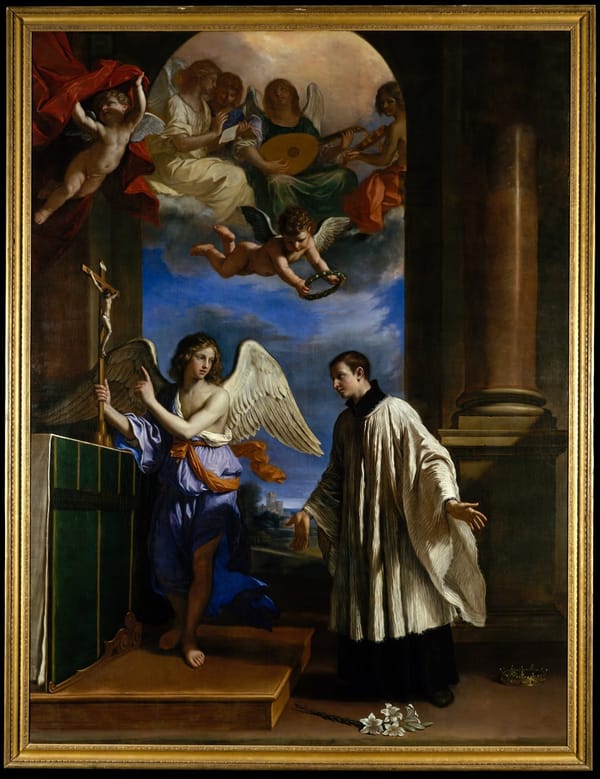 |
OH! how exceeding great is the glory of Aloysius, son of Ignatius! Never could I have believed it, had not my Jesus shown it to me. Never could I have believed that such glory was to be seen in heaven!’ Thus cries out St Mary Magdalene de Pazzi, whose memory we were celebrating a month ago: she is speaking in ecstasy. From the heights of Carmel, whence her ken may reach beyond the heavens, she reveals to earth the splendour wherewith the youthful hero of this day shines amidst the celestial phalanxes.
Yet short was the life of Aloysius, and it had offered nothing to the superficial gaze of a vast majority, save the preliminaries, so to say, of a career broken off in its flower before bearing fruit of any kind. Ah! God does not take account of things as men do; of very slight weight are their appreciations in his judgement! Even in the case of saints themselves, the mere fractional number of years, or brilliant deeds, goes far less to the filling up of a lifetime, in his view, than does love. The usefulness of a human existence ought surely to be measured by the amount produced in it of what is lasting. Now beyond this present time charity remains alone, fixed for ever at the precise degree of growth attained during this life of passage. Little matters it, therefore, if ithout any long duration or any apparent works, one of God’s elect has developed in himself a love as great as, or greater than, some others have done, in the midst of many toils, be they never so holy, and throughout a long career admired of men.
The illustrious Society that gave Aloysius Gonzaga to holy Church owes the sanctity of her members and the benedictions poured upon their works to the fidelity she has ever professed to this important truth, which throws so much light on the Christian life. From the very first age of her history, it would seem that our Lord Jesus, not content with allowing her to assume his own blessed name, has been lovingly determined so to arrange circumstances in her regard that she may never forget wherein her real strength lies, in the midst of the actively militant career which he has especially opened before her. The brilliant works of St Ignatius her founder; of St Francis Xavier, the apostle of the Indies; of St Francis Borgia, the noble conquest of Christ’s humility; manifested truly wondrous holiness in them, and to the eyes of all; but these works had no other spring or basis than the hidden virtues of that other glorious triumvirate, in which, under the eye of God alone, by the sole strength of contemplative prayer, SS Stanislaus Kostka, Aloysius Gonzaga, and John Berchmans rose to such a degree of love, and consequently to the sanctity of their heroic fathers.
Again, it is by Mary Magdalene de Pazzi, the depositary of the secrets of the Spouse, that this mystery is revealed to us. In the rapture during which the glory of Aloysius was displayed before her eyes, she thus continues, while still under the influence of the Holy Ghost: 'Who could ever explain the value and the power of interior acts? The glory of Aloysius is so great simply because he acted thus interiorly. Between an interior act and that which is seen, there is no comparison possible. Aloysius, as long as he dwelt on earth, kept his eye attentively fixed on the Word; and this is just why he is so splendid. Aloysius was a hidden martyr; whosoever loveth thee, my God, knoweth thee to be so great, so infinitely lovable, that keen indeed is the martyrdom of such a one, to see clearly that he loves thee not so much as he desireth to love thee, and that thou art not loved by thy creatures, but art offended! . . . Thus he became a martyrdom unto himself. Oh! he did love while on earth! Wherefore now in heaven he possesses God in a sovereign plenitude of love. While still mortal, he discharged his bow at the heart of the Word; and now that he is in heaven, his arrows are all lodged in his own heart. For this communication of the Divinity, which he merited by the arrows of his acts of love and of union with God, he now verily and indeed possesses and clasps for ever.’
To love God, to allow his grace to turn our heart towards infinite Beauty, which alone can fill it, such is then the true secret of highest perfection. Who can fail to see how this teaching of to-day’s feast answers to the end pursued by the Holy Ghost ever since his coming down at our glorious Pentecost? This sweet and silent teaching was given by Aloysius, wheresoever he turned his steps, during his short career. Bom to heaven, in holy Baptism, almost before he was born to earth, he was a very angel from his cradle; grace seemed to gush from him into those who bore him in their arms, filling them with heavenly sentiments. At four years of age he followed the marquis his father into the camps; and thus some unconscious faults, which had not so much as tarnished his innocence, became for the rest of his life the object of a penitence that one would have thought beseemed some grievous sinner. He was but nine years old when, being taken to Florence, there to be perfected in the Italian language, he became the edification of the court of duke Francis:1 but though the most brilliant in Italy, it failed to have any attraction for him, and rather served to detach him more decisively than ever from the world. During this period, likewise, at the feet of the miraculous picture of the Annunziata, he consecrated his virginity to our Lady.
The Church herself, in the Breviary Lessons, will relate the other details of that sweet life, in which, as is ever the case with souls fully docile to the Holy Ghost, heavenly piety never marred what was of duty in earthly things. It is because he was a true model for all youth engaged in study, that Aloysius has been proclaimed their protector. Of a singularly quick intelligence, as faithful to work as to prayer in the gay turmoil of city life, he mastered all the sciences then exacted of one of his rank. Very intricate negotiations of worldly interest were more than once confided to his management: and thus was opportunity afforded of realizing to what a high degree he might have excelled in government affairs. Here, again, he comes forward as an example to such as have friends and relatives who would fain hold them back, when on the threshold of the religious state, under pretence of the great good they may do in the world, and how much evil they may prevent. Just as though the Most High must be contented with useless nonentities in that select portion of men He reserves to himself amidst nations; or, as though the aptitudes of the richest and most gifted natures may not be turned all the better and all the more completely to God, their very principle, precisely because they are the most perfect. On the other hand, neither State nor Church ever really loses anything by this fleeing to God, this apparent throwing away of the best subjects! If, in the old law, Jehovah showed himself jealous in having the very best of all kinds of goods offered at his altar, his intention was not to impoverish his people. Whether admitted or not, it is a certain fact that the chief strength of society, the fountain-head of benediction and protection to the world, is always to be found in holocausts well pleasing to the Lord.
‘Venerable old age is not that of long time, nor counted by the number of years: but the understanding of man is grey hairs; and a spotless life is old age.’2 And therefore, Aloysius, thou dost hold a place of honour amidst the ancients of thy people! Glory be to the holy Society in the midst whereof thou didst, in so short a space, fulfil a long course; obtain that she may ever continue to treasure, both for herself and others, the teaching that flows from thy life of innocency and love. Holiness is the one only thing, when life is ended, that can be called a true gain; and holiness is acquired from within. External works count with God, only in as far as the interior breath that inspires them is pure; if occasion for exercising works be wanting, man can always supply that deficiency by drawing nigh unto the Lord, in the secrecy of his soul, as much as, and even more than, he could have done by their means. Thus didst thou see and understand the question; and therefore prayer, which held thee absorbed in its ineffable delights, succeeded in making thee equal to the very martyrs. What a priceless treasure was prayer in thine eyes, what a heaven-lent boon, and one that is indeed in our reach too, just as it was in thine! But in order to find therein, as thou didst express it, 'the short cut to perfection,' perseverance is needed and a careful elimination from the soul, by a generous selfrepression, of every emotion which is not of God. For how could muddy or troubled waters mirror forth the image of him who stands on their brink? Even so, a soul that is sullied, or a soul that without being quite a slave of passion is not yet mistress of every earthly perturbation, can never reach the object of prayer, which is to reproduce within her the tranquil image of her God.
The reproduction of the one great model was perfect in thee; and hence it can be seen how nature (as regards what she has of good), far from losing or suffering aught, rather gains by this process of recasting in the divine crucible. Even in what touches the most legitimate affections, thou didst look at things no longer from the earthly point of view; but beholding all in God, far were the things of sense transcended, with all their deceptive feebleness, and wondrously did thy love grow in consequence! For instance, what could be more touching than thy sweet attentions, not only upon earth, but even from thy throne in heaven, for that admirable woman given thee by our Lord to be thine earthly mother? Where may tenderness be found equal to the affectionate effusions written to her by thee in that letter of a saint to the mother of a saint, which thou didst address to her shortly before quitting thine earthly pilgrimage? And still more, what exquisite delicacy thou didst evince, in making her the recipient of thy first miracle, worked after thine entrance into glory! Furthermore, the Holy Ghost, by setting thee on fire with the flame of divine charity, developed also within thee immense love for thy neighbour: necessarily so, because charity is essentially one; and well was this proved when thou wast seen sacrificing thy life so blithely for the sick and the plague-stricken.
Cease not, O dearest saint, to aid us in the midst of so many miseries; lend a kindly hand to each and all. Christian youth has a special claim upon thy patronage, for it is by the Sovereign Pontiff himself that this precious portion of the flock is gathered around thy throne. Direct their feeble steps along the right path, so often enticed to turn into dangerous by-roads; may prayer and earnest toil, for God's dear sake, be their stay and safeguard; may they be enlightened in the serious matter before them of choosing a state of life. We beseech thee, dearest saint, exert strong influence over them during this most critical period of their opening years, so that they may truly experience all the potency of that fair privilege which is ever thine, of preserving in thy devout clients the angelical virtue! Yea, furthermore, Aloysius, look compassionately on those who have not imitated thine innocence, and obtain that they may yet follow thee in the example of thy penance; such is the petition of holy Church this day!
| Previous June 20: St. Silverius, Pope and Martyr | Next June 21: St. Aloysius Gonzaga, Confessor |