Daily reading
After Pentecost
Double of the I Class · July 1 · Sanctoral
July 1, 2019
From Dom Guéranger’s The Liturgical Year.

|
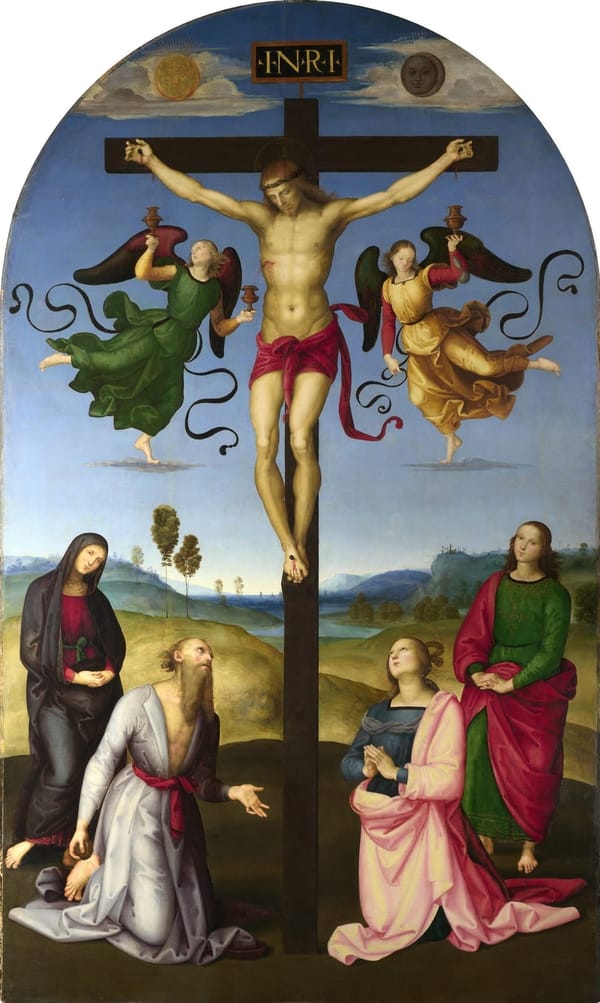
July 1: Feast of the Most Precious Blood of Our Lord Jesus Christ
JOHN the Baptist has pointed out the Lamb, Peter has firmly established his throne, Paul has prepared the bride; their joint work, admirable in its unity, at once suggests the reason for their feasts occurring almost simultaneously in the cycle. The alliance being now secured, all three fall into shade; whilst the bride herself, raised up by them to such lofty heights, appears alone before us, holding in her hands the sacred cup of the nuptial-feast.
This gives the key of to-day's solemnity, revealing how its appearance in the heavens of the holy liturgy at this particular season is replete with mystery. The Church, it is true, has already made known to the sons of the new covenant, in a much more solemn manner, the price of the Blood that redeemed them, its nutritive strength and the adoring homage which is its due. On Good Friday earth and heaven beheld all sin drowned in the saving stream, whose eternal flood-gates at last gave way beneath the combined effort of man's violence and of the love of the divine Heart. The festival of Corpus Christi witnessed our prostrate worship before the altars whereon is perpetuated the Sacrifice of Calvary, and where the outpouring of the precious Blood affords drink to the humblest little ones, as well as to the mightiest potentates of earth, lowly bowed in adoration before it. How is it, then, that holy Church is now inviting all Christians to hail, in a particular manner, the stream of life ever gushing from the sacred fount? What else can this mean, but that the preceding solemnities have by no means exhausted the mystery? The peace which this Blood has made to reign in the high places as well as in the low; the impetus of its wave bearing back the sons of Adam from the yawning gulf, purified, renewed and dazzling white in the radiance of their heavenly apparel; the sacred Table outspread before them on the waters’ brink, and the chalice brimful of inebriation—all this preparation and display would be objectless, all these splendours would be incomprehensible, if man were not brought to see therein the wooings of a love that could never endure its advances to be outdone by the pretensions of any other. Therefore, the Blood of Jesus is set before our eyes at this moment as the Blood of the Testament; the pledge of the alliance proposed to us by God;1 the dower stipulated by eternal Wisdom for this divine union to which he is inviting all men, and its consummation in our soul which is being urged forward with such vehemence by the Holy Ghost.
‘Having therefore, brethren, a confidence in entering into the Holies by the Blood of Christ,' says the apostle, ‘ a new and living way which he hath dedicated for us through the veil—that is to say, his flesh—let us draw near with a pure heart in fullness of faith, having our hearts sprinkled from an evil conscience, and our bodies washed with clean water, let us hold fast the confession of our hope without wavering, for he is faithful that hath promised. Let us consider one another to provoke unto charity and to good works.2 And may the God of peace who brought again from the dead the great Pastor of the sheep, our Lord Jesus Christ, in the Blood of the everlasting Testament, fit you in all goodness, that you may do his will: doing in you that which is well-pleasing in his sight, through Jesus Christ, to whom is glory for ever and ever. Amen!'3
Nor must we omit to mention here, that this feast is a monument of one of the most brilliant victories of holy Church in our own age. Pius IX had been driven from Rome in 1848 by the triumphant revolution; but the following year, just about this season, his power was re-established. Under the aegis of the apostles on June 28 and the two following days, the eldest daughter of the Church, faithful to her past glories, swept the ramparts of the eternal city; and on July 2, Mary’s festival, the victory was completed. Not long after this, a twofold decree notified to the city and to the world the Pontiff’s gratitude and the way in which he intended to perpetuate, in the sacred liturgy, the memory of these events. On August 10, from Gaeta itself, the place of his exile in the evil day, Pius IX, before returning to reassume the government of his States, addressing himself to the invisible Head of the Church, confided her in a special manner to his divine care, by the institution of this day's festival; reminding him that it was for his Church that he had vouchsafed to shed all his precious Blood. Then, when the Pontiff re-entered his capital, turning to Mary, just as Pius V and Pius VIII had done under other circumstances, the Vicar of Christ solemnly attributed the honour of the recent victory to her who is ever the help of Christians; for on the feast of her Visitation it had been gained; and he now decreed that this said feast of July 2 should be raised from the rite of double major to that of second class throughout the whole world. This was a prelude to the definition of the dogma of the Immaculate Conception, which the immortal Pontiff had already projected, whereby the crushing of the serpent’s head would be completed.
Mass
The Church, formed by the apostles from all the nations under heaven, advances towards the altar of the Spouse who hath redeemed her in his Blood, and in the Introit hails his merciful love. She, henceforth, is the kingdom of God, the depository of truth.
Introit
The Blood of the Man-God, being the pledge of peace between heaven and earth, the object of profoundest worship, the centre of the whole liturgy, and our assured protection against all the evils of this present life, deposits, even now, in the souls and bodies of those whom it has ransomed, the germ of eternal happiness. The Church, therefore, in her Collect, begs of the Father, who has given us his only-begotten Son, that this divine germ may not remain sterile within us, but may come to full development in heaven.
Collect
Epistle
Cap. ix.Fratres, Christus assistens Pontifex futurorum bonorum, per amplius et perfectius tabemaculum non manufactum, id est, non hujus creationis: neque per sanguinem hircorum aut vitulorum, sed per proprium Sanguinem introivit semel in Sancta, æterna redemptione inventa. Si enim sanguis hircorum et taurorum, et cinis vitulæ aspersus inquinatos sanctificat ad emundationem carnis: quanto magis Sanguis Christi, qui per Spiritum sanctum semetipsum obtulit immaculatum Deo, emundabit conscientiam nostram ab operibus mortuis, ad serviendum Deo viventi? Et ideo novi Testamenti Mediator est: ut morte intercedente, in redemptionem earum prævaricationum quæ erant sub priori Testamento, repromissionem accipiant, qui vocati sunt, ætemæ hæreditatis: in Christo Jesu Domino nostro.
Ch. ix.Brethren, Christ, being come a High Priest of the good things to come, by a greater and more perfect tabernacle not made with hands, that is, not of this creation, neither by the blood of goats or of calves, but by his own Blood, entered once into the Holies, having obtained eternal redemption. For if the blood of goats and of oxen, and the ashes of an heifer being sprinkled, sanctify such as are defiled, to the cleansing of the flesh, how much more shall the Blood of Christ, who through the Holy Ghost, offered himself without spot to God, cleanse our conscience from dead works to serve the living God? And, therefore, he is the Mediator of the New Testament; that by means of his death, for the redemption of those transgressions which were under the former Testament, those that are called may receive the promise of eternal inheritance; in Christ Jesus our Lord.
The Epistle that has just been read to us is the confirmation of what we were saying above, as regards the special character of this festival. It was by his own Blood that the Son of God entered into heaven; this divine Blood continues to be the means whereby we also may be introduced into the eternal alliance. Thus, the old Covenant, founded on the observance of the precepts of Sinai, had likewise by blood consecrated the people and the law, the tabernacle and the vessels it was to contain; but the whole was but a figure. 'Now,' says St Ambrose, 'it behoves us to tend to truth. Here below, there is the shadow; here below, there is the image; up yonder, there is the truth. In the law was but the shadow; the image is to be found in the Gospel; the truth is in heaven. Formerly a lamb was immolated; now Christ is sacrificed, but only under the signs of the mysteries, whereas in heaven it is without veil. There alone, consequently, is full perfection unto which our thoughts should cleave, because all perfection is in truth without image and without shadow.'4 There alone is rest: thither, even in this world, do the sons of God tend; without indeed attaining fully thereunto, they reach nearer and nearer day by day; for there alone is to be found that peace which forms saints.
‘O Lord God,’ cries out in his turn another illustrious doctor, the great St Augustine, ‘give us this peace, the peace of repose, the peace of the seventh day, of that Sabbath whose sun never sets. Yea! verily the whole order of nature and grace is very beautiful unto thy servitors, and goodly are the realities they cover; but these images, these successive forms, bide only awhile, and their evolution ended they pass away. The days thou didst fill with thy creations are composed of morning and of evening, the seventh alone excepted, for it declineth not, because thou hast for ever sanctified it in thine own rest. Now what is this rest, save that which thou takest in us, when we ourselves repose in thee, in the fruitful peace which crowns the series of thy graces in us? O sacred rest, more productive than labour! the perfect alone know thee, they who suffer the divine hand to accomplish within them the work of the six days.'5
And the apostle goes on to say, interpreting by means of other parts of Scripture his own words, just read to us by holy Church,'And therefore to-day if ye shall hear his voice, harden not your hearts.'6 The divine Blood has made us participators of Christ: it is our part not to squander, as though it were worthless, this immense treasure, this initial incorporation which unites us to Christ, the divine Head; but let us abandon ourselves, without reserve, to the energy of this precious leaven, whose property it is to transform our whole being into him. Let us be afraid lest we fall short of the promise referred to in to-day's Epistle, that promise of our entering into God's rest, as St Paul tells us. It regards all believers, he says, and this divine Sabbath is for the whole people of the Lord. Therefore, let us make haste to enter in; let us not be like those Jews whose incredulity excluded them for ever from the promised land.7
The Gradual brings us back to the great testimony of the love of the Son of God, confided to the Holy Ghost, together with the Blood and Water of the Mysteries: a testimony which is closely linked here below with that which is rendered by the Holy Trinity in heaven. If we receive the testimony of men, the testimony of God is greater, sings the Verse. What is this but to say, once again, that we must absolutely yield to these reiterated invitations of love? None may excuse himself by pleading either ignorance or want of vocation to a higher state than that to which tepidity inclines him. Let us hearken to the apostle addressing himself to all, in this same Epistle to the Hebrews: ‘Yea, verily; great and ineffable are these things. But if you have become little able to understand them, it is your own fault; for whereas for the time you ought to be masters, you have need to be taught again what are the first elements of the words of God: and you are become such as have need of milk, though your age would require the solid meat of the perfect. Wherefore, as far as concerns us in our instructions to you, leaving the word of the elementary teaching of Christ, let us go on to things more perfect, not laying again the foundation of penance from dead works, and of faith towards God. Have you not been illuminated? have you not tasted also the heavenly gift? have you not been made partakers of the Holy Ghost? What showers of graces at every moment water the earth of your soul! It is time that it bring in a return to God who tills it. Ye have delayed long enough: be now, at last, of the number of those who by patience and faith shall inherit the promises, casting your hope like an anchor sure and firm, which entereth in even within the veil, where the forerunner Jesus has entered for us—that is, to draw us in thither after him.'8
Gradual
Gospel
Cap. xix.In illo tempore: Cum accepisset Jesus acetum, dixit: Consummatum est. Et inclinato capite, tradidit spiritum. Judæi ergo (quoniam Parasceve erat), ut non remanerent in cruce corpora Sabbato (erat enim magnus dies ille Sabbati), rogaverunt Pilatum, ut frangerentur eorum crura, et tollerentur. Venerunt ergo milites: et primi quidem fregerunt crura, et alterius qui crucifixus est cum eo. Ad Jesum autem cum venissent, ut viderunt eum jam mortuum, non fregerunt ejus crura; sed unus militum lancea latus ejus aperuit, et continuo exivit sanguis et aqua. Et qui vidit, testimonium perhibuit: et verum est testimonium ejus.
Ch. xix.At that time, when Jesus had taken the vinegar, he said: It is consummated. And bowing his head, he gave up the ghost. Then the Jews (because it was the Parasceve) that the bodies might not remain upon the cross on the Sabbath-day (for that was a great Sabbath-day), besought Pilate that their legs might be broken, and that they might be taken away. The soldiers therefore came, and they broke the legs of the first, and of the other that was crucified with him. But after they were come to Jesus, when they saw that he was already dead, they did not break his legs. But one of the soldiers with a spear opened his side, and immediately there came out blood and water. And he that saw it hath given testimony, and his testimony is true.
On Good Friday we heard for the first time this passage from the beloved disciple. The Church, as she stood mourning at the foot of the cross whereon her Lord had just died, was all tears and lamentation. To-day, however, she is thrilling with other sentiments, and the very same narration that then provoked her bitter tears now makes her burst out into anthems of gladness and songs of triumph. If we would know the reason of this, let us turn to those who are authorized by her to interpret to us the burthen of her thoughts this day. They will tell us that the new Eve is celebrating her birth from the side of her sleeping Spouse;9 that from the solemn moment when the new Adam permitted the soldier's lance to open his Heart, we became, in very deed, bone of his bone and flesh of his flesh.10 Dc not be surprised if holy Church sees naught but love and life in the Blood which is gushing forth.
And thou, O soul, long rebellious to the secret touches of choicest graces, be not disconsolate; do not say: ‘Love is no more for me!' How far away soever the old enemy may, by wretched wiles, have dragged thee, is it not still true, that to every winding way, perhaps even to every pitfall, the streamlets of this sacred fount have followed thee? Thinkest thou, perhaps, that thy long and tortuous wanderings from the merciful course of these ever pursuant waters may have weakened their power? Do but try; do but, first of all, bathe in their cleansing wave; do but quaff long draughts from this stream of life; then, O weary soul, arming thyself with faith, be strong, and mount once more the course of the divine torrent; for, as in order to reach thee it never once was separated from its fountain-head, so likewise be certain that by so doing thou needs must reach the very source itself. Believe me, this is the whole secret of the bride—namely, that whencesoever she may come, she has no other course to pursue than this, if she would hear the answer to that yearning request expressed in the sacred Canticle: 'Show me, O thou whom my soul loveth, where thou restest in the midday!'11 Indeed, by reascending the sacred stream, not only is she sure of reaching the divine Heart, but moreover she is ceaselessly renewing, in its waters, that pure beauty which makes her become in the eyes of the Spouse an object of delight and glory to him.12 For thy part, carefully gather up to-day the testimony of the disciple of love; and congratulating Jesus with the Church, his bride and thy mother, on the brilliancy of her empurpled robe,13 take good heed likewise to conclude with St John: ‘ Let us then love God, since he hath first loved us.'14
The Church, whilst presenting her gifts for the sacrifice, sings how that chalice which she is offering to the benediction of her sons, the priests, becomes by virtue of the sacred words the inexhaustible source whence the Blood of her Lord flows out upon the whole world.
Offertory
The Secret begs for the full effect of the divine alliance, of which the Lord's Blood is both the means and the pledge, since its effusion continually renewed in the sacred Mysteries has hushed the cry of vengeance that the blood of Abel had sent up from earth to heaven.
Secret
Preface
The Communion antiphon hails the merciful love of which our Lord gave proof by his coming, not suffering himself to be turned aside from his divine projects by the accumulation of crimes which he must destroy in his own Blood, in order to purify the bride. Thanks to the adorable mystery of faith operating in the secret of hearts, when he shall come again visibly, nothing will remain of this sad past but a memory of victory.
Communion
Inebriated with gladness at the Saviour's fountains, his sacred Wounds, let us pray that the precious Blood now empurpling our lips may remain unto eternity the living source whence we may ever draw beatitude and life.
Postcommunion
Vespers
Yesterday, at the opening of the feast, the Church sang: 'Who is this that cometh from Bosra, in Edom, with his robe so richly dyed? Comely is he in his vesture! It is I,' replied he, ' I whose word is full of justice, I who am a defender, to save.' He that spoke thus was clad in a garment dyed with blood, and the name given unto him is the Word of God. ‘ Wherefore, then,' continued the Church, 'is thy robe all bespotted, and thy garments like to those who tread in the wine press? I have trodden the winepress alone, and among men none was there to lend aid.’
Thus did he appear, by the virtue of his divine Blood, to whom the psalmist exclaimed: ‘Arise in thy glory and beauty, march forward unto victory!'15 After this first sublime dialogue concerning the Spouse, another, this morning, pointed out to us the bride drawing for herself from this precious Blood that superhuman loveliness which beseems the nuptial banquet of the Lamb. The Lauds antiphons brought upon the scene the members of holy Church, especially her martyrs in whom her radiant beauty glitters most of all: 'These who are clad in white robes, who are they, and whence come they? These are they who have come out of great tribulation, and have washed their robes in the Blood of the Lamb. This is why they stand before the throne of God, ministering to him day and night. They have conquered the dragon by the Blood of the Lamb and the word of the Testament. Blessed are they who have washed their robes in the Blood of the Lamb!’
This evening the Church returns to her Lord, repeating at her Second Vespers the same antiphons as at her First.
Ps. Dixit Dominus, p. 35.
Ps. Confitebor tibi Domine, p. 37.
Ps. Beatus vir, p. 38.
Ps. Laudate pueri, p. 39.
Psalm 147
Quoniam confortavit seras portarum tuarum: benedixit filiis tuis in te.
Qui posuit fines tuos pacem: et adipe frumenti satiat te.
Qui emittit eloquium suum terræ: velociter currit senno ejus.
Qui dat nivem sicut lanam: nebulam sicut cinerem spargit.
Mittit crystallum suam sicut bucellas: ante faciem frigoris ejus quis sustinebit?
Emittet verbum suum, et liquefaciet ea: flabit spiritus ejus, et fluent aquæ.
Qui annuntiat verbum suum Jacob: justitias et judicia sua Israel.
Non fecit taliter omni nationi: et judicia sua non manifesta vit eis.
Because he hath strengthened the bolts of thy gates: he hath blessed thy children within thee.
Who hath placed peace in thy borders: and filleth thee with the fat of corn.
Who sendeth forth his speech to the earth; his word runneth swiftly.
Who giveth snow like wool: scattereth mists like ashes.
He sendeth his crystal like morsels: who shall stand before the face of his cold?
He shall send out his word, and shall melt them: his wind shall blow, and the waters shall run.
Who declareth his word to Jacob: his justices and his judgements to Israel.
He hath not done in like manner to every nation: and his judgements he hath not made manifest to them.
Capitulum (Heb. ix.)
Hymn
Cives lætitiam frontibus explicent:
Tædis flammiferis ordine prodeant
Instructi pueri et senes.
Fudit multiplici vulnere Sanguinem,
Nos facti memores dum colimus, decet
Saltem fundere lacrymas.
Adami veteris crimine contigit:
Adami integritas et pietas novi
Vitam reddidit omnibus.
Languentis Geniti si Pater audiit,
Placare potius Sanguine debuit,
Et nobis veniam dare.
Abstergit macuias; et roseum decus.
Quo fiat similis protinus angelis,
Et Regi placeat, capit.
Se nullus retrahat; meta sed ultima
Tangatur: tribuet nobile præmium,
Qui cursum Deus adjuvat.
Ut quos unigenæ Sanguine Filii
Emisti, et placido Flamine recreas,
Cœli ad culmina transferas.
let the brow of every citizen beam gladsomeness;
let young and old file along,
in order due, bearing lighted torches.
upon the cruel tree, did dying shed
for many a thousand wounds, let us at least,
the while, pour forth our mingling tears.
by the old Adam's sin.
The new Adam's sinlessness
and tender love have life restored to all.
the strong cry of his expiring Son,
far more is he appeased by this dear Blood,
and is thereby enforced to grant us pardon.
is wholly freed from stain, and roseate beauty gains,
whereby he is made like unto angels
and well-pleasing to the King.
but let the furthest goal be fairly touched.
May God, who aideth them that run the race,
bestow the noble prize.
whom thou didst purchase by the Blood of thine only-begotten Son,
and whom thou dost re-create in the Paraclete Spirit,
thou mayst one day transfer unto the heavenly heights.
Though this feast passes away like all else here below, the object it celebrates remains, and is the treasure of the world. Let, then, this feast be for each one of us, as it indeed is for the Church herself, a monument of heaven's sublimest favours. Each year, as it recurs in the cycle, may our hearts be found bearing new fruits of love, that have budded forth, watered by the fructifying dew of the precious Blood.
Antiphon of the Magnificat
Collect
We here add the Matins hymn of the feast, which is redolent of grace and tenderness.
Hymn
Imbre aquarum vindice,
Criminosum mersit orbem,
Noe in arca sospite;
Mira tandem vis amoris
Lavit orbem Sanguine.
Irrigata pluvia,
Ante spinis quæ scatebat,
Germinavit flosculos:
Inque nectaris saporem
Transiere absynthia.
Dirus anguis posuit,
Et cruenta belluarum
Desiit ferocia:
Mitis Agni vulnerati
Hæc fuit victoria.
Altitudo impervia!
O suavitas benigni
Prædicanda pectoris!
Servus erat morte dignus,
Rex luit pœnam optimus.
Ultionem Judicis,
Tunc loquentis protegamur
Sanguinis præsentia:
Ingruentium malorum
Tunc recedant agmina.
Grata servans munera,
O salutis sempiternæ
Dux et auctor inclyte,
Qui tenes beata regna
Cum Parente et Spiritu.
did erst the guilty world submerge
beneath the vengeful rain of waters,
Noe, in the Ark sequestered safe the while.
But yet more wondrous still the violence of love
that hath the world in Blood now laved.
watered by such salubrious rain,
now buds forth fair flowers,
where erst sprang naught but thorns:
yea, now hath wormwood nectar's
savoury sweetness e'en assumed.
laid aside his poison dire,
and vanished is
the wild ferocity of beasts:
such the victory
of the wounded Lamb all meek!
of heavenly wisdom!
O benignant tenderness of love!
Thus every heart aloud proclaims:
The slave was worthy of death, and the King,
in goodness infinite, did undergo the punishment.
the wrath of the judge divine,
then by the pleading of this
eloquent Blood may we be protected.
Then may the throng of threatened
evils pass from us away!
bringing her grateful gifts,
O thou, the leader
and loving author of eternal salvation,
who, together with the Father and the Holy Ghost,
dost possess the blessed kingdom.
- Exod. xxiv 8; Heb. ix 20. ↩︎
- Heb. x 19-24. ↩︎
- Ibid. xiii 20, 21. ↩︎
- Ambr. De Offic. I 48. ↩︎
- Aug. Confess. xiii 35-37; de Genesi ad litt. iv 13-17; ct alibi passim. ↩︎
- Heb. iii 7, 8, ex Ps. xciv. ↩︎
- Heb. iii, iv. ↩︎
- Heb. V, vi passim. ↩︎
- Aug. Hom, diei, ex tract, cxx in Joan. ↩︎
- Sermo II Nocturni. ↩︎
- Cant. i 6. ↩︎
- Eph. v 27. ↩︎
- Prima ant. in Vesp. ↩︎
- 1 St John iv 19. ↩︎
- Ps. xliv. ↩︎
July 1 (the Same Day): The Octave Day of St. John the Baptist
THE Church unites on June 24 in one celebration, the memory both of the birth of the Precursor and of his circumcision, surrounded as it was by prodigies, related in the Gospel of the feast itself. But, properly speaking, this is the day whereon these wonders were operated, according to the words of the Gospel: ‘It came to pass that on the eighth day the child was circumcised.’ By placing on the morrow of this eighth day the celebration of Mary's visit to her cousin Elizabeth, the Church seems to insinuate that our Lady, who had been staying in Zachary's house during the last three months, prolonged her stay and her tender care of the infant and his mother up to this date. The babe that three months ago, at her first arrival, had leaped as though fain to force the prison of the maternal womb, seemed at the moment of his birth to spring towards her; she received him into her arms, and pressed him to her breast, wherein the Son of God still lay reposing. She gave herself entirely to him during these eight days; for she knew they would be the only ones in which the friend of the Bridegroom would taste here below, although without seeing him, the intimate presence of him to whom his whole heart turned. Except for the solemn moment of his Baptism, the sublime majesty of which would hold in subjection every sentiment in the soul of the Precursor but that of self-annihilation and of adoration, John is never to behold (excepting once or twice at a distance) the Well-Beloved he has come to announce. O profound mystery of the divine plan! John is never to know the Bridegroom, never to enjoy Jesus, save in Mary.
Nevertheless, even to-morrow must the farewell be; even to-morrow the desert is to open before him; a desert of the soul, more terrific a thousand times than that which affects the outward senses. His flight from the world to the desert of Judea, far from being a trial to John, will be rather a solace to this infant soul for whom earth was already too narrow. In the wilderness, at least, the air is pure, heaven seems ready to open, and God gives answer to the soul that calls upon him.1 Let us not, then, be astonished that scarcely is John born than he seeks solitude, and passes almost at once from his mother's breast to the desert wilds.2 There was no childhood for the man who three months previous to his birth had attained, at one bound, to the plenitude of the age of Christ;3 no need of human master had he whom heaven had undertaken to instruct,4 who knew both the past and the future, in God,5 and whose own plenitude of knowledge, transmitted by him to his parents, had turned them also into prophets.6 Better far than Elizabeth had he entered into the meaning of our Lady in her Magnificat; even on this day he had understood Zachary hailing him as prophet of the Highest in the Benedictus:7 and from whom, save from the Word himself, could the Voice of the Word have received the science of language? Gifted with the full use of his will,8 what progress on the other side must he have made in love during these three months! The Mother of divine grace neglected nothing in the formation of this natural disposition so singularly favoured, where no obstacle opposed the full development of the divine germs. St Ambrose, whose exquisite delicacy has so wonderfully penetrated into these mysteries, shows us John under Mary's influence exercising himself in the several virtues, anointing his limbs like a valiant athlete, and essaying, even from his mother’s womb, the combats which await him.9 The eight days which have just lapsed for him in the arms of our Lady have completed the work. His sweet Mistress, whom he is to see no more, may even now bespeak their meeting again in heaven, he at the left of her Son's throne, she at the right, according to the tradition of which Christian art has made itself the faithful interpreter up to our own time.10
While awaiting for another six months the birth of the Virgin's Son, earth is meanwhile in possession of him who is the greatest amongst all that are born of women. No human ken in its highest soarings may touch the summits whereon dwells the intelligence of this child but eight days old; no sanctity may stretch to farther limits the heroism of love. Fully enlightened on all the bearings of the approaching farewell, he will not shrink at seeing the Son and the Mother depart on the morrow. Like the divine Spouse himself, he, the friend of the Bridegroom, is strong enough to have no other food than the accomplishment of the will of the Father who has sent them both.11 His soul, filled henceforth with the memory of these days wherein his heart has been throbbing to the pulsations of that of Jesus, whilst Mary has been clasping him to her breast, will by its fidelity, despite the distant parting, ever keep up between his own and these two Hearts the sublime concert wherein, during these happy hours, the eternal Trinity has been listening for the first time to an echo in the flesh, of its own harmony. Like to the sunflower, friend of the day-star, which, without quitting earth whereon it is placed, keeps ever turning towards him its wistful corolla, John, from the desert's midst, will follow in heart and thought every step of Jesus; but yet will he keep restraint upon his soul. With that eagle-glance of his which heretofore espied him in our Lady's womb, he will behold him, in spite of all obstacles, now a Child, now grown up to manhood, passing by not far from his solitude; yet never once will the impetuosity of his love carry him away to climb the few hills then separating him from Jesus, and to throw himself at his sacred feet; never once will the zeal which devours him, the Voice, the witness of the Word, urge him to anticipate by one moment the hour that heaven has fixed for him to cry out to the ignorant crowd: 'Behold your God, the Lamb that is to save you, the expected Messias P And when at last, in the fifteenth year of Tiberius Cæsar, he manifests the Bridegroom at the divine command, he, the great Baptist, is not the one to come nigh to Jesus saying: ‘Master, where dwellest thou’ Nor is he the one that receives the answer: ‘Come and see!'12 To all others falls the happy lot of following Jesus, of abiding with Jesus: but as to John, he thrills indeed at the blissful meeting; yet for his part he keeps afar off, he disappears until that day, now fast approaching, when the prison of the adulterous Herod is to become his grave. ‘O God!' cries out the gentle St Francis de Sales, ‘such an example as this overwhelms my mind with its grandeur.'13 ‘Oh, what divine abstinence!’ exclaims the eagle of Meaux, in his turn, ‘oh abstinence more admirable far than all those other abstinences related of St John the Baptist!'14 Let us, too, share with the Church in her admiration and joy, while during these days she makes echo to Gabriel's voice proclaiming at once the dignity both of the son of Zachary and of our Saviour himself. Let us enter into the enthusiasm wherewith so many fathers and doctors (hailing first of all Mary blessed above all) are loud in their applause of the eulogium given to John by the Word himself.15 Let us understand them, when they declare that amongst all men Christ alone is more exalted than he;16 that whosoever else is bom of woman is inferior to him;17 that he is the most excellent of all saints;18 yea, more than saint is he,19 a demi-god,20 marking the limit of human merit;21 so great that a greater must necessarily be God.22 Contemplating a perfection so sublime which surpasses the ken of human intelligence,23 we cannot be surprised to learn that, according to the doctrine laid down in the works of Gerson, whose authority here is of such great weight, John the Baptist is exalted in heaven above all the choirs of the celestial hosts, and holds the place left vacant by Lucifer at the foot of the throne of God.24
Having during this octave been following with holy Church the teachings which it inspires, we shall conclude this day with the words of St Ambrose which form the last lesson of the Matins Office now in use: ‘"John is his name,” writes Zachary, and forthwith his tongue is loosed. Let us also write these mysteries spiritually, and we shall know how to speak. Let us engrave the Precursor of Christ, not on inanimate tablets, but on our living hearts. For to name John is to announce Christ. Let these two names, John and Jesus Christ, be united upon our lips; and therefrom perfect praise will arise, like to that which issued from the mouth of that priest whose hesitating faith concerning the Precursor had rendered him dumb!'25
Let us now hear the conclusion of St Ephraem's song in which he gives the meeting of the Bridegroom and the friend of the Bridegroom on the banks of the Jordan. John continues to expose the endless difficulties wherewith his humility inspires him, in order to decline the honour of baptizing the Word made Flesh.
Hymn
- Origen. in Luc. Horn, xi, translatio Hieron. ↩︎
- Hieron. Dialog. contr. Lucif. viii. ↩︎
- Ambr. in Luc. ii 30. ↩︎
- Chrysost. Hom xiii al. xii in Joan. 2. ↩︎
- Paulin, poema vi de S Joan. Bapt. v 217, 218. ↩︎
- Guerric Ign. Serm. i in Nativ. S Joan. 2. ↩︎
- Amb. in Luc. ii 34. ↩︎
- Petr. Chrysol. Serm. 87, 88, 91. ↩︎
- Amb. in Luc. ii 29. Before him almost in the same terms, Origen in Luc. Hom, vii-ix. ↩︎
- Grimouard de Saint-Laurent, Guide de l'Art Chrétien, t. v. ↩︎
- St John iv 34. ↩︎
- St John i 38, 39. ↩︎
- Lettre du 14 octobre, 1604, a Ste Jeanne-Françoise de Chantal. ↩︎
- Bossuet, Élévations sur les Myst. xv, sem. èl. 7. ↩︎
- St Matt. xi. ↩︎
- Aug. Sermo lxvi 2. ↩︎
- Maxim. Taurin. Hom. in Nat. S Joan. 3. ↩︎
- De Imit. Chr. iv 17. ↩︎
- Guerric Ign. Sermo i in Nat. S Joan. ↩︎
- Paulin. Poema vi, v, 252. ↩︎
- Max. Taur. Sermo lxi in Nat. S Joan. 5. ↩︎
- Aug. Serm. cclxxxvii in Nat. S Joan. 1. ↩︎
- Guerric, ubi supra. ↩︎
- Lectiones duæ super Marcum. ↩︎
- Amb. in Luc. ii 32. ↩︎
| Previous June 30: The Commemoration of St. Paul | Next July 1 (the Same Day): The Octave Day of St. John the Baptist |