Daily reading
Semidouble · July 3 · Sanctoral
July 3, 2019
From Dom Guéranger’s The Liturgical Year.
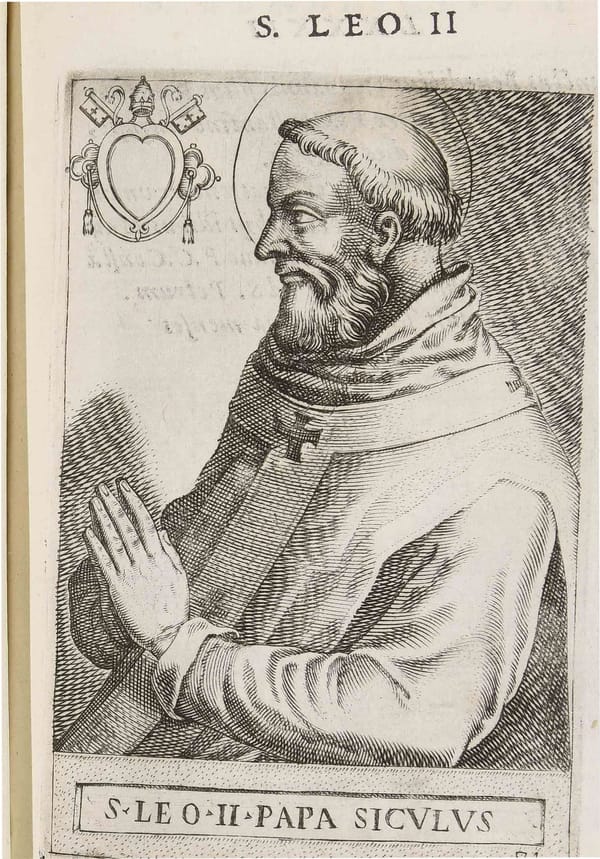
July 3 (the Same Day): St. Leo the Second, Pope and Confessor
IT were fitting that our attention should not be diverted during this Octave from the feast which the Church is keeping. But the triumph of Peter will shine out with all the more splendour in proportion as the testimony he rendered to the Son of God is shown to have been maintained with all fidelity during the long series of succeeding ages by the Pontiffs, inheritors of his Primacy. For a considerable time the twentyeighth of June was consecrated by the memory of St Leo the Great; it was the day chosen by Sergius I for the translation of the illustrious doctor, and indeed a more magnificent usher for the solemnity could hardly be desired. From no other lips than his has Rome ever set forth, in such elevated language, the glories of these two princes of the apostles and her own fame; never since the incomparable scene enacted at Caesarea Philippi has the mystery of the Man-God been affirmed in a manner so sublime as on that day whereon the Church, striking the impious Eutyches at Chalcedon, received from Leo the immortal formula of Christian dogma. Peter once more spoke by the mouth of Leo; yet the evil was far from being ended: two centuries more were needed; and another Leo, he whom we this day honour, had the honour of ending it at the sixth Council.
The Spirit of God, ever watchful over the development of the sacred liturgy, by no means wished any change to be effected in the train of thought of the faithful people. Thus when towards the beginning of the fourteenth century April 11 was again assigned to St Leo I (for that was really the primitive place occupied by him in the cycle), St. Leo II, the anniversary of whose death was June 28, and who hitherto had been merely commemorated thereon, being now raised to the rank of a semi-double, came forward to remind the faithful of the glorious struggles maintained both by his predecessor and by himself, in the order of apostolic confession. Latterly his feast was transferred to this day, in order that St Irenæus may be commemorated on the Vigil of the Apostles.
How was it that St Leo’s clear and complete exposition of the dogma and the anathemas of Chalcedon did not succeed in silencing the arguments of that heresy which refused to our nature its noblest title, by denying that it had been assumed in its integrity by the divine Word? Because for truth to win the day it suffices not merely to expose the lie uttered by error. More than once, history gives instances of the most solemn anathemas ending in nothing but lulling the vigilance of the guardians of the holy city. The struggle seemed ended, the need of repose was making itself felt amidst the combatants, a thousand other matters called for the attention of the Church's rulers; and so whilst feigning utmost deference, nay, ardour even, if needful, for the new enactments, error went on noiselessly, making profit of the silence which ensued after its defeat. Then did its progress become all the more redoubtable at the very time it was pretending to have disappeared without leaving a trace behind.
Thanks, however, to the divine Head, who never ceases to watch over his work, such trials seldom reach to such a painful depth as that into which Leo II had to probe with steel and fire in order to save the Church. Once only has the terrified world beheld anathema strike the summit of the holy mount. Honorius, placed on the pinnacle of the Church, ‘had not made her shine with the splendour of apostolic doctrine, but by profane treason had suffered the faith, which should be spotless, to be exposed to subversion';1 Leo II, therefore, sending forth his thunders in unison with the assembled Church against the new Eutychians and their accomplices, did not spare even his predecessor. And yet, as all acknowledge, Honorius had otherwise been an irreproachable Pope; and even in the question at stake he had been far from professing heresy or teaching error. Wherein, then, did his fault lie?
The Emperor Heraclius, who by victory had reached the height of power, beheld with much concern how continual division persisted between the Catholics of his empire and the late disciples of Eutyches. The bishop of the imperial city, the patriarch Sergius, fostered these misgivings in his master's mind. Vain of a certain amount of political skill which he fancied himself to possess, he now aimed at re-establishing, by his sole effort, that unity which the Council of Chalcedon and St Leo the Great had failed to obtain; thus would he make himself a name. The disputants agreed in acknowledging two natures in Jesus Christ; hence to reply to their advances one thing was needed, he thought, to impose silence on the question as to whether there are in him two wills or only one. The enthusiasm with which this evident compromise was hailed by the various sects rebellious to the fourth General Council showed that they still preserved all the venom of error; and the fact that they denied, or hesitated to acknowledge, that in the Man-God there is any other will than that proper to the divine Nature, was equivalent to declaring that he had assumed but a semblance of human nature, since this nature could by no means exist devoid of that will which is proper to it. Therefore, the Monophysites, or partisans of the one Nature in Christ, made no difficulty in henceforth being called by the name of Monothelites, or partisans of the one will. Sergius, the apostle of this novel unity, might well congratulate himself; Alexandria, Antioch, Constantinople, hailed with one accord the benefit of this peace. Was not the whole East here represented by her patriarchs? If Rome in her turn would but acquiesce, the triumph would be complete! Jerusalem, however, proved a jarring note in this strange concert.
Jerusalem, the witness of the anguish suffered by the Man-God in his human nature, had heard him cry out in the garden of his agony: 'Father, if it be possible, let this chalice pass from me; yet, not my will, but thine be done!'2 The city of dolours knew better than any other what to believe concerning these two wills, which by the heroism of incomparable love were maintained in such full harmony, and the time for her to bear testimony had come. The monk Sophronius, now her bishop, was by his sanctity, courage and learning ready for the task that lay before him. But while, in the charity of his soul, he was seeking to reclaim Sergius before appealing against him to the Roman Pontiff, the bishop of Constantinople took the initiative; he succeeded thus by a hypocritical letter in circumventing Honorius, and in getting him to impose silence on the patriarch of Jerusalem. Hence, when at last St Sophronius, at the head of the bishops of his province assembled in council, thought it had become his positive duty to turn towards Rome, it was but to receive for answer a confirmation of the prohibition to disturb the peace. This was a sad mistake, which though it did not directly implicate the infallible magistracy because it was a measure exclusively political, was one that cost the Church bitter tears and much blood, and which resulted fifty years later in the condemnation of the unfortunate Honorius.
The Holy Ghost, who has guaranteed the infallible purity of the doctrine taught officially from the apostolic Chair, has not pledged himself to protect in a like degree from all failure either the virtue, or the private judgement, or even the administrative acts of the Sovereign Pontiff. In order to promote this marvellous union which the Creator made to reign both upon earth and in heaven, our Lord, when he founded the society of saints upon the authentic and immutable basis of the faith of Peter, willed that to the prayers of all should be confided the charge of completing his work by obtaining for the successors of Peter such preservative graces as do not of themselves necessarily spring from the divine constitution of the Church.
Meanwhile Mahomet was just letting loose his hordes upon the world. Heraclius was now to learn the worth of his patriarch's lying peace, and was to come down lower in shame than he had been exalted in glory by his victories over the Persians, in the days when he had acted as the hero of the cross. Palestine, Syria and Egypt fell simultaneously beneath the blows of the lieutenants of the prophet. Sophronius, placed as he was in the very midst of the scene of invasion, grew still greater under trial. Abandoned by the emperor where the defence of the empire was at stake, disavowed by Rome as to faith, he alone intrepidly treated with Omar as power opposed to power; and when about to die, still hoping against all hope in Rome, though thence had come a blow harder far to bear than that of the caliph, he confided to Stephen of Dora the supreme mission, which the latter thus relates: 'In his justice strong as a lion, contemning calumnies and intrigues, blessed Sophronius took me, unworthy as I am, and conducted me to the sacred spot of Calvary. There he bound me by an indissoluble engagement, in these words: “Thou shalt have to render account to him who being God was voluntarily crucified for us according to the flesh on this spot, when on the day of his terrible coming he will appear in glory to judge the living and the dead, if thou defer or neglect the interests of his faith now in peril. Thou knowest that I cannot in the body do this thing, being hindered by the incursion of the Saracens which our sins have deserved. Set out as soon as possible, and go from here to the farthest ends of the earth, until thou reach the apostolic See, where the foundations of orthodox dogma are set. Go again and again, not once, not twice, but endlessly, and make known to those living there the shock that our land has sustained. Importunately, ceaselessly, implore and supplicate, until apostolic prudence at length determine, by its canonical judgement, the victory over these perfidious teachings."’3
The bishop of Dora was faithful to this command. When, twelve years later, he gave this touching narrative at the Council of Lateran in 649, it was then the third time that, in spite of the snares and other difficulties of the times, he could say: ' We have taken the wings of a dove, as David speaks, and we have come to declare our situation to this See, elevated in the sight of all, this sovereign, this principal See, where is to be found remedy for the wound that has been inflicted upon us.'4 St Martin I, who received this appeal, was one worthy to hear it; and soon afterwards he repaired by his own martyrdom the fault committed by Honorius in suffering himself to be tricked by an impostor. His glorious death, followed by the tortures endured for the truth by the saintly abbot Maximus and his companions, prepared the victory which the heroic faith of Sophronius had announced to the Roman Pontiff. Thus was an odious silence rectified by holy Church: now were her doctors to be seen, with tongue plucked out, still continuing by divine power to proclaim that Christian dogma which cannot be enchained;5 still with lopped-off hands finding means, in their indomitable zeal, to affix to the mutilated arm the pen whose function, now made doubly glorious, continued thus to carry throughout the world the refutation of falsehood.
But it is time to come to the issue of this memorable contest. It is to be found in him whose feast we are celebrating. St Agatho had assembled the sixth General Council at Constantinople, at the request of another Constantine, an enemy of heresy and a victor over Islam. Faith and justice now did the work hand in hand; and St Leo II could at last sing aloud: 'O holy mother Church, put off thy garb of mourning, and deck thee in robes of gladness. Exult now with joyous confidence: thy liberty is not cramped.'6
The holy liturgy devotes the following lines to the history of this pontificate, short indeed, but well filled:
O glorious Pontiff, to thee was granted the privilege of completing the apostolic confession by giving the furthest development to the testimony rendered by Peter to the Son of the living God, who is at the same time Son of man. Thou wast to finish the work of Sylvester, Celestine and that other Leo, a Pontiff beloved of earth and of heaven. Convoking, inspiring, confirming the illustrious Councils of Nicæa, Ephesus and Chalcedon, they had triumphantly proved in our Emmanuel both his Divinity consubstantial with the Father, and his unity of person which causes Mary to be truly his Mother, and furthermore his twofold Nature, without which he could not have been our Brother. Satan, who had allowed himself to be more easily overcome on the first two points, disputed the third with utmost rage. As on that great battle-day when he was hurled from heaven, the form of his revolt had been a refusal to adore God under human features; so now, together with all hell, enforced by holy Church to bend the knee, his jealousy would fain pretend that at least God had taken of man but a mutilated nature. Let it be granted that the Word was made Flesh, but in this Flesh do not allow that he had other impulses, other energies, save those of the Divinity itself; such an inert nature as this, uncrowned of its proper will, would in reality be no human nature, even though it were to retain all the rest. Then would Lucifer, in his pride, have less cause to blush; for then man, the object of his infernal envy, would have nothing in common with the divine Word save a vain appearance! Thanks be to thee, O Leo, in the name of all mankind! By thee, in face of heaven, earth and hell, is promulgated authentically the incomparable title whereby, without any restriction, our nature is established at the right hand of the Father, in the highest heavens; by thee our Lady crushes the vile serpent's head once again.
But what craft was displayed by Satan in this campaign, prolonged for two centuries, noiselessly, the better to secure success! What exultation rang through the abyss when one sad day saw the representative of him who is essential Light appear to side for a moment with the powers of darkness! A cloud seemed to have come between heaven and those mountains of God, where he dwells with his Vicar; it is probable that the social aid of intercession was weaker just then than it should have been. Be ever at hand, O Leo, to ward off all similarly dangerous situations. Uphold, in every age, the Pastor who rules Christ's Church, that he may keep himself aloof from the darkening mists that earth exhales; keep ever alive in the hearts of the faithful flock that strong prayer, which should continually be made without ceasing for him by the Church:7 and then Peter, were he even chained in the depths of the darkest dungeon, will be reached by the Sun of justice and clearly see his way in that pure ray; then will the whole body of the Church be lightsome. For Jesus hath said, 'the light of the body is the eye: if the eye be single the whole body will be lightsome.'8
By thy teaching we realize more fully the strength of the rock whereon the Church stands; we know that the gates of hell shall never prevail against her.9 For surely the efforts of the spirits of darkness never went to such lengths as they did in that sad crisis to which thou didst put an end; nor was their success, however great in appearance, contrary to the divine promise; for it is to the teaching of Peter, not to his silence, that the unfailing assistance of the Holy Ghost is guaranteed. O loving Pontiff, obtain for us uprightness of faith and heavenly enthusiasm wherewith it behoves us to hail Peter and Christ acting together in the unity divinely established between them. The liturgy is deeply indebted to thee; grant us to relish more and more the hidden manna it contains, and may our hearts and voices fittingly render these sacred melodies!
July 3 (the Same Day): The Fifth Day within the Octave of the Holy Apostles Peter and Paul
ALTHOUGH amongst the saints there is none who is undeserving of earth's humble homage, or whose intercession is powerless on our behalf, yet the cultus rendered to them, and the confidence evinced, necessarily vary in proportion to what we know of their glory. It is therefore only just, as St Leo remarks in to-day’s Office, that we should honour in a most special manner those whom divine grace has exalted so far above all others, that they are considered, as it were, the two brilliant eyes of Christ’s mystical body, the Church, giving light to all of us, who are the members thereof.* For this reason, the festival of these two princes of the apostles is held superior to that of any other servant of God occurring in the entire cycle.
When the Church’s own practice gave tone to the particular customs of the various countries, national confidence and even private devotion knew no other preferences than those of the holy liturgy; and long were it to tell of all that can be produced by history, public charts, simple contracts and monuments of every sort, in endless proof of our forefathers' love for the glorious doorkeeper of heaven and his illustrious companion armed with the sword. Faith was lively in those days. It was then well understood that of all God's gifts to earth, none is comparable to the graces of sanctification, doctrine and unity, of which Peter and Paul are for all the predestined instruments. The heart became dilated as the mind expanded. Men were eager, therefore, to know as much as they could touching the lives of these fathers of the Christian people; and they made great account of the devotedness wherewith the two apostles had so unsparingly poured out their sweat and blood for them.
Alas! can it be said that such is the case nowadays? How many baptized persons are there, Catholics not merely in name, but even considered practical Catholics, who scarcely possess such elementary notions of true Christianity as to appreciate the importance of the role performed amongst men by these founders of the Church, or even to give it a passing thought! Yet some there are, and thanks be to God their number is now on the increase, who glory in studying the principles on which rests the divine constitution of society purchased by the Blood of our Lord. Such men as these understand and revere the august position which has been, and always must be, held by Peter and Paul in the economy of Christian dogma. Nevertheless, do even these persons honour really as they ought these two princes of the apostles? What they know on this subject shows them plainly enough that it cannot be the case with these two apostles as it is with many other saints, whose cultus increases or diminishes according to circumstances of time, place and the like: the cultus of SS Peter and Paul has its roots in the very foundations of Catholicism; whether in nations or in individual souls it cannot wane, save to the great detriment of Catholicity itself. But then, no cultus is real, except that which implies devotion and love; can it be really said of the class of persons to whom we refer that their knowledge of the holy apostles has penetrated deeply enough from their mind into their heart?
In the case of too many people, this knowledge, being confined to the region of theory, is not sufficiently personal with regard to the two apostles themselves; and, therefore, principles the most nicely drawn do by no means impart the spirit of faith, the seat of which is in the heart, and which animates the life. Let them put the finishing stroke to their science. Without losing sight of dog matic science, let them seek in prayer and in humble study of the Gospel of the Acts of the Apostles, of the Epistles and of ecclesiastical tradition, that intimate revelation of the very soul of Peter and of Paul which cannot fail to make them admire, and above all love them personally as much as and even more than their sublime prerogatives. Then perhaps will they be astonished to have come so late to a knowledge of many precious details and thousands of instructive features about them, which little children in bygone ages (now reputed barbarous) would have blushed not to know. As a necessary consequence, they will thus begin to feel more Catholic in soul; they will consider themselves happy to have learnt, at last, how to share the devotion of the humble peasant woman and her ingenuous confidence, not unmixed with fear, in the doorkeeper of paradise.
The following beautiful Preface is taken from the Mozarabic Missal. Its theme is that assemblage of divine contrasts, amidst which eternal Wisdom loves, as it were, to play, and which are found wonderfully multiplied in the lives of these two apostles.
Illatio
His igitur dispari mortis genere, non dispari moriendi amore perfunctis: exsultet in eorum doctrinis Ecclesia catholica; in exsequiis religiositas universa; in memoriis urbs Romana; in patrociniis omnis anima christiana. Hæc autem omnia tu, Domine, operaris: qui a prophetis demonstraris; ab angelis adoraris; et in omni sæculo apostolorum lumine declararis. Cui merito omnes Angeli et Archangeli non cessant clamare quotidie, ita dicentes: Sanctus, Sanctus, Sanctus.
These two, therefore, differ in the manner of their death, but not in the love shown forth in dying: the Catholic Church exults in their teaching; all religion, in the celebration of their death; the Roman city, in their memory; each Christian soul, in their patronage. Now, all these things thou, O Lord, hast operated, thou who wast pointed out by the prophets, art adored by the angels, art manifested throughout the world, by the light of the apostles. To whom meetly, all Angels and Archangels unceasingly cry out daily, saying: Holy, Holy, Holy.
The same liturgy makes use of the following hymn on this festival. It is attributed, not without some foundation, to St Ambrose, and seems to have preceded the hymn of Elpis in liturgical use.
Hymn
Diem sacravit sæculis,
Petri triumphum nobilem,
Pauli coronam proferens.
Cruor triumphalis necis;
Deum secutos præsules
Christi coronavit fides.
Nec Paulus impar gratia:
Electionis vas sacræ
Petri adæquavit fidem.
Simon honorem dans Deo,
Suspensus ascendit, dati
Non immemor oraculi.
Elevatus ab altero,
Quo nollet ivit, sed volens
Mortem subegit asperam.
Devotionis extulit,
Fundata tali sanguine
Et vate tanto nobilis.
Stipata tendunt agmina:
Trinis celebratur viis
Festum sacrorum martyrum.
Concurrere plebem poli:
Electa genitum caput,
Sedes magiatri gentium.
Ejusque soli Filio,
Cum Spiritu Paraclito
In sempiterna sæcula.
hath consecrated this immortal day,
presenting Peter's noble triumph
and Paul's crown.
hath conjoined these men, peers in fame;
the faith of Christ hath crowned
these jubilant followers of God.
next, Paul his peer in grace.
The vessel of sacred election
hath equalled the faith of Peter.
Simon, suspended, ascends
along the heaven-turned footprints
of the cross, giving glory to God.
girded by another’s hand, is upraised.
Whither he would not, he has had to go;
but willing now, dire death hath he subdued.
the exalted head of religious worship,
founded, as she is, in such blood as this,
and by so illustrious a prophet.
of so great a city, close packed,
crowds are pressing along, by three ways,
for the celebration of the holy martyrs' festival.
that the people of all nations had assembled here;
lo! verily, the chosen head of the Gentiles,
the seat of the teacher of the Gentiles!
and to his only Son,
together with the Paraclete Spirit,
for ever and ever.
* Sermo I in Nat. A post. Lect. II Nocturni. ↩︎
| Previous July 2 (the Same Day): Sts. Processus and Martinianus, Martyrs | Next July 3 (the Same Day): The Fifth Day within the Octave of the Holy Apostles Peter and Paul |