Daily reading
After Pentecost
Double · July 18 · Sanctoral
July 18, 2019
From Dom Guéranger’s The Liturgical Year.
A Double leads; St. Symphorosa and her Seven Sons is commemorated.Rubric
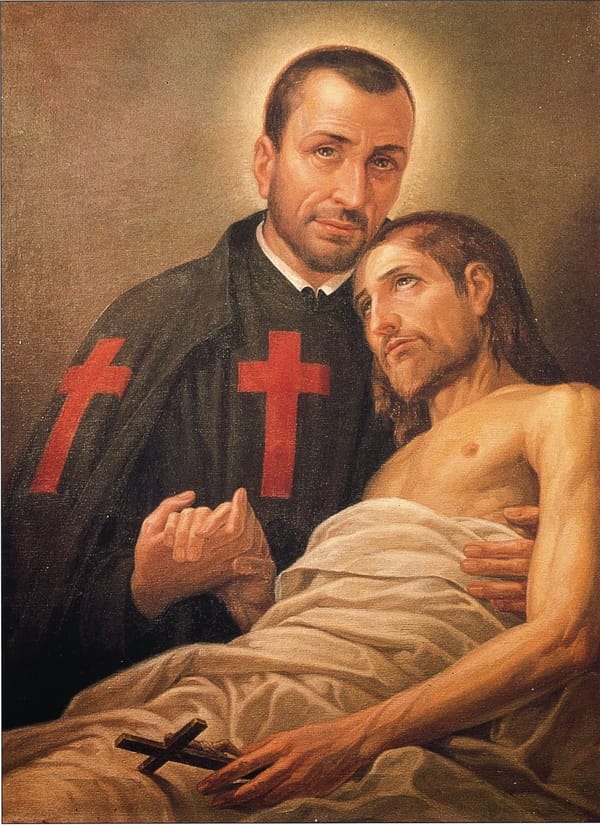 |
July 18: St. Camillus of Lellis, Confessor
THE Holy Spirit, who desires to raise our souls above this earth, does not therefore despise our bodies. The whole man is His creature and His temple, and it is the whole man He must lead to eternal happiness. The Body of the Man-God was His masterpiece in material creation; the divine delight He takes in that perfect Body He extends in a measure to ours; for that same Body, framed by Him in the womb of the most pure Virgin, was from the very beginning the model on which ours are formed. In the re-creation which followed the Fall, the Body of the Man-God was the means of the world’s redemption; and the economy of our salvation requires that the virtue of His saving Blood should not reach the soul except through the body, the divine sacraments being all applied to the soul through the medium of the senses. Admirable is the harmony of nature and grace; the latter so honours the material part of our being that she will not draw the soul without it to the light and to heaven. For in the unfathomable mystery of sanctification, the senses do not merely serve as a passage; they themselves experience the power of the sacraments, like the higher faculities of which they are the channels; and the sanctified soul finds the humble companion of her pilgrimage already associated with her in the dignity of divine adoption, which will cause the glorification of our bodies after the resurrection. Hence the care given to the very body of our neighbour is raised to the nobleness of holy charity; for being inspired by this charity, such acts partake of the love wherewith our heavenly Father surrounds even the members of His beloved children. I was sick, and ye visited Me,1 our Lord will say on the last day, showing that even the infirmities of our fallen state in this land of exile, the bodies of those whom He deigns to call His brethren, share in the dignity belonging by right to the eternal. only-begotten Son of the Father. The Holy Spirit, too, whose office it is to recall to the Church all the words of our Saviour, has certainly not forgotten this one; the seed, falling into the good earth of chosen souls, has produced a hundredfold the fruits of grace and heroic self-devotion. Camillus of Lellis received it lovingly, and the mustard-seed became a great tree offering its shade to the birds of the air. The Order of Regular Clerks, Servants of the Sick, or of Happy Death, deserves the gratitude of mankind; as a sign of heaven's approbation, angels have more than once been seen assisting its members at the bedside of the dying.
The liturgical account of St. Camillus' life is so full that we need add nothing to it.
Angel of charity, by what wonderful paths did the Divine Spirit lead thee! The vision of thy pious mother remained long unrealized; before taking on thee the holy Cross and enlisting comrades under that sacred sign, thou didst serve the odious tyrant, who will have none but slaves under his standard, and the passion of gambling was wellnigh thy ruin. O Camillus, remembering the danger thou didst incur, have pity on the unhappy slaves of passion; free them from the madness wherewith they risk, to the caprice of chance, their goods, their honour, and their peace in this world and in the next. Thy history proves the power of grace to break the strongest ties and alter the most inveterate habits: may these men, like thee, turn their bent towards God, and change their rashness into love of the dangers to which holy charity may expose them! For charity, too, has its risks, even the peril of life, as the Lord of charity laid down His life for us: a heavenly game of chance, which thou didst play so well that the very angels applauded thee. But what is the hazarding of earthly life compared with the prize reserved for the winner?
According to the commandment of the Gospel read by the Church in thy honour, may we all, like thee, love our brethren as Christ has loved us! Few, says St. Augustine, love one another to this end, that God may be all in all.2 Thou, O Camillus, having this love, didst exercise it by preference towards those suffering members of Christ's mystic Body, in whom our Lord revealed Himself more clearly to thee, and in whom His kingdom was nearer at hand. Therefore has the Church in gratitude chosen thee, together with John of God, to be guardian of those homes for the suffering which she has founded with a mother’s thoughtful care. Do honour to that Mother’s confidence. Protect the hospitals against the attempts of an odious and incapable secularization, which, in its eagerness to lose the souls, sacrifices even the corporal well-being of the unhappy mortals committed to the care of its evil philanthropy. In order to meet our increasing miseries, multiply thy sons, and make them worthy to be assisted by angels. Wherever we may be in this valley of exile when the hour of our last struggle sounds, make use of thy precious prerogative which the holy liturgy honours to-day; help us, by the spirit of holy love, to vanquish the enemy and attain unto the heavenly crown!
July 18 (the Same Day): St. Symphorosa and her Seven Sons, Martyrs
FOR the second time in July a constellation of seven stars shines in the heavens. More fortunate than Felicitas, Symphorosa preceded in the arena the seven sons she was offering to God. From the throne where he was already reigning crowned with the martyr’s diadem, Getulius the tribune, father of this illustrious family, applauded the combat whereby his race earned a far greater nobility than that of patrician blood, and gave to Rome a grander glory than was ever dreamed of by her heroes and poets. The Emperor Adrian, corrupt yet brilliant, sceptical yet superstitious, like the society around him, presided in person at the defeat of his gods. Threatening to bum the valiant woman in sacrifice to the idols, he received this courageous answer: ‘Thy gods cannot receive me in sacrifice; but if thou bum me and my sons for the name of Christ, my God, I shall cause thy demons to bum with more cruel flames!’ The execution of the mother and her sons was, indeed, the signal for a period of peace, during which the Kingdom of our Lord was considerably extended. Jerusalem, having under the leadership of a last false Messias revolted against Rome, was punished by being deprived of her very name; but the Church received the glory which the Synagogue once possessed when she produced the mother of the Machabees.
Another glory was reserved for this eighteenth day of July, in the year 1870: the (Ecumenical Council of the Vatican, presided over by the immortal Pius IX, defined in its constitution, Pastor Æternus, the full, supreme, and immediate power of the Roman Pontiff over all the Churches, and pronounced anathema against all who should refuse to recognize the personal infallibility of the same Roman Pontiff, speaking ex cathedra—i.e., defining, as universal pastor, any doctrine concerning faith or morals. We may also remark that during these same days—viz., on a Sunday in the middle of July—the Greeks make a commemoration of the first six general councils: Nicea, Constantinople, Ephesus, Chalcedon, and the second and third of Constantinople. Thus, during these midsummer days, we are in the midst of feasts of heavenly light; and let us not forget that it is martyrdom, the supreme act of faith, that merits and produces light. Doubtless, Divine Wisdom, who plays in the world with number, weight, and measure, planned the beautiful coincidence which unites these two days, July 18, 136, and July 18, 1870. If in these latter days the word of God has been set free, it is owing to the bloodshed by our fathers in its defence. The liturgy gives but a very short account of the immortal combat which glorifies this day:
O Symphorosa, thou wife, sister, and mother of martyrs, thy desires are amply fulfilled; followed by thy seven children, thou rejoinest in the court of the Eternal King thy husband Getulius and his brother Amantius, brave combatants in the imperial army, but far more valiant soldiers of Christ. The words of our Lord: A man's enemies shall be they of his own household,1 are abrogated in heaven; nor can this other sentence be there applied: He that loveth father and mother more than Me, is not worthy of Me; he that loveth son or daughter more than Me, is not worthy of Me.2 There, the love of Christ our King predominates over all other loves; yet, far from extinguishing them, it makes them ten times stronger by putting its own energy into them; and, far from having to set a man at variance against his father, and the daughter against her mother,3 it sets a divine seal upon the family and rivets its bonds for all eternity.
What nobility, O heroes, have ye conferred upon the world! Men may look up with more confidence towards heaven, for the angels will not despise a race that can produce such valiant combatants. The perfume of your holocaust accompanied your souls to the throne of God, and an effusion of grace was poured down in return. From the luminous track left by your martyrdom have sprung forth new splendours in our own days. With joyful gratitude we hail the providential reappearance, immediately after the Vatican Council, of the tomb which first received your sacred relics on the morrow of your triumph. Soldiers of Christ! preserve in us the gifts ye have bestowed on us; convince the many Christians who have forgotten it, that faith is the most precious possession of the just.
| Previous July 17: St. Alexius, Confessor | Next July 18 (the Same Day): St. Symphorosa and her Seven Sons, Martyrs |