Daily reading
After Pentecost
Double · July 20 · Sanctoral
July 20, 2019
From Dom Guéranger’s The Liturgical Year.
A Double leads; St. Margaret is commemorated.Rubric
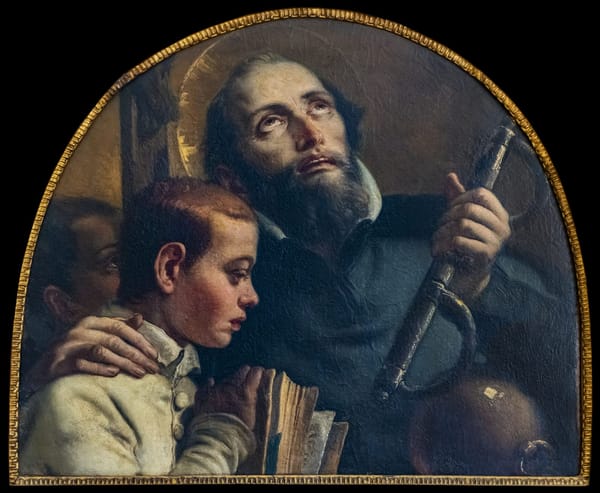 |
July 20: St. Jerome Æmilian, Confessor
SPRUNG from the powerful aristocracy which won for Venice twelve centuries of splendour, Jerome came into the world when that city had reached the height of its glory. At fifteen years of age he became a soldier, and was one of the heroes in that formidable struggle wherein his country withstood the united powers of almost all Europe in the League of Cambrai. The golden city, crushed for a moment, but soon restored to her former condition, offered her honours to the defender of Castelnovo, who, like herself, had fallen bravely and risen again. But our Lady of Treviso had delivered him from his German prison, only to make him her own captive; she brought him back to the city of St. Mark, there to fulfil a higher mission than the proud republic could have entrusted to him. The descendant of the Æmiliani, captivated, as was Lawrence Justinian a century before, by Eternal Beauty, would now live only for the humility which leads to heaven, and for the lofty deeds of charity. His title of nobility will be derived from the obscure village of Somascha, where he will gather his newly recruited army; and his conquests will be the bringing of little children to God. He will no more frequent the palaces of his patrician friends, for he now belongs to a higher rank: they serve the world, he serves heaven; his rivals are the angels, whose ambition, like his own, is to preserve unsullied for the Father the service of those innocent souls whom the greatest in heaven must resemble.
‘The soul of the child,’ as the Church tells us to-day by the golden mouth of St. John Chrysostom, ‘is free from all passions. He bears no ill-will towards them that have done him harm, but goes to them as friends, just as if they had done nothing. And though he be often beaten by his mother, yet he always seeks her and loves her more than anyone else. If you show him a queen in her royal crown, he prefers his mother clad in rags, and would rather see her unadorned than the queen in magnificent attire; for he does not appreciate according to riches or poverty, but by love. He seeks not for more than is necessary, and as soon as he has had sufficient milk he quits the breast. He is not oppressed with the same sorrows as we, nor troubled with care for money and the like; neither is he rejoiced by our transitory pleasures, nor affected by corporal beauty. Therefore our Lord said: Of such is the kingdom of heaven, wishing us to do of our own free will what children do by nature.’*
Their guardian angels, as our Lord Himself said, gazing into those pure souls, are not distracted from the contemplation of their heavenly Father: for He rests in them as on the wings of Cherubim, since baptism has made them His children. Happy was our saint to have been chosen by God to share the loving cares of the angels here below, before partaking of their bliss in heaven. The following detailed account is given by Holy Church:
With Vincent de Paul and Camillus of Lellis, thou, O Jerome Æmilian, completest the triumvirate of charity. Thus does the Holy Spirit mark His reign with traces of the Blessed Trinity; moreover, he would show that the love of God which He kindles on earth, can never be without the love of our neighbour. At the very time when He gave thee to the world as a demonstration of this truth, the spirit of evil made it evident that true love of our neighbour cannot exist without love of God, and that this latter soon disappears in its turn when faith is extinct. Thus, between the ruins of the pretended reform and the ever-new fecundity of the Spirit of holiness, mankind was free to choose. The choice made was, alas! far from being always conformable to man’s interest, either temporal or eternal.
With what good reason may we repeat the prayer thou didst teach thy little orphans: 'Lord Jesus Christ, our loving Father, we beseech Thee, by Thine infinite goodness, raise up Christendom once more, and bring it back to that upright holiness which flourished in the apostolic age.’
Thou didst labour strenuously at this great work of restoration. The Mother of Divine Grace, when she broke thy prison chains, set thy soul free from a more cruel captivity to continue the flight begun at baptism and in thy early years. Thy youth was renewed as the eagle’s; and the valour which won thee thy spurs in earthly battles, being now strengthened tenfold in the service of the all-powerful Prince, carried the day over death and hell. Who could count thy victories in this new militia? Jesus, the King of the warfare of salvation, inspired thee with His own predilection for little children; countless numbers, saved by thee from perishing, and brought in their innocence to His divine caresses, owe to thee their crown in heaven. From thy throne, where thou art surrounded by this lovely company, multiply thy sons; uphold those who continue thy work on earth; may thy spirit spread more and more in these days, when Satan’s jealousy strives more than ever to snatch the little ones from our Lord. Happy shall they be in their last hour who have accomplished the work of mercy pre-eminent in our days: saved the faith of children, and preserved their baptismal innocence! Should they have formerly merited God’s anger, they may with all confidence repeat the words thou didst love so well: ‘O sweetest Jesus, be not unto me a Judge, but a Saviour!’
* Chrys. in Matt. Hom. lxii. al. lxiii. ↩︎
July 20 (the Same Day): St. Margaret, Virgin and Martyr
THIS same day brings before us a rival of the warrior-martyr, St. George: Margaret, like him victorious over the dragon, and like him called in the Menæa of the Greeks, the Great Martyr. The cross was her weapon; and, like the soldier, the virgin, too, consummated her trial in her blood. They were equally renowned, also, in those chivalrous times when valour and faith fought hand in hand for Christ beneath the standard of the saints. So early as the seventh century our Western island rivalled the East in honouring the pearl drawn from the abyss of infidelity. Before the disastrous schism brought about by Henry VIII, the Island of Saints celebrated this feast as a double of the second class; women alone were obliged to rest from servile work, in gratitude for the protection afforded them by St. Margaret at the moment of childbirth—a favour which ranked her among the saints called in the Middle Ages auxiliatores or helpers. But it was not in England alone that Margaret was invoked, as history proves by the many and illustrious persons of all countries who have borne her blessed name. In heaven, too, there is great festivity around the throne of Margaret; we learn this from such trustworthy witnesses as St. Gertrude the Great1 and St. Frances of Rome,2 who, though divided by a century of time, were both, by a special favour of their divine Spouse, allowed, while still on earth, to assist at this heavenly spectacle.
The ancient legend in the Roman Breviary was suppressed in the sixteenth century by St. Pius V as not being sufficiently authentic. We, therefore, give instead some responsories and antiphons and a collect, taken from what appears to be the very office said by St. Gertrude; for in the vision mentioned above allusion is made to one of these responsories, Virgo veneranda:3
Responsories
Antiphons
Prayer
| Previous July 19: St. Vincent de Paul, Confessor | Next July 20 (the Same Day): St. Margaret, Virgin and Martyr |