Daily reading
After Pentecost
Greater Double · Movable from Easter · Temporal
August 4, 2019
From Dom Guéranger’s The Liturgical Year.

|
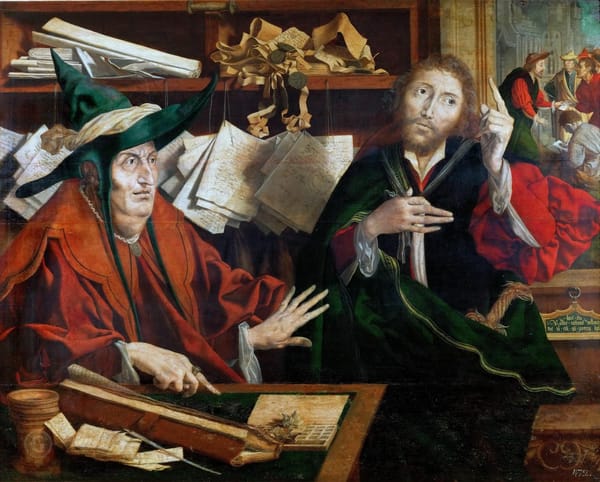
The Eighth Sunday after Pentecost
In the middle ages this Sunday was called the sixth and last Sunday after the Natalis of the apostles (that is, the feast of St. Peter); it was, indeed, the last for the years when Easter had been kept as late in April as was possible; but it was only the first after that feast of St. Peter when Easter immediately followed the spring equinox.
We have already noticed the variable character of this last portion of the liturgical cycle, which is the result of Easter being kept on a different day each year; and that in consequence of this variation this week may be the second in which the Sapiential Books are read, or, what is of more frequent occurrence, the Books of Kings may still be providing the lessons for the Divine Office. In this latter case it is the ancient temple raised by Solomon, the king of peace, to the glory of Jehovah, that engages the Church's attention to-day. We shall find that the portions of the Mass which are chanted on this Sunday are closely connected with the lessons read in last night’s Office.
Let us, then, turn our reverential thought's once more to this splendid monument of the ancient Covenant. The Church is now going through that month which immediately preceded the events so momentous to Jerusalem; she would do honour to-day to the glorious and divine past which prepared her own present. Let us, like her, enter into the feelings of the first Christians, who were Juda’s own children; they had been told of the impending destruction foretold by the prophets, and an order from God bade them depart from Jerusalem. What a solemn moment that was, when the little flock of the elect,—the only ones in whom was kept up the faith of Abraham and the knowledge of the destinies of the Hebrew people—had just begun their emigration, and looked back on the city of their fathers, to take a last farewell! They took the road to the east; it led towards the Jordan, beyond which God had provided a refuge for the remnant of Israel.1 They halted on the incline of Mount Olivet, whence they had a full view of Jerusalem; in a few moments that hill would be between them and the city. Not quite forty years before the Man-God had sat down on that same spot,2 taking His own last look at the city and her temple. Jerusalem was seen in all her magnificence from this portion of the mount, which afterwards would be visited and venerated by our Christian pilgrims. The city had long since recovered from its ruins, and had, at the time we are speaking of, been enlarged by the princes of the Herodian family, so favourably looked on by the Romans. Never in any previous period of her history had Jerusalem been so perfect and so beautiful as she then was, when our fugitives were gazing upon her. There was not, as yet, the slightest outward indication that she was the city accursed of God. There, as a queen in her strength and power, she was throned amidst the mountains of which the psalmist had sung;3 her towers4 and palaces seemed as though they were her crown. Within the triple enclosure of the walls built by her latest kings, she embraced those three hills, the grandest, not only of Judea, but of the whole world: first, there was Sion, with its unparalleled memories; then, Golgotha, which had not yet been honoured on account of the holy sepulchre, and which, nevertheless, was even then attracting to itself the Roman legions, who were to wreak vengeance on this guilty land; and, lastly, Moriah, the sacred mount of the old world, on whose summit was raised that unrivalled temple, which gave Jerusalem to be the queen of all the cities of the east, for as such even the Gentiles acknowledged her.5
‘At sunrise, when in the distance there appeared the sanctuary, towering upwards of a hundred cubits above the two rows of porticoes which formed its double enclosure; when the sun cast his morning rays on that façade of gold and white marble; when there glittered the thousand gilded spires which mounted from its roof, it seemed, says Josephus, that it was a hill capped with snow, which gradually shone, and reddened, with the morning beams. The eye was dazzled, the soul was amazed, religion was roused within the beholder, and even the pagans fell down prostrate.'6 Yes, when the pagan came hither either for conquest or for curiosity, if he ever returned, it was as a pilgrim. Full of holy sentiments, he ascended the hill; and, having reached the summit, he entered by the golden gate into the gorgeous galleries which formed the outward enclosure of the temple. In the court of the Gentiles he met with men from every country. His soul was struck by the holiness of a place where he felt that there were preserved in all purity the ancient religious traditions of the human race; and he, being profane, stood afar off, assisting at the celebrations of the Hebrew worship, such as God had commanded it to be, that is, with all the magnificence of a divine vritual. The white column of smoke from the burning victims rose up before him as earth’s homage to God, its Creator and Saviour; from the inner courts there fell on his ear the harmony of the sacred chants, carrying as they did to heaven both the ardent prayer of those ages of expectation and the inspired expression of the world’s hope; and when, from the midst of the levite choirs and the countless priests who were busy in their ministry of sacrifice and praise, the high priest, with his golden crown on his head, came forth holding the censer in his hand, and entering himself alone within the mysterious veil which curtained off the Holy of holies, the stranger, though he had but a glimpse of all those splendid symbols of religion, yet confessed himself overpowered, and acknowledged the incomparable greatness of that invisible Deity, whose majesty made all the vain idols of the Gentiles seem to him paltry and foolish pretences. The princes of Asia and the greatest kings considered it an honour to be permitted to contribute, both by personal gifts of their own making and by sums taken from the national treasuries, towards defraying the expenses of the holy place.7 The Roman generals and the Cæsar themselves kept up the traditions of Cyrus8 and Alexander9 in this respect. Augustus ordered that every day a bull and two lambs should be presented in his name to the Jewish priests, and be immolated on Jehovah's altar for the well-being of the empire;10 his successors insisted on the practice being continued; and Josephus tells us that the beginning of the war was attributable to the sacrificers refusing any longer to accept the imperial offerings.11
But, if the majesty of the temple thus impressed the very pagans right up to its last days, there were reasons for an intensity of veneration and love on the part of a faithful Jew, which he alone could realize. He was the inheritor of the submissive faith of the patriarchs; as such, he was well aware that the prophetic privileges of his fatherland were but an announcement to the whole world, that it was one day to be blessed with the more real and lasting benefits of which he, the Jew, possessed but a figure; he quite understood that the hour had come when the children of God would not confine their worship within the narrow limits of one mountain or one city;12 he knew that God's true temple was then actually being built up on every hill of the Gentile world;13 and that, in its immensity, it took in all those countries of the earth into which the Blood that flowed first from Calvary had won its way. And yet, we can easily understand what a sharp pang of anguish thrilled through his patriot heart, now that God was about to consummate, before the astonished universe, the terrible consumption14 of the ungrateful people, whom He had chosen for His portion, His inheritance.15 Who is there that would not share in the grief of these holy ones of Jacob, few in number as the ears of corn gathered by the gleaner,16 and now bidding an eternal farewell to that holy, but now accursed, city? These true Israelites might well weep; they were leaving for ever, leaving to devastation and ruin, their homes, their country, and, dearest of all, that temple, which, for ages, had sanctified the glory of Israel, and given Juda the right and title to be the noblest of the nations of the earth.17
There was something even beyond all this : it was that their dear Jerusalem had been the scene of the grandest mysteries of the law of grace. Was it not in yonder temple that, as the prophets expressed it, God had manifested the Angel of the Testament,18 and given peace? The honour of that temple is no longer the exclusive right of an isolated people; for the Desired of all nations, by His going into it, has brought it a grander glory than all the ages of expectation and prophecy have imparted.19 It was under the shadow of those walls that Mary—she that was to be the future seat of Wisdom eternal—prepared within her soul and body a more august sanctuary for the divine Word than was that whose cedared and golden wainscoting made it so exquisite a shelter for the infant maiden. Yes, it was there that, when but three years old, Mary joyously mounted up the fifteen steps which separated the court of women from the eastern gate, offering to God the pure homage of her immaculate heart. Here, then, on the summit of Moriah, began, in the person of their Queen, the long line of consecrated virgins, who, to the end of time, will come offering, after her, their love to the King.20 There, also, the new priesthood found its type and model in the blessed Mother, presenting in that holy temple the world’s victim, Jesus, the new-born Child of her chaste womb. In that same dwelling, made by the hands of men; in those halls where sat the doctors, eternal Wisdom, too, seated Himself under the form of a child of twelve, instructing the very teachers of the Law by His sublime questions and divine answers.21 Every one of those courts had seen the Word Incarnate giving forth treasures of goodness, power, and heavenly doctrine. One of those porticoes was the favourite one where Jesus used to walk,22 and the infant Church made it the place of its early assemblies.23
Truly, then, this temple is holy with a holiness possessed by no other spot on earth; it is holy for the Jew of Sinai; it is holy for the Christian, be he Jew or Gentile, for here he finds that the Law ends, because here are verified all its figures.24 With good reason did our mother the Church, in her Office for this night, repeat the words which were spoken by God to Solomon : ‘I have sanctified this house which thou hast built, to put my name there for ever; and mine eyes and my heart shall be always there.'25
How, then, is it that dark forebodings are come terrifying the watchmen of the holy mount? Strange apparitions, fearful noises, have deprived the sacred edifice of that calm and peace which become the house of the Lord. At the Feast of Pentecost the priests, who were fulfilling their ministry, have heard in the holy place a commotion like that of a mighty multitude, and many voices crying out together: 'Let us go hence!' On another occasion, at midnight, the heavy brazen gate which closed the sanctuary on the eastern side, and which took twenty men to move it, has opened of itself.26 O temple, O temple, let us say it, with them that witnessed these threatening prodigies,27 why art thou troubled? why workest thou thine own destruction? Alas! we know what awaits thee! The prophet Zacharias foretold it when he said: ‘Open thy gates, O Libanus, and let fire devour thy cedars!'28
Has God forgotten His promises of infinite goodness? No : but let us think upon the terrible and just warning, which He added to the promise He made to Solomon, when he had finished building the temple : ‘But if ye and your children, revolting, shall turn away from following Me, and will not keep My commandments and My ceremonies which I have set before you, I will take away Israel from the face of the land, which I have given them; and the temple which I have sanctified to My name, I will cast out of My sight; and Israel shall be a proverb, and a by-word among all people. And this house shall be made an example of; every one that shall pass by it shall be astonished, and shall hiss, and say : "Why hath the Lord done thus to this land, and to this house?'"29
O Christian soul! thou that, by the grace of God, art become a temple30 more magnificent, more beloved in His eyes, than that of Jerusalem, take a lesson from these divine chastisements; and reflect on the words of the Most High, as recorded by Ezechiel: ‘The justice of the just shall not deliver him, in what day soever he shall sin.... Yea, if I shall say to the just, that he shall surely live, and he, trusting in his justice, commit iniquity —all his justices shall be forgotten, and, in his iniquity, which he hath committed, in the same shall he die.'31
With the Greeks, the multiplication of the five loaves and two fishes is the subject of the Gospel for this Sunday; they count it the eighth of St. Matthew.
Mass
The Introit speaks of the glory of the ancient temple, and of the holy mount. But greater far is the splendour of the Church, which is now carrying the name and praise of the Most High even to the end of the earth, far more efficiently than had done that temple which was but a figure of our mother the Church.
Introit
Not only are we incapable, of ourselves, of doing any good work, but, without the help of grace, we cannot even have a thought of supernatural good. Now, the surest means for obtaining the help that is so needed by us is to acknowledge humbly before God that we depend entirely upon Him; it is what the Church does in the Collect.
Collect
The other Collects, as on page 120.
Epistle
Cap. viii.Fratres, Debitores sumus non carni, ut secundum carnem vivamus. Si enim secundum carnem vixeritis, moriemini : si autem spiritu facta carnis mortificaveritis, vivetis. Quicumque enim Spiritu Dei aguntur, ii sunt filii Dei. Non enim accepistis spiritum servitutis iterum in timore, sed accepistis spiritum adoptionis filiorum, in quo clamamus : Abba (Pater). Ipse enim Spiritus testimonium redditi spiritui nostro, quod sumus filii Dei. Si autem filii, et hæredes : hæredes quidem Dei, cohæredes autem Christi.
Ch. viii.Brethren : We are debtors, not to the flesh, to live according to the flesh. For if you live according to the flesh, you shall die : but if by the spirit you mortify the deeds of the flesh, you shall live. For whosoever are led by the Spirit of God, they are the sons of God. For you have not received the spirit of bondage again in fear : but you have received the spirit of adoption of sons, whereby we cry : Abba (Father). For the Spirit himself giveth testimony to our spirit, that we are the sons of God. And if sons, heirs also : heirs indeed of God, and joint heirs with Christ.
The apostle and doctor of the Gentiles here goes on, forming to the Christian life the new recruits, whom his own voice and that of his fellow apostles, dispersed as they are throughout the world, are every day leading, by hundreds, to the fount of salvation. Although the Church is all attention to the events which are preparing for Judea, yet is she full of maternal solicitude for the great work of training those children whom she has given to her divine Spouse. Whilst Israel is obstinate in his fatal refusal to accept the Messiah, another family is growing up in his place; and, by its docility, richly repays our Lord for all the rebellion and slights offered Him by the children He had first made His chosen ones. They were the ancient people, and are jealous of others being now called to the same privilege. The contradictions of which Christ complains in the Psalm are anything but over; and yet, thanks to the Church, the Man-God is already the Head of the Gentiles.32
Admirable is the fruitfulness of the bride; for wonderful is the power of sanctification which she is using all through the world of various nations. Scarcely has she sprung into her beauteous existence, than she offers to her Lord and her King a new empire, consolidated in unity of love; she presents Him with a generation that is all pure in the intelligence and practice of every virtue. It is quite true, that the Holy Ghost acts directly on the souls of the newly baptized; but there is something else to be considered in the divine plan. It is this : the Word, having been made flesh, and having taken to Himself a bride (which is the visible Church on earth), whom He has made His associate in the work of man's salvation, has willed that the invisible operation of the divine Spirit, who proceeds from Him (the Word), shall not be in its normal state, unless there be added to it the extrinsic cooperation and intervention of this His bride. Not only is the Church the depository of those allpotent formulas and mysterious rites which change man’s heart into a new soil, cleansing it from thorns and weeds, making it able to produce a hundredfold, but she also sows the seed of the divine husbandman into that same soil,33 by her countless modes of teaching the truth. To the Holy Ghost, indeed, a magnificent share is due of that fecundity and that social life of the Church; still, her portion of work is exquisite; it deals with the elect taken as individuals, and consists especially in bringing them to profit by the divine energies of the sacraments which she administers, and in developing the germs of salvation which her teaching plants in their souls.
How important, then, and sublime will ever be that mission, winch is confided to those men who are set over particular churches, as teachers or directors of souls; they represent, to these isolated congregations, the common mother of all the faithful, for, in her name, they really provide for the holy Spirit those elements upon which He is to make His all-powerful action felt. For that very same reason, woe to those times when the dispensers of the divine word, having themselves nought but halved or false principles, give but weak, shrivelled seed to the souls entrusted to them! The Holy Ghost; is not bound to supply their insuffciency; ordinarily speaking, He does not supply it, for such is not the way established by Christ for the sanctification of the members of His Church.
The common mother, however, has a supplementary aid for such of her children as may be thus treated; it is her liturgy. There they will find, not only the holy sacrifice which will support them, and the graces of the Sacrament of love which will nourish spiritual life within them, but, moreover, the surest rule of conduct, and the sublimest teachings of every virtue. Such souls as these have perhaps the idea that the poor subjective system they have made for themselves is the royal road to perfection; but, if they be of an earnest good will, desirous to find the best way, God will, some happy day, lead them to find, and, finding, to appreciate, the inexhaustible and divinely given treasures of the Church's liturgy; possessing and enriching themselves with these, they will soon put aside what the prophet Isaias terms bread without strength, and water without power.34 The same prophet would thus urge them, in the Church's name, to what is best: 'All ye that thirst, come to the waters! And ye that have no money, make haste, buy, and eat. Come ye! buy wine and milk, without money, and without any price. Why spend ye money for that which is not bread, and your labour for that which doth not satisfy you? Hearken diligently to me, and eat that which is good, and your soul shall be delighted in fatness!'35 And truly there is a fact which should rouse, both to attention and gratitude, any Christian who longs to be enlightened as to the best way of getting to heaven : this fact is, that the Church herself has made a selection, for our reading, from the treasury of the Scriptures, and, in her missal, which she puts into our hands, she has inserted practical teachings from the same divine Books, which she knew were best suited to the wants of her children. A Christian, who is humbly and devoutly assiduous in the study of this admirable book of the liturgy, will abound in spiritual knowledge. His guide will say to him, and with a well-grounded assurance : 'This is the way; walk in it! And go not aside, neither to the right, nor to the left!'36 We have no need to wonder at all this; for, in the guidance of souls, the Church is far superior to the most learned doctors and to the greatest saints, all of whom were humble disciples in her school.
Let us put together the few lines which have been read to us as the Epistles of the last three Sundays, taken from that written by St. Paul to the Romans. To say nothing of their infallible truth as being inspired by the Holy Ghost, could we have had any exposition of the principles of revealed morality which could be compared to it? Clearness, simplicity of diction, earnest vehemence of exhortation–all are perfect in these few words; and yet, they are but the outward expression of the sublimest truths of Christian dogma. Let us make the barest possible summary of what these three Epistles have taught us; and we shall see how grand they are. Christ Jesus, foundation of man's salvation; His death and burial made, in Baptism, the regeneration of man; His life in God, the model of our own; the disgrace of our enslaved bodies and its removal; the sanctifying fruitfulness of every virtue substituted in our members for the poisonous roots of all vices; and, on this very Sunday, the pre-eminence of the spirit over the flesh; the duties incumbent on our spirit, if she is to maintain her superiority; what man must do, if he would preserve the liberty bestowed on him by the Spirit of love, and prove himself to be, what he really is, a son of God and joint-heir of Christ. Yes, these are the splendid realities, which are henceforth to light up in us the law of the spirit of life (that is, the law of the life we are to live by the Spirit) in Christ Jesus;37 these are the axioms of the science of salvation now taught to the whole world, which are to be substituted for both the weaknesses of the Jewish law and the empty ethics of philosophers.
For, the leading idea which pervades the whole of this sublime Epistle to the Romans is this : man, unaided by grace, is incapable of producing perfect justice and absolute good. Experience has proved it, St. Paul teaches it, the fathers will, later on, unanimously assert it, and the Church, in her Councils, will define it. True, by the mere powers of his fallen nature, man may come to the knowledge of some truths, and to the practice of some virtues; but, without grace, he can never know, and still less observe, the precepts of even the natural law, if they are taken as a whole.
From Jesus, then, from Jesus alone, comes all justice. Not only is supernatural justice, which supposes the infusion of sanctifying grace in the sinner's soul, wholly from Him; but even that natural justice, of which men are so proud, and which they say is quite enough without anything else, soon leaves one who does not cling to Christ by faith and love. Our modern world has a pompous phrase about 'the independence of the human mind let those who pretend to acknowledge no other goodness but that, go on with their boasting of being moral and honest men; but, as to us Christians, we believe what our mother the Church teaches us; and, agreeably to such teaching, we believe that 'a moral and honest man,' that is to say, a man who lives up to all the duties which nature puts upon him, can only be such here below by a special aid of our Redeemer and Saviour Christ Jesus. With St. Paul, therefore, let us be proud of the Gospel; for, as he calls it, it is the power of God,38 not only to justify the ungodly,39 but also to enrich souls, that thirst after what is right, with an active and perfect justice. 'The just man,' says the same apostle, 'liveth by faith'; and according to the growth of his faith, so is his growth in justice. Without faith in Christ, the pretension to reach perfection in good, by one’s own power and works, produces nothing but the stagnation of pride and the wrath of God.40
The Jews are a proof of it. Proud of their Law, which gave them light greater than that enjoyed by the Gentiles,41 and wishing to make their whole virtue consist in the possession of that Law, they have rejected Him who was the end of the Law, and the source of all holiness;42 they have refused to accept the Christ, who not only delivered them from tneir previous misery,43 but also brought them the knowledge of what would save them, and the strength to fulfil it;44 they have continued in their iniquity, adding sin upon sin to that contracted from their first parents, and thus 'treasuring up wrath against the day of wrath.'45 Now is being fulfilled the prediction of Isaias, whose words might very appropriately have been used by the faithful few of Israel, as they fled from Jerusalem : 'Except the Lord of hosts had left us seed, we should have been as Sodom, and we should have been like to Gomorrha.'46
‘What, then, shall we say?’ asks the apostle; and he answers his own question thus : 'That the Gentiles, who followed not after justice, have attained to justice, even the justice that is of faith. But Israel, by following after the law of justice, is not come unto the law of justice. Why so? Because they sought it, not by faith, but as it were of works; for they stumbled at the stumbling-stone, as it is written : 'behold! I lay in Sion a stumblingstone and a rock of scandal; and whosoever believeth in Him, shall not be confounded.’47
The Gradual seems to express the sentiments of the Jewish converts, who had to depart from their cities; they might thus have besought God to be henceforth their protector and a place of refuge where they might be safe. The Alleluia-versicle again sings of the glory that was once given to the Lord in Jerusalem, especially on the holy mountain where His temple was built.
Gradual
Gospel
Cap. xvi.In illo tempore : Dixit Jesus discipulis suis parabolani hanc : Homo quidam erat dives, qui habebat villicum : et hic diffamatus est apud illum quasi dissipasset bona ipsius. Et vocavit ilium, et ait illi: Quid hoc audio de te? Redde rationem villicationis tuæ : jam enim non poteria villicare. Ait autem villicus intra se : Quid faciam, quia dominus meus aufert a me villicationem? Fodere non valeo, mendicare erubesco. Scio quid faciam, ut, cura amotus fuero a villicatione, recipiant me in domos suas. Convocatis itaque singulis debitoribua domini sui, dicebat primo : Quantum debes domino meo? At ille dixit : Centum cados olei. Dixitque illi : Accipe cautionem tuam : et sede cito, scribe quinquaginta. Deinde alii dixit : Tu vero quantum debes? Qui ait : Centum coros tritici. Ait illi : Accipe litteras tuas, et scribe octoginta. Et laudavit dominus villicum iniquitatis, quia prudenter fecisset : quia filii hujus sæculi prudentiores filiis lucis in generatione sua sunt. Et ego vobis dico : Facite vobis amicos de mammona iniquitatis : ut, cum defeceritis, recipiant vos in æterna tabemacula.
Ch. xvi.At that time : Jesus spoke to his disciples this parable: There was a certain rich man who had a steward : and the same was accused unto him, that he had wasted his goods. And he called him, and said to him : How is it that I hear this of thee? give an account of thy stewardship : for now thou canst be steward no longer. And the steward said within himself : What shall I do, because my lord taketh away from me the stewardship? To dig I am not able; to beg I am ashamed. I know what I will do, that when I shall be removed from the stewardship, they may receive me into their houses. Therefore, calling together every one of his lord's debtors, he said to the first : How much dost thou owe my lord? But he said : A hundred barrels of oil. And he said to him : Take thy bill and sit down quickly, and write fifty. Then he said to another : And how much dost thou owe? Who said : A hundred quarters of wheat. He said to him : Take thy bill and write eighty. And the lord commended the unjust steward, forasmuch as he had done wisely : for the children of this world are wiser in their generation than the children of light. And I say to you : Make unto you friends of the mammon of iniquity, that when you shall fail, they may receive you into everlasting dwellings.
The several parts of the parable here proposed to us are easy to be understood, and convey a deep teaching. God alone is rich by nature, for to Him alone belongs the direct and absolute dominion over all things : they are His, because He made them.48 But, by sending His Son into the world under a created form, He, by this temporal mission, appointed Him heir to all the works of His hands,49 just as truly as He already was owner of the riches of the divine Nature because of His eternal generation. The rich man, then, of our Gospel is Jesus, who, in His sacred Humanity, united to the Word, is heir of all things,50 and, as such, all things of the most high God, created or uncreated, finite or infinite, belong to Him. To Him belong the heavens which proclaim His glory,51 and which, as long as they last,52 clothe Him with their garment of light;53 to Him the ocean, whose surges are but a voice that speaks His praise,54 and hushes the fury of its tempests when He bids it be still;55 to Him the earth, which gladly offers Him the homage of all its fullness.56 The grass and flowers of the meadows, the varied fruits, the fertile loveliness of the fields;57 the birds of the air and the fishes that inhabit the rivers, or that sport in the paths of the sea;58 the huge oxen as well as the tiniest insect that lives; the wild beasts of forest or mountain;59 all are His, all are subject to His rule. Silver, too, is His, and gold is His;60 and man, too, is His, and would have been eternally His servant, had not Jesus mercifully vouchsafed to divinize him, and make him a partaker of His own eternal happiness and riches.
Instead of our being His slaves or servants, He would have us be His brothers; and, when He returned from this world to His Father, whom He had also made to be ours by the grace He had infused into us,61 He sent us the Holy Ghost, who should bear testimony to us that we are the sons of God,62 and be to us the pledge of our sacred inheritance, heaven.63 O ineffable riches of the world to come! O inheritance the fullest that ever was! Our Jesus Himself is all joy at the sight of it, and, in the psalm of His Resurrection, He gives expression to that joy. We, His members and jointheirs, have a right to repeat those words after Him, and say : 'The lines are fallen unto me in goodly places; for my inheritance is goodly to me! for the Lord Himself is my portion! I will bless Him for having given me to understand my happiness!'64
But, in order that we may attain to those eternal riches, there is a condition imposed on us : we must turn to profit the visible domain of Christ; we must see that it is used in His service. The future rewards we are to have in heaven depend upon the greater or less fidelity wherewith we have employed our share of these inferior good things, for they are entrusted to us, to each of us in the measure which seemed good in God's eyes. What a divine agreement has been drawn up for us! What perfect adjustment between justice and love! Our Lord Jesus Christ has divided His property into two portions; He gives the eternal portion unreservedly to us; it is the only one that is truly great, the only one that is capable of contenting our infinite longings. As to the other portion, which, in itself, would not be worthy of the attention of beings that are made for the contemplation of the divine essence, He could not think of allowing us to set our hearts on it, neither will He permit us to have absolute dominion over it. The real possession of temporal goods belongs, therefore, to Him alone; the ownership of earthly riches, which He permits to the future joint-heirs of His own blissful eternity, is subject to numberless restrictions during their life-time, and, at their death, exhibits its essentially precarious tenure, by not being able to follow its owner beyond the grave.
For the fool, as well as for the wise man, the day will come when his soul will be required of him;65 and when the rich man, as well as the poor, will be brought before his Maker, exactly as he was on the day of his first entrance into the world,66 and it will be said to him : Give an account of thy stewardship! At that dread hour, the rule observed for the judgment will be that which our Lord revealed to us during His mortal life : ‘Unto whomsoever much is given, of him much shall be required; and to whom they have committed much, of him they will demand the more.’67 Woe, at that hour, to the servant who has comported himself as though he were the absolute master! Woe to the steward who, disregarding the trust assigned to him, has done just what his own whim suggested with the goods of which he was only the dispenser!68 When the light of eternity shall be upon him, he will understand the error of his foolish pride. He will see the shameful injustice of a life which the world perhaps thought a very decent one, but which was spent without the slightest regard to God's intentions in giving him the riches of which he boasted. He will then be entirely deprived of them all; neither will it be then in his power to make a better use of them for the future—that is, a use more in accordance with the designs of God. If he might, at least, make some restitution for the goods he has abused! if he might sue for aid from those with whom he lived upon earth! But, no! when time is over, labour is over too. He has nothing to show for all his riches; he is powerless; and when he goes before that dread tribunal, where every man is afraid that he cannot put his own accounts right, whom can he get to help him?69
Happy, therefore, if, now that time is still granted him, he would allow the thousand calls of God70 to awaken him from his false conscience. Happy if, like the steward mentioned in our Gospel, he would profit by the days he has still to live, and would say to himself those words of Job: 'What shall I do, when God shall rise to judge? And, when He shall examine, what shall I answer Him?'71
This very Judge, whom he so rightly fears, now most mercifully points out to him how he may escape the punishment due to his past mal-administration. Let him imitate the prudence of the unjust steward, and he will have praise for it from his Lord; not only because of his prudence, but because by thus spreading over God's servants the riches that were entrusted to his care, far from robbing his divine Master, he acts in strict accordance with His wishes. ‘Who thinkest thou,’ asks our Lord, ‘is the faithful and wise steward, whom his Lord setteth over His family, to give them, in due time, their measure of wheat72 and oil?'73 Alms, whether corporal or spiritual, secure us powerful friends for that awful day of our death and judgment. It is to the poor that the kingdom of heaven belongs;74 so that if we spend the riches of this present life in solacing the sufferings of the poor now that they are living here below, afterwards they will not fail to make us a return by receiving us into their future homes, the everlasting dwellings of heaven.
Such is the immediate and obvious meaning of the parable given to us to-day. But if we would go further—if we would understand the whole intention of the Church in her choice of the present Gospel—we must listen to St. Jerome, whose homily for last night’s Office is put before us as the official interpretation of the sacred text. Let us first listen to the words of Scripture which the saint quotes (they immediately follow those of our Gospel): 'He that is faithful in that which is least, is faithful also in that which is greater; and he that is unjust in that which is little, is unjust also in that which is greater. If, then, ye have not been faithful in the unjust mammon, who will trust you with that which is the true?'75 These words, says St. Jerome, were said in the presence of the scribes and pharisees; they felt that the parable was intended for them; and they derided the divine preacher. The one that was 'unjust in that which is little' is the jealous Jew, who, in the limited possession of the present life, refuses to his fellow-men the use of those goods which were created for all. If, then, you avaricious scribes are convicted of mal-administration in the management of temporal riches, how can you expect to have confided to you the true, the eternal, riches of the divine word, and the teaching of the Gentiles?76 Terrible question, which our Lord leaves thus unanswered; let these unjust stewards, the depositaries of the figurative law, deride Jesus as much as they please, and pretend that His question does not refer to them; they will soon receive the true answer, the ruin of Jerusalem.
Meanwhile, the little humble flock of the elect of Juda, leaving these hard-hearted men to the vengeance which their proud madness is hurrying on, is continuing its journey, knowing that the promises of Sion belong to it. The Offertory-anthem is the expression of their faith and their hope.
Offertory
It is from God that we receive the gifts, which He deigns to accept at our hands; and yet, the sacred mysteries, which are about to transform our oblation, do, none the less, obtain for us, by His grace, the sanctification of our present life, and the joys of eternity.
Secret
The other Secrets, as on page 130.
The hope which man has in his God could never disappoint him; what, stronger pledge could he wish for than the sweetness of the divine banquet which he is now enjoying?
Communion
The heavenly nourishment we have now received has power to renew both our souls and bodies: let us make ourselves worthy of experiencing the fullness of its effects.
Postcommunion
The other Postcommunions, as on page 131.
Vespers
The psalms, capitulum, hymn, and versicle as above, pages 71-81.
Antiphon of the Magnificat
- Isa. x. 20-23. ↩︎
- St. Mark xiii. 1-3. ↩︎
- Ps. cxxiv. 2. ↩︎
- Ps. cxxi. 7. ↩︎
- Pliny, 'Nat. Hist.,' v.15. ↩︎
- Josephus, De Bell., v. 5, translated by Champagny. ↩︎
- 2 Mach. iii. 2, 3. ↩︎
- 1 Esdras vi 7. ↩︎
- Jos., 'Antiq.,’ xi. 5. ↩︎
- Philo., Legat. ↩︎
- Jos. De bell. ii.17. ↩︎
- St. John iv. 21, 28. ↩︎
- Isa. ii. 2. ↩︎
- Ibid. x. 23. ↩︎
- Deut xxxii. 9. ↩︎
- Isa. xvii. 5. ↩︎
- Deut. iv. 6-8. ↩︎
- Mal. iii.1. ↩︎
- Agg. ii. 8, 10. ↩︎
- Ps. xliv.15, 16. ↩︎
- St. Luke ii. 46, 47. ↩︎
- St. John X. 23. ↩︎
- Acts iii. 11, v. 12. ↩︎
- Rom. x. 4. ↩︎
- 3 Kings ix. 3. ↩︎
- Jos. De Bell., vi. 5. ↩︎
- Talmud, as quoted by Sepp, 2nd part, vi. 62. ↩︎
- Zach. xi. 1. ↩︎
- 3 Kings ix. 6-8. ↩︎
- 1 Cor. in. 16, 17. ↩︎
- Ezech. xxxiii.12,13. ↩︎
- Ps. xvii. 44-46. ↩︎
- St. Luke viii. 11. ↩︎
- Isa. iii 1, xxx 20. ↩︎
- Ibid. lv. 1, 2. ↩︎
- Isa. xxx. 21. ↩︎
- Rom. viii. 2. ↩︎
- Rom. i. 16. ↩︎
- Ibid. iv. 5. ↩︎
- Ibid. i. 17, 18. ↩︎
- Ibid. ii. 17-20. ↩︎
- Ibid. x. 3, 4. ↩︎
- Ibid. iii. 25. ↩︎
- Ibid. viii. 3, 4. ↩︎
- Ibid. ii. 5. ↩︎
- Isa. i 9. ↩︎
- Rom. ix. 30-33. ↩︎
- Ps. xxiii. 2, lxxxviii.12. ↩︎
- Ps. viii. 6-8. ↩︎
- Heb. i. 2, ii. 8. ↩︎
- Ps. xviii. 2, 6. ↩︎
- Ibid. ci. 27 ↩︎
- Ibid. ciii. 2. ↩︎
- Ibid. xcii. 3, 4. ↩︎
- St. Mark iv. 39, 40. ↩︎
- Ps. xxiii. 1. ↩︎
- Ibid. xlix.11. ↩︎
- Ibid. viii. 9. ↩︎
- Ibid. xlix. 9, 10. ↩︎
- Agg. ii. 9. ↩︎
- St. John xx. 17. ↩︎
- Rom. viii. 16. ↩︎
- Eph. i. 14. ↩︎
- Ps. xv. 5-7. ↩︎
- St. Luke xii. 20. ↩︎
- Job i. 21. ↩︎
- St. Luke xii. 48. ↩︎
- Ibid. 45-47. ↩︎
- St. Matt. xxv. 9. ↩︎
- Ps. xciv. 8. ↩︎
- Job. xxxi. 14. ↩︎
- St. Luke xii. 42. ↩︎
- 2 Esdras v. 11. ↩︎
- St. Matt. v. 3. ↩︎
- St. Luke xvi. 10. 14. ↩︎
- S. Hieron., Ep. ad Algasiam, cap, vi. ↩︎
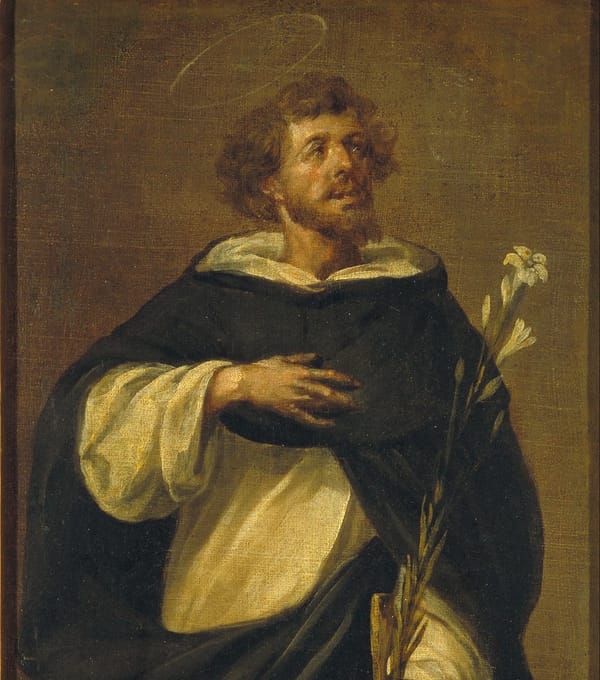
August 4: St. Dominic, Confessor
|
In that clime
Where springs the pleasant west wind to unfold
The fresh leaves, with which Europe sees herself
New-garmented; nor from those billows far,
Beyond whose chiding, after weary course,
The sun doth sometimes hide him; safe abides
The happy Calaroga under guard
Of the great shield, wherein the lion lies
Subjected and supreme. And there was born
The loving minion of the Christian faith,
The hallowed wrestler, gentle to his own,
And to his enemies terrible. So replete
His soul with lively virtue, that when first
Created, even in the mother's womb,
It prophesied. When, at the sacred font,
The spousals were complete 'twixt faith and him,
Where pledge of mutual safety was exchanged,
The dame, who was his surety, in her sleep
Beheld the wondrous fruit, that was from him
And from his heirs to issue. And that such
He might be construed, as indeed he was,
She was inspired to name him of his owner,
Whose he was wholly; and so called him Dominic.
O happy father! Felix rightly named.
O favoured mother! rightly named Joanna;
If that do mean as men interpret it.1
Then, with sage doctrine and goodwill to help,
Forth on his great apostleship he fared,
Like torrent bursting from a lofty vein;
And dashing 'gainst the stocks of heresy,
Smote fiercest, where resistance was most stout.
Thence many rivulets have since been turned,
Over the garden Catholic to lead
Their living waters, and have fed its plants.2
This eulogium, truly worthy of heaven, is placed by Dante, in his ‘Paradiso,’ on the lips of the most illustrious son of the poor man of Assisi. In the great poet’s journey through the upper world, it was fitting that Bonaventure should extol the patriarch of the Preachers as in the preceding canto Thomas Aquinas, Dominic’s son, had celebrated the father of the family humbly girt with the cord.
The Providence that governeth the world,
In depth of counsel by created ken
Unfathomable, to the end that she,
Who with loud cries was spoused in precious Blood,
Might keep her footing towards her well-beloved,
Safe in herself and constant unto him,
Hath two ordained, who should on either hand
In chief escort her: one, seraphic all
In fervency; for wisdom upon earth,
The other, splendour of cherubic light.3
O Wisdom of the Father, thou wast the one love of both; Francis’ poverty, the true treasure of the soul, and Dominic’s faith, the incomparable light of our exile, are but two aspects of Thee from below, expressing to us, in our time of trial and shadow, Thy adorable beauty. Speaking with no less profoundness and with greater authority, the immortal pontiff Gregory IX says: ‘ The Fountain of Wisdom, the Word of the Father, our Lord Jesus Christ, whose nature is goodness, whose work is mercy, does not abandon in the course of ages the vine He has brought out of Egypt; He comes to the aid of wavering souls by new signs, He adapts His wonders to the weakness of the incredulous. When therefore the day was declining towards evening, and while charity was becoming frozen by the abundance of wickedness, the light of justice was beginning to wane, the Father of the family gathered together workmen fitted for the labours of the eleventh hour; to clear His vineyard of the thorns that had overgrown it, and to drive away the multitude of mischievous little foxes that were doing their best to destroy it, He raised up the companies of Friars Preachers and Minors with the chiefs armed for battle.’4 In this expedition of the Lord of hosts, Dominic was 'His glorious charger, full of fire in his faith, fearlessly neighing by preaching the divine word.’5 In October we shall see the great share in the combat taken by his brother-at-arms, who appeared as a living standard of Christ crucified, in the midst of a society where the triple concupiscence was in league with every error, striving to overthrow Christianity itself.
Finding everywhere this union of sensuality with heresy, which was henceforth to be the principal strength of false preachers, Dominic, like Francis, prescribed to his sons the most absolute renunciation of this world's goods, and he too became a beggar for Christ's sake. The time was past when the people, rejoicing in all the consequences of the Incarnation, made over to the Man-God the most extensive territorial domain that ever was, and at the same time placed his Vicar at the head of kings. The unworthy descendants of these highminded Christians, after having vainly attempted to humiliate the Bride by subjecting the priesthood to the empire, reproached the Church with possessing those goods of which she was but the depository in the name of our Lord; the time had come for the Dove of the Canticle to begin, by abandoning the earth, her return journey towards heaven.
But if the two leaders of the campaign which arrested for a time the progress of the enemy were but one in their love of holy poverty, this last was the special choice of the Assisian Patriarch. Dominic's more direct means for obtaining the glory of God and the salvation of souls was science; this was his excellent portion, more fertile than that of Caleb's daughter. Less than fifty years after Dominic had bequeathed this inheritance to his descendants, the wisely combined irrigation, by the upper and the nether waters of faith and reason, had brought to full growth the tree of theological science, with its powerful roots and branches loftier than the clouds, whereon the birds of all tribes under heaven loved to perch without fear and gaze upon the sun.
‘The father of the Preachers,’ said the Eternal Father to St. Catherine of Siena, ‘established his principle on the light, by making it his aim and his armour; he took upon him the office of the Word My Son, sowing My word, dispelling darkness, enlightening the earth; Mary, by whom I gave him to the world, made him the extirpator of heresies.’6 In the same way, as we have already seen, spoke the Florentine poet half a century earlier. The order, called to become the chief support of the sovereign pontiff in uprooting pernicious doctrines, ought, if possible, to justify that name even more than its patriarch: the first of the tribunals of Holy Church, the Holy Roman Universal Inquisition, the Holy Office, truly invested with the office of the Word with His two-edged sword, to convert or to chastise, could find no instrument more trusty or more sure.
Little thought the virgin of Siena, or the illustrious author of the ‘Divina Commedia,’ that the chief title of the Dominican family to the grateful love of the people would be discussed in a certain apologetic school, and there discarded as insulting, or dissembled as unpleasant. The present age glories in a liberalism which has given proofs of its power by multiplying ruins, and which rests on no better philosophical basis than a strange confusion between licence and liberty; only such intellectual grovelling could have failed to understand that, in a society which has faith for the basis of its institutions as well as the principle of salvation for all, no crime could equal that of shaking the foundation on which thus rest both social interest and the most precious possession of individuals. Neither the idea of justice, nor still less that of liberty, could consist in leaving to the mercy of evil or evil men the weak who are unable to protect themselves: this truth was the axiom and the glory of chivalry: the brothers of Peter the Martyr devoted their lives to protect the safety of the children of God against the surprises of the strong armed one, and the business that walketh about in the dark:7 it was the honour of the 'saintly flock led by Dominic along a way where they thrive well who do not go astray.'8
Who could be truer knights than those athletes of the faith,9 taking their sacred vow in the form of allegiance,10 and choosing for their Lady her who, terrible as an army, alone crushes heresies throughout the whole world? To the buckler of truth and the sword of the word, she who keeps in Sion the armour of valiant men, added for her devoted liegemen the Rosary, the special mark of her own militia; she, as being their true commander-in-chief, assigned them the habit of her choice, and in the person of Blessed Reginald, anointed them with her own hands for the battle. She herself, too, watched over the recruiting of the holy band, attracting to it from among the élite youth of the universities souls the purest, the most generously devoted, and of the noblest intellect. At Paris, the capital of theology, and Bologna, of law and jurisprudence, masters and scholars, disciples of every branch of science, were pursued and overtaken by the sweet Queen amid incidents more heavenly than earthly. How graceful were those beginnings, wherein Dominic's virginal serenity seemed to surround all his children! It was indeed in this the Order of light that the Gospel word was seen verified: Blessed are the clean of heart, for they shall see God.11 Eyes enlightened from above beheld the foundations of the Friars Preachers under the figure of fields of lilies; and Mary, by whom the Splendour of eternal Light came down to us, became their heavenly mistress and led them from every science to Wisdom, the friend of pure hearts. She came, accompanied by Cecilia and Catherine, to bless their rest at night, and covered them all with her royal mantle beside the throne of our Lord. After this we are not astonished at the freshness and purity, which continued even after St. Dominic, under the generalship of Jordan of Saxony, Raymund of Pennafort, John the Teuton, and Humbert de Romans, in those 'Lives of the Brethren,' and 'Lives of the Sisters,' so happily handed down to us. It is instructive to note that in the Dominican family, apostolic in its very essence, the Sisters were founded ten years before the Brethren, which shows how, in the Church of God, action can never be fruitful unless preceded and accompanied by contemplation, which obtains for it every blessing and grace.
Notre Dame de Prouille, at the foot of the Pyrenees, was not only by this right of primogeniture the beginning of the whole order; it was here also that the first companions of St. Dominic made with him their choice of a rule, and divided the world amongst them, going from here to found the convents of St. Romanus at Toulouse, St. James at Paris, St. Nicholas at Bologna, St. Sixtus and St. Sabina in the Eternal City. About the same period the establishment of the Militia of Jesus Christ placed under the direction of the Friars Preachers secular persons, who undertook to defend, by all the means in their power, the goods and liberty of the Church against the aggressions of heresy; when the sectaries had laid down their arms, leaving the world in peace for a time, the association did not disappear: it continued to fight with spiritual arms, and changed its name into that of the Third Order of Brothers and Sisters of Penance of St. Dominic.
Let us read in the Church's book the abridged life of the holy patriarch:
How many sons and daughters surround thee on the sacred cycle! This very month, Rose of Lima and Hyacinth keep thee company, and thy coming has long since been heralded in the liturgy by Raymund of Pennafort, Thomas Aquinas, Vincent Ferrer, Peter the Martyr, Catherine of Siena, Pius V, and Antoninus. And now at length appears in the firmament the new star whose brightness dispels ignorance, confounds heresy, increases the faith of believers. O Dominic, thy blessed mother, who preceded thee to heaven, now penetrates in all its fulness the happy meaning of that mysterious vision which once excited her fears. And that other Dominic, the glory of ancient Silos, at whose tomb she received the promise of thy blessed birth, rejoices at the tenfold splendour given by thee for all eternity to the beautiful name he bequeathed thee. But what a special welcome dost thou receive from the Mother of all grace, who heretofore, embracing the feet of her angered Son, stood surety that thou wouldst bring back the world to its Saviour! A few years passed away; and error, put to confusion, felt that a deadly struggle was engaged between itself and thy family; the Lateran Church saw its walls, which were threatening to fall, strengthened for a time; and the two princes of the apostles, who had bidden thee go and preach, rejoice that the word has gone forth once more into the whole world.
Stricken with barrenness, the nations, which the Apocalypse likens to great waters, seemed to have become once for all corrupt; the prostitute of Babylon was setting up her throne before the time; when, in imitation of Eliseus, putting the salt of Wisdom into the new vessel of the order founded by thee, thou didst cast this divine salt into the unhealthy waters, neutralize the poison of the beast so soon risen up again, and, in spite of the snares which will never cease, didst render the earth habitable once more. How clearly thy example shows us that they alone are powerful before God and over the people, who give themselves up to Him without seeking anything else, and only give to others out of their own fulness. Despising, as thine historians tell us, every opportunity and every science where eternal Wisdom was not to be seen, thy youth was charmed with her alone; and she, who prevents those that seek her, inundated thee from thy earliest years with the light and the anticipated sweetness of heaven. It is from her that overflowed upon thee that radiant serenity, which so struck thy contemporaries, and which no occurrence could ever alter. In heavenly peace thou didst drink long draughts from the everflowing fountain springing up into eternal life; but while thine inmost soul was thus slaking the thirst of its love, the divine source produced a marvellous fecundity; and its streams becoming thine, thy fountains were conveyed abroad in the streets, thou didst divide thy waters. Thou hadst welcomed Wisdom, and she exalted thee; not content to adorn thy brow with the rays of the mysterious star, she gave thee also the glory of patriarchs, and multiplied thy years and thy works in those of thy sons. In them thou hast not ceased to be one of the strongest stays of the Church. Science has made thy name wonderful among the nations, and because of it their youth is honoured by the ancients; may it ever be for them, as it was for their elders, both the fruit of Wisdom and the way that leads to her; may it be fostered by prayer; for thy holy order so well keeps up the beautiful traditions of prayer as to approach the nearest, in that respect, to the ancient monastic orders. To praise, to bless, and to preach will be to the end its loved motto; for its apostolate must be, according to the word of the Psalm, the overflowing of the abundance of sweetness tasted in communication with God. Thus strengthened in Sion, thus blessed in its glorious rôle of propagator and guardian of the truth, thy noble family will ever deserve to hear, from the mouth of our Lady herself, that encouragement above all praise: ' Fortiter, fortiter, viri fortes!—Courage, courage, ye men of courage!'
- Dominic, belonging to the Lord; Felix, happy; Joanna, grace. ↩︎
- Dante, Divina Commedia, Paradiso, Canto xii. (Cary’s translation). ↩︎
- Dante, Paradiso, Canto xi. ↩︎
- Bulla Fons Sapientiæ, de canonizatione S. Dominici. ↩︎
- Ibid. ↩︎
- Dialogue, clviii. ↩︎
- Ps. xc. 6. ↩︎
- Dante, Paradiso, Canto x. ↩︎
- Honorius III., Diploma confirmans ordinem. ↩︎
- Promitto obedientiam Deo et B. Mariæ, Constitutiones Fratr. Ord. Prædicat. 12 Distinctio, cap. xv. de Professione. ↩︎
- St. Matt. v. 8. ↩︎
| Previous August 3: Finding of St. Stephen, Protomartyr | Next August 4: St. Dominic, Confessor |