Daily reading
After Pentecost
Double · August 17 · Sanctoral
August 17, 2019
From Dom Guéranger’s The Liturgical Year.

|
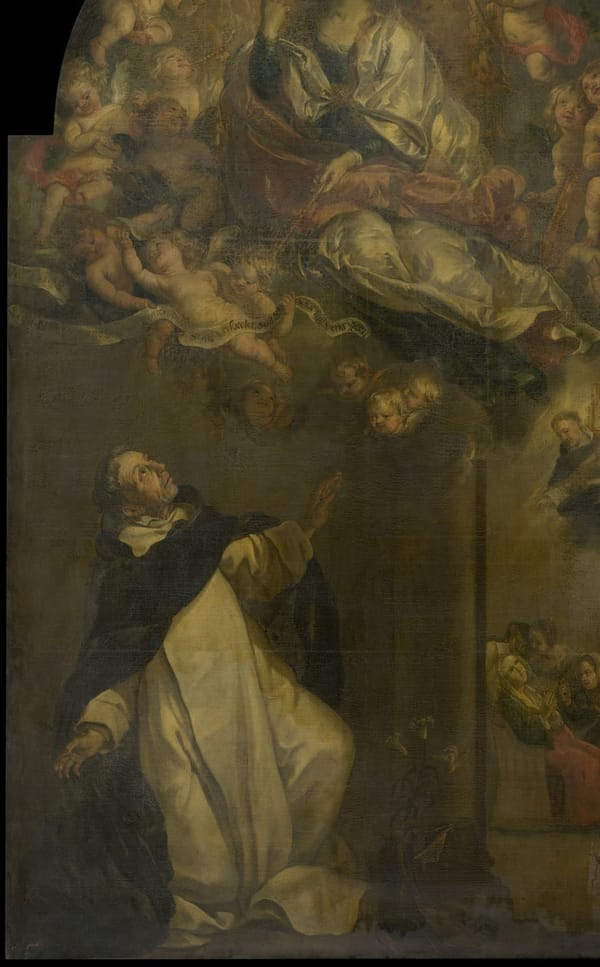
August 17: St. Hyacinth, Confessor
ONE of the loveliest lilies from the Dominican field to-day unfurls its petals at the foot of Mary's throne. Hyacinth represents on the sacred cycle that intrepid band of missionaries who, in the thirteenth and fourteenth centuries, faced the barbarism of the Tartars and Mussulmans which was threatening the West. From the Alps to the northern frontiers of the Chinese Empire, from the islands of the Archipelago to the Arctic regions, he propagated his Order and spread the kingdom of God. On the steppes, where the schism of Constantinople disputed its conquests with the idolatrous invaders from the North, he was seen for forty years working prodigies, confounding heresy, dispelling the darkness of infidelity.
The consecration of martyrdom was not wanting to this, any more than to the first apostolate. Many were the admirable episodes where the angels seemed to smile upon the hard combats of their earthly brethren. In the convent founded by Hyacinth at Sandomir on the Vistula, forty-eight Friars Preachers were gathered together under the rule of blessed Sadoc. One day the lector of the Martyrology, announcing the feast of the morrow, read these words which appeared before his eyes in letters of gold: At Sandomir on the fourth of the Nones of June, the Passion of Forty-nine Martyrs. The astonished brethren soon understood this extraordinary announcement; in the joy of their souls they prepared to gather the palm, which was procured for them by an irruption of the Tartars on the very day mentioned. They were assembled in choir at the happy moment, and whilst singing the Salve Regina they dyed with their blood the pavement of the church.
No executioner’s sword was to close Hyacinth’s glorious career. John, the beloved disciple, had had to remain on earth till the Lord should come; our saint waited for the Mother of his Lord to fetch him.
Neither labour nor the greatest sufferings, nor, above all, the most wonderful divine interventions were wanting to his beautiful life. Kieff, the holy city of the Russians, having for fifty years resisted his zeal, the Tartars, as avengers of God's justice, swept over it and sacked it. The universal devastation reached the very doors of the sanctuary where the man of God was just concluding the holy Sacrifice. Clothed as he was in the sacred vestments, he took in one hand the most holy Sacrament and in the other the statue of Mary, who asked him not to leave her to the barbarians; then, together with his brethren, he walked safe and sound through the very midst of the bloodthirsty pagans, along the streets all in flames, and lastly across the Dnieper, the ancient Borysthenes, whose waters, growing firm beneath his feet, retained the marks of his steps. Three centuries later, the witnesses examined for the process of canonization attested on oath that the prodigy still continued; the footprints always visible upon the water, from one bank to the other, were called by the surrounding inhabitants St. Hyacinth’s Way.
The saint, continuing his miraculous retreat as far as Cracow, there laid down his precious burden in the convent of the Blessed Trinity. The statue of Mary, light as a reed while he was carrying it, now resumed its natural weight, which was so great that one man could not so much as move it. Beside this statue Hyacinth, after many more labours, would return to die. It was here that, at the beginning of his apostolic life, the Mother of God had appeared to him for the first time, saying: 'Have great courage and be joyful, my son Hyacinth! Whatsoever thou shalt ask in my name, shall be granted thee.’ This happy interview took place on the Vigil of the Assumption. The saint gathered from it the superhuman confidence of the thaumaturgus, which no difficulty could ever shake; but above all he retained from it the virginal fragrance which embalmed his whole life, and the light of supernatural beauty which made him the picture of his father Dominic.
Years passed away: heroic Poland, the privileged centre of Hyacinth’s labours, was ready to play its part, under Mary’s shield, as the bulwark of Christendom; at the price of what sacrifices we shall hear in October from a contemporary of our saint, St. Hedwiges, the blessed mother of the hero of Liegnitz. Meantime, like St. Stanislaus his predecessor in the labour, the son of St. Dominic came to Cracow, to breathe his last sigh and leave there the treasure of his sacred relics. Not on the Vigil this time, but on the very day of her triumph, August 15, 1257, in the church of the Most Holy Trinity, our Lady came down once more, with a brilliant escort of angels, and virgins forming her court. ‘Oh! who art thou?’ cried a holy soul who beheld all this in ecstasy. ‘I,’ answered Mary, 'am the Mother of mercy; and he whom I hold by the hand is brother Hyacinth, my devoted son, whom I am leading to the eternal nuptials.’ Then our Lady intoned herself with her sweet voice: ‘I will go to the mountain of Libanus,’ and the angels and virgins continued the heavenly song with exquisite harmony, while the happy procession disappeared into the glory of heaven.
Let us read the notice of St. Hyacinth given by the liturgy. We shall there see that his above-mentioned passage over the Dnieper was not the only circumstance wherein he showed his power over the waves.
Great was thy privilege, O Son of Dominic, to be so closely associated to Mary as to enter into thy glory on the very feast of her triumph. As thou occupiest so fair a place in the procession accompanying her to heaven, tell us of her greatness, her beauty, her love for us poor creatures, whom she desires to make sharers, like thee, in her bliss.
It is through her that thou wert so powerful in this thy exile, before being near her in happiness and glory. Long after Adalbert and Anschar, Cyril and Methodius, thou didst traverse once more the ungrateful North, where thorns and briars so quickly spring up again, where the people, whom the Church has with such labour delivered from the yoke of paganism, are continually letting themselves be caught in the meshes of schism and the snares of heresy. In his chosen domain the prince of darkness suffered fresh defeats, an immense multitude broke his chains, and the light of salvation shone further than any of thy predecessors had carried it. Poland, definitively won to the Church, became her rampart, until the days of treason which put an end to Christian Europe.
O Hyacinth, preserve the faith in the hearts of this noble people. Obtain grace for the Northern regions, which thou didst warm with the fiery breath of thy word. Nothing thou askest of Mary will be refused, for the Mother of Mercy promised thee so. Keep up the apostolic zeal of thy illustrious Order. May the number of thy brethren be multiplied, for it is far below our present needs.
Akin to thy power over the waves, is another attributed to thee by the confidence of the faithful, and justified by many prodigies: viz., that of restoring life to the drowned. Many a time also have Christian mothers experienced thy miraculous power, in bringing to the saving font their little ones, whom a dangerous delivery threatened to deprive of baptism. Prove to thy devout clients that the goodness of God is ever the same, and the influence of His elect not lessened.
August 17 (the Same Day): Octave Day of St. Laurence
AT Christmas Stephen watched beside the crib, where the Infant God attracted our hearts; Laurence to-day escorts the Queen whose beauty out-shines the heavens. It was fitting that a deacon should be present at both triumphs of love, shown at Bethlehem in the weakness of the Babe, and in heaven in the glory wherewith the Son delights to honour His Mother. During her pilgrimage through the desert of this world, the deacons are the guardians of the Bride, the Church, signified by the ancient tabernacle, wherein was the Ark of the Covenant, a figure of Mary.
‘Beloved sons,’ said the Pontiff to them on the day of their consecration, 'consider by how great a privilege, inheriting both the office and the name of the Levitical tribe, you surround the tabernacle of the testimony, which is the Church, to defend it against an untiring enemy. As your fathers carried the tabernacle, so must you support the Church; adorn her by sanctity, strengthen her by the divine word, uphold her by the example of perfection. Levi signifies set apart; be you then separated from earthly desires; shine with the brightness of spotless purity, as beseems the tribe beloved of the Lord.’1
By this disengagement from earth which gives true liberty, the Church, who is free herself, whereas the Synagogue was a slave, clothes her deacons with a grace unknown to the Levites of old. It would be true to say of Laurence what was written of Stephen, that his face appeared as the face of an angel amongst men; from the brow of each shone the light of Wisdom who dwelt in them, and the Holy Ghost who spoke by them put a grace upon their lips. In blood not his own did the Levite of Sinai, raising his sword, consecrate his hands to Jehovah; the deacon, ever ready to give his own blood, manifests his power by a fidelity of love, not of servitude; keeps up his energy by righteousness and self-forgetfulness; and while his feet are on the earth, where he combats, his eyes are on heaven, to which he aspires, and his heart is given to the Church, who has entrusted herself to him.
With what devotedness he guards both her and her treasures; from the precious pearl of the Body of her spouse, to the jewels of the Mother, which are her poor and suffering children; from the purely spiritual riches springing from baptism and the word of God, to those material goods, the possession of which proves the Bride’s right of citizenship here below. It were well to recall this lesson in our days: God willed that the greatest martyr of the holy City should win his crown by refusing to deliver up the revenues of the Church; and yet, under the circumstances, the confiscation of the treasure was legal, at least as far as an edict of Cæsar could legalize injustice. Laurence did not consider that this pretended legality authorized him to yield to the governor’s demands; he had no answer but disdain for this man who knew not that the earth being the Lord’s the Bride of the Lord is responsible to Him alone in the administration of His goods. Would he have acted differently if the State had then, as later, joined hypocrisy to tyranny, and tried to vindicate its spoliations by artful language, unknown to the straightforward highway robber? Where are now the State and the Cæsar of those days? It is no new thing for persecutors to end in shame; the imperial murderer of the great deacon had not long to wait; in less than two years, Valerian had become the footstool of Sapor, and afterwards his skin, dyed red, was hung from the roof of a Persian temple.
Laurence, meanwhile, has received more homage than was ever offered to king or Cæsar. What ancient Roman conqueror ever attained to his glory? Rome itself became his conquest: twenty-four sanctuaries dedicated to Christ in his name in the Eternal City eclipse all the imperial palaces. And throughout the world, how many important churches and monasteries rejoice in his powerful patronage. The New World imitates the Old, giving the name of St. Laurence to its towns and provinces, its islands, bays, rivers, capes, and mountains. But among all Christian kingdoms, his native Spain justly distinguishes itself in paying honour to the illustrious archdeacon; it celebrates the feast of his holy parents Orentius and Patience, who gave him birth in the territory of Huesca; and it consecrated to him the noblest monument of its grandest age, St. Laurence of the Escurial, at once a church, a monastery, and a palace, built in the form of a gigantic gridiron.
Let us close the Octave with the prayer addressed to him to-day by our common Mother:
Raise up, O Lord, in Thy Church the spirit which was followed by the blessed Levite, Laurence; that we, being filled with it, may study to love what he loved, and in our works to practice what he taught.
We have just quoted the Collect of the octave day; it is borrowed, together with the Introit and other prayers of to-day, from the Mass which was anciently celebrated in the night of August 10. We take the opportunity of remarking that supernatural prodigies at various times have proved that this glorious night won for the martyr a special privilege of delivering souls from purgatory in virtue of his own fiery torture. It became the custom in Rome to pray for the dead in the basilica of St. Laurence in agro Verano, raised by the first Christian emperor over the martyr’s tomb. The faithful of the Eternal City come to sleep their last sleep under its shadow, and within its walls Pius IX, of happy memory, willed to await his resurrection.
Notker gives us this fine Sequence, after which we will conclude with a prayer from the Leonine Sacramentary.
Sequence
martyr milesque fortis.
tu manus tortorum cruentas
atque manu fortem,
superare tyranni crudelis.
facit amorem milites eius,
dispendio vitae praesentis.
et iudicis minas derides.
craticulam vane consumunt.
victus a pisce assato, Christi cibo.
conresurgendi cum ipso saturatus.
invictissime regis aeterni,
deprecare veniam semper,
Amen.
of the great and true David,
the blood-stained hand of the executioners,
and the strong in hand,
the kingdom of the cruel tyrant;
makes his soldiers,
at the loss of this present life.
and laugh at the judge’s threats;
and the burner with his gridiron, labour in vain.
conquered by a roasted fish, the food of Christ;
filled with the hope of rising again with him.
of David the eternal King,
for his little servants,
Amen.
Prayer
| Previous August 16 (the Same Day): St. Roch, Confessor | Next August 17 (the Same Day): Octave Day of St. Laurence |