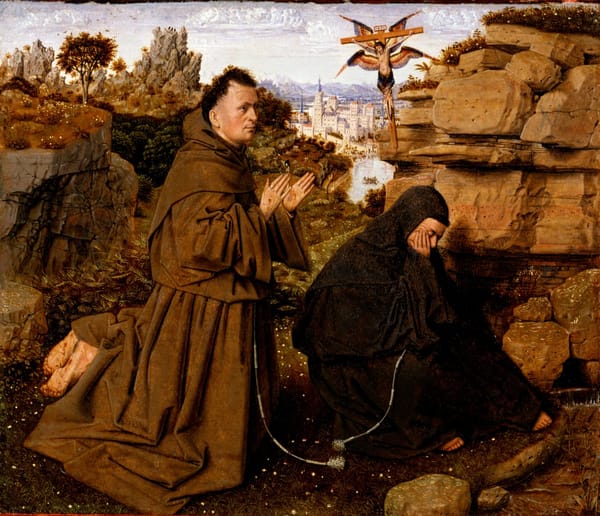
The great patriarch of Assisi will soon appear a second time in the holy liturgy, and we shall praise God for the marvels wrought in him by divine grace. The subject of to-day’s feast, while a personal glory to St. Francis, is of greater importance for its mystical signification.
The Man-God still lives in the Church by the continual reproduction of His mysteries in this His bride, making her a faithful copy of Himself. In the thirteenth century, while the charity of the many had grown cold,1 the divine fire burned with redoubled ardour in the hearts of a chosen few. It was the hour of the Church’s passion; the beginning of that series of social defections, with their train of denials, treasons, and derisions, which ended in the proscription we now witness. The cross had been exalted before the eyes of the world: the bride was now to be nailed thereto with her divine Spouse, after having stood with Him in the pretorium exposed to the insults and blows of the multitude.
Like an artist selecting a precious marble, the holy Spirit chose the flesh of the Assisian seraph as the medium for the expression of His divine thought. He thereby manifested to the world the special direction He intended to give to the sanctity of souls; He offered to heaven a first and complete model of the new work He was meditating, viz: the perfect union, upon the very cross, of the mystical body with its divine Head. Francis was the first to be chosen for this honour: but others were to follow; and henceforward, here and there through the world, the stigmata of our blessed Lord will ever be visible in the Church.
Let us read in this light the admirable history of the event, composed by the seraphic doctor in honour of his holy father St. Francis.
Fidelis revera famulus et minister Christi Franciscus, biennio antequam spiritimi redderet cœlo, cum in loco excelso seorsum, qui mons Alverniædicitur, quadragenarium ad honorem Archangeli Michælis jejunium inchoasset, supernæ contemplationis dulcedine abundantius solito superfusus, ac cœlestium desideriorum ardentiori flamma succensus, supernarum cœpit immissionum cumulatius dona sentire. Dum igitur seraphicis desideriorum ardoribus sursum ageretur in Deum, et affectus compassiva teneritudine in eum transformaretur, cui ex cantate nimia crucifigi complacuit: quodam mane circa festum Exaltationis sanctæ crucis, in latere montis orans, vidit quasi speciem unius Seraphim sex alas tam fulgidas quam ignitas habentem de cœlorum sublimitate descendere: qui volatu celerrimo ad æris locum viro Dei propinquum perveniens, non solum alatus, sed et crucifixus apparuit: manus quidem et pedes habens extensos, et cruci affixos, alas vero sic miro modo hinc inde dispositas, ut duas super caput erigeret, duas ad volandum extenderet, duabus vero reliquis totum corpus circumplectendo velaret. Hoc videns, vehementer obstupuit, mixtumque dolori gaudium mens ejus incurrit, dum et in gratioso ejus aspectu sibi tam mirabiliter quam fainiliariter apparentis excessivam quamdam concipiebat lætitiam, et dira conspecta crucis affixio ipsius animam compassivi doloris gladio pertransivit.
Intellexit quidem illo docente interius, qui et apparebat exterius: quod licet passions infirmitas cum immortalitate spiritus seraphici nullatenus conveniret, ideo tamen hujusmodi visio suis fuerat præsentata conspectibus; ut amicus ipse Christi prænosceret, se non per martyrium carnis, sed per incendium mentis totum in Christi Jesu crucifixi expressam similitudinem transformandum. Disparens itaque visio post arcanum ac familiare colloquium mentem ipsius seraphico interius inflammavit ardore; carnem vero Crucifixo conformi exterius insignivit effigie, tamquam si ad ignis liquefactivam virtutem præambulam sigillativa quædam esset impressio subsecuta. Statim namque in manibus et pedibus ejus apparere cœperunt signa clavorum, ipsorum capitibus in inferiori parte manuum et superiori pedum apparentibus, et eorum acuminibus exsistentibus ex adverso. Dextrum quoque latus quasi lancea transfixum rubra cicatrice obductum erat: quod sæpe sanguinem sacrum effundens, tunicam et femoralia respergebat.
Postquam igitur novus homo Franciscus novo et stupendo miraculo claruit, cum singulari privilegio retroactis sæculis non concesso insignitus apparuit, sacris videlicet stigmatibus decoratus, descendit de monte secum ferens Crucifìxi effigiem, non in tabulis lapideis vel ligneis manu figuratam artificis, sed in carneis membris descriptam digito Dei vivi: quoniam sacramentum regis seraphicus vir abscondere bonum esse optime norat, secreti regalis conscius, signacula illa sacra pro viribus occultabat. Veruni quia Dei est ad gloriam suam magna revelare, quæ facit Dominus ipse, qui signacula illa secrete impresserat, miracula quædam aperte per ipsa monstravit, ut illorum occulta et mira vis stigmatum, manifesta pateret claritate signorum. Porro rem admirabilem ac tantopere testatam, atque in pontificiis diplomatibus præcipuis laudibus et favoribus exaltatam, Benediotus Papa undecimus anniversaria solemnitate celebrari voluit: quam postea Paulus quintus Pontifex maximus, ut corda fidelium in Christi crucifìxi accenderentur amorem, ad universam Ecclesiam propagavit.
He, who appeared outwardly to Francis, taught him inwardly that, although weakness and suffering are incompatible with the immortal life of a seraph, yet this vision had been shown to him to the end that he, Christ’s lover, might learn how his whole being was to be transformed into a living image of Christ crucified, not by martyrdom of the flesh, but by the burning ardour of his soul. After a mysterious and familiar colloquy, the vision disappeared, leaving the saint’s mind burning with seraphic ardour, and his flesh impressed with an exact image of the Crucified, as though, after the melting power of that fire, it had next been stamped with a seal. For immediately the marks of nails began to appear in his hands and feet, their heads showing in the palms of his hands and the upper part of his feet, and their points visible on the other side. There was also a red scar on his right side, as if it had been wounded by a lance, and from which blood often flowed staining his tunic and underclothing.
Two years before the faithful servant and minister of Christ, Francis, gave up his spirit to God, he retired alone into a high place, which is called Mount Alvernia, and began a forty days’ fast in honour of the Archangel St. Michæl. The sweetness of heavenly contemplation was poured out on him more abundantly than usual, till, burning with the flame of celestial desires, he began to feel an increasing overflow of these divine favours. While the seraphic ardour of his desires thus raised him up to God, and the tenderness of his love and compassion was transforming him into Christ the crucified Victim of excessive love; one morning about the feast of the Exaltation of holy cross, as he was praying on the mountain-side, he saw what appeared to be a Seraph, with six shining and fiery wings, coming down from heaven. The vision flew swiftly through the air and approached the man of God, who then perceived that it was not only winged, but also crucified; for the hands and feet were stretched out and fastened to a cross; while the wings were arranged in a wondrous manner, two being raised above the head, two outstretched in flight, and the remaining two crossed over and veiling the whole body. As he gazed, Francis was much astonished, and his soul was filled with mingled joy and sorrow. The gracious aspect of him, who appeared in so wonderful and loving a manner, rejoiced him exceedingly, while the sight of his cruel crucifixion pierced his heart with a sword of sorrowing compassion.
Francis, now a new man, honoured by this new and amazing miracle, and, by a hitherto unheard of privilege, adorned with the sacred stigmata, came down from the mountain bearing with him the image of the Crucified, not carved in wood or stone by the hand of an artist, but engraved upon his flesh by the finger of the living God. The seraphic man well knew that it is good to hide the secret of the king; wherefore, having been thus admitted into his king’s confidence, he strove, as far as in him lay, to conceal the sacred marks. But it belongs to God to reveal the great things which he himself has done; and hence, after impressing those signs upon Francis in secret, he publicly worked miracles by means of them, revealing the hidden and wondrous power of the stigmata by the signs wrought through them. Pope Benedict XI willed that this wonderful event, which is so well attested and in pontifical diplomas has been honoured with the greatest praises and favours, should be celebrated by a yearly solemnity. Afterwards, Pope Paul V, wishing the hearts of all the faithful to be enkindled with the love of Christ crucified, extended the feast to the whole Church.
Standard-bearer of Christ and of His Church, we would fain, with the apostle and with thee, glory in nothing save the cross of our Lord Jesus. We would fain bear in our souls the sacred stigmata, which adorned thy holy body. To him whose whole ambition is to return love for love, every suffering is a gain, persecution has no terrors; for the effect of persecutions and sufferings is to assimilate him, together with his mother the Church, to Christ persecuted, scourged, and crucified.
It is with our whole hearts that we pray, with the Church: ‘O Lord Jesus Christ, who, when the world was growing cold, didst renew the sacred marks of Thy Passion in the flesh of the most blessed Francis, to inflame our hearts with the fire of Thy love; mercifully grant, that by bis merits and prayers we may always carry the cross, and bring forth worthy fruits of penance. Who livest and reignest with God the Father, in the unity of the Holy Ghost, God, world without end. Amen.’2