Daily reading
After Pentecost
Double of the II Class · September 20 · Sanctoral
September 20, 2019
From Dom Guéranger’s The Liturgical Year.

|
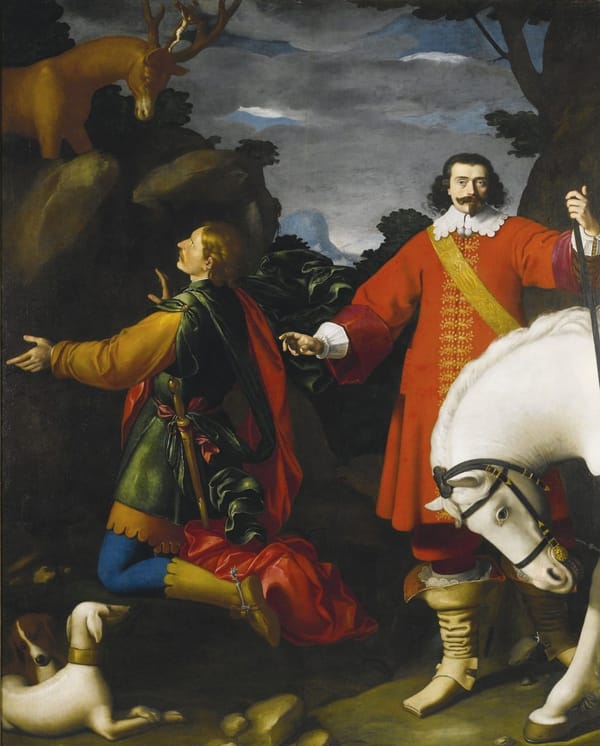
September 20: St. Eustace and His Companions, Martyrs
The twentieth of September marks one of the saddest events in history. At the height of her power, in the glorious days of Pepin and Charlemagne, the eldest daughter of the Church had crowned her mother; and the Church, in the person of her Head, reigned in reality, as well as by right, until, a thousand years later, satan took advantage of the fallen state of France to despoil Peter of the patrimony which ensured his independence. The holy cross is still shedding its rays upon us!
To-day a group of martyrs, and this time a whole family, father, mother, and sons, take up their position around the standard of salvation. While the antiquity of their cultus in both east and west rests on the best authority, the details of their life are extremely vague. Could Placid the tribune, whose exploits are recorded by Josephus in his Wars of the Jews,1 be the same as the Eustace we are celebrating to-day? Does the genealogy of our saint connect him with the Octavia family, from which Augustus sprang? Again are we to recognize as his direct descendant the noble Tertullus, who confided to St. Benedict his son Placid, the favourite child of the holy patriarch, and the proto-martyr of the Benedictine Order?2 Subiaco long possessed the mountain designated by ancient tradition as the site of the apparition of the mysterious stag; Tertullus may have bequeathed it to the monastery, as his son's patrimony. But we have not space enough to do more than record the fact that these questions have been raised.3
There could hardly be a more touching legend than that of our martyrs.
Our trials are light compared with yours, O blessed martyrs! Obtain for us the grace not to betray the confidence of our Lord, when He calls us to suffer for Him in this world. It is thus we must win the glory of heaven. How can we triumph with the God of armies, unless we have marched under His standard? Now, that standard is the cross. The Church knows it, and therefore she is not troubled even by the greatest calamities. She knows, too, that her Spouse is watching over her, even when He seems to sleep; and she looks to the protection of such of her sons as are already glorified. And yet, O martyrs, for how many years has the sorrowful shadow of a sacrilegious invasion hung over the day of your triumph! Rome honoured you with so much love! Take vengeance on the audacity of hell, and deliver the holy city!
September 15 (the Same Day): Feast of the Seven Dolours of the Blessed Virgin Mary
|
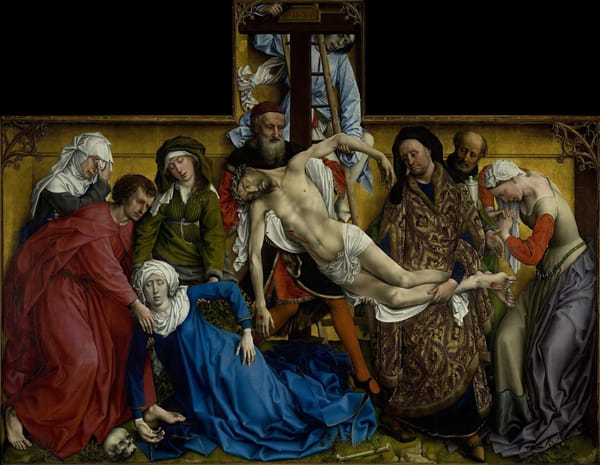
[This feast day, previously kept on the third Sunday of September, was moved to Sept. 15 in the reforms of Pope St. Pius X, and is also celebrated on the Friday before Palm Sunday. We provide this on both Sept. 15 and on the Friday before Palm Sunday.]
From Dom Guéranger's The Liturgical Year.
‘O all ye that pass by the way, attend, and see if there be any sorrow like to my sorrow!’1 Is this, then, the first cry of that sweet babe, whose coming brought such pure joy to our earth? Is the standard of suffering to be so soon unfurled over the cradle of such lovely innocence? Yet the heart of mother Church has not deceived her; this feast, coming at such a time, is ever the answer to that question of the expectant human race: What shall this child be?
The Saviour to come is not only the reason of Mary’s existence, He is also her exemplar in all things. It is as His Mother that the blessed Virgin came, and therefore as the ‘Mother of sorrows’; for the God, whose future birth was the very cause of her own birth, is to be in this world 'a Man of sorrows and acquainted with infirmity.’2 ‘To whom shall I compare thee?’ sings the prophet of lamentations: ‘O Virgin . . . great as the sea is thy destruction.’3 On the mountain of the sacrifice, as Mother she gave her Son, as bride she offered herself together with Him; by her sufferings both as bride and eus Mother, she was the co-redemptress of the human race. This teaching and these recollections were deeply engraved on our hearts on that other feast of our Lady’s dolours which immediately preceded Holy Week.
Christ dieth now no more: and our Lady’ sufferings are over. Nevertheless the Passion of Christ is continued in His elect, in His Church, against which hell vents the rage it cannot exercise against Himself. To this Passion of Christ’s mystical body, of which she is also Mother, Mary still contributes her compassion; how often have her venerated images attested the fact, by miraculously shedding tears! This explains the Church’s departure from liturgical custom, by celebrating two feasts, in different seasons, under one same title.
On perusing the register of the apostolic decrees concerning sacred rites, the reader is astonished to find a long and unusual interruption lasting from March 20, 1809 to September 18, 1814, at which latter date is entered the decree instituting on this present Sunday a second Commemoration of our Lady’s Dolours.4 1809-1814, five sorrowful years, during which the government of Christendom was suspended; years of blood which beheld the Man-God agonizing once more in the person of His captive Vicar. But the Mother of sorrows was still standing beneath the cross, offering to God the Church's sufferings; and when the trial was over, Pius VII, knowing well whence the mercy had come, dedicated this day to Mary as a fresh memorial of the day of Calvary.
Even in the seventeenth century, the Servites had the privilege of possessing this second feast, which they celebrated as a double of the second class, with a vigil and an octave. It is from them that the Church has borrowed the Office and Mass. This honour and privilege was due to the Order established by our Lady to honour her sufferings and to spread devotion to them. Philip Benizi, heir to the seven holy Founders, propagated the flame kindled by them on the heights of Monte Senario; thanks to the zeal of his sons and successors, the devotion to the Seven Dolours of the blessed Virgin Mary, once their family property, is now the treasure of the whole world.
The prophecy of the aged Simeon, the flight into Egypt, the loss of the divine Child in Jerusalem, the carrying of the cross, the Crucifixion, the taking down from the cross, and the burial of Jesus: these are the seven mysteries into which are grouped the well-nigh infinite sufferings which made our Lady the Queen of martyrs, the first and loveliest rose in the garden of the Spouse. Let us take to heart the recommendation from the Book of Tobias which the Church reads during this week in the Office of the time: Thou shalt honour thy mother: for thou must be mindful what and how great perils she suffered in giving thee birth.5
Mass
The daily Sacrifice, though surrounded with all the pomps of the liturgy, is substantially the same as that of Calvary. But the only assistants at the foot of the cross were, as our Introit points out, one man, and a few women weeping around the Mother of sorrows. The Gospel will repeat this Introit, and even its verse which, contrary to custom, is not taken from the Psalms.
Introit
The honouring of our Lady’s Dolours does not distract our thoughts from the one Victim of salvation. On the contrary, its immediate result, as the Collect shows, is to cause the Passion of our Saviour to bear fruit in our souls.
Collect
Then is added the Collect of the occurring Sunday.
Epistle
Cap. xiii.Benedixit te Dominus in virtute sua, quia per te ad nihilum redegit inimicos nostros. Benedicta es tu, filia, a Domino Deo excelso, præ omnibus mulieribus super terram. Benedictus Dominus, qui creavit cœlum et terram: quia hodie nomen tuum ita magnificavit, ut non recedat laus tua de ore hominum, qui memores fuerint virtutis Domini in sternum, pro quibus non pepercisti animie tuæ propter angustias, et tribulationem generis tui, sed subvenisti ruinæ ante conspectum Dei nostri.
Ch. xiii.The Lord hath blessed thee by his power, because by thee he hath brought our enemies to nought. Blessed art thou, O daughter, by the Lord the most high God above all women upon the earth. Blessed be the Lord who made heaven and earth, because he hath so magnified thy name this day, thatthy praise shall not depart out of the mouth of men, who shall be mindful of the power of the Lord for ever; for that thou hast not spared thy life by reason of the distress and tribulation of thy people, but hast prevented our ruin in the presence of our God.
Oh the greatness of our Judith among all creatures! ‘God,’ says the pious and profound Father Faber, ‘vouchsafed to select the very things about Him which are most incommunicable, and in a most mysteriously real way communicate them to her. See how He had already mixed her up with the eternal designs of creation, making her almost a partial cause and partial model of it. Our Lady’s co-operation in the redemption of the world gives us a fresh view of her magnificence. Neither the Immaculate Conception nor the Assumption will give us a higher idea of Mary’s exaltation than the title of co-redemptress. Her dolours were not necessary for the redemption of the world, but in the counsels of God they were inseparable from it. They belong to the integrity of the divine plan. Are not Mary’s mysteries Jesus’ mysteries, and His mysteries hers? The truth appears to be, that all the mysteries of Jesus and Mary were in God’s design as one mystery. Jesus Himself was Mary’s sorrow, seven times repeated, aggravated sevenfold. During the hours of the Passion, the offering of Jesus and the offering of Mary were tied in one. They kept pace together; they were made of the same materials; they were perfumed with kindred fragrance; they were lighted with the same fire; they were offered with kindred dispositions. The two things were one simultaneous oblation, interwoven each momentthrough the thickly crowded mysteries of that dread time, unto the eternal Father, out of two sinless hearts, that were the hearts of Son and Mother, for the sins of a guilty world which fell on them contrary to their merits, but according to their own free will.’6 Let us mingle our tears with Mary’s, in union with the sufferings of the great Victim. In proportion as we do this during life we shall rejoice in heaven with the Son and the Mother; if our Lady is now, as we sing in the Alleluia verse, Queen of heaven and mistress of the world, is there one among all the elect who can recall sufferings comparable to hers?
After the Gradual follows the Stabat Mater, the touching Complaint attributed to the Franciscan, blessed Jacopone de Todi.
Gradual
Sequence
Juxta crucem lacrymosa,
Dum pendebat Filius.
Contristatam et dolentem,
Pertransivit gladius.
Fuit illa benedicta
Mater Unigeniti!
Pia Mater, dum videbat
Nati pænas inclyti.
Matrem Christi si videret
In tanto supplicio?
Christi Matrem contemplari
Dolentem cum Filio?
Vidit Jesum in tormentis,
Et flagellis subditum.
Moriendo desolatum,
Dum emisit spiritum.
Me sentire vim doloris
Fac ut tecum lugeam.
In amando Christum Deum,
Ut sibi complaceam.
Crucifixi fige plagas
Cordi meo valide.
Tam dignati pro me pati,
Pænas mecum divide.
Crucifixo condolere,
Donec ego vixero.
Et me tibi sociare
In planctu desidero.
Mihi jam non sis amara:
Fac me tecum plangere.
Passionis fac consortem,
Et plagas recolere.
Fac me cruce inebriari,
Et cruore Filii.
Per te, Virgo, sim defensus,
In die judicii.
Da per Matrem me venire
Ad palmam victoriæ.
Fac ut animæ donetur
Paradisi gloria.
hung her Son, the sorrowing
Mother stood and wept.
that sighed, and mourned,
and grieved.
was that blessed Mother
of an only Son!
and mourned at seeing
her divine Son suffer.
to see Jesus’ Mother
in such suffering?
the Mother and the Son in sorrow,
and not join his own with theirs?
tormented and scourged
for the sins of his people.
as he breathed forth
his soul and died.
make me feel the force of sorrow;
make me weep with thee!
with the love of Jesus my God,
that so I may content his heart.
deeply stamp the wounds
of the Crucified upon my heart.
for it is for me he graciously deigned
to be wounded and to suffer.
make me compassionate with thee our crucified Jesus,
as long as life shall last.
to stand nigh the cross with thee,
and be a sharer in thy grief.
be not displeased at my prayer:
make me weep with thee.
make me a partner of his Passion,
an adorer of his Wounds.
make me to be inebriated with the cross
and Blood of thy Son.
let me be defended by thee, O Virgin,
on the day of judgment!
let me, by thy Mother’s aid,
come to my crown of victory.
oh! give to my soul
the reward of heaven’s glory.
Gospel
Cap. xix.In illo tempore: Stabant juxta crucem Jesu Mater ejus, et soror Matris ejus Maria Cleophæ, et Maria Magdalene. Cum vidisset ergo Jesus Matrem, et discipulum stantem quem diligebat, dicit Matri suæ: Mulier, ecce filius tuus. Deinde dicit discipulo: Ecce mater tua. Et ex illa hora accepit eam discipulus in sua.
Ch. xix.At that time, there stood by the cross of Jesus, his Mother, and his Mother’s sister Mary of Cleophas, and Mary Magdalene. When Jesus therefore had seen his Mother and the disciple standing, whom he loved, he saith to his Mother, Woman, behold thy Son. After that he saith to the disciple, Behold thy Mother. And from that hour the disciple took her to his own.
‘Woman, behold thy son.—My God, My God, why hast Thou forsaken Me?’ Such are the words of Jesus on the cross. Has He, then, no longer a Father in heaven, a Mother on earth? Oh! mystery of justice, and still more of love! God so loved the world as to give His only-begotten Son for it, so far as to lay upon Him, instead of upon sinful men, the curse our sins deserved; and our Lady too, in her sublime union with the Father, did not spare, but offered in like manner for us all, this same Son of her virginity. If on this head we belong to the eternal Father, we belong henceforth to Mary also; each has bought us at a great price: the exchange of an only Son for sons of adoption.
It is at the foot of the cross that our Lady truly became the Queen of mercy. At the foot of the altar, where the renewal of the great Sacrifice is preparing, let us commend ourselves to her omnipotent influence over the Heart of her divine Son.
Offertory
Recordare, Virgo Mater Dei, dum steteris in conspectu Domini, ut loquaris pro nobis bona, et ut avertat indignationem suam a nobis.
Be mindful, O Virgin Mother of God, when thou standest in the sight of the Lord, to speak good things for us, that he may turn away his anger from us.
How many holy souls, in the course of ages, have come to keep faithful company with the Mother of sorrows! Their intercession united with Mary’s is a strength to the Church; and we hope to obtain thereby the effect of the merits of our Saviour’s death.
Secret
Offerimus tibi preces et hostias, Domine Jesu Christe, humiliter supplicantes: ut, qui transfixionem dulcissimi spiritus beatæ Mariæ Matris tuæ precibus recensemus; suo, suorumque sub cruce sanctorum consortium, multiplicato piissimo interventu, meritis mortis tuæ, meritum cum beatis habeamus. Qui vivis.
We offer to thee prayers and sacrifices, O Lord Jesus Christ, humbly beseeching, that we who pray in remembrance of the transfixion of the most sweet soul of blessed Mary thy Mother, by the multiplied and pious intercession of her and her holy companions under the cross, may have a reward with the blessed, by the merits of thy death. Who livest.
A commemoration is then made of the Sunday.
The Preface is the same as on September 8, page 165, except that for ‘in Nativitate, on the Nativity,’ is substituted ‘in Transfixione, on the Transfixion’ of the blessed Mary ever Virgin.
So great, it has been said, was Mary’s grief on Calvary, that, had it been divided among all creatures capable of suffering, it would have caused them all to die instantly.7 It was our Lady’s wonderful peace, maintained by perfect acquiescence and the total abandonment of her whole being to God, that alone was able to sustain in her the life which the Holy Ghost was preserving for the Church’s sake. May our participation in the sacred mysteries give us that peace of God which passeth all understanding, and which keepeth minds and hearts in Christ Jesus!
Communion
As the Postcommunion points out, the loving memory of our Mother’s sorrows will powerfully assist us to find all good things in the holy Sacrifice of the altar.
Postcommunion
The Postcommunion of the occurring Sunday is added, and the Gospel of the same is read at the end of the Mass instead of the usual passage from St. John.
Vespers
The first and fifth antiphons of Vespers are taken from the Canticle of canticles, the three intermediate ones from Isaias, and that of the Magnificat from Job; the capitulum is from Jeremias.
Ps. Dixit Dominus, page 38.
Ps. Laudate pueri, page 41.
Ps. Lætatus sum, page 152.
Ps. Nisi Dominus, page 153.
Ps. Lauda Jerusalem, page 154.
Capitulum
Thren. ii.
Hymn
Quo dolore volvitur,
Luctuosa de cruento
Dum, revulsum stipite,
Cernit ulnis incubantem
Virgo Mater Filium!
Et latus dulcissimum,
Dexteramque vulneratam,
Et sinistram sauciam,
Et rubras cruore plantas
Ægra tingit lacrymis.
Stringit arctis nexibus
Pectus illud, et lacertos,
Illa figit vulnera:
Sicque tota colliquescit
In doloris osculis.
Per tuas has lacrymas,
Filiique triste funus,
Vulnerumque purpuram,
Hunc tui cordis dolorem
Conde nostris cordibus.
Et coævo Flamini,
Esto summæ Trinitati
Sempiterna gloria,
Et perennis laus, honorque
Hoc, et omni sæculo.
in what an abyss of sorrow
is she whelmed, that Virgin Mother,
as mourning she beholds her Son
taken down from the blood-stained tree
and laid in her arms!
that side most sweet,
that right hand all pierced,
and the left hand wounded too,
those feet all rosy with his blood:
the desolate Mother bathes them with her tears.
she locks in loving embrace
that breast and those arms,
and kisses their wounds;
and thus she melts away
in sorrowful caresses.
by these thy tears,
by the cruel death of thy Son,
and by his empurpled wounds,
plant deep in our hearts
this anguish of thine own.
and to the coequal Spirit,
to the most high Trinity,
be everlasting glory,
unending praise and honour,
now and for evermore.
Antiphon of the Magnificat
The Prayer is the Collect of the Mass page 211.
Then is made a commemoration of the Sunday.
| Previous September 19: St. Januarius, Bishop and Martyr, and his Companions, Martyrs | Next September 15 (the Same Day): Feast of the Seven Dolours of the Blessed Virgin Mary |