Daily reading
After Pentecost
Double of the I Class · Movable from Easter · Temporal
September 29, 2019
From Dom Guéranger’s The Liturgical Year.

|
The Sixteenth Sunday after Pentecost
The resuscitation of the son of the widow of Naim, on which our thoughts were fixed last Sunday, has reanimated the confidence of our beloved mother, the Church; her prayer goes up all the more earnestly to her Spouse, who leaves her on earth, for a time, that she may grow dearer to Him by sufferings and tears. Let us, of course, enter into the sentiments which guided her in the choice of to-day’s Introit.
Introit
Ps. Inclina, Domine, aurem tuam mihi, et exaudi me : quoniam inops et pauper sum ego. Gloria Patri. Miserere.
Ps. Incline thine ear unto me, O Lord, and hear me : for I am needy and poor. Glory, etc. Have mercy.
Such is our inability in the work of salvation, that, unless grace prevent, that is, anticipate, us, we cannot have so much as the thought of doing what is holy; and again, unless it follow up the inspirations it has given us, and lead them to a happy termination, we shall never be able to pass from the simple thought to the act of any virtue whatsoever. If, on the other hand, we be faithful to grace, our life will be one uninterrupted tissue of good works. Let us, in our Collect, ask, both for ourselves and for all our neighbours, the persevering continuity of this most precious aid.
Collect
The other Collects, as on page 120.
Epistle
Cap. iii.Fratres, Obsecro vos, ne deficiatis in tribulationibus meis pro vobis, quæ est gloria vostra. Hujus rei gratia flecto genua mea ad Patrem Domini nostri Jesu Christi, ex quo omnis patemitas in cœlis, et in terra nominatur, ut det vobis secundum divitias gloria sua, virtute corroborali per Spiritum ejus in interiorem hominem, Christum habitare per fidem in cordibus vestris : in charitate radicati, et fundati, ut possitis comprehendere cum omnibus sanctis, quæ sit latitudo, et longitudo, et sublimitas, et profundum: scire etiam supereminentem scientiæ charitatem Christi, ut impleamini in omnem plenitudinem Dei. Ei autem, qui potens est omnia facere superabundanter quam petimus, aut intelligimus, secundum virtutem, quæ operatur in nobis : ipsi gloria in Ecclesia, et in Christo Jesu in omnes generationes sæculi sæculorum. Amen.
Ch. iii.Brethren: I pray you not to faint at my tribulations for you, which is your glory. For this cause I bow my knees to the Father of our Lord Jesus Christ, of whom all paternity in heaven and earth is named, that he would grant you, according to the riches of his glory, to be strengthened by his Spirit with might unto the inward man. That Christ may dwell by faith in your hearts: that being rooted and founded in charity, you may be able to comprehend, with all the saints, what is the breadth, and length, and height, and depth: to know also the charity of Christ, which surpasseth all knowledge, that you may be filled unto all the fullness of God. Now to him who is able to do all things more abundantly than we desire or understand, according to the power that worketh in us : to him be glory in the church, and in Christ Jesus, unto all generations, world without end. Amen.
‘My heart hath uttered a good word: I speak my works to the King.’1 The enthusiasm of the royal psalmist, when singing the glorious nuptial song, has taken possession of our apostle’s whole soul, and inspires him with this marvellous Epistle, which seems to put into music, into a song of love, the sublime teachings of all his other letters. When he wrote this to his Ephesians he was Nero’s prisoner; but it shows that the word of God is anything but hampered by the chains that make an apostle a captive.2
Although the Epistle to the Ephesians is far from being the longest of his letters, yet it is from it that the Church borrows most during these Sundays after Pentecost; and we may argue from such choice that it gives, more than any other of St. Paul’s Epistles, that leading subject, upon which the Church is particularly anxious to direct her children’s thoughts during this season of the liturgical year. Let us, therefore, thoroughly master the mystery of the Gospel,3 by hearkening to the herald who received it as his special mission to make known to the Gentiles the treasure that had been hidden from eternity in God.4 It is as ambassador that he comes to us;5 and the chains which bind him, far from weakening the authority of his message, are but the glorious badges which accredit him with the disciples of the Christ who died on Calvary.
For, God alone, as he tells us in the music we have just heard, can strengthen in us the inward man enough to make us understand, as the saints do, the dimensions (breadth, length, height, and depth) of the great mystery of Christ dwelling in man, and dwelling in him for the purpose of filling him with the plenitude of God. Therefore is it, that falling on his knees before Him from whom flows every perfect gift, and who has begotten us in the truth by His love,6 our apostle asks God to open, by faith and charity, the eyes of our heart, that so we may be able to understand the splendid riches of the inheritance He reserves to His children, and the exceeding greatness of the divine power used in our favour, even in this life.7
But, if holiness is requisite in order to obtain the full development of the divine life spoken of by the apostle, let us also take notice how the desire and the prayer of St. Paul are for all men; and how, therefore, no one is excluded from that divine vocation. Indeed, as St. John Chrysostom observes,8 the Christians, to whom he sends his Epistle, are people living in the world, married, having children and servants, for he gives them rules of conduct with regard to each point.9 The saints of Ephesus, as of all other places, are no others than the faithful of Christ Jesus,10 that is to say, they are those who faithfully follow the divine precepts, in the condition of life proper to each. Now, it depends on us to follow God's grace; nothing else but our own resistance prevents the Holy Ghost from making saints of us. Those sublime heights, to which the progressive movement of the sacred liturgy has, since Pentecost, been leading the Church, are open to all of us. If the new order of ideas introduced by this movement strike us, at times, as being beyond our practical attainment, the probable reason of such cowardice is—and a short examination of conscience will bear witness against us—that we have neglected, ever since Advent and Christmas, to profit, as we should have done, by the teachings and graces of every kind, which were given us as means for advancing in light and in Christian virtue. The Church, at the commencement of the cycle, offered her aid to every one of us, and that aid she adapted to each one’s capabilities; but she could never remain stationary, because some of us were too lazy to move onwards; she could never consent, out of a regard for our laggings and sluggishness, to neglect leading men of good will to that divine union, which they were told ‘crowns both the year of the Church, and the faithful soul that has spent the year under the Church’s guidance.’11 But on no account must we lose courage. The cycle of the liturgy runs its full course in the heavens of the Church each year. It will soon be starting afresh, again adapting the power of its graces to each one’s necessities and weaknesses. If, with that new year of grace, we learn a lesson from our past deficiencies; if we do not content ourselves with a mere theoretical admiration of the exquisite poetry, and loveliness, and charms of its opening seasons; if we seriously set ourselves to grow with the growth of that light which is no other than Christ Himself,12—if, that is, we profit by the graces of progress which that light will again infuse into our souls—then the work of our sanctification, having been this time prepared, has a cheering and 'a new chance of receiving that completeness, which had been retarded by the weakness of human nature.’13
Even now, though our dispositions may not be all they should be, yet the Holy Ghost, that Spirit of loving mercy who reigns over this portion of the cycle, will not refuse the humble prayer we make to Him, and will supply, at least in some measure, our sad shortcomings. Great, after all, has been our gain in this, that the eye of our faith has had new supernatural horizons opened out to it, and that it has reached those peaceful regions which the dull vision of the animal man14 fails to discover. It is there that divine Wisdom reveals to the perfect that great secret of love, which is not known by the wise and the princes of this world— secret which the eye had not before seen, nor the ear heard, nor the heart even suspected as possible.15 From this time forward, we shall better understand the divine realities, which fill up the life of the servants of God; they will seem to us, as they truly are, a thousand times preferable, both in importance and in greatness, to those vain frivolities and occupations, in the midst of which is spent the existence of so-called practical men. Let us take delight in thinking upon that divine choice, which, before time was, selected us for the fullness of all spiritual benedictions,16 of which the temporal blessings of the people of old17 were but a shadow. The world was not as yet existing, and already God saw us in His Word;18 to each one among us, He assigned the place he was to hold in the body of His Christ;19 already, His fatherly eye beheld us clad with that grace20 which made Him well pleased with the Man-God; and He predestinated us,21 as being members of this His beloved Son, to sit with Him, on His right hand, in the highest heavens.22
Oh! how immense are our obligations to the eternal Father, whose good pleasure23 has decreed to grant such wondrous gifts to our earth! His will is His counsel,24 it is the one rule of all His acts; and His will is all love. It is from the voluntary and culpable death of sin25 that He calls us to that life which is His own life. It is from the deep disgrace of every vice that, after having cleansed us in the Blood of His Son,26 He has exalted us to a glory, which is the astonishment of the angels, and makes them tremble with adoring admiration.27 Let us then be holy for the sake of giving praise to the glory of such grace.28 Christ, in His Divinity, is the substantial brightness and eternal glory of His Father;29 if He has taken to Himself a Body, if He has made Himself our Head, it was for no other purpose than that He might sing the heavenly canticle in a new way. Not satisfied with presenting in His sacred Humanity, a sight most pleasing to His Father— that is, the sight of the created reflex of divine, and therefore infinite, perfections — He wished, moreover, that the whole of creation should give back to the adorable Trinity an echo of the divine harmonies. It is on this account that He, in His own Flesh, broke down the old enmities existing between Gentile and Jew;30 and then, bringing together these that were once enemies, He made of them all one spirit and one body, so that their countless human voices might, through Him, blend in unison of love with the angelic choirs, and thus, standing around God’s throne, might attune the one universal song of their praise to that of the infinite Word Himself. Thus shall we become for ever to God, like this divine Word, the praise of His glory, as the apostle thrice loves to express himself in the beginning of this his Epistle to the Ephesians.31 Thus, too, is to be wrought that mystery which, from all eternity, was the object of God’s eternal designs: the mystery, that is, of divine union, realized by our Lord Jesus uniting, in His own Person, in infinite love, both earth and heaven.32
The Church, which is showing herself in the midst of the Gentiles, bears on herself the mark of her divine Architect; God shows Himself, in her, in all majesty; and, by her, the kings of the earth are made to fear Him.
Gradual
Gospel
Cap. xiv.In illo tempore : Cum intraret Jesus in domum cujusdam principis pharisæorum sabbato manducare panem, et ipsi observabant eum. Et ecce homo quidam hydropicus erat ante illum. Et respondens Jesus, dixit ad legisperitos, et pharisæos, dicens : Si licet sabbato curare? At illi tacuerunt. Ipse vero apprehensum sanavit eum, ac dimisit. Et respondens ad illos, dixit : Cujus vestrum asinus, aut bos in puteum cadet, et non continuo extrahet illum die sabbati? Et non poterant ad hæc respondere illi. Dicebat autem et ad invitatos parabolani, intendens quomodo primos accubitus eligerent, dicens ad illos : Cum invitatus fueris ad nuptias, non discumbas in primo loco, ne forte honoratior te sit invitatus ab illo, et veniens is, qui te et illum vocavit, dicat tibi : Da huic locum : et tunc incipias cum rubore novissimum locum tenere. Sed cum vocatus fueris, vade, recumbe in novissimo loco : ut, cum venerit qui te invitavit, dicat tibi : Amice, ascende superius. Tune erit tibi gloria coram simul discumbentibus : quia omnis qui se exaltat, humiliabitur: et qui se humiliat, exaltabitur.
Ch. xiv.At that time : When Jesus went into the house of one of the chief of the pharisees on the Sabbath-day to eat bread, they watched him. And behold there was a certain man before him that had the dropsy. And Jesus answering, spoke to the lawyers and pharisees saying: Is it lawful to heal on the Sabbath-day? But they held their peace. But he taking him, healed him, and sent him away. And answering them, he said: Which of you shall have an ass or an ox fall into a pit; and will not immediately draw him out on the Sabbathday? And they could not answer him to these things. And he spoke a parable also to them that were invited, marking how they chose the first seats at the table, saying to them: When thou art invited to a wedding, sit not down in the first place, lest perhaps one more honourable than thou be invited by him: and he that invited thee and him, come and say to thee: Give this man place; and then thou begin with shame to take the lowest place. But when thou art invited, go, sit down in the lowest place, that when he who invited thee cometh, he may say to thee : Friend, go up higher. Then shalt thou have glory before them that sit at table with thee; because every one that exalteth himself shall be humbled; and he that humbleth himself shall be exalted.
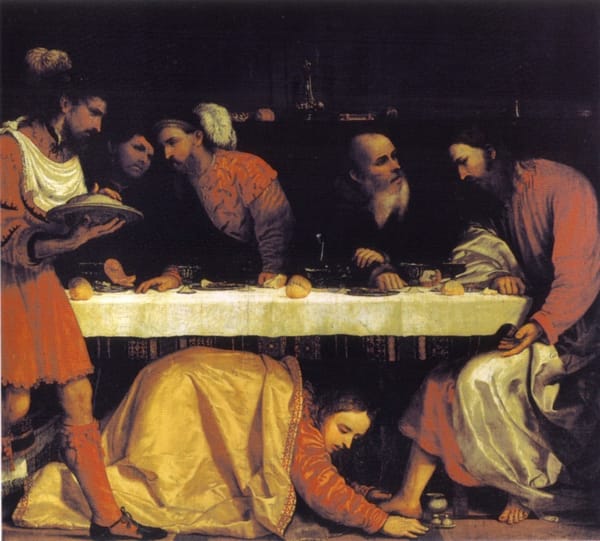
Holy Church here tells us, and in a most unmistakable way, what has been her chief aim for her children ever since the feast of Pentecost. The wedding spoken of in to-day’s Gospel is that of heaven, of which there is a prelude given here below, by the union effected in the sacred banquet of holy Communion. The divine invitation is made to all; and the invitation is not like that which is given on occasion of earthly weddings, to which the bridegroom and bride invite their friends and relatives as simple witnesses to the union contracted between two individuals. In the Gospel wedding, Christ is the Bridegroom, and the Church is the bride.33 These nuptials are ours, inasmuch as we are members of the Church; and the banquet-hall, in this case, is something far superior to that of a commonplace marriage.
But, that this union be as fruitful as it ought to be, the soul, in the sanctuary of her own conscience, must bring with her a fidelity which is to be an enduring one, and a love which is to be active, even when the feast of the sacred mysteries is past. Divine union, when it is genuine, masters one’s entire being. It fixes one in the untiring contemplation of the beloved Object, in the earnest attention to His interests, in the continual aspiration of the heart towards Him, even when He seems to have absented Himself from the soul. The bride of the divine nuptials should be no less intent on her God, than those of earth are on their earthly spouse.34 It is on this condition alone, that the Christian soul can be said to have entered on the unitive life, or can yield its precious fruits.
But, for the attainment of all this—that is, that our Lord Jesus Christ may have that full control over the soul and its powers which makes her to be truly His, and subjects her to Him as the bride to her Spouse35—it is necessary that all alien competition be entirely and definitively put aside. Now, there is one sad fact, which everyone knows : the divinely noble Son of the eternal Father, the Incarnate Word whose beauty enraptures the heavenly citizens,36 the immortal King, whose exploits and power and riches are beyond all that the children of men can imagine37—has rivals, human rivals, who pretend to have stronger claims than He to creatures whom He has redeemed from slavery, and invited to share with Him the honours of His throne. Even in the case of those whom His loving mercy succeeds in winning over wholly to Himself, is He not frequently kept waiting, for perhaps years, before they can make up their minds to be wise enough to take Him? During that long period of unworthy wavering, He loses not His patience, He does not turn elsewhere as He might in all justice do, but He keeps on asking them to be wholly His,38 mercifully waiting for some secret touch of one of His graces, joined with the unwearied labour of the Holy Ghost, to get the better of all this inconceivable resistance.
Let us not be surprised at the Church bringing the whole influence of her liturgy to bear on the winning of souls to Christ; for every such conquest she makes for Him is a fresh and closer bond of union between herself and her Lord. This explains how, on some of these previous Sundays, she has given us such admirable instructions regarding the efforts of the triple concupiscence. Earthly pleasures, pride, and covetousness, are really the treacherous advisers, who excite within us, against God’s claims, those impertinent rivals of whom we were just now speaking. Having now reached the sixteenth week of this season of the reign of the Holy Ghost, and taking it for granted that her sons and daughters are in right good earnest about their Christian perfection, the Church hopes that they have fairly unmasked the enemy. To-day, therefore, hoping that her teaching will not fail to impress us, and that we shall no longer put off our most loving Jesus, she proposes to us, in the allegory of our Gospel, the great mystery of love of which He Himself has said : ‘The kingdom of heaven is likened to a King, who made a marriage for His Son.’39 But, after all, her anxiety as mother and bride never allows her to make quite sure of even her best and dearest children, so long as they are in this world. In order to keep them on their guard against falling into sin, she bids them listen to St. Ambrose, whom she has selected as her homilist for this Sunday. He addresses himself to the Christian who has become a veteran in the spiritual combat, and tells him that concupiscence has snares without end, even for him! Alas! he may trip, any day; he has gone far, perhaps very far, on the road to the kingdom of God, but, even so, he may go wrong, and be for ever shut out from the marriage feast, together with heretics, pagans, and Jews. Let him be on the watch, then, or he may become tainted with those sins, from which, hitherto, thanks to God’s grace, he has kept clear. Let him take heed, or he may become like the man mentioned in to-day’s Gospel, who had the dropsy; and dropsy, says our saintly preacher of Milan, is a morbid exuberance of humours, which stupefy the soul, and induce a total extinction of spiritual ardour. And yet, even if he were to have such a fall as that, let him not forget that the heavenly physician is ever ready to cure him. The saint, in this short homily, condenses the whole of St. Luke’s fourteenth chapter, of which we have been reading but a portion; and he shows, a little farther on, that attachment to the goods of this life is opposed to the ardour which should carry us on the wings of the spirit, towards the heaven where lives and reigns our loved One.’40 But, above all, it is to the constant attitude and exercise of humility that he must especially direct his attention who would secure a prominent place in the divine feast of the nuptials. All saints are ambitious for future glory of this best kind; but they are well aware that, in order to win it, they must go low down, during the present life, into their own nothingness; the higher in the world to come, the lower in this. Until the great day dawn, when each one is to receive according to his works,41 we shall lose nothing by putting ourselves, meanwhile, below everybody. The position reserved for us in the kingdom of heaven depends not, in the least, either upon our own thoughts about ourselves, or upon the judgment passed on us by other people; it depends solely on the will of God, who exalteth the humble, and bringeth down the mighty from their seat.42 Let us hearken to Ecclesiasticus. ‘The greater thou art, the more humble thyself in all things, and thou shalt find grace before God; for great is the power of God alone, and He is honoured by the humble.'43 Were it only, then, from a motive of self-interest, let us follow the advice of the Gospel, and, in all things, claim, as our own, the last place. Humility is not sterling, and cannot please God, unless, to the lowly estimation we have of ourselves, we join an esteem for others, preventing everyone with honour,44 gladly yielding to all in matters which do not affect our conscience; and all this, from a deep-rooted conviction of our own misery and worthlessness in the sight of Him who searches the reins and heart.45 The surest test of our humility before God, is that practical charity for our neighbour, which, in the several circumstances of everyday life, induces us, and without affectation, to give him the precedence over ourselves.
On the contrary, one of the most unequivocal proofs of the falseness of certain so-called spiritual ways, into which the enemy sometimes leads incautious souls, is the lurking contempt wherewith he inspires them for one or more of their acquaintance; it is dormant, perhaps, habitually, but when occasion offers—and it frequently offers—they allow it to influence their thoughts, and words, and actions. To a greater or less extent, and, it may be, with more or less unconsciousness, self-esteem is the basis of the structure of their virtues; but, as for the illuminations, and mystical sweetnesses, which these people sometimes tell their intimate friends they enjoy, they may be quite sure that such favours do not come to them from the holy Spirit. When the substantial light of the Sun of justice shall appear in the valley of the judgment, all counterfeits of this kind will be made evident,46 and they that trusted to them, and spent their lives in petting such phantoms, will find them all vanishing in smoke. Having then to take a much lower place than the one they dreamt of, they may reckon it a solace, that some place is still given them at the divine banquet. They will have to thank God that their chastisement goes no farther than the shame of seeing those very people passing high up in honour above them, for whom, during life, they had such utter contempt.
The greater the conquests made by the Church, the greater are the efforts of hell to destroy the souls of her dear children. This fearful danger calls for her fervent prayers; and our Offertory-anthem is one of these.
Offertory
The Secret reminds us, how the Sacrifice, at which we are present, and which is to be consummated, in a few moments, by the words of Consecration, is the most direct and efficacious of all the immediate preparations that we can make for the Communion of the Body and Blood, which that Sacrifice produces on the altar.
Secret
The other Secrets, as on page 180.
Now that the Church is filled, by the holy Communion just received, with the true substantial Wisdom of the Father, she promises God, as her thank-offering, that she will keep His justice, which is His law, and that she will labour to make His divine teaching produce its fruits.
Communion
In the Postcommunion, let us pray, with the Church, that we may be renewed by the purity, which these heavenly mysteries bring to us, who are well prepared for the gift: the effect of such a gift tells upon our bodies, both in this and in the next life.
Postcommunion
The other Postcommunions, as on page 131.
Vespers
The psalms, capitulum, hymn, and versicle, as above, pages 71-81.
Antiphon of the Magnificat
- Ps. xliv. 2. ↩︎
- 2 Tim. ii. 9. ↩︎
- Eph. vi. 19. ↩︎
- Eph. iii. 8, 9. ↩︎
- Ibid. vi. 20. ↩︎
- St. Jas. i. 17, 18. ↩︎
- Eph. i. 18, 19. ↩︎
- In ep. ad Eph., Hom. 1. ↩︎
- Eph. v. 22; vi. 1, 5. ↩︎
- Eph. i. 1. ↩︎
- Our Volume for Christmas, p. 23. ↩︎
- St. John i. 5. ↩︎
- See above, p. 11. ↩︎
- 1 Cor. ii. 14. ↩︎
- Ibid. 6-9. ↩︎
- Eph. i. 3. ↩︎
- Deut. xxviii. 1-14. ↩︎
- Eph. i. 4. ↩︎
- 1 Cor. xii. 12-31; Eph. iv. 12-16. ↩︎
- Ibid. i. 6. ↩︎
- Ibid 4, 5. ↩︎
- Ibid. i. 20, 23; ii. 6. ↩︎
- Ibid. i. 9. ↩︎
- Ibid. 11. ↩︎
- Ibid. 7; ii. 1-5. ↩︎
- Ibid. i. 7. ↩︎
- Hymn for the Ascension; Matins. ↩︎
- Eph. i. 4, 6. ↩︎
- Heb. i. 3. ↩︎
- Eph. ii. 14-18. ↩︎
- Ibid. i. 6, 12, 14. ↩︎
- Ibid. 9, 10. ↩︎
- Apoc. xix. 7. ↩︎
- 1 Cor. vii. 34. ↩︎
- 1 Cor. xi. 8-10. ↩︎
- Acta S. Agnetis. ↩︎
- Ps. xliv. ↩︎
- Apoc. iii. 20. ↩︎
- St. Matt. xxii. 2. ↩︎
- S. Amb., in Luc., vii., Homil. Diei. ↩︎
- St. Matt. xvi. 27. ↩︎
- St. Luke i. 52. ↩︎
- Ecclus. iii. 20, 21. ↩︎
- Rom. xii. 10. ↩︎
- Apoc. ii. 23. ↩︎
- 1 Cor. iv. 5. ↩︎
September 29: Dedication of St. Michael the Archangel
|
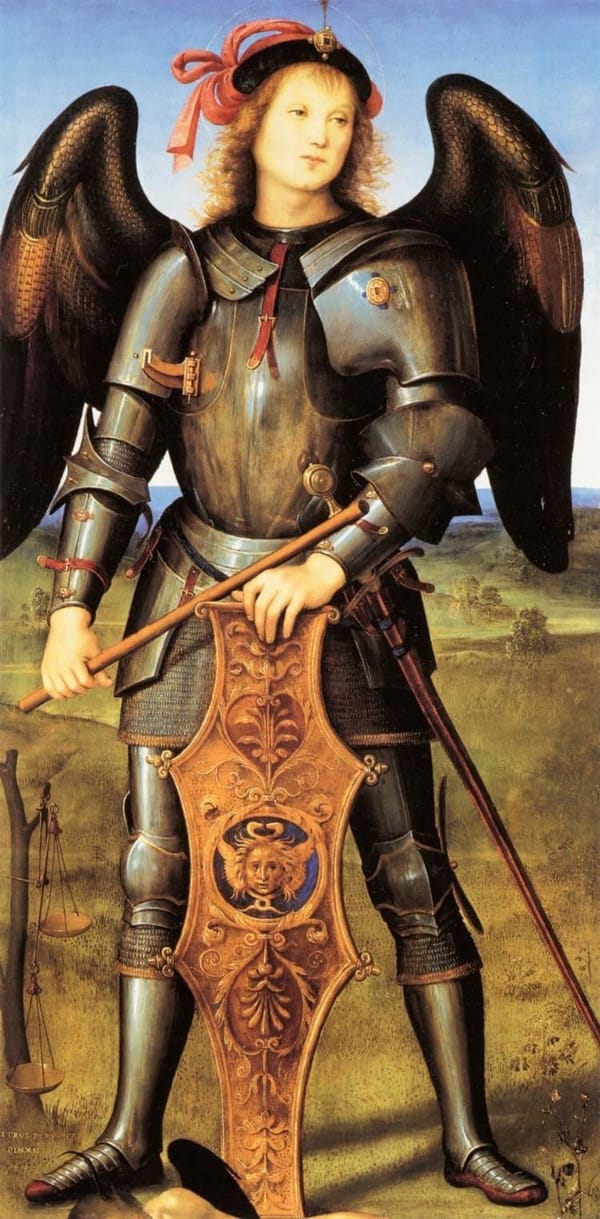
The glorious Archangel appears to-day at the head of the heavenly army: There was a great battle in heaven, Michael and his angels fought with the dragon, and the dragon fought and his angels.1 In the sixth century, the dedication of the churches of St. Michael on Monte Gargano and in the Roman Circus increased the celebrity of this day, which had however been long before consecrated by Rome to the memory of all the heavenly Virtues.
The east commemorates on the sixth of September an apparition of the victorious Prince at Chone2 in Phrygia; while the eighth of November is their solemnity of the angels, corresponding to our feast of to-day, and bearing the title: ‘Synaxis of Saint Michæl prince of the heavenly host, and of the other spiritual Powers.’ Although the term synaxis is usually applied only to religious assemblies here on earth, we are informed that in this instance it also signifies the gathering of the faithful angels at the cry of their chief, and their union eternally sealed by their victory.3
Who, then, are these heavenly Powers, whose mysterious combat heads the first page of history? Their existence is attested by the traditions of all nations as well as by the authority of holy Scripture. If we consult the Church, she teaches us that in the beginning God created simultaneously two natures, the spiritual and the corporal, and afterwards man who is composed of both.4 The scale of nature descends by gradation from beings made to the likeness of God, to the very confines of nothingness; and by the same degrees the creature mounts upwards to his Creator. God is infinite being, infinite intelligence, infinite love. The creature is for ever finite: but man, endowed with a reasoning intellect, and the angel, with an intuitive grasp of truth, are ever, by a continual process of purification, widening the bounds of their imperfect nature, in order to reach, by increase of light, the perfection of greater love.
God alone is simple with that unchangeable productive simplicity, which is absolute perfection excluding the possibility of progress; He is pure Act, in whom substance, power, and operation are one thing. The angel, though entirely independent of matter, is yet subject to the natural weakness necessary to a created being; he is not absolutely simple, for in him action is distinct from power, and power from essence5 How much greater is the weakness of man’s composite nature, unable to carry on the operations of the intellect without the aid of the senses!
One of the most enlightened brethren of the angelic doctor says:
Compared with ours, how calm and how luminous is the knowledge of pure spirits! They are not doomed to the intricate discoursing of our reason, which runs after the truth, composes and analyzes, and laboriously draws conclusions from premisses. They instantaneously apprehend the whole compass of primary truths. Their intuition is so prompt, so lively, so penetrating, that it is impossible for them to be surprised, as we are, into error. If they deceive themselves, it must be of their own will. The perfection of their will is equal to the perfection of their intellect. They know not what it is to be disturbed by the violence of appetites. Their love is without emotion; and their hatred of evil is as calm and as wisely tempered as their love. A will so free can know no perplexity as to its aims, no inconstancy in its resolutions. Whereas with us long and anxious meditation is necessary before we make a decision, it is the property of the angels to determine by a single act the object of their choice. God proposed to them, as He does to us, infinite beatitude in the vision of His own Essence; and to fit them for so great an end, He endowed them with grace at the same time as He gave them being. In one instant they said Yes or No; in one instant they freely and deliberately decided their own fate.6
Let us not be envious. By nature the angel is superior to us; but, to which of the angels hath He said at any time, ‘Thou art My Son?’7 The only begotten Son of God did not take to Himself the angelic nature. When on earth, He acknowledged the temporary subordination of humanity to those pure spirits, and deigned to receive from them, even as do His brethren in the flesh, the announcements of the divine will,8 and help and strength.9 But ‘God hath not subjected unto angels the world to come,’ says the apostle.10 How can we understand this attraction of God towards what is feeblest? We can only worship it in humble, loving faith. It was Lucifer’s stumbling-block on the day of the great battle in heaven. But the faithful angels prostrated themselves in joyous adoration at the feet of the Infant-God foreshown to them enthroned on Mary’s knee, and then rose up to sing: ‘Glory to God in the highest, and on earth peace to men of good will.’
O Christ, my Christ as St. Denis calls Thee,11 the Church to-day delightedly proclaims Thee the beauty of the holy angels.12 Thou, the God-Man, art the lofty height whence purity, light, and love flow down upon the triple hierarchy of the nine choirs. Thou art the supreme Hierarch, the centre of worlds, controller of the deifying mysteries at the eternal feast.
Flaming Seraphim, glittering Cherubim, steadfast Thrones, court of honour to the Most High, and possessed of the noblest inheritance: according to the Areopagite, ye receive your justice, your splendour, and your burning love by direct communication from our Lord:13 and through you, all grace overflows from Him upon the holy city.
Dominations, Virtues, and Powers; sovereign disposers, prime movers, and rulers of the universe: in whose name do ye govern the world? Doubtless in His whose inheritance it is; in the name of the King of glory, the Man-God, the Lord strong and mighty, the Lord of hosts.
Angels, Archangels, and Principalities; heaven’s messengers, ambassadors, and overseers here below: are ye not also, as the apostle says, ministers of the salvation wrought on earth by Jesus, the heavenly High-Priest?
We also, through this same Jesus, O most holy Trinity, glorify Thee, together with the three princely hierarchies, which surround Thy Majesty with their nine immaterial rings as with a many-circled rampart. To tend to Thee, and to draw all things to Thee, is their common law. Purification, illumination, union: by these three ways in succession, or simultaneously, are these noble beings attracted to God, and by the same they attract those who strive to emulate them. Sublime spirits, it is with your gaze ever fixed on high that ye influence those below and around you. Draw plentifully, both for yourselves and for us, from the central fires of the Divinity; purify us from more than the involuntary infirmities of nature; enlighten us; kindle us with your heavenly flames. For the same reason that satan hates us, ye love us: protect the race of the Word made Flesh against the common enemy. So guard us, that we may hereafter be worthy to occupy among you the places left vacant by the victims of pride.
Adam of St. Victor thus sings the fullness of to-day’s mystery.
Sequence
Psallat chorus in conspectu supernorum civium:
Laus jocunda, laus decora,
Quando laudi concanora puritas est cordium.
Nec ab hujus se defraudent Diei lætitia:
Felix dies qua sanctorum
Recensetur angelorum solemnis victoria.
Et draconis effugatur inimica legio:
Exturbatus est turbator
Et projectus accusator a cœli fastigio.
Pax in terra, pax in cœlis, laus et jubilatio:
Cum sit potens hic virtute,
Pro communi stans salute, triumphat in prælio.
Per hujus æris oberrat spatia:
Dolis invigilat, virus insibilat,
Sed hunc annihilat præsens custodia.
Jugi vacant theoriæ jugique psallentio:
Nec obsistit theoria
Sive jugis harmonia Jugi ministerio.
Est supernæ civitatis ter terna distinctio:
Quæ nos amat et tuetur,
Ut ex nobis restauretur ejus diminutio.
Distinctæ gloriæ justis in præmio:
Solis est alia quam lunæ dignitas,
Stellarum varia relucit claritas: sic resurrectio.
Se terrenus puritati conformet cœlestium:
Coæqualis his futurus,
Licet nondum plene punis, spe præsumat præmium.
Hos devote veneremur instantes obsequio:
Deo nos conciliat
Angelisque sociat sincera devotio.
Erigamus puras mentes in cœlum cum manibus:
Ut superna nos dignetur cohæredes curia,
Et divina collaudetur ab utrisque gratia.
Membrisque concordia.
let our choir sing in presence of the heavenly citizens:
our praise will be pleasing and beautiful,
if the purity of our hearts be in accord therewith.
let none deprive himself of this day’s joy.
O happy day! whereon the solemn victory
of the holy angels is recorded.
and all his hostile legions put to flight:
the disturber is himself disturbed,
the accuser is hurled down from the height of heaven.
there is peace on earth, peace in heaven, praise and exultation;
for he, mighty and valorous,
stands for the safety of all and triumphs in the battle.
wanders through the air:
he watches to lay his snares, and insinuates his poison;
but the guardian band of angels reduces his power to nought.
are ever occupied in contemplation and unending song;
nor does their contemplation
nor their ceaseless harmony interrupt their continual ministry.
of the three tripled choirs;
they love us and defend us,
and hope to see their ranks filled up by us.
the just will receive divers degrees of glory;
other is the excellence of the sun, other that of the moon,
and various the brightness of the stars; so shall be the resurrection.
the earthly to the purity of the heavenly citizens;
he is one day to be equal to them, and though not yet wholly pure,
let him in hope look forward to the prize.
let us devoutly venerate them and be untiring in our homage;
sincere devotion reconciles to God
and unites us with the angels.
and lift up pure minds and spotless hands on high:
Thus may the most high senate recognize us as coheirs;
and may the divine grace be praised alike by angels and men.
and among his members union.
- Apoc. xii. 7. ↩︎
- Thu ancient Colossæ. ↩︎
- Menolog. Basilii. ↩︎
- Conoil. Lateran. iv. cap. Firmiter. ↩︎
- Thom. Aquin. Summ. Theol. i. q. liv. art. 1-3. ↩︎
- Monsabré 15th Conference, Lent 1875. ↩︎
- Heb. i. 5; ex Ps. ii. 7. ↩︎
- Dionys. Areop. De cælesti hierarchiæ, iv. 4; ex Matt. ii. 13-15, 19-21. ↩︎
- St. Luke xxii. 43. ↩︎
- Heb. ii. 5. ↩︎
- Dionys. De cælesti hierarchia, ii. 5. ↩︎
- Hymn of Lauds. ↩︎
- Dionys. ubi supra, vii. 2. ↩︎
| Previous September 28: St. Wenceslas, Duke and Martyr | Next September 29: Dedication of St. Michael the Archangel |