Daily reading
Simple · October 7 · Sanctoral
October 7, 2019
From Dom Guéranger’s The Liturgical Year.
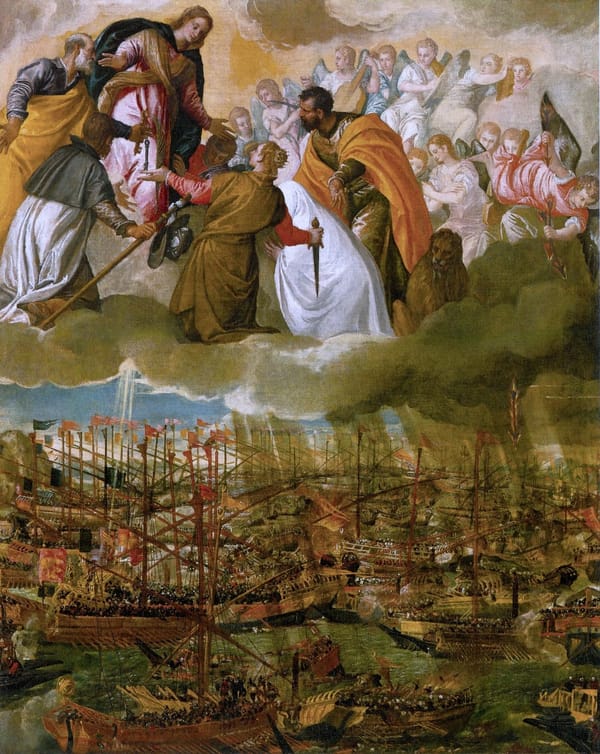
October 7: Our Lady of Victory
On the same day, in the Roman martyrology, the commemoration of our Lady of Victory, established under the circumstances mentioned on the first Sunday of this month. Although the Virgin of virgins gave to the youthful martyr Justina a share in the triumph of Lepanto, nevertheless the chief honour of the day redounds to Mary herself. It behoves us, then, to renew our homage to the Queen of the holy rosary, on the exact anniversary of her deliverance of Christendom under that title. Let us do so by offering her the three hymns of her Office, which recall the joyful, sorrowful, and glorious mysteries of the rosary, and which are epitomized in that of second Vespers given on the feast.*
Hymn of First Vespers
Arcana pandens Numinis,
Plenam salutat gratia
Dei Parentem Virginem.
Matrem Joannis visitat,
Qui clausus alvo gestiens
Adesse Christum nuntiat.
E mente Patris prodiit,
E Matris alvo Virginis
Mortalia infans nascitur.
Legique paret Legifer,
Hic se Redemptor paupere
Pretio redemptus immolat.
Mox læta Mater invenit
Ignota doctis mentibus
Edisserentem Filium.
Qui natus es de Virgine,
Cum Patre et almo Spiritu
In sempiterna sæcula.
disclosing the hidden myateries of the Divinity,
hails as full of grace
the Virgin about to become Mother of God.
the mother of John, who,
though yet a captive in the womb,
leaps with joy announcing the presence of Christ.
had proceeded from the Father’s Intellect,
is born a mortal Babe
of a Virgin Mother.
the Legislator obeys the Law,
the Redeemer offers himself in sacrifice,
and is redeemed at a pauper’s price.
whom she had mourned as lost;
finds him expounding to learned minds
things unknown to them.
born of the Virgin;
together with the Father and the holy Spirit,
through everlasting ages.
Hymn of Matins
Redemptor orans, procidit,
Mœret, pavescit, deficit,
Sudore manans sanguinis.
Raptatur in pœnas Deus,
Durisque vinctus nexibus
Flagris cruentis cæditur.
Corona contumeliæ,
Squallenti amictum purpura,
Regem coronat gloriæ.
Sudans, anhelans, concidens,
Ad montis usque verticem
Gustare vi compellitur.
Inter scelestos innocens,
Orando pro tortoribus,
Exsanguis efflat spiritum.
Qui natus es de Virgine,
Cum Patre et almo Spiritu
In sempiterna sæcula.
prostrate the Redeemer prays;
he grieves, he fears, he well-nigh faints,
pouring forth a sweat of blood.
is dragged away to punishment;
bound with tight bonds,
he bleeds beneath the cruel scourges.
woven of sharp thorns,
adorns the King of glory
clothed with purple tatters.
thrice falling beneath the heavy cross,
he is compelled by force
to bear it to the mountain-top.
the Innocent hangs between two criminals;
till, praying for his torturers,
he yields up his Spirit with the last drop of his Blood.
born of the Virgin;
together with the Father and the holy Spirit,
through everlasting ages.
Hymn of Lauds
Ab inferis Christus redit,
Fractisque culpæ vinculis,
Cœli recludit limina.
Ascendit ad cœlestia,
Dextræque Patris assidet
Consors paternæ gloriæ.
Sanctum daturus Spiritum,
Linguis amoris igneis
Mœstis alumnis impluit.
Ad astra Virgo tollitur,
Excepta cœli jubilo,
Et angelorum canticis.
Almæ parentis verticem:
Throno propinqua Filii
Cunctis creatis imperat.
Qui natus es de Virgine,
Cum Patre et almo Spiritu
In sempiterna sæcula.
Christ rises victorious from limbo,
and breaking the bonds of sin,
throws open heaven’s gate.
he ascends to the heavenly dwellings,
and is enthroned at his Father’s right hand,
a partner in his glory.
whom he had promised to give them,
he sends down upon his sorrowing disciples
in fiery tongues of love.
the Virgin is raised above the stars;
she is welcomed with heaven’s jubilant delight,
and with the songs of angels.
the lovely Mother’s brow;
and from her throne beside her Son,
she reigns over all creation.
born of the Virgin;
together with the Father and the holy Spirit,
through everlasting ages.
* The four hymns are of the eighteenth century. Though now slightly modified, the three here given were composed by Thomas Ricchini, Master of the sacred Palace, and that of second Vespers by the Dominican Eustace Sirena. ↩︎
October 7 (the Same Day): St. Mark, Pope and Confessor
Mark, successor to Sylvester the Pontiff of peace, has been honoured on this day from time immemorial. According to the testimony of St. Damasus, his virtues no less than his name recalled St. Mark the Evangelist.* He occupied the supreme See only eight months, but in that short time, he followed up the recent triumph of the Church by wise organizations. He built two new sanctuaries in Rome. He gave the pallium, of which this is the first mention in history, to the bishop of Ostia, to enhance his high privilege of being the appointed consecrator of the Roman Pontiffs.
This pontificate witnessed the awful death of Arius. Constantine had been deceived into ordering the reinstatement of this wicked man, who taught that the Word Incarnate was a mere creature. The heresiarch, followed by his partisans, was proceeding in triumph through the streets of Constantinople, intending to force open the doors of the basilica, where the faithful, with their bishop St. Alexander, were beseeching God, with fasting and tears, to avert the profanation. Suddenly, seized with an ignominious trembling, Arius was obliged to retire to a secret place, where his flatterers soon afterwards found him stretched upon the floor with his bowels cast out. He had merited the death of a Judas, for having delivered up the Son of God to the disputes of the people, to the mockeries of the proud, to the contradictions of the pretorium.
Prayer
* De Rossi. Inscript. Christ. ii. 108. ↩︎
October 7 (the Same Day): St. Justina, Virgin and Martyr
‘Memor ero tui, Justina virgo. I will ever bear thee in mind, O virgin Justina.’ This inscription Venice engraved on the coin of its republic, after the victory of Lepanto. On that day of triumph, the martyr, who had won her palm on October 7 fifteen centuries before, had united the power of her prayers with the strength of St. Mark’s lion; and the dukedom proclaimed Justina its second patron. But Lepanto is not her only claim upon the world’s gratitude. In her native city, the sons of St Benedict had gathered round the tomb where lay her precious relics. The great movement initiated by the Venetian, Luigi Barbo (1408), began at St. Justina’s monastery in Padua: the Order was rescued from the disastrous consequences of having secular abbots in commendam; and thus Monte Cassino itself was restored to some part of its ancient splendour.
Honour, then, to this day of salvation! And glory to her, through whose intercession the heavens have rained down their dew of consolation upon the earth!
Prayer
| Previous October 6: St. Bruno, Confessor | Next October 7 (the Same Day): St. Mark, Pope and Confessor |